
Hydrocarbons The basis for organic chemistry Organic Compounds
Hydrocarbons The basis for organic chemistry
Organic Compounds • Contain C bonded to other elements, commonly H, O, N, S, and halogens • Carbon – Has intermediate electonegativity, so its most likely to form molecular compounds (Recall: molecular compounds have diverse properties) – Can make single, double, and triple bonds – Can form isomers (same molecular formula but different arrangement of atoms)
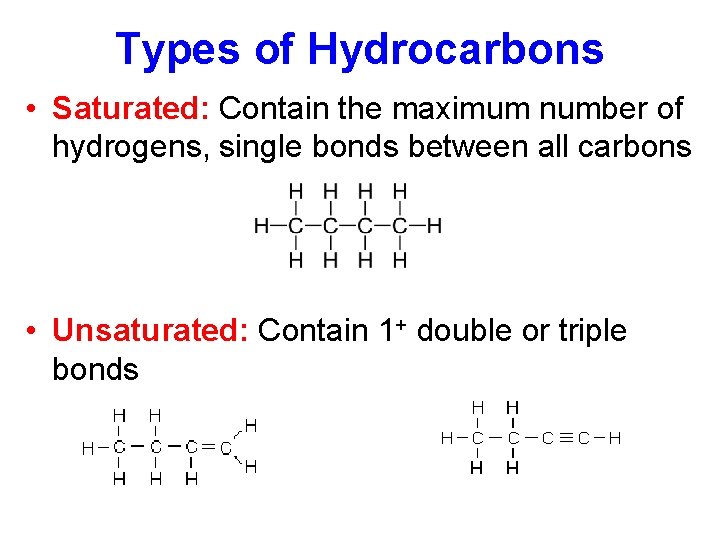
Types of Hydrocarbons • Saturated: Contain the maximum number of hydrogens, single bonds between all carbons • Unsaturated: Contain 1+ double or triple bonds
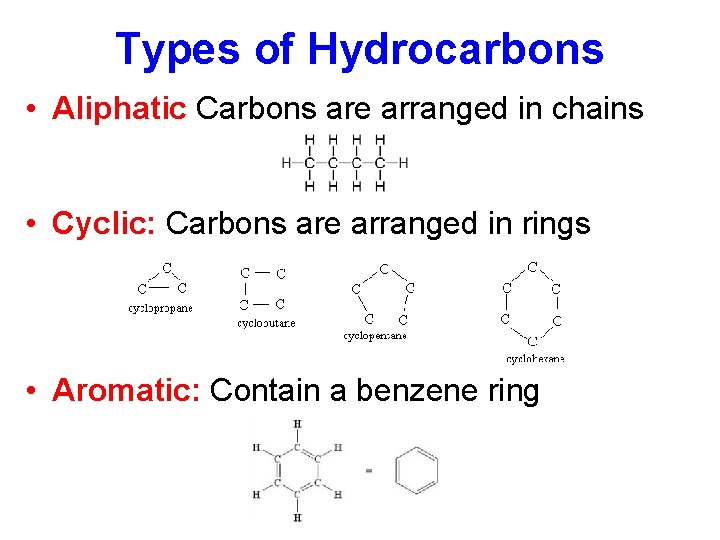
Types of Hydrocarbons • Aliphatic Carbons are arranged in chains • Cyclic: Carbons are arranged in rings • Aromatic: Contain a benzene ring
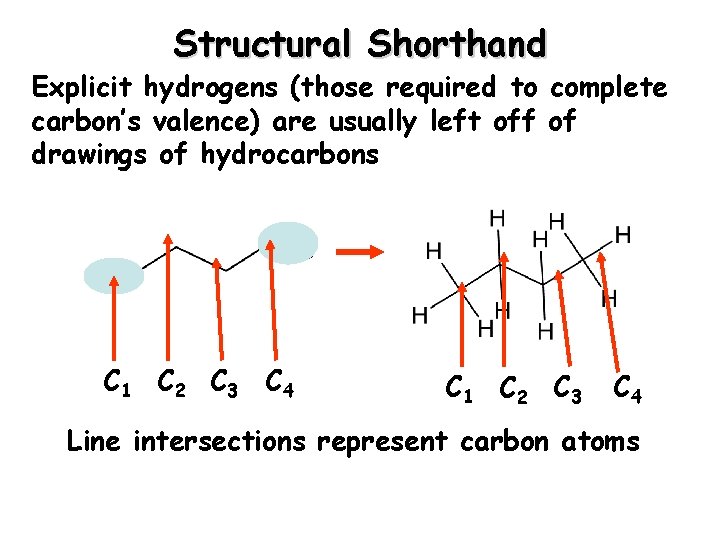
Structural Shorthand Explicit hydrogens (those required to complete carbon’s valence) are usually left off of drawings of hydrocarbons C 1 C 2 C 3 C 4 Line intersections represent carbon atoms
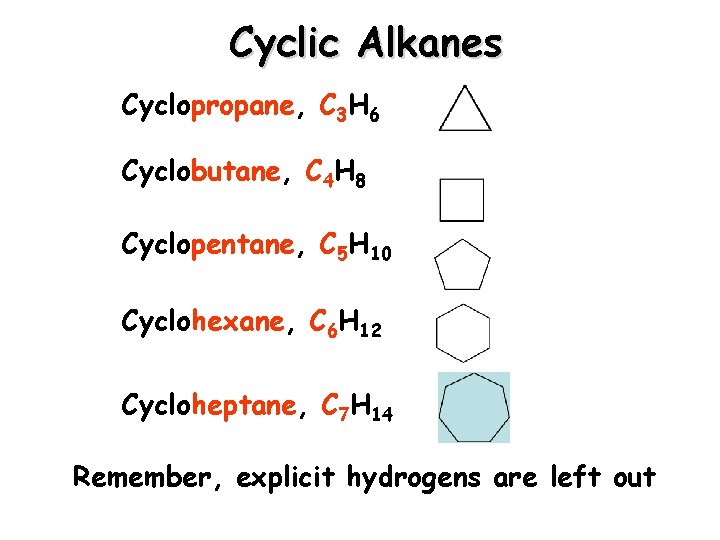
Cyclic Alkanes Cyclopropane, C 3 H 6 Cyclobutane, C 4 H 8 Cyclopentane, C 5 H 10 Cyclohexane, C 6 H 12 Cycloheptane, C 7 H 14 Remember, explicit hydrogens are left out
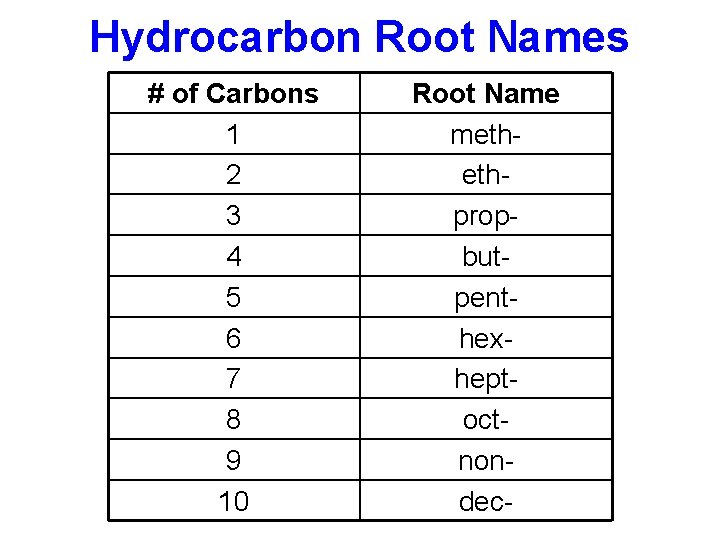
Hydrocarbon Root Names # of Carbons 1 2 3 4 5 6 7 8 9 10 Root Name methethpropbutpenthexheptoctnondec-
Naming Alkanes Based off the number of C atoms in the longest chain 1. Count the number of C’s in the longest chain 2. Determine the appropriate root 3. Add the suffix “ane”
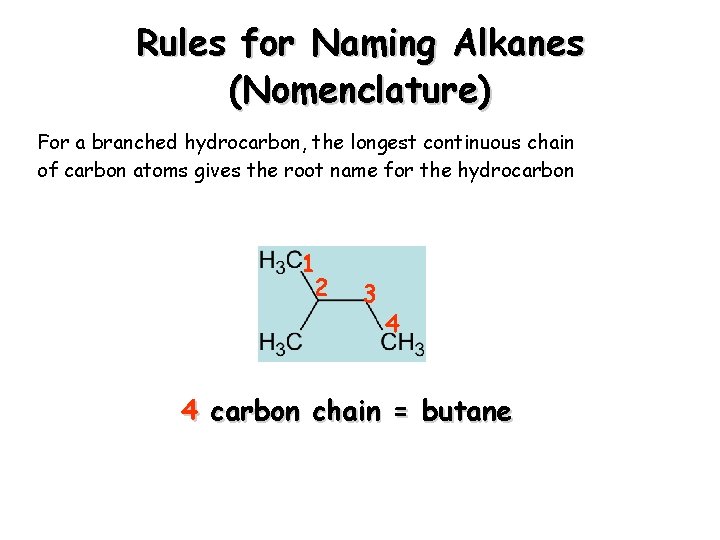
Rules for Naming Alkanes (Nomenclature) For a branched hydrocarbon, the longest continuous chain of carbon atoms gives the root name for the hydrocarbon 1 2 3 4 4 carbon chain = butane
Naming Branched Alkanes Based off the number of C atoms in the longest chain 1. Count the number of C’s in the longest chain 2. Determine the appropriate root 3. Use the numbered C’s to give the branches a position number add “yl” suffix 4. Add the suffix “ane”
Naming Branched Alkanes Important Rules: 1. Start numbering from the end that will give you the lowest number of branches 2. If there is more than one type of branch, name the branches in alphabetical order 3. If there is more than two of the same type of branch, give the branch a position number and prefixes “di”, “tri” “tetra” etc. 4. Put commas between numbers and hyphens between numbers and letters
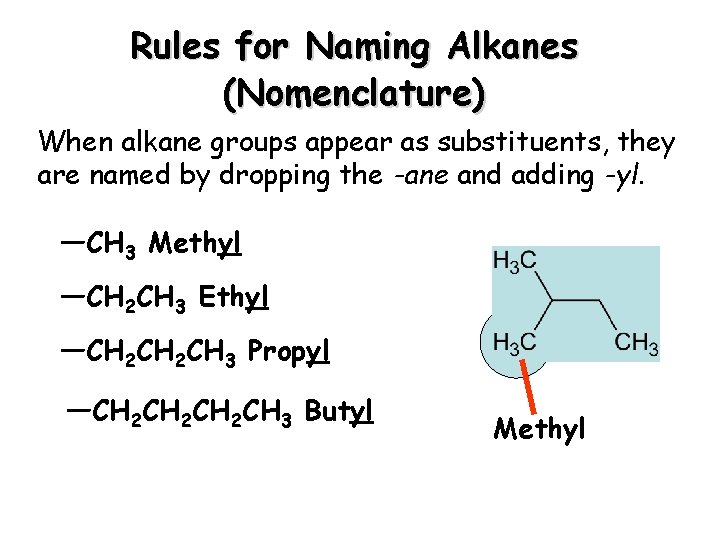
Rules for Naming Alkanes (Nomenclature) When alkane groups appear as substituents, they are named by dropping the -ane and adding -yl. —CH 3 Methyl —CH 2 CH 3 Ethyl —CH 2 CH 3 Propyl —CH 2 CH 2 CH 3 Butyl Methyl
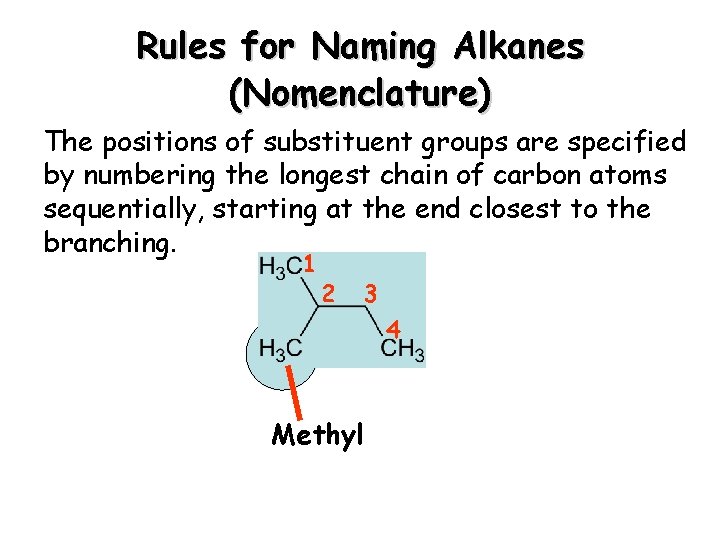
Rules for Naming Alkanes (Nomenclature) The positions of substituent groups are specified by numbering the longest chain of carbon atoms sequentially, starting at the end closest to the branching. 1 2 3 4 Methyl
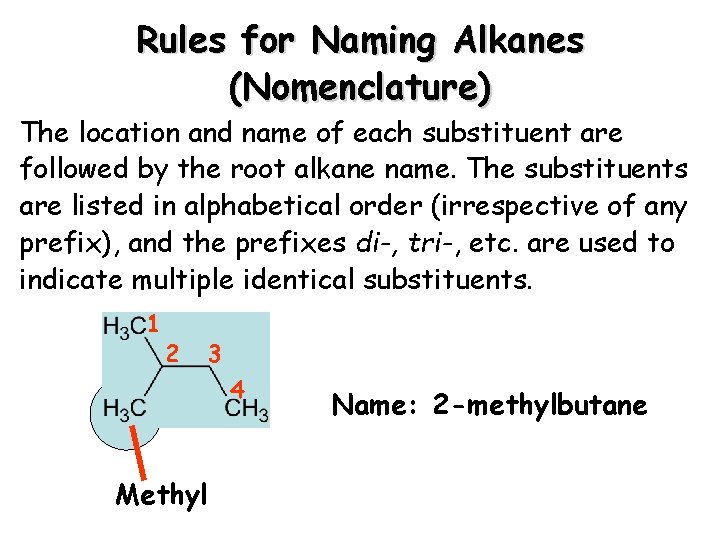
Rules for Naming Alkanes (Nomenclature) The location and name of each substituent are followed by the root alkane name. The substituents are listed in alphabetical order (irrespective of any prefix), and the prefixes di-, tri-, etc. are used to indicate multiple identical substituents. 1 2 3 4 Methyl Name: 2 -methylbutane
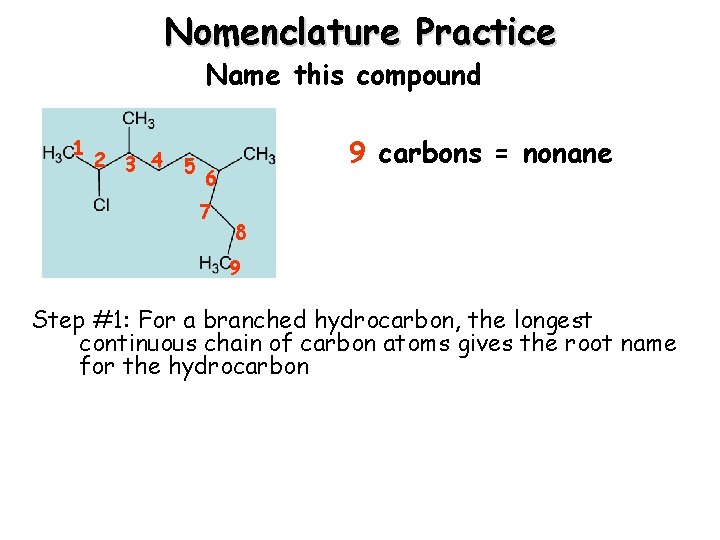
Nomenclature Practice Name this compound 1 2 3 4 5 9 carbons = nonane 6 7 8 9 Step #1: For a branched hydrocarbon, the longest continuous chain of carbon atoms gives the root name for the hydrocarbon
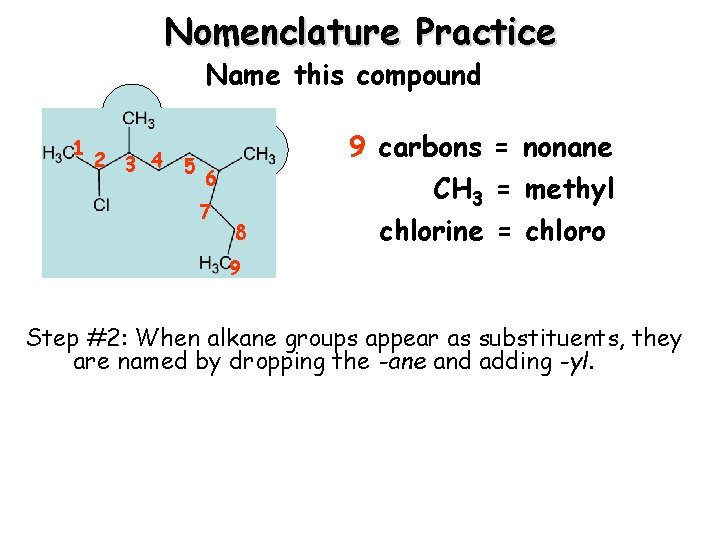
Nomenclature Practice Name this compound 1 2 3 4 5 6 7 8 9 carbons = nonane CH 3 = methyl chlorine = chloro 9 Step #2: When alkane groups appear as substituents, they are named by dropping the -ane and adding -yl.
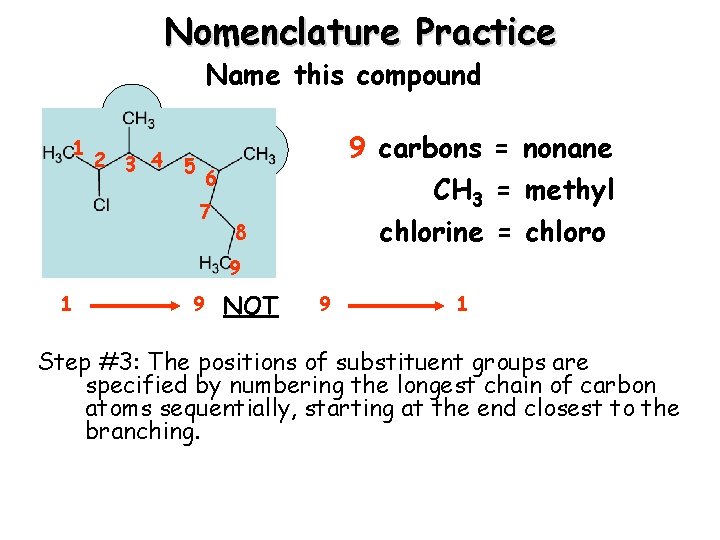
Nomenclature Practice Name this compound 1 2 3 4 5 9 carbons = nonane CH 3 = methyl chlorine = chloro 6 7 8 9 1 9 NOT 9 1 Step #3: The positions of substituent groups are specified by numbering the longest chain of carbon atoms sequentially, starting at the end closest to the branching.
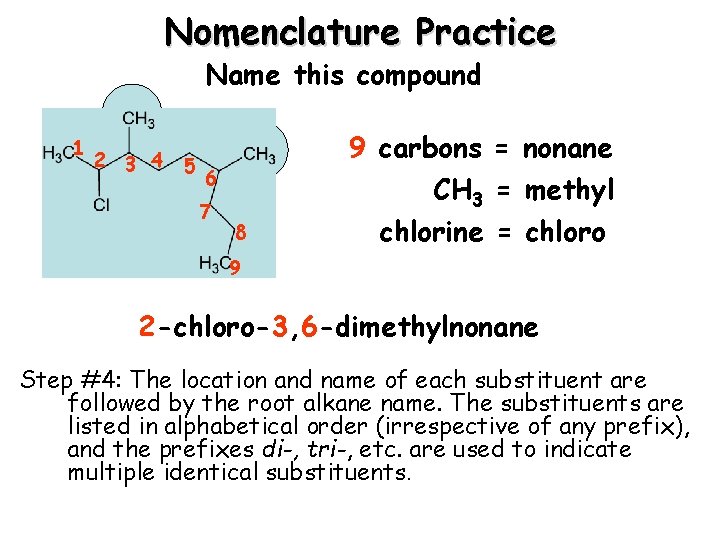
Nomenclature Practice Name this compound 1 2 3 4 5 6 7 8 9 carbons = nonane CH 3 = methyl chlorine = chloro 9 2 -chloro-3, 6 -dimethylnonane Step #4: The location and name of each substituent are followed by the root alkane name. The substituents are listed in alphabetical order (irrespective of any prefix), and the prefixes di-, tri-, etc. are used to indicate multiple identical substituents.
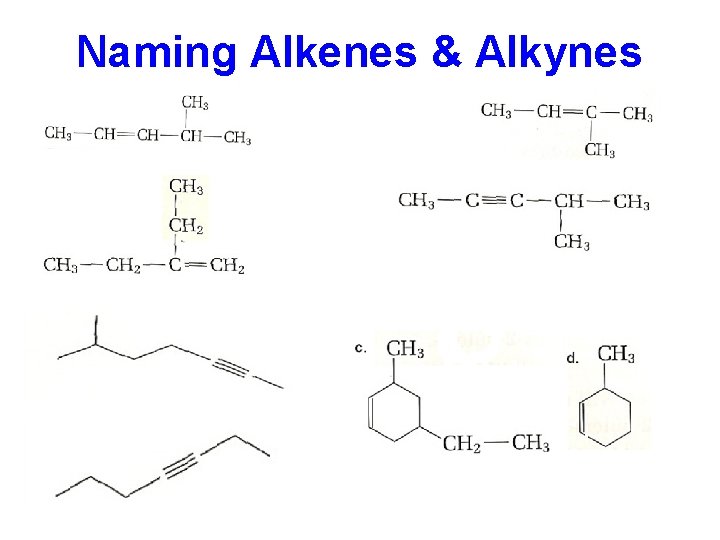
Naming Alkenes & Alkynes 1. Count the number of C’s in the longest chain containing the double/triple bond. • • This is the parent chain, determine the root Number the parent chain so that the double/triple bond has the lowest possible position number 2. Identify the position numbers of branches • Same rules as before 3. Write the branches in alphabetical order 4. Write the root, including a prefix that identifies the position of the double/triple bond • Add the prefix “cyclo” if its cyclic 5. Add the suffix “ene” or “yne”
Naming Alkenes & Alkynes
Naming Aromatics 1. Same rules 2. If benzene is the parent chain “benzene” suffix 3. If benzene is a branch group “phenyl”
- Slides: 21