
Hydrocarbons Straight Chain Alkanes arent Straight C C
Hydrocarbons
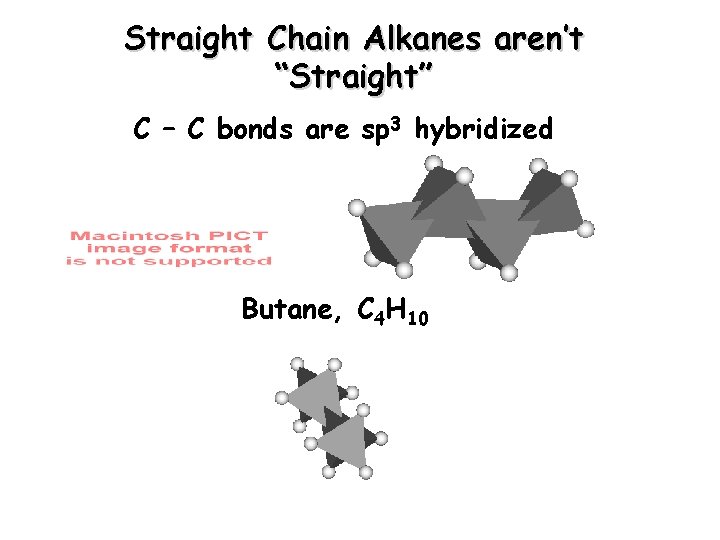
Straight Chain Alkanes aren’t “Straight” C – C bonds are sp 3 hybridized Butane, C 4 H 10
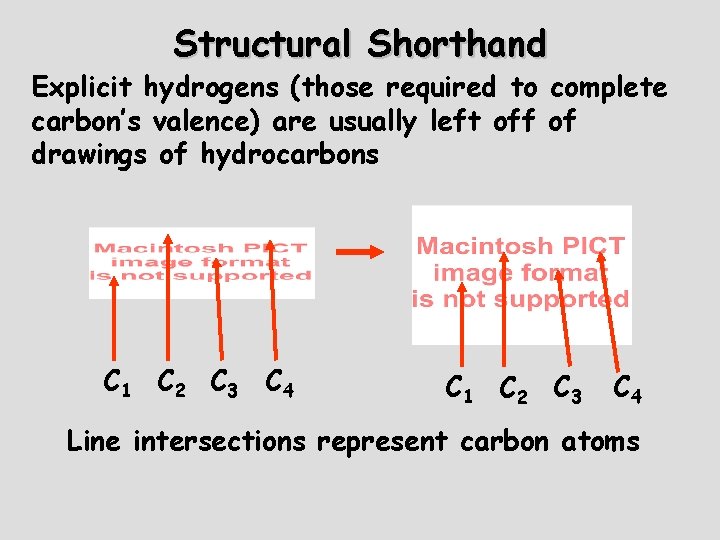
Structural Shorthand Explicit hydrogens (those required to complete carbon’s valence) are usually left off of drawings of hydrocarbons C 1 C 2 C 3 C 4 Line intersections represent carbon atoms
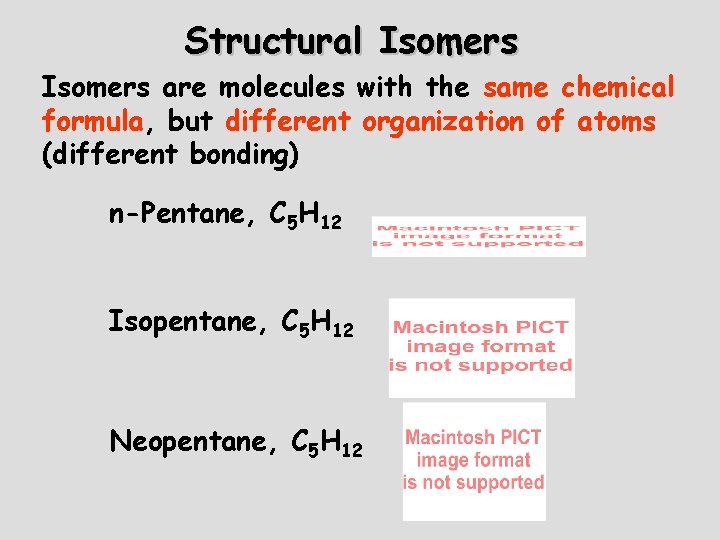
Structural Isomers are molecules with the same chemical formula, but different organization of atoms (different bonding) n-Pentane, C 5 H 12 Isopentane, C 5 H 12 Neopentane, C 5 H 12
Cyclic Alkanes Cyclopropane, C 3 H 6 Cyclobutane, C 4 H 8 Cyclopentane, C 5 H 10 Cyclohexane, C 6 H 12 Cycloheptane, C 7 H 14 Remember, explicit hydrogens are left out
Rules for Naming Alkanes (Nomenclature) For a branched hydrocarbon, the longest continuous chain of carbon atoms gives the root name for the hydrocarbon 1 2 3 4 4 carbon chain = butane
Rules for Naming Alkanes (Nomenclature) When alkane groups appear as substituents, they are named by dropping the -ane and adding -yl. —CH 3 Methyl —CH 2 CH 3 Ethyl —CH 2 CH 3 Propyl —CH 2 CH 2 CH 3 Butyl Methyl
Rules for Naming Alkanes (Nomenclature) The positions of substituent groups are specified by numbering the longest chain of carbon atoms sequentially, starting at the end closest to the branching. 1 2 3 4 Methyl
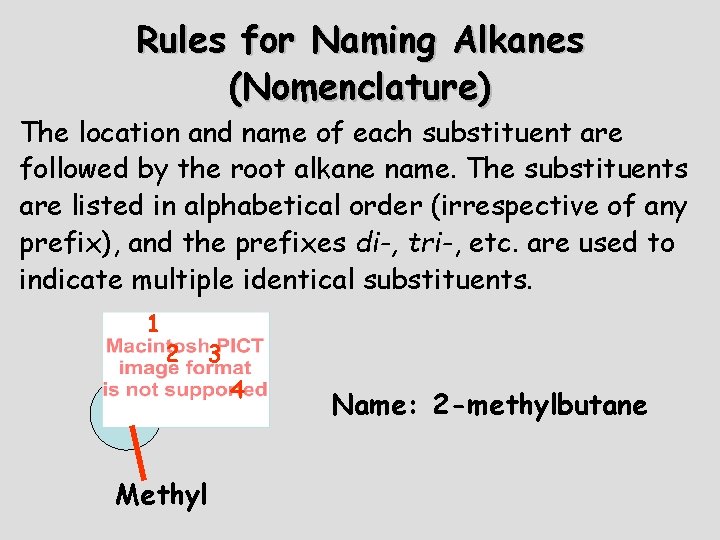
Rules for Naming Alkanes (Nomenclature) The location and name of each substituent are followed by the root alkane name. The substituents are listed in alphabetical order (irrespective of any prefix), and the prefixes di-, tri-, etc. are used to indicate multiple identical substituents. 1 2 3 4 Methyl Name: 2 -methylbutane

Nomenclature Practice Name this compound 1 2 3 4 5 9 carbons = nonane 6 7 8 9 Step #1: For a branched hydrocarbon, the longest continuous chain of carbon atoms gives the root name for the hydrocarbon
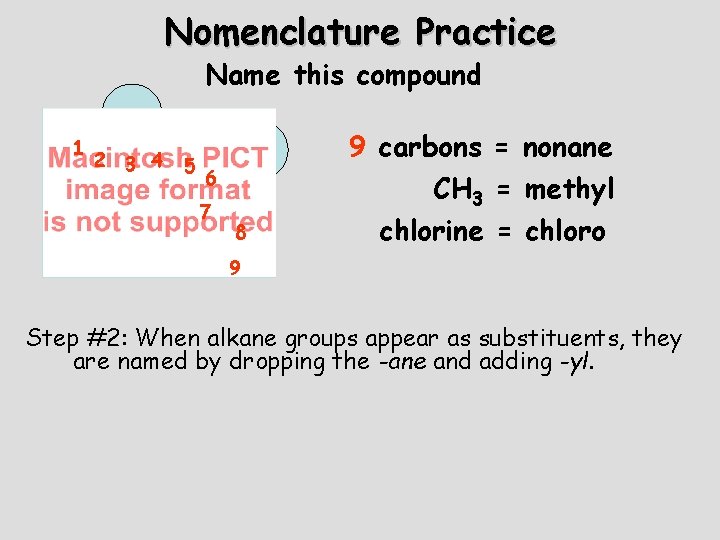
Nomenclature Practice Name this compound 1 2 3 4 5 6 7 8 9 carbons = nonane CH 3 = methyl chlorine = chloro 9 Step #2: When alkane groups appear as substituents, they are named by dropping the -ane and adding -yl.
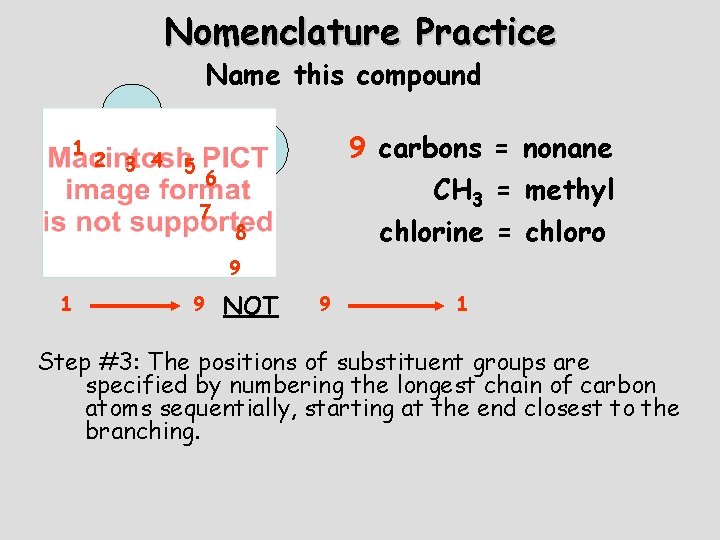
Nomenclature Practice Name this compound 1 2 3 4 5 9 carbons = nonane CH 3 = methyl chlorine = chloro 6 7 8 9 1 9 NOT 9 1 Step #3: The positions of substituent groups are specified by numbering the longest chain of carbon atoms sequentially, starting at the end closest to the branching.
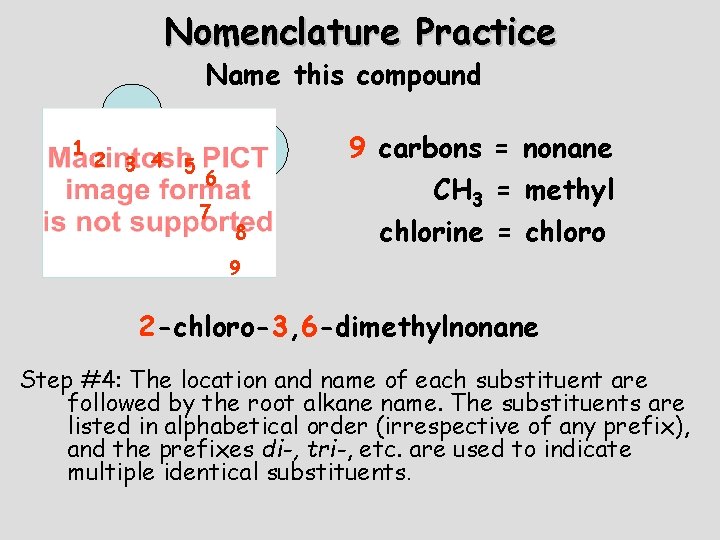
Nomenclature Practice Name this compound 1 2 3 4 5 6 7 8 9 carbons = nonane CH 3 = methyl chlorine = chloro 9 2 -chloro-3, 6 -dimethylnonane Step #4: The location and name of each substituent are followed by the root alkane name. The substituents are listed in alphabetical order (irrespective of any prefix), and the prefixes di-, tri-, etc. are used to indicate multiple identical substituents.
Properties of Hydrocarbons • Made up of mostly C and H • Relatively nonpolar – Low solubility in polar solvents (e. g. water) – Good solvents for other nonpolar molecules • Mostly london-dispersion forces (weak) – Low boiling and melting points
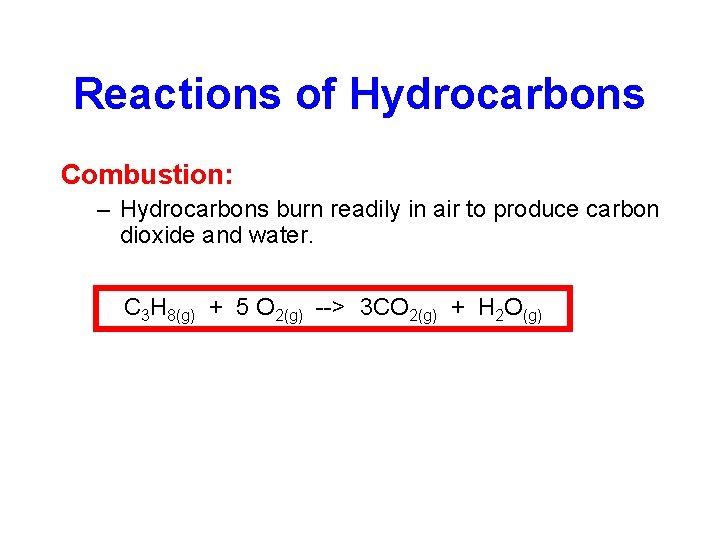
Reactions of Hydrocarbons Combustion: – Hydrocarbons burn readily in air to produce carbon dioxide and water. C 3 H 8(g) + 5 O 2(g) --> 3 CO 2(g) + H 2 O(g)

Reactivity of Hydrocarbons • Alkanes are generally less reactive than alkenes or alkynes • Aromatic compounds are more reactive than alkanes, but less reactive than alkenes and alkynes. Alkanes < aromatics < alkenes < alkynes
Reactions of Alkanes • Single bonds between carbon atoms are difficult to break. (This is why alkanes are relatively unreactive) • Can undergo combustion reactions
Reactions of Alkanes Substitution Reactions: • Hydrogen atoms may be substituted by a halogen. • The product is a halogenated alkane (alkyl halides)
Reactions of Alkenes and Alkynes Addition Reactions: • Reactions in which a molecule is added to a double or triple bond. • No loss of hydrogen atoms from the hydrocarbon
Hydrogenation Halogenation
Hydrohalogenation Hydration
Markovnikov’s Rule • When molecules with two identical atoms (e. g. H 2) are added to a double bond, only one possible product is formed. • When molecules of nonidentical atoms (e. g. HBr) are added, two different products are theoretically possible
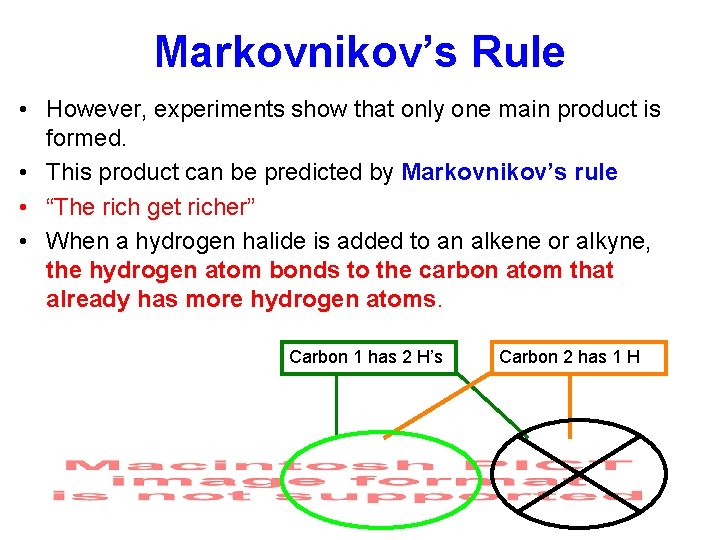
Markovnikov’s Rule • However, experiments show that only one main product is formed. • This product can be predicted by Markovnikov’s rule • “The rich get richer” • When a hydrogen halide is added to an alkene or alkyne, the hydrogen atom bonds to the carbon atom that already has more hydrogen atoms. Carbon 1 has 2 H’s Carbon 2 has 1 H
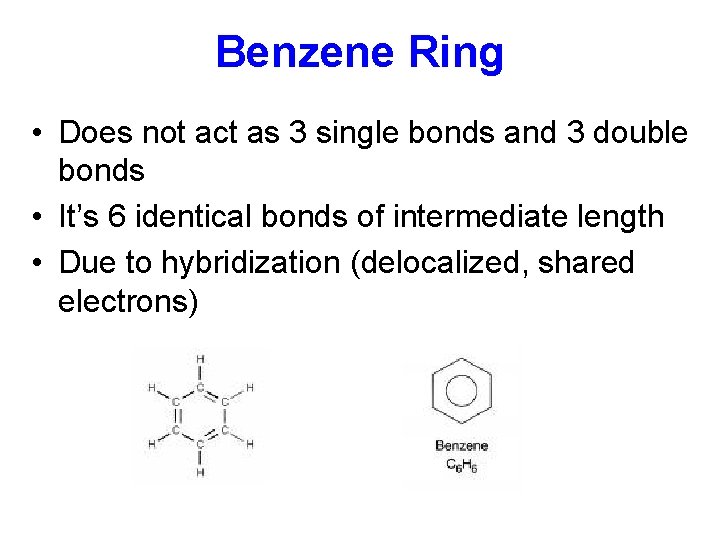
Benzene Ring • Does not act as 3 single bonds and 3 double bonds • It’s 6 identical bonds of intermediate length • Due to hybridization (delocalized, shared electrons)
Reactions of Aromatic Hydrocarbons • Less reactive than alkenes and do not undergo addition reactions unless under conditions of extreme temperature or pressure • Do undergo substitution reactions (more reactive than alkanes)


- Slides: 27