
Hydrocarbons and Fuels Alkanes Alkenes and Alkynes Halogen
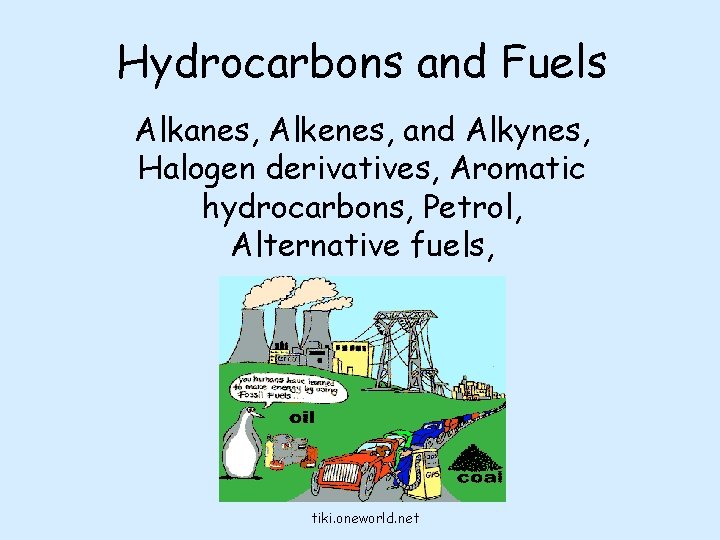
Hydrocarbons and Fuels Alkanes, Alkenes, and Alkynes, Halogen derivatives, Aromatic hydrocarbons, Petrol, Alternative fuels, tiki. oneworld. net

Index Carbon Chemistry Introduction Alkanes and Alkenes Alkynes Halogen Derivatives, e. g. CFC’s Aromatic Hydrocarbons Petrol and Alternative Fuels
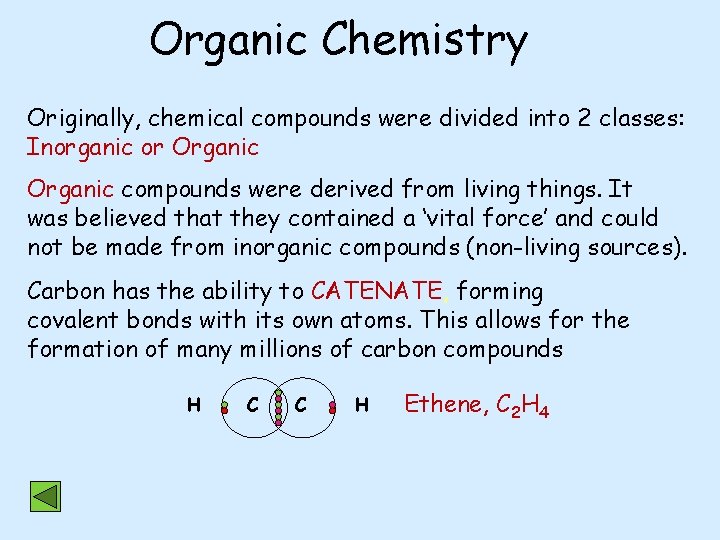
Organic Chemistry Originally, chemical compounds were divided into 2 classes: Inorganic or Organic compounds were derived from living things. It was believed that they contained a ‘vital force’ and could not be made from inorganic compounds (non-living sources). Carbon has the ability to CATENATE, forming covalent bonds with its own atoms. This allows for the formation of many millions of carbon compounds H C C H Ethene, C 2 H 4
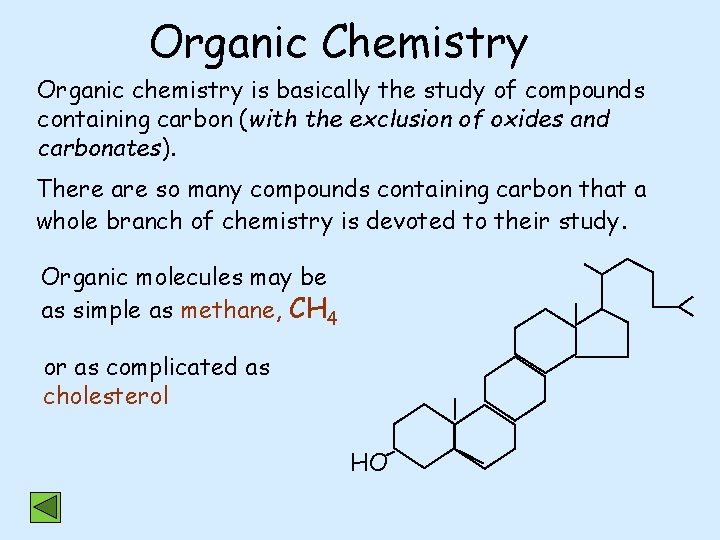
Organic Chemistry Organic chemistry is basically the study of compounds containing carbon (with the exclusion of oxides and carbonates). There are so many compounds containing carbon that a whole branch of chemistry is devoted to their study. Organic molecules may be as simple as methane, CH 4 or as complicated as cholesterol HO
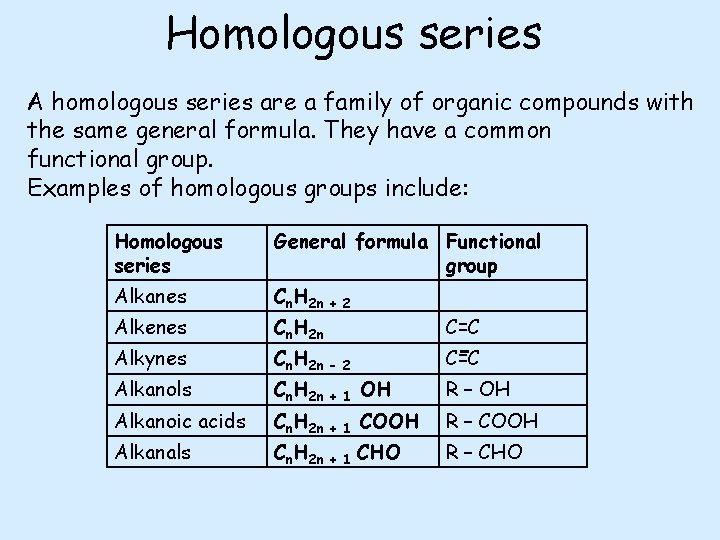
Homologous series A homologous series are a family of organic compounds with the same general formula. They have a common functional group. Examples of homologous groups include: Homologous series General formula Functional group Alkanes Cn. H 2 n + 2 Alkenes Cn. H 2 n C=C Alkynes Cn. H 2 n - 2 C=C Alkanols Cn. H 2 n + 1 OH R – OH Alkanoic acids Cn. H 2 n + 1 COOH R – COOH Alkanals Cn. H 2 n + 1 CHO R – CHO
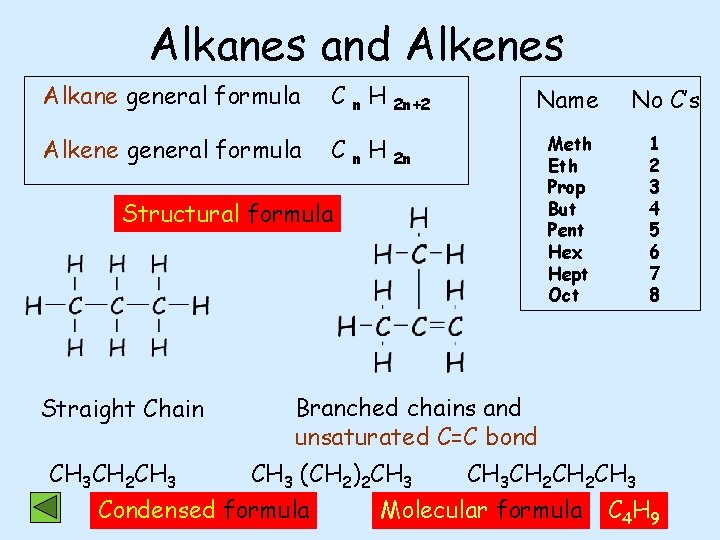
Alkanes and Alkenes Alkane general formula C n H 2 n+2 Alkene general formula C n H 2 n Name Structural formula Straight Chain Meth Eth Prop But Pent Hex Hept Oct No C’s 1 2 3 4 5 6 7 8 Branched chains and unsaturated C=C bond CH 3 CH 2 CH 3 (CH 2)2 CH 3 CH 2 CH 3 Condensed formula Molecular formula C 4 H 9
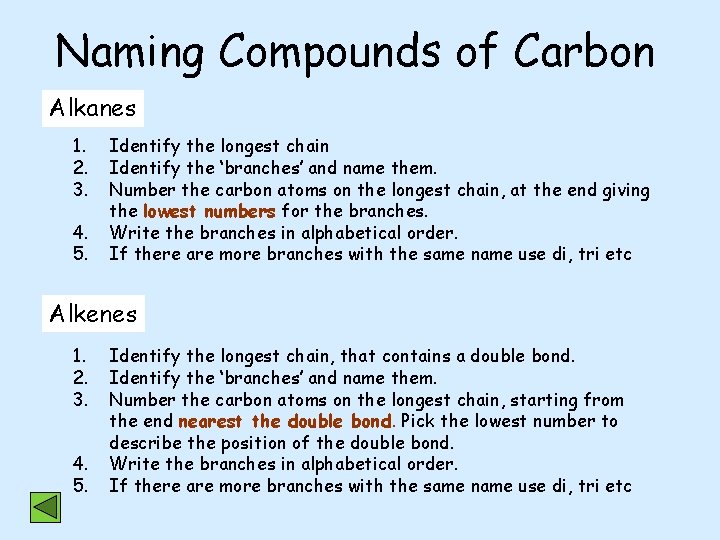
Naming Compounds of Carbon Alkanes 1. 2. 3. 4. 5. Identify the longest chain Identify the ‘branches’ and name them. Number the carbon atoms on the longest chain, at the end giving the lowest numbers for the branches. Write the branches in alphabetical order. If there are more branches with the same name use di, tri etc Alkenes 1. 2. 3. 4. 5. Identify the longest chain, that contains a double bond. Identify the ‘branches’ and name them. Number the carbon atoms on the longest chain, starting from the end nearest the double bond. Pick the lowest number to describe the position of the double bond. Write the branches in alphabetical order. If there are more branches with the same name use di, tri etc
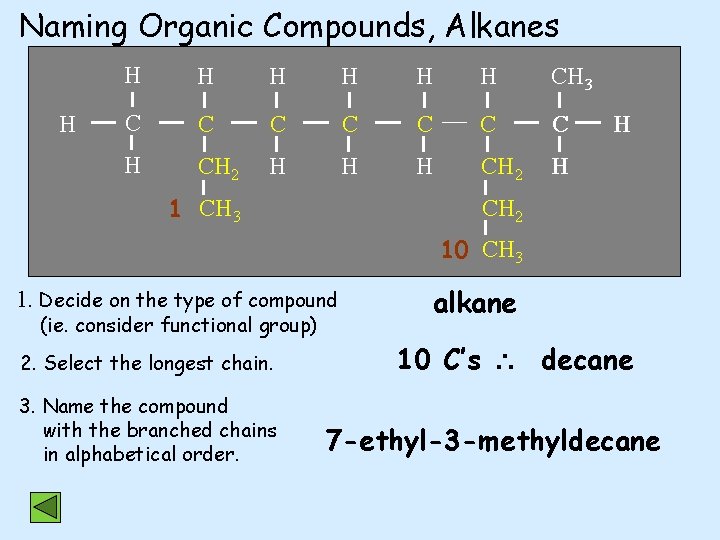
Naming Organic Compounds, Alkanes H H H H CH 3 C C C C H CH 2 H H H CH 2 H 1 CH 3 H CH 2 10 CH 3 1. Decide on the type of compound (ie. consider functional group) 2. Select the longest chain. 3. Name the compound with the branched chains in alphabetical order. alkane 10 C’s decane 7 -ethyl-3 -methyldecane
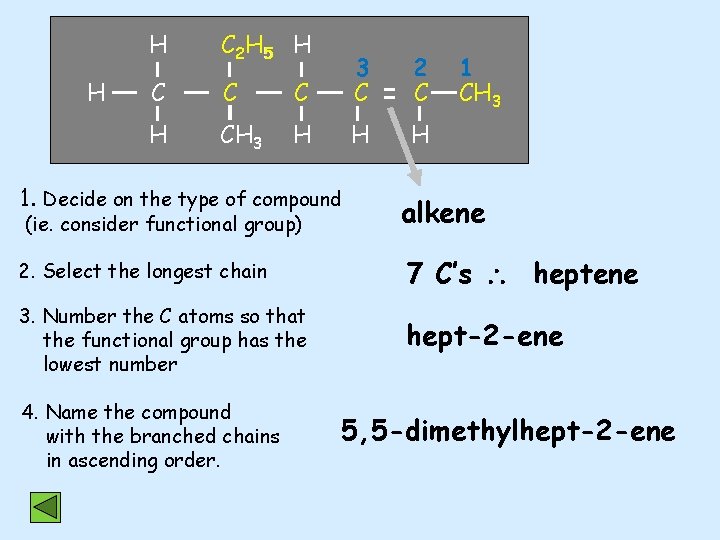
H H C 2 H 5 H C C C 2 3 C = C H CH 3 H H 1. Decide on the type of compound (ie. consider functional group) 1 CH 3 H alkene 2. Select the longest chain 7 C’s heptene 3. Number the C atoms so that the functional group has the lowest number hept-2 -ene 4. Name the compound with the branched chains in ascending order. 5, 5 -dimethylhept-2 -ene
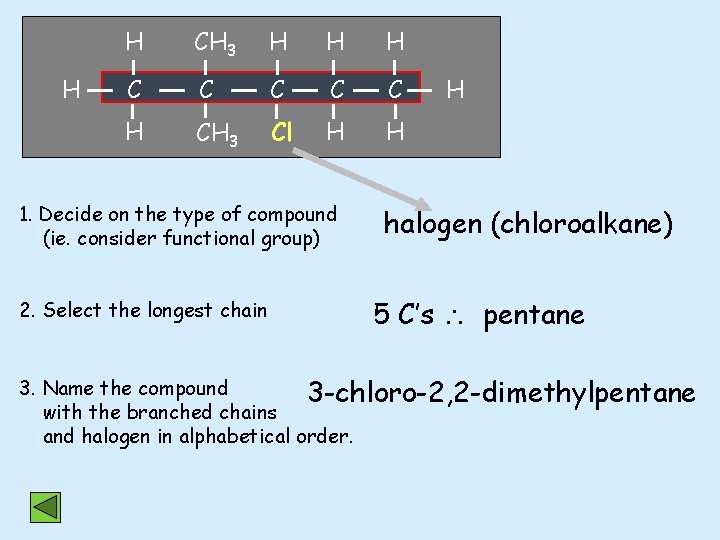
H H CH 3 H H H C C C H CH 3 Cl H H 1. Decide on the type of compound (ie. consider functional group) 2. Select the longest chain H halogen (chloroalkane) 5 C’s pentane 3. Name the compound 3 -chloro-2, 2 -dimethylpentane with the branched chains and halogen in alphabetical order.
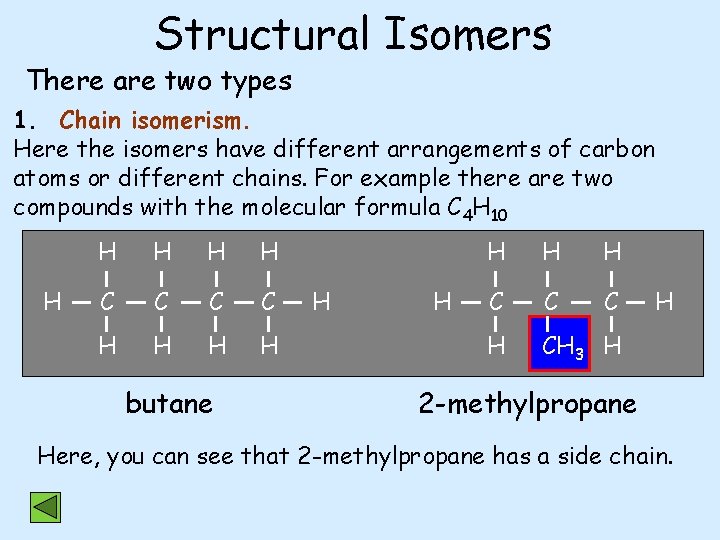
Structural Isomers There are two types 1. Chain isomerism. Here the isomers have different arrangements of carbon atoms or different chains. For example there are two compounds with the molecular formula C 4 H 10 H H H C C H H butane H H H C C C H CH 3 H H 2 -methylpropane Here, you can see that 2 -methylpropane has a side chain.
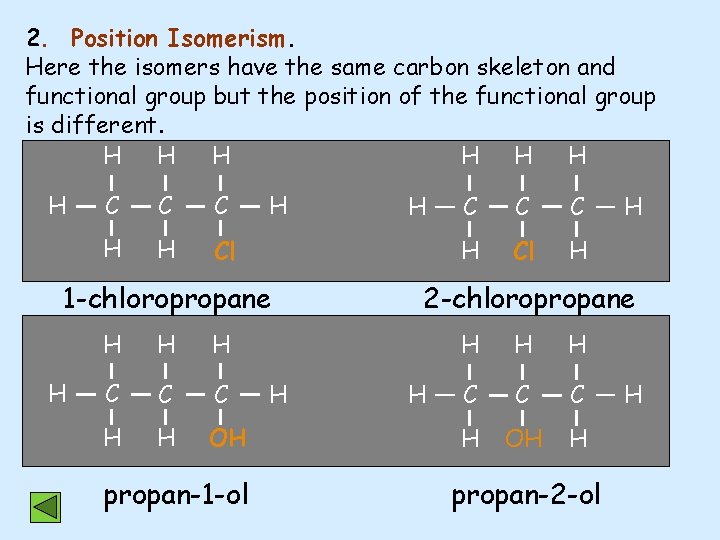
2. Position Isomerism. Here the isomers have the same carbon skeleton and functional group but the position of the functional group is different. H H H H C C C H H Cl H 1 -chloropropane H H C C C H H OH propan-1 -ol H H C C C H Cl H H 2 -chloropropane H H C C C H OH H propan-2 -ol H
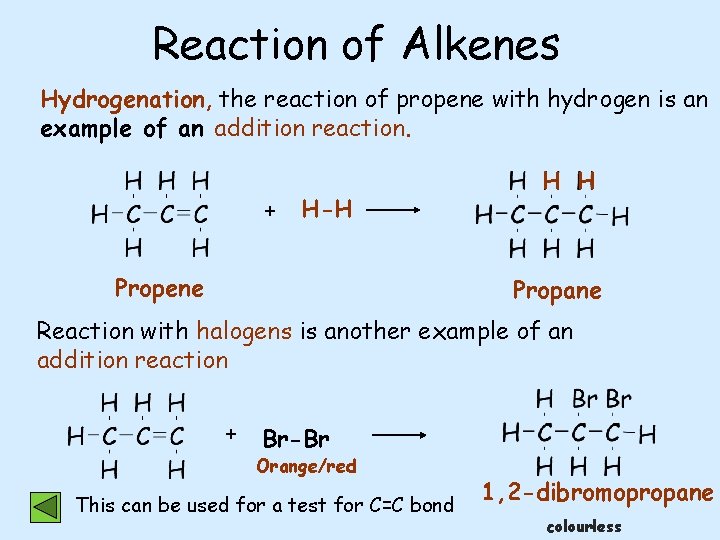
Reaction of Alkenes Hydrogenation, the reaction of propene with hydrogen is an example of an addition reaction. + H-H Propene H H Propane Reaction with halogens is another example of an addition reaction + Br-Br Orange/red This can be used for a test for C=C bond 1, 2 -dibromopropane colourless
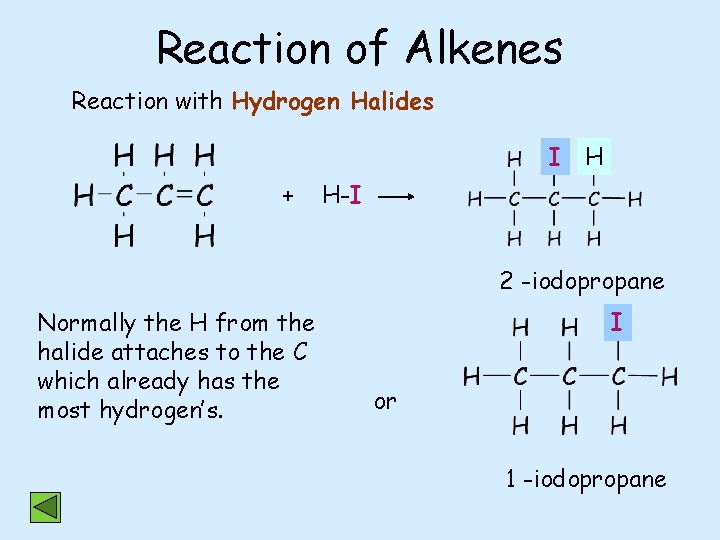
Reaction of Alkenes Reaction with Hydrogen Halides I H + H-I 2 -iodopropane Normally the H from the halide attaches to the C which already has the most hydrogen’s. I or 1 -iodopropane
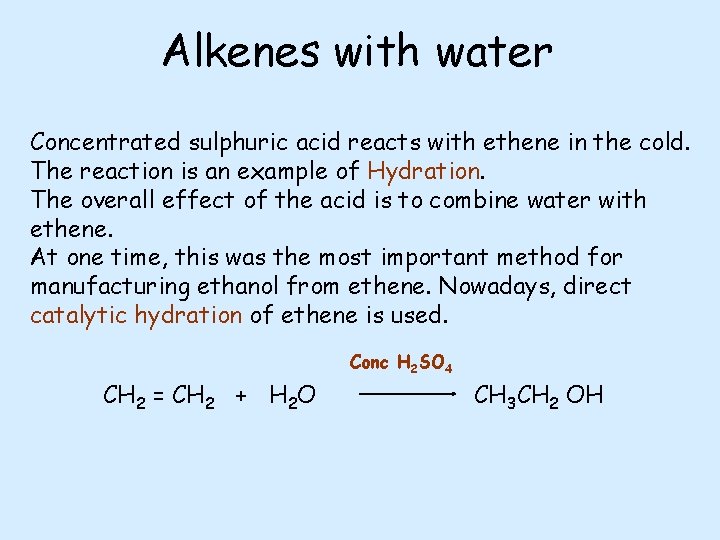
Alkenes with water Concentrated sulphuric acid reacts with ethene in the cold. The reaction is an example of Hydration. The overall effect of the acid is to combine water with ethene. At one time, this was the most important method for manufacturing ethanol from ethene. Nowadays, direct catalytic hydration of ethene is used. Conc H 2 SO 4 CH 2 = CH 2 + H 2 O CH 3 CH 2 OH
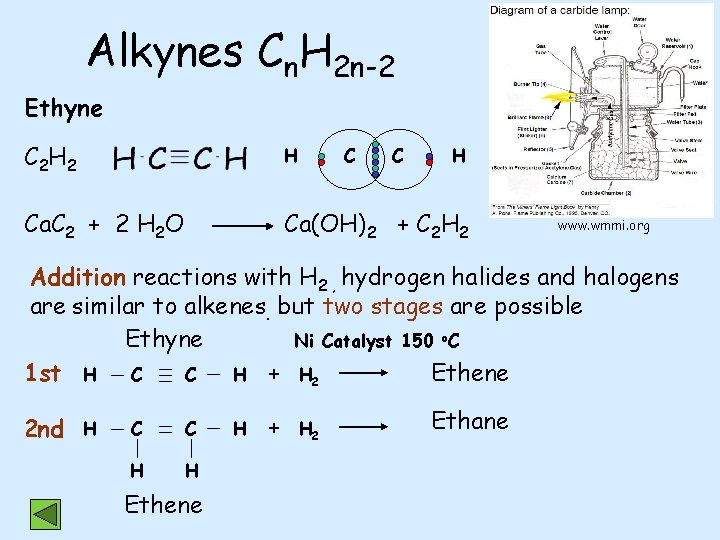
Alkynes Cn. H 2 n-2 Ethyne C 2 H Ca. C 2 + 2 H 2 O Ca(OH)2 + C 2 H 2 C C H www. wmmi. org Addition reactions with H 2 , hydrogen halides and halogens are similar to alkenes. but two stages are possible Ni Catalyst 150 o. C Ethyne 1 st H C Ethene C H + H 2 2 nd H C C H H Ethene H + H 2 Ethane
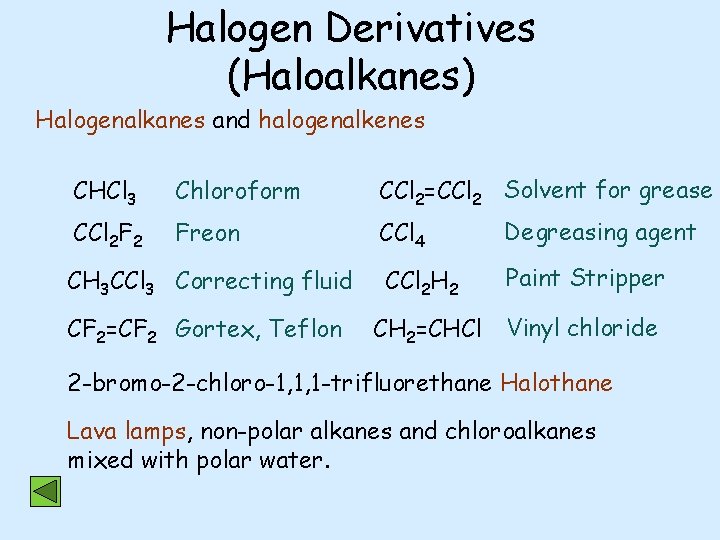
Halogen Derivatives (Haloalkanes) Halogenalkanes and halogenalkenes CHCl 3 Chloroform CCl 2=CCl 2 Solvent for grease CCl 2 F 2 Freon CCl 4 Degreasing agent CH 3 CCl 3 Correcting fluid CCl 2 H 2 Paint Stripper CF 2=CF 2 Gortex, Teflon CH 2=CHCl Vinyl chloride 2 -bromo-2 -chloro-1, 1, 1 -trifluorethane Halothane Lava lamps, non-polar alkanes and chloroalkanes mixed with polar water.
Halogen Derivatives, CFC’s Chlorofluorocarbons CFC’s All CFC’s are very unreactive, are not flammable and not toxic. They are used as flame retardants. CCl 2 F 2 The first refrigerant, and in aerosols. CCl 3 F Used as a blowing agent to make expanded foam Recently hydrofluorocarbons have replaced some CFC’s. e. g. 1, 1, 1, 2 -tetrafluoroethane is used as a refrigerant.
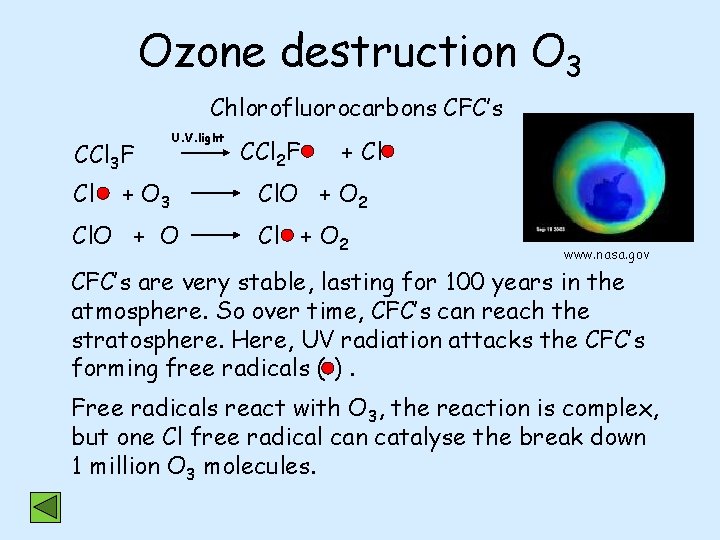
Ozone destruction O 3 Chlorofluorocarbons CFC’s CCl 3 F Cl U. V. light + O 3 Cl. O + O CCl 2 F + Cl Cl. O + O 2 Cl + O 2 www. nasa. gov CFC’s are very stable, lasting for 100 years in the atmosphere. So over time, CFC’s can reach the stratosphere. Here, UV radiation attacks the CFC’s forming free radicals ( ). Free radicals react with O 3, the reaction is complex, but one Cl free radical can catalyse the break down 1 million O 3 molecules.
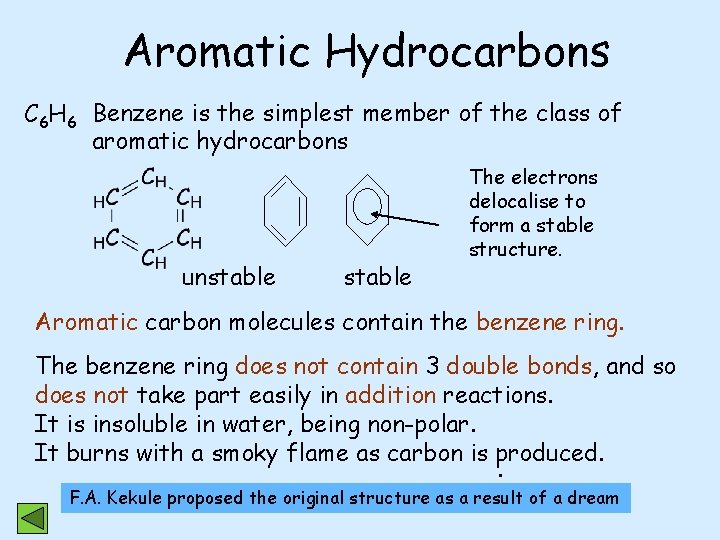
Aromatic Hydrocarbons C 6 H 6 Benzene is the simplest member of the class of aromatic hydrocarbons unstable The electrons delocalise to form a stable structure. Aromatic carbon molecules contain the benzene ring. The benzene ring does not contain 3 double bonds, and so does not take part easily in addition reactions. It is insoluble in water, being non-polar. It burns with a smoky flame as carbon is produced. . F. A. Kekule proposed the original structure as a result of a dream
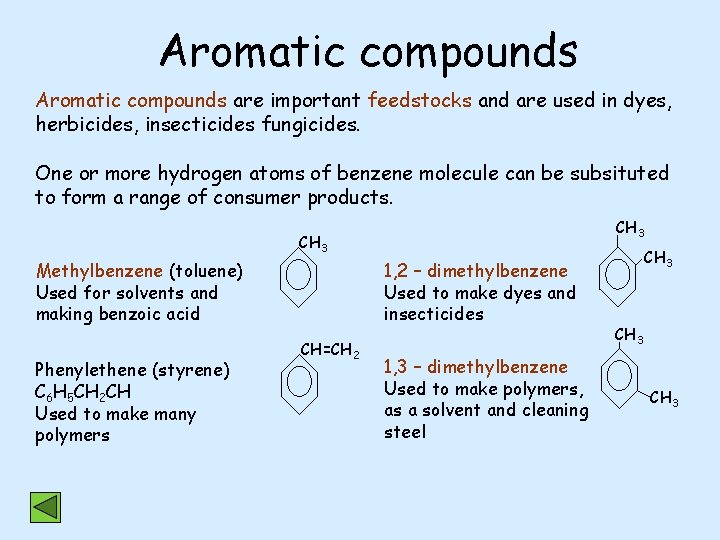
Aromatic compounds are important feedstocks and are used in dyes, herbicides, insecticides fungicides. One or more hydrogen atoms of benzene molecule can be subsituted to form a range of consumer products. CH 3 Methylbenzene (toluene) Used for solvents and making benzoic acid Phenylethene (styrene) C 6 H 5 CH 2 CH Used to make many polymers 1, 2 – dimethylbenzene Used to make dyes and insecticides CH=CH 2 1, 3 – dimethylbenzene Used to make polymers, as a solvent and cleaning steel CH 3
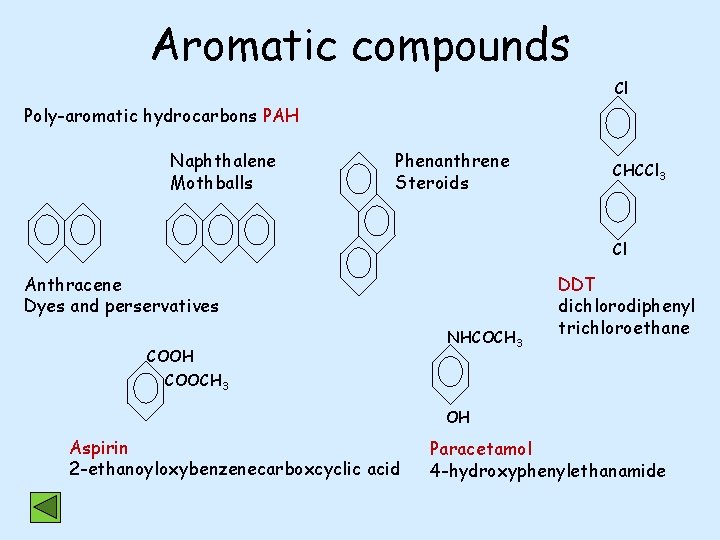
Aromatic compounds Cl Poly-aromatic hydrocarbons PAH Naphthalene Mothballs Phenanthrene Steroids CHCCl 3 Cl Anthracene Dyes and perservatives COOH COOCH 3 NHCOCH 3 DDT dichlorodiphenyl trichloroethane OH Aspirin 2 -ethanoyloxybenzenecarboxcyclic acid Paracetamol 4 -hydroxyphenylethanamide
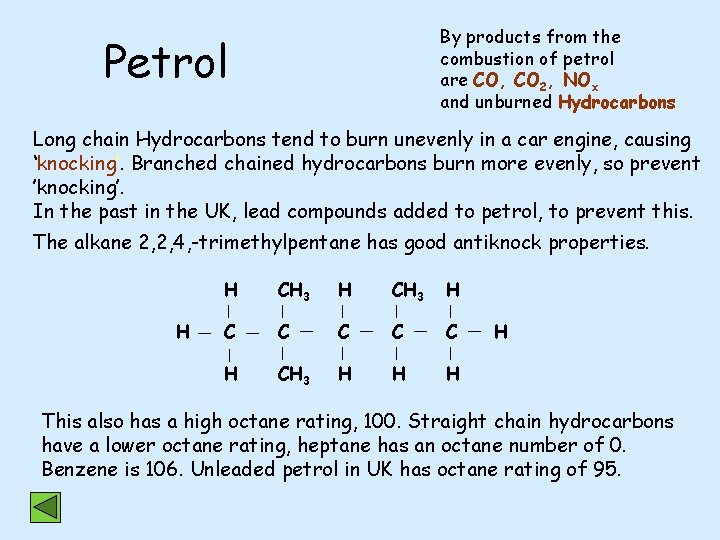
By products from the combustion of petrol are CO, CO 2, NOx and unburned Hydrocarbons Petrol Long chain Hydrocarbons tend to burn unevenly in a car engine, causing ‘knocking’. Branched chained hydrocarbons burn more evenly, so prevent ’knocking’. In the past in the UK, lead compounds added to petrol, to prevent this. The alkane 2, 2, 4, -trimethylpentane has good antiknock properties. H H CH 3 H C C C H CH 3 H H This also has a high octane rating, 100. Straight chain hydrocarbons have a lower octane rating, heptane has an octane number of 0. Benzene is 106. Unleaded petrol in UK has octane rating of 95.
Petrol Reforming, is the process by which straight-chain alkanes undergo a chemical change , which results in new, smoother burning compounds. High temperatures, pressures and a catalyst are used. Platinum is often used in a process called ‘Platforming’ Branched-alkanes, cycloalkanes and aromatic compounds are produced. Hydrocracking, takes place at high temperatures in the presence of hydrogen. Long straight chain hydrocarbons are changed into small branched chain and straight chain alkanes. Petrol is a blend of different hydrocarbons ( branched, aromatics and cycloalkanes) and this can change depending on the season, e. g. in the winter you would need a petrol which was more volatile. Companies change their blend 3 or 4 times a year.
Alternative Fuels Biogas Methane is produced by anaerobic respiration of biological materials. Ethanol Produced by fermentation e. g. sugar cane. It has an octane rating of 111. In Brazil about 20% of their ‘petrol’ is ethanol. Methanol A liquid, made from steam and methane. Octane rating of 114, also ‘clean’ burning. Toxic and corrosive Hydrogen economy The dream fuel, but needs electricity to make it. It burns to produce water. Fuel Cells Twice as efficient as the internal combustion engine. Requires a source of hydrogen and oxygen.
Did you know? CFC’s were replaced by HFC’s which do not destroy the ozone layer. However, they are greenhouse gases which are 1200 times more powerful than CO 2. A fridge contains 0. 67 kg of HFC’s, equivalent to 800 kg of CO 2. For this reason, some fridges now use HC’s, such as butane and propane. These are only 3 to 4 times more powerful than CO 2 as a green house gas.
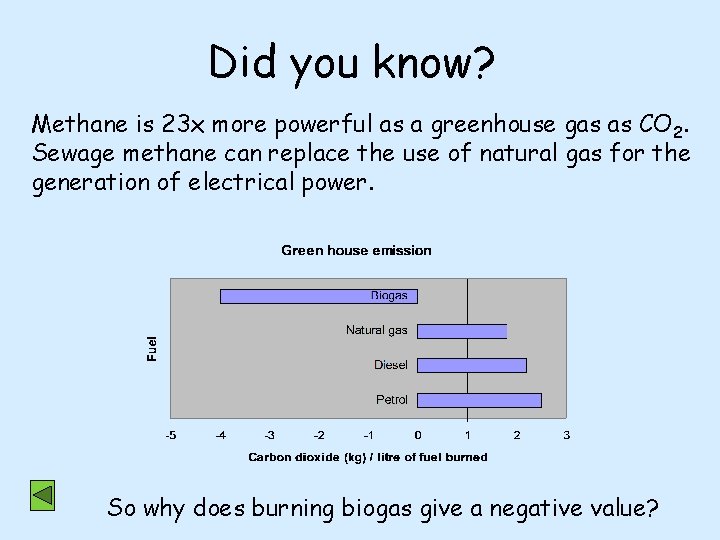
Did you know? Methane is 23 x more powerful as a greenhouse gas as CO 2. Sewage methane can replace the use of natural gas for the generation of electrical power. So why does burning biogas give a negative value?
- Slides: 27