
Hydraulic Head 1 Pressure and Elevation Heads Laboratory
Hydraulic Head 1
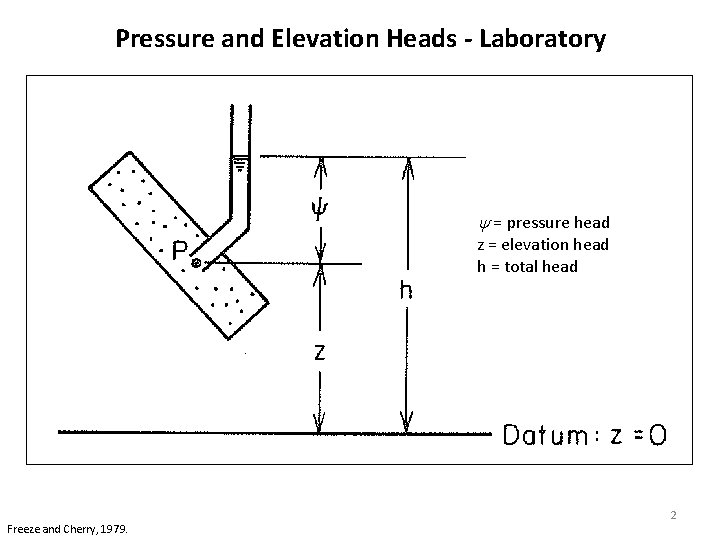
Pressure and Elevation Heads - Laboratory = pressure head z = elevation head h = total head Freeze and Cherry, 1979. 2
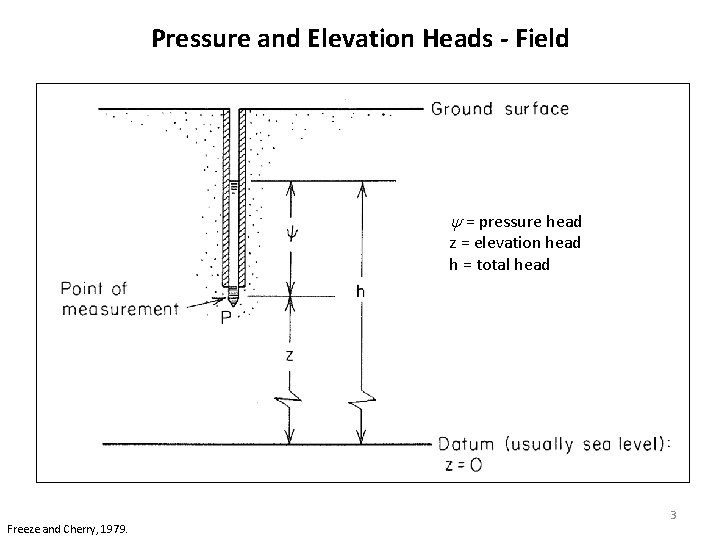
Pressure and Elevation Heads - Field = pressure head z = elevation head h = total head Freeze and Cherry, 1979. 3
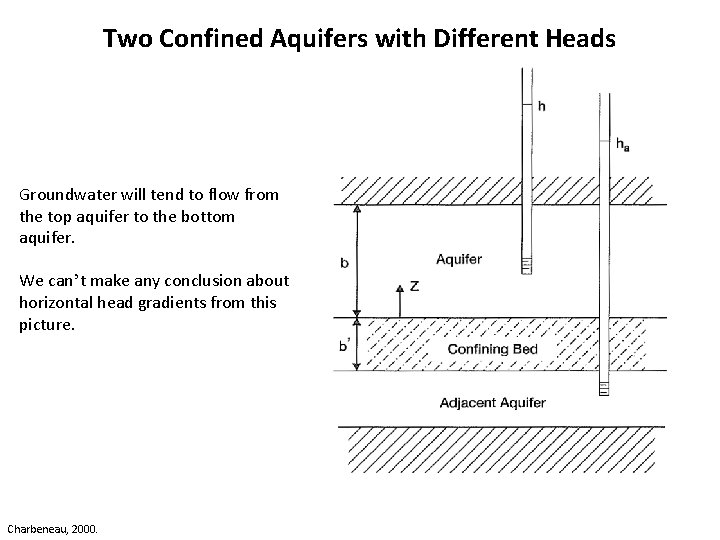
Two Confined Aquifers with Different Heads Groundwater will tend to flow from the top aquifer to the bottom aquifer. We can’t make any conclusion about horizontal head gradients from this picture. Charbeneau, 2000. 4
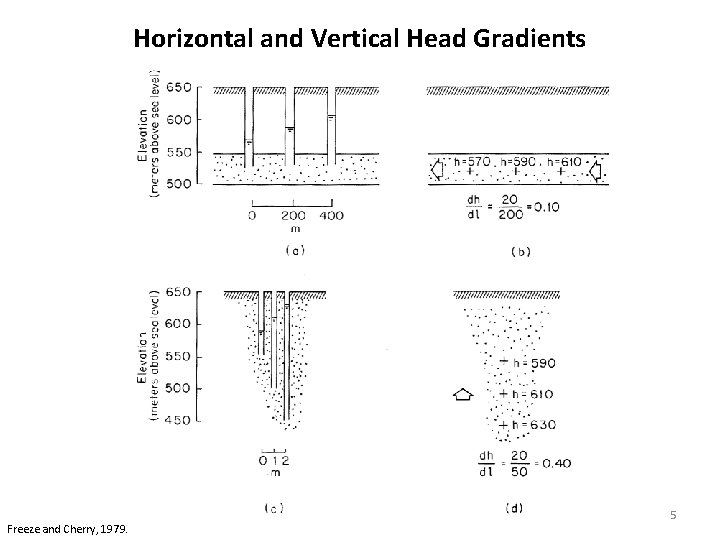
Horizontal and Vertical Head Gradients Freeze and Cherry, 1979. 5
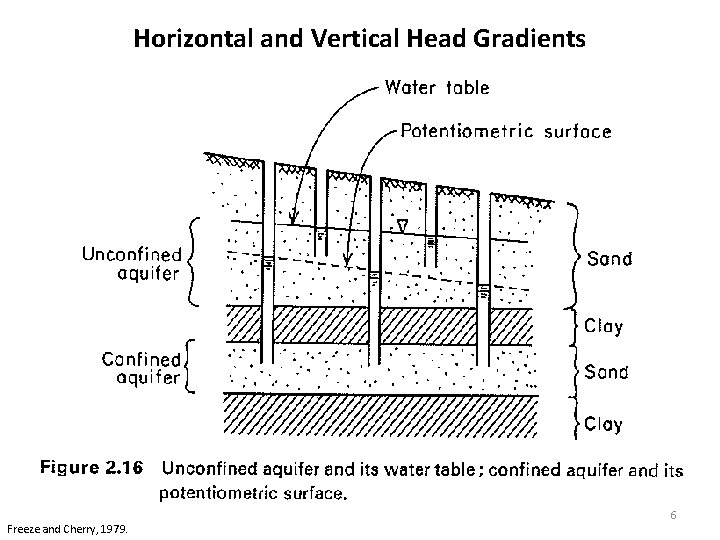
Horizontal and Vertical Head Gradients Freeze and Cherry, 1979. 6
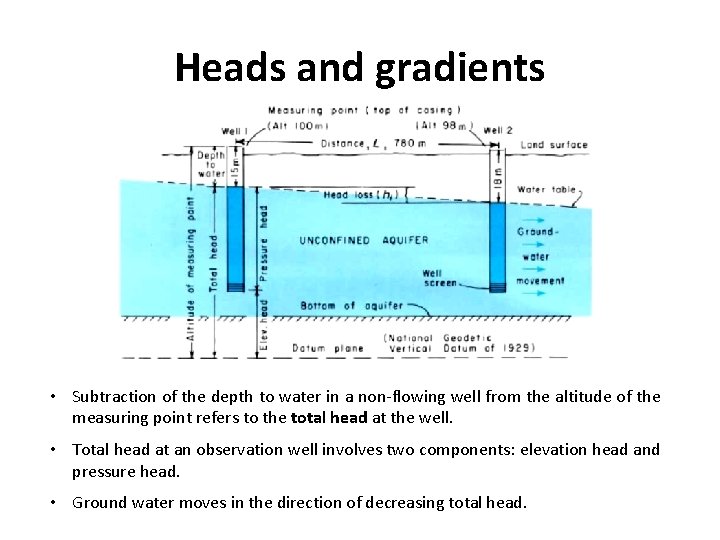
Heads and gradients • Subtraction of the depth to water in a non-flowing well from the altitude of the measuring point refers to the total head at the well. • Total head at an observation well involves two components: elevation head and pressure head. • Ground water moves in the direction of decreasing total head.
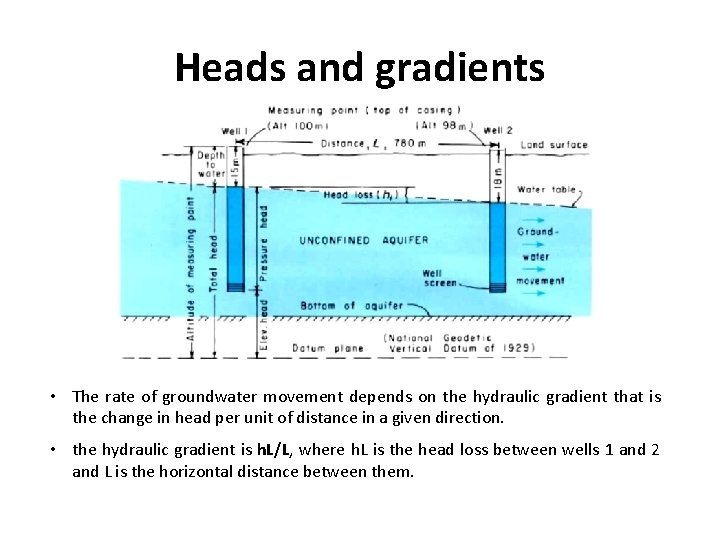
Heads and gradients • The rate of groundwater movement depends on the hydraulic gradient that is the change in head per unit of distance in a given direction. • the hydraulic gradient is h. L/L, where h. L is the head loss between wells 1 and 2 and L is the horizontal distance between them.
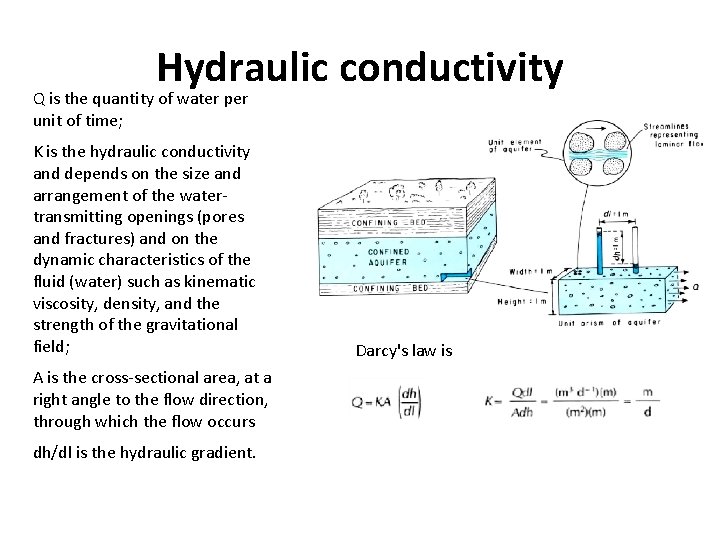
Hydraulic conductivity Q is the quantity of water per unit of time; K is the hydraulic conductivity and depends on the size and arrangement of the watertransmitting openings (pores and fractures) and on the dynamic characteristics of the fluid (water) such as kinematic viscosity, density, and the strength of the gravitational field; A is the cross-sectional area, at a right angle to the flow direction, through which the flow occurs dh/dl is the hydraulic gradient. Darcy's law is
Hydraulic conductivity replaces the term "field coefficient of permeability". If the hydraulic conductivity is essentially the same in any area, the aquifer in that area is said to be homogeneous. If, on the other hand, the hydraulic conductivity differs from one part of the area to another, the aquifer is said to be heterogeneous If the hydraulic conductivity is essentially the same in all directions, the aquifer is said to be isotropic. If it is different in different directions, the aquifer is said to be anisotropic.
- Slides: 10