
Hydraulic Fracturing Overview The Fundamentals Horizontal Drilling Hydraulic










- Slides: 42
Hydraulic Fracturing
Overview § § § § The Fundamentals Horizontal Drilling Hydraulic Fracturing Water Management Produced Water Baseline Sampling Disclosure Questions and Answers
The Fundamentals
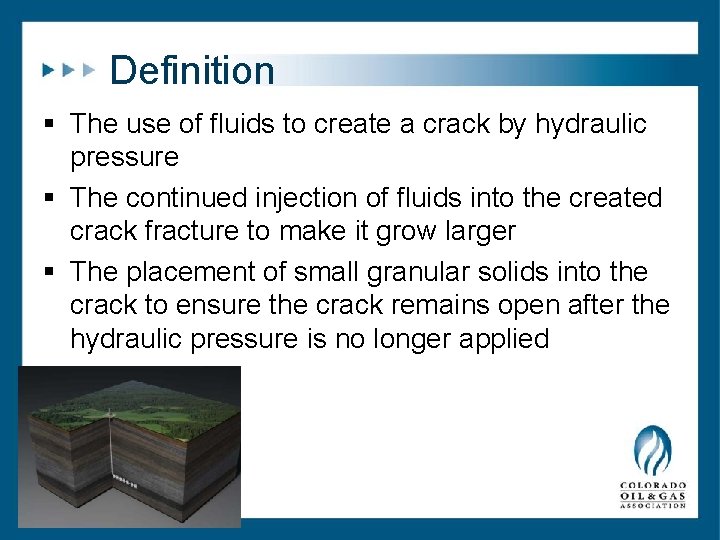
Definition § The use of fluids to create a crack by hydraulic pressure § The continued injection of fluids into the created crack fracture to make it grow larger § The placement of small granular solids into the crack to ensure the crack remains open after the hydraulic pressure is no longer applied
Why HF a Well? § Increase the Rate at which the well is capable of producing oil or gas § Most unconventional formations Require hydraulic fracturing to be economic § Does not increase total Reserves
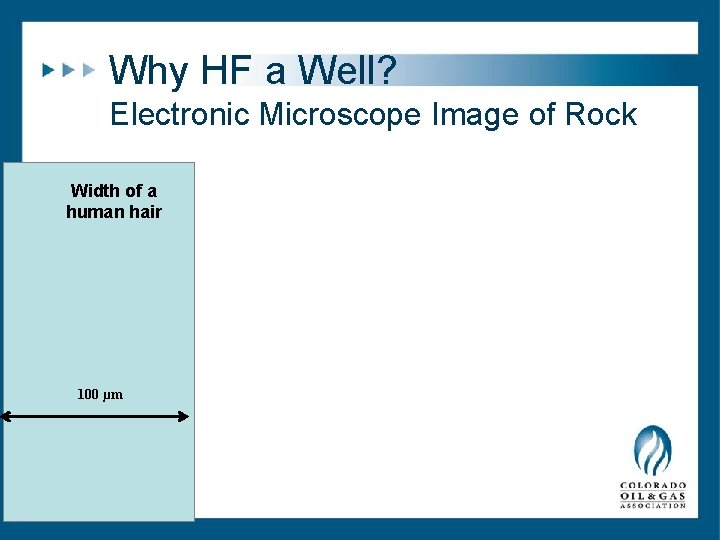
Why HF a Well? Electronic Microscope Image of Rock Width of a human hair 100 µm
Fractured Contact
“Hydra. Frac” Process § July of 1947 - Stanolind Oil and Gas • 1 st Job: Klepper No. 1 gelled kerosene/gasoline mix • Hugoton Gas Field, Kansas § Late 1948 - Patent issued, 23 wells H. F. before commercial application began § In 1949, The Halliburton Oil Well Cementing Co. was granted an exclusive license to pump the new “Hydrafrac” process • 332 wells were treated first 12 months • 75% success rate
Drilling
Drilling Distance Aquifer 400 -800 ft. Wells Fargo Center ~700 ft 7000 ft.
Casing § Multiple layers surrounding the aquifer § § § § Cement Conductor Casing Cement Surface Casing Drilling Mud/Cement Production Casing Production Tubing
Surface Casing § Purpose • Protect ground water • Provide stable wellbore during drilling operation • Provide well control during drilling § Depth Requirements • Set by State and BLM regulations • Extends below the aquifer § Cement Helps • Protect casing from corrosion • Provide zonal isolation • Support casing in wellbore
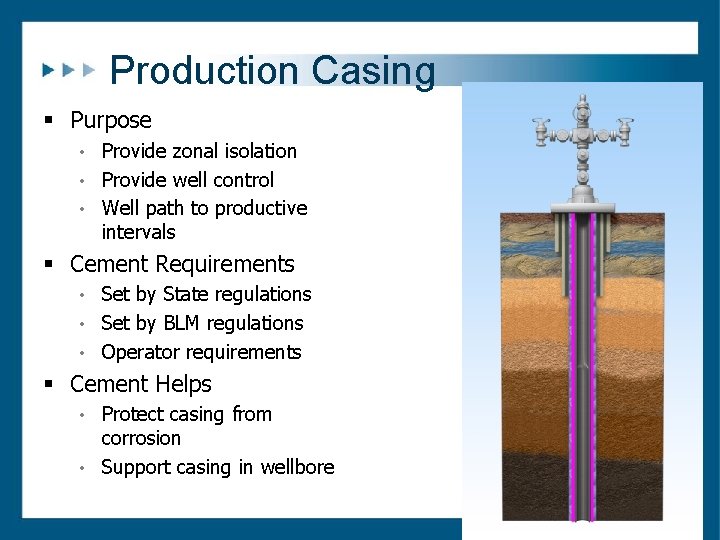
Production Casing § Purpose • Provide zonal isolation • Provide well control • Well path to productive intervals § Cement Requirements • Set by State regulations • Set by BLM regulations • Operator requirements § Cement Helps • Protect casing from corrosion • Support casing in wellbore
Drilling Depths (feet) § DJ Basin: 7, 000 -8, 000 § Piceance Valley: 7000 § Piceance Mesa: 12, 000 § Raton Basin: 2, 000
Hydraulic Fracturing
HF Fluids
HF Fluids
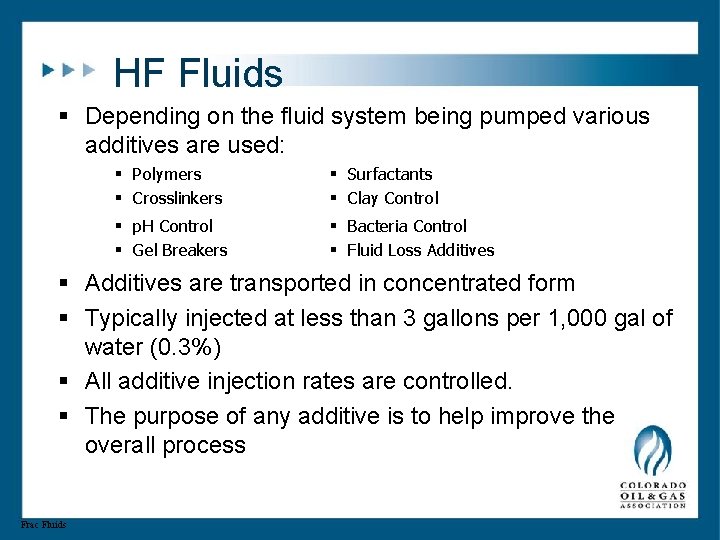
HF Fluids § Depending on the fluid system being pumped various additives are used: § Polymers § Crosslinkers § Surfactants § Clay Control § p. H Control § Gel Breakers § Bacteria Control § Fluid Loss Additives § Additives are transported in concentrated form § Typically injected at less than 3 gallons per 1, 000 gal of water (0. 3%) § All additive injection rates are controlled. § The purpose of any additive is to help improve the overall process Frac Fluids
Water Management
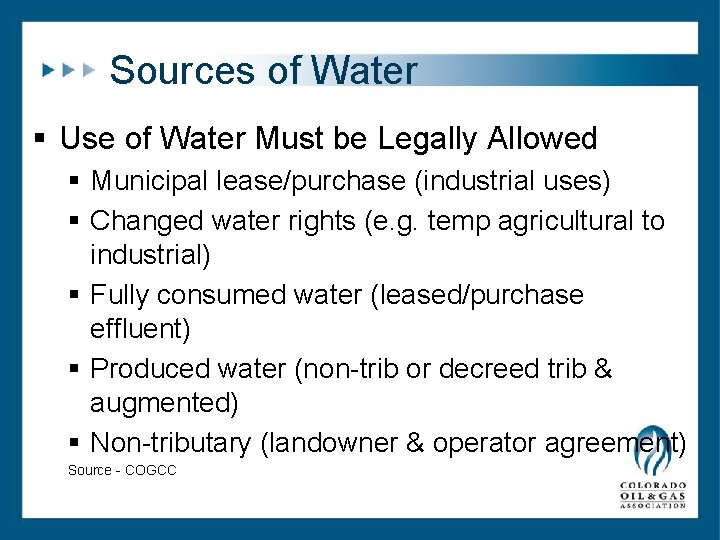
Sources of Water § Use of Water Must be Legally Allowed § Municipal lease/purchase (industrial uses) § Changed water rights (e. g. temp agricultural to industrial) § Fully consumed water (leased/purchase effluent) § Produced water (non-trib or decreed trib & augmented) § Non-tributary (landowner & operator agreement) Source - COGCC
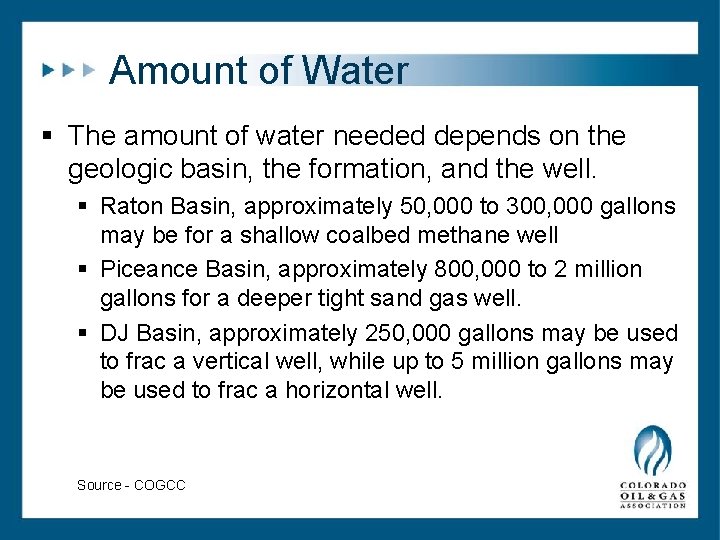
Amount of Water § The amount of water needed depends on the geologic basin, the formation, and the well. § Raton Basin, approximately 50, 000 to 300, 000 gallons may be for a shallow coalbed methane well § Piceance Basin, approximately 800, 000 to 2 million gallons for a deeper tight sand gas well. § DJ Basin, approximately 250, 000 gallons may be used to frac a vertical well, while up to 5 million gallons may be used to frac a horizontal well. Source - COGCC
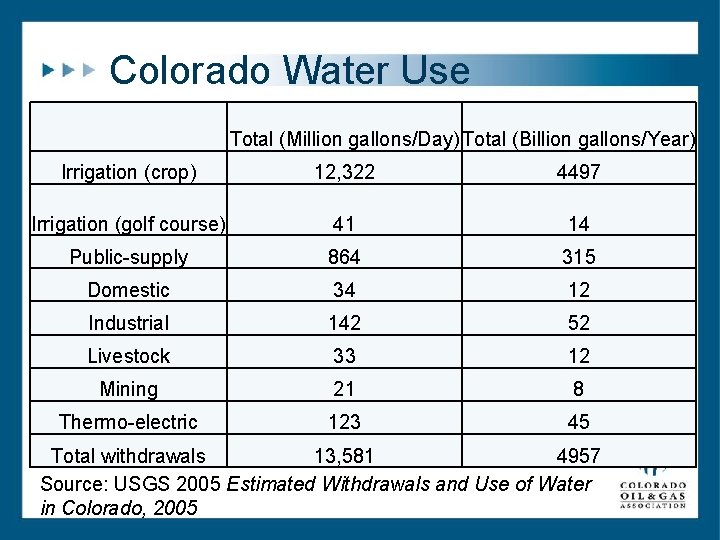
Colorado Water Use Total (Million gallons/Day) Total (Billion gallons/Year) Irrigation (crop) 12, 322 4497 Irrigation (golf course) 41 14 Public-supply 864 315 Domestic 34 12 Industrial 142 52 Livestock 33 12 Mining 21 8 Thermo-electric 123 45 Total withdrawals 13, 581 4957 Source: USGS 2005 Estimated Withdrawals and Use of Water in Colorado, 2005
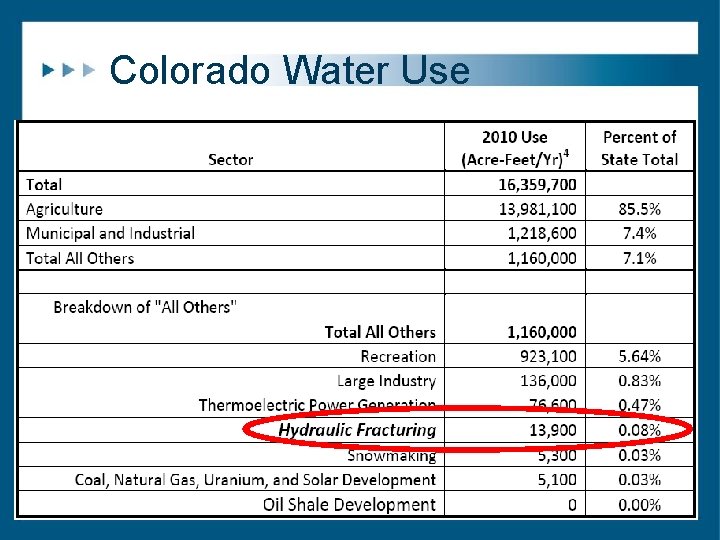
Colorado Water Use
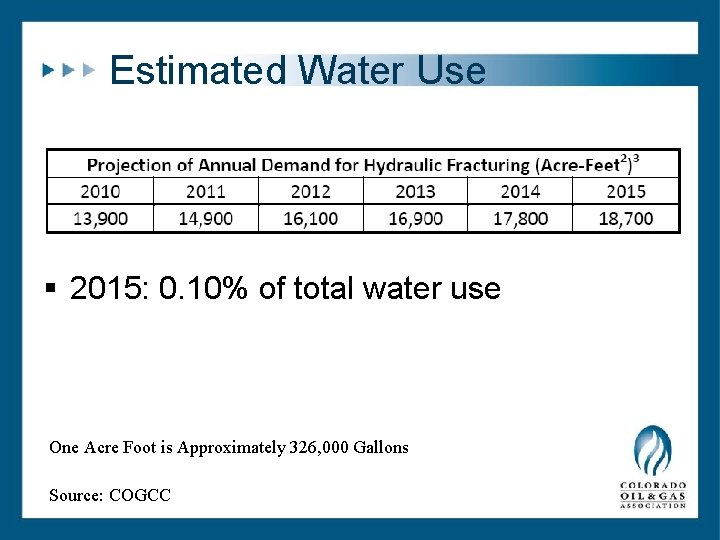
Estimated Water Use § 2015: 0. 10% of total water use One Acre Foot is Approximately 326, 000 Gallons Source: COGCC
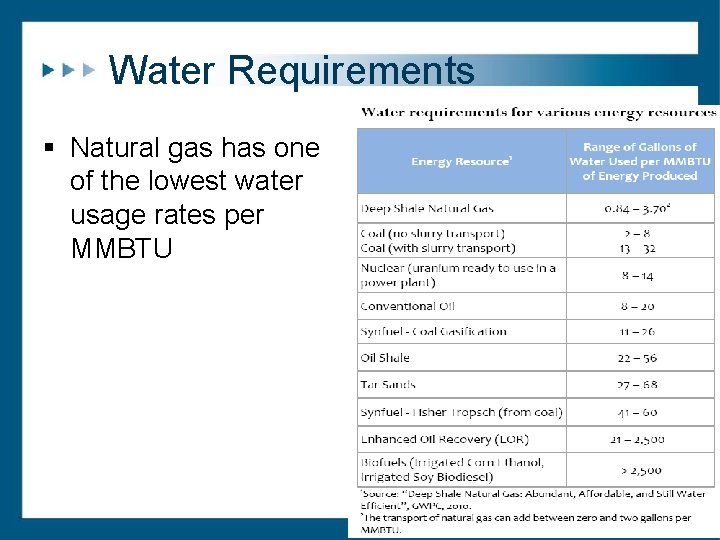
Water Requirements § Natural gas has one of the lowest water usage rates per MMBTU
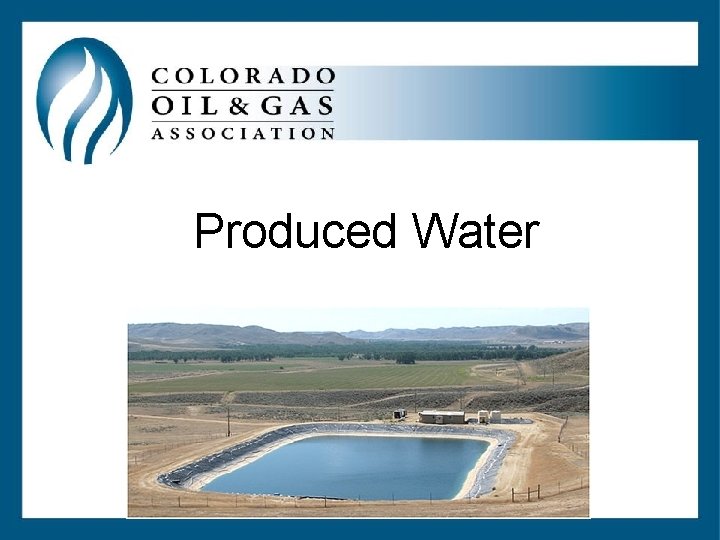
Produced Water
Produced & Flowback § Produced water is naturally-occurring (“connate”) water that exists in the formation and is “produced” along with hydrocarbons § Flowback water is recovered water from HF use that returns to the surface
Disposal § 60% Underground Injection Wells § 20% Lined Open-Air Pits § 20% Surface Discharge: rivers and streams, dirt roads
Disposal Regulation § Rule 907 - Management of Exploration and Production (E&P) Waste § Rule 908 - E&P Waste Management Facilities Regulation § Rule 325 - Underground Injection of Water
Baseline Water Sampling
Concept § Pre and Post-drilling water samples taken around new well starts § Increased transparency & accountability for industry § Allows public to search all public records on COGCC § Analytical results on a timely basis
Program § COGA, Hickenlooper, Dept. of Natural Resources, and COGCC § 93% Participation
Program Details § Samples collected on new wells and new expansions § In accordance with COGCC Sampling and Analysis Plan § Post-Drilling sampling conducted within 1 -3 years § ½ mile radius of well pad surface location § Sample collected within 48 hours of notified complaint
Program Details Cont. § Samples sent to certified lab § Landowners notified of results along with education materials § Samples available to public via database on COGCC website § Annual review of program implementation and results
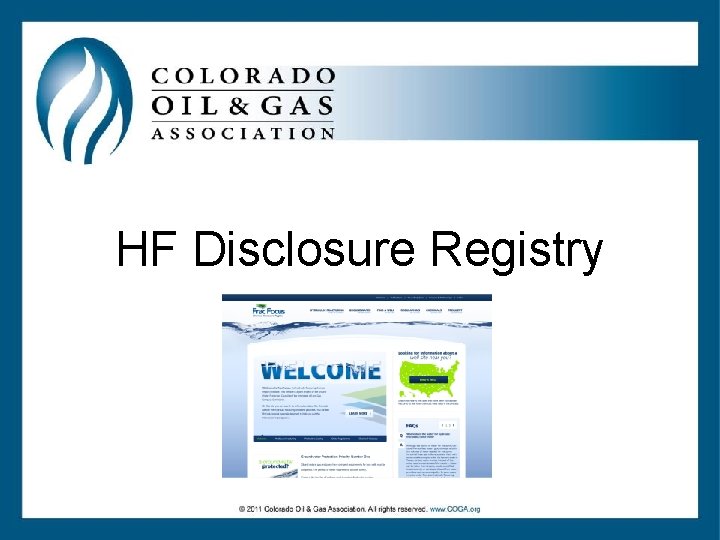
HF Disclosure Registry
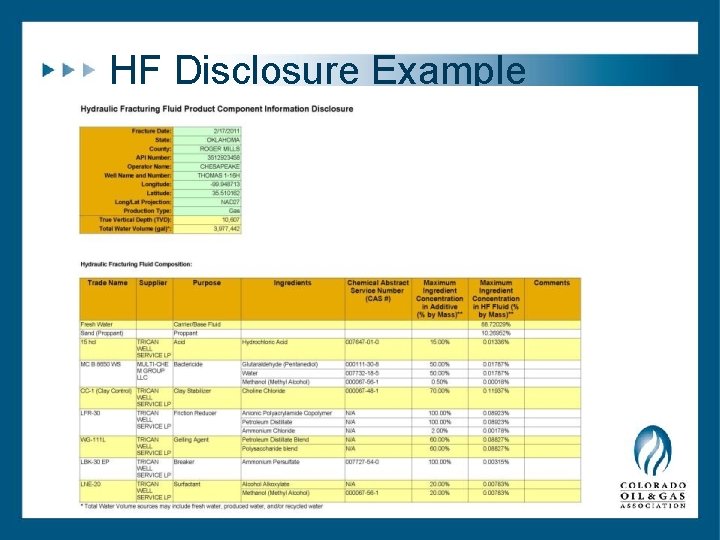
New HF Rule § Requires public disclosure of HF chemicals using Frac. Focus. org § Well-by-well Basis § Trade Secret Protection § File with COGCC § 48 hour advance notice from Operator to the Commission is required of intention to hydraulically fracture a well.
HF Disclosure Registry § Initiated by the Ground Water Protection Council (GWPC) and Interstate Oil & Gas Compact Commission (IOGCC) § Website Development Committee: Industry, State, & GWPC § Industry has unanimously supported the Registry § § § ANGA (American Natural Gas Alliance) AXPC (American Exploration & Production Companies) API (American Petroleum Institute) IPAA (Independent Petroleum Association of America) NGSA (Natural Gas Supply Association) INGAA (Interstate Natural Gas Association of America)
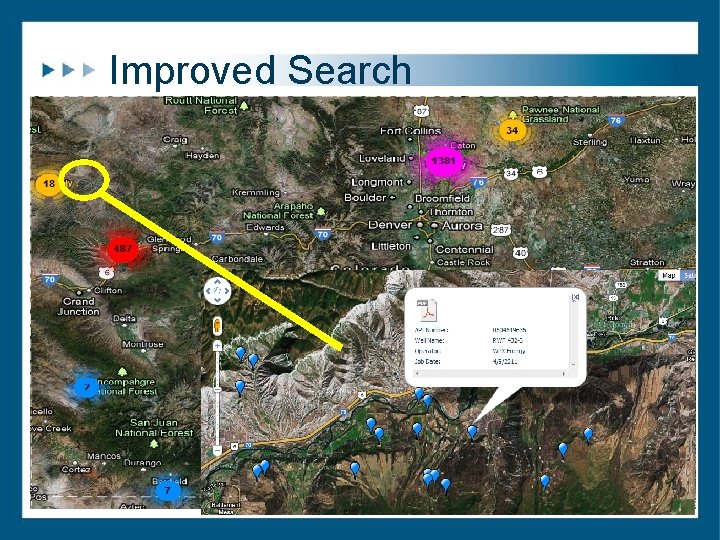
Concept of the Registry § Web interface where operators voluntarily register HF chemicals § Timely, consistent data § Centralized upload area for operators § Secure information § Web interface where public finds more information on the HF process § Well site search tool § Allow public to search for individual HF wells § Query by state, county, API number, production type, lease name or well number § From 2011 forward
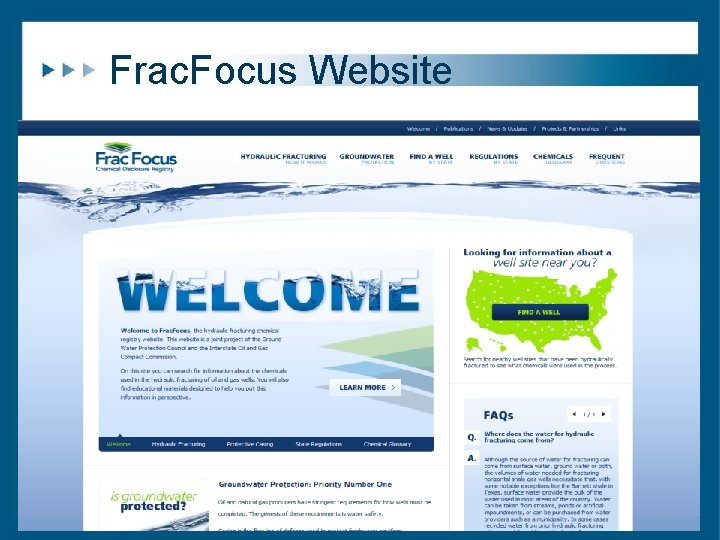
Frac. Focus Website 39
Improved Search
HF Disclosure Example
Questions? Thank you for your interest in Colorado’s oil and gas industry! www. coga. org