
Hydraulic Electrical Steam CONTROL OF HAZARDOUS ENERGY LOCKOUTTAGOUT

- Slides: 57
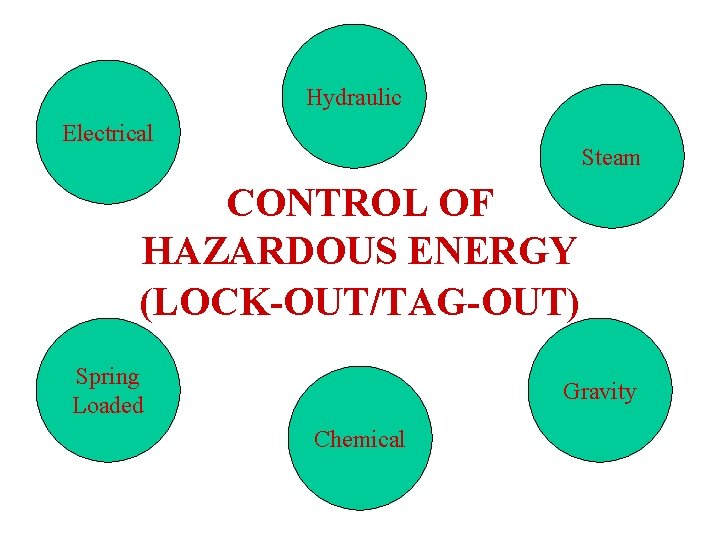
Hydraulic Electrical Steam CONTROL OF HAZARDOUS ENERGY (LOCK-OUT/TAG-OUT) Spring Loaded Gravity Chemical
Developed by Garold L. Russell Joseph P. Flick Mark C. Radomsky Raja V. Ramani Department of Energy & Geo-Engineering The Pennsylvania State University 126 Hosler Building University Park, PA 16802 (814) 865 -7472 June, 2001
Energy We’ve harnessed it, tamed it and put it to work for us. But, energy is always ready to escape. And if it is not kept under control, it can hurt you----even kill you
The objectives of this program is to assist miner(s) to become more aware of; • Electrical hazards • Types of electrical hazards • MSHA regulations • Prudent safe work procedures
Consequences of Lock-Out/Tag-Out Incidents Unexpectedly getting caught in machinery Unplanned startup of machinery Unexpected movement of machine parts Unexpected release of stored energy
Consequences of Lock-Out/Tag-Out Incidents Loss of life Personal injury Property damage Loss of production Loss of jobs
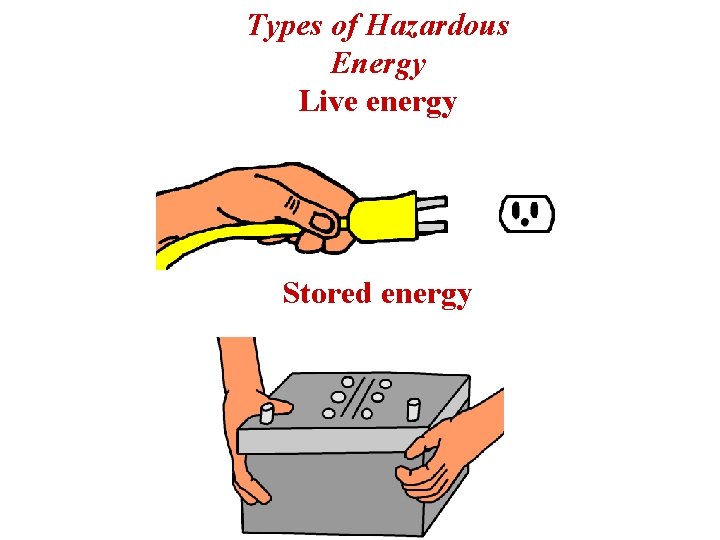
Types of Hazardous Energy Live energy Stored energy
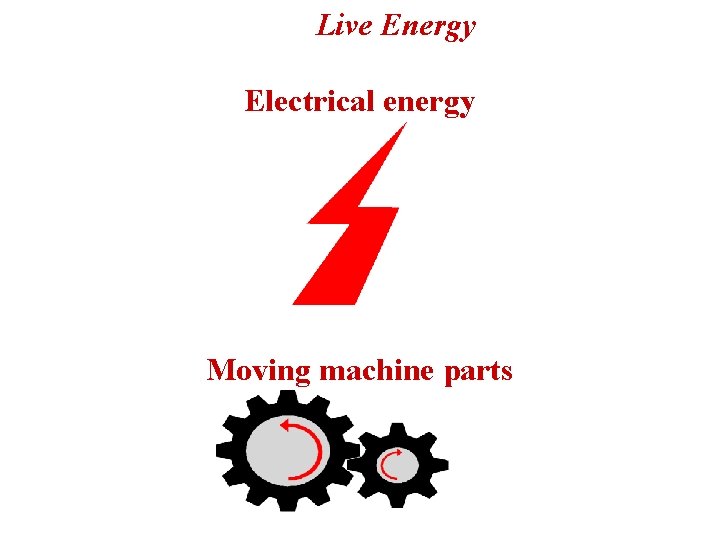
Live Energy Electrical energy Moving machine parts
Stored Energy Hydraulic or pneumatic pressure that could be released Electric energy stored in electric components
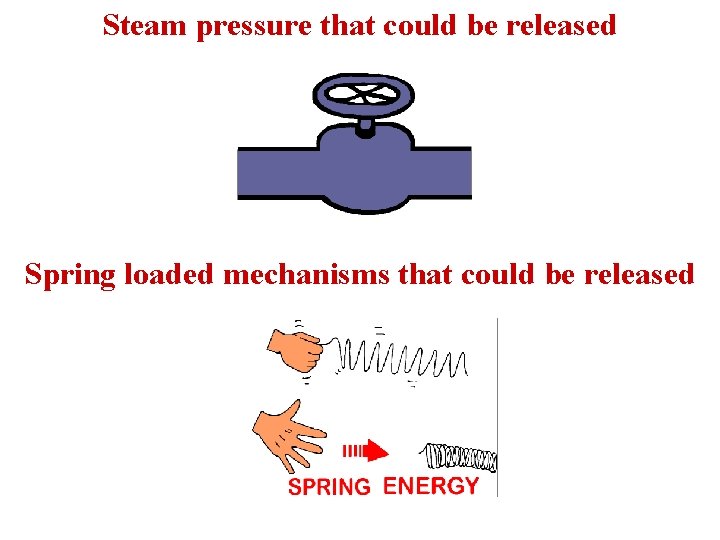
Steam pressure that could be released Spring loaded mechanisms that could be released
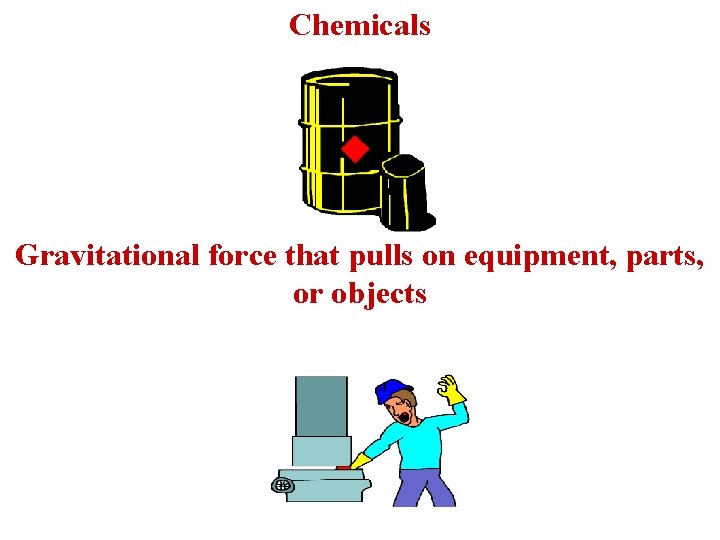
Chemicals Gravitational force that pulls on equipment, parts, or objects
Common Factors in Lock-Out/Tag-Out Incidents • Accidental start up • Release of stored energy • Working on energized equipment • Removal of guards
Accidental Start Up Equipment being accidentally started by someone who did not know that work was being performed Electrical energy from an alternative source providing power for a machine or equipment to start
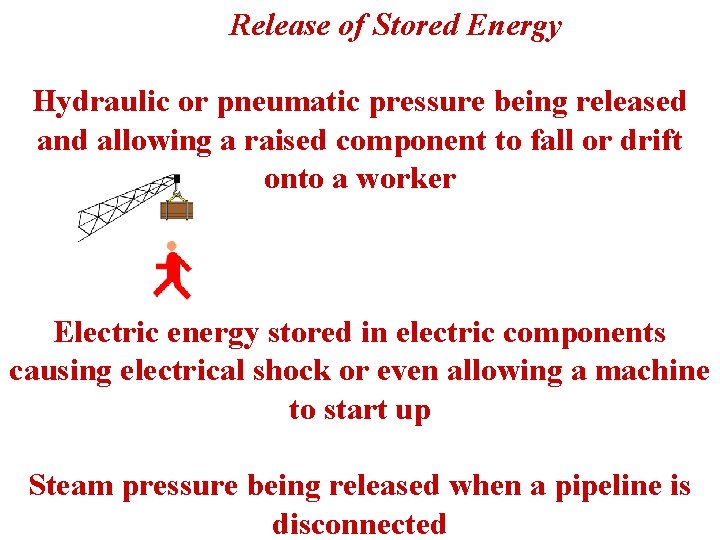
Release of Stored Energy Hydraulic or pneumatic pressure being released and allowing a raised component to fall or drift onto a worker Electric energy stored in electric components causing electrical shock or even allowing a machine to start up Steam pressure being released when a pipeline is disconnected
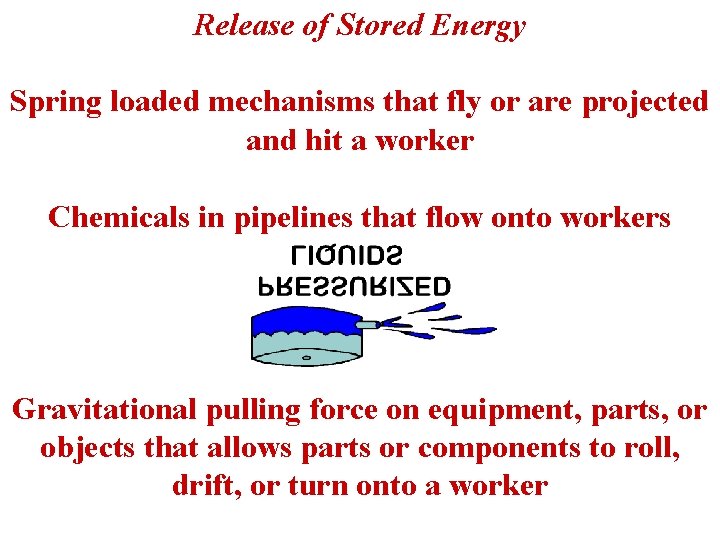
Release of Stored Energy Spring loaded mechanisms that fly or are projected and hit a worker Chemicals in pipelines that flow onto workers Gravitational pulling force on equipment, parts, or objects that allows parts or components to roll, drift, or turn onto a worker
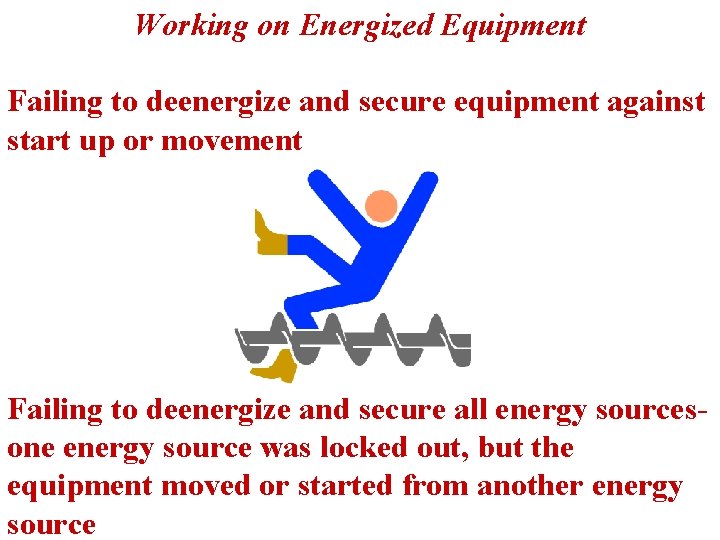
Working on Energized Equipment Failing to deenergize and secure equipment against start up or movement Failing to deenergize and secure all energy sourcesone energy source was locked out, but the equipment moved or started from another energy source
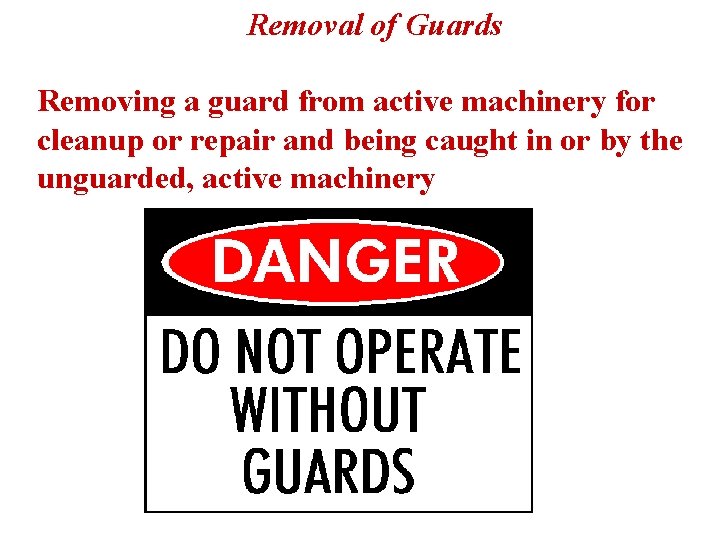
Removal of Guards Removing a guard from active machinery for cleanup or repair and being caught in or by the unguarded, active machinery
MSHA Regulations, Part 56 (highlights and overview only--not complete for all regulations) Electrically powered equipment shall be deenergized before work is done on such equipment--power switches shall be locked out or other measures taken which shall prevent the equipment from being energized without the knowledge of the individuals working on it--Suitable warning notices shall be posted at the power switch and signed by the individuals who are to do the work--such locks or preventive devices shall be removed only by the persons who installed them or by authorized personnel
MSHA Regulations, Part 56 (highlights and overview only--not complete for all regulations) Power circuits shall be deenergized before work is done on such circuits unless hot-line tools are used--suitable warning signs shall be posted by the individuals who are to do the work--switches shall be locked out or other measures taken which shall prevent the power circuits from being energized without the knowledge of the individuals working on them--such locks, signs, or preventative devices shall be removed only by the persons who installed them or by authorized
MSHA Regulations, Part 56 (highlights and overview only--not complete for all regulations) Repairs or maintenance of machinery or equipment shall be performed only after the power is off, and the machinery or equipment is blocked against hazardous motion Persons shall not work on top of, under, or work from mobile equipment in a raised position until the equipment has been blocked or mechanically secured to prevent it from rolling, falling, or being accidentally lowered
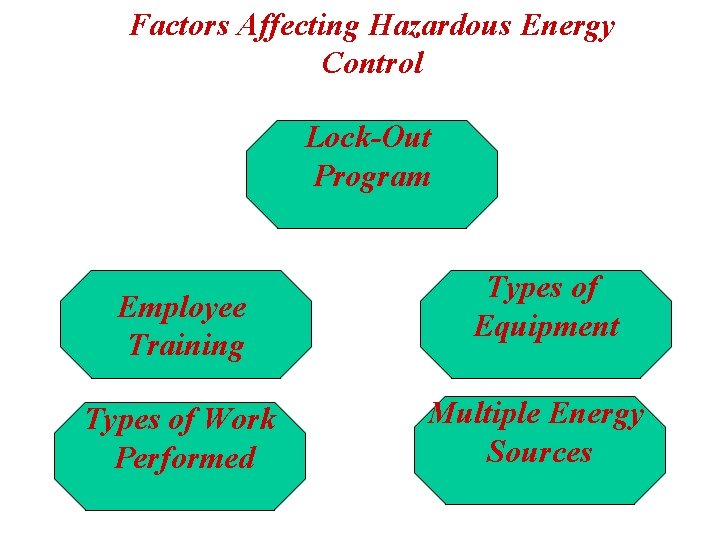
Factors Affecting Hazardous Energy Control Lock-Out Program Employee Training Types of Work Performed Types of Equipment Multiple Energy Sources
Lock-Out Program An organized program must be in effect to identify and control all energy sources The plan must be consistently used during all types of work involving the control of hazardous energy
Employee Training MSHA-required task training should address all parts of hazardous energy control If you do not know how to perform lock-out/tag-out --don’t attempt to do so until you have been trained
Employee Training If you are asked to participate in the lock out of any machinery or equipment and do not know the correct and proper procedures--stop--advise the supervisor immediately If you are going to be part of the work, you must be part of the lock-out--if you don’t know, aren’t sure, or have any doubts or questions--stop--advise the supervisor immediately
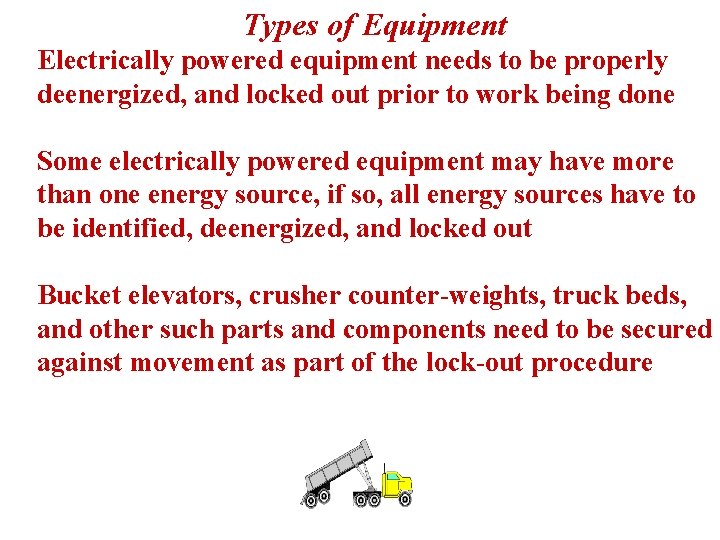
Types of Equipment Electrically powered equipment needs to be properly deenergized, and locked out prior to work being done Some electrically powered equipment may have more than one energy source, if so, all energy sources have to be identified, deenergized, and locked out Bucket elevators, crusher counter-weights, truck beds, and other such parts and components need to be secured against movement as part of the lock-out procedure
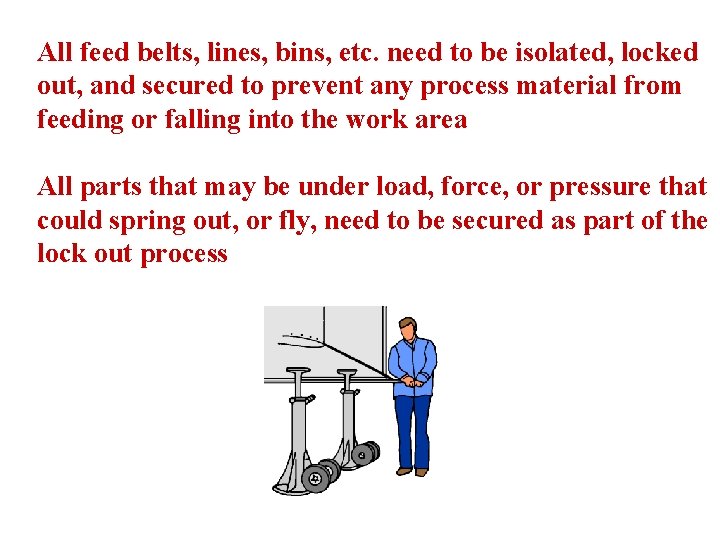
All feed belts, lines, bins, etc. need to be isolated, locked out, and secured to prevent any process material from feeding or falling into the work area All parts that may be under load, force, or pressure that could spring out, or fly, need to be secured as part of the lock out process
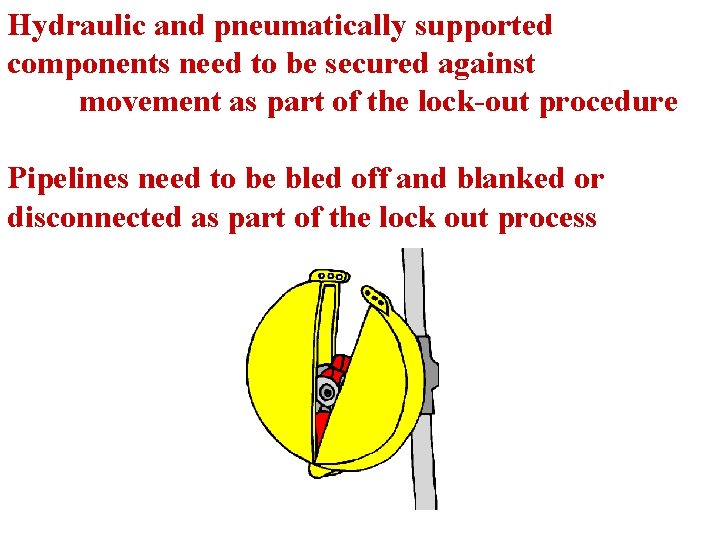
Hydraulic and pneumatically supported components need to be secured against movement as part of the lock-out procedure Pipelines need to be bled off and blanked or disconnected as part of the lock out process
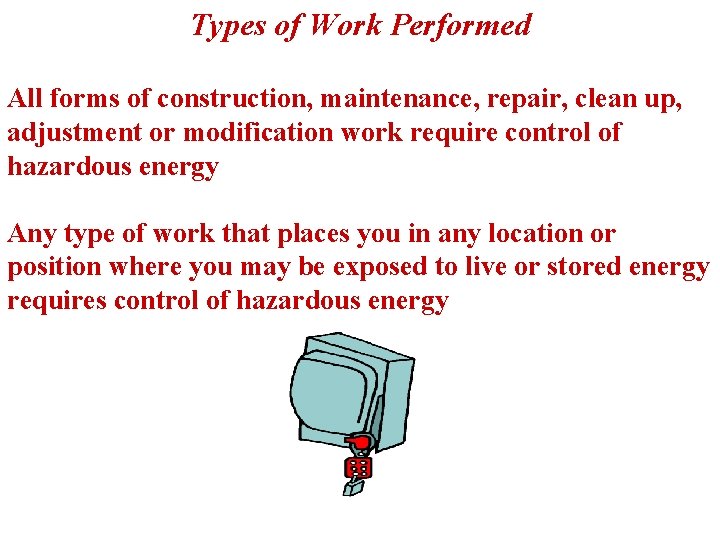
Types of Work Performed All forms of construction, maintenance, repair, clean up, adjustment or modification work require control of hazardous energy Any type of work that places you in any location or position where you may be exposed to live or stored energy requires control of hazardous energy
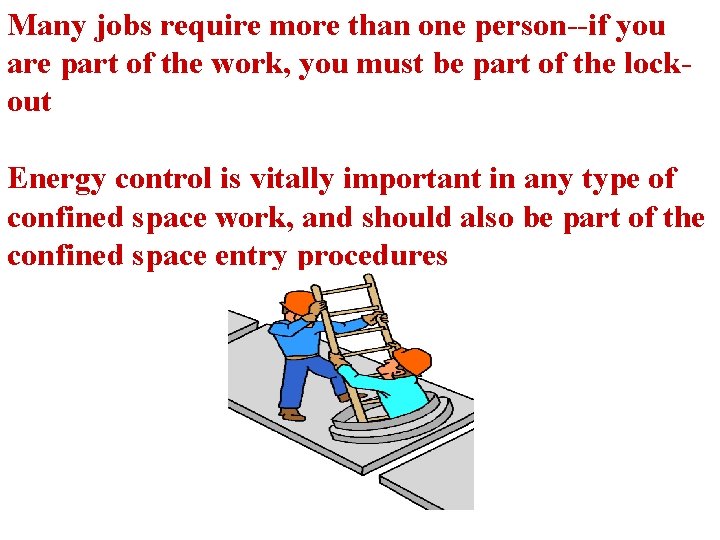
Many jobs require more than one person--if you are part of the work, you must be part of the lockout Energy control is vitally important in any type of confined space work, and should also be part of the confined space entry procedures
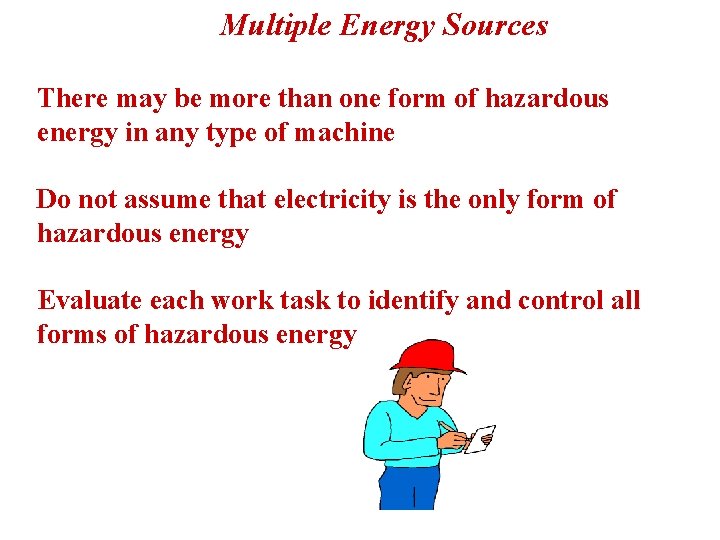
Multiple Energy Sources There may be more than one form of hazardous energy in any type of machine Do not assume that electricity is the only form of hazardous energy Evaluate each work task to identify and control all forms of hazardous energy
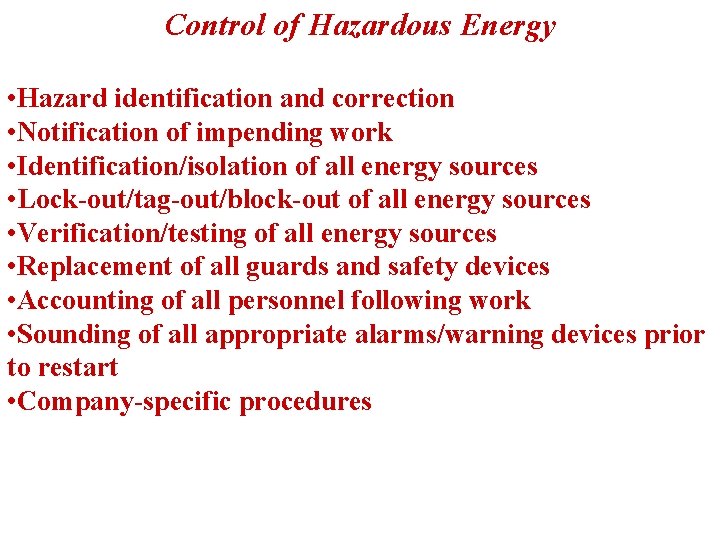
Control of Hazardous Energy • Hazard identification and correction • Notification of impending work • Identification/isolation of all energy sources • Lock-out/tag-out/block-out of all energy sources • Verification/testing of all energy sources • Replacement of all guards and safety devices • Accounting of all personnel following work • Sounding of all appropriate alarms/warning devices prior to restart • Company-specific procedures
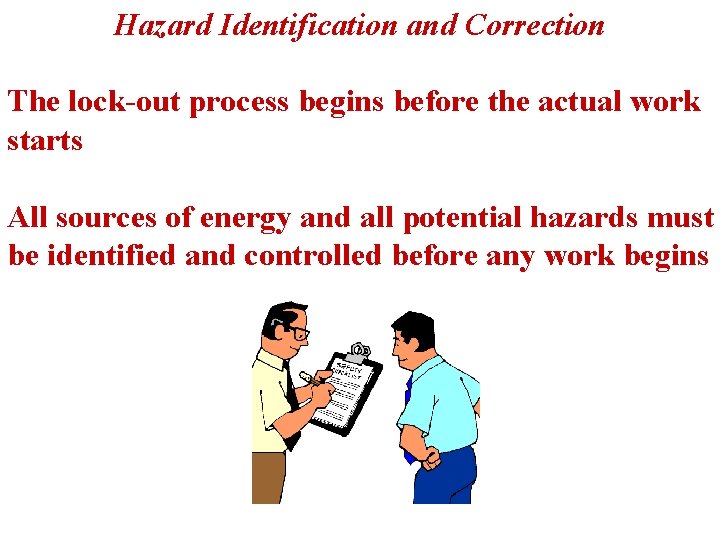
Hazard Identification and Correction The lock-out process begins before the actual work starts All sources of energy and all potential hazards must be identified and controlled before any work begins
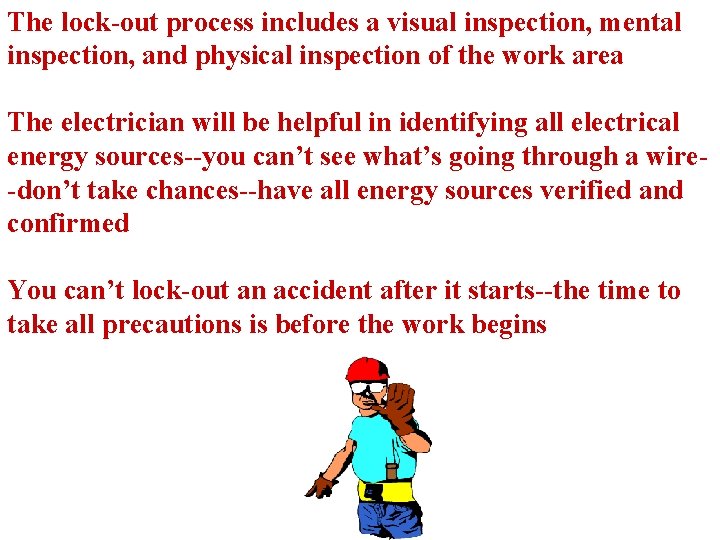
The lock-out process includes a visual inspection, mental inspection, and physical inspection of the work area The electrician will be helpful in identifying all electrical energy sources--you can’t see what’s going through a wire-don’t take chances--have all energy sources verified and confirmed You can’t lock-out an accident after it starts--the time to take all precautions is before the work begins
Notification of Impending Work Notify and all employees who may be affected by the impending shut down of equipment of what is about to occur--you do not need to cause any upstream or downstream surprises (or accidents) Have a “team meeting” with all other employees who will be part of the work to standardize and confirm what is to be done and why
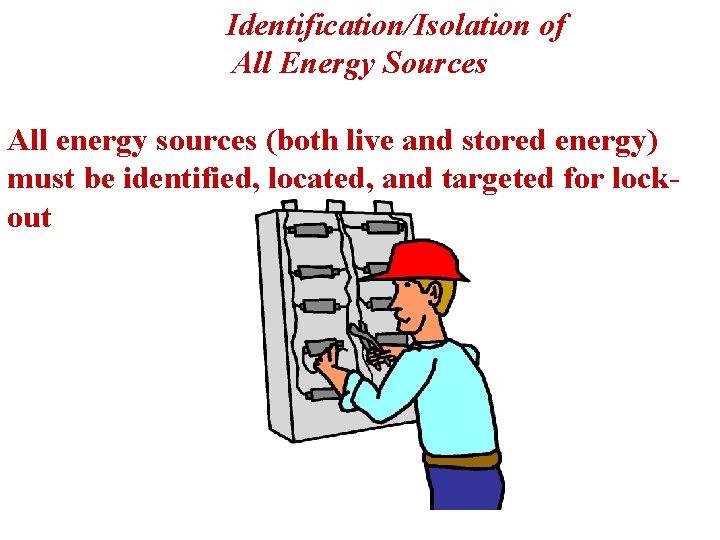
Identification/Isolation of All Energy Sources All energy sources (both live and stored energy) must be identified, located, and targeted for lockout
Lock-Out/Tag-Out All Energy Sources q All energy sources must be deenergized and locked out q Lock electrical energy sources at main sources q If there is more than one energy source, it needs to be locked-out
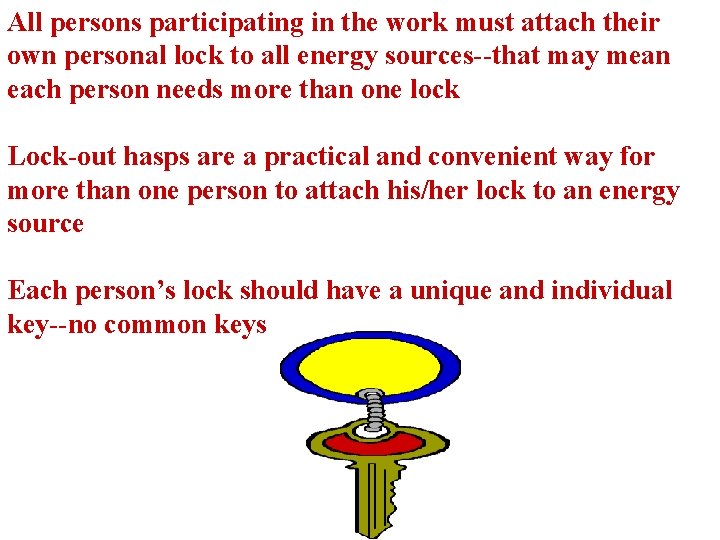
All persons participating in the work must attach their own personal lock to all energy sources--that may mean each person needs more than one lock Lock-out hasps are a practical and convenient way for more than one person to attach his/her lock to an energy source Each person’s lock should have a unique and individual key--no common keys
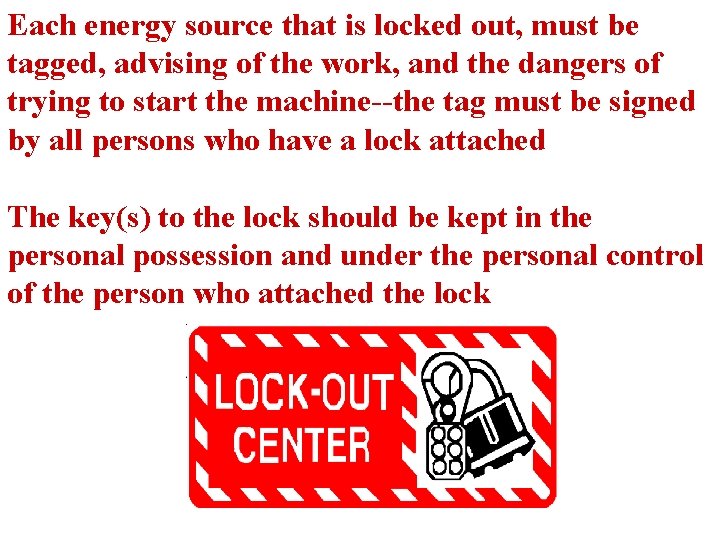
Each energy source that is locked out, must be tagged, advising of the work, and the dangers of trying to start the machine--the tag must be signed by all persons who have a lock attached The key(s) to the lock should be kept in the personal possession and under the personal control of the person who attached the lock
Verification/Testing of All Energy Sources Verify that all electrical energy is controlled by attempting to start the machine
Control Stored Energy Stored energy sources must be bled off, supported, blocked, or otherwise neutralized to prevent any and all movement, motion, or other hazard
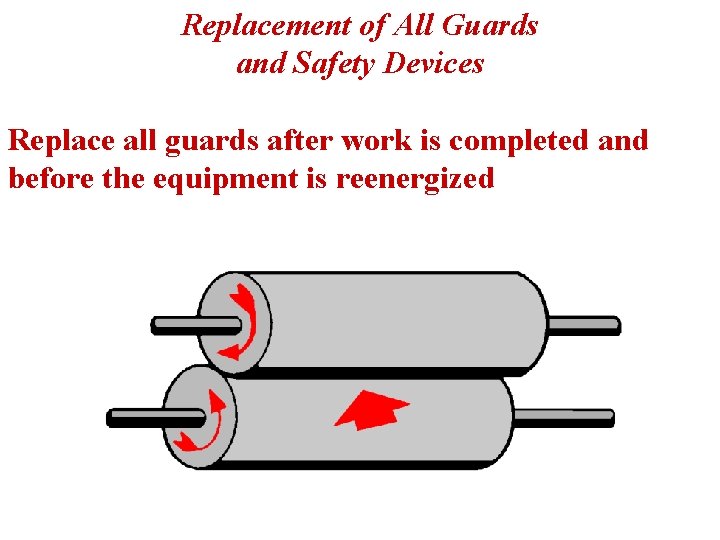
Replacement of All Guards and Safety Devices Replace all guards after work is completed and before the equipment is reenergized
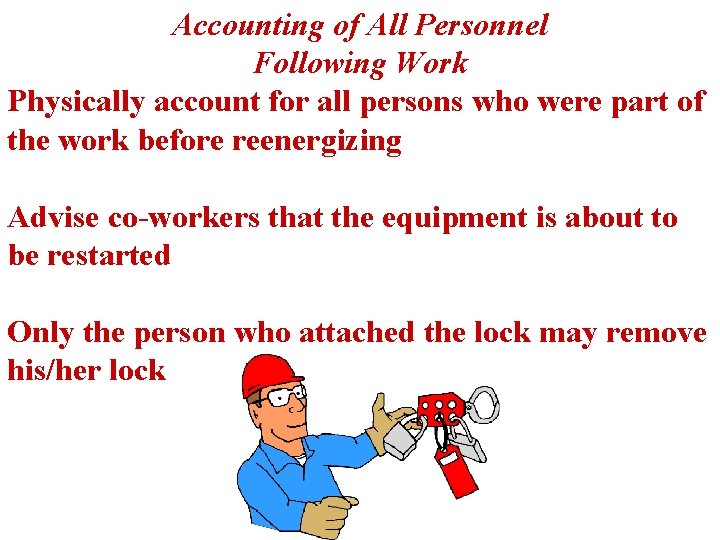
Accounting of All Personnel Following Work Physically account for all persons who were part of the work before reenergizing Advise co-workers that the equipment is about to be restarted Only the person who attached the lock may remove his/her lock
Sounding of All Appropriate Alarms/Warning Devices Prior to Restart After all guards have been replaced, all persons have been accounted for, and all upstream and downstream workers advised of the impending restart, sound all warning or start-up alarms before actually restarting the equipment
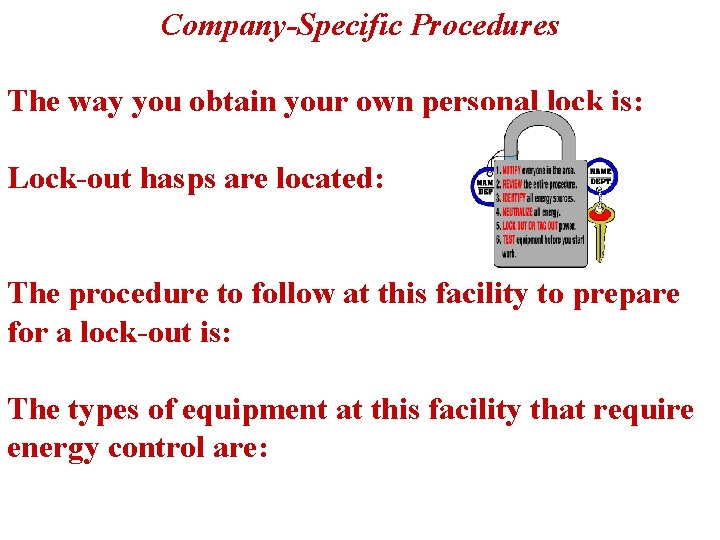
Company-Specific Procedures The way you obtain your own personal lock is: Lock-out hasps are located: The procedure to follow at this facility to prepare for a lock-out is: The types of equipment at this facility that require energy control are:
Equipment at this facility that has more than one electrical energy source is: The actual lock-out procedure at this facility is: The procedure to follow at this facility if you are relieving someone and that person has a lock attached is: The procedure to follow at this facility if/when using a box-system lock-out is:
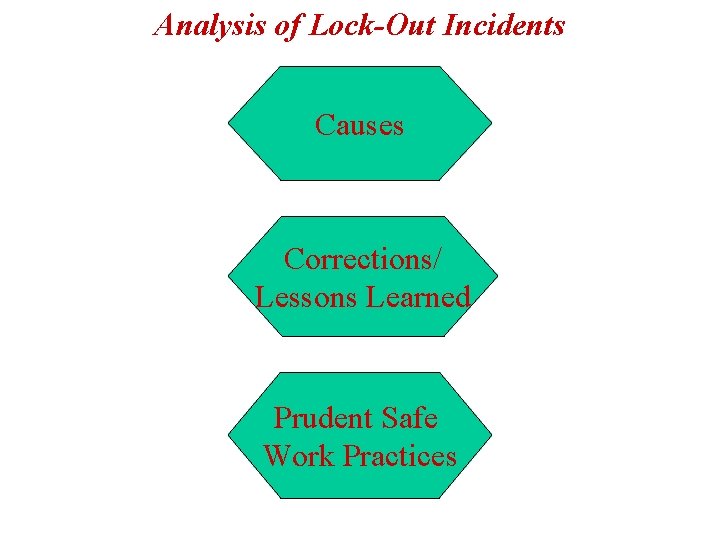
Analysis of Lock-Out Incidents Causes Corrections/ Lessons Learned Prudent Safe Work Practices
Causes • Review of MSHA fatalgram or fatal accident report involving energy control • Review of company incident reports
Corrections/Lessons Learned • Analysis of MSHA fatalgram or fatal accident reports involving energy control • Review of company incident reports
Prudent Safe Work Practices • If you have the slightest doubt, concern, or confusion about any part of the lock-out process--STOP--do not continue--ASK the supervisor--have your issues addressed to YOUR satisfaction before continuing • Once a piece of machinery has you in its grasp, it’s very difficult to start the lock-out process--that is why all energy must be controlled before starting work • Hazardous energy control is not a “gray-area” subject--it is not debatable--it must, and it will, be part of regular work procedures at this facility because it is literally a matter of life and death
• If you will be part of the work, you must be part of the lock-out process • You must have your own personal lock(s) and key(s) • Never pass your lock or key off to somebody else, or accept theirs • You and you alone must put on and take off your own lock • Keep your key(s) in your own personal control and possession
• Never remove any lock that belongs to anyone else-you are in control of your lock--they are in control of their lock • Remember that there may be numerous types of energy to control on one piece of equipment • Consult the electrician to identify all electrical energy sources • Lock-out and tag-out all electrical energy sources-this may mean that you need more than one personal lock
• Have a team meeting with coworkers to review the lock-out procedure before starting the job • Block and support any and all parts and components that could fall, slide, or roll onto you • Test all energy sources to verify that they are deenergized • Do not remove guards for any reason without locking out • Replace all guards and sound all warning alarms before reenergizing
• Regularly review your company energy control procedures--always be alert for ways to improve the program--lives are on the line • Ask questions--get answers--know, understand follow energy control procedures at all times • Instead of thinking about the time you may save by not locking out, think about the time you may lose--forever is a long, long time
• Several possible last words regarding hazardous energy control “I thought someone else locked it out…” “I never thought it would start…” “We’ve done it before without locking out…” “Lock out takes too much time…”
“I was only going in there for a few seconds…” “They should have known I was working on it…” “Why didn’t the start-up alarm sound…” “I locked out but forgot the hydraulic pressure…” “The odds were a million to one that I’d get hurt…”
References Florida Department of Environmental Protection, U. S. Department of Labor. Mine Safety and Health Administration. Lock out and Tag Out for Safety. Videotape. Cat. No. VC-852. Beckley, WV: National Mine Health and Safety Academy, 1994. Title 30 Code of Federal Regulations. Part 56, Subpart C, Fire Prevention and Control. Washington: U. S. Government Printing Office. U. S. Department of Health and Human Services. Center for Disease Control and Prevention. National Institute for Occupational Safety and Health. Preventing Worker Deaths From Uncontrolled Release of Electrical, Mechanical and Other Types of Hazardous Energy. NIOSH Publications: 99 -110. Cincinnati: NIOSH, 1999.
References U. S. Department of Labor. Mine Safety and Health Administration. Electrical Hazards Awareness Program. Cat. No. : IG-65. Beckley, WV: National Mine Health and Safety Academy, 1988. U. S. Department of Labor. Occupational Safety and Health Administration. Control of Hazardous Energy Sources (Lockout/Tagout). OSHA Factsheet. Washington: OSHA. U. S. Department of Labor. Occupational Safety and Health Administration. Control of Hazardous Energy Sources (Lockout/Tagout). OSHA Publication: Unnumbered. Washington: OSHA Rev. 1997. Graphics Safety Services of Texas, Safety Clipart. Austin, TX 2000. U. S. Department of Labor. Mine Safety and Health Administration.