
HYDRAULIC ARM EXAMPLE BUILD Hydraulic Arm Application Guide
HYDRAULIC ARM EXAMPLE BUILD Hydraulic Arm Application Guide © Teacher. Geek™, 2011

HYDRAULIC ARM EXAMPLE BUILD QUICK-START GUIDE q The Teacher. Geek Quick-Start Guide provides a great reference for techniques, tools and tips used to assure successful building. q Before beginning construction, take time to review this important information. . Click on this image to open the full PDF document. Teacher. Geek™ 2

HYDRAULIC ARM EXAMPLE BUILD Teacher. Geek™ A 3 B C D G F K E L N I M O P R Q H S J
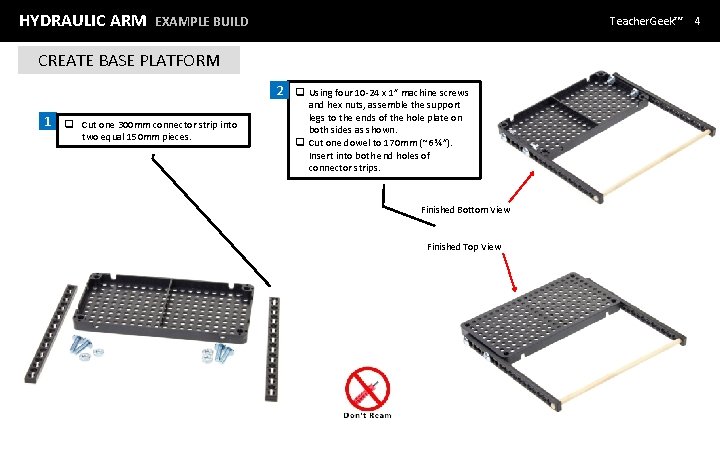
HYDRAULIC ARM EXAMPLE BUILD Teacher. Geek™ CREATE BASE PLATFORM 2 1 q Cut one 300 mm connector strip into two equal 150 mm pieces. q Using four 10 -24 x 1” machine screws and hex nuts, assemble the support legs to the ends of the hole plate on both sides as shown. q Cut one dowel to 170 mm (~6 ¾”). Insert into both end holes of connector strips. Finished Bottom View Finished Top View 4
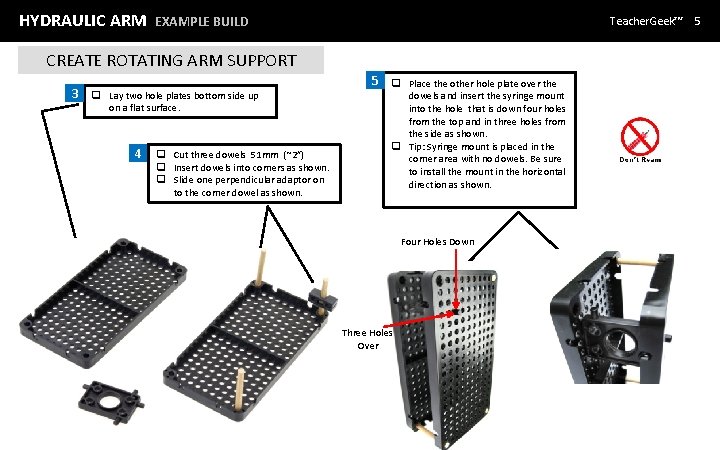
HYDRAULIC ARM EXAMPLE BUILD Teacher. Geek™ CREATE ROTATING ARM SUPPORT 3 5 q Lay two hole plates bottom side up on a flat surface. 4 q Cut three dowels 51 mm (~2”) q Insert dowels into corners as shown. q Slide one perpendicular adaptor on to the corner dowel as shown. q Place the other hole plate over the dowels and insert the syringe mount into the hole that is down four holes from the top and in three holes from the side as shown. q Tip: Syringe mount is placed in the corner area with no dowels. Be sure to install the mount in the horizontal direction as shown. Four Holes Down Three Holes Over 5

HYDRAULIC ARM EXAMPLE BUILD Teacher. Geek™ ATTACHING SWIVEL ARM SUPPORT TO BASE 6 q Place 10 -24 x 1” machine screw from the bottom of the base through the hole that is 9 holes over in the 2 nd as shown. Place two #10 washers over the bolt. 7 q Place the inside hole of the perpendicular adaptor that is mounted to the swivel arm support over the washers on the machine screw. 2 nd row 9 holes over 8 q Place 10 -24 locking hex nut on the screw and tighten. q Loosen the locking nut just enough so the swivel arm support can rotate freely. 6
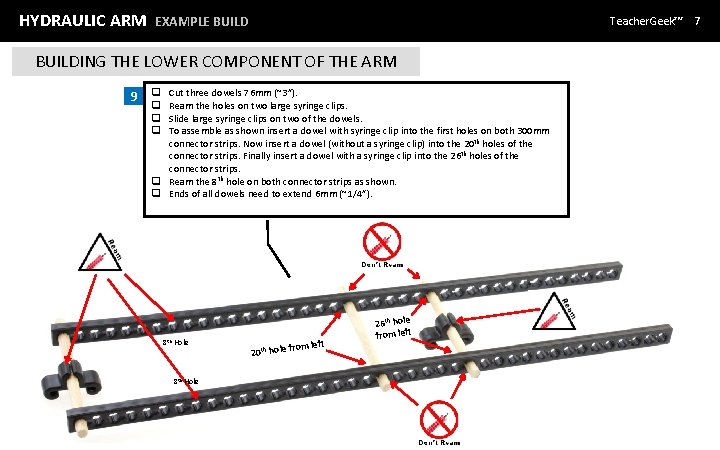
HYDRAULIC ARM EXAMPLE BUILD Teacher. Geek™ BUILDING THE LOWER COMPONENT OF THE ARM 9 Cut three dowels 76 mm (~3”). Ream the holes on two large syringe clips. Slide large syringe clips on two of the dowels. To assemble as shown insert a dowel with syringe clip into the first holes on both 300 mm connector strips. Now insert a dowel (without a syringe clip) into the 20 th holes of the connector strips. Finally insert a dowel with a syringe clip into the 26 th holes of the connector strips. q Ream the 8 th hole on both connector strips as shown. q Ends of all dowels need to extend 6 mm (~1/4”). q q 8 th Hole 20 th hole from left 26 th hole from left 7
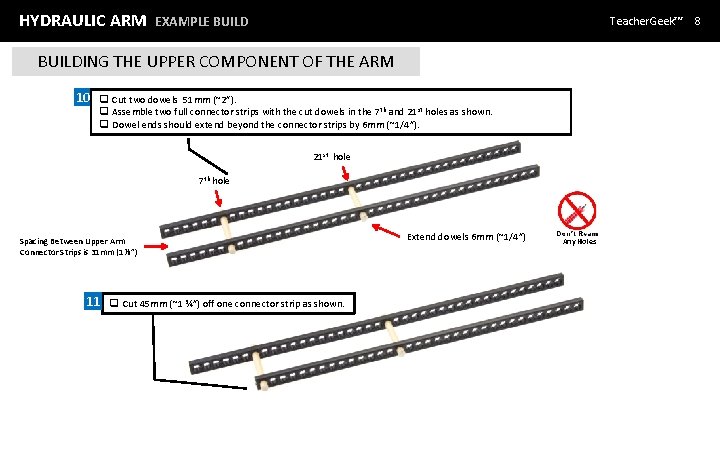
HYDRAULIC ARM EXAMPLE BUILD Teacher. Geek™ BUILDING THE UPPER COMPONENT OF THE ARM 10 q Cut two dowels 51 mm (~2”). q Assemble two full connector strips with the cut dowels in the 7 th and 21 st holes as shown. q Dowel ends should extend beyond the connector strips by 6 mm (~1/4”). 21 st hole 7 th hole Spacing Between Upper Arm Connector Strips is 31 mm (1 ¼”) 11 q Cut 45 mm (~1 ¾”) off one connector strip as shown. Extend dowels 6 mm (~1/4”) Any Holes 8

HYDRAULIC ARM EXAMPLE BUILD Teacher. Geek™ 9 JOINING THE LOWER AND UPPER ARM COMPONENTS 12 q Cut one dowel 90 mm (~3 1/2”). q Insert the 90 mm (3 1/2”) dowel through one reamed hole (8 th from end) of the lower arm section. Then into both of the unreamed 7 th holes of the upper arm component. Finally insert the dowel through the reamed hole of the lower arm component. q Spacing between the upper arm connector strips should be 31 mm (~1 ¼”). q Place Teacher Geek Clips on both ends of the dowel. Upper Arm Section 7 th Hole Lower Arm Section Spacing Between Upper Arm Connector Strips is 31 mm (1 ¼”) 8 th Hole Reamed Both Sides Lower Arm Section
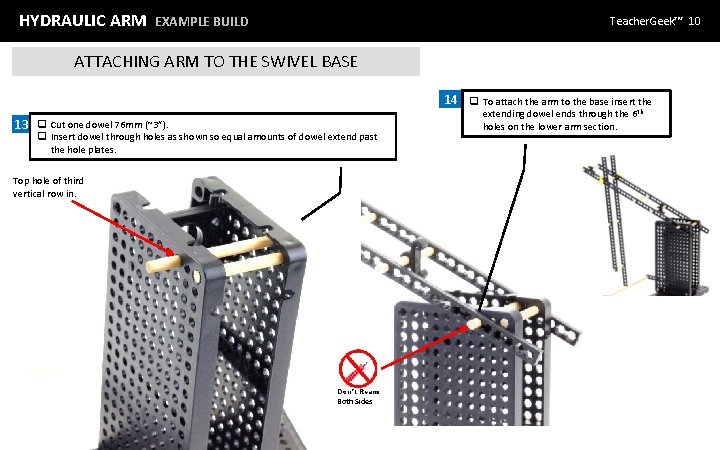
HYDRAULIC ARM EXAMPLE BUILD Teacher. Geek™ 10 ATTACHING ARM TO THE SWIVEL BASE 14 13 q Cut one dowel 76 mm (~3”). q Insert dowel through holes as shown so equal amounts of dowel extend past the hole plates. Top hole of third vertical row in. Both Sides q To attach the arm to the base insert the extending dowel ends through the 6 th holes on the lower arm section.

HYDRAULIC ARM EXAMPLE BUILD Teacher. Geek™ 11 INSTALLING 10 ML SYRINGE ON ARM 15 q Place syringe mount pins into the 3 rd hole from the end of the upper arm component. q Press 10 ml syringe into the syringe mount and slide the end of the syringe into the clip as shown. Syringe Mount Any Holes 3 rd Hole
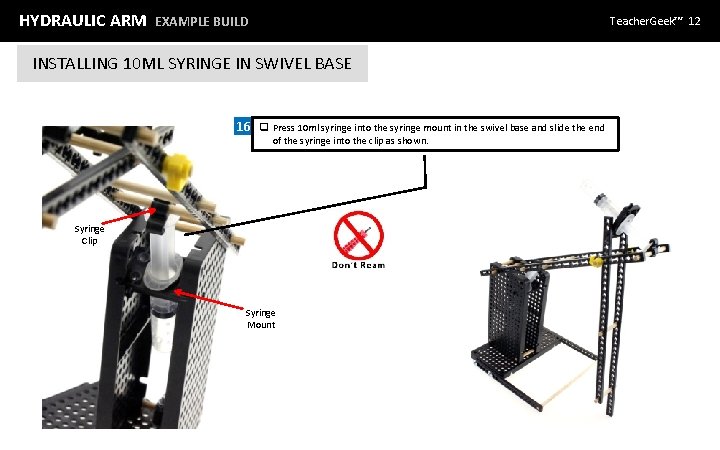
HYDRAULIC ARM EXAMPLE BUILD Teacher. Geek™ 12 INSTALLING 10 ML SYRINGE IN SWIVEL BASE 16 q Press 10 ml syringe into the syringe mount in the swivel base and slide the end of the syringe into the clip as shown. Syringe Clip Syringe Mount
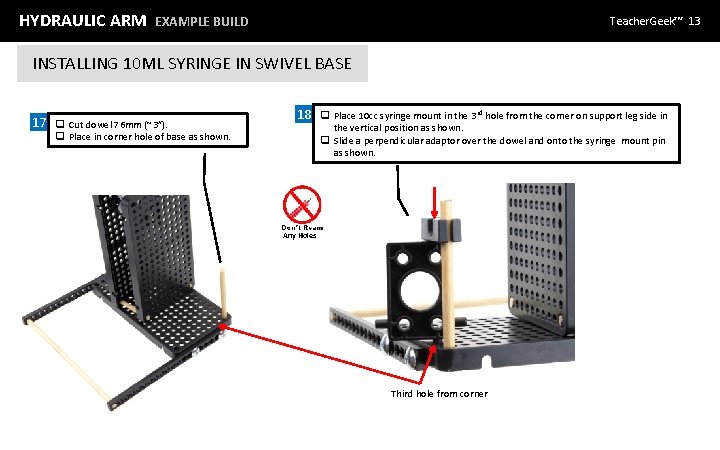
HYDRAULIC ARM EXAMPLE BUILD Teacher. Geek™ 13 INSTALLING 10 ML SYRINGE IN SWIVEL BASE 17 q Cut dowel 76 mm (~3”). q Place in corner hole of base as shown. 18 q Place 10 cc syringe mount in the 3 rd hole from the corner on support leg side in the vertical position as shown. q Slide a perpendicular adaptor over the dowel and onto the syringe mount pin as shown. Any Holes Third hole from corner

HYDRAULIC ARM EXAMPLE BUILD Teacher. Geek™ 14 INSTALLING 10 ML SYRINGE ON SWIVEL BASE 19 q Insert a 10 -24 x 1. 5” machine screw from the inside out in the 6 th hole up in the first vertical row as shown. q Install a 10 -24 hex nut and tighten to the hole plate. q Thread a 2 nd hex nut onto the machine screw leaving a 19 mm (~3/4”) space between the hex nuts. q Cut dowel 39 mm (~1 ½”) and insert into the center hole of a perpendicular adaptor. q Slide an end hole of the perpendicular adaptor on the machine screw so that it contacts the hex nut. q Install another 10 -24 hex nut and tighten securely on the perpendicular adaptor. 20 First vertical row 6 holes up Syringe Clip Hole q Ream a large syringe clip and slide over the end of a 10 ml syringe. q Press syringe into the syringe mount installed on the base and slide the reamed syringe clip up on to the dowel as shown.
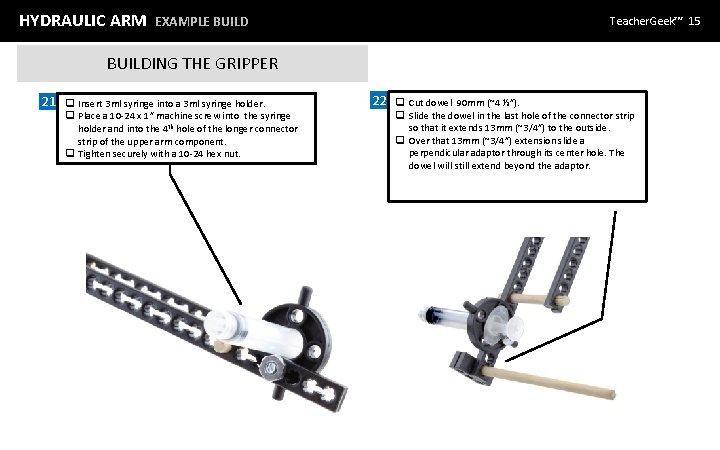
HYDRAULIC ARM EXAMPLE BUILD Teacher. Geek™ 15 BUILDING THE GRIPPER 21 q Insert 3 ml syringe into a 3 ml syringe holder. q Place a 10 -24 x 1” machine screw into the syringe holder and into the 4 th hole of the longer connector strip of the upper arm component. q Tighten securely with a 10 -24 hex nut. 22 q Cut dowel 90 mm (~4 ½”). q Slide the dowel in the last hole of the connector strip so that it extends 13 mm (~3/4”) to the outside. q Over that 13 mm (~3/4”) extension slide a perpendicular adaptor through its center hole. The dowel will still extend beyond the adaptor.
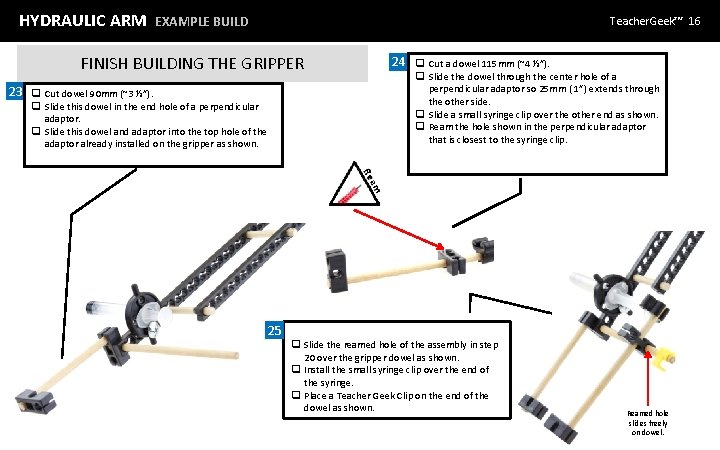
HYDRAULIC ARM EXAMPLE BUILD Teacher. Geek™ 16 FINISH BUILDING THE GRIPPER 23 q Cut dowel 90 mm (~3 ½”). q Slide this dowel in the end hole of a perpendicular adaptor. q Slide this dowel and adaptor into the top hole of the adaptor already installed on the gripper as shown. 25 24 q Cut a dowel 115 mm (~4 ½”). q Slide the dowel through the center hole of a perpendicular adaptor so 25 mm ( 1”) extends through the other side. q Slide a small syringe clip over the other end as shown. q Ream the hole shown in the perpendicular adaptor that is closest to the syringe clip. q Slide the reamed hole of the assembly in step 20 over the gripper dowel as shown. q Install the small syringe clip over the end of the syringe. q Place a Teacher Geek Clip on the end of the dowel as shown. Reamed hole slides freely on dowel.
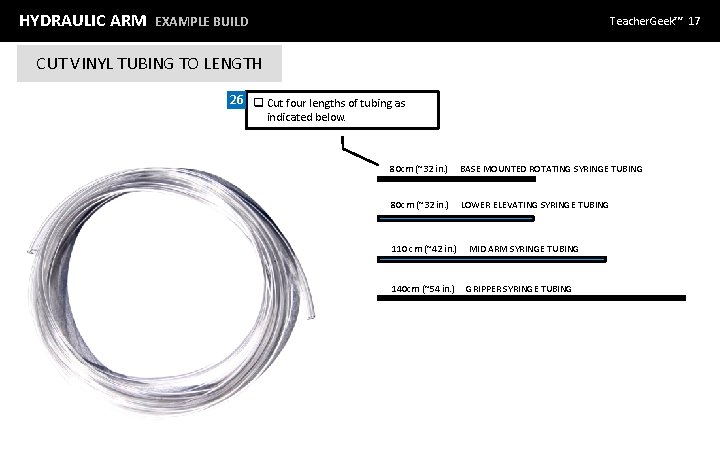
HYDRAULIC ARM EXAMPLE BUILD Teacher. Geek™ 17 CUT VINYL TUBING TO LENGTH 26 q Cut four lengths of tubing as indicated below. 80 cm (~32 in. ) BASE MOUNTED ROTATING SYRINGE TUBING 80 cm (~32 in. ) LOWER ELEVATING SYRINGE TUBING 110 cm (~42 in. ) MID ARM SYRINGE TUBING 140 cm (~54 in. ) GRIPPER SYRINGE TUBING
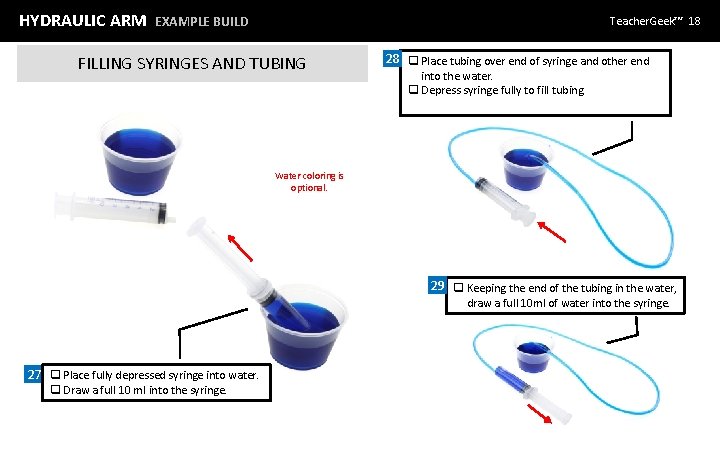
HYDRAULIC ARM EXAMPLE BUILD Teacher. Geek™ 18 FILLING SYRINGES AND TUBING 28 q Place tubing over end of syringe and other end into the water. q Depress syringe fully to fill tubing. Water coloring is optional. 29 q Keeping the end of the tubing in the water, draw a full 10 ml of water into the syringe. 27 q Place fully depressed syringe into water. q Draw a full 10 ml into the syringe.

HYDRAULIC ARM EXAMPLE BUILD Teacher. Geek™ 19 FILLING SYRINGES AND TUBING 30 Push the mounted syringe plunger all the way in as shown. 31 q Place end of filled tube on to the base mounted syringe. 32 q Push and pull the control syringe to rotate the rotating base.
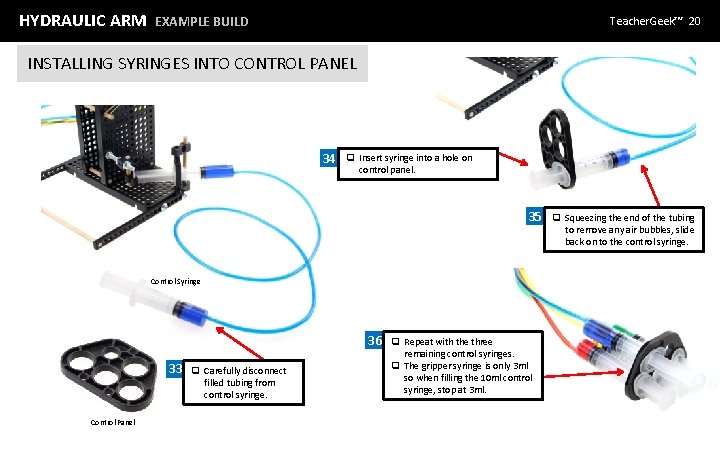
HYDRAULIC ARM EXAMPLE BUILD Teacher. Geek™ 20 INSTALLING SYRINGES INTO CONTROL PANEL 34 q Insert syringe into a hole on control panel. 35 Control Syringe 36 33 Control Panel q Carefully disconnect filled tubing from control syringe. q Repeat with the three remaining control syringes. q The gripper syringe is only 3 ml so when filling the 10 ml control syringe, stop at 3 ml. q Squeezing the end of the tubing to remove any air bubbles, slide back on to the control syringe.
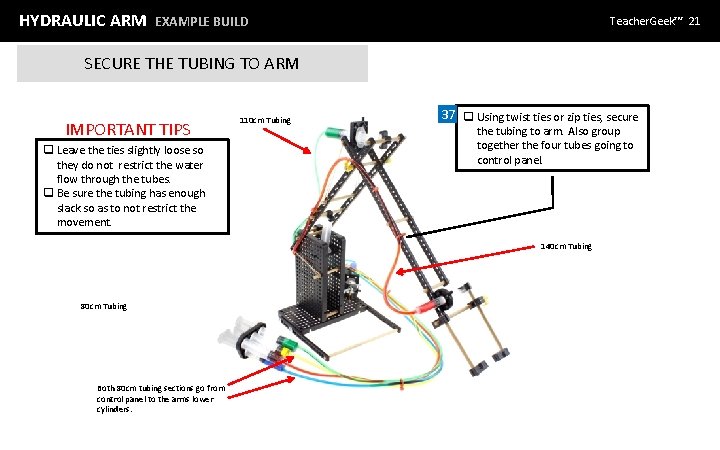
HYDRAULIC ARM EXAMPLE BUILD Teacher. Geek™ 21 SECURE THE TUBING TO ARM IMPORTANT TIPS q Leave the ties slightly loose so they do not restrict the water flow through the tubes. q Be sure the tubing has enough slack so as to not restrict the movement. 110 cm Tubing 37 q Using twist ties or zip ties, secure the tubing to arm. Also group together the four tubes going to control panel. 140 cm Tubing 80 cm Tubing Both 80 cm tubing sections go from control panel to the arms lower cylinders.

HYDRAULIC ARM EXAMPLE BUILD CREATING COUNTER BALANCE WITH RUBBER BANDS 38 q Loop rubber bands through the end of both upper arm connector strips. q Hook the other end of the rubber bands over the dowel extensions as shown. Teacher. Geek™ 22 39 q Loop rubber bands through the end of both lower arm connector strips. q Ream the 8 th hole down in the first vertical row of the hole plates (both sides). q Cut a 76 mm (~3”) dowel and insert into the reamed holes. q Hook the other end of the rubber bands over the dowel ends as shown. 8 th Hole Down
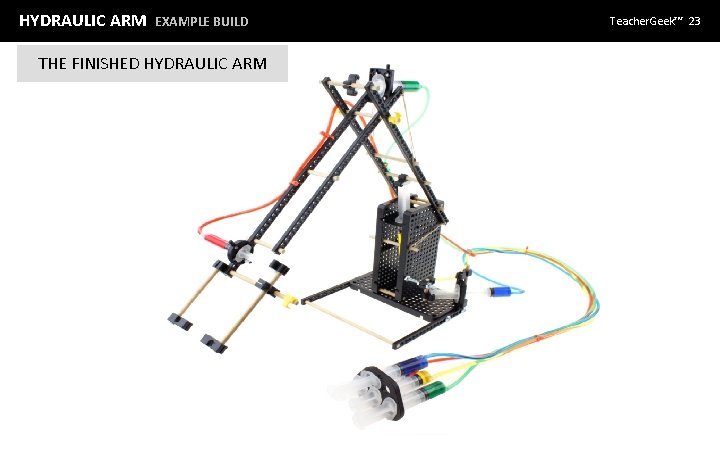
HYDRAULIC ARM EXAMPLE BUILD 3 THE FINISHED HYDRAULIC ARM Teacher. Geek™ 23
- Slides: 23