
Hydraulic and Pneumatic Systems Dr Gyrgy Pal 20052006

![Viscosity [mm 2/s] Hydraulic Systems Viscosity over temperature Temperature [C°] 2005/2006 I. Hydraulic and](https://slidetodoc.com/presentation_image_h/d8b144090ca7b531a96ee5145f1f3cc7/image-48.jpg "Viscosity [mm 2/s] Hydraulic Systems Viscosity over temperature Temperature [C°] 2005/2006 I. Hydraulic and")
- Slides: 59
Hydraulic and Pneumatic Systems Dr. György Paál 2005/2006 I. Hydraulic and Pneumatic Systems 1
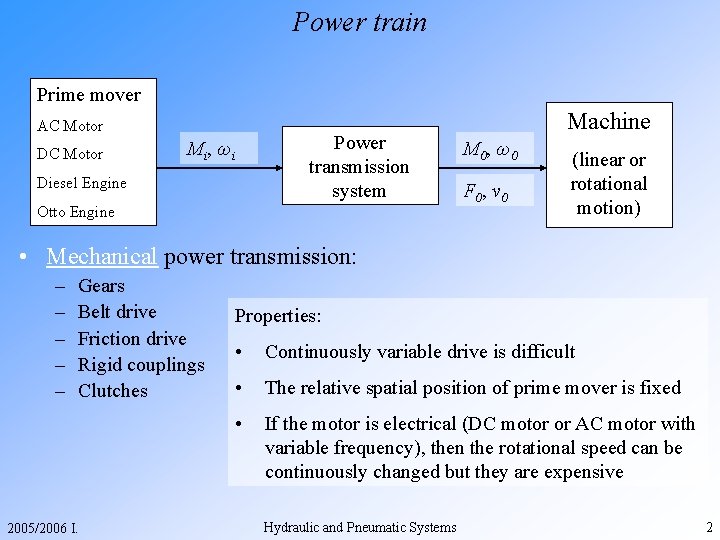
Power train Prime mover AC Motor DC Motor Mi, ωi Diesel Engine Power transmission system Otto Engine Machine M 0 , ω 0 F 0 , v 0 (linear or rotational motion) • Mechanical power transmission: – – – Gears Belt drive Friction drive Rigid couplings Clutches 2005/2006 I. Properties: • Continuously variable drive is difficult • The relative spatial position of prime mover is fixed • If the motor is electrical (DC motor or AC motor with variable frequency), then the rotational speed can be continuously changed but they are expensive Hydraulic and Pneumatic Systems 2
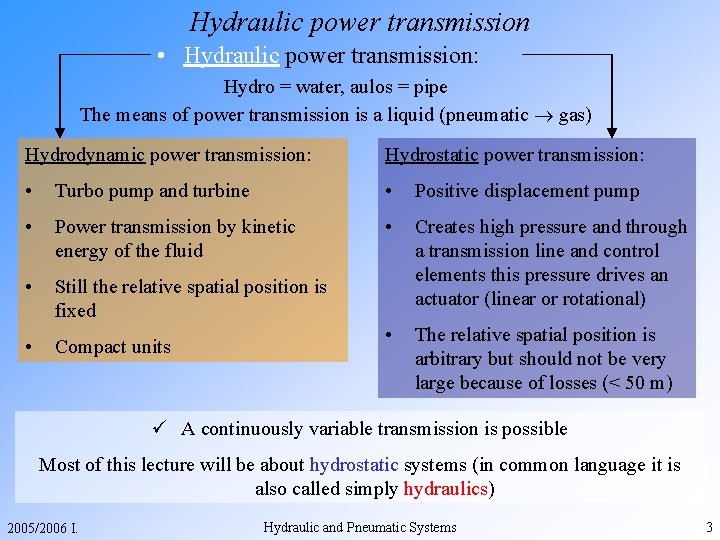
Hydraulic power transmission • Hydraulic power transmission: Hydro = water, aulos = pipe The means of power transmission is a liquid (pneumatic gas) Hydrodynamic power transmission: Hydrostatic power transmission: • Turbo pump and turbine • Positive displacement pump • Power transmission by kinetic energy of the fluid • • Still the relative spatial position is fixed Creates high pressure and through a transmission line and control elements this pressure drives an actuator (linear or rotational) • Compact units • The relative spatial position is arbitrary but should not be very large because of losses (< 50 m) ü A continuously variable transmission is possible Most of this lecture will be about hydrostatic systems (in common language it is also called simply hydraulics) 2005/2006 I. Hydraulic and Pneumatic Systems 3
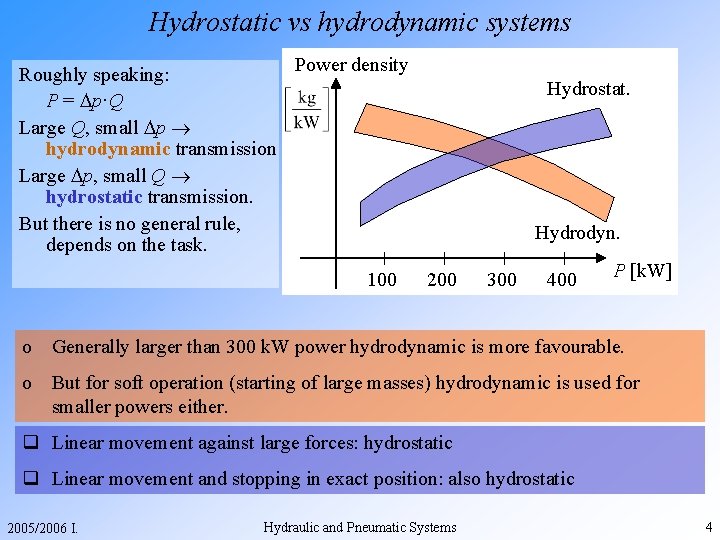
Hydrostatic vs hydrodynamic systems Roughly speaking: P = p·Q Large Q, small p hydrodynamic transmission Large p, small Q hydrostatic transmission. But there is no general rule, depends on the task. Power density Hydrostat. Hydrodyn. 100 200 300 400 P [k. W] o Generally larger than 300 k. W power hydrodynamic is more favourable. o But for soft operation (starting of large masses) hydrodynamic is used for smaller powers either. q Linear movement against large forces: hydrostatic q Linear movement and stopping in exact position: also hydrostatic 2005/2006 I. Hydraulic and Pneumatic Systems 4
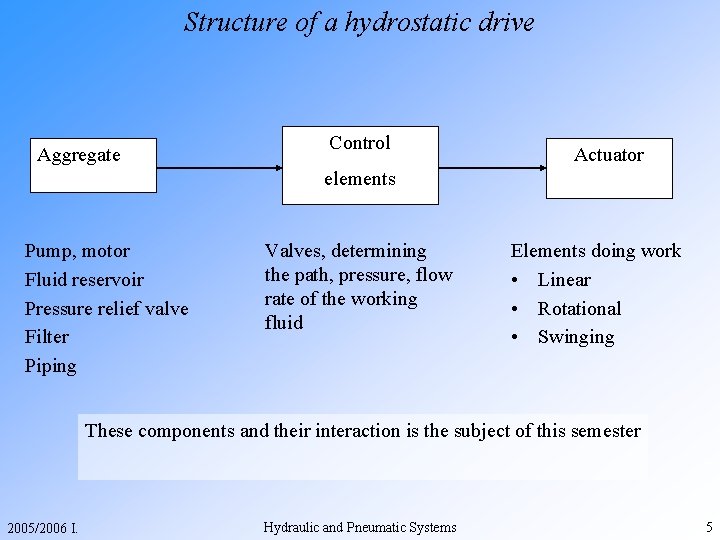
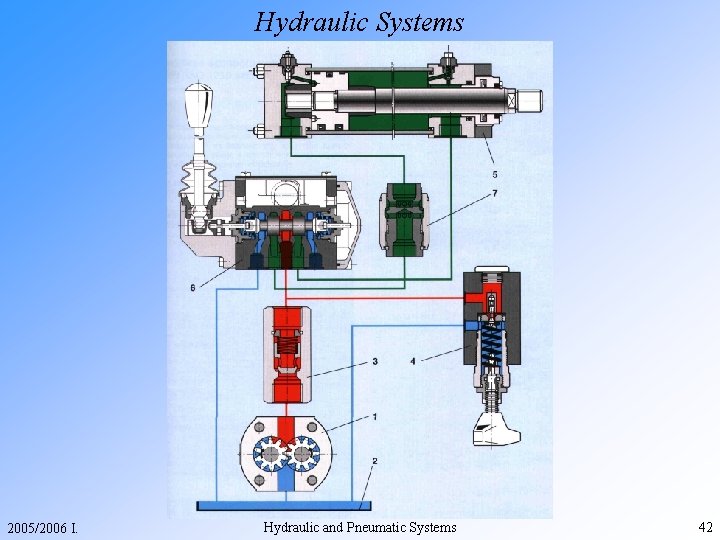
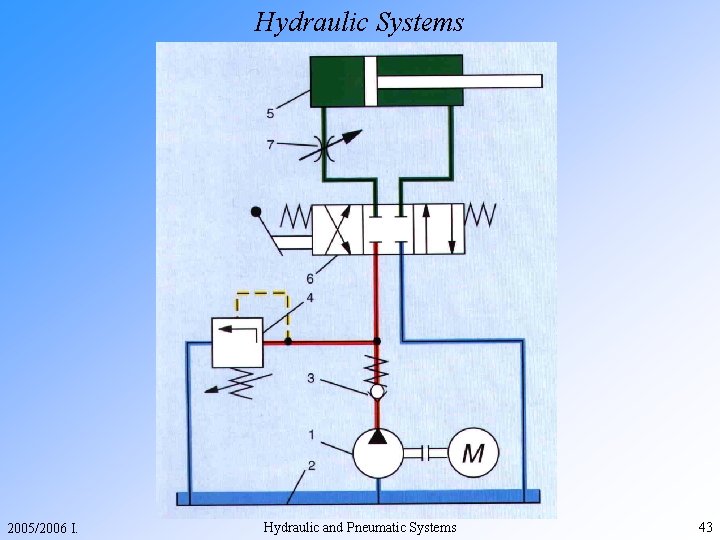
Structure of a hydrostatic drive Aggregate Control Actuator elements Pump, motor Fluid reservoir Pressure relief valve Filter Piping Valves, determining the path, pressure, flow rate of the working fluid Elements doing work • Linear • Rotational • Swinging These components and their interaction is the subject of this semester 2005/2006 I. Hydraulic and Pneumatic Systems 5
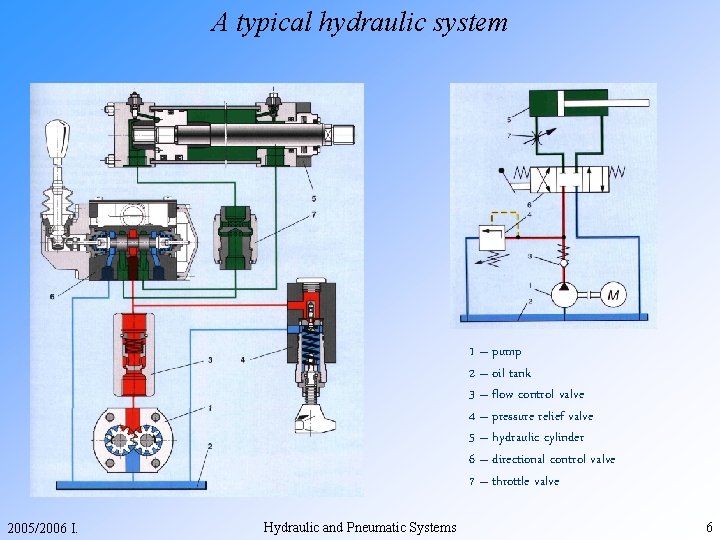
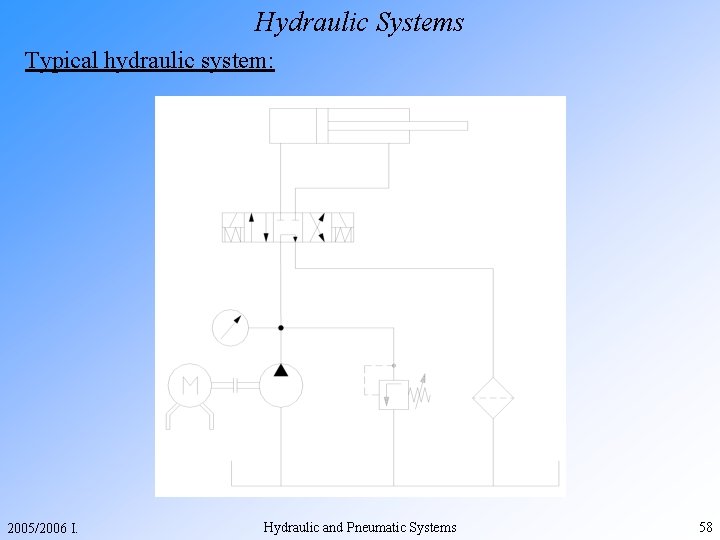
A typical hydraulic system 1 – pump 2 – oil tank 3 – flow control valve 4 – pressure relief valve 5 – hydraulic cylinder 6 – directional control valve 7 – throttle valve 2005/2006 I. Hydraulic and Pneumatic Systems 6
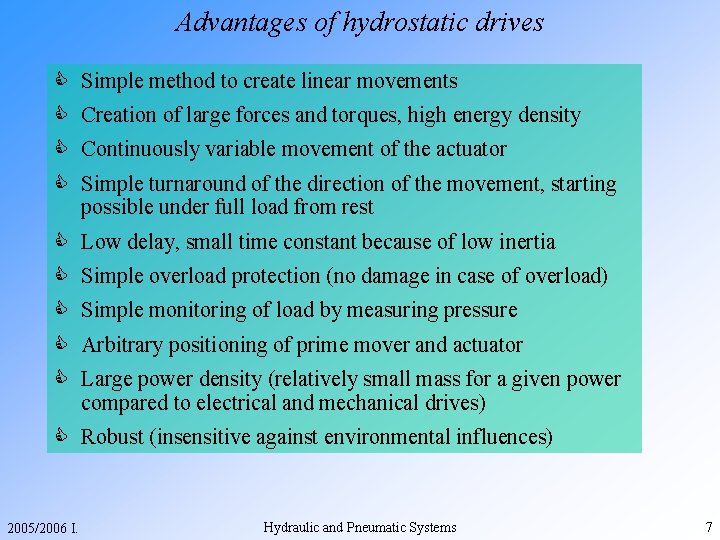
Advantages of hydrostatic drives C Simple method to create linear movements C Creation of large forces and torques, high energy density C Continuously variable movement of the actuator C Simple turnaround of the direction of the movement, starting possible under full load from rest C Low delay, small time constant because of low inertia C Simple overload protection (no damage in case of overload) C Simple monitoring of load by measuring pressure C Arbitrary positioning of prime mover and actuator C Large power density (relatively small mass for a given power compared to electrical and mechanical drives) C Robust (insensitive against environmental influences) 2005/2006 I. Hydraulic and Pneumatic Systems 7
Disadvantages of hydrostatic drives D Working fluid is necessary (leakage problems, filtering, etc. ) D It is not economic for large distances 2005/2006 I. Hydraulic and Pneumatic Systems 8
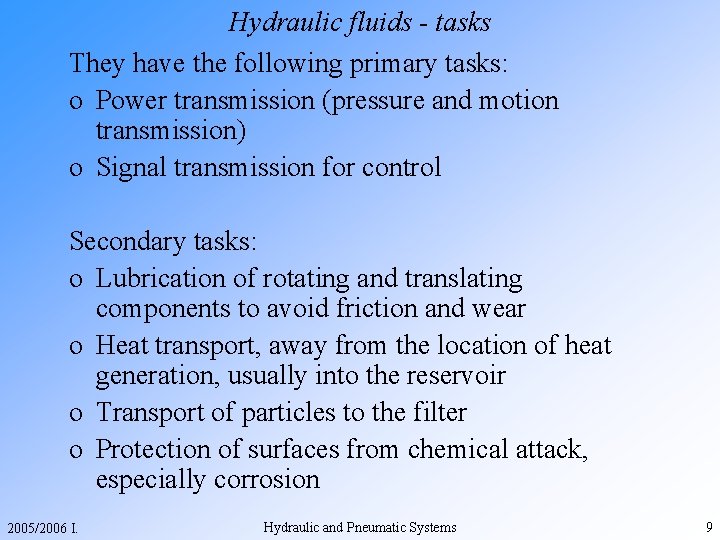
Hydraulic fluids - tasks They have the following primary tasks: o Power transmission (pressure and motion transmission) o Signal transmission for control Secondary tasks: o Lubrication of rotating and translating components to avoid friction and wear o Heat transport, away from the location of heat generation, usually into the reservoir o Transport of particles to the filter o Protection of surfaces from chemical attack, especially corrosion 2005/2006 I. Hydraulic and Pneumatic Systems 9
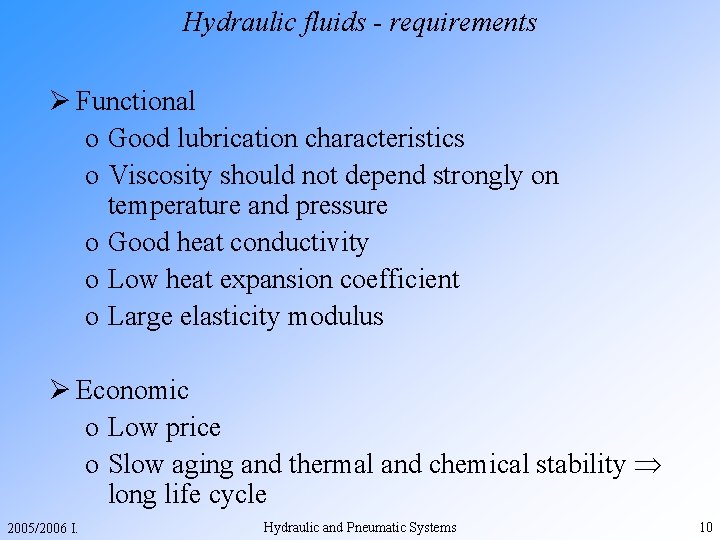
Hydraulic fluids - requirements Ø Functional o Good lubrication characteristics o Viscosity should not depend strongly on temperature and pressure o Good heat conductivity o Low heat expansion coefficient o Large elasticity modulus Ø Economic o Low price o Slow aging and thermal and chemical stability long life cycle 2005/2006 I. Hydraulic and Pneumatic Systems 10
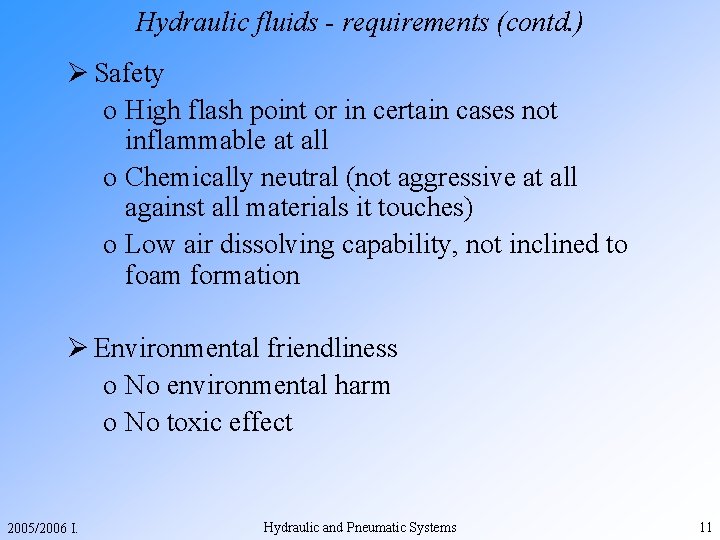
Hydraulic fluids - requirements (contd. ) Ø Safety o High flash point or in certain cases not inflammable at all o Chemically neutral (not aggressive at all against all materials it touches) o Low air dissolving capability, not inclined to foam formation Ø Environmental friendliness o No environmental harm o No toxic effect 2005/2006 I. Hydraulic and Pneumatic Systems 11
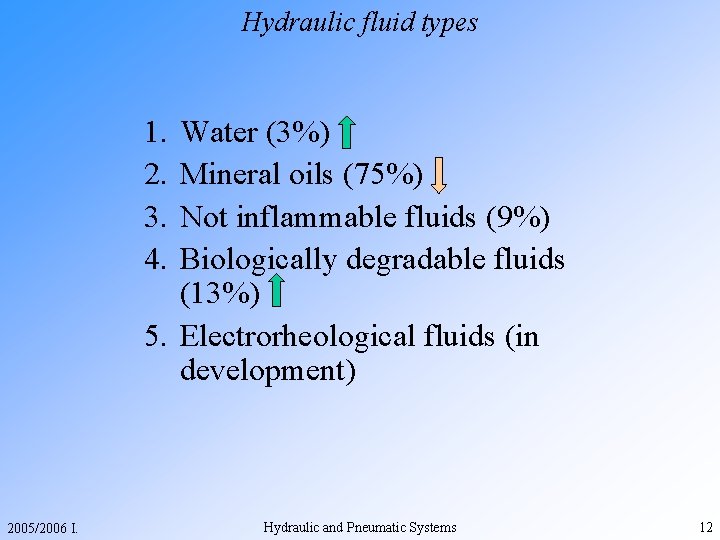
Hydraulic fluid types 1. 2. 3. 4. Water (3%) Mineral oils (75%) Not inflammable fluids (9%) Biologically degradable fluids (13%) 5. Electrorheological fluids (in development) 2005/2006 I. Hydraulic and Pneumatic Systems 12
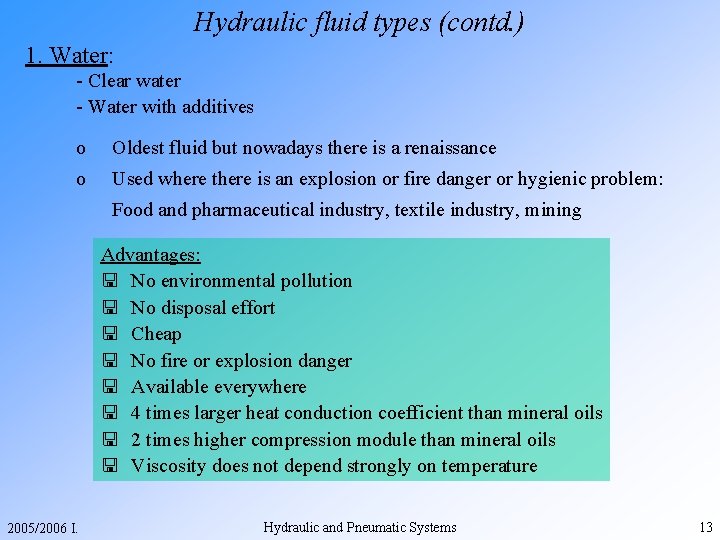
Hydraulic fluid types (contd. ) 1. Water: - Clear water - Water with additives o Oldest fluid but nowadays there is a renaissance o Used where there is an explosion or fire danger or hygienic problem: Food and pharmaceutical industry, textile industry, mining Advantages: < No environmental pollution < No disposal effort < Cheap < No fire or explosion danger < Available everywhere < 4 times larger heat conduction coefficient than mineral oils < 2 times higher compression module than mineral oils < Viscosity does not depend strongly on temperature 2005/2006 I. Hydraulic and Pneumatic Systems 13
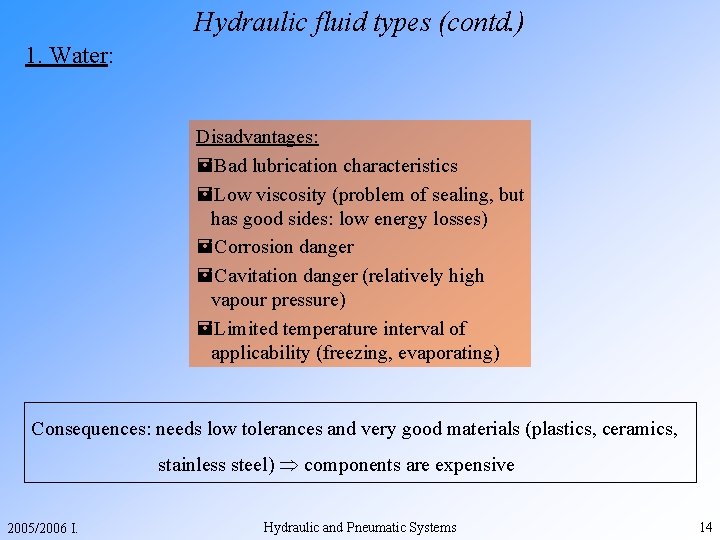
Hydraulic fluid types (contd. ) 1. Water: Disadvantages: =Bad lubrication characteristics =Low viscosity (problem of sealing, but has good sides: low energy losses) =Corrosion danger =Cavitation danger (relatively high vapour pressure) =Limited temperature interval of applicability (freezing, evaporating) Consequences: needs low tolerances and very good materials (plastics, ceramics, stainless steel) components are expensive 2005/2006 I. Hydraulic and Pneumatic Systems 14
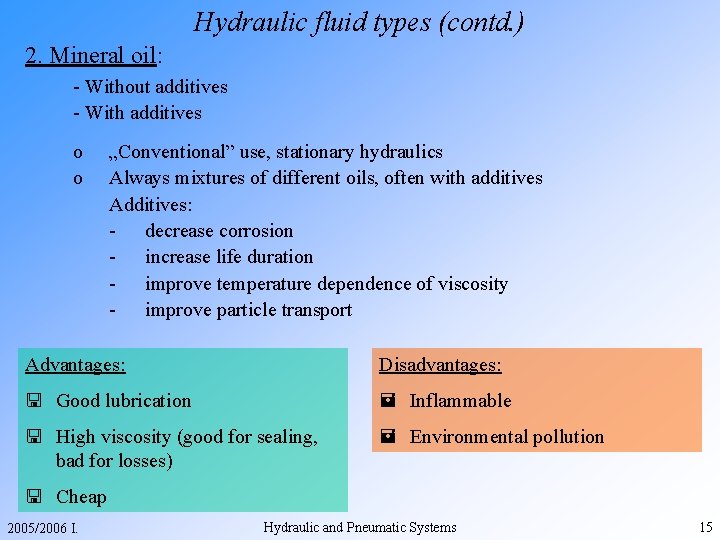
Hydraulic fluid types (contd. ) 2. Mineral oil: - Without additives - With additives o o „Conventional” use, stationary hydraulics Always mixtures of different oils, often with additives Additives: - decrease corrosion - increase life duration - improve temperature dependence of viscosity - improve particle transport Advantages: Disadvantages: < Good lubrication = Inflammable < High viscosity (good for sealing, bad for losses) = Environmental pollution < Cheap 2005/2006 I. Hydraulic and Pneumatic Systems 15
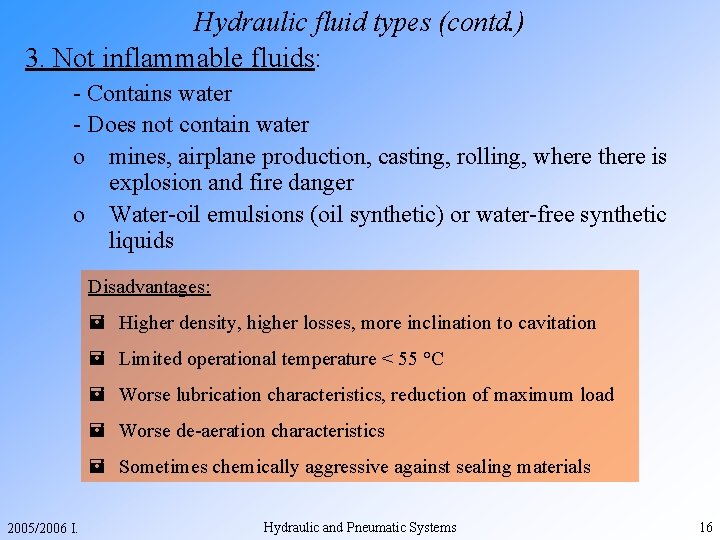
Hydraulic fluid types (contd. ) 3. Not inflammable fluids: - Contains water - Does not contain water o mines, airplane production, casting, rolling, where there is explosion and fire danger o Water-oil emulsions (oil synthetic) or water-free synthetic liquids Disadvantages: = Higher density, higher losses, more inclination to cavitation = Limited operational temperature < 55 °C = Worse lubrication characteristics, reduction of maximum load = Worse de-aeration characteristics = Sometimes chemically aggressive against sealing materials 2005/2006 I. Hydraulic and Pneumatic Systems 16
Hydraulic fluid types (contd. ) 4. Biologically degradable fluids: - Natural - Synthetic o Environmental protection, water protection o Agricultural machines o Mobile hydraulics Characteristics similar to mineral oils but much more expensive. If the trend continues its usage expands, price will drop. 2005/2006 I. Hydraulic and Pneumatic Systems 17
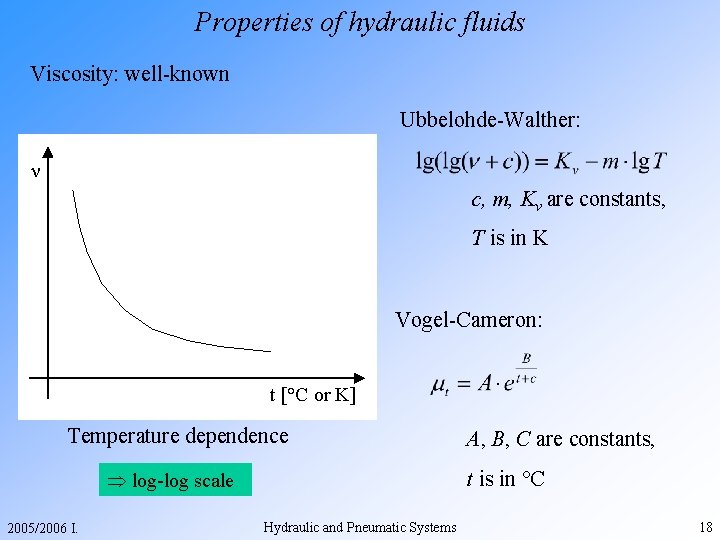
Properties of hydraulic fluids Viscosity: well-known Ubbelohde-Walther: ν c, m, Kv are constants, T is in K Vogel-Cameron: t [°C or K] Temperature dependence t is in °C log-log scale 2005/2006 I. A, B, C are constants, Hydraulic and Pneumatic Systems 18
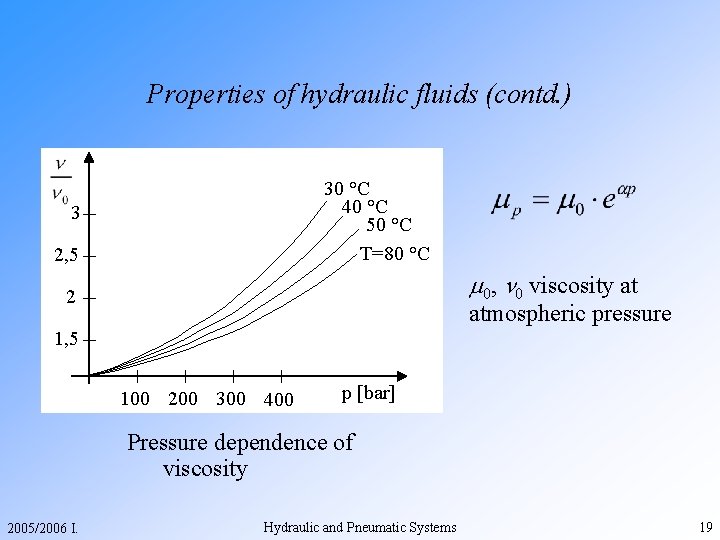
Properties of hydraulic fluids (contd. ) 30 °C 40 °C 50 °C T=80 °C 3 2, 5 0, 0 viscosity at 2 atmospheric pressure 1, 5 100 200 300 400 p [bar] Pressure dependence of viscosity 2005/2006 I. Hydraulic and Pneumatic Systems 19
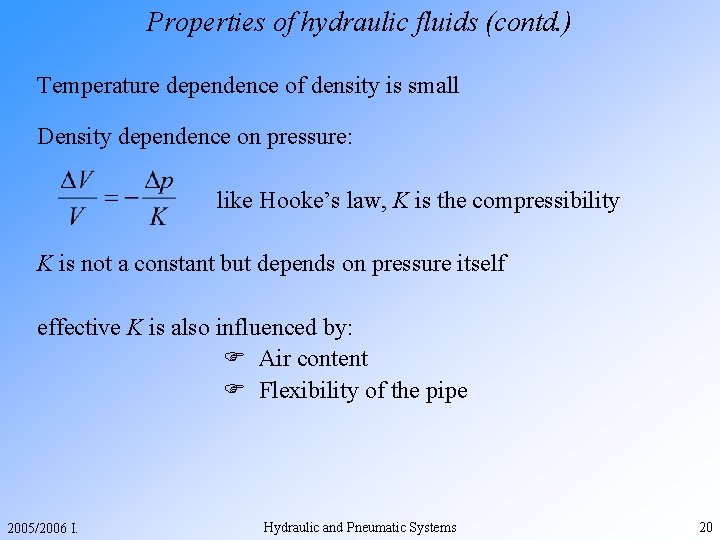
Properties of hydraulic fluids (contd. ) Temperature dependence of density is small Density dependence on pressure: like Hooke’s law, K is the compressibility K is not a constant but depends on pressure itself effective K is also influenced by: F Air content F Flexibility of the pipe 2005/2006 I. Hydraulic and Pneumatic Systems 20
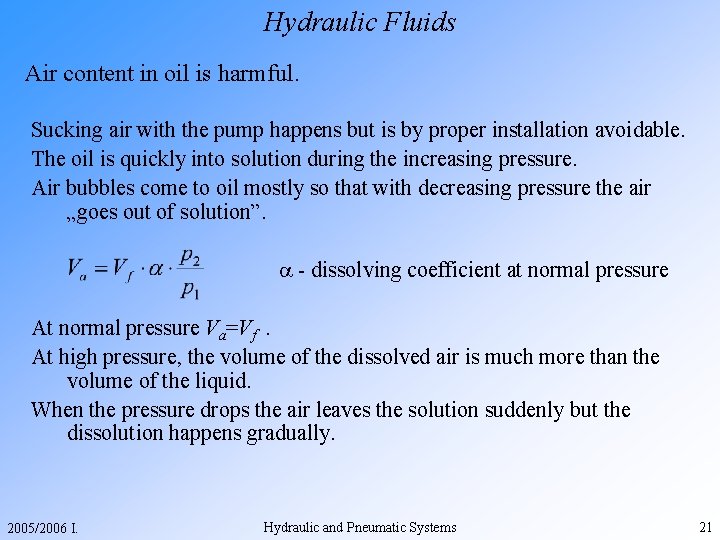
Hydraulic Fluids Air content in oil is harmful. Sucking air with the pump happens but is by proper installation avoidable. The oil is quickly into solution during the increasing pressure. Air bubbles come to oil mostly so that with decreasing pressure the air „goes out of solution”. - dissolving coefficient at normal pressure At normal pressure Va=Vf. At high pressure, the volume of the dissolved air is much more than the volume of the liquid. When the pressure drops the air leaves the solution suddenly but the dissolution happens gradually. 2005/2006 I. Hydraulic and Pneumatic Systems 21
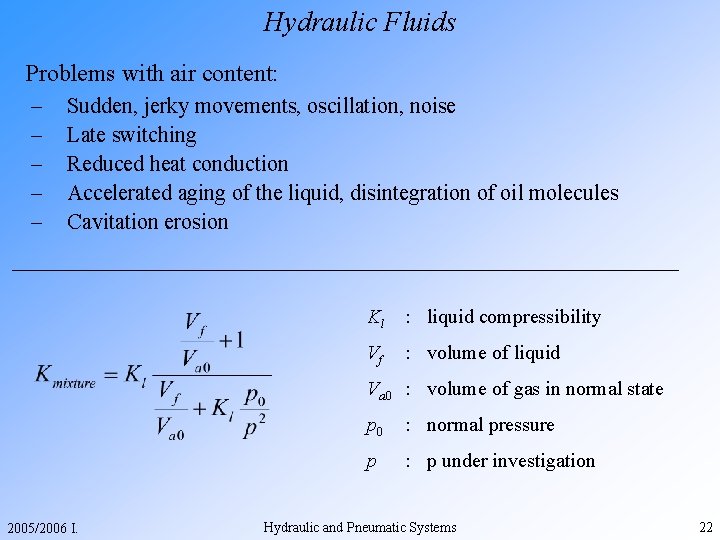
Hydraulic Fluids Problems with air content: – – – Sudden, jerky movements, oscillation, noise Late switching Reduced heat conduction Accelerated aging of the liquid, disintegration of oil molecules Cavitation erosion Kl : liquid compressibility Vf : volume of liquid Va 0 : volume of gas in normal state 2005/2006 I. p 0 : normal pressure p : p under investigation Hydraulic and Pneumatic Systems 22
Hydraulic Fluids The manufacturer specifies the characteristics of the required liquid and the duration of usage. Before filling in the new oil, the rig has to be washed with oil. Never mix old and new oil! 2005/2006 I. Hydraulic and Pneumatic Systems 23
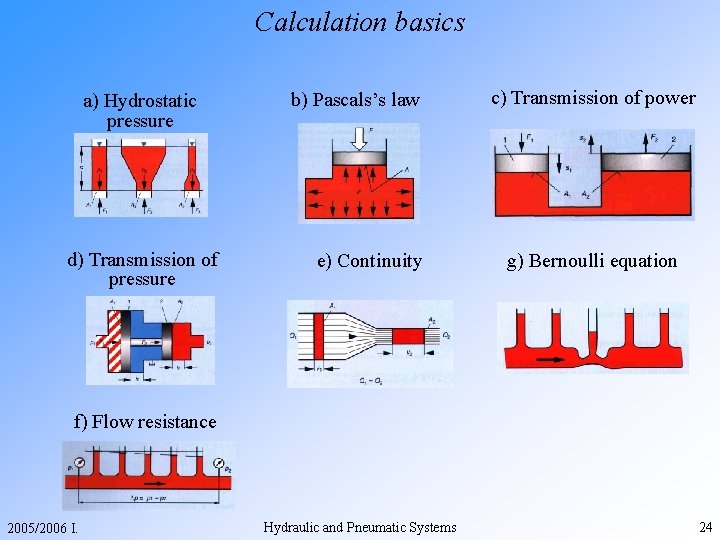
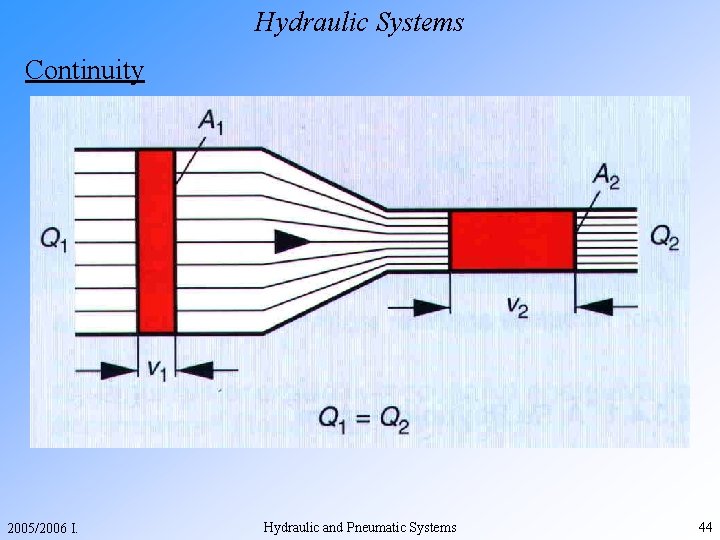
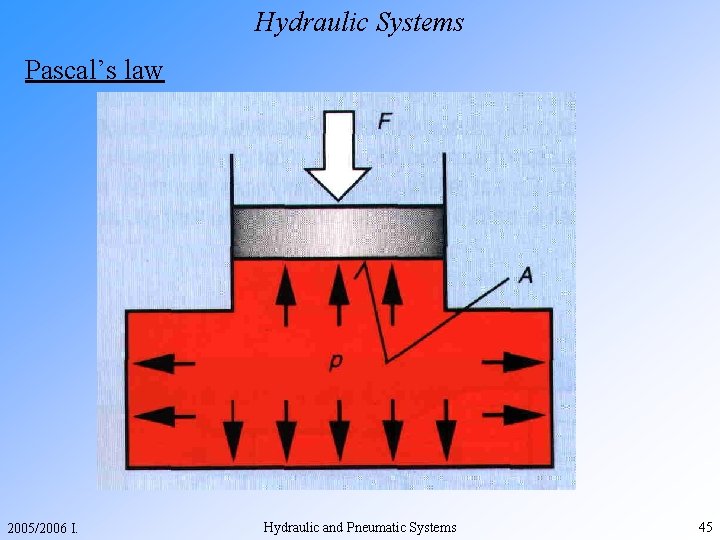
Calculation basics a) Hydrostatic pressure d) Transmission of pressure b) Pascals’s law e) Continuity c) Transmission of power g) Bernoulli equation f) Flow resistance 2005/2006 I. Hydraulic and Pneumatic Systems 24
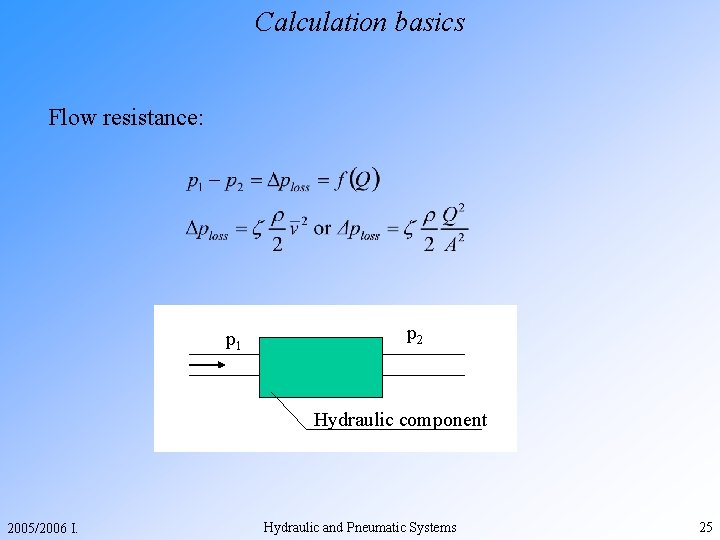
Calculation basics Flow resistance: p 1 p 2 Hydraulic component 2005/2006 I. Hydraulic and Pneumatic Systems 25
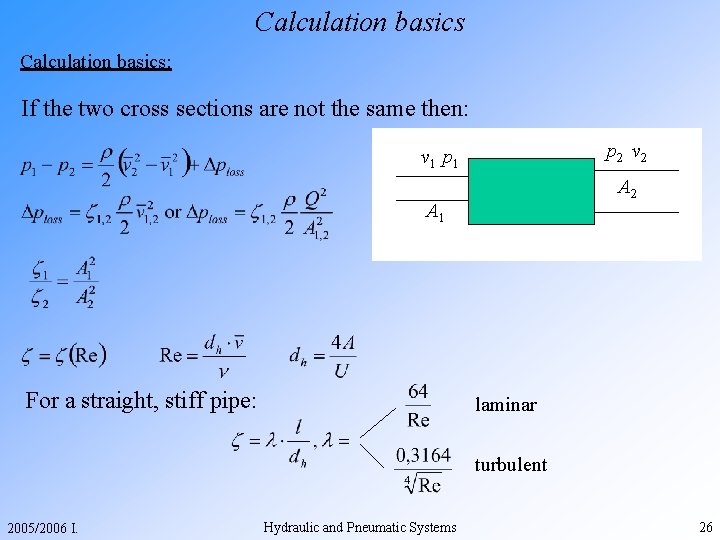
Calculation basics: If the two cross sections are not the same then: p 2 v 1 p 1 A 2 A 1 For a straight, stiff pipe: laminar turbulent 2005/2006 I. Hydraulic and Pneumatic Systems 26
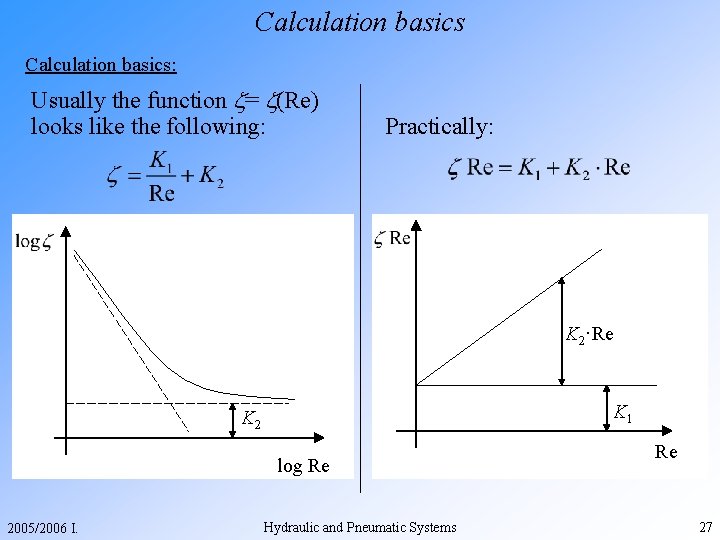
Calculation basics: Usually the function = (Re) looks like the following: Practically: K 2·Re K 1 K 2 log Re 2005/2006 I. Hydraulic and Pneumatic Systems Re 27
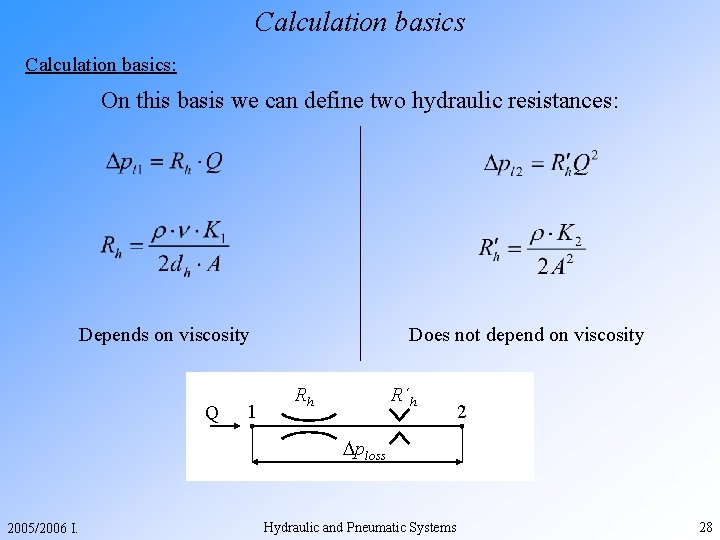
Calculation basics: On this basis we can define two hydraulic resistances: Depends on viscosity Q 1 Does not depend on viscosity Rh R´h 2 ploss 2005/2006 I. Hydraulic and Pneumatic Systems 28
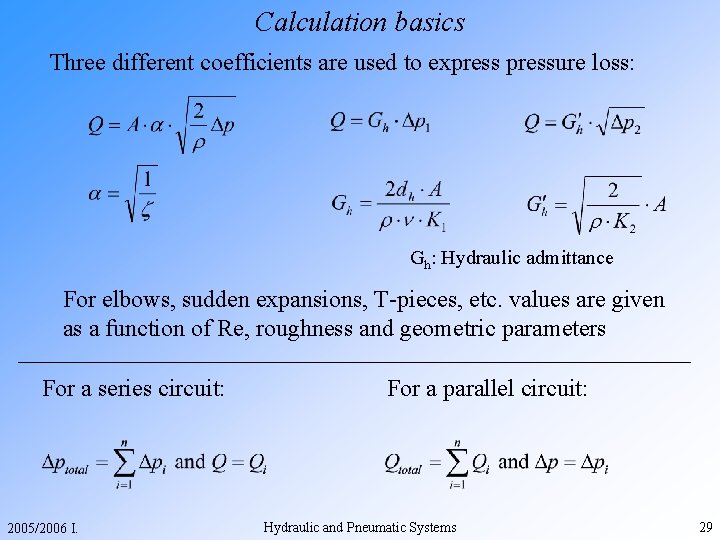
Calculation basics Three different coefficients are used to expressure loss: Gh: Hydraulic admittance For elbows, sudden expansions, T-pieces, etc. values are given as a function of Re, roughness and geometric parameters For a series circuit: 2005/2006 I. For a parallel circuit: Hydraulic and Pneumatic Systems 29
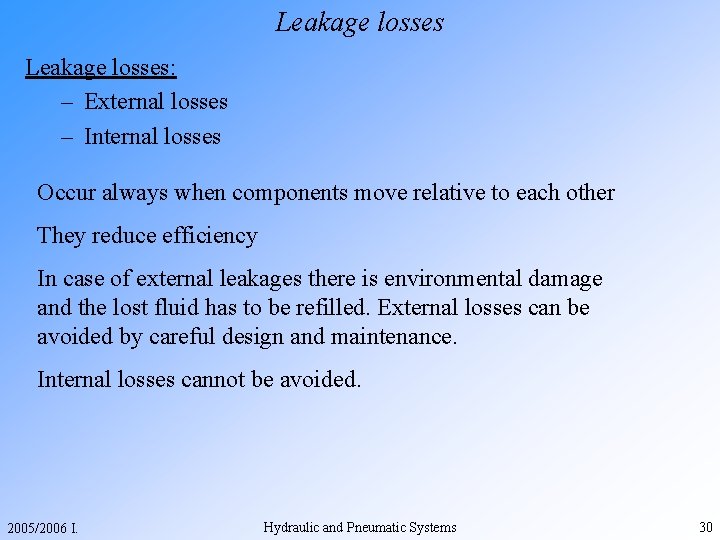
Leakage losses: – External losses – Internal losses Occur always when components move relative to each other They reduce efficiency In case of external leakages there is environmental damage and the lost fluid has to be refilled. External losses can be avoided by careful design and maintenance. Internal losses cannot be avoided. 2005/2006 I. Hydraulic and Pneumatic Systems 30
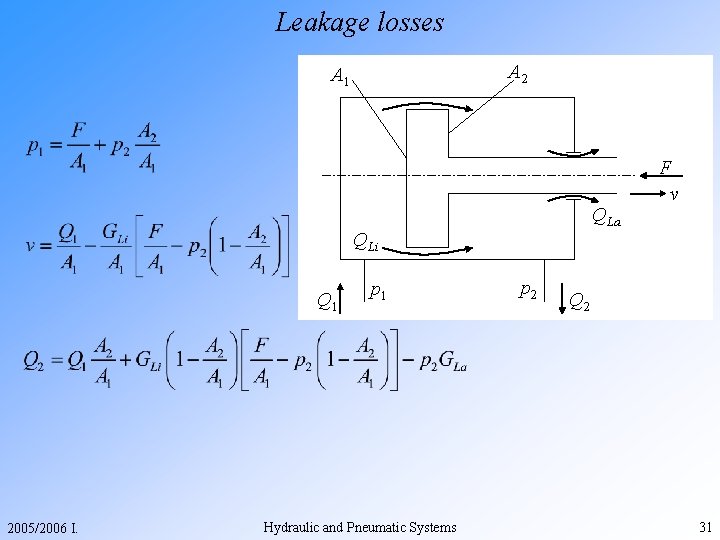
Leakage losses A 2 A 1 QLa QLi Q 1 2005/2006 I. p 1 Hydraulic and Pneumatic Systems p 2 F v Q 2 31
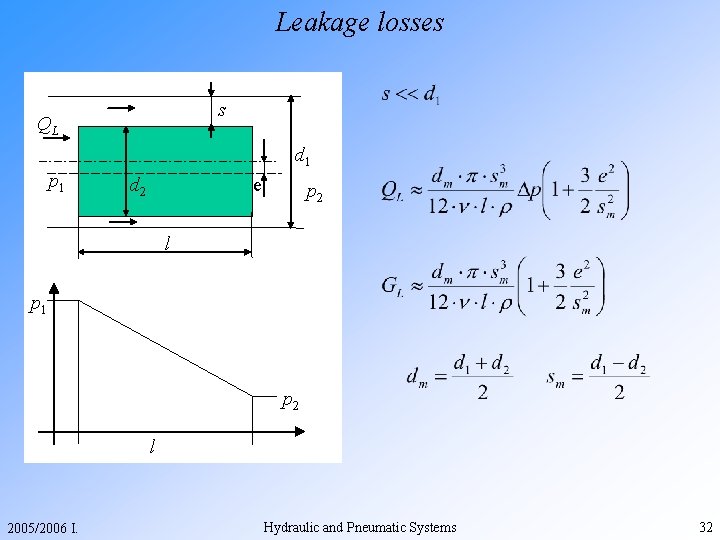
Leakage losses s QL d 1 p 1 d 2 e p 2 l p 1 p 2 l 2005/2006 I. Hydraulic and Pneumatic Systems 32
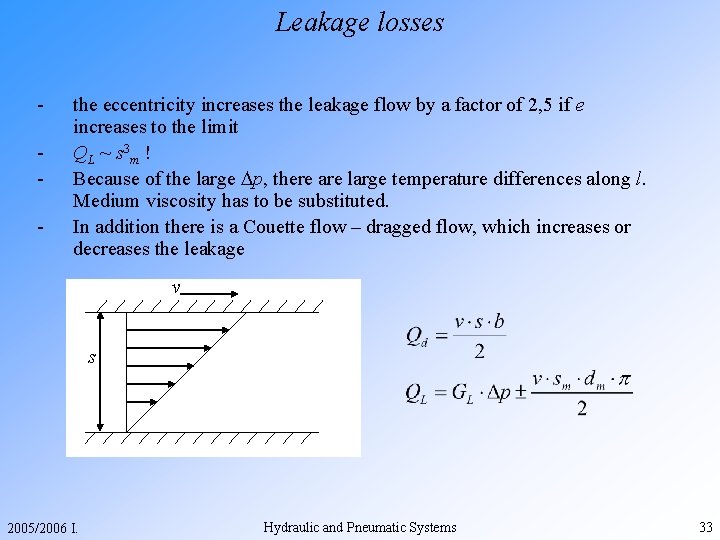
Leakage losses - the eccentricity increases the leakage flow by a factor of 2, 5 if e increases to the limit QL ~ s 3 m ! Because of the large p, there are large temperature differences along l. Medium viscosity has to be substituted. In addition there is a Couette flow – dragged flow, which increases or decreases the leakage v s 2005/2006 I. Hydraulic and Pneumatic Systems 33
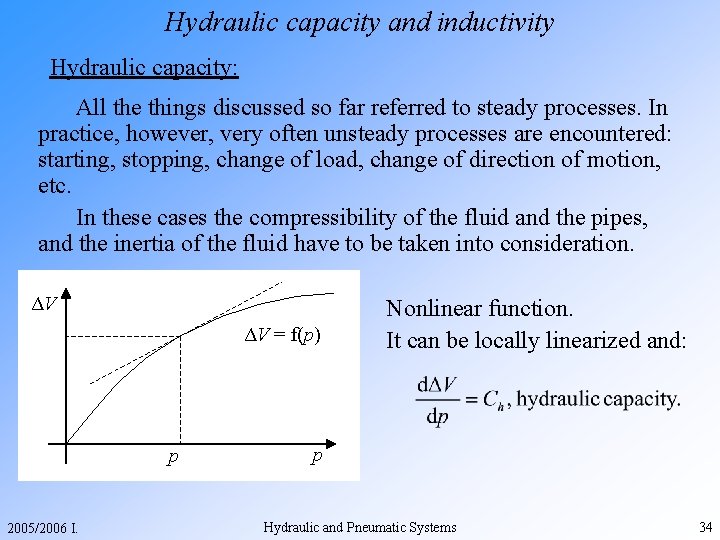
Hydraulic capacity and inductivity Hydraulic capacity: All the things discussed so far referred to steady processes. In practice, however, very often unsteady processes are encountered: starting, stopping, change of load, change of direction of motion, etc. In these cases the compressibility of the fluid and the pipes, and the inertia of the fluid have to be taken into consideration. ΔV ΔV = f(p) p 2005/2006 I. Nonlinear function. It can be locally linearized and: p Hydraulic and Pneumatic Systems 34
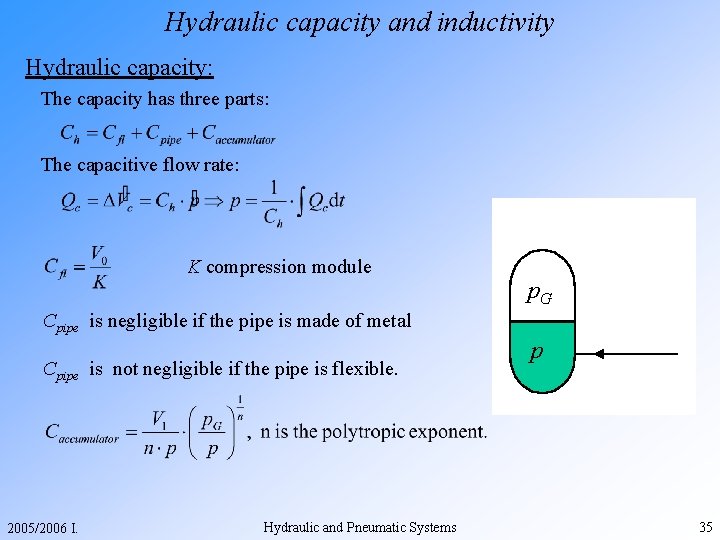
Hydraulic capacity and inductivity Hydraulic capacity: The capacity has three parts: The capacitive flow rate: K compression module p. G Cpipe is negligible if the pipe is made of metal Cpipe is not negligible if the pipe is flexible. 2005/2006 I. Hydraulic and Pneumatic Systems p 35
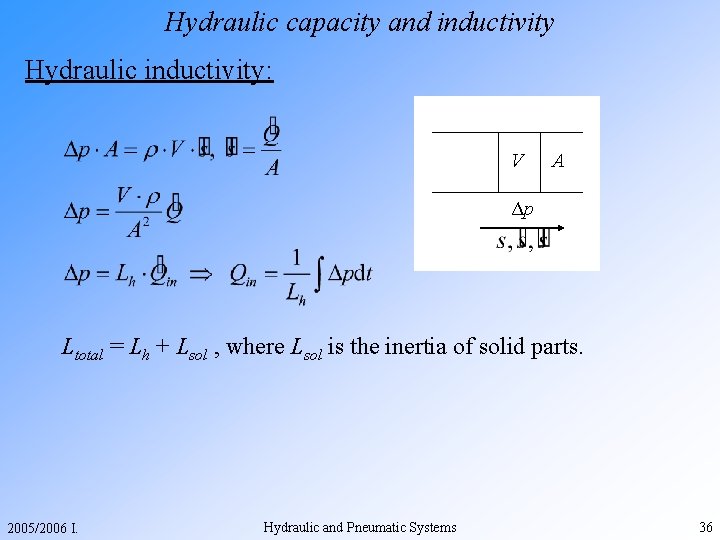
Hydraulic capacity and inductivity Hydraulic inductivity: V A Δp Ltotal = Lh + Lsol , where Lsol is the inertia of solid parts. 2005/2006 I. Hydraulic and Pneumatic Systems 36
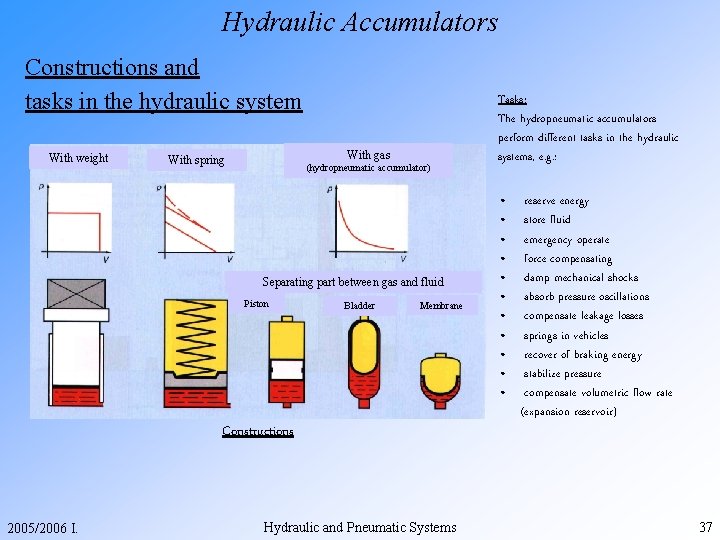
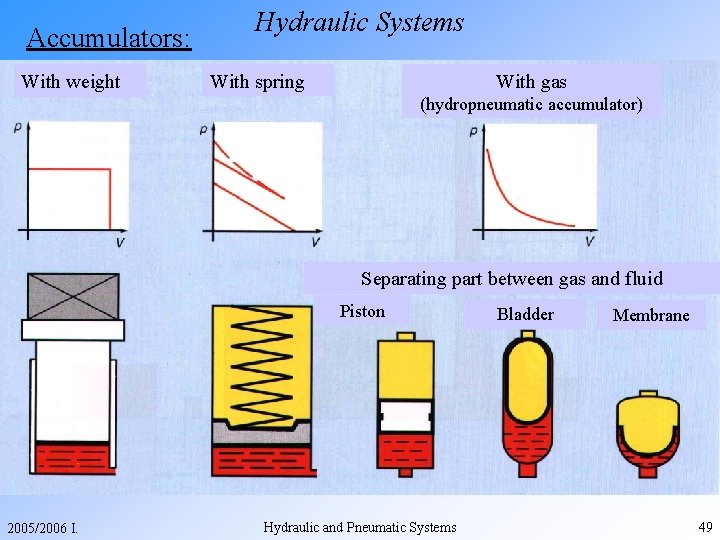
Hydraulic Accumulators Constructions and tasks in the hydraulic system With weight With gas With spring (hydropneumatic accumulator) Separating part between gas and fluid Piston Bladder Membrane Constructions 2005/2006 I. Hydraulic and Pneumatic Systems Tasks: The hydropneumatic accumulators perform different tasks in the hydraulic systems, e. g. : • • • reserve energy store fluid emergency operate force compensating damp mechanical shocks absorb pressure oscillations compensate leakage losses springs in vehicles recover of braking energy stabilize pressure compensate volumetric flow rate (expansion reservoir) 37
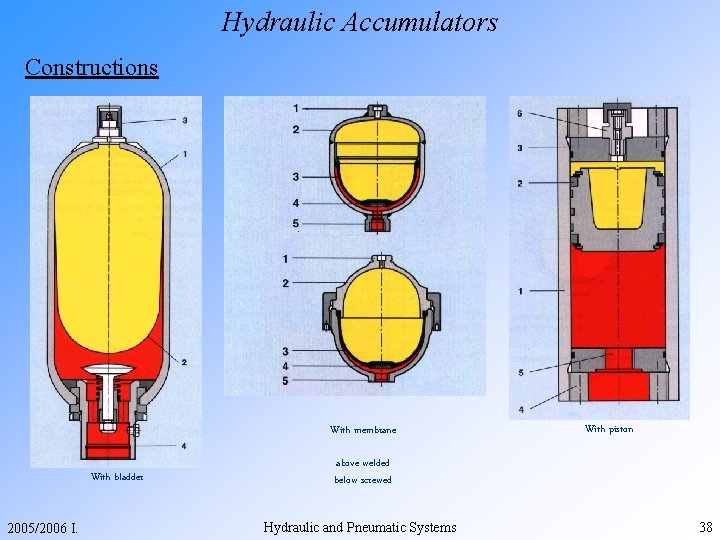
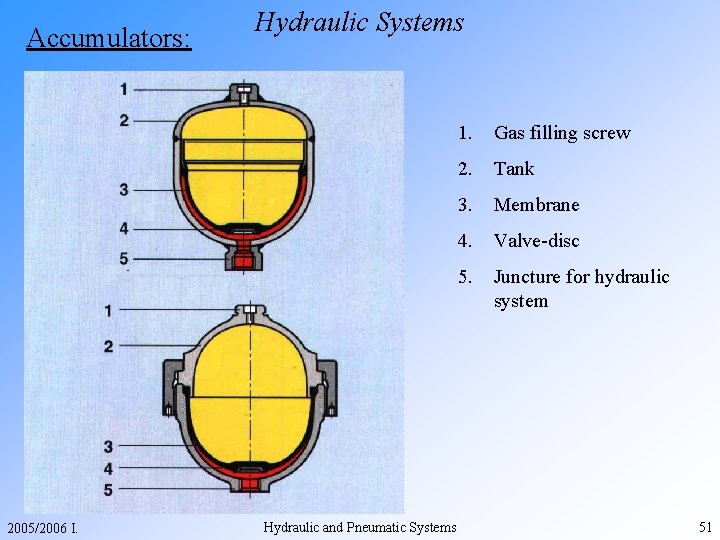
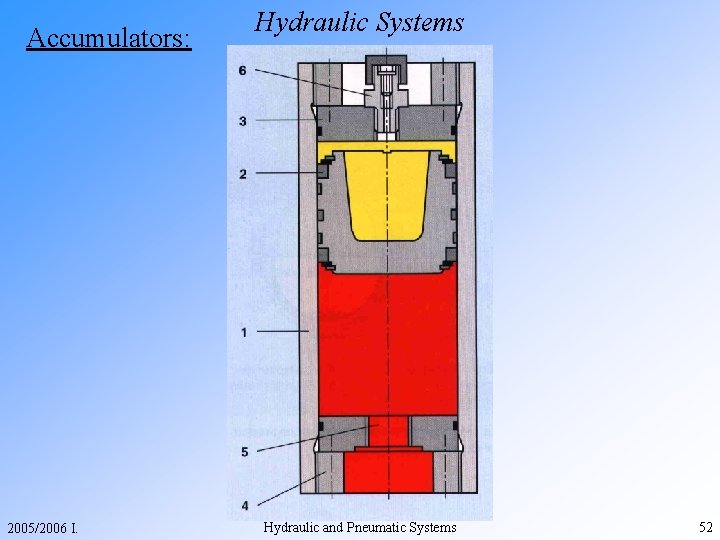
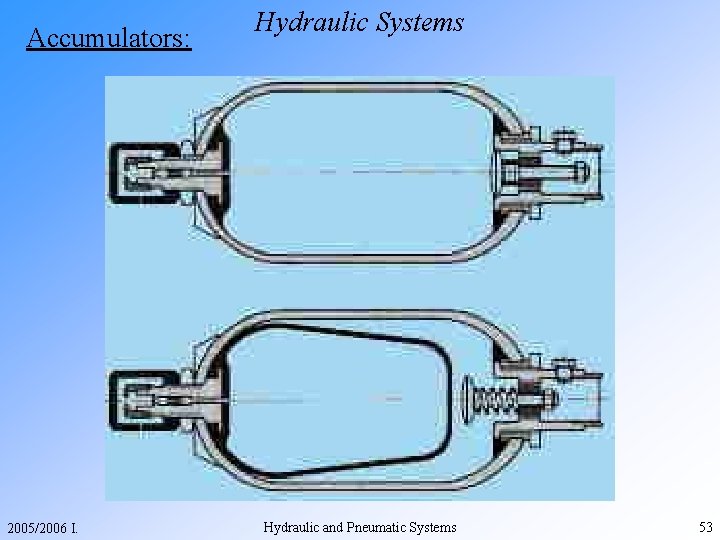
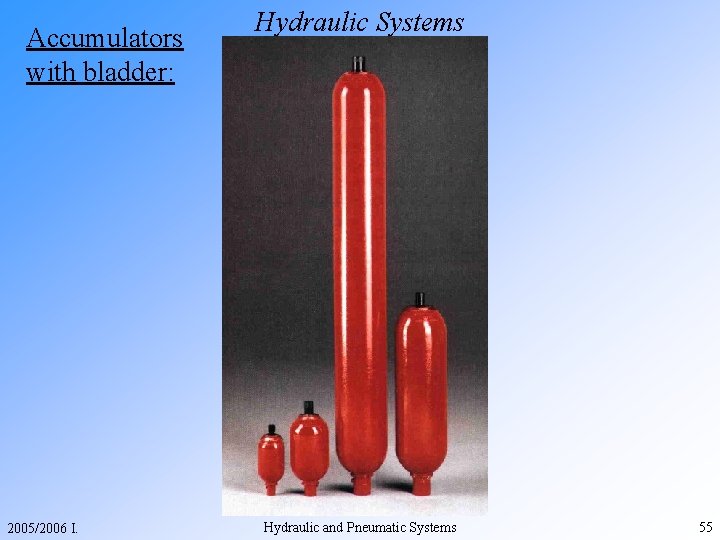
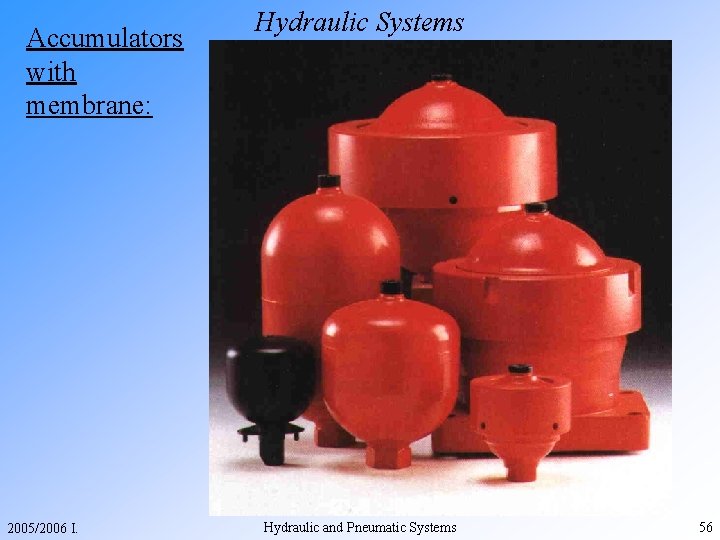
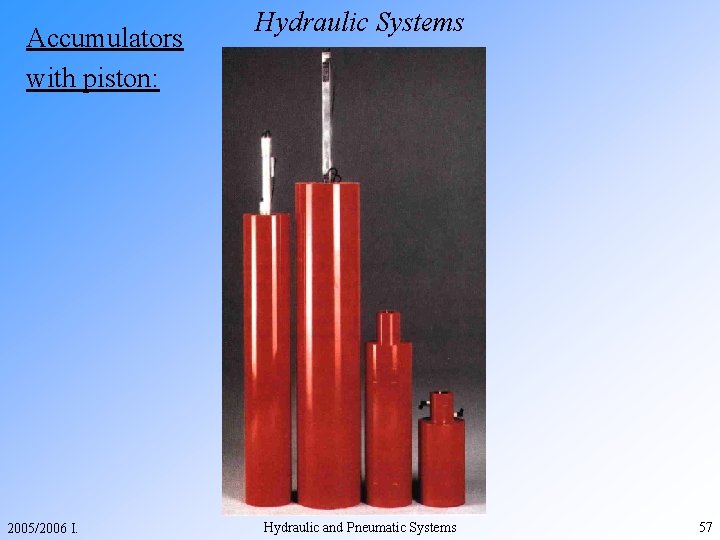
Hydraulic Accumulators Constructions With membrane With bladder 2005/2006 I. With piston above welded below screwed Hydraulic and Pneumatic Systems 38
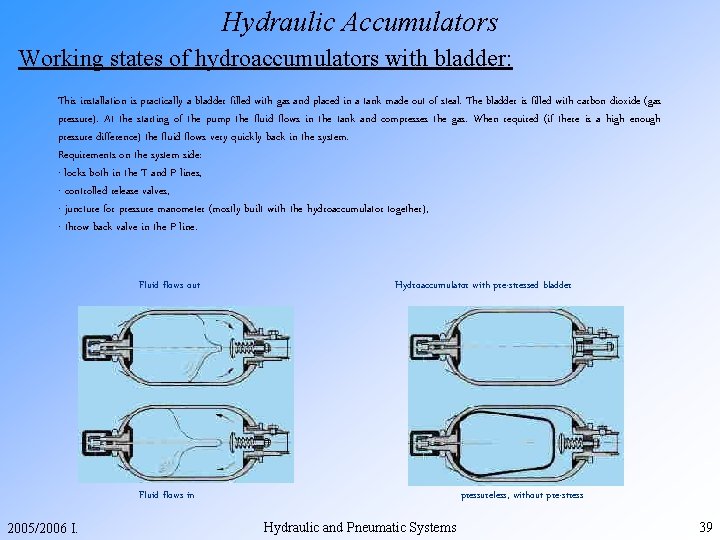
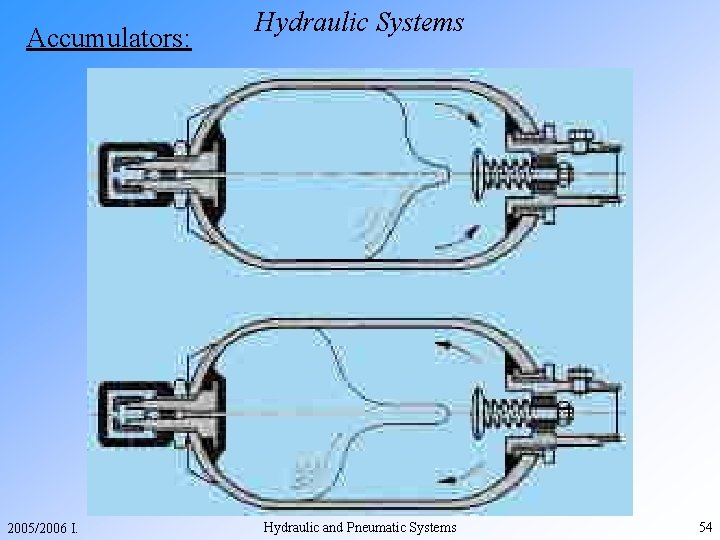
Hydraulic Accumulators Working states of hydroaccumulators with bladder: This installation is practically a bladder filled with gas and placed in a tank made out of steal. The bladder is filled with carbon dioxide (gas pressure). At the starting of the pump the fluid flows in the tank and compresses the gas. When required (if there is a high enough pressure difference) the fluid flows very quickly back in the system. Requirements on the system side: - locks both in the T and P lines, - controlled release valves, - juncture for pressure manometer (mostly built with the hydroaccumulator together), - throw back valve in the P line. Fluid flows out Hydroaccumulator with pre-stressed bladder Fluid flows in 2005/2006 I. pressureless, without pre-stress Hydraulic and Pneumatic Systems 39
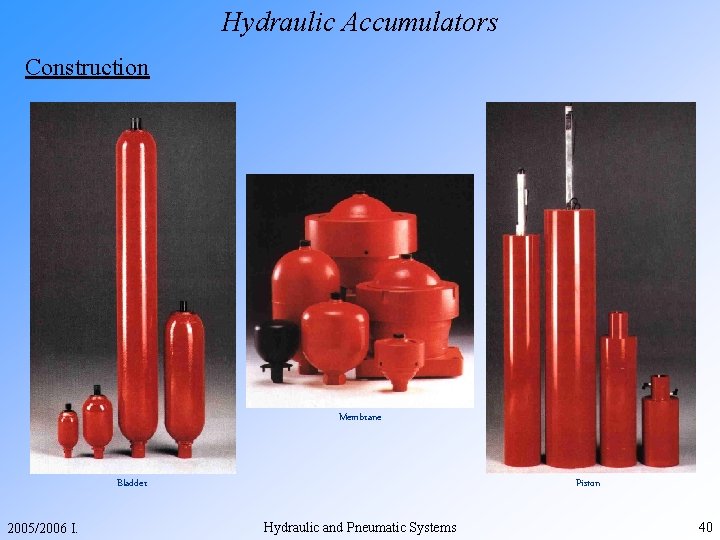
Hydraulic Accumulators Construction Membrane Bladder 2005/2006 I. Piston Hydraulic and Pneumatic Systems 40
Big pictures End of normal presentation Beginning of big pictures 2005/2006 I. Hydraulic and Pneumatic Systems 41
Hydraulic Systems 2005/2006 I. Hydraulic and Pneumatic Systems 42
Hydraulic Systems 2005/2006 I. Hydraulic and Pneumatic Systems 43
Hydraulic Systems Continuity 2005/2006 I. Hydraulic and Pneumatic Systems 44
Hydraulic Systems Pascal’s law 2005/2006 I. Hydraulic and Pneumatic Systems 45
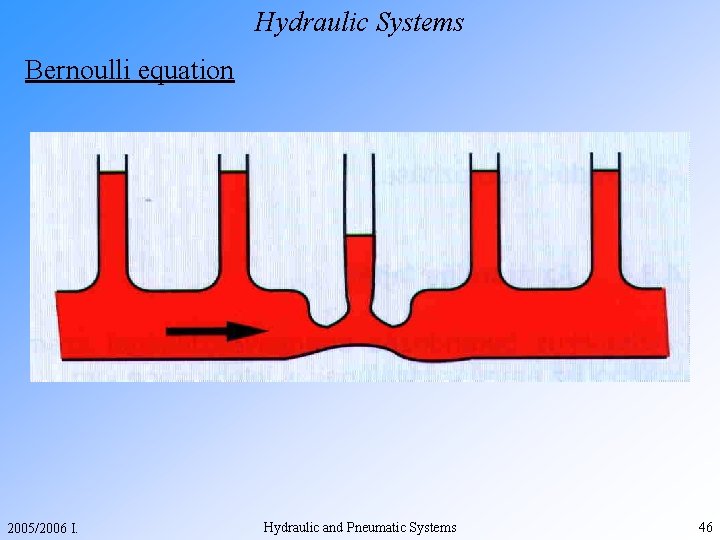
Hydraulic Systems Bernoulli equation 2005/2006 I. Hydraulic and Pneumatic Systems 46
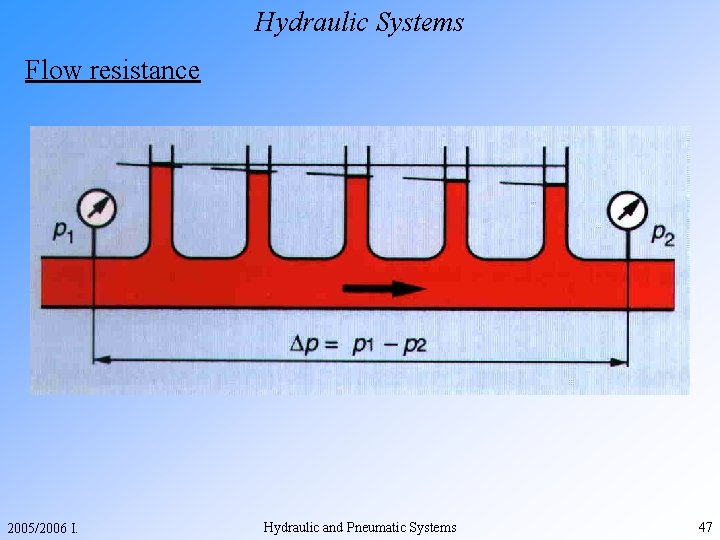
Hydraulic Systems Flow resistance 2005/2006 I. Hydraulic and Pneumatic Systems 47
Viscosity [mm 2/s] Hydraulic Systems Viscosity over temperature Temperature [C°] 2005/2006 I. Hydraulic and Pneumatic Systems 48
Accumulators: With weight Hydraulic Systems With spring With gas (hydropneumatic accumulator) Separating part between gas and fluid Piston 2005/2006 I. Hydraulic and Pneumatic Systems Bladder Membrane 49
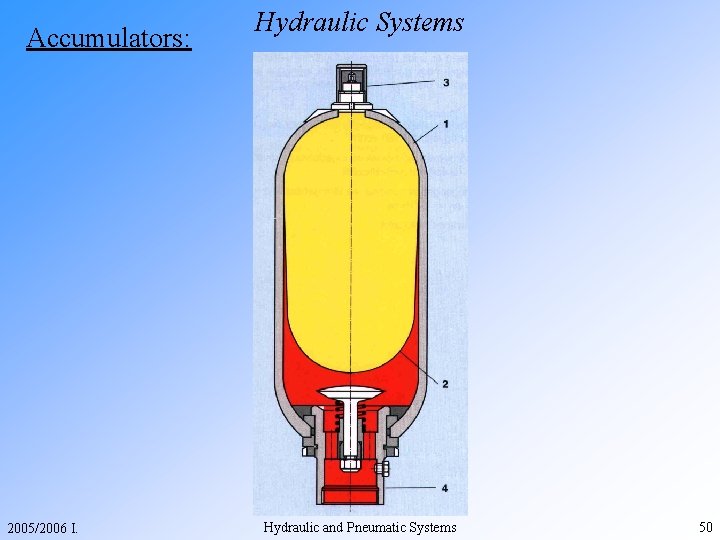
Accumulators: 2005/2006 I. Hydraulic Systems Hydraulic and Pneumatic Systems 50
Accumulators: 2005/2006 I. Hydraulic Systems Hydraulic and Pneumatic Systems 1. Gas filling screw 2. Tank 3. Membrane 4. Valve-disc 5. Juncture for hydraulic system 51
Accumulators: 2005/2006 I. Hydraulic Systems Hydraulic and Pneumatic Systems 52
Accumulators: 2005/2006 I. Hydraulic Systems Hydraulic and Pneumatic Systems 53
Accumulators: 2005/2006 I. Hydraulic Systems Hydraulic and Pneumatic Systems 54
Accumulators with bladder: 2005/2006 I. Hydraulic Systems Hydraulic and Pneumatic Systems 55
Accumulators with membrane: 2005/2006 I. Hydraulic Systems Hydraulic and Pneumatic Systems 56
Accumulators with piston: 2005/2006 I. Hydraulic Systems Hydraulic and Pneumatic Systems 57
Hydraulic Systems Typical hydraulic system: 2005/2006 I. Hydraulic and Pneumatic Systems 58
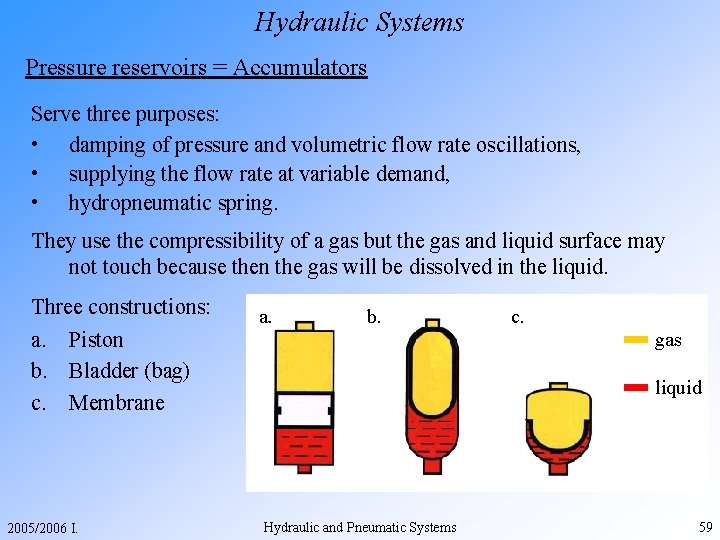
Hydraulic Systems Pressure reservoirs = Accumulators Serve three purposes: • damping of pressure and volumetric flow rate oscillations, • supplying the flow rate at variable demand, • hydropneumatic spring. They use the compressibility of a gas but the gas and liquid surface may not touch because then the gas will be dissolved in the liquid. Three constructions: a. Piston b. Bladder (bag) c. Membrane 2005/2006 I. a. b. c. gas liquid Hydraulic and Pneumatic Systems 59