
Hydration of cement The chemical reactions that take
- Slides: 9
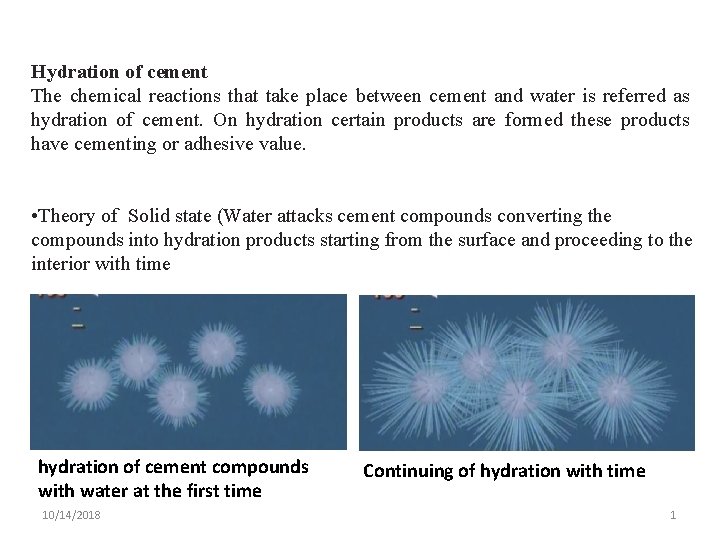
Hydration of cement The chemical reactions that take place between cement and water is referred as hydration of cement. On hydration certain products are formed these products have cementing or adhesive value. • Theory of Solid state (Water attacks cement compounds converting the compounds into hydration products starting from the surface and proceeding to the interior with time hydration of cement compounds with water at the first time 10/14/2018 Continuing of hydration with time 1
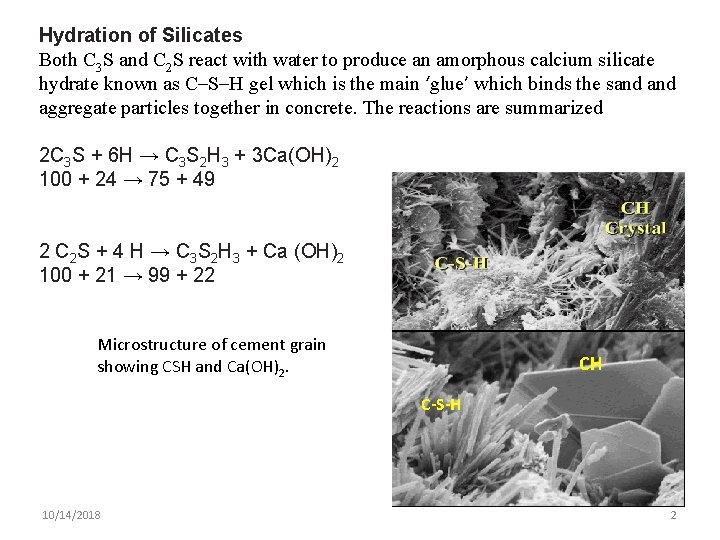
Hydration of Silicates Both C 3 S and C 2 S react with water to produce an amorphous calcium silicate hydrate known as C–S–H gel which is the main ‘glue’ which binds the sand aggregate particles together in concrete. The reactions are summarized 2 C 3 S + 6 H → C 3 S 2 H 3 + 3 Ca(OH)2 100 + 24 → 75 + 49 2 C 2 S + 4 H → C 3 S 2 H 3 + Ca (OH)2 100 + 21 → 99 + 22 Microstructure of cement grain showing CSH and Ca(OH)2. CH C-S-H 10/14/2018 2
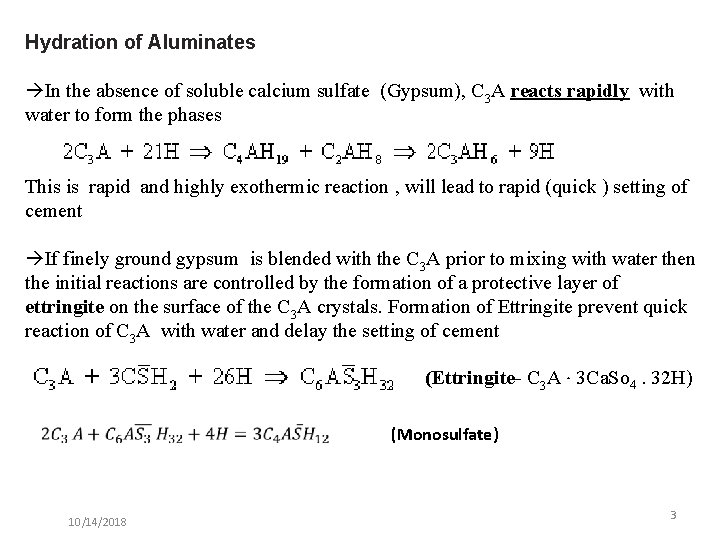
Hydration of Aluminates In the absence of soluble calcium sulfate (Gypsum), C 3 A reacts rapidly with water to form the phases This is rapid and highly exothermic reaction , will lead to rapid (quick ) setting of cement If finely ground gypsum is blended with the C 3 A prior to mixing with water then the initial reactions are controlled by the formation of a protective layer of ettringite on the surface of the C 3 A crystals. Formation of Ettringite prevent quick reaction of C 3 A with water and delay the setting of cement (Ettringite- C 3 A · 3 Ca. So 4. 32 H) (Monosulfate) 10/14/2018 3
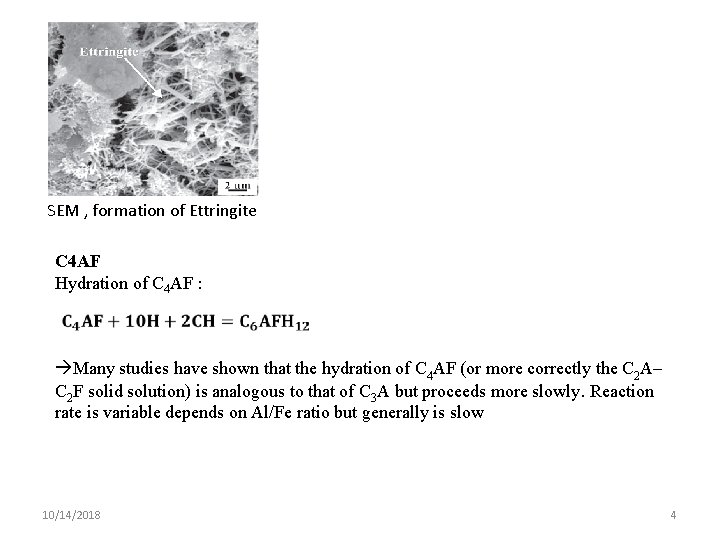
SEM , formation of Ettringite C 4 AF Hydration of C 4 AF : Many studies have shown that the hydration of C 4 AF (or more correctly the C 2 A– C 2 F solid solution) is analogous to that of C 3 A but proceeds more slowly. Reaction rate is variable depends on Al/Fe ratio but generally is slow 10/14/2018 4
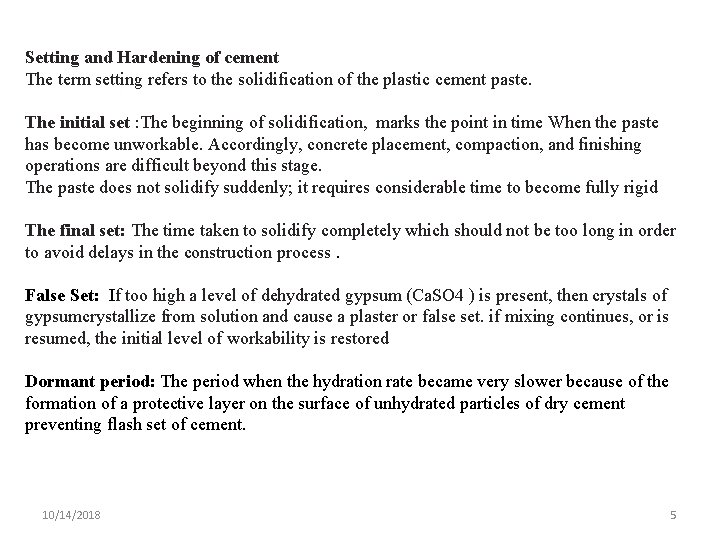
Setting and Hardening of cement The term setting refers to the solidification of the plastic cement paste. The initial set : The beginning of solidification, marks the point in time When the paste has become unworkable. Accordingly, concrete placement, compaction, and finishing operations are difficult beyond this stage. The paste does not solidify suddenly; it requires considerable time to become fully rigid The final set: The time taken to solidify completely which should not be too long in order to avoid delays in the construction process. False Set: If too high a level of dehydrated gypsum (Ca. SO 4 ) is present, then crystals of gypsumcrystallize from solution and cause a plaster or false set. if mixing continues, or is resumed, the initial level of workability is restored Dormant period: The period when the hydration rate became very slower because of the formation of a protective layer on the surface of unhydrated particles of dry cement preventing flash set of cement. 10/14/2018 5
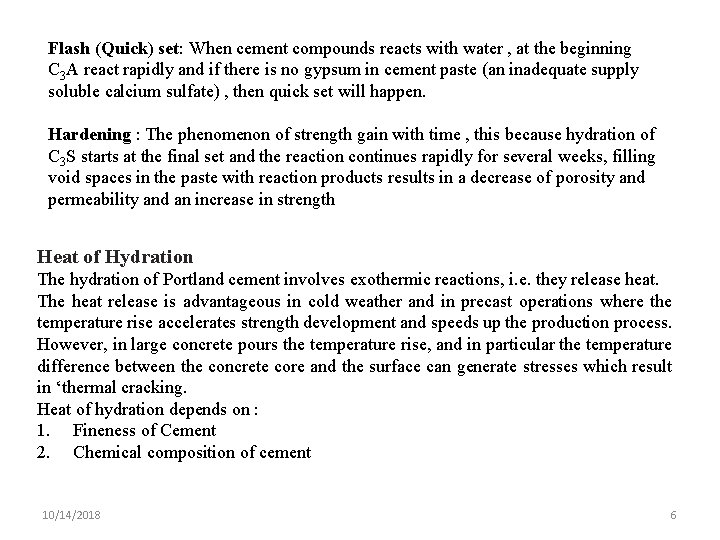
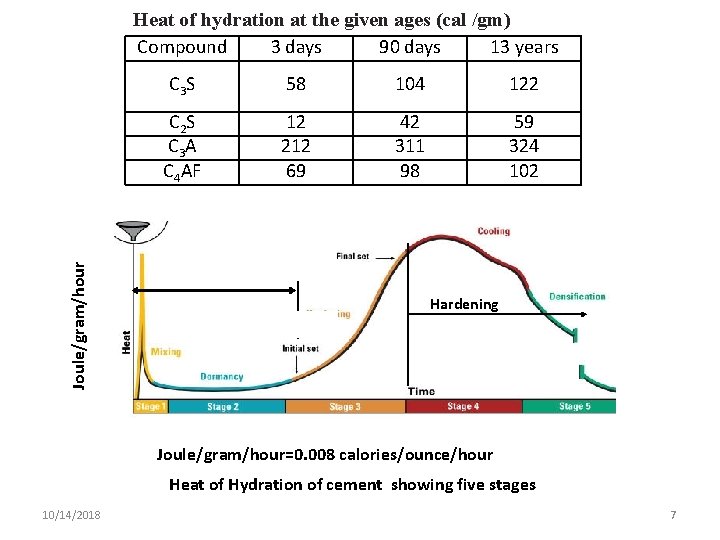
Flash (Quick) set: When cement compounds reacts with water , at the beginning C 3 A react rapidly and if there is no gypsum in cement paste (an inadequate supply soluble calcium sulfate) , then quick set will happen. Hardening : The phenomenon of strength gain with time , this because hydration of C 3 S starts at the final set and the reaction continues rapidly for several weeks, filling void spaces in the paste with reaction products results in a decrease of porosity and permeability and an increase in strength Heat of Hydration The hydration of Portland cement involves exothermic reactions, i. e. they release heat. The heat release is advantageous in cold weather and in precast operations where the temperature rise accelerates strength development and speeds up the production process. However, in large concrete pours the temperature rise, and in particular the temperature difference between the concrete core and the surface can generate stresses which result in ‘thermal cracking. Heat of hydration depends on : 1. Fineness of Cement 2. Chemical composition of cement 10/14/2018 6
Joule/gram/hour Heat of hydration at the given ages (cal /gm) Compound 3 days 90 days 13 years C 3 S 58 104 122 C 2 S C 3 A C 4 AF 12 212 69 42 311 98 59 324 102 Working time Hardening Joule/gram/hour=0. 008 calories/ounce/hour Heat of Hydration of cement showing five stages 10/14/2018 7
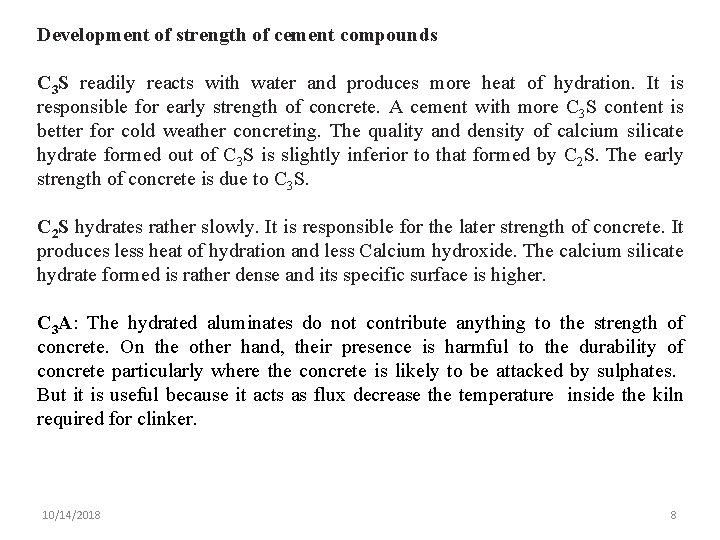
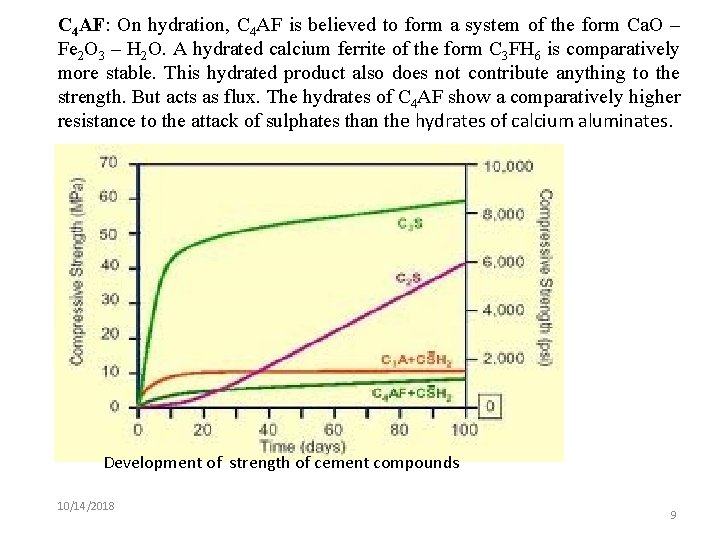
Development of strength of cement compounds C 3 S readily reacts with water and produces more heat of hydration. It is responsible for early strength of concrete. A cement with more C 3 S content is better for cold weather concreting. The quality and density of calcium silicate hydrate formed out of C 3 S is slightly inferior to that formed by C 2 S. The early strength of concrete is due to C 3 S. C 2 S hydrates rather slowly. It is responsible for the later strength of concrete. It produces less heat of hydration and less Calcium hydroxide. The calcium silicate hydrate formed is rather dense and its specific surface is higher. C 3 A: The hydrated aluminates do not contribute anything to the strength of concrete. On the other hand, their presence is harmful to the durability of concrete particularly where the concrete is likely to be attacked by sulphates. But it is useful because it acts as flux decrease the temperature inside the kiln required for clinker. 10/14/2018 8
C 4 AF: On hydration, C 4 AF is believed to form a system of the form Ca. O – Fe 2 O 3 – H 2 O. A hydrated calcium ferrite of the form C 3 FH 6 is comparatively more stable. This hydrated product also does not contribute anything to the strength. But acts as flux. The hydrates of C 4 AF show a comparatively higher resistance to the attack of sulphates than the hydrates of calcium aluminates. Development of strength of cement compounds 10/14/2018 9