
Hybrid System Design and Implementation Methodologies for MultiVehicle
Hybrid System Design and Implementation Methodologies for Multi-Vehicle Multi. Modal Control Shankar Sastry, Thomas Henzinger and Edward. Lee Alberto Sangiovanni Vincentelli Department of Electrical Engineering and Computer Sciences University of California at Berkeley 5/99 DARPA Software Enabled Control, UC Berkeley
Statement of Work Thrust I: Experimental Evaluation of Multi-Vehicle Control System Designs. Run Time Executions: 1. Mode Switching in UAVs: flight envelop protection, survivability in normal modes of operation. 2. Degraded Modes of Operation: loss of communication, loss of individual sensors, actuators. 3. Multiple UAV Coordination: formation flying, pursuitevasion scenarios. l Thrust II Multi-modal Control Derivation and Analysis. Design Tools: 1. Algorithmic Analysis for Nonlinear Hybrid Control 2. Hierarchical Hybrid Control Design, Modular techniques 3. Model Reduction and Conservative Approximatons l
Statement of Work Part II l Thrust III: Hybrid Model Simulation and Implementation on the Open Control Platform. Run Time Implementation. 1. Hybrid Multi-Vehicle Model Simulation: mixed models of computation. 2. Structuring Mechanisms for Hybrid Models: for managing complexity. 3. Executability of Hybrid Models: determinacy, receptiveness. 4. Architectural Mapping and Real time Analysis of Hybrid Control Designs: mapping “proven” designs onto OCP and to provide “guarantees” for different implementations: synchronous at low level, Corba/Tao at networked level? 5. Robustness and Error Analysis of Hybrid Control Designs.
Statement of Work Part II l Thrust III: Hybrid Model Simulation and Implementation on the Open Control Platform. Run Time Implementation. 1. Hybrid Multi-Vehicle Model Simulation: mixed models of computation. 2. Structuring Mechanisms for Hybrid Models: for managing complexity. 3. Executability of Hybrid Models: determinacy, receptiveness. 4. Architectural Mapping and Real time Analysis of Hybrid Control Designs: mapping “proven” designs onto OCP and to provide “guarantees” for different implementations: synchronous at low level, Corba/Tao at networked level? 5. Robustness and Error Analysis of Hybrid Control Designs.
Statemement of Work Part III l Thrust IV: Probabilistic Design and Active Fault Handling for Hybrid Systems. Design Time / Real Time. 1. Probabilistic Control: when specs cannot be met deterministically. 2. Probabilistic Analysis: probabilistic estimates of safe and desired behavior. 3. On-line Customization of Control: Active Hybrid Control: “adaptive control” during operation of system, embedding design abstractions.
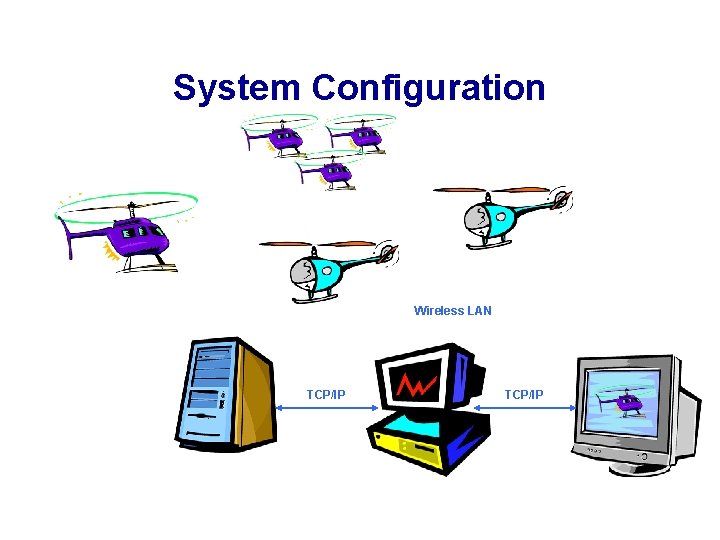
System Configuration Wireless LAN TCP/IP WIRELESS HUB GROUNDSTATION VIRTUAL COCKPIT TCP/IP GRAPHICAL EMMULATION
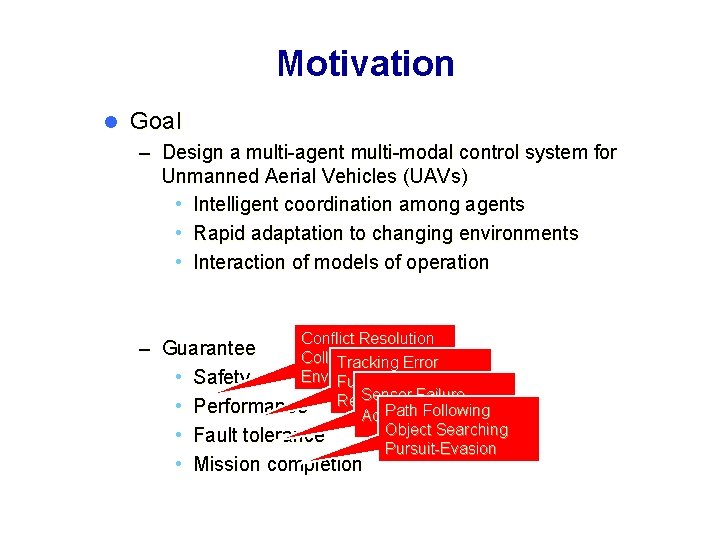
Motivation l Goal – Design a multi-agent multi-modal control system for Unmanned Aerial Vehicles (UAVs) • Intelligent coordination among agents • Rapid adaptation to changing environments • Interaction of models of operation Conflict Resolution – Guarantee Collision Avoidance Tracking Error Envelope • Safety Fuel Protection Consumption Sensor Time Failure • Performance Response Path Actuator Following Failure Object Searching • Fault tolerance Pursuit-Evasion • Mission completion
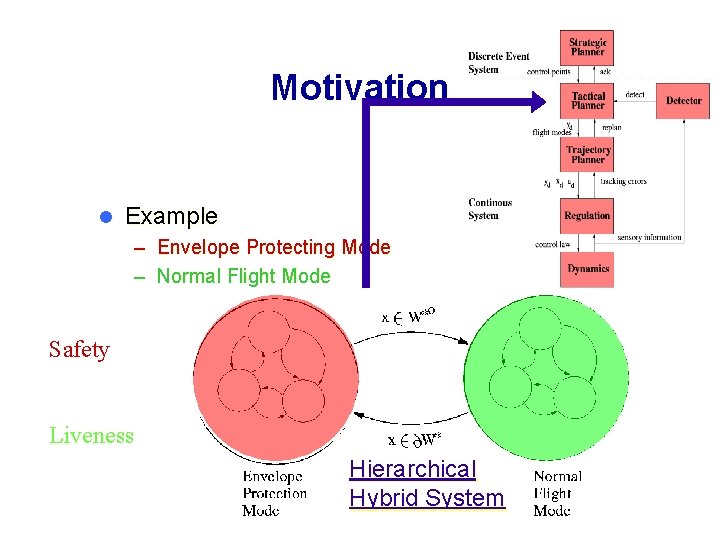
Motivation l Example – Envelope Protecting Mode – Normal Flight Mode Safety Invariant Liveness Reachability Hierarchical Hybrid System
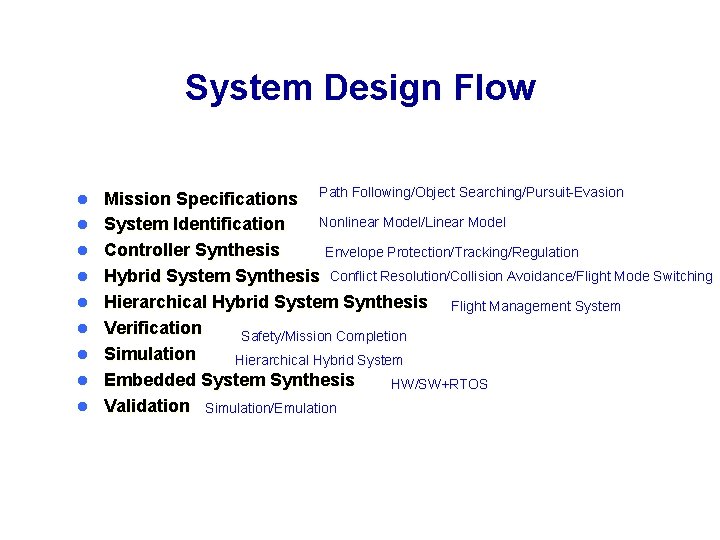
System Design Flow l l l l l Mission Specifications Path Following/Object Searching/Pursuit-Evasion Nonlinear Model/Linear Model System Identification Controller Synthesis Envelope Protection/Tracking/Regulation Hybrid System Synthesis Conflict Resolution/Collision Avoidance/Flight Mode Switching Hierarchical Hybrid System Synthesis Flight Management System Verification Safety/Mission Completion Simulation Hierarchical Hybrid System Embedded System Synthesis HW/SW+RTOS Validation Simulation/Emulation

What Are Hybrid Systems? Dynamical systems with interacting continuous and discrete dynamics
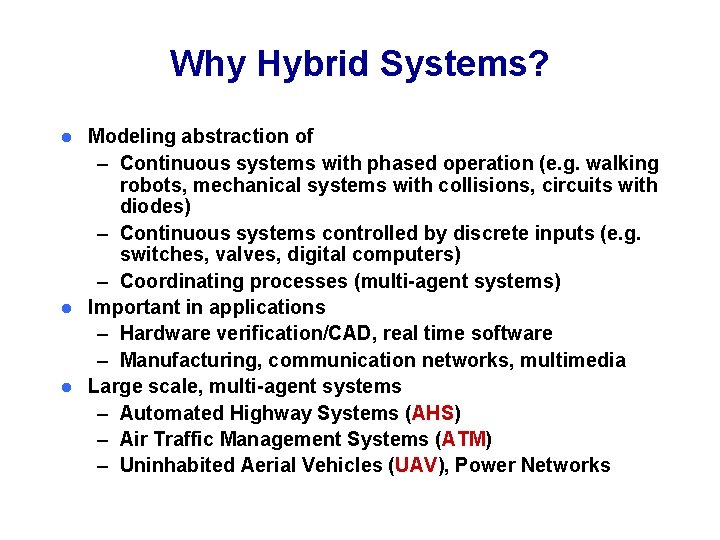
Why Hybrid Systems? Modeling abstraction of – Continuous systems with phased operation (e. g. walking robots, mechanical systems with collisions, circuits with diodes) – Continuous systems controlled by discrete inputs (e. g. switches, valves, digital computers) – Coordinating processes (multi-agent systems) l Important in applications – Hardware verification/CAD, real time software – Manufacturing, communication networks, multimedia l Large scale, multi-agent systems – Automated Highway Systems (AHS) – Air Traffic Management Systems (ATM) – Uninhabited Aerial Vehicles (UAV), Power Networks l
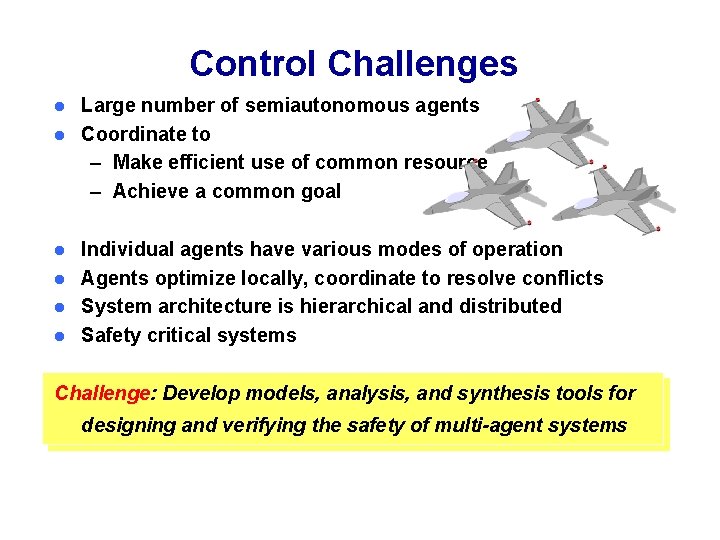
Control Challenges Large number of semiautonomous agents l Coordinate to – Make efficient use of common resource – Achieve a common goal l Individual agents have various modes of operation l Agents optimize locally, coordinate to resolve conflicts l System architecture is hierarchical and distributed l Safety critical systems l Challenge: Develop models, analysis, and synthesis tools for designing and verifying the safety of multi-agent systems
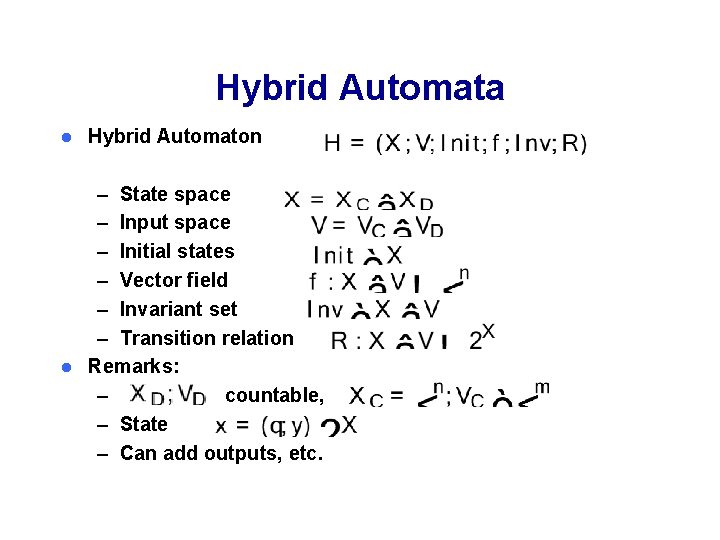
Hybrid Automata l Hybrid Automaton – State space – Input space – Initial states – Vector field – Invariant set – Transition relation l Remarks: – countable, – State – Can add outputs, etc.

Executions l Hybrid time trajectory, with l Execution , finite or infinite with and – Initial Condition: – Discrete Evolution: – Continuous Evolution: over , continuous, piecewise continuous, and l Remarks: – x, v not function, multiple transitions possible – q constant along continuous evolution – Can study existence uniqueness – Use to denote the set of executions of

Controller Synthesis l l l Consider plant hybrid automaton, inputs partitioned to: – Controls, U – Disturbances, D Controls specified by “us” Disturbances specified by the “environment” – Unmodeled dynamics – Noise, reference signals – Actions of other agents Memoryless controller is a map The closed loop executions are
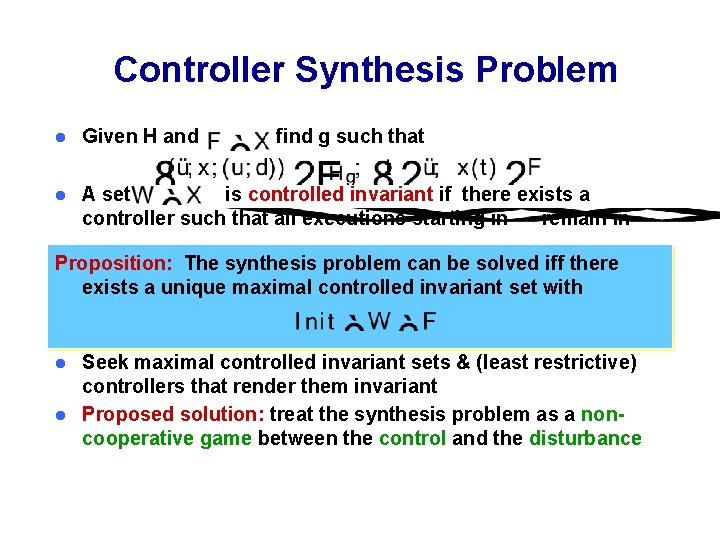
Controller Synthesis Problem l Given H and find g such that l A set is controlled invariant if there exists a controller such that all executions starting in remain in Proposition: The synthesis problem can be solved iff there exists a unique maximal controlled invariant set with Seek maximal controlled invariant sets & (least restrictive) controllers that render them invariant l Proposed solution: treat the synthesis problem as a noncooperative game between the control and the disturbance l
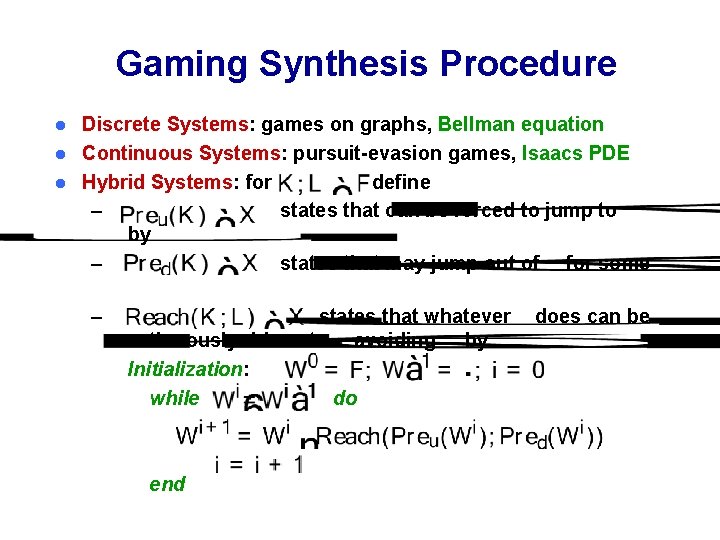
Gaming Synthesis Procedure Discrete Systems: games on graphs, Bellman equation l Continuous Systems: pursuit-evasion games, Isaacs PDE l Hybrid Systems: for define – states that can be forced to jump to K Kby u – states that may jump out of K for some d – states that whatever u does can be continuously driven to K avoiding L by u Initialization: while do l end
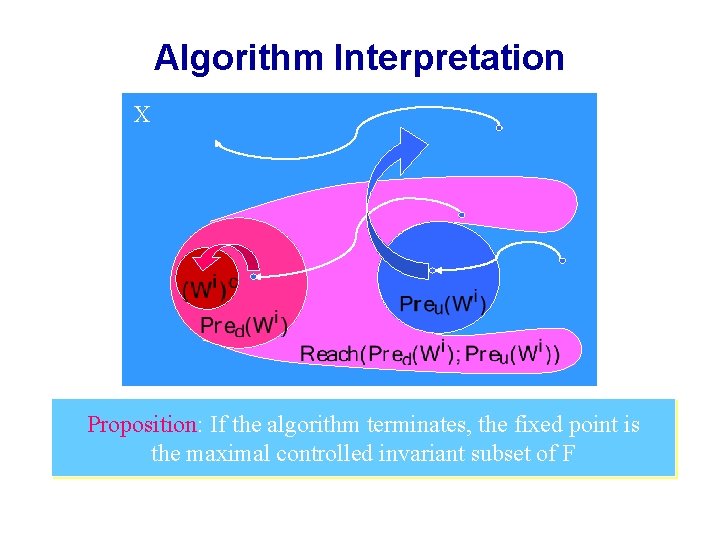
Algorithm Interpretation X Proposition: If the algorithm terminates, the fixed point is the maximal controlled invariant subset of F
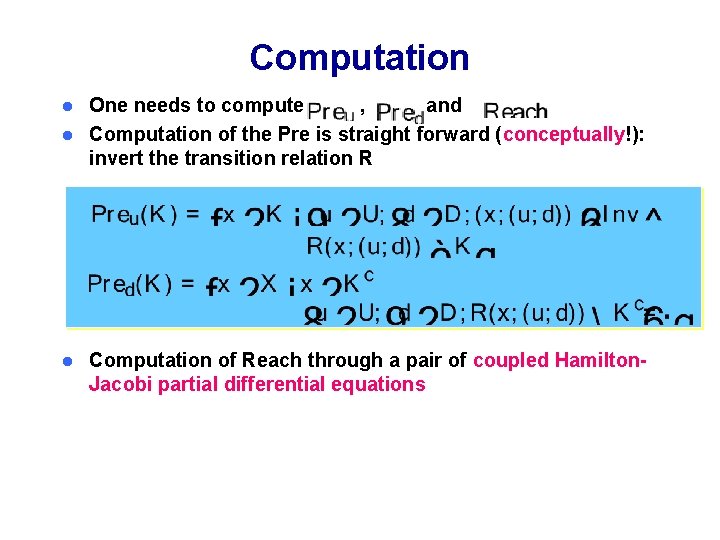
Computation One needs to compute , and l Computation of the Pre is straight forward (conceptually!): invert the transition relation R l l Computation of Reach through a pair of coupled Hamilton. Jacobi partial differential equations
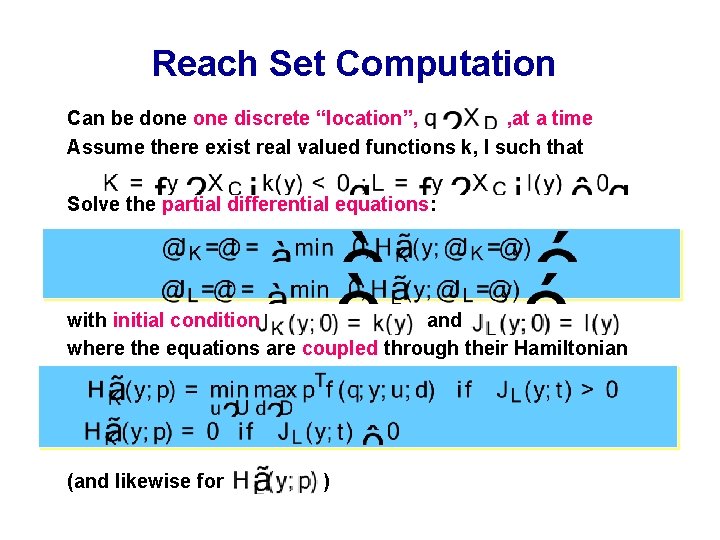
Reach Set Computation Can be done discrete “location”, , at a time Assume there exist real valued functions k, l such that Solve the partial differential equations: with initial condition and where the equations are coupled through their Hamiltonian (and likewise for )
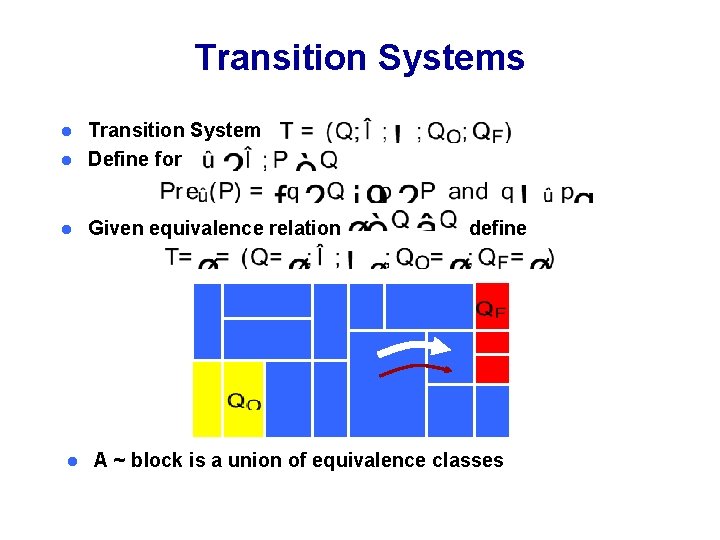
Transition Systems Transition System l Define for l l l Given equivalence relation define A ~ block is a union of equivalence classes
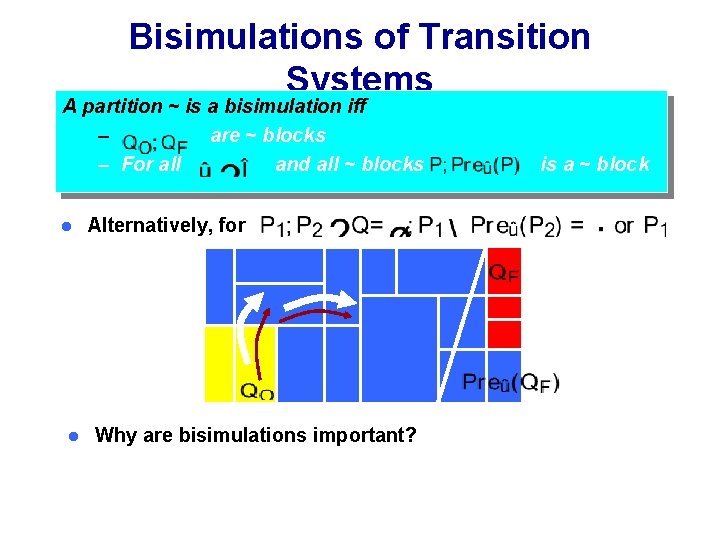
Bisimulations of Transition Systems A partition ~ is a bisimulation iff – are ~ blocks – For all and all ~ blocks l l Alternatively, for Why are bisimulations important? is a ~ block
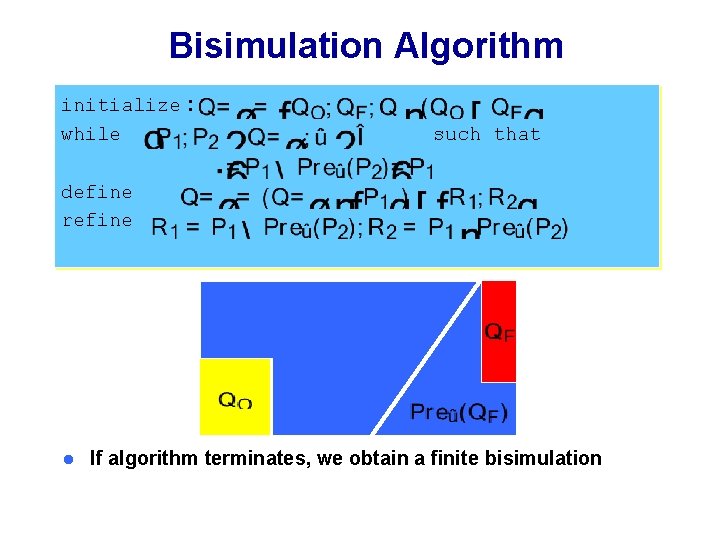
Bisimulation Algorithm initialize : while such that define refine l If algorithm terminates, we obtain a finite bisimulation
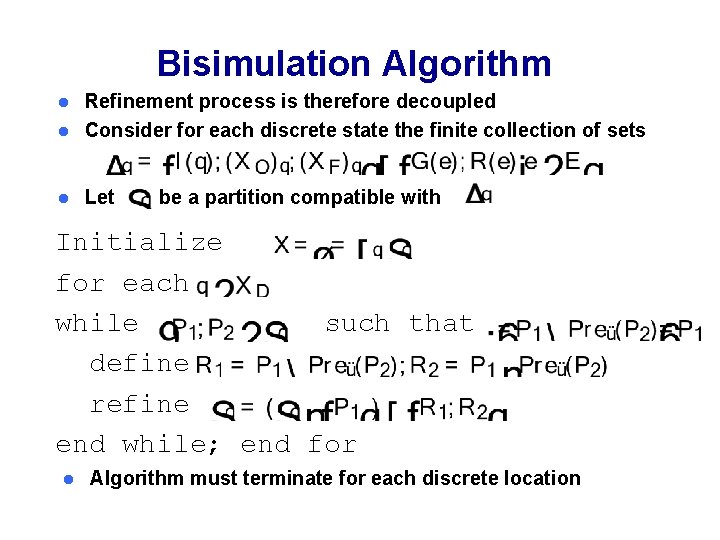
Bisimulation Algorithm Refinement process is therefore decoupled l Consider for each discrete state the finite collection of sets l l Let be a partition compatible with Initialize for each while such that define refine end while; end for l Algorithm must terminate for each discrete location
Computability & Finitiness Decidability requires the bisimulation algorithm to – Terminate in finite number of steps and – Be computable l For the bisimulation algorithm to be computable we need to – Represent sets symbollically, – Perform boolean combinations on sets – Check emptyness of a set, – Compute Pre(P) of a set P l Class of sets and vector fields must be topologically simple – Set operations must not produce pathological sets l – Sets must have desirable finiteness properties
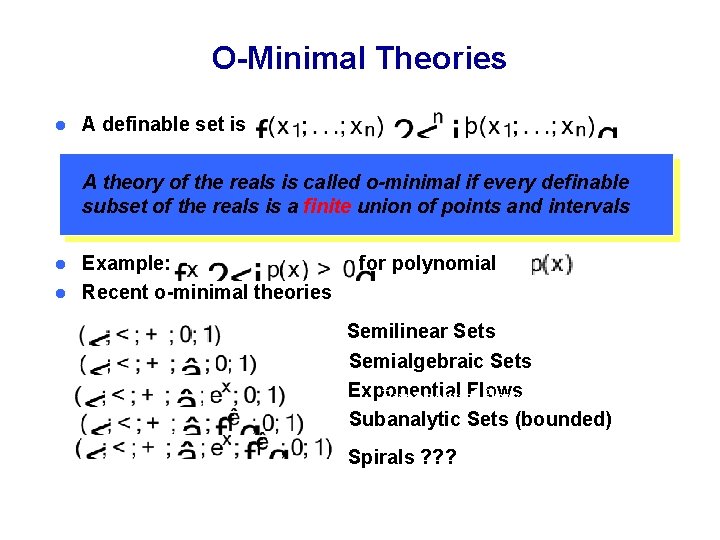
O-Minimal Theories l A definable set is A theory of the reals is called o-minimal if every definable subset of the reals is a finite union of points and intervals Example: l Recent o-minimal theories l for polynomial Semilinear Sets Semialgebraic Sets Exponential Flows Exponential flows Subanalytic Sets (bounded) ? Spirals ? ? ?
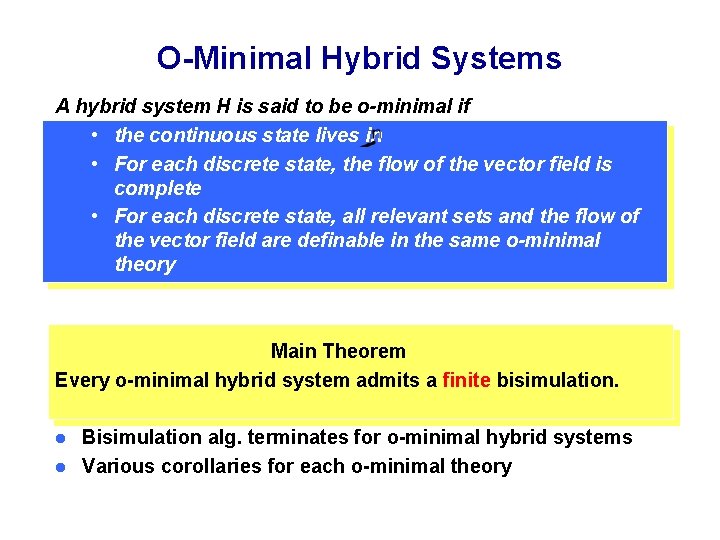
O-Minimal Hybrid Systems A hybrid system H is said to be o-minimal if • the continuous state lives in • For each discrete state, the flow of the vector field is complete • For each discrete state, all relevant sets and the flow of the vector field are definable in the same o-minimal theory Main Theorem Every o-minimal hybrid system admits a finite bisimulation. Bisimulation alg. terminates for o-minimal hybrid systems l Various corollaries for each o-minimal theory l
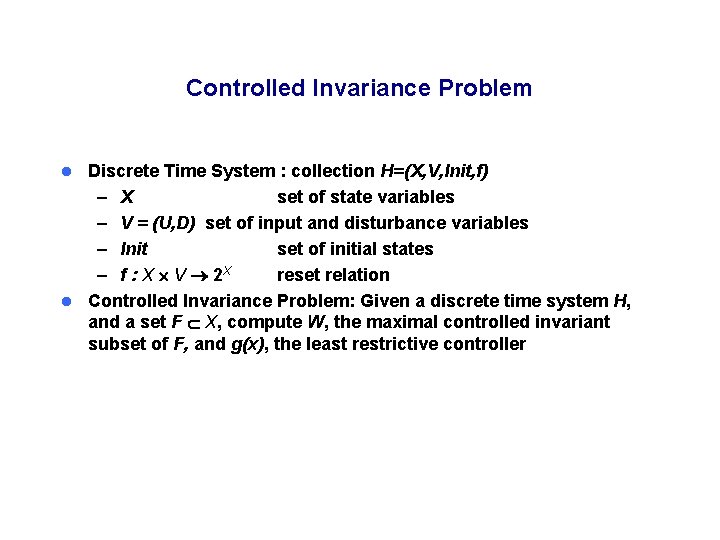
Controlled Invariance Problem Discrete Time System : collection H=(X, V, Init, f) – X set of state variables – V = (U, D) set of input and disturbance variables – Init set of initial states – f : X V 2 X reset relation l Controlled Invariance Problem: Given a discrete time system H, and a set F X, compute W, the maximal controlled invariant subset of F, and g(x), the least restrictive controller l
Controlled Invariance Algorithm
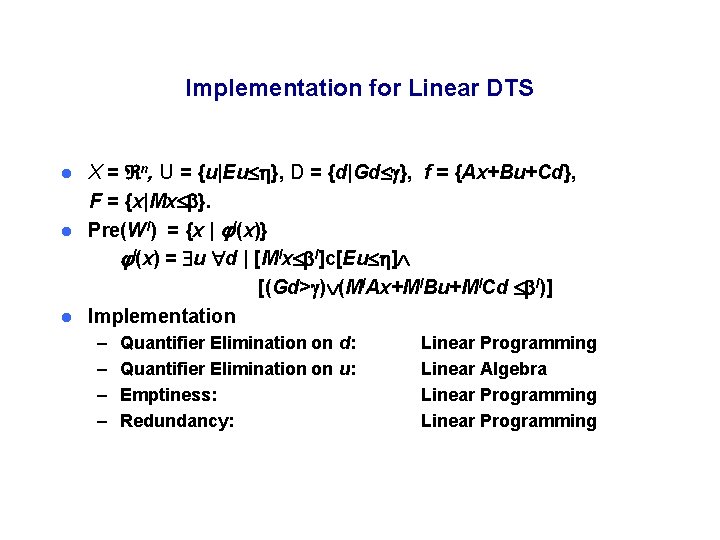
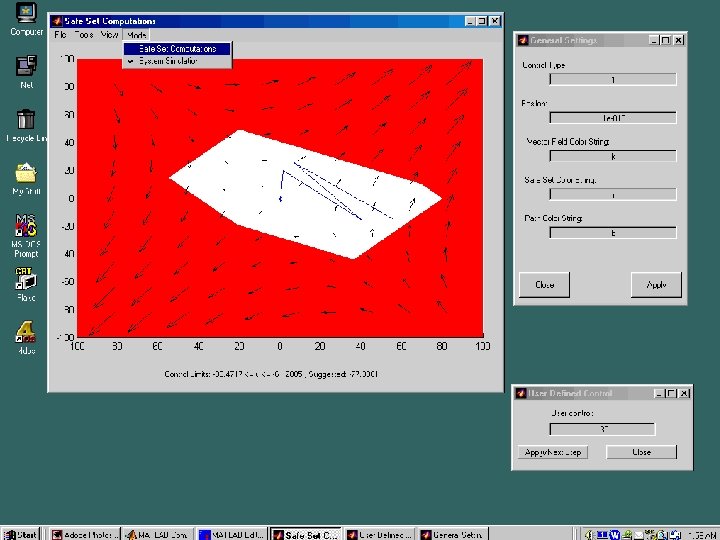
Implementation for Linear DTS X = n, U = {u|Eu }, D = {d|Gd }, f = {Ax+Bu+Cd}, F = {x|Mx }. l Pre(Wl) = {x | l(x)} l(x) = u d | [Mlx l]c[Eu ] [(Gd> ) (Ml. Ax+Ml. Bu+Ml. Cd l)] l Implementation l – – Quantifier Elimination on d: Quantifier Elimination on u: Emptiness: Redundancy: Linear Programming Linear Algebra Linear Programming
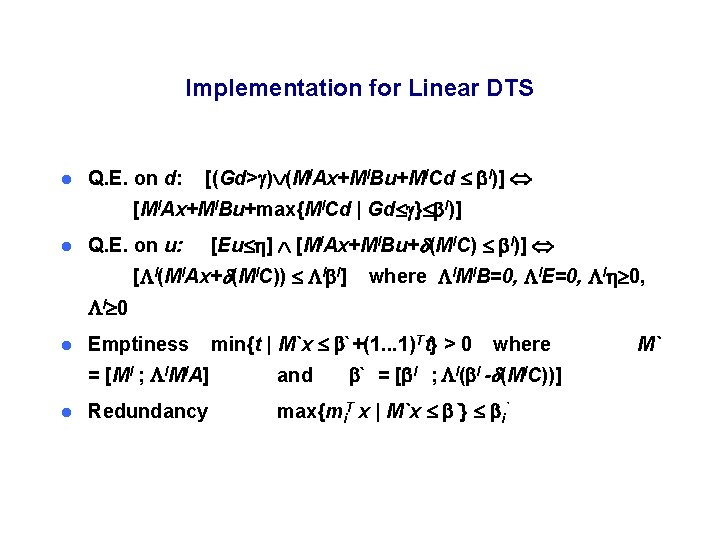
Implementation for Linear DTS l Q. E. on d: [(Gd> ) (Ml. Ax+Ml. Bu+Ml. Cd l)] [Ml. Ax+Ml. Bu+max{Ml. Cd | Gd } l)] l Q. E. on u: [Eu ] [Ml. Ax+Ml. Bu+ (Ml. C) l)] [ l(Ml. Ax+ (Ml. C)) l l] where l. Ml. B=0, l. E=0, l 0 l l Emptiness min{t | M`x `+(1. . . 1)Tt} > 0 where ` = [ l ; l( l - (Ml. C))] = [Ml ; l. Ml. A] and Redundancy max{mi. T x | M`x `} i` M`
Decidability Results for Algorithm The controlled invariant set calculation problem is l Semi-decidable in general. l Decidable when F is a rectangle, and A, b is in controllable canonical form for single input single disturbance. Extensions: Hybrid systems with continuous state evolving according to discrete time dynamics: difficulties arise because sets may not be convex or connected. There are other classes of decidable systems which need to be identified.
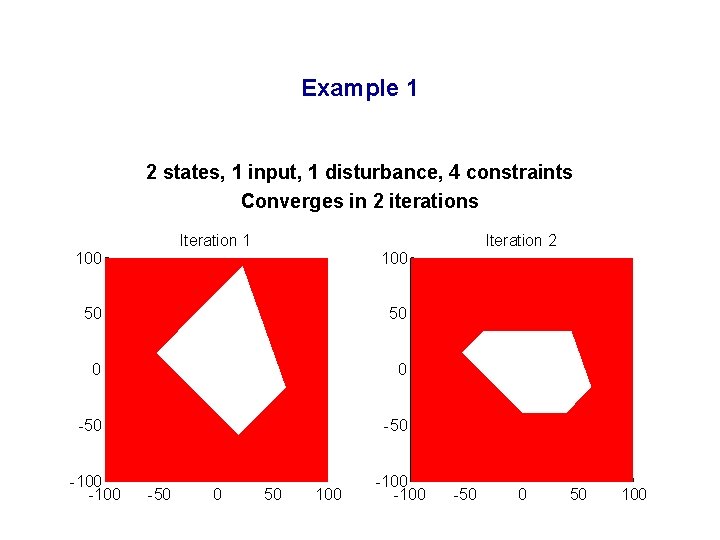
Example 1 2 states, 1 input, 1 disturbance, 4 constraints Converges in 2 iterations Iteration 1 Iteration 2 100 50 50 0 0 -50 -100 -50 0 50 100
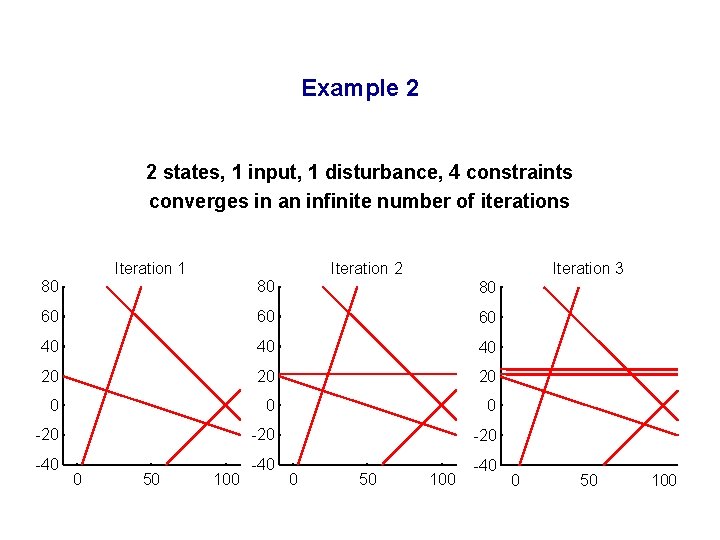
Example 2 2 states, 1 input, 1 disturbance, 4 constraints converges in an infinite number of iterations Iteration 1 Iteration 2 Iteration 3 80 80 80 60 60 60 40 40 40 20 20 20 0 -20 -20 -40 -40 0 50 100
- Slides: 35