
Hybrid Simulator for Compressible Fluid Flow Prof Dr
Hybrid Simulator for Compressible Fluid Flow Prof. Dr. Nuri Saryal Middle East Technical University Ankara - Turkey International Conference Advances in Physics and Astrophysics Of the 21. Century September 6 - 11, 2005 Varna–Bulgar. Ia
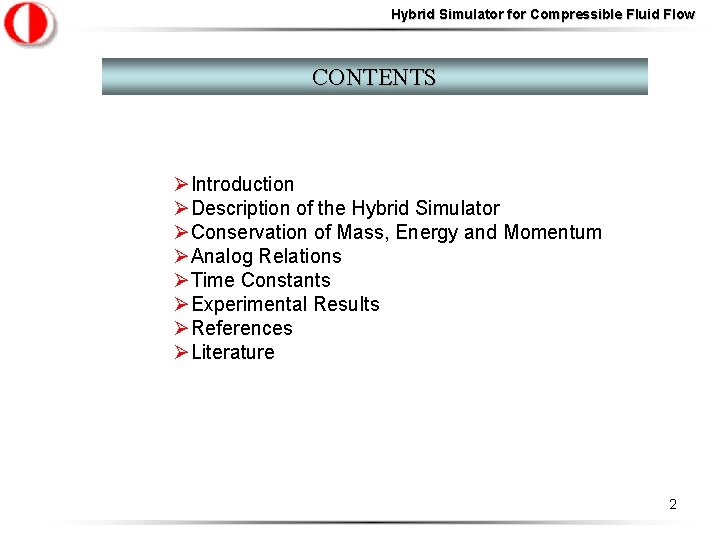
Hybrid Simulator for Compressible Fluid Flow CONTENTS ØIntroduction ØDescription of the Hybrid Simulator ØConservation of Mass, Energy and Momentum ØAnalog Relations ØTime Constants ØExperimental Results ØReferences ØLiterature 2
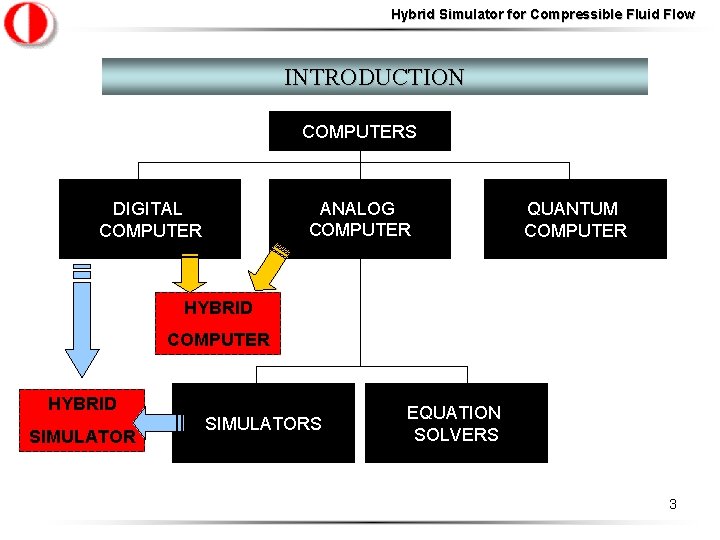
Hybrid Simulator for Compressible Fluid Flow INTRODUCTION COMPUTERS ANALOG COMPUTER DIGITAL COMPUTER QUANTUM COMPUTER HYBRID SIMULATORS EQUATION SOLVERS 3
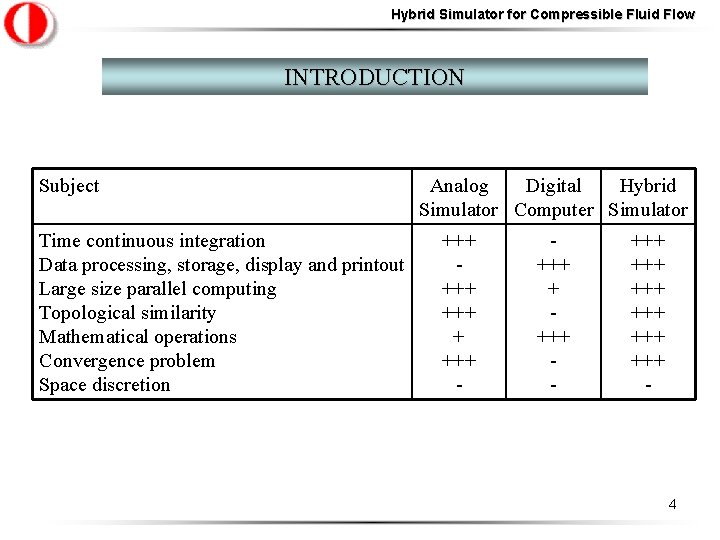
Hybrid Simulator for Compressible Fluid Flow INTRODUCTION Subject Time continuous integration Data processing, storage, display and printout Large size parallel computing Topological similarity Mathematical operations Convergence problem Space discretion Analog Digital Hybrid Simulator Computer Simulator +++ +++ - +++ +++ +++ - 4
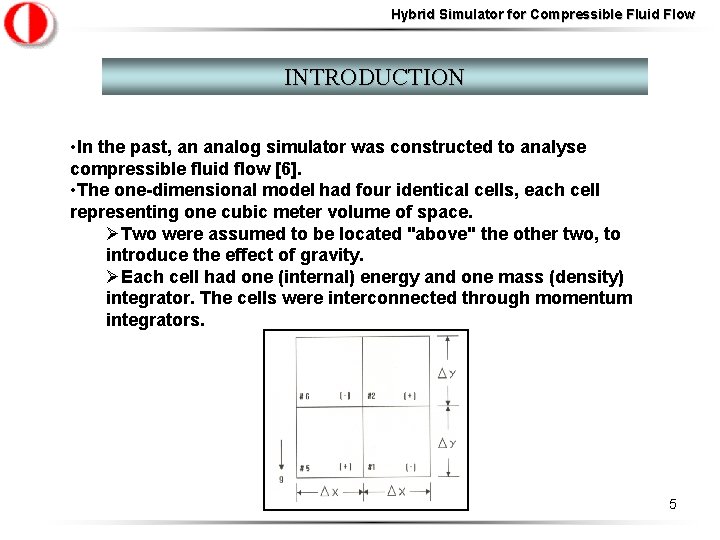
Hybrid Simulator for Compressible Fluid Flow INTRODUCTION • In the past, an analog simulator was constructed to analyse compressible fluid flow [6]. • The one-dimensional model had four identical cells, each cell representing one cubic meter volume of space. ØTwo were assumed to be located "above" the other two, to introduce the effect of gravity. ØEach cell had one (internal) energy and one mass (density) integrator. The cells were interconnected through momentum integrators. 5
Hybrid Simulator for Compressible Fluid Flow INTRODUCTION • The model was not realistic but satisfied all the requirements of a "chaotic" system: ØSimulation of a sudden extraction of a fixed amount of heat energy from one of the "lower" energy integrators, causing shock waves to bounce back and forth, giving a different pattern each time, but the total mass of the system was constant and the total internal energy decreased by the amount extracted, otherwise it was constant. ØHigh viscosity was simulated through the momentum integrators to shorten the running time, because the integrators were stable for only five to ten seconds and after each experiment the operational amplifiers had to be readjusted. There were some more deficiencies, not of interest anymore. 6
Hybrid Simulator for Compressible Fluid Flow INTRODUCTION • After years of hard work, the above-mentioned deficiencies were eliminated and a simple, low cost and extremely accurate (open ended, max. 1% drift per hour) analog integrator was developed. • The new system is an analog-digital hybrid, consisting of a great number of cells, each containing (as before), one energy, one mass and for each dimension one momentum integrator, providing energy, mass and momentum transfers between neighboring cells time continuously. • Integration, summing and multiplication of variables by a constant are performed time continuously in the analog part. • In the past, multiplication and division of variables (time dependent voltages) were performed through analog circuitry time continuously, but will be done digitally by programmable micro controllers (one in each cell), in the future. 7
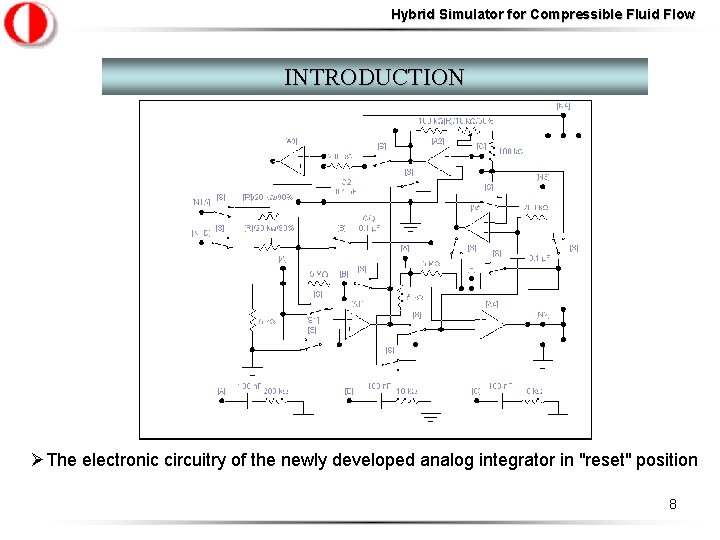
Hybrid Simulator for Compressible Fluid Flow INTRODUCTION ØThe electronic circuitry of the newly developed analog integrator in "reset" position 8
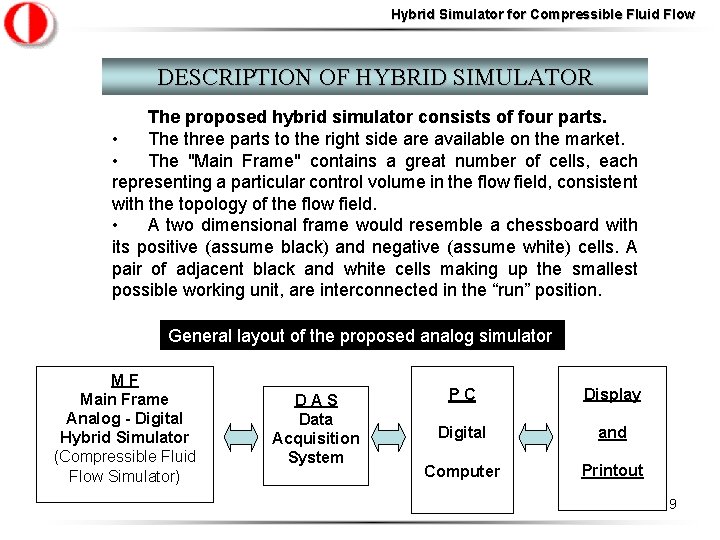
Hybrid Simulator for Compressible Fluid Flow DESCRIPTION OF HYBRID SIMULATOR The proposed hybrid simulator consists of four parts. • The three parts to the right side are available on the market. • The "Main Frame" contains a great number of cells, each representing a particular control volume in the flow field, consistent with the topology of the flow field. • A two dimensional frame would resemble a chessboard with its positive (assume black) and negative (assume white) cells. A pair of adjacent black and white cells making up the smallest possible working unit, are interconnected in the “run” position. General layout of the proposed analog simulator MF Main Frame Analog - Digital Hybrid Simulator (Compressible Fluid Flow Simulator) DAS Data Acquisition System PC Display Digital and Computer Printout 9
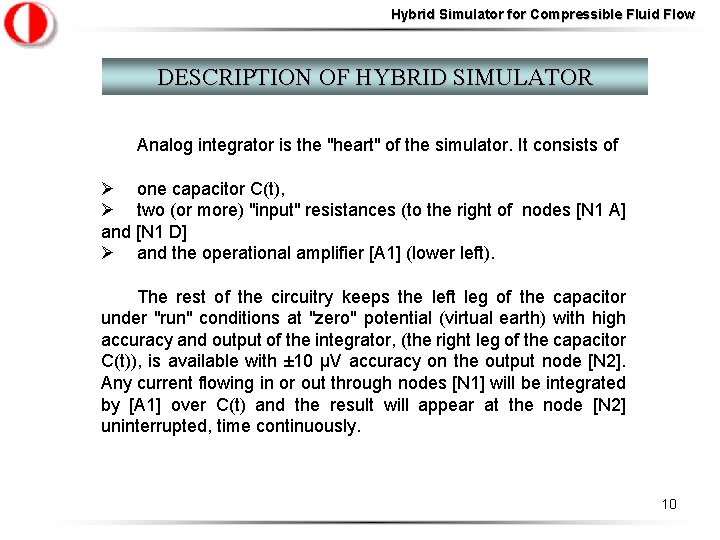
Hybrid Simulator for Compressible Fluid Flow DESCRIPTION OF HYBRID SIMULATOR Analog integrator is the "heart" of the simulator. It consists of Ø one capacitor C(t), Ø two (or more) "input" resistances (to the right of nodes [N 1 A] and [N 1 D] Ø and the operational amplifier [A 1] (lower left). The rest of the circuitry keeps the left leg of the capacitor under "run" conditions at "zero" potential (virtual earth) with high accuracy and output of the integrator, (the right leg of the capacitor C(t)), is available with ± 10 μV accuracy on the output node [N 2]. Any current flowing in or out through nodes [N 1] will be integrated by [A 1] over C(t) and the result will appear at the node [N 2] uninterrupted, time continuously. 10
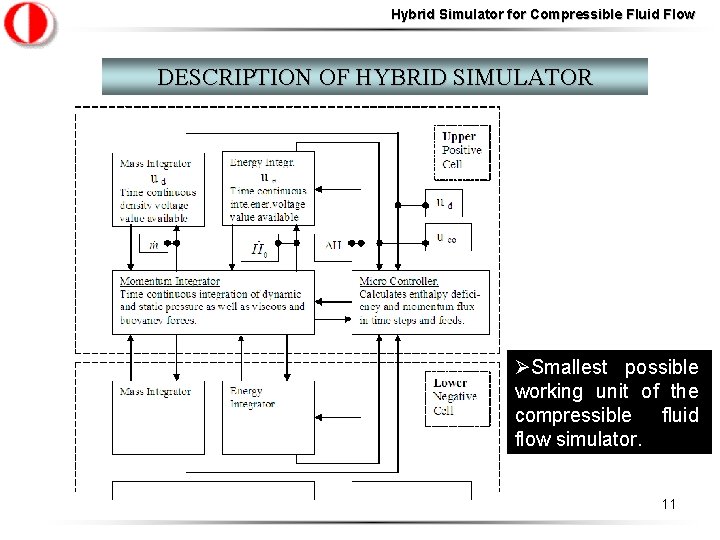
Hybrid Simulator for Compressible Fluid Flow DESCRIPTION OF HYBRID SIMULATOR ØSmallest possible working unit of the compressible fluid flow simulator. 11
Hybrid Simulator for Compressible Fluid Flow DESCRIPTION OF HYBRID SIMULATOR 12
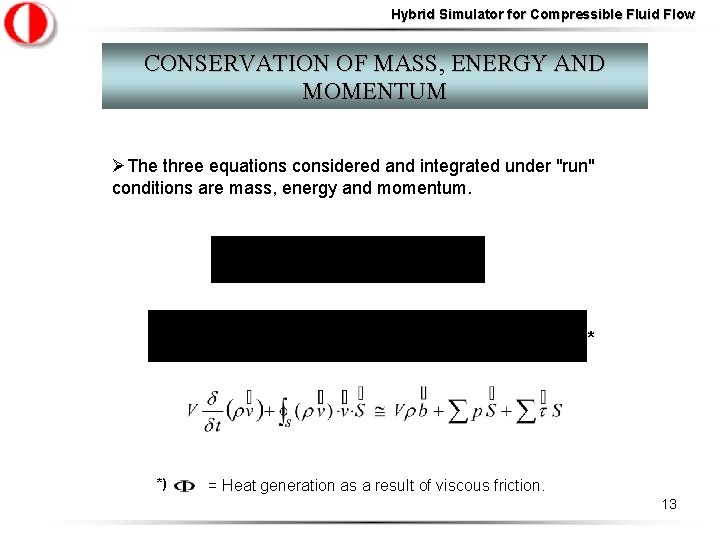
Hybrid Simulator for Compressible Fluid Flow CONSERVATION OF MASS, ENERGY AND MOMENTUM ØThe three equations considered and integrated under "run" conditions are mass, energy and momentum. * *) = Heat generation as a result of viscous friction. 13
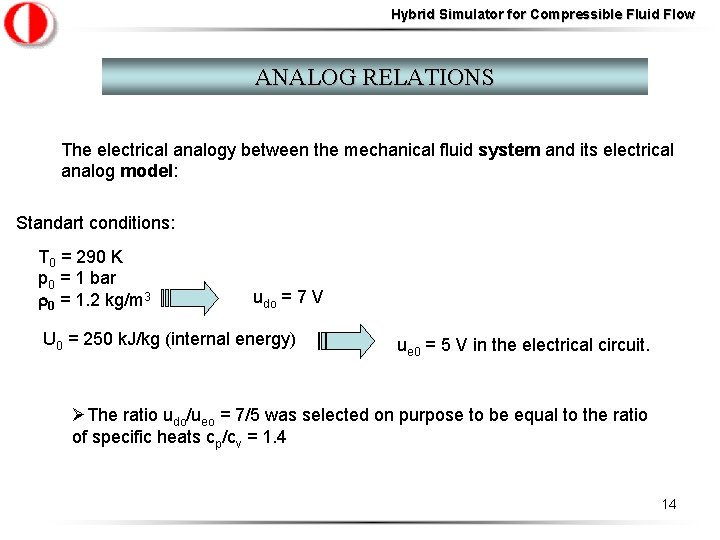
Hybrid Simulator for Compressible Fluid Flow ANALOG RELATIONS The electrical analogy between the mechanical fluid system and its electrical analog model: Standart conditions: T 0 = 290 K p 0 = 1 bar 0 = 1. 2 kg/m 3 udo = 7 V U 0 = 250 k. J/kg (internal energy) ue 0 = 5 V in the electrical circuit. ØThe ratio udo/ueo = 7/5 was selected on purpose to be equal to the ratio of specific heats cp/cv = 1. 4 14

Hybrid Simulator for Compressible Fluid Flow ANALOG RELATIONS ØThe system (actual)-to-model (circuit) ratios of analogy utilized are as follows: üMass (density) and energy (internal) are scalars and represented by volatages ud and ue on the integrator capacitors, respectively üThe other system to model analog ratios are as follows: n 0 = Δt/ Δtel [s/sel] n 1 = m /Q [kg/C] n 2 = V/C [m 3/F] n 3 = ρ/ud [kg/m 3 V] n 4 = S∙R [m 2Ω] n 5 = cv∙ ρ∙T/ue [J/m 3 V] n 6 = ρ∙v/um [kg/m 2 s. V] [Ns/m 3 V] where 15
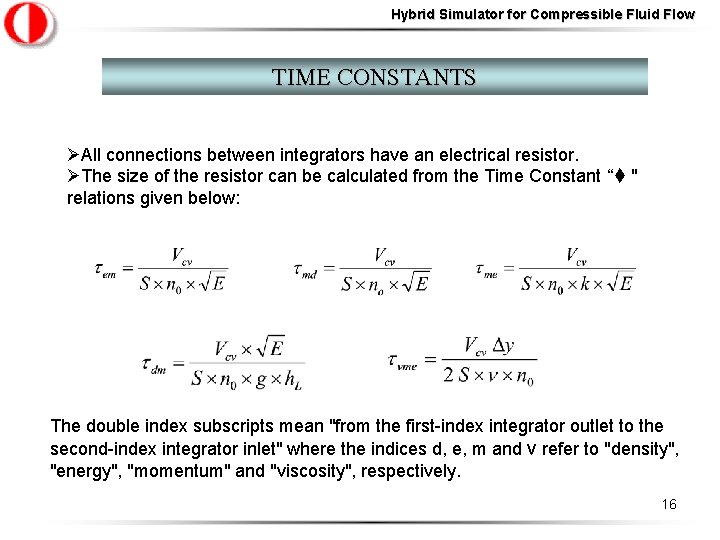
Hybrid Simulator for Compressible Fluid Flow TIME CONSTANTS ØAll connections between integrators have an electrical resistor. ØThe size of the resistor can be calculated from the Time Constant “ " relations given below: The double index subscripts mean "from the first-index integrator outlet to the second-index integrator inlet" where the indices d, e, m and ν refer to "density", "energy", "momentum" and "viscosity", respectively. 16
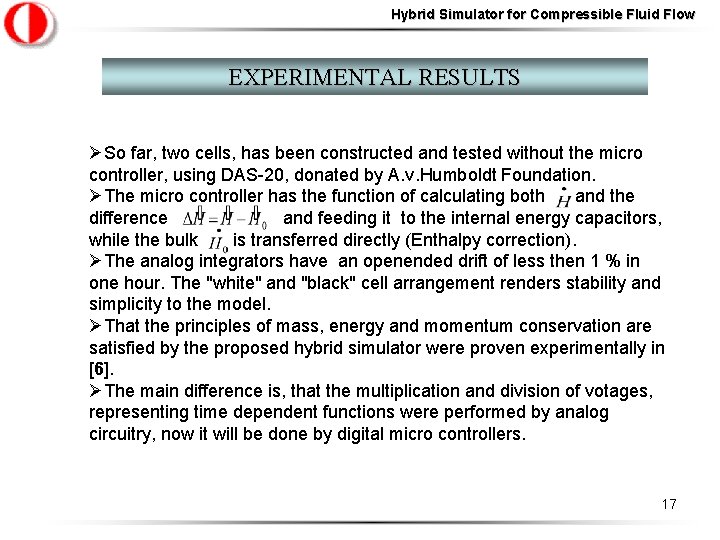
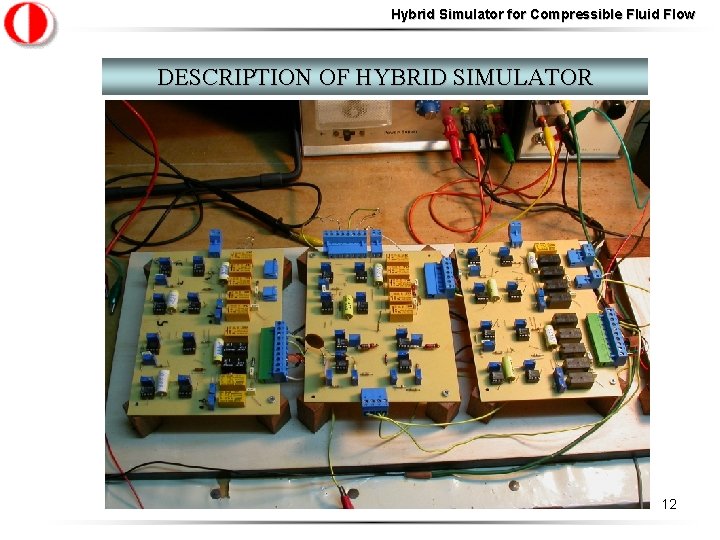
Hybrid Simulator for Compressible Fluid Flow EXPERIMENTAL RESULTS ØSo far, two cells, has been constructed and tested without the micro controller, using DAS-20, donated by A. v. Humboldt Foundation. ØThe micro controller has the function of calculating both and the difference and feeding it to the internal energy capacitors, while the bulk is transferred directly (Enthalpy correction). ØThe analog integrators have an openended drift of less then 1 % in one hour. The "white" and "black" cell arrangement renders stability and simplicity to the model. ØThat the principles of mass, energy and momentum conservation are satisfied by the proposed hybrid simulator were proven experimentally in [6]. ØThe main difference is, that the multiplication and division of votages, representing time dependent functions were performed by analog circuitry, now it will be done by digital micro controllers. 17
Hybrid Simulator for Compressible Fluid Flow REFERENCES 1) Saryal, N. "Lösung des Temperaturverteilungsproblems in Rotoren von Dampfturbinen beim Anfahren, im satationaeren Zustand und beim Abschalten durch die elektrische Analogie-Methode" (Ph. D. Thesis, Berlin 1956) 2) Saryal, N. "Solution of Transient State Thermal Stress Problems Through Electrical Analogy. " (METU 1966, Engr. Faculty Publication No. 16) 3) Saryal, N. "Electro-Analog Models for Heat Exchangers and Simplified Method for Heat Exchanger Calculations. " (Int. J. Heat Mass Transfer, Vol. 17 pp 971 - 980 Pergamon Press 1974) 4) Saryal, N. "Beuken Model for Complicated Diffusion Systems", (Elektrowaerme International, Vol. 39 pp. , August 1981) 5) Saryal, N. "Elektrische Analogie von Druckwasser-Kernreaktoren. " (Waerme, Vol. 87 Nr. 1 pp 5 - 9 , Febr. 1981) 6) Sönmez M. “A New Double Hybrid Computer System to Analyse Natural Convection Heat Transfer” (Dissertation, METU, Ankara, 1995) 18
Hybrid Simulator for Compressible Fluid Flow LITERATURE 1) Sterling T. "How to Build a Hyper Computer" (Scientific American, July 2001, pp. 28 -35 especially; tabulated information on pages 31 and 32). 2) Hoffman R. N. "Controlling Hurricanes" (October 2004, pp. 38 -45, esp. page 41 "Modeling Chaos"). 3) Lloyd S. and NG Y. J. "Black Hole Computers" (November 2004, pp. 30 -39, esp. page 34, first and second column). 4) Glatzmaier G. A. and Olson P. "Probing the Geodynamo" (April 2005, pp. 32 -39, esp. page 37 "What Might Be Missing"). 19
- Slides: 19