
Hybrid Rice Breeding Seed Production FANGMING XIE International

Hybrid Rice Breeding & Seed Production FANGMING XIE International Rice Research Institute DAPO BOX 7777 Metro Manila, Philippines f. xie@cgiar. org

What is Hybrid Rice? The first generation offspring of a rice cross between two genetically diverse parents
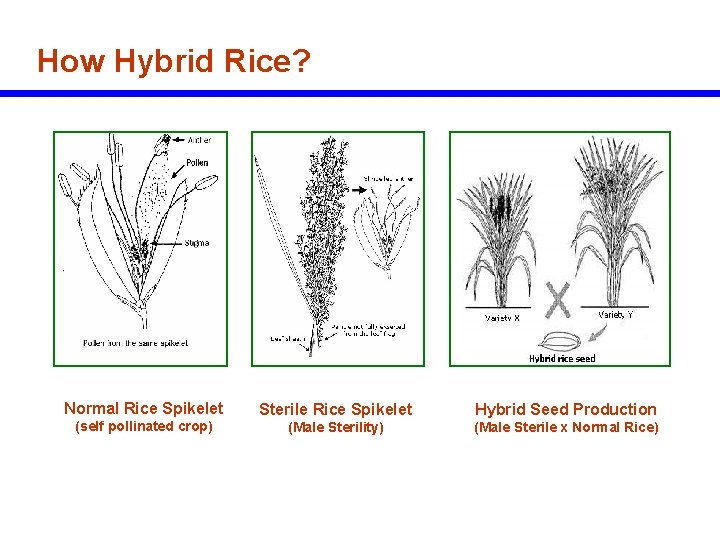
How Hybrid Rice? Normal Rice Spikelet (self pollinated crop) Sterile Rice Spikelet Hybrid Seed Production (Male Sterility) (Male Sterile x Normal Rice)
Why Hybrid Rice? Ø Heterosis (Hybrid vigor) Application to Increase: • Productivity (yield/unit/time, 15 -20% of yield advantage), and • Economic returns Ø Heterosis ü A universal phenomenon that F 1 generation shows superiority to both parents in agronomic traits or yield ü It presents in all biological systems and has been exploited commercially in many agricultural crops.
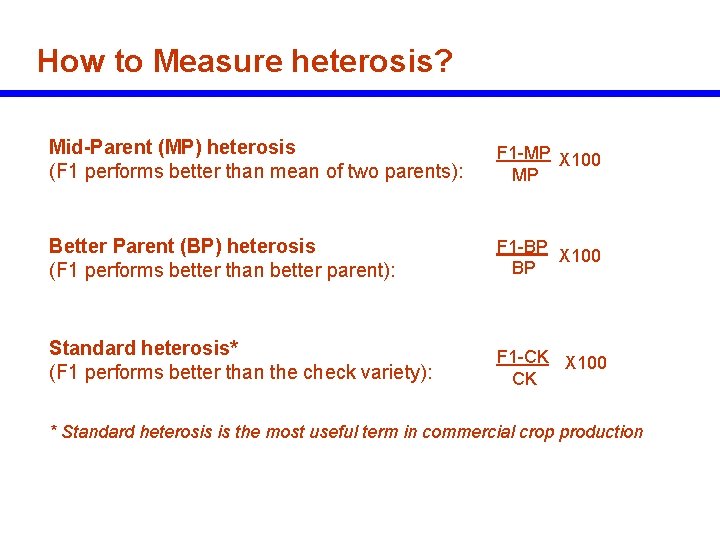
How to Measure heterosis? Mid-Parent (MP) heterosis (F 1 performs better than mean of two parents): F 1 -MP X 100 MP Better Parent (BP) heterosis (F 1 performs better than better parent): F 1 -BP X 100 BP Standard heterosis* (F 1 performs better than the check variety): F 1 -CK X 100 CK * Standard heterosis is the most useful term in commercial crop production

Male Sterility Systems in Rice Ø Male sterility: a condition in which the pollen grain is unviable or cannot germinate and fertilize normally to set seeds. Ø Male Sterility Systems (genetic and non-genetic): ü Cytoplasmic genetic male sterility (CMS) Male sterility is controlled by the interaction of a genetic factor (S) present in the cytoplasm and nuclear gene (s). ü Environment-sensitive genic male sterility (EGMS) Male sterility system is controlled by nuclear gene expression, which is influenced by environmental factors such as temperature (TGMS), daylength (PGMS), or both (TPGMS). ü Chemically induced male sterility Male sterility is induced by some chemicals (gametocides)

Brief history of hybrid rice ü 1926 - Heterosis in rice reported ü 1964 - China started hybrid rice research ü 1970 - China discovered a commercially usable genetic tool for hybrid rice (male sterility in a wild rice = Wide Abortive ) ü 1973 - PTGMS rice was found in China ü 1974 - First commercial three-line rice hybrid released in China ü 1976 - Large scale hybrid rice commercialization began in China ü 1979 - IRRI revived research on hybrid rice ü 1981 - PTGMS rice genetics and application was confirmed ü 1982 - Yield superiority of rice hybrids in the tropics confirmed (IRRI) ü 1990 s - India and Vietnam started hybrid rice programs with IRRI ü 1991 - More than 50% of China’s riceland planted to hybrids ü 1994 - First commercial two-line rice hybrid released in China ü 1994 - 1998 - Commercial rice hybrids released in India, Philippines Vietnam
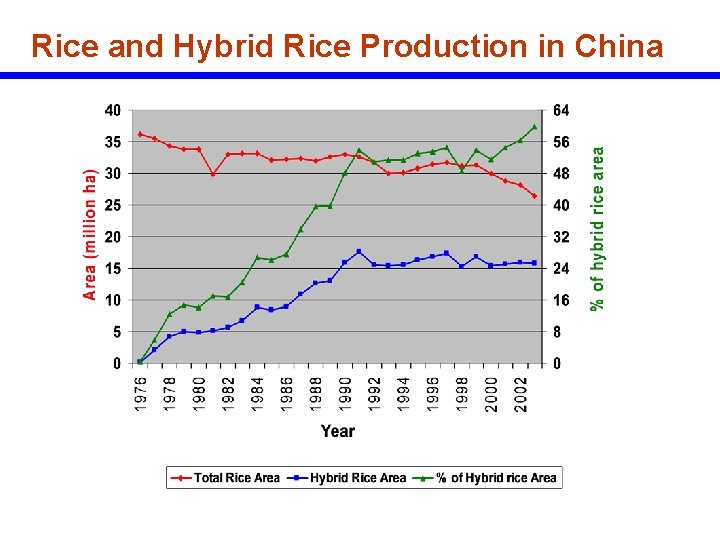
Rice and Hybrid Rice Production in China
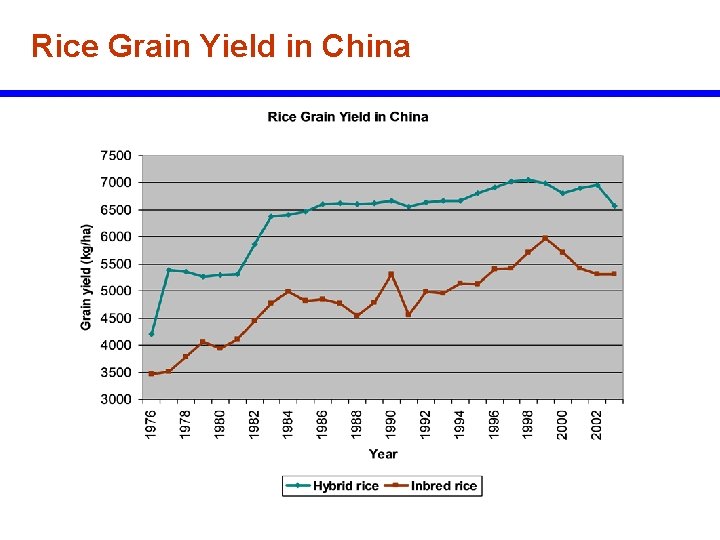
Rice Grain Yield in China

Hybrid Rice Area in other Asia Countries Hybrid Rice Area (1, 000 ha) Country 1997 Bangladesh India 100 2001 2004 2005 2006 15 50 90 150 (Exp) 200 560 NA 10 NA Indonesia Myanmar 2 42 NA Philippines 13 189 367 NA Vietnam 188 480 650 Total 288 710 1, 445 300(DS)
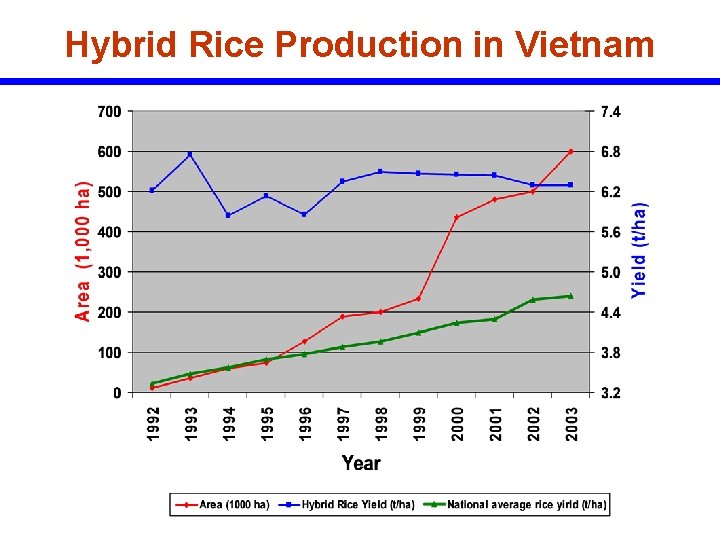
Hybrid Rice Production in Vietnam

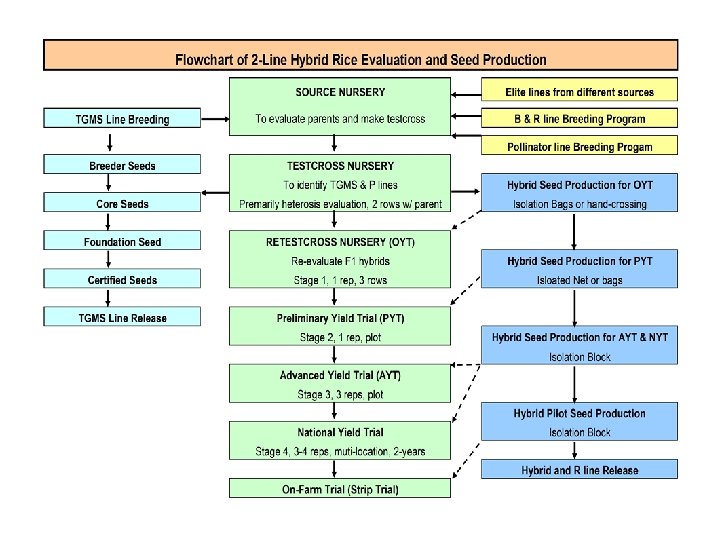
Two Commercial Systems for Hybrid Rice

Requirements for 3 Lines in CMS System Ø A-line ü Stable Sterility ü Well developed floral traits for outcrossing ü Easily, wide-spectum, & strongly to be restored Ø B-line ü Well developed floral traits with large pollen load ü Good combining ability Ø R-line ü Strong restore ability ü Good combining ability ü Taller than A-line ü Large pollen load, normal flowering traits and timing

TGMS and two-line hybrid Temperature Reproductive Upper Limit high Ø Based on the discovery of P(T)GMS mutant Sterile F 1 Seed Production Critical Sterility Point Ø Male sterility controlled by 1 or 2 pairs of recessive gene(s) Partial Sterility Critical Fertility Point Fertile S-line Multiplication low Reproductive Lower Limit Model of Sterility / Fertility Expression for TGMS Rice
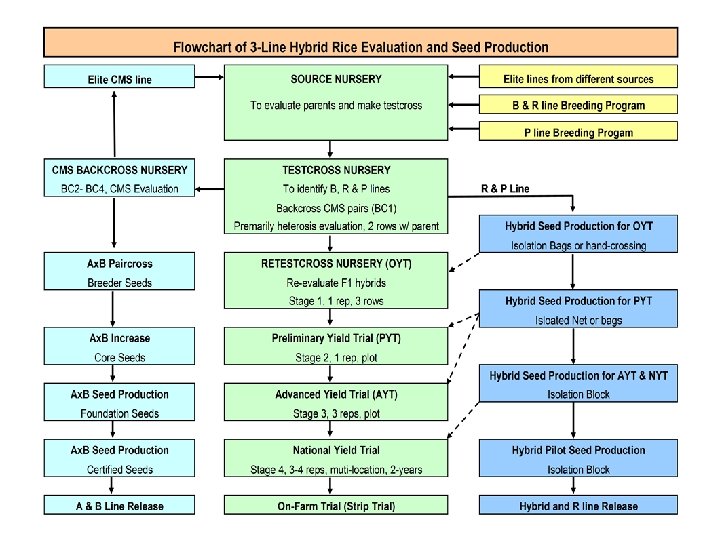

Advantage & Disadvantage of 3 -line hybrid rice system Ø Advantages ü Stable male sterility Ø Disadvantages ü Limit germplasm source (CMS, Restorer) ü Dominant CMS cytoplasm in large area (WA) ü One more step for parental seed production ü Time consuming of CMS breeding
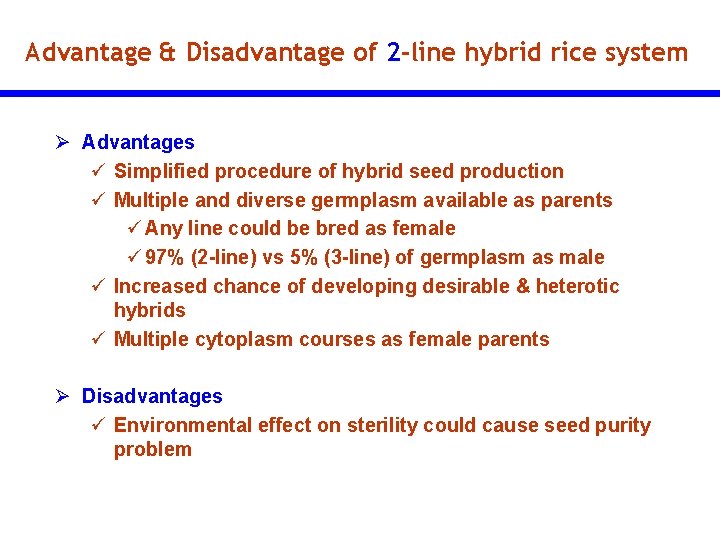
Advantage & Disadvantage of 2 -line hybrid rice system Ø Advantages ü Simplified procedure of hybrid seed production ü Multiple and diverse germplasm available as parents ü Any line could be bred as female ü 97% (2 -line) vs 5% (3 -line) of germplasm as male ü Increased chance of developing desirable & heterotic hybrids ü Multiple cytoplasm courses as female parents Ø Disadvantages ü Environmental effect on sterility could cause seed purity problem

Two-line hybrid production in China

Hybrid Rice Seed Standard
Mission of IRRI Hybrid Rice Program Ø Developing germplasm, parents and hybrids as internationally public goods Ø Research new technology for breeding and seed production Ø Collaboration with NARS and private sectors in hybrid rice research and production Ø Promotion of exchange of information, technology, scientist and germplasm
Strategy of IRRI Hybrid Rice Program Ø Focusing on conventional tools and integrate them with proven non-conventional methods to develop the technology Ø Developing parental lines, especially female parents with high outcrossing and high quality, to promote hybrid rice spreading Ø Facilitating development of close partnership between public and private sectors in national programs Ø Intensifying agronomic research to get maximized manifestation of heterosis in hybrids
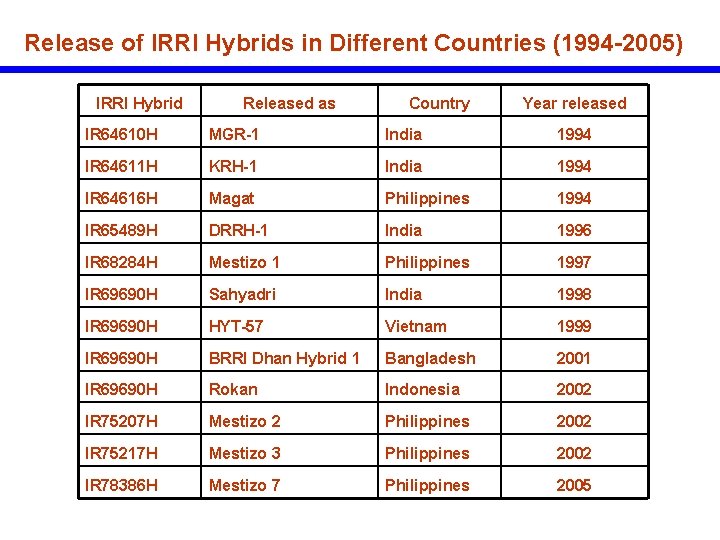
Release of IRRI Hybrids in Different Countries (1994 -2005) IRRI Hybrid Released as Country Year released IR 64610 H MGR-1 India 1994 IR 64611 H KRH-1 India 1994 IR 64616 H Magat Philippines 1994 IR 65489 H DRRH-1 India 1996 IR 68284 H Mestizo 1 Philippines 1997 IR 69690 H Sahyadri India 1998 IR 69690 H HYT-57 Vietnam 1999 IR 69690 H BRRI Dhan Hybrid 1 Bangladesh 2001 IR 69690 H Rokan Indonesia 2002 IR 75207 H Mestizo 2 Philippines 2002 IR 75217 H Mestizo 3 Philippines 2002 IR 78386 H Mestizo 7 Philippines 2005
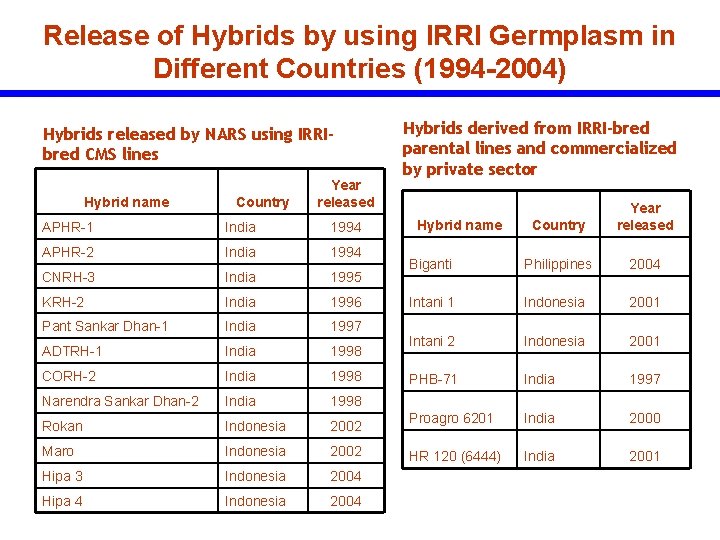
Release of Hybrids by using IRRI Germplasm in Different Countries (1994 -2004) Hybrids released by NARS using IRRIbred CMS lines Hybrid name Country Year released APHR-1 India 1994 APHR-2 India 1994 CNRH-3 India 1995 KRH-2 India 1996 Pant Sankar Dhan-1 India 1997 ADTRH-1 India 1998 CORH-2 India 1998 Narendra Sankar Dhan-2 India 1998 Rokan Indonesia 2002 Maro Indonesia 2002 Hipa 3 Indonesia 2004 Hipa 4 Indonesia 2004 Hybrids derived from IRRI-bred parental lines and commercialized by private sector Country Year released Biganti Philippines 2004 Intani 1 Indonesia 2001 Intani 2 Indonesia 2001 PHB-71 India 1997 Proagro 6201 India 2000 HR 120 (6444) India 2001 Hybrid name
Germplasm Shared
“Super high-yielding” hybrid rice breeding in China
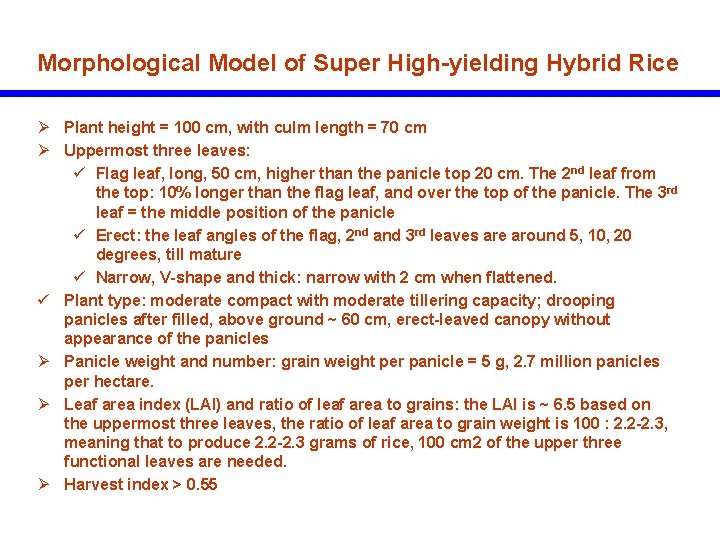
Morphological Model of Super High-yielding Hybrid Rice Ø Plant height = 100 cm, with culm length = 70 cm Ø Uppermost three leaves: ü Flag leaf, long, 50 cm, higher than the panicle top 20 cm. The 2 nd leaf from the top: 10% longer than the flag leaf, and over the top of the panicle. The 3 rd leaf = the middle position of the panicle ü Erect: the leaf angles of the flag, 2 nd and 3 rd leaves are around 5, 10, 20 degrees, till mature ü Narrow, V-shape and thick: narrow with 2 cm when flattened. ü Plant type: moderate compact with moderate tillering capacity; drooping panicles after filled, above ground ~ 60 cm, erect-leaved canopy without appearance of the panicles Ø Panicle weight and number: grain weight per panicle = 5 g, 2. 7 million panicles per hectare. Ø Leaf area index (LAI) and ratio of leaf area to grains: the LAI is ~ 6. 5 based on the uppermost three leaves, the ratio of leaf area to grain weight is 100 : 2. 2 -2. 3, meaning that to produce 2. 2 -2. 3 grams of rice, 100 cm 2 of the upper three functional leaves are needed. Ø Harvest index > 0. 55

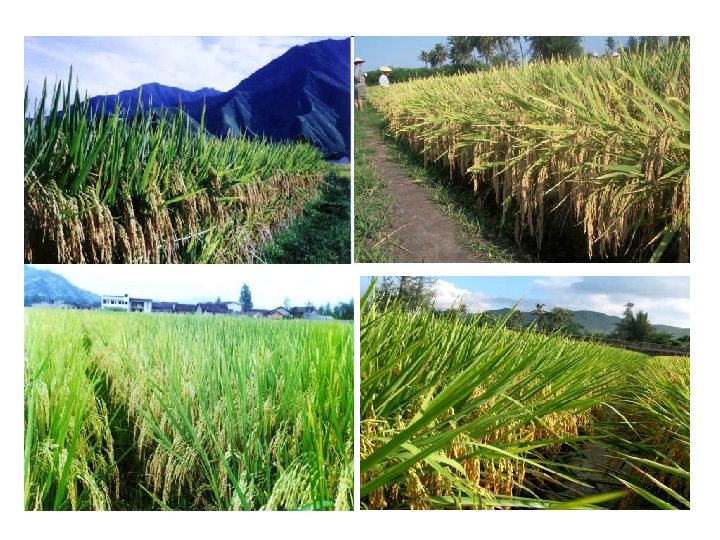

Hybrid Heterosis in Rice Indica x japonica Indica x javanica japonica x javanica indica x indica japonica x japonica
Inter-subspecific hybrid rice breeding Ø Difficult in breeding inter-subspecific hybrid rice ü Low seed set ü Tall plant height ü Poor grain-filling ü Late maturity ü Grain quality market Ø Solution for breeding of inter-subspecific hybrid rice ü wide compatibility (WC) genes ü allelic dwarf gene ü indica/javanica hybrids in indica rice growing region ü japonica/javanica hybrids in japonica rice growing
Future Opportunity: Enhance yield heterosis Ø Exploiting subspecies heterosis Ø Applying biotechnology for parent selection (heterotic groups and/or heterotic gene blocks Enhanced yield heterosis in indica / NPT hybrids compared to indica / indica hybrids (retestcross, IRRI, 2004 WS) Yield advantage (%) over best inbred check Hybrid # of heterotic Total # of % of heterotic hybrids Range Mean indica / indica 34 85 40 1 -80 29 Indica / NPT 20 40 50 6 -131 42
Future Opportunity: Increase yield of hybrid seed production Performance of hybrid seed production in tropical countries (2003 -2004) Yield (kg/ha) Country Mean Range India 1, 600 1, 000 – 4, 500 Vietnam 2, 000 1, 500 – 3, 500 Philippines 810 (04 DS) 600 – 2, 000 Bangladesh 800 600 – 2, 000 Indonesia 500 300 – 1, 600 2, 750 1, 500 – 6, 000 China Ø Developing high outcrossing parents ü Improving seed production technology ü Training seed growers ü Selecting adequate location / season
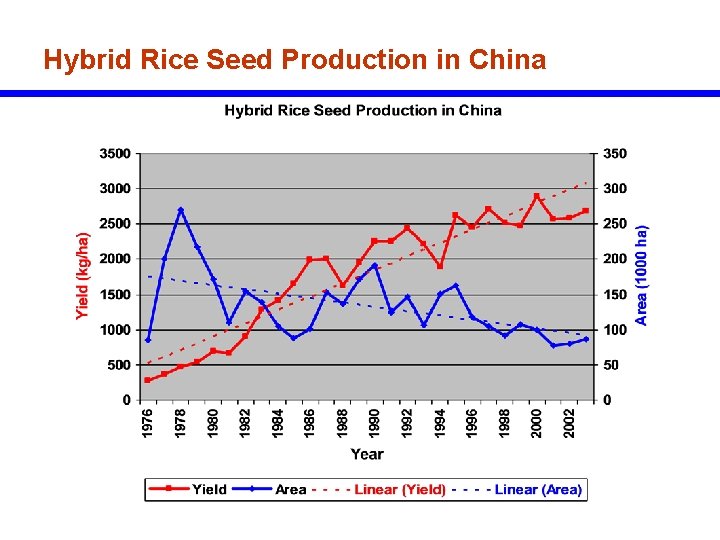
Hybrid Rice Seed Production in China
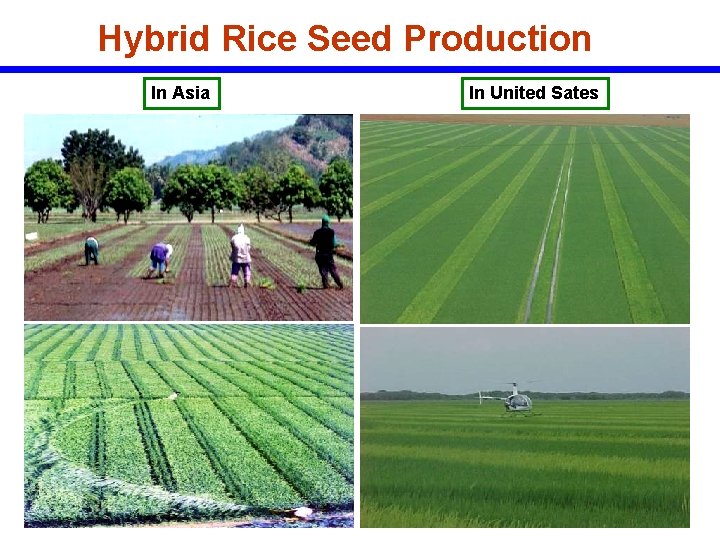
Hybrid Rice Seed Production In Asia In United Sates
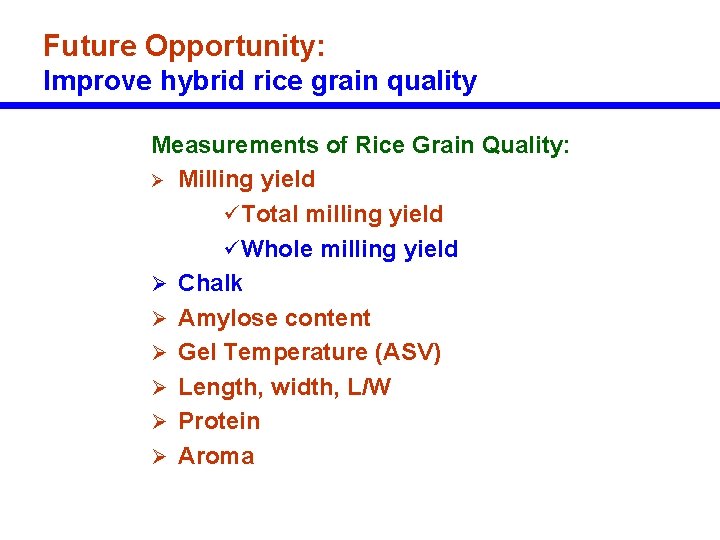
Future Opportunity: Improve hybrid rice grain quality Measurements of Rice Grain Quality: Ø Milling yield ü Total milling yield ü Whole milling yield Ø Chalk Ø Amylose content Ø Gel Temperature (ASV) Ø Length, width, L/W Ø Protein Ø Aroma
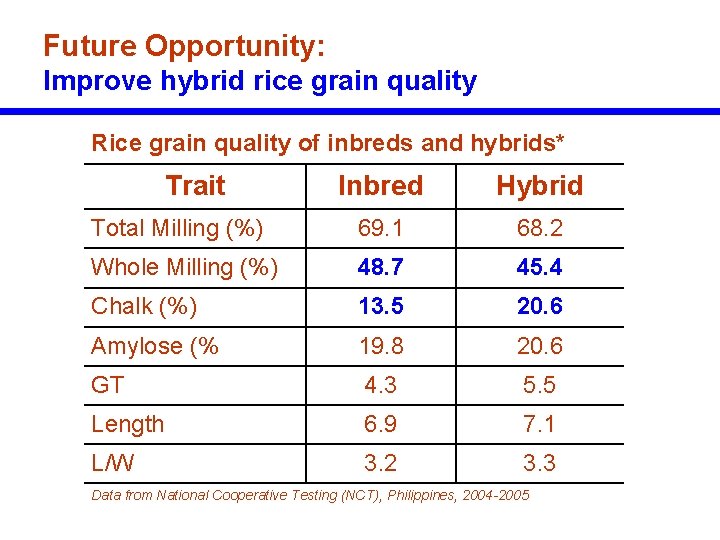
Future Opportunity: Improve hybrid rice grain quality Rice grain quality of inbreds and hybrids* Trait Inbred Hybrid Total Milling (%) 69. 1 68. 2 Whole Milling (%) 48. 7 45. 4 Chalk (%) 13. 5 20. 6 Amylose (% 19. 8 20. 6 GT 4. 3 5. 5 Length 6. 9 7. 1 L/W 3. 2 3. 3 Data from National Cooperative Testing (NCT), Philippines, 2004 -2005
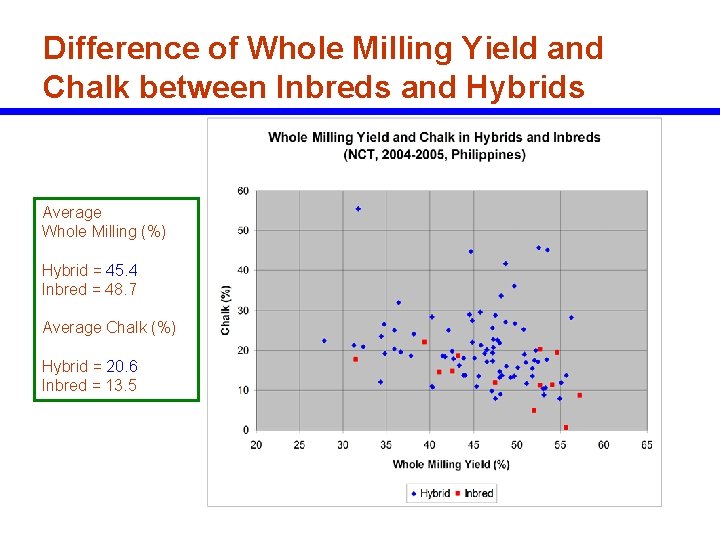
Difference of Whole Milling Yield and Chalk between Inbreds and Hybrids Average Whole Milling (%) Hybrid = 45. 4 Inbred = 48. 7 Average Chalk (%) Hybrid = 20. 6 Inbred = 13. 5
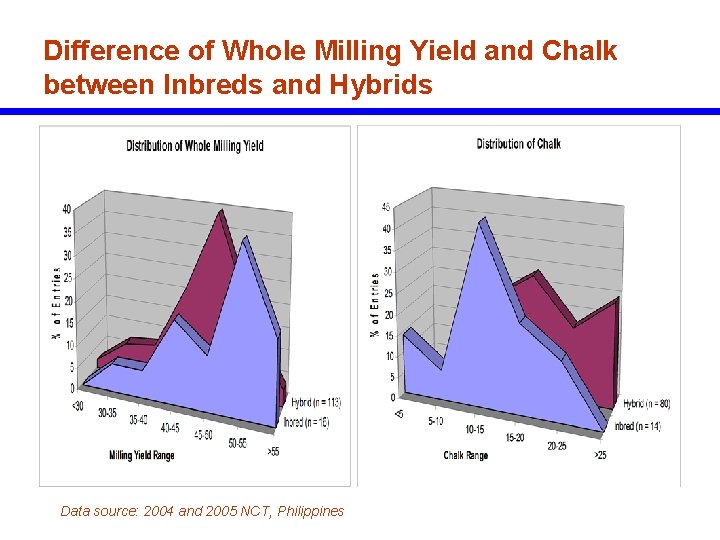
Difference of Whole Milling Yield and Chalk between Inbreds and Hybrids Data source: 2004 and 2005 NCT, Philippines
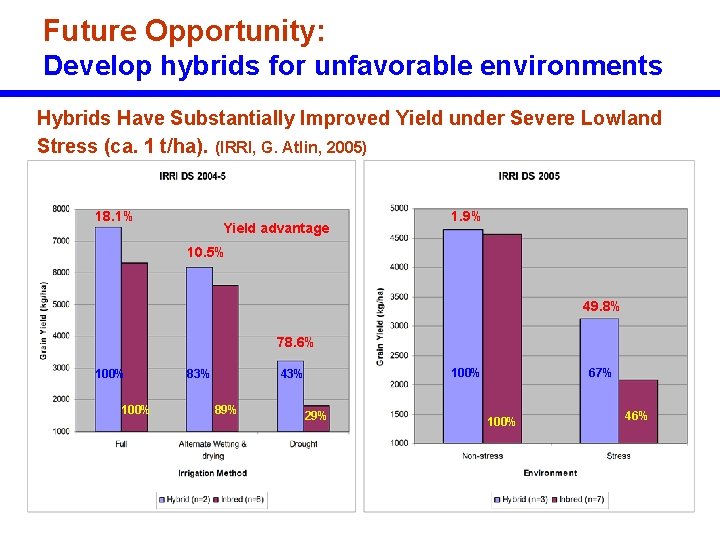
Future Opportunity: Develop hybrids for unfavorable environments Hybrids Have Substantially Improved Yield under Severe Lowland Stress (ca. 1 t/ha). (IRRI, G. Atlin, 2005) 18. 1% Yield advantage 1. 9% 10. 5% 49. 8% 78. 6% 100% 83% 43% 89% 29% 100% 67% 100% 46%
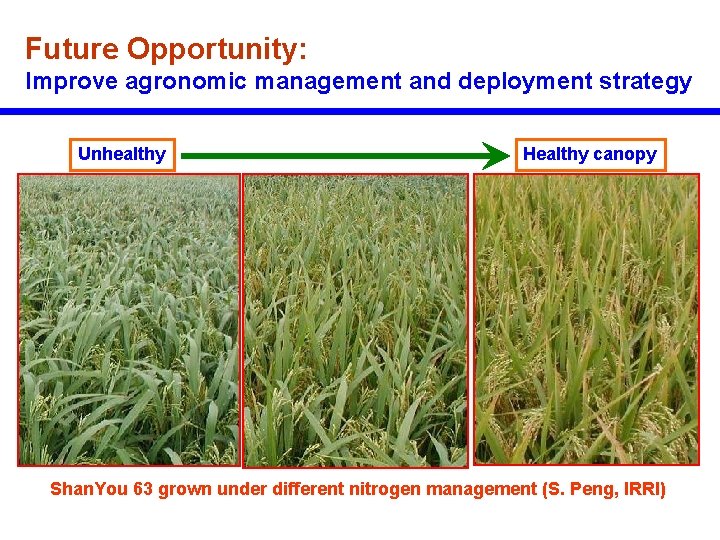
Future Opportunity: Improve agronomic management and deployment strategy Unhealthy Healthy canopy Shan. You 63 grown under different nitrogen management (S. Peng, IRRI)
- Slides: 41