
Hybrid quantum decoupling and error correction Leonid Pryadko
Hybrid quantum decoupling and error correction Leonid Pryadko University of California, Riverside Yunfan Li Daniel Lidar (UCR) (USC) Pinaki Sengupta (LANL) Greg Quiroz (USC) Sasha Korotkov (UCR)
Outline • Motivation: QEC and encoded dynamical decoupling with correlated noise • General results on dynamical decoupling • Concurrent application of logic • Intercalated application of logic • Conclusions and perspective
Stabilizer QECC • Error correction is done by measuring the stabilizers frequently and correcting with the corresponding error operators if needed • QECC period should be small compared to the decoherence rate • Traditional QECCs: – Expensive: need many ancillas, fast measurement, processing & correcting – May not work well with correlated environment
![QECC with constant error terms [[3, 1, 3]] 1 qubit [[5, 1, 3]] [[5,](http://slidetodoc.com/presentation_image/85c548fb5f91577b0c3c5d81ee3efd84/image-4.jpg "QECC with constant error terms [[3, 1, 3]] 1 qubit [[5, 1, 3]] [[5,")
QECC with constant error terms [[3, 1, 3]] 1 qubit [[5, 1, 3]] [[5, 1, 5]]
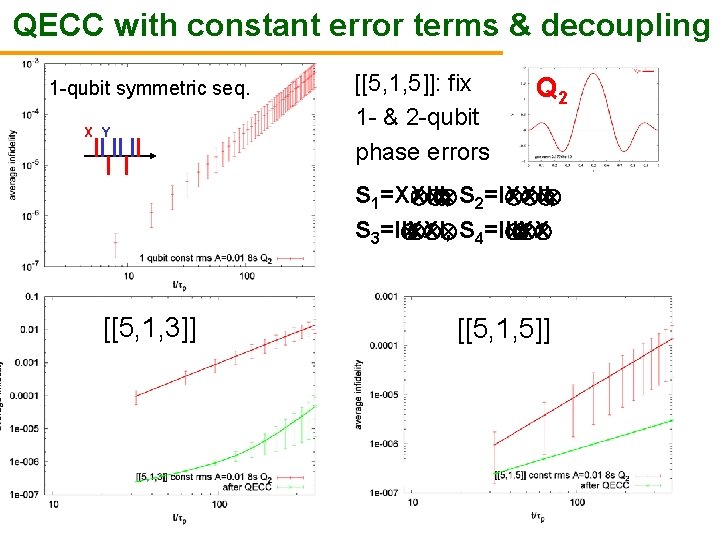
QECC with constant error terms & decoupling 1 -qubit symmetric seq. X Y [[5, 1, 5]]: fix 1 - & 2 -qubit phase errors Q 2 S 1=X X I I I, S 2=I X X I I, S 3=I I X X I, S 4=I I I X X [[5, 1, 3]] [[5, 1, 5]]
Combined coherence protection technique • Passive: Dynamical Decoupling – Effective with low-frequency bath – Most frugal with ancilla qubits needed – Needs fast pulsing (resource used: bandwidth) • Active: Quantum error correcting codes – – Most universal Needs many ancilla qubits Needs fast measurement, processing & correcting Expensive • Combined: Encoded Dynamical Recoupling [Viola, Lloyd & Knill (1999)] – Better suppression of decoherence due to slow environment potentially much more efficient – Control can be done along with decoupling

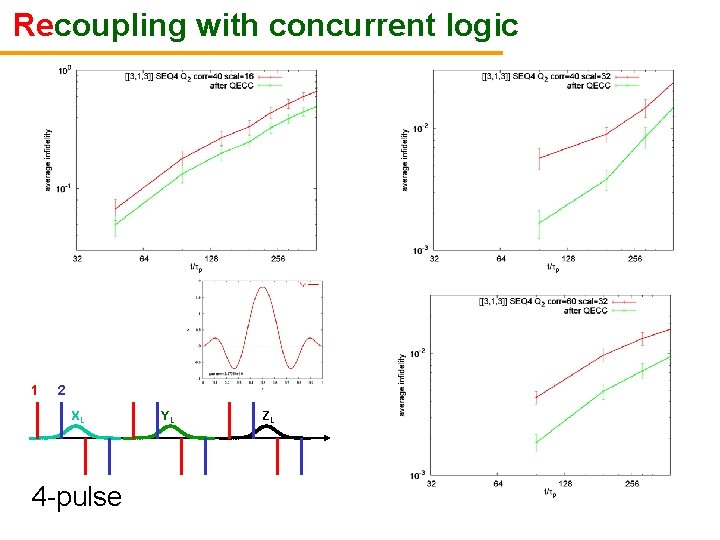
Example with hard pulses & constant errors • Errors are fully reversed at the end of the decoupling cycle 1 2 • Normalizer and stabilizer commute – add logic anywhere!? 1 2 XL YL ZL
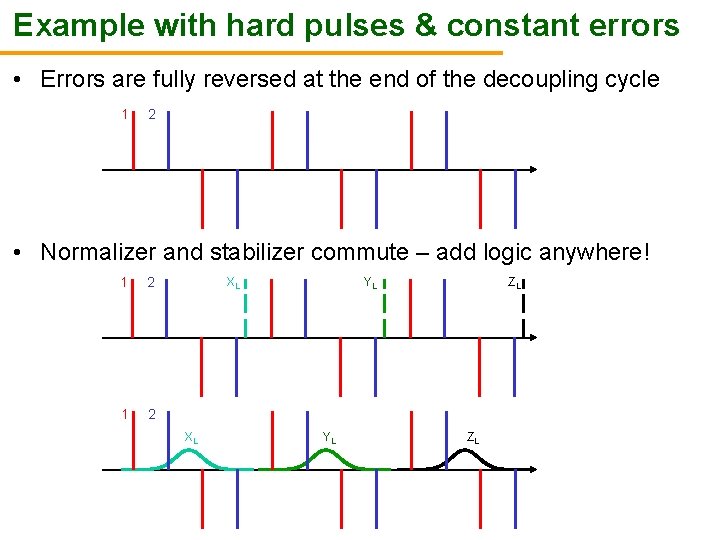
Example with hard pulses & constant errors • Errors are fully reversed at the end of the decoupling cycle 1 2 • Normalizer and stabilizer commute – add logic anywhere! 1 2 XL XL YL YL ZL ZL

Error operators in rotating frame • S: system, E: environment, DD: dynamical decoupling • Dynamical decoupling is dominant: is large • Solve controlled dynamics and write the Hamiltonian in the interaction representation with respect to DD • Interaction representation with respect to environment • Bath coupling is now modulated at the combination of the environment and dynamical decoupling frequencies • With first-order average Hamiltonian suppressed, all S+E coupling is shifted to high frequences no T 1 processes (Kofman & Kurizki, 2001)
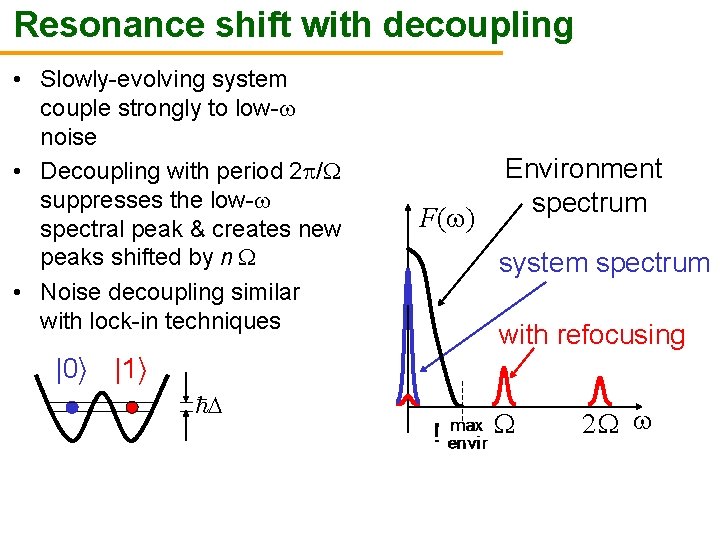
Resonance shift with decoupling • Slowly-evolving system couple strongly to low- noise • Decoupling with period 2 / suppresses the low- spectral peak & creates new peaks shifted by n • Noise decoupling similar with lock-in techniques F( ) Environment spectrum system spectrum with refocusing |0 i |1 i ~ 2
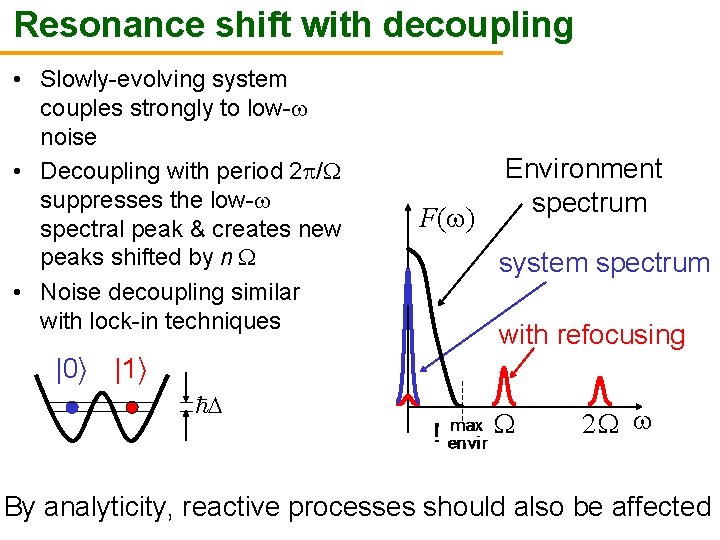
Resonance shift with decoupling • Slowly-evolving system couples strongly to low- noise • Decoupling with period 2 / suppresses the low- spectral peak & creates new peaks shifted by n • Noise decoupling similar with lock-in techniques F( ) Environment spectrum system spectrum with refocusing |0 i |1 i ~ 2 By analyticity, reactive processes should also be affected
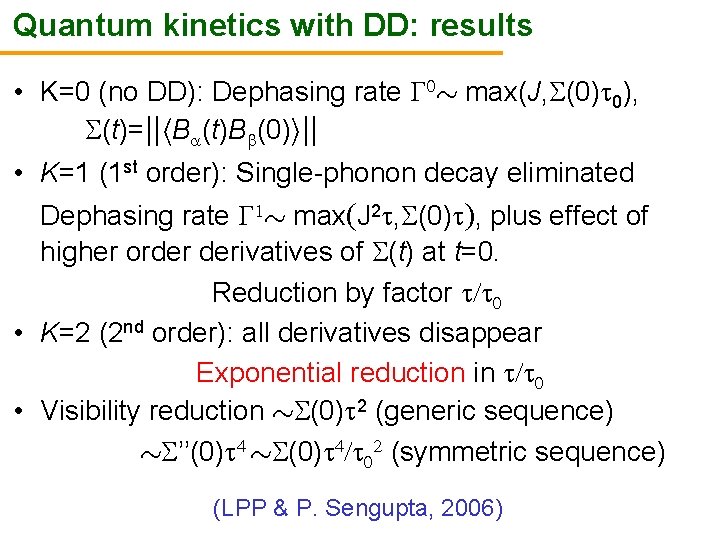
Quantum kinetics with DD: results • K=0 (no DD): Dephasing rate 0» max(J, (0) 0), (t)=||h. B (t)B (0)i|| • K=1 (1 st order): Single-phonon decay eliminated Dephasing rate 1» max(J 2 , (0) ), plus effect of higher order derivatives of (t) at t=0. Reduction by factor / 0 • K=2 (2 nd order): all derivatives disappear Exponential reduction in / 0 • Visibility reduction » (0) 2 (generic sequence) » ’’(0) 4 » (0) 4/ 02 (symmetric sequence) (LPP & P. Sengupta, 2006)
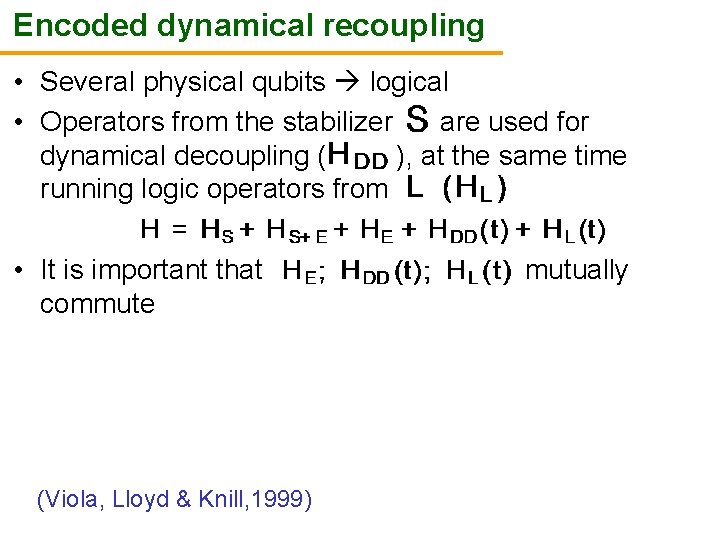
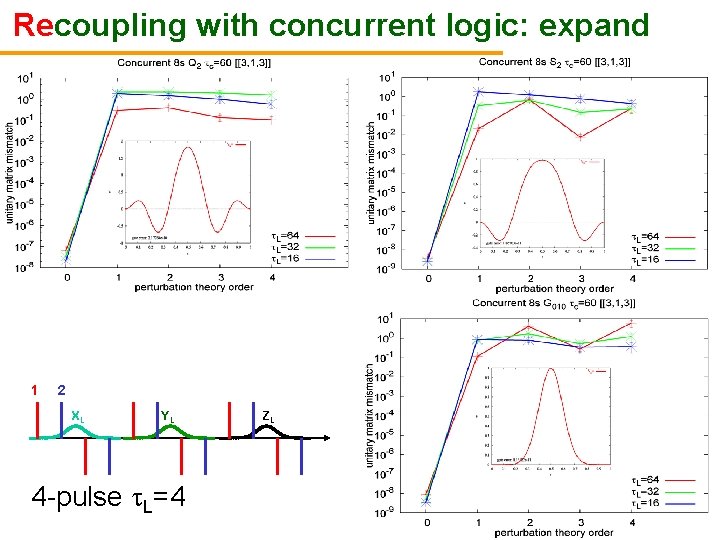
Encoded dynamical recoupling • Several physical qubits logical • Operators from the stabilizer are used for dynamical decoupling ( ), at the same time running logic operators from • It is important that commute (Viola, Lloyd & Knill, 1999) mutually
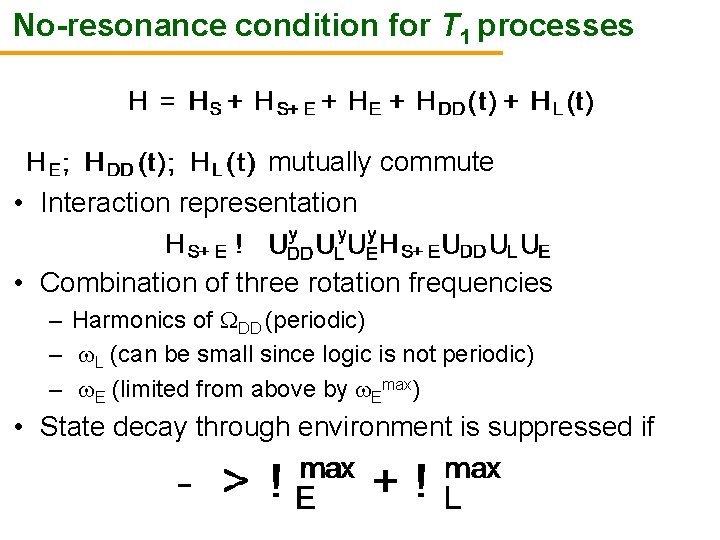
No-resonance condition for T 1 processes mutually commute • Interaction representation • Combination of three rotation frequencies – Harmonics of DD (periodic) – L (can be small since logic is not periodic) – E (limited from above by Emax) • State decay through environment is suppressed if
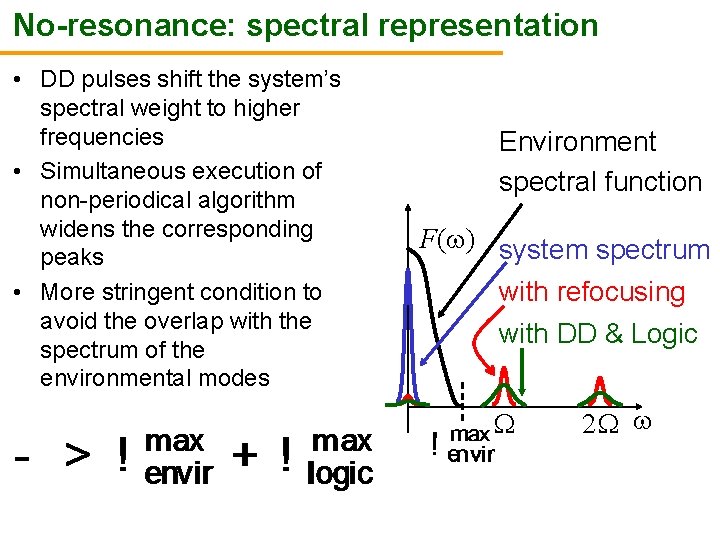
No-resonance: spectral representation • DD pulses shift the system’s spectral weight to higher frequencies • Simultaneous execution of non-periodical algorithm widens the corresponding peaks • More stringent condition to avoid the overlap with the spectrum of the environmental modes Environment spectral function F( ) system spectrum with refocusing with DD & Logic 2
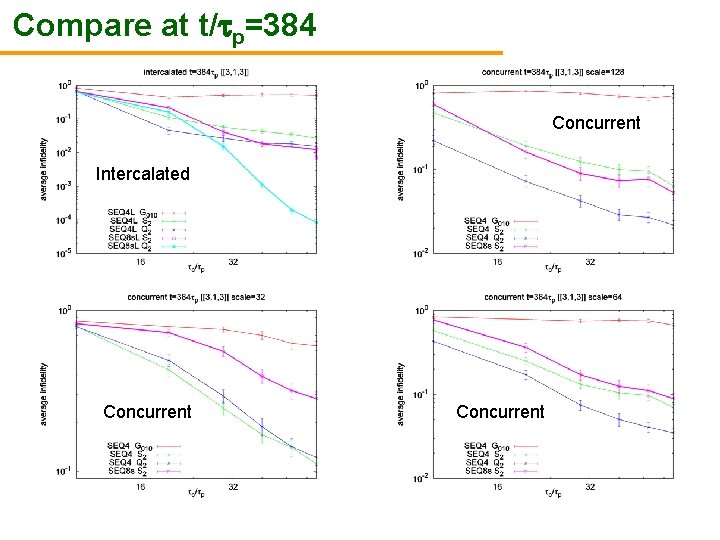
Recoupling with concurrent logic 1 2 XL 4 -pulse YL ZL
Recoupling with concurrent logic: expand 1 2 XL YL 4 -pulse L=4 ZL
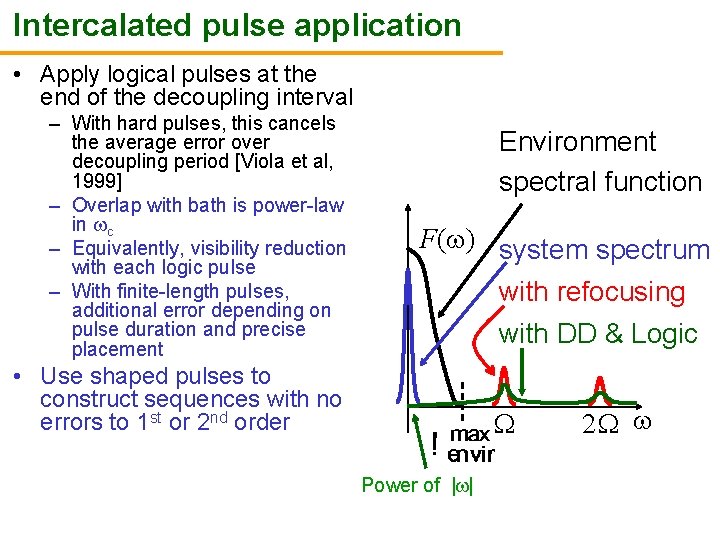
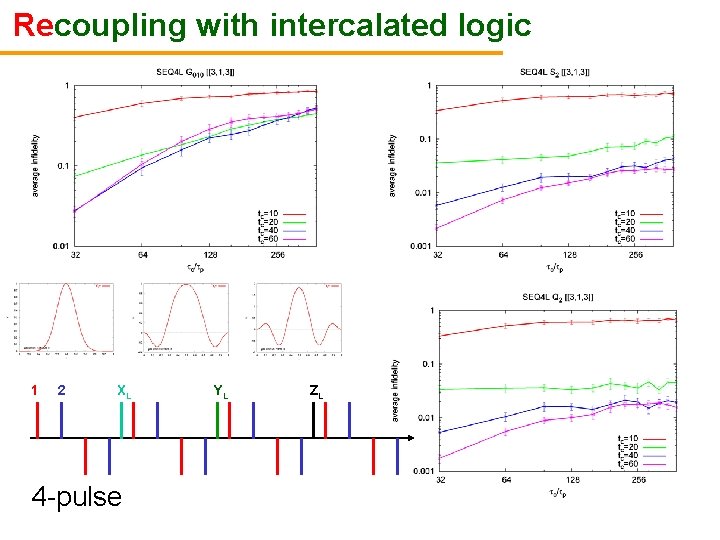
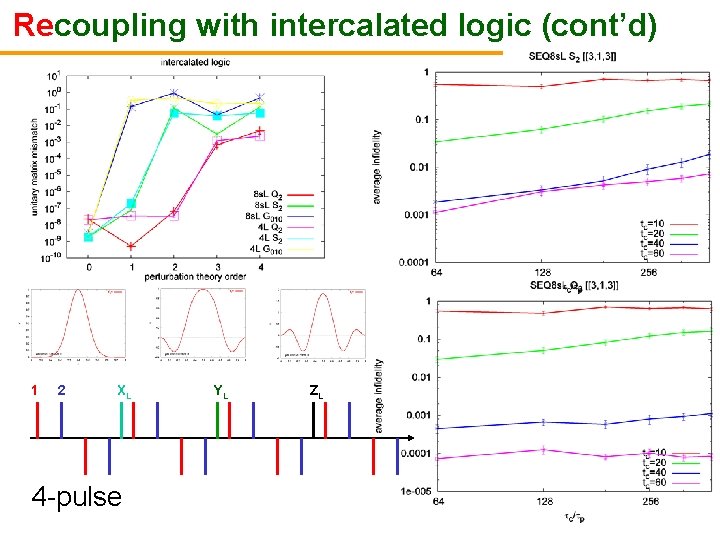
Intercalated pulse application • Apply logical pulses at the end of the decoupling interval – With hard pulses, this cancels the average error over decoupling period [Viola et al, 1999] – Overlap with bath is power-law in c – Equivalently, visibility reduction with each logic pulse – With finite-length pulses, additional error depending on pulse duration and precise placement Environment spectral function F( ) system spectrum with refocusing with DD & Logic • Use shaped pulses to construct sequences with no errors to 1 st or 2 nd order Power of | | 2
Recoupling with intercalated logic 1 2 XL 4 -pulse YL ZL
Recoupling with intercalated logic (cont’d) 1 2 XL 4 -pulse YL ZL
Compare at t/ p=384 Concurrent Intercalated Concurrent
Conclusions and Outlook • Much mileage can be gained from carefully engineered concatenation – With decoupling at the lowest level, need careful pulse placement, pulse & sequence design • Bandwidth is used to combine logic and decoupling • Still to confirm predicted parameter scaling • Analyze effects of: – Actual many-qubit gates needed – Fast decoherence addition – QEC dynamics (gates with ancillas, measurement, …) • Can fault-tolerance be achieved in this scheme?
- Slides: 22