
Hybrid Orbital Theory THE NEXT FRONTIER The Extension
Hybrid Orbital Theory THE NEXT FRONTIER
The Extension of Valence Bond Theory �Valence Bond theory does a good job in explaining which orbitals are involved in bonding. �The break down comes when we try to explain molecular shape. �Water, according to VBT should have a 90 o bond angle, in reality, the bond is closer to 104 o.
Hybridization of Orbitals �Hybridization is not a physical phenomenon; it is merely a mathematical operation that combines the atomic orbitals we are familiar with in such a way that the new (hybrid) orbitals possess the geometric and other properties that are reasonably consistent with what we observe in a wide range (but certainly not in all) molecules.
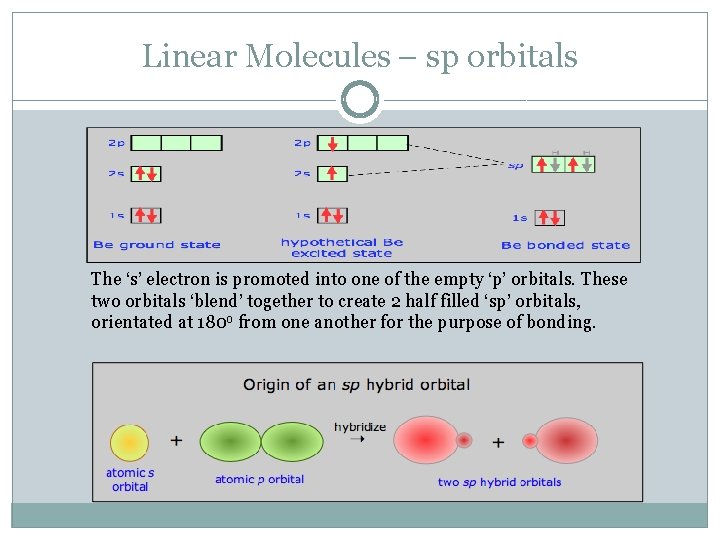
Linear Molecules – sp orbitals The ‘s’ electron is promoted into one of the empty ‘p’ orbitals. These two orbitals ‘blend’ together to create 2 half filled ‘sp’ orbitals, orientated at 180 o from one another for the purpose of bonding.
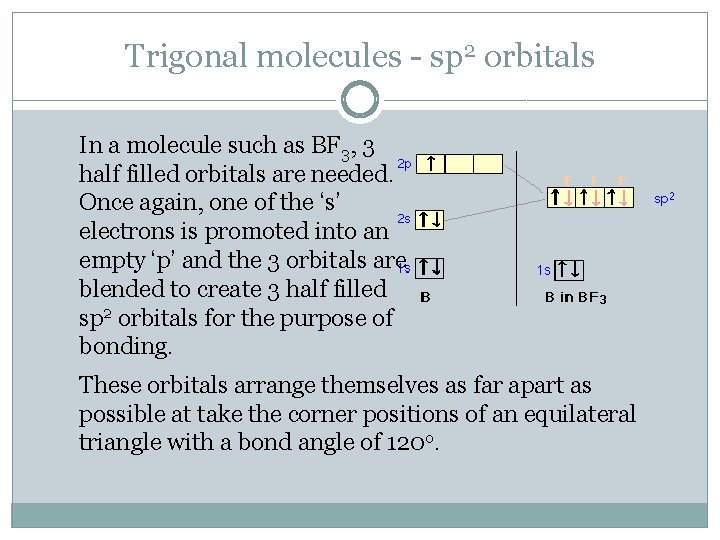
Trigonal molecules - sp 2 orbitals In a molecule such as BF 3, 3 half filled orbitals are needed. Once again, one of the ‘s’ electrons is promoted into an empty ‘p’ and the 3 orbitals are blended to create 3 half filled sp 2 orbitals for the purpose of bonding. These orbitals arrange themselves as far apart as possible at take the corner positions of an equilateral triangle with a bond angle of 120 o.
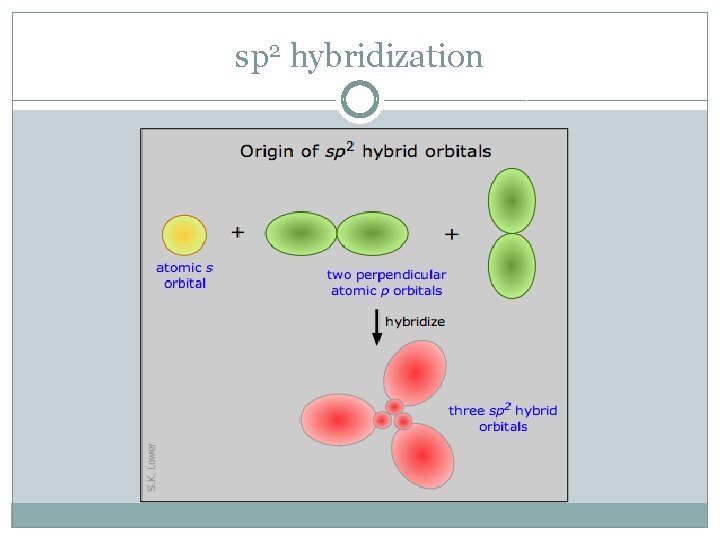
sp 2 hybridization
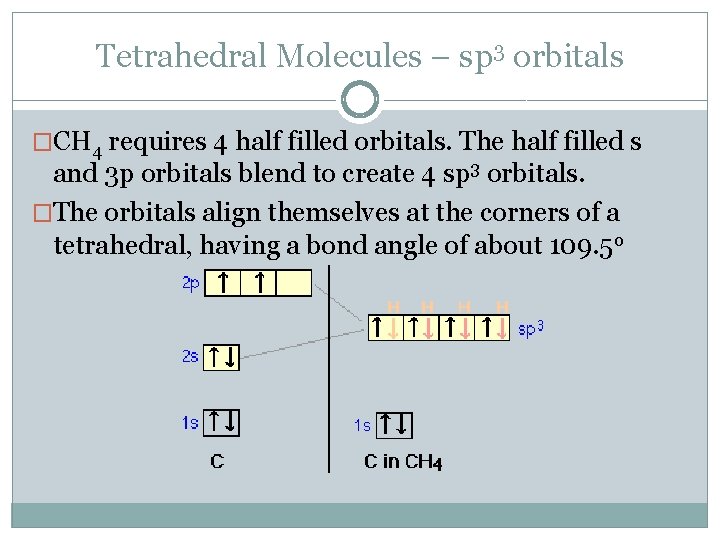
Tetrahedral Molecules – sp 3 orbitals �CH 4 requires 4 half filled orbitals. The half filled s and 3 p orbitals blend to create 4 sp 3 orbitals. �The orbitals align themselves at the corners of a tetrahedral, having a bond angle of about 109. 5 o
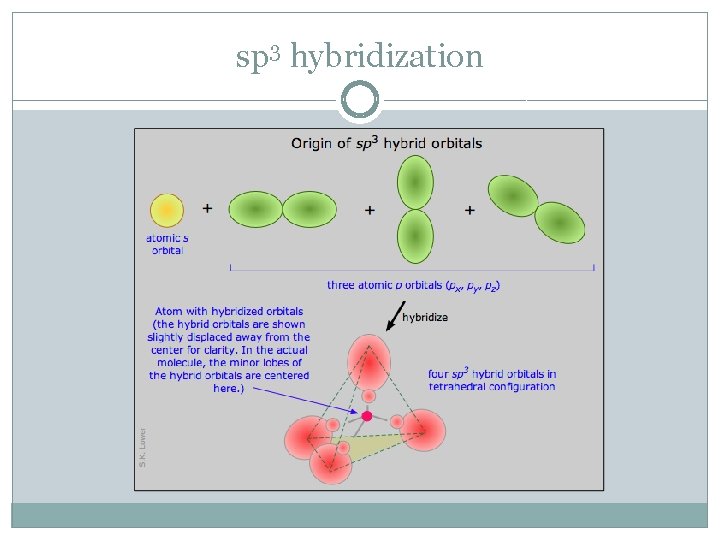
sp 3 hybridization
Extention �It is possible to extend this idea to predict how 5 or even 6 hybrid orbitals can be formed by including ‘d’ orbitals for any element beyond the 2 nd period. �sp 3 d – 5 bonding orbitals �sp 3 d 2 – 6 bonding orbitals

Lone Pairs �If lone pair electrons are present on the central atom, these can occupy one or more of the hybrid orbitals. �Lets look at ammonia – NH 3
References �http: //www. chem 1. com/acad/webtext/chembond/c b 06. html#SEC 2
- Slides: 11