
Hybrid Multicore Programming for Exascale Computing John Levesque

Hybrid Multi-core Programming for Exascale Computing John Levesque Director of Cray’s Supercomputing Center of Excellence NCAR Workshop September 7 -8, 2011
Hybrid Multi-core Architecture For the foreseeable future, Multi-petaflop and Exaflop systems will be massively parallel systems with high powered nodes that exhibit Multiple levels of parallelism Shared Memory parallelism on the node SIMD vector units on each core or thread Potentially disparate processing units Host with conventional X 86 architecture Accelerator with highly parallel – SIMD units Potentially disparate memories (Even when memory spaces are merged) Host with conventional DDR memory Accelerator with high bandwidth memory
Hybrid Multi-core Architecture All MPI will not be best approach Memory per core will decrease Injection bandwidth/core will decrease Memory bandwidth/core will decrease Hybrid MPI + threading on node may be able to Save Memory Reduce amount of off node communication required Reduce amount of memory bandwidth required (If shared caches are used effectively)
Programming for Future Multi-Petaflop and Exaflop Computers aka Finding more parallelism in existing applications Copyright 2011 Cray Inc. NCAR 2011
Hybridization* of an All MPI Application * Creation of an application that exhibits three levels of parallelism, MPI between nodes, Open. MP** on the node and vectorized looping structures ** Why Open. MP? To provide performance portability. Open. MP is the only threading construct that a compiler can analyze sufficiently to generate efficient threading on multi-core nodes and to generate efficient code for companion accelerators. Copyright 2011 Cray Inc. NCAR 2011
Programming Issues with Accelerated Computing Primary issues with programming for GPUs: Learn new language/programming model Maintain two code bases/lack of portability Tuning for complex processor architecture (and split CPU/GPU structure) Need a single programming model that is portable across machine types, and also forward scalable in time Portable expression of heterogeneity and multi-level parallelism Programming model and optimization should not be significantly difference for “accelerated” nodes and multi-core x 86 processors Allow users to maintain a single code base Need to shield user from the complexity of dealing with heterogeneity High level language with good complier and runtime support Optimized libraries for heterogeneous multicore processors Directive-based approach makes sense (adding to Open. MP 4. 0) Getting the division of labor right: User should focus on identifying parallelism (we can help with good tools) Compiler and runtime can deal with mapping it onto the hardware Copyright 2011 Cray Inc. NCAR 2011
Comparisons between Cuda and Open. MP accelerator extensions Cuda Widely used programming model for effectively utilizing the accelerator Flexibility to obtain good performance on the accelerator Open. MP accelerator extensions – things to prove Can the compiler generate code that get performance close to Cuda. Are the directives powerful enough to allow the developer to pass information on to the compiler Copyright 2011 Cray Inc. NCAR 2011

Can A Compiler generate efficient code from the Directives?
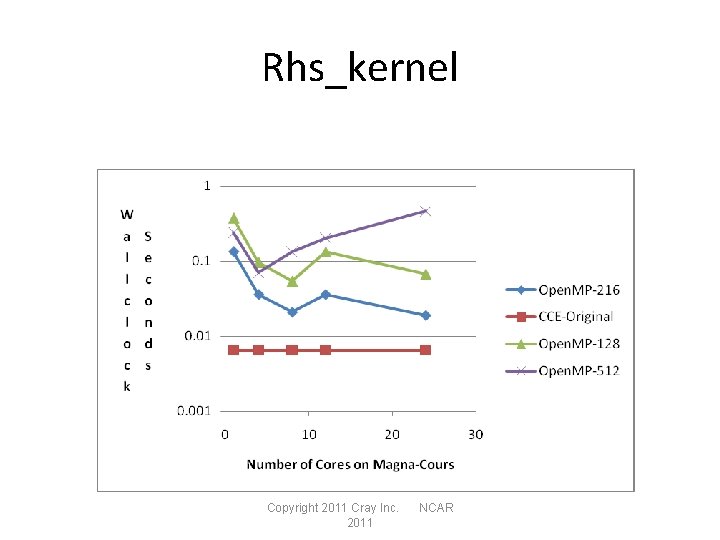
Rhs_kernel Copyright 2011 Cray Inc. 2011 NCAR
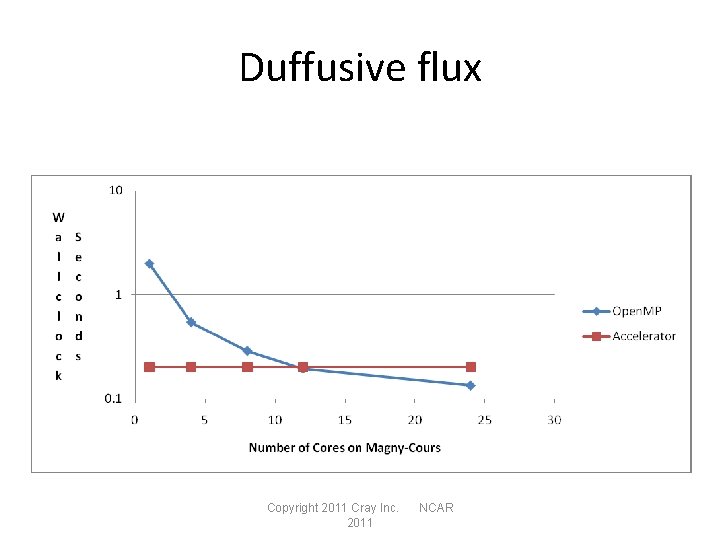
Duffusive flux Copyright 2011 Cray Inc. 2011 NCAR
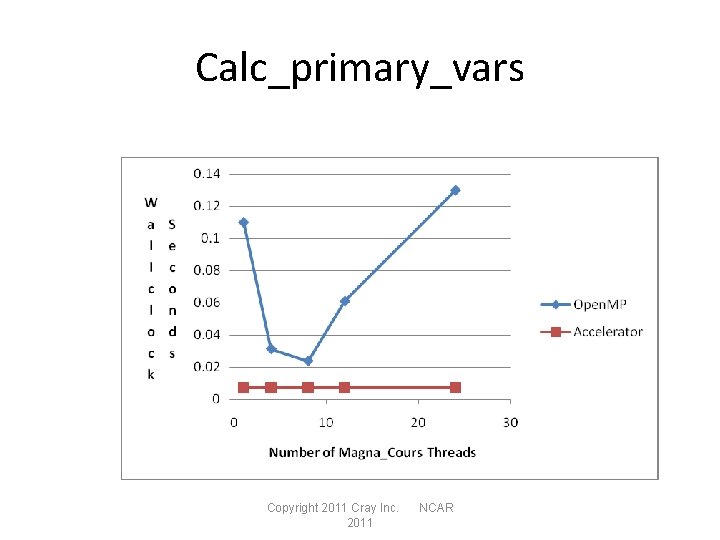
Calc_primary_vars Copyright 2011 Cray Inc. 2011 NCAR
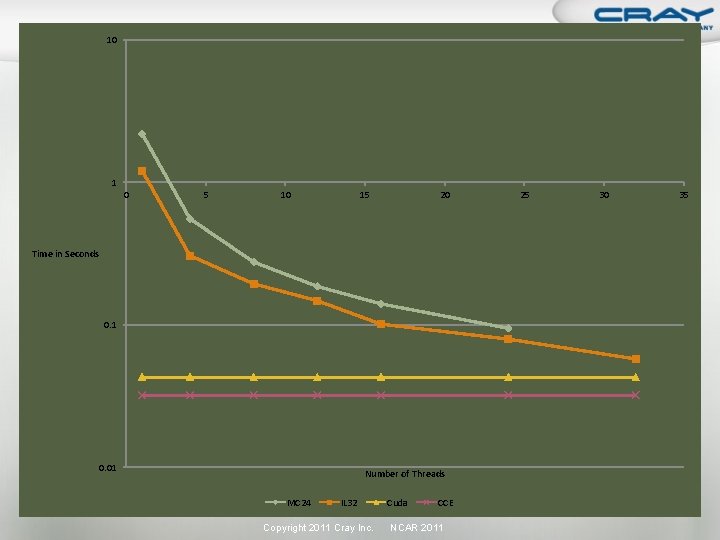
10 of Getrates on XK 6 Performance 1 0 5 10 15 20 Time in Seconds 0. 1 0. 01 Number of Threads MC 24 IL 32 Copyright 2011 Cray Inc. Cuda CCE NCAR 2011 25 30 35
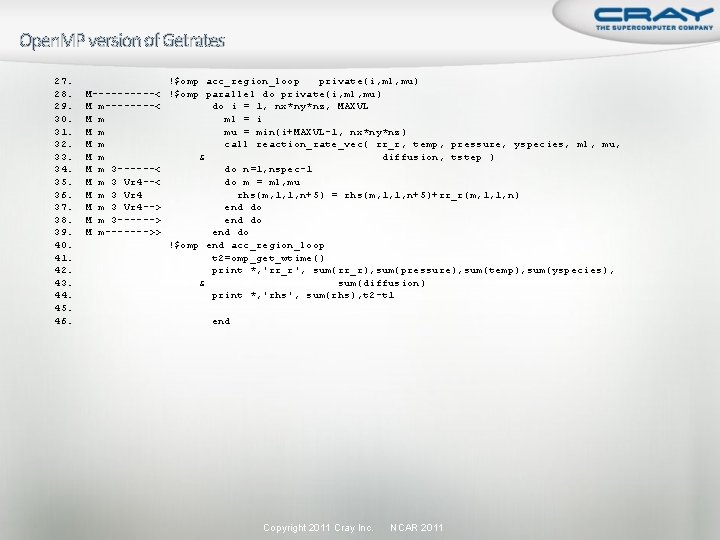
Open. MP version of Getrates 27. 28. 29. 30. 31. 32. 33. 34. 35. 36. 37. 38. 39. 40. 41. 42. 43. 44. 45. 46. !$omp acc_region_loop private(i, ml, mu) M-----< !$omp parallel do private(i, ml, mu) M m----< do i = 1, nx*ny*nz, MAXVL M m ml = i M m mu = min(i+MAXVL-1, nx*ny*nz) M m call reaction_rate_vec( rr_r, temp, pressure, yspecies, ml, mu, M m & diffusion, tstep ) M m 3 ------< do n=1, nspec-1 M m 3 Vr 4 --< do m = ml, mu M m 3 Vr 4 rhs(m, 1, 1, n+5) = rhs(m, 1, 1, n+5)+rr_r(m, 1, 1, n) M m 3 Vr 4 --> end do M m 3 ------> end do M m------->> end do !$omp end acc_region_loop t 2=omp_get_wtime() print *, 'rr_r', sum(rr_r), sum(pressure), sum(temp), sum(yspecies), & sum(diffusion) print *, 'rhs', sum(rhs), t 2 -t 1 end Copyright 2011 Cray Inc. NCAR 2011
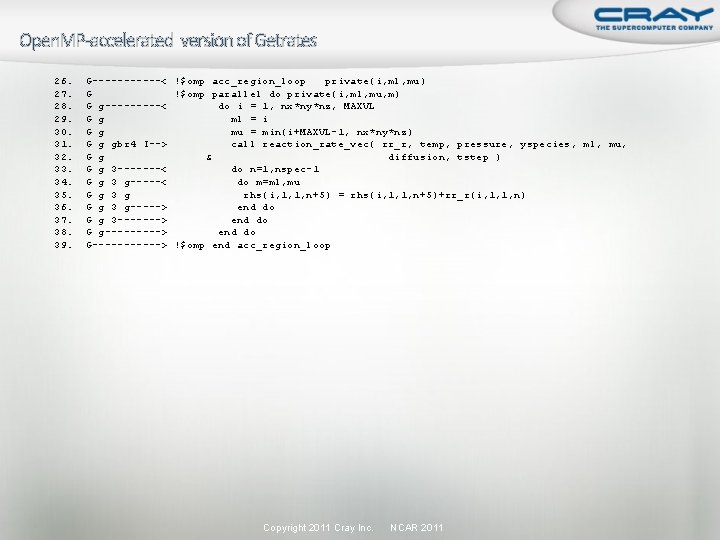
Open. MP-accelerated version of Getrates 26. 27. 28. 29. 30. 31. 32. 33. 34. 35. 36. 37. 38. 39. G------< !$omp acc_region_loop private(i, ml, mu) G !$omp parallel do private(i, ml, mu, m) G g-----< do i = 1, nx*ny*nz, MAXVL G g ml = i G g mu = min(i+MAXVL-1, nx*ny*nz) G g gbr 4 I--> call reaction_rate_vec( rr_r, temp, pressure, yspecies, ml, mu, G g & diffusion, tstep ) G g 3 -------< do n=1, nspec-1 G g 3 g-----< do m=ml, mu G g 3 g rhs(i, 1, 1, n+5) = rhs(i, 1, 1, n+5)+rr_r(i, 1, 1, n) G g 3 g-----> end do G g 3 -------> end do G g-----> end do G------> !$omp end acc_region_loop Copyright 2011 Cray Inc. NCAR 2011

Are the Directives powerful enough to express acceleration?
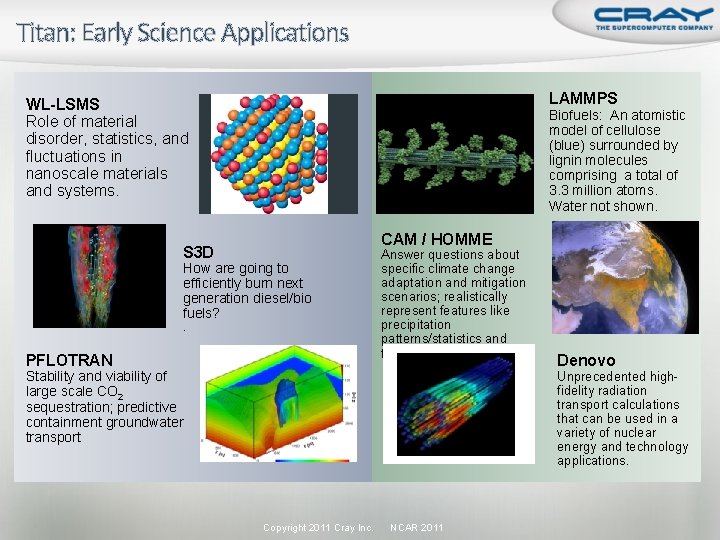
Titan: Early Science Applications LAMMPS WL-LSMS Role of material disorder, statistics, and fluctuations in nanoscale materials and systems. Biofuels: An atomistic model of cellulose (blue) surrounded by lignin molecules comprising a total of 3. 3 million atoms. Water not shown. CAM / HOMME S 3 D How are going to efficiently burn next generation diesel/bio fuels? . PFLOTRAN Answer questions about specific climate change adaptation and mitigation scenarios; realistically represent features like precipitation patterns/statistics and tropical storms Stability and viability of large scale CO 2 sequestration; predictive containment groundwater transport Denovo Unprecedented highfidelity radiation transport calculations that can be used in a variety of nuclear energy and technology applications. Copyright 2011 Cray Inc. NCAR 2011
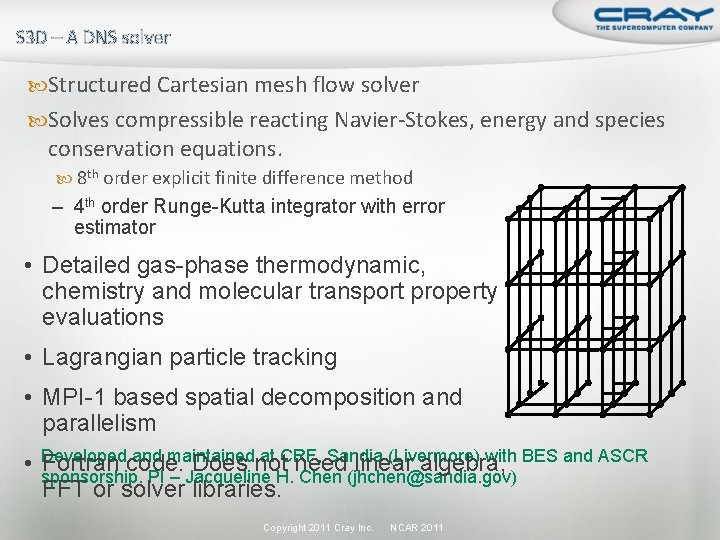
S 3 D – A DNS solver Structured Cartesian mesh flow solver Solves compressible reacting Navier-Stokes, energy and species conservation equations. 8 th order explicit finite difference method – 4 th order Runge-Kutta integrator with error estimator • Detailed gas-phase thermodynamic, chemistry and molecular transport property evaluations • Lagrangian particle tracking • MPI-1 based spatial decomposition and parallelism and maintained at CRF, Sandia (Livermore) with BES and ASCR • Developed Fortran code. Does not need linear algebra, sponsorship. PI – Jacqueline H. Chen (jhchen@sandia. gov) FFT or solver libraries. Copyright 2011 Cray Inc. NCAR 2011
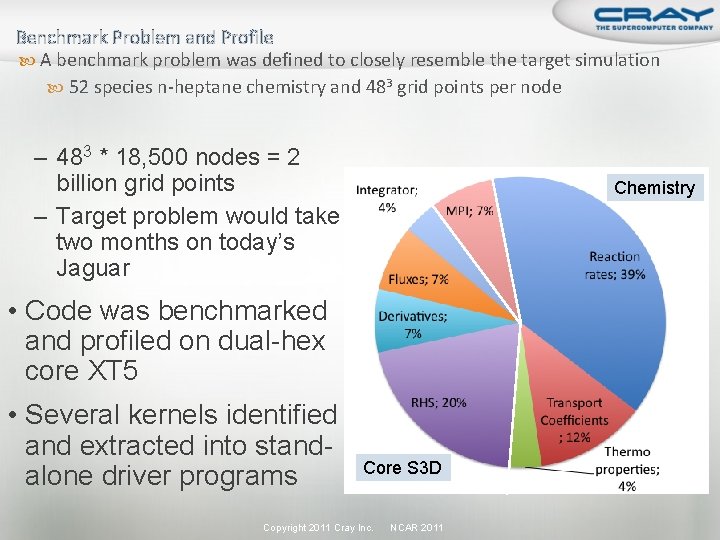
Benchmark Problem and Profile A benchmark problem was defined to closely resemble the target simulation 52 species n-heptane chemistry and 483 grid points per node – 483 * 18, 500 nodes = 2 billion grid points – Target problem would take two months on today’s Jaguar Chemistry • Code was benchmarked and profiled on dual-hex core XT 5 • Several kernels identified and extracted into standalone driver programs Core S 3 D Copyright 2011 Cray Inc. NCAR 2011
Acceleration Strategy Team: Ramanan Sankaran. ORNL Ray Grout NREL John Levesque Cray Goals: § Convert S 3 D to a hybrid multi-core application suited for a multi-core node with § or without an accelerator. Be able to perform the computation entirely on the accelerator. - Arrays and data able to reside entirely on the accelerator. - Data sent from accelerator to host CPU for halo communication, I/O and monitoring only. Strategy: § To program using both hand-written and generated code. - Hand-written and tuned CUDA*. - Automated Fortran and CUDA generation for chemistry kernels - Automated code generation through compiler directives § S 3 D is now a part of Cray’s compiler development test cases Copyright 2011 Cray Inc. NCAR 2011
Step in converting all-MPI code to Performance Portable Hybrid-multi-core form Convert all-MPI code to Hybrid-Multi-core form Use Craypat looping profile to identify looping structure Use Scoping tools to identify shared and private down the call chain Copyright 2011 Cray Inc. NCAR 2011
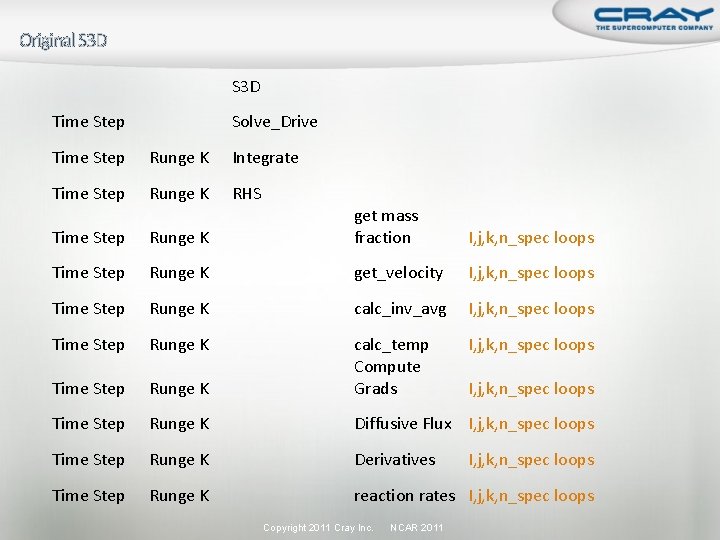
Original S 3 D Time Step Solve_Drive Time Step Runge K Integrate Time Step Runge K RHS Time Step Runge K get mass fraction Time Step Runge K get_velocity I, j, k, n_spec loops Time Step Runge K calc_inv_avg I, j, k, n_spec loops Time Step Runge K calc_temp Compute Grads Time Step Runge K Diffusive Flux I, j, k, n_spec loops Time Step Runge K Derivatives Time Step Runge K reaction rates I, j, k, n_spec loops Copyright 2011 Cray Inc. NCAR 2011 I, j, k, n_spec loops
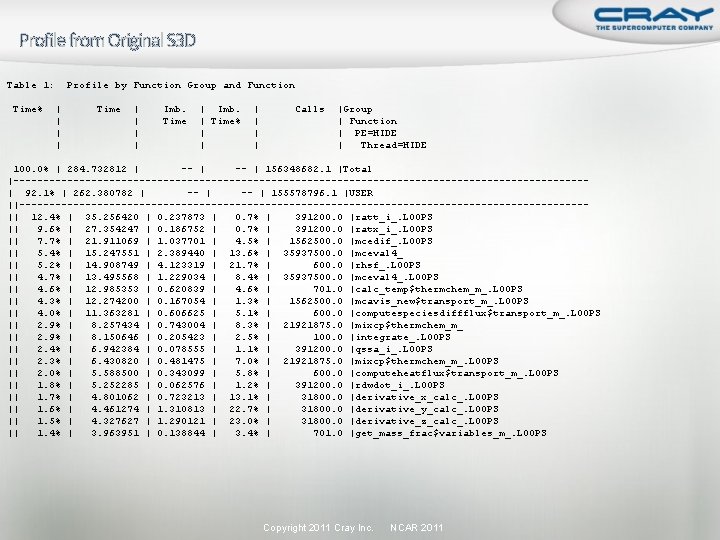
Profile from Original S 3 D Table 1: Time% Profile by Function Group and Function | | Time | | Imb. Time | Imb. | Time% | | | Calls |Group | Function | PE=HIDE | Thread=HIDE 100. 0% | 284. 732812 | -- | 156348682. 1 |Total |------------------------------------------------| 92. 1% | 262. 380782 | -- | 155578796. 1 |USER ||-----------------------------------------------|| 12. 4% | 35. 256420 | 0. 237873 | 0. 7% | 391200. 0 |ratt_i_. LOOPS || 9. 6% | 27. 354247 | 0. 186752 | 0. 7% | 391200. 0 |ratx_i_. LOOPS || 7. 7% | 21. 911069 | 1. 037701 | 4. 5% | 1562500. 0 |mcedif_. LOOPS || 5. 4% | 15. 247551 | 2. 389440 | 13. 6% | 35937500. 0 |mceval 4_ || 5. 2% | 14. 908749 | 4. 123319 | 21. 7% | 600. 0 |rhsf_. LOOPS || 4. 7% | 13. 495568 | 1. 229034 | 8. 4% | 35937500. 0 |mceval 4_. LOOPS || 4. 6% | 12. 985353 | 0. 620839 | 4. 6% | 701. 0 |calc_temp$thermchem_m_. LOOPS || 4. 3% | 12. 274200 | 0. 167054 | 1. 3% | 1562500. 0 |mcavis_new$transport_m_. LOOPS || 4. 0% | 11. 363281 | 0. 606625 | 5. 1% | 600. 0 |computespeciesdiffflux$transport_m_. LOOPS || 2. 9% | 8. 257434 | 0. 743004 | 8. 3% | 21921875. 0 |mixcp$thermchem_m_ || 2. 9% | 8. 150646 | 0. 205423 | 2. 5% | 100. 0 |integrate_. LOOPS || 2. 4% | 6. 942384 | 0. 078555 | 1. 1% | 391200. 0 |qssa_i_. LOOPS || 2. 3% | 6. 430820 | 0. 481475 | 7. 0% | 21921875. 0 |mixcp$thermchem_m_. LOOPS || 2. 0% | 5. 588500 | 0. 343099 | 5. 8% | 600. 0 |computeheatflux$transport_m_. LOOPS || 1. 8% | 5. 252285 | 0. 062576 | 1. 2% | 391200. 0 |rdwdot_i_. LOOPS || 1. 7% | 4. 801062 | 0. 723213 | 13. 1% | 31800. 0 |derivative_x_calc_. LOOPS || 1. 6% | 4. 461274 | 1. 310813 | 22. 7% | 31800. 0 |derivative_y_calc_. LOOPS || 1. 5% | 4. 327627 | 1. 290121 | 23. 0% | 31800. 0 |derivative_z_calc_. LOOPS || 1. 4% | 3. 963951 | 0. 138844 | 3. 4% | 701. 0 |get_mass_frac$variables_m_. LOOPS Copyright 2011 Cray Inc. NCAR 2011
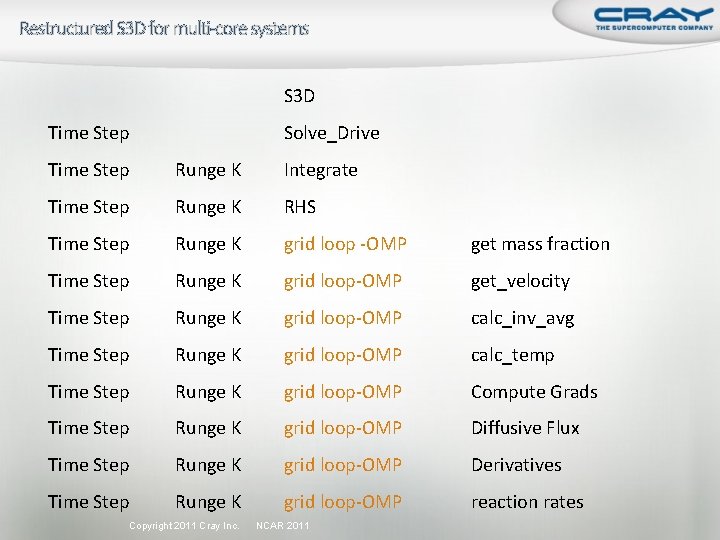
Restructured S 3 D for multi-core systems S 3 D Time Step Solve_Drive Time Step Runge K Integrate Time Step Runge K RHS Time Step Runge K grid loop -OMP get mass fraction Time Step Runge K grid loop-OMP get_velocity Time Step Runge K grid loop-OMP calc_inv_avg Time Step Runge K grid loop-OMP calc_temp Time Step Runge K grid loop-OMP Compute Grads Time Step Runge K grid loop-OMP Diffusive Flux Time Step Runge K grid loop-OMP Derivatives Time Step Runge K grid loop-OMP reaction rates Copyright 2011 Cray Inc. NCAR 2011
Advantage of raising loops Create good granularity Open. MP Loop Improves cache re-use Reduces Memory usage significantly Creates a good potential kernel for an accelerator Copyright 2011 Cray Inc. NCAR 2011
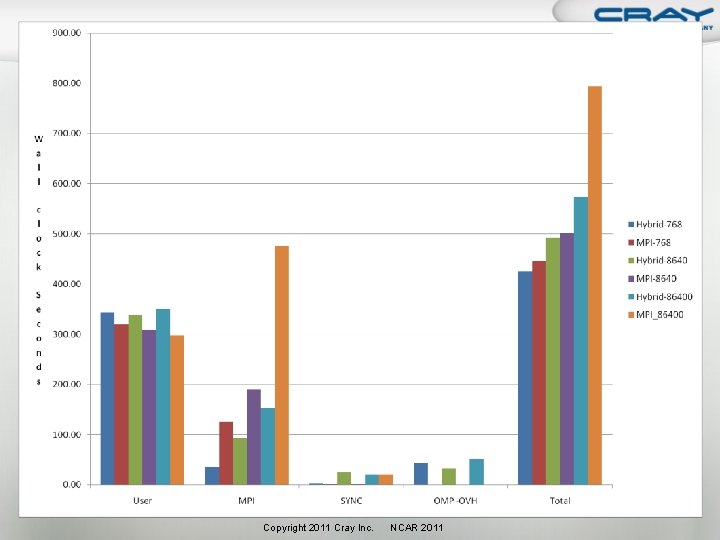
The Hybridization of S 3 D Copyright 2011 Cray Inc. NCAR 2011
Step in converting all-MPI code to Performance Portable Hybrid-multi-core form Convert all-MPI code to Hybrid-Multi-core form Introduce Open. MP Accelerator extensions Copyright 2011 Cray Inc. NCAR 2011
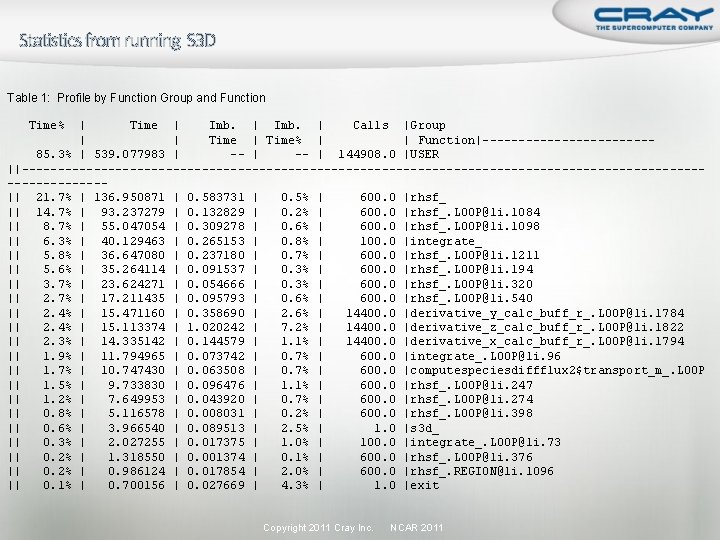
Statistics from running S 3 D Table 1: Profile by Function Group and Function Time% | Time | Imb. | Calls |Group | | Time% | | Function|------------85. 3% | 539. 077983 | -- | 144908. 0 |USER ||------------------------------------------------------|| 21. 7% | 136. 950871 | 0. 583731 | 0. 5% | 600. 0 |rhsf_ || 14. 7% | 93. 237279 | 0. 132829 | 0. 2% | 600. 0 |rhsf_. LOOP@li. 1084 || 8. 7% | 55. 047054 | 0. 309278 | 0. 6% | 600. 0 |rhsf_. LOOP@li. 1098 || 6. 3% | 40. 129463 | 0. 265153 | 0. 8% | 100. 0 |integrate_ || 5. 8% | 36. 647080 | 0. 237180 | 0. 7% | 600. 0 |rhsf_. LOOP@li. 1211 || 5. 6% | 35. 264114 | 0. 091537 | 0. 3% | 600. 0 |rhsf_. LOOP@li. 194 || 3. 7% | 23. 624271 | 0. 054666 | 0. 3% | 600. 0 |rhsf_. LOOP@li. 320 || 2. 7% | 17. 211435 | 0. 095793 | 0. 6% | 600. 0 |rhsf_. LOOP@li. 540 || 2. 4% | 15. 471160 | 0. 358690 | 2. 6% | 14400. 0 |derivative_y_calc_buff_r_. LOOP@li. 1784 || 2. 4% | 15. 113374 | 1. 020242 | 7. 2% | 14400. 0 |derivative_z_calc_buff_r_. LOOP@li. 1822 || 2. 3% | 14. 335142 | 0. 144579 | 1. 1% | 14400. 0 |derivative_x_calc_buff_r_. LOOP@li. 1794 || 1. 9% | 11. 794965 | 0. 073742 | 0. 7% | 600. 0 |integrate_. LOOP@li. 96 || 1. 7% | 10. 747430 | 0. 063508 | 0. 7% | 600. 0 |computespeciesdiffflux 2$transport_m_. LOOP || 1. 5% | 9. 733830 | 0. 096476 | 1. 1% | 600. 0 |rhsf_. LOOP@li. 247 || 1. 2% | 7. 649953 | 0. 043920 | 0. 7% | 600. 0 |rhsf_. LOOP@li. 274 || 0. 8% | 5. 116578 | 0. 008031 | 0. 2% | 600. 0 |rhsf_. LOOP@li. 398 || 0. 6% | 3. 966540 | 0. 089513 | 2. 5% | 1. 0 |s 3 d_ || 0. 3% | 2. 027255 | 0. 017375 | 1. 0% | 100. 0 |integrate_. LOOP@li. 73 || 0. 2% | 1. 318550 | 0. 001374 | 0. 1% | 600. 0 |rhsf_. LOOP@li. 376 || 0. 2% | 0. 986124 | 0. 017854 | 2. 0% | 600. 0 |rhsf_. REGION@li. 1096 || 0. 1% | 0. 700156 | 0. 027669 | 4. 3% | 1. 0 |exit Copyright 2011 Cray Inc. NCAR 2011
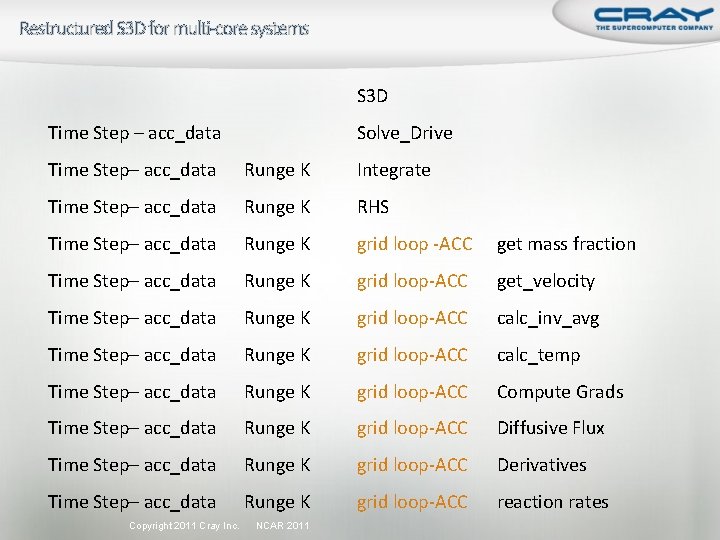
Restructured S 3 D for multi-core systems S 3 D Time Step – acc_data Solve_Drive Time Step– acc_data Runge K Integrate Time Step– acc_data Runge K RHS Time Step– acc_data Runge K grid loop -ACC get mass fraction Time Step– acc_data Runge K grid loop-ACC get_velocity Time Step– acc_data Runge K grid loop-ACC calc_inv_avg Time Step– acc_data Runge K grid loop-ACC calc_temp Time Step– acc_data Runge K grid loop-ACC Compute Grads Time Step– acc_data Runge K grid loop-ACC Diffusive Flux Time Step– acc_data Runge K grid loop-ACC Derivatives Time Step– acc_data Runge K grid loop-ACC reaction rates Copyright 2011 Cray Inc. NCAR 2011
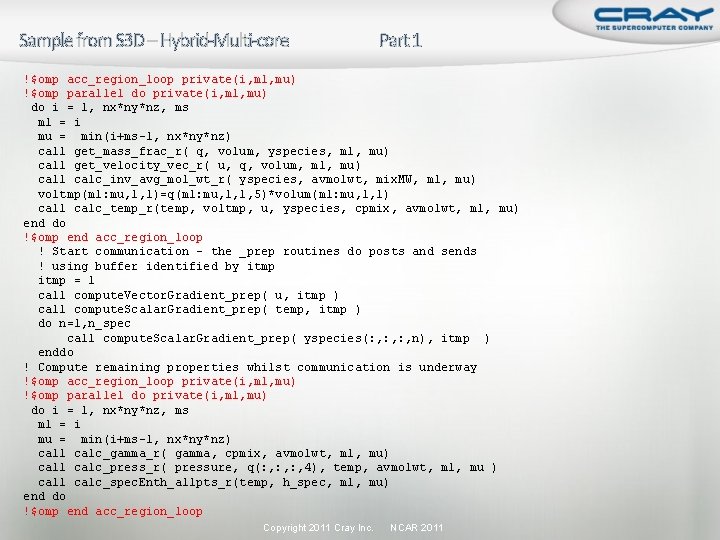
Sample from S 3 D – Hybrid-Multi-core Part 1 !$omp acc_region_loop private(i, ml, mu) !$omp parallel do private(i, ml, mu) do i = 1, nx*ny*nz, ms ml = i mu = min(i+ms-1, nx*ny*nz) call get_mass_frac_r( q, volum, yspecies, ml, mu) call get_velocity_vec_r( u, q, volum, ml, mu) call calc_inv_avg_mol_wt_r( yspecies, avmolwt, mix. MW, ml, mu) voltmp(ml: mu, 1, 1)=q(ml: mu, 1, 1, 5)*volum(ml: mu, 1, 1) call calc_temp_r(temp, voltmp, u, yspecies, cpmix, avmolwt, ml, mu) end do !$omp end acc_region_loop ! Start communication - the _prep routines do posts and sends ! using buffer identified by itmp = 1 call compute. Vector. Gradient_prep( u, itmp ) call compute. Scalar. Gradient_prep( temp, itmp ) do n=1, n_spec call compute. Scalar. Gradient_prep( yspecies(: , : , n), itmp ) enddo ! Compute remaining properties whilst communication is underway !$omp acc_region_loop private(i, ml, mu) !$omp parallel do private(i, ml, mu) do i = 1, nx*ny*nz, ms ml = i mu = min(i+ms-1, nx*ny*nz) call calc_gamma_r( gamma, cpmix, avmolwt, ml, mu) call calc_press_r( pressure, q(: , : , 4), temp, avmolwt, ml, mu ) call calc_spec. Enth_allpts_r(temp, h_spec, ml, mu) end do !$omp end acc_region_loop Copyright 2011 Cray Inc. NCAR 2011
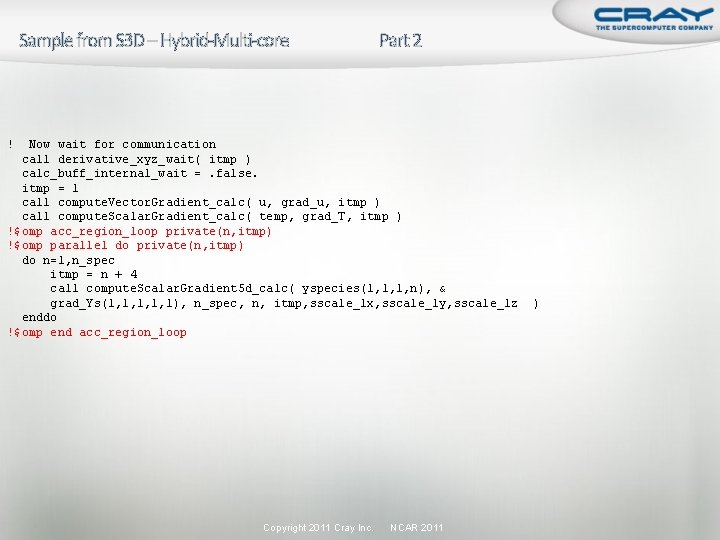
Sample from S 3 D – Hybrid-Multi-core Part 2 ! Now wait for communication call derivative_xyz_wait( itmp ) calc_buff_internal_wait =. false. itmp = 1 call compute. Vector. Gradient_calc( u, grad_u, itmp ) call compute. Scalar. Gradient_calc( temp, grad_T, itmp ) !$omp acc_region_loop private(n, itmp) !$omp parallel do private(n, itmp) do n=1, n_spec itmp = n + 4 call compute. Scalar. Gradient 5 d_calc( yspecies(1, 1, 1, n), & grad_Ys(1, 1, 1), n_spec, n, itmp, sscale_1 x, sscale_1 y, sscale_1 z enddo !$omp end acc_region_loop Copyright 2011 Cray Inc. NCAR 2011 )
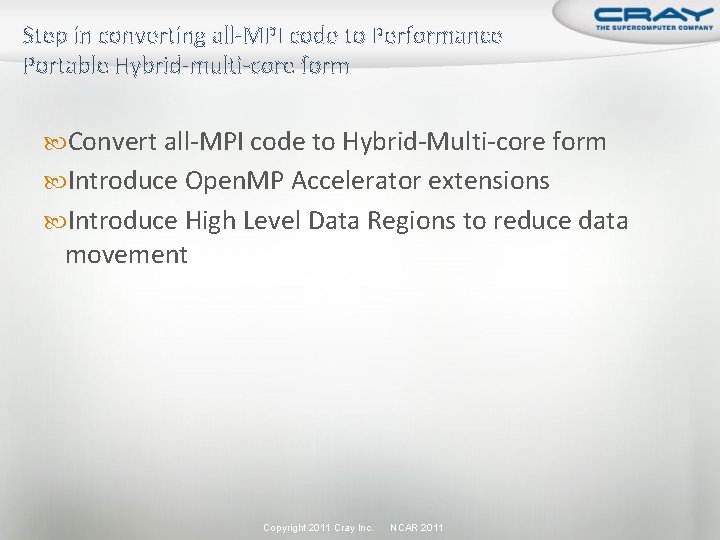
Step in converting all-MPI code to Performance Portable Hybrid-multi-core form Convert all-MPI code to Hybrid-Multi-core form Introduce Open. MP Accelerator extensions Introduce High Level Data Regions to reduce data movement Copyright 2011 Cray Inc. NCAR 2011
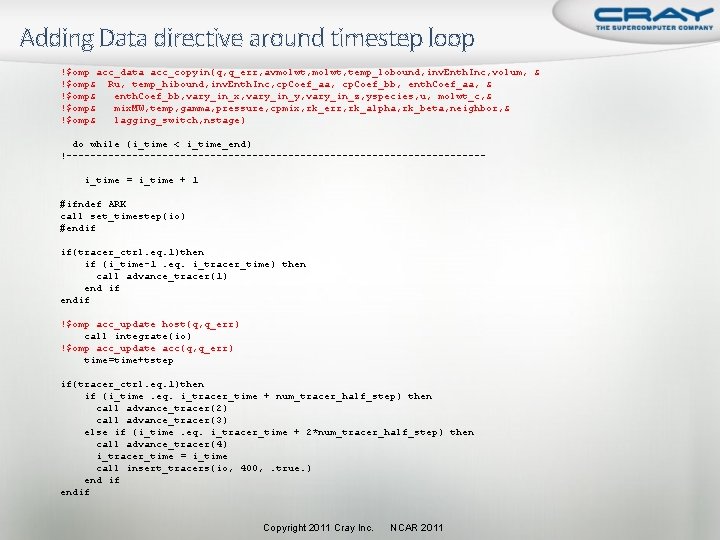
Adding Data directive around timestep loop !$omp acc_data acc_copyin(q, q_err, avmolwt, temp_lobound, inv. Enth. Inc, volum, & !$omp& Ru, temp_hibound, inv. Enth. Inc, cp. Coef_aa, cp. Coef_bb, enth. Coef_aa, & !$omp& enth. Coef_bb, vary_in_x, vary_in_y, vary_in_z, yspecies, u, molwt_c, & !$omp& mix. MW, temp, gamma, pressure, cpmix, rk_err, rk_alpha, rk_beta, neighbor, & !$omp& lagging_switch, nstage) do while (i_time < i_time_end) !-----------------------------------i_time = i_time + 1 #ifndef ARK call set_timestep(io) #endif if(tracer_ctrl. eq. 1)then if (i_time-1. eq. i_tracer_time) then call advance_tracer(1) end if endif !$omp acc_update host(q, q_err) call integrate(io) !$omp acc_update acc(q, q_err) time=time+tstep if(tracer_ctrl. eq. 1)then if (i_time. eq. i_tracer_time + num_tracer_half_step) then call advance_tracer(2) call advance_tracer(3) else if (i_time. eq. i_tracer_time + 2*num_tracer_half_step) then call advance_tracer(4) i_tracer_time = i_time call insert_tracers(io, 400, . true. ) end if endif Copyright 2011 Cray Inc. NCAR 2011
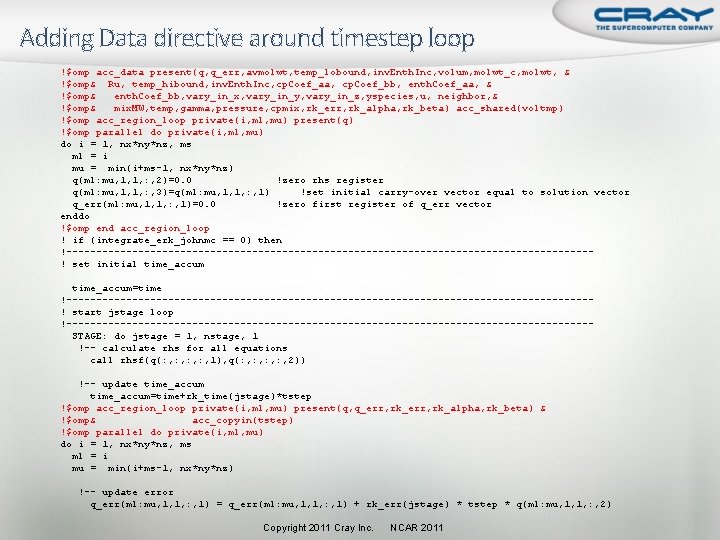
Adding Data directive around timestep loop !$omp acc_data present(q, q_err, avmolwt, temp_lobound, inv. Enth. Inc, volum, molwt_c, molwt, & !$omp& Ru, temp_hibound, inv. Enth. Inc, cp. Coef_aa, cp. Coef_bb, enth. Coef_aa, & !$omp& enth. Coef_bb, vary_in_x, vary_in_y, vary_in_z, yspecies, u, neighbor, & !$omp& mix. MW, temp, gamma, pressure, cpmix, rk_err, rk_alpha, rk_beta) acc_shared(voltmp) !$omp acc_region_loop private(i, ml, mu) present(q) !$omp parallel do private(i, ml, mu) do i = 1, nx*ny*nz, ms ml = i mu = min(i+ms-1, nx*ny*nz) q(ml: mu, 1, 1, : , 2)=0. 0 !zero rhs register q(ml: mu, 1, 1, : , 3)=q(ml: mu, 1, 1, : , 1) !set initial carry-over vector equal to solution vector q_err(ml: mu, 1, 1, : , 1)=0. 0 !zero first register of q_err vector enddo !$omp end acc_region_loop ! if (integrate_erk_johnmc == 0) then !--------------------------------------------! set initial time_accum=time !--------------------------------------------! start jstage loop !--------------------------------------------STAGE: do jstage = 1, nstage, 1 !-- calculate rhs for all equations call rhsf(q(: , : , 1), q(: , : , 2)) !-- update time_accum=time+rk_time(jstage)*tstep !$omp acc_region_loop private(i, ml, mu) present(q, q_err, rk_alpha, rk_beta) & !$omp& acc_copyin(tstep) !$omp parallel do private(i, ml, mu) do i = 1, nx*ny*nz, ms ml = i mu = min(i+ms-1, nx*ny*nz) !-- update error q_err(ml: mu, 1, 1, : , 1) = q_err(ml: mu, 1, 1, : , 1) + rk_err(jstage) * tstep * q(ml: mu, 1, 1, : , 2) Copyright 2011 Cray Inc. NCAR 2011
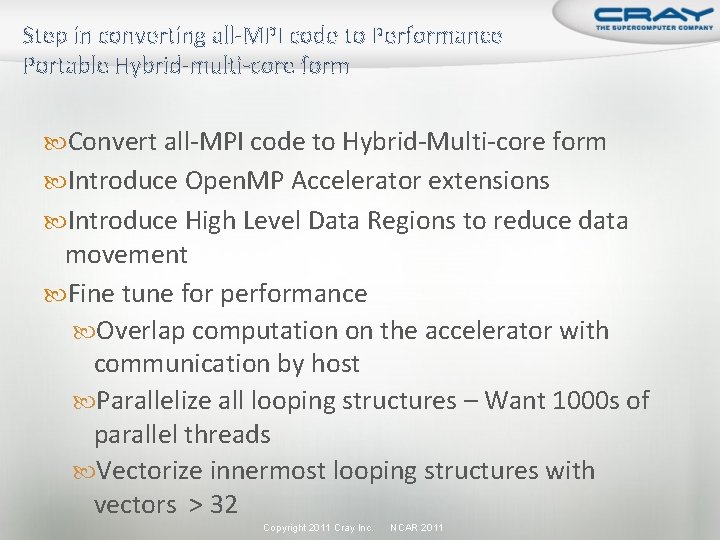
Step in converting all-MPI code to Performance Portable Hybrid-multi-core form Convert all-MPI code to Hybrid-Multi-core form Introduce Open. MP Accelerator extensions Introduce High Level Data Regions to reduce data movement Fine tune for performance Overlap computation on the accelerator with communication by host Parallelize all looping structures – Want 1000 s of parallel threads Vectorize innermost looping structures with vectors > 32 Copyright 2011 Cray Inc. NCAR 2011

Go to listing file Copyright 2011 Cray Inc. NCAR 2011
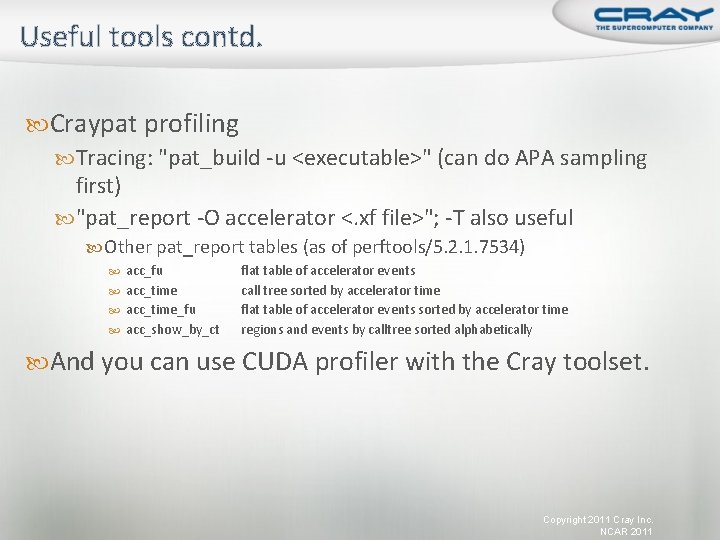
Useful tools contd. Craypat profiling Tracing: "pat_build -u <executable>" (can do APA sampling first) "pat_report -O accelerator <. xf file>"; -T also useful Other pat_report tables (as of perftools/5. 2. 1. 7534) acc_fu acc_time_fu acc_show_by_ct flat table of accelerator events call tree sorted by accelerator time flat table of accelerator events sorted by accelerator time regions and events by calltree sorted alphabetically And you can use CUDA profiler with the Cray toolset. Copyright 2011 Cray Inc. NCAR 2011
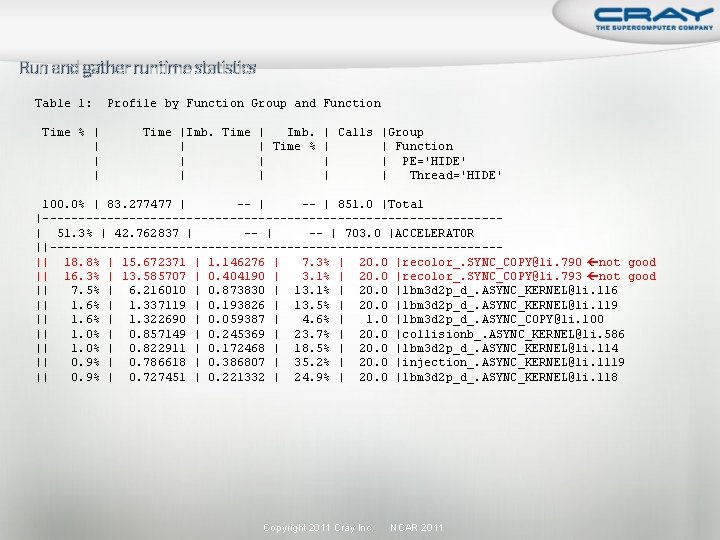
Run and gather runtime statistics Table 1: Time % | | Profile by Function Group and Function Time |Imb. Time | Imb. | | Time % | | | Calls |Group | | Function | | PE='HIDE' | | Thread='HIDE' 100. 0% | 83. 277477 | -- | 851. 0 |Total |--------------------------------| 51. 3% | 42. 762837 | -- | 703. 0 |ACCELERATOR ||-------------------------------|| 18. 8% | 15. 672371 | 1. 146276 | 7. 3% | 20. 0 |recolor_. SYNC_COPY@li. 790 not good || 16. 3% | 13. 585707 | 0. 404190 | 3. 1% | 20. 0 |recolor_. SYNC_COPY@li. 793 not good || 7. 5% | 6. 216010 | 0. 873830 | 13. 1% | 20. 0 |lbm 3 d 2 p_d_. ASYNC_KERNEL@li. 116 || 1. 6% | 1. 337119 | 0. 193826 | 13. 5% | 20. 0 |lbm 3 d 2 p_d_. ASYNC_KERNEL@li. 119 || 1. 6% | 1. 322690 | 0. 059387 | 4. 6% | 1. 0 |lbm 3 d 2 p_d_. ASYNC_COPY@li. 100 || 1. 0% | 0. 857149 | 0. 245369 | 23. 7% | 20. 0 |collisionb_. ASYNC_KERNEL@li. 586 || 1. 0% | 0. 822911 | 0. 172468 | 18. 5% | 20. 0 |lbm 3 d 2 p_d_. ASYNC_KERNEL@li. 114 || 0. 9% | 0. 786618 | 0. 386807 | 35. 2% | 20. 0 |injection_. ASYNC_KERNEL@li. 1119 || 0. 9% | 0. 727451 | 0. 221332 | 24. 9% | 20. 0 |lbm 3 d 2 p_d_. ASYNC_KERNEL@li. 118 Copyright 2011 Cray Inc. NCAR 2011
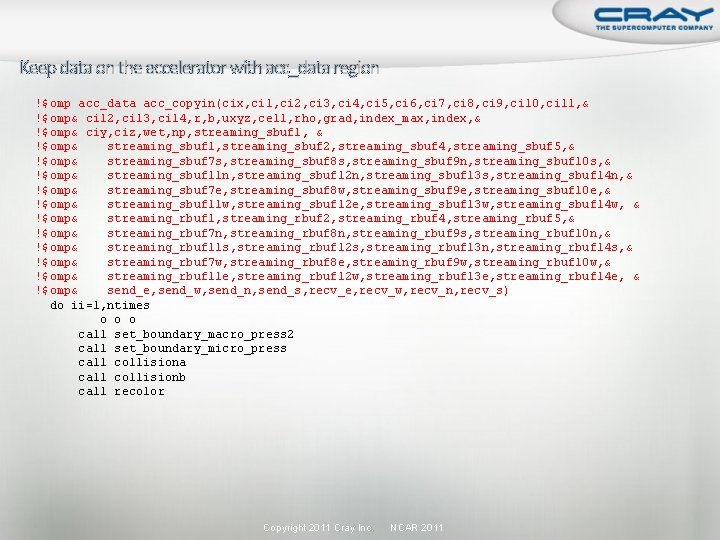
Keep data on the accelerator with acc_data region !$omp acc_data acc_copyin(cix, ci 1, ci 2, ci 3, ci 4, ci 5, ci 6, ci 7, ci 8, ci 9, ci 10, ci 11, & !$omp& ci 12, ci 13, ci 14, r, b, uxyz, cell, rho, grad, index_max, index, & !$omp& ciy, ciz, wet, np, streaming_sbuf 1, & !$omp& streaming_sbuf 1, streaming_sbuf 2, streaming_sbuf 4, streaming_sbuf 5, & !$omp& streaming_sbuf 7 s, streaming_sbuf 8 s, streaming_sbuf 9 n, streaming_sbuf 10 s, & !$omp& streaming_sbuf 11 n, streaming_sbuf 12 n, streaming_sbuf 13 s, streaming_sbuf 14 n, & !$omp& streaming_sbuf 7 e, streaming_sbuf 8 w, streaming_sbuf 9 e, streaming_sbuf 10 e, & !$omp& streaming_sbuf 11 w, streaming_sbuf 12 e, streaming_sbuf 13 w, streaming_sbuf 14 w, & !$omp& streaming_rbuf 1, streaming_rbuf 2, streaming_rbuf 4, streaming_rbuf 5, & !$omp& streaming_rbuf 7 n, streaming_rbuf 8 n, streaming_rbuf 9 s, streaming_rbuf 10 n, & !$omp& streaming_rbuf 11 s, streaming_rbuf 12 s, streaming_rbuf 13 n, streaming_rbuf 14 s, & !$omp& streaming_rbuf 7 w, streaming_rbuf 8 e, streaming_rbuf 9 w, streaming_rbuf 10 w, & !$omp& streaming_rbuf 11 e, streaming_rbuf 12 w, streaming_rbuf 13 e, streaming_rbuf 14 e, & !$omp& send_e, send_w, send_n, send_s, recv_e, recv_w, recv_n, recv_s) do ii=1, ntimes o o o call set_boundary_macro_press 2 call set_boundary_micro_press call collisiona call collisionb call recolor Copyright 2011 Cray Inc. NCAR 2011
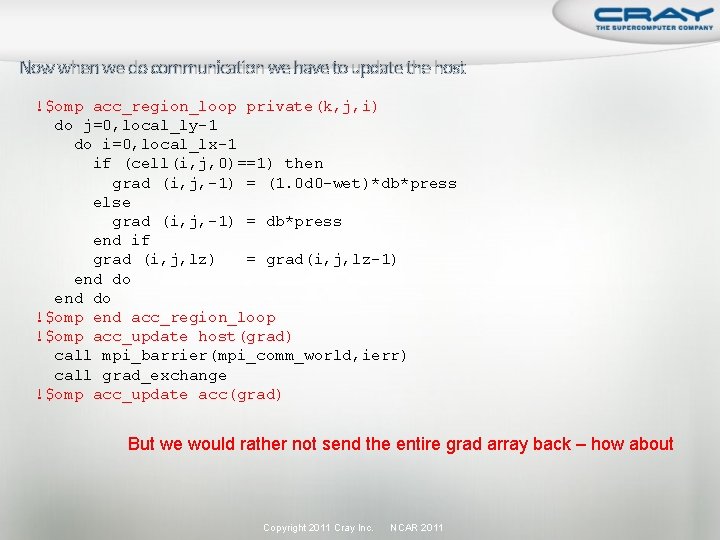
Now when we do communication we have to update the host !$omp acc_region_loop private(k, j, i) do j=0, local_ly-1 do i=0, local_lx-1 if (cell(i, j, 0)==1) then grad (i, j, -1) = (1. 0 d 0 -wet)*db*press else grad (i, j, -1) = db*press end if grad (i, j, lz) = grad(i, j, lz-1) end do !$omp end acc_region_loop !$omp acc_update host(grad) call mpi_barrier(mpi_comm_world, ierr) call grad_exchange !$omp acc_update acc(grad) But we would rather not send the entire grad array back – how about Copyright 2011 Cray Inc. NCAR 2011
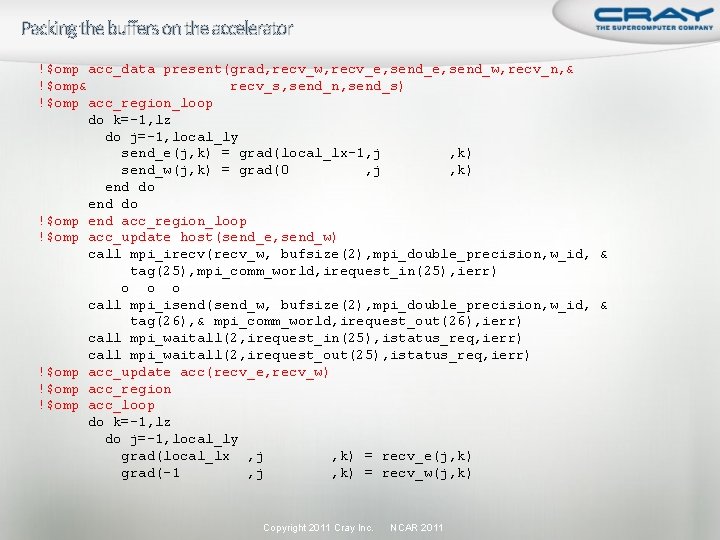
Packing the buffers on the accelerator !$omp acc_data present(grad, recv_w, recv_e, send_w, recv_n, & !$omp& recv_s, send_n, send_s) !$omp acc_region_loop do k=-1, lz do j=-1, local_ly send_e(j, k) = grad(local_lx-1, j , k) send_w(j, k) = grad(0 , j , k) end do !$omp end acc_region_loop !$omp acc_update host(send_e, send_w) call mpi_irecv(recv_w, bufsize(2), mpi_double_precision, w_id, & tag(25), mpi_comm_world, irequest_in(25), ierr) o o o call mpi_isend(send_w, bufsize(2), mpi_double_precision, w_id, & tag(26), & mpi_comm_world, irequest_out(26), ierr) call mpi_waitall(2, irequest_in(25), istatus_req, ierr) call mpi_waitall(2, irequest_out(25), istatus_req, ierr) !$omp acc_update acc(recv_e, recv_w) !$omp acc_region !$omp acc_loop do k=-1, lz do j=-1, local_ly grad(local_lx , j , k) = recv_e(j, k) grad(-1 , j , k) = recv_w(j, k) Copyright 2011 Cray Inc. NCAR 2011
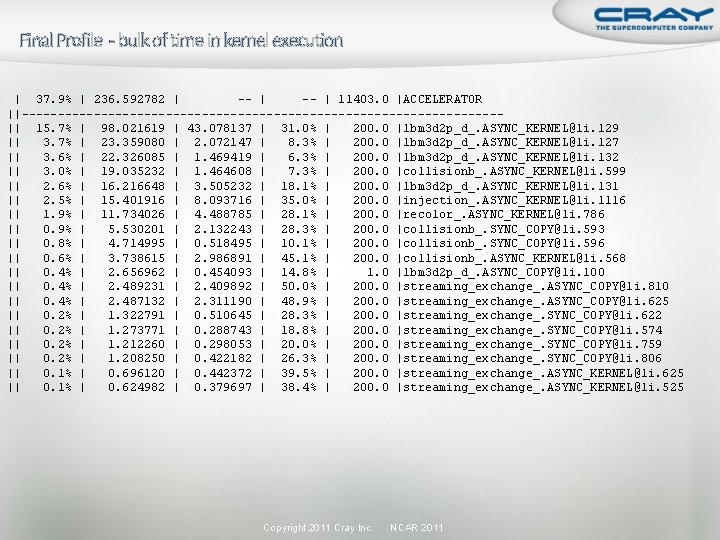
Final Profile - bulk of time in kernel execution | 37. 9% | 236. 592782 | -- | 11403. 0 |ACCELERATOR ||---------------------------------|| 15. 7% | 98. 021619 | 43. 078137 | 31. 0% | 200. 0 |lbm 3 d 2 p_d_. ASYNC_KERNEL@li. 129 || 3. 7% | 23. 359080 | 2. 072147 | 8. 3% | 200. 0 |lbm 3 d 2 p_d_. ASYNC_KERNEL@li. 127 || 3. 6% | 22. 326085 | 1. 469419 | 6. 3% | 200. 0 |lbm 3 d 2 p_d_. ASYNC_KERNEL@li. 132 || 3. 0% | 19. 035232 | 1. 464608 | 7. 3% | 200. 0 |collisionb_. ASYNC_KERNEL@li. 599 || 2. 6% | 16. 216648 | 3. 505232 | 18. 1% | 200. 0 |lbm 3 d 2 p_d_. ASYNC_KERNEL@li. 131 || 2. 5% | 15. 401916 | 8. 093716 | 35. 0% | 200. 0 |injection_. ASYNC_KERNEL@li. 1116 || 1. 9% | 11. 734026 | 4. 488785 | 28. 1% | 200. 0 |recolor_. ASYNC_KERNEL@li. 786 || 0. 9% | 5. 530201 | 2. 132243 | 28. 3% | 200. 0 |collisionb_. SYNC_COPY@li. 593 || 0. 8% | 4. 714995 | 0. 518495 | 10. 1% | 200. 0 |collisionb_. SYNC_COPY@li. 596 || 0. 6% | 3. 738615 | 2. 986891 | 45. 1% | 200. 0 |collisionb_. ASYNC_KERNEL@li. 568 || 0. 4% | 2. 656962 | 0. 454093 | 14. 8% | 1. 0 |lbm 3 d 2 p_d_. ASYNC_COPY@li. 100 || 0. 4% | 2. 489231 | 2. 409892 | 50. 0% | 200. 0 |streaming_exchange_. ASYNC_COPY@li. 810 || 0. 4% | 2. 487132 | 2. 311190 | 48. 9% | 200. 0 |streaming_exchange_. ASYNC_COPY@li. 625 || 0. 2% | 1. 322791 | 0. 510645 | 28. 3% | 200. 0 |streaming_exchange_. SYNC_COPY@li. 622 || 0. 2% | 1. 273771 | 0. 288743 | 18. 8% | 200. 0 |streaming_exchange_. SYNC_COPY@li. 574 || 0. 2% | 1. 212260 | 0. 298053 | 20. 0% | 200. 0 |streaming_exchange_. SYNC_COPY@li. 759 || 0. 2% | 1. 208250 | 0. 422182 | 26. 3% | 200. 0 |streaming_exchange_. SYNC_COPY@li. 806 || 0. 1% | 0. 696120 | 0. 442372 | 39. 5% | 200. 0 |streaming_exchange_. ASYNC_KERNEL@li. 625 || 0. 1% | 0. 624982 | 0. 379697 | 38. 4% | 200. 0 |streaming_exchange_. ASYNC_KERNEL@li. 525 Copyright 2011 Cray Inc. NCAR 2011
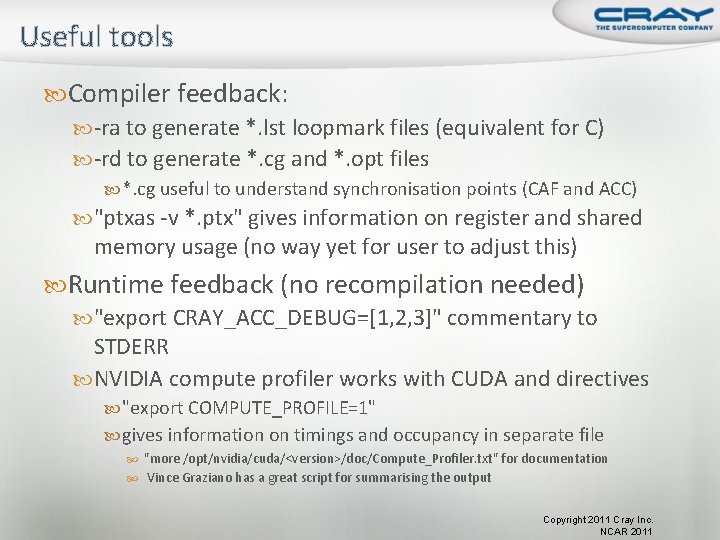
Useful tools Compiler feedback: -ra to generate *. lst loopmark files (equivalent for C) -rd to generate *. cg and *. opt files *. cg useful to understand synchronisation points (CAF and ACC) "ptxas -v *. ptx" gives information on register and shared memory usage (no way yet for user to adjust this) Runtime feedback (no recompilation needed) "export CRAY_ACC_DEBUG=[1, 2, 3]" commentary to STDERR NVIDIA compute profiler works with CUDA and directives "export COMPUTE_PROFILE=1" gives information on timings and occupancy in separate file "more /opt/nvidia/cuda/<version>/doc/Compute_Profiler. txt" for documentation Vince Graziano has a great script for summarising the output Copyright 2011 Cray Inc. NCAR 2011
Cray GPU Programming Environment Objective: Enhance productivity related to porting applications to hybrid multi-core systems Four core components Cray Statistics Gathering Facility on host and GPU Cray Optimization Explorer – Scoping Tools (COE) Cray Compilation Environment (CCE) Cray GPU Libraries Copyright 2011 Cray Inc. NCAR 2011
Current Status of putting S 3 D on XK 6 Internal XK 6 with 171 nodes of Magna-Cours Fermi + Hybrid S 3 D running across entire system without accelerators Computation sections 4 point-wise calculations of primary variables 2 diffusive flux calculations Inlining a very deep call chain 2 getrates calculations Inlining a very deep call chain 3 derivative computations Now debugging performance and correctness on XK 6 Copyright 2011 Cray Inc. NCAR 2011
Interprocedural Analysis with Inlining For the next year, until we can call subroutines and functions on the accelerator, the compiler must inline all subroutines and functions within a acc_region. This is performed automatically by the compiler Can be incrementally controlled by using compile line options -hwp –hpl=<path to program library> Copyright 2011 Cray Inc. NCAR 2011
Whole Program Analysis -hwp There are several things that inhibit the inlining of the call chain beneath the acc_region Call to subroutines and functions that the compiler does not see Array shape changing through argument passing Dummy arguments Real*8 dummy(*), dummy_2 d(nx, *)
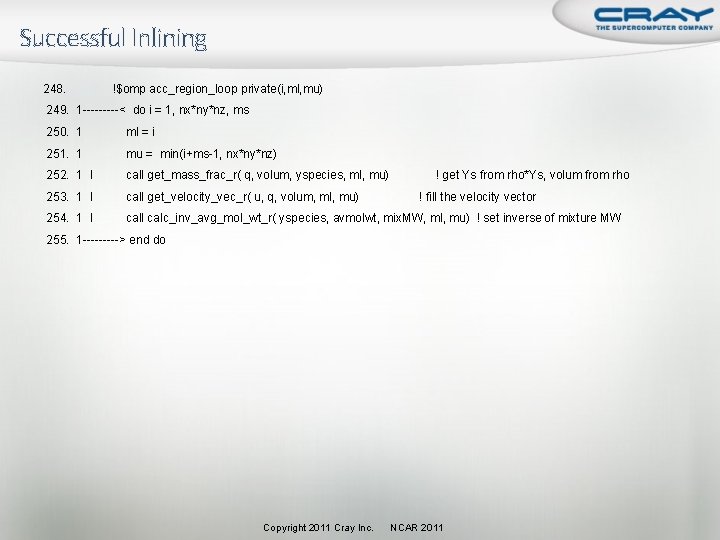
Successful Inlining 248. !$omp acc_region_loop private(i, ml, mu) 249. 1 -----< do i = 1, nx*ny*nz, ms 250. 1 ml = i 251. 1 mu = min(i+ms-1, nx*ny*nz) 252. 1 I call get_mass_frac_r( q, volum, yspecies, ml, mu) 253. 1 I call get_velocity_vec_r( u, q, volum, ml, mu) 254. 1 I call calc_inv_avg_mol_wt_r( yspecies, avmolwt, mix. MW, ml, mu) ! set inverse of mixture MW ! get Ys from rho*Ys, volum from rho ! fill the velocity vector 255. 1 -----> end do Copyright 2011 Cray Inc. NCAR 2011
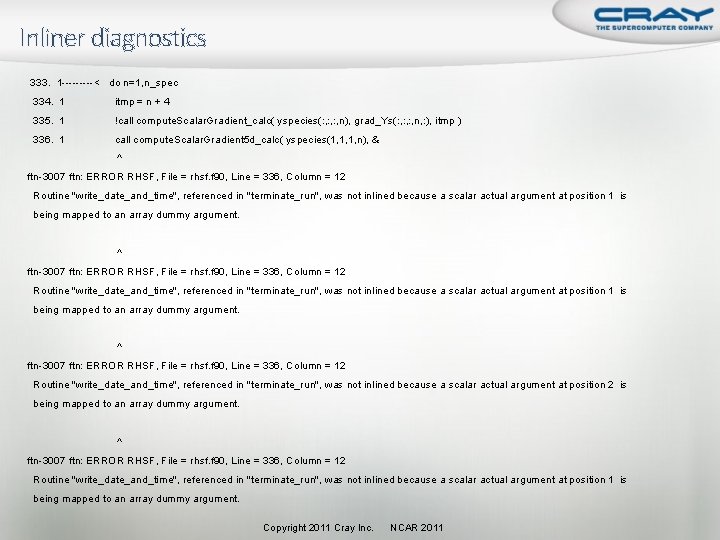
Inliner diagnostics 333. 1 -----< do n=1, n_spec 334. 1 itmp = n + 4 335. 1 !call compute. Scalar. Gradient_calc( yspecies(: , : , n), grad_Ys(: , : , n, : ), itmp ) 336. 1 call compute. Scalar. Gradient 5 d_calc( yspecies(1, 1, 1, n), & ^ ftn-3007 ftn: ERROR RHSF, File = rhsf. f 90, Line = 336, Column = 12 Routine "write_date_and_time", referenced in "terminate_run", was not inlined because a scalar actual argument at position 1 is being mapped to an array dummy argument. ^ ftn-3007 ftn: ERROR RHSF, File = rhsf. f 90, Line = 336, Column = 12 Routine "write_date_and_time", referenced in "terminate_run", was not inlined because a scalar actual argument at position 2 is being mapped to an array dummy argument. ^ ftn-3007 ftn: ERROR RHSF, File = rhsf. f 90, Line = 336, Column = 12 Routine "write_date_and_time", referenced in "terminate_run", was not inlined because a scalar actual argument at position 1 is being mapped to an array dummy argument. Copyright 2011 Cray Inc. NCAR 2011
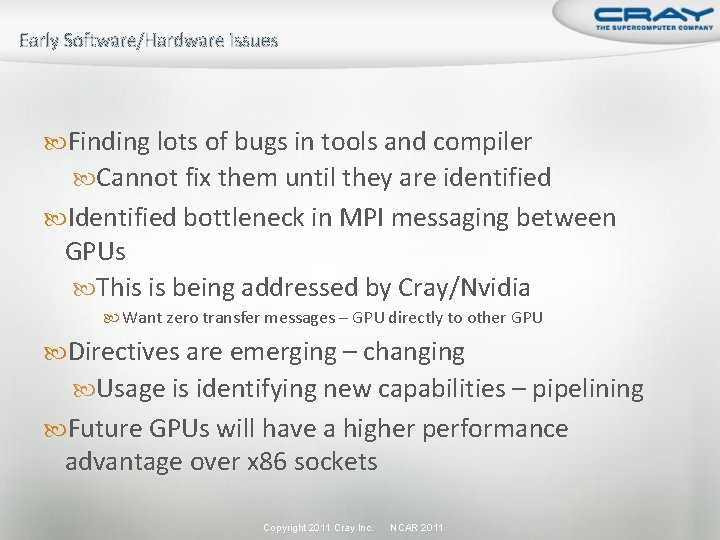
Early Software/Hardware Issues Finding lots of bugs in tools and compiler Cannot fix them until they are identified Identified bottleneck in MPI messaging between GPUs This is being addressed by Cray/Nvidia Want zero transfer messages – GPU directly to other GPU Directives are emerging – changing Usage is identifying new capabilities – pipelining Future GPUs will have a higher performance advantage over x 86 sockets Copyright 2011 Cray Inc. NCAR 2011
Copyright 2011 Cray Inc. NCAR 2011

Thank you. Questions?
- Slides: 51