
HYBRID COCHLEAR IMPLANTATION TREATMENT FOR HIGH FREQUENCY HEARING
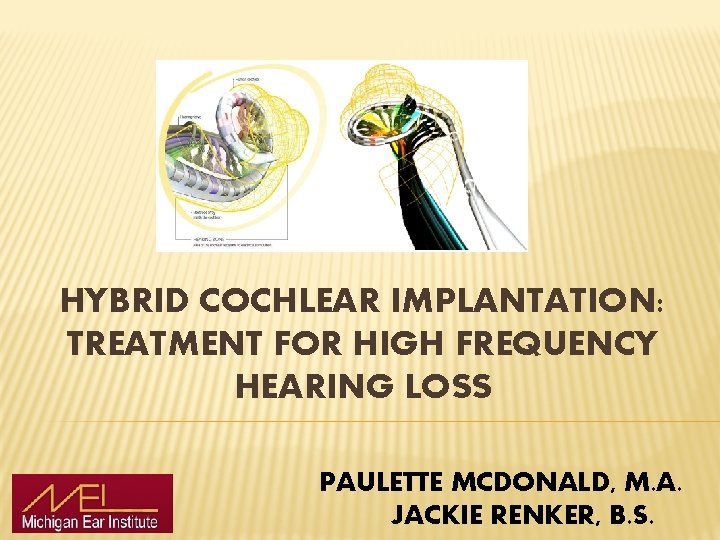
HYBRID COCHLEAR IMPLANTATION: TREATMENT FOR HIGH FREQUENCY HEARING LOSS PAULETTE MCDONALD, M. A. JACKIE RENKER, B. S.

Hybrid defined by Merrimam-Webster: an animal or plant that is produced from two animals or plants of different kinds : something that is formed by combining two or more things
WHY HYBRID? New treatment option, New Indication Word score assessment (CNC) Significant Performance Increase Unique Electrode Array Integrated Sound Processor FDA Approval for Hearing Preservation Documented Two Ear Performance
WHY HYBRID? Those patients where hearing aids are not helping Ability to preserve hearing with the new electrode. A soft insertion technique which maintains the structural integrity of the apical portion of the cochlea. Technology is available to combine acoustic and electric.
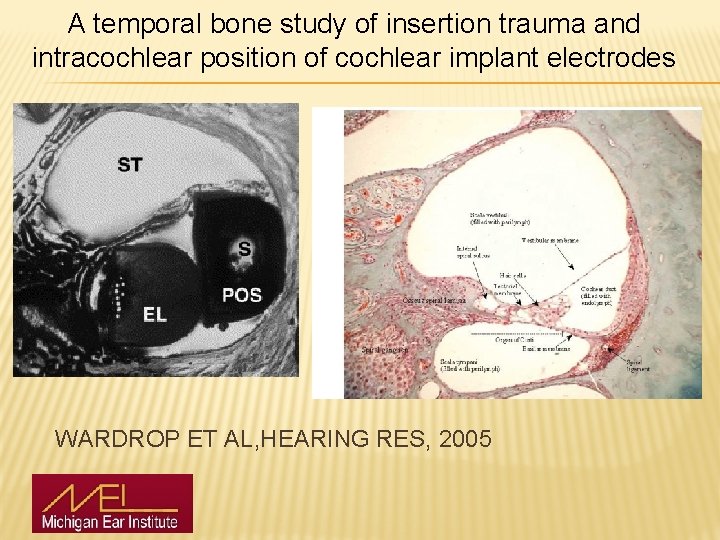
A temporal bone study of insertion trauma and intracochlear position of cochlear implant electrodes WARDROP ET AL, HEARING RES, 2005
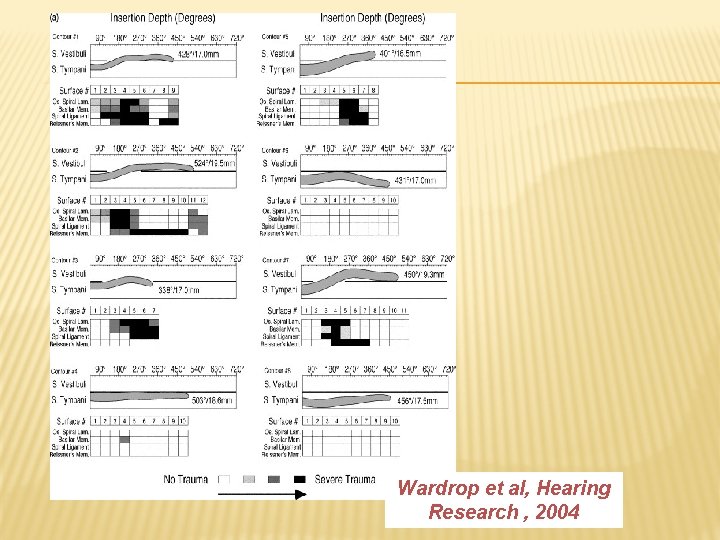
Wardrop et al, Hearing Research , 2004
TYPES OF TRAUMA Trauma to the delicate structures of the inner ear frequently occurs during insertion of the cochlear implant electrode Greatest damage occurs to the partition above the scala typmani. . Damaged ranged from minor displacement of the basilar membrane to seer fracture of the osseous spiral ligament and deviation of the electrode path from its intended path into the scala tympani to the overlying scala media or scala vestibuli. It was found that even moderately severe intracochlear trauma resulted in reduced number of functional peripheral dendrites or spiral lamina,
FACTORS AFFECTING DAMAGE TO THE COCHLEA Mechanical properties of a particular electrode des Variations in the size and shape of each cochlea. The specific surgical techniques used for insertion the cochlea. It is possible that damage to the medial surface of the scala typmani which separates the scala tympani from the internal auditory meatus might serve as a pathway for infection of the central nervous system.
CONCLUSIONS Because damage to intracochlear structures occurs most frequently to the partition above the scala tympani it has been proposed that an electrode array designed to minimize upward bending might reduce the incidence and severity of insertion related damage. Wardrop, et al designed two different electodes that were of a stiffer design and minimized upward bending of the cochlea. He concluded that more researched needed to be done.
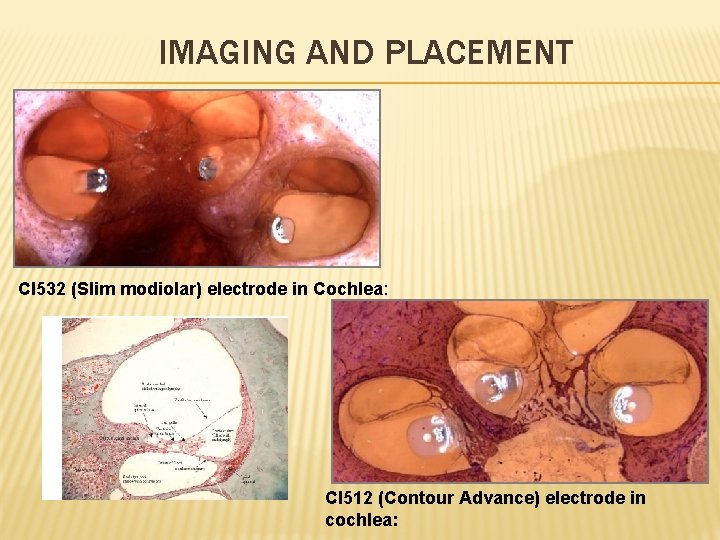
IMAGING AND PLACEMENT CI 532 (Slim modiolar) electrode in Cochlea: CI 512 (Contour Advance) electrode in cochlea:

BÉKÉSYS' PLACE THEORY OF HEARING Georg Von Békésy found that hair cells near the BASE of the cochlea represent HIGH FREQUENCY coded for higher frequencies and as you moved down from the base and then moved to the APEX = LOW FREQUENCY. . SO THE PLACE from base to apex: determines or codes what frequency is perceived

BÉKÉSYS' PLACE THEORY OF HEARING Frequency of sound is indicated by the place on the organ of Corti that has the highest firing rate. Hair cells all along the cochlea send signals to nerve fibers that combine to form the auditory nerve. According to place theory, low frequencies cause maximum activity at the apex end of the cochlea, and high frequencies cause maximum activity at the base.
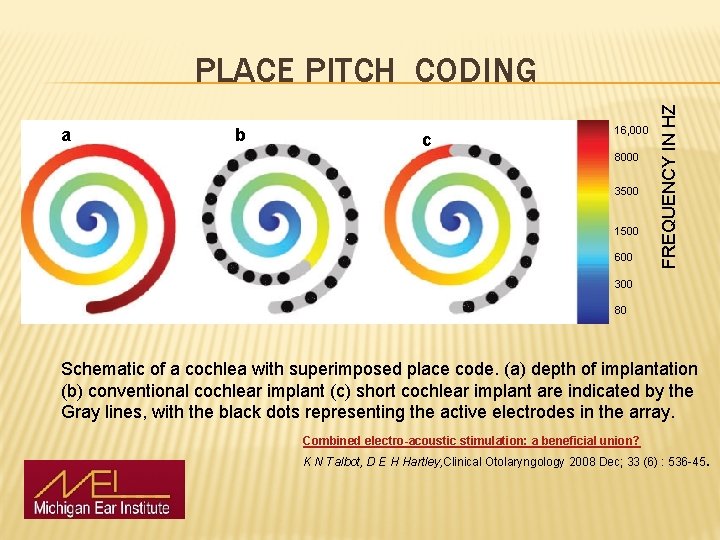
a b c 16, 000 8000 3500 1500 600 FREQUENCY IN HZ PLACE PITCH CODING 300 80 Schematic of a cochlea with superimposed place code. (a) depth of implantation (b) conventional cochlear implant (c) short cochlear implant are indicated by the Gray lines, with the black dots representing the active electrodes in the array. Combined electro-acoustic stimulation: a beneficial union? K N Talbot, D E H Hartley, Clinical Otolaryngology 2008 Dec; 33 (6) : 536 -45.
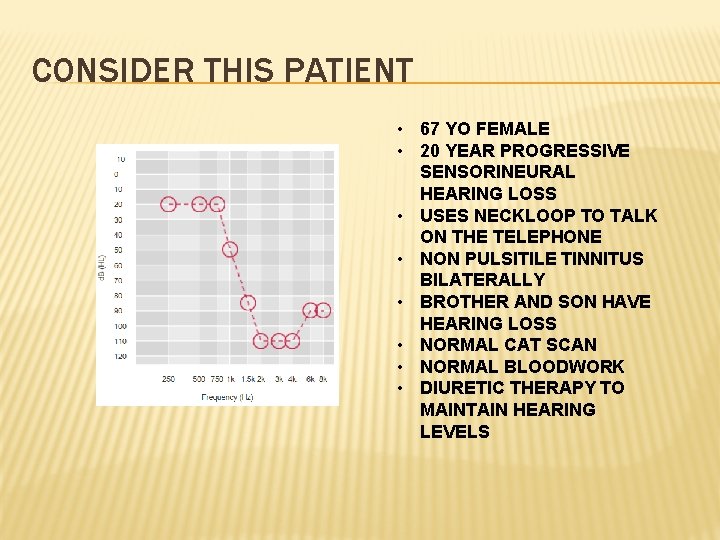
CONSIDER THIS PATIENT • 67 YO FEMALE • 20 YEAR PROGRESSIVE SENSORINEURAL HEARING LOSS • USES NECKLOOP TO TALK ON THE TELEPHONE • NON PULSITILE TINNITUS BILATERALLY • BROTHER AND SON HAVE HEARING LOSS • NORMAL CAT SCAN • NORMAL BLOODWORK • DIURETIC THERAPY TO MAINTAIN HEARING LEVELS
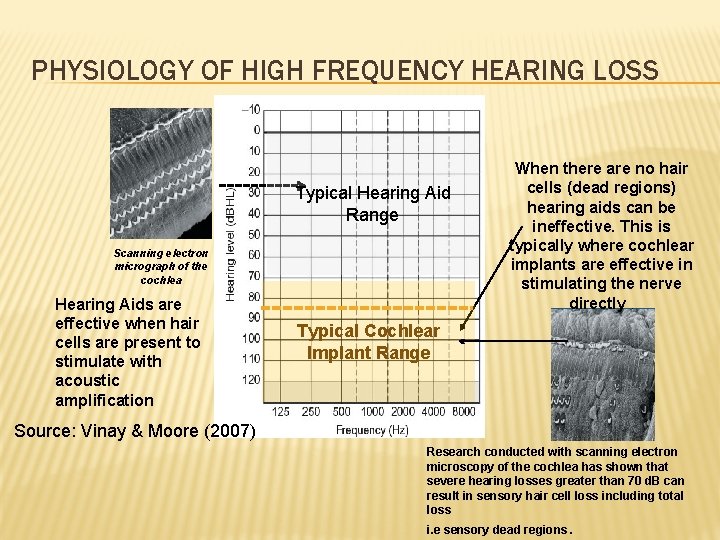
PHYSIOLOGY OF HIGH FREQUENCY HEARING LOSS Typical Hearing Aid Range Scanning electron micrograph of the cochlea Hearing Aids are effective when hair cells are present to stimulate with acoustic amplification When there are no hair cells (dead regions) hearing aids can be ineffective. This is typically where cochlear implants are effective in stimulating the nerve directly. Typical Cochlear Implant Range Source: Vinay & Moore (2007) Research conducted with scanning electron microscopy of the cochlea has shown that severe hearing losses greater than 70 d. B can result in sensory hair cell loss including total loss i. e sensory dead regions.
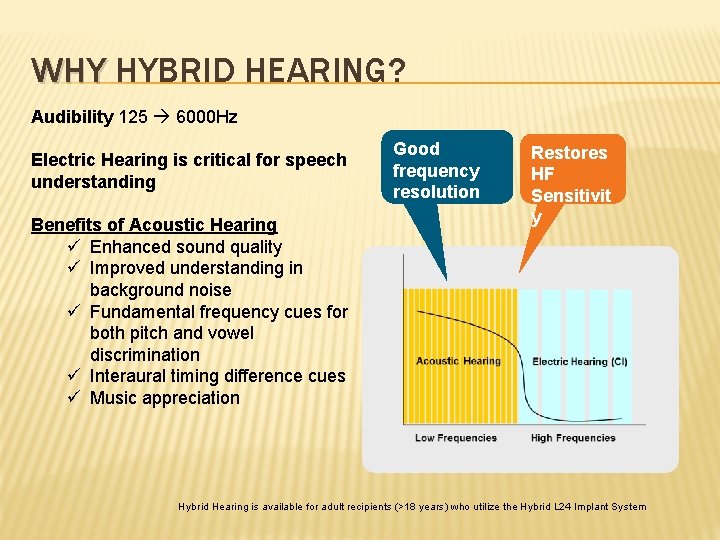
WHY HYBRID HEARING? Audibility 125 6000 Hz Electric Hearing is critical for speech understanding Benefits of Acoustic Hearing ü Enhanced sound quality ü Improved understanding in background noise ü Fundamental frequency cues for both pitch and vowel discrimination ü Interaural timing difference cues ü Music appreciation Good frequency resolution Restores HF Sensitivit y Hybrid Hearing is available for adult recipients (>18 years) who utilize the Hybrid L 24 Implant System
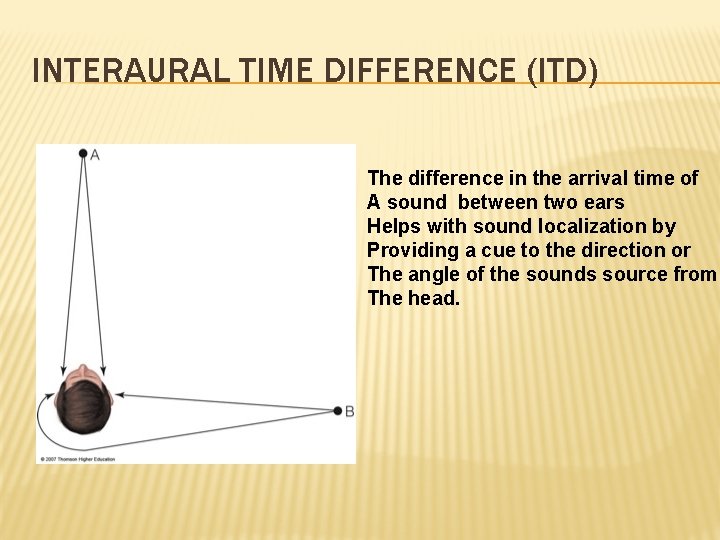
INTERAURAL TIME DIFFERENCE (ITD) The difference in the arrival time of A sound between two ears Helps with sound localization by Providing a cue to the direction or The angle of the sounds source from The head.
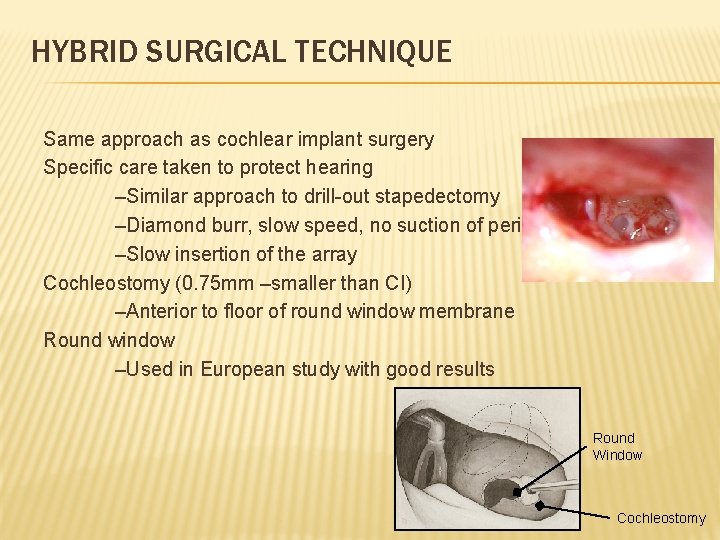
HYBRID SURGICAL TECHNIQUE Same approach as cochlear implant surgery Specific care taken to protect hearing –Similar approach to drill-out stapedectomy –Diamond burr, slow speed, no suction of perilymph –Slow insertion of the array Cochleostomy (0. 75 mm –smaller than CI) –Anterior to floor of round window membrane Round window –Used in European study with good results Round Window Cochleostomy
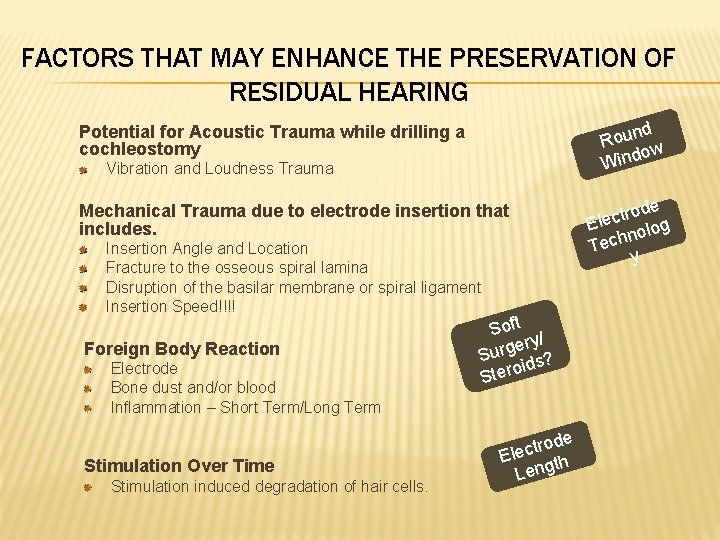
FACTORS THAT MAY ENHANCE THE PRESERVATION OF RESIDUAL HEARING nd Rou w o Wind Potential for Acoustic Trauma while drilling a cochleostomy Vibration and Loudness Trauma Mechanical Trauma due to electrode insertion that includes. Insertion Angle and Location Fracture to the osseous spiral lamina Disruption of the basilar membrane or spiral ligament Insertion Speed!!!! Foreign Body Reaction Electrode Bone dust and/or blood Inflammation – Short Term/Long Term Stimulation Over Time Stimulation induced degradation of hair cells. Soft / ery g r u S ds? i o r e St trode c e l E th Leng trode c e l E olog n h c Te y
BACKGROUND: >15 years of research � 8 year FDA trial of 50 adult subjects 1 st implantable FDA-approved for treatment of HF SNHL � � � FDA-approved March 2014 1 st Hybrid implant (U. S. ) April 16, 2014 1 st and only cochlear implant labeled for potential preservation of RH 1 st indication using CNC words 1 st integrated electric+ acoustic SP 1 st trial publication July 2015 Laryngoscope 2 Post-Approval Studies Ongoing: � � Longitudinal hearing preservation and performance data to 5 years Up to 100 subjects implanted Hybrid Hearing is available for adult recipients (>18 years) who utilize the Hybrid L 24 Implant System
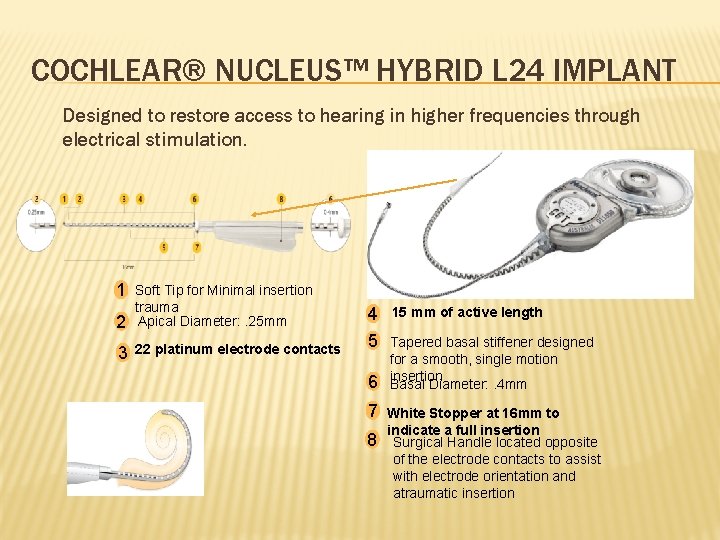
COCHLEAR® NUCLEUS™ HYBRID L 24 IMPLANT Designed to restore access to hearing in higher frequencies through electrical stimulation. 1 2 Soft Tip for Minimal insertion trauma Apical Diameter: . 25 mm 3 22 platinum electrode contacts 4 5 6 7 8 15 mm of active length Tapered basal stiffener designed for a smooth, single motion insertion Basal Diameter: . 4 mm White Stopper at 16 mm to indicate a full insertion Surgical Handle located opposite of the electrode contacts to assist with electrode orientation and atraumatic insertion
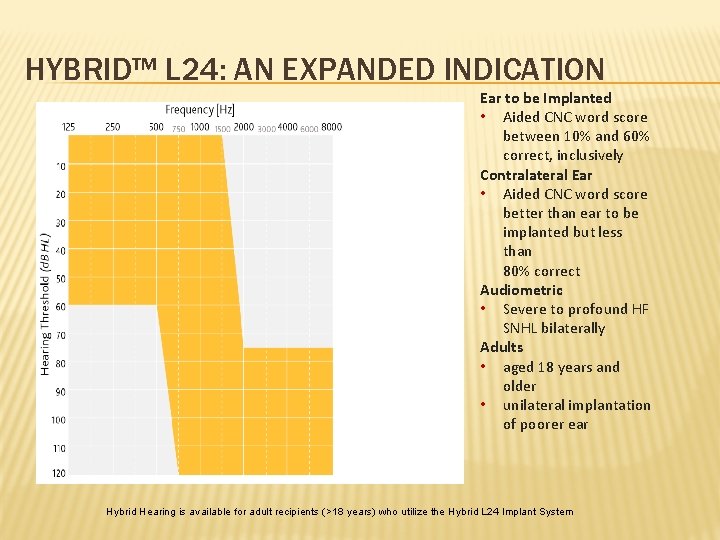
HYBRID™ L 24: AN EXPANDED INDICATION Ear to be Implanted • Aided CNC word score between 10% and 60% correct, inclusively Contralateral Ear • Aided CNC word score better than ear to be implanted but less than 80% correct Audiometric • Severe to profound HF SNHL bilaterally Adults • aged 18 years and older • unilateral implantation of poorer ear Hybrid Hearing is available for adult recipients (>18 years) who utilize the Hybrid L 24 Implant System
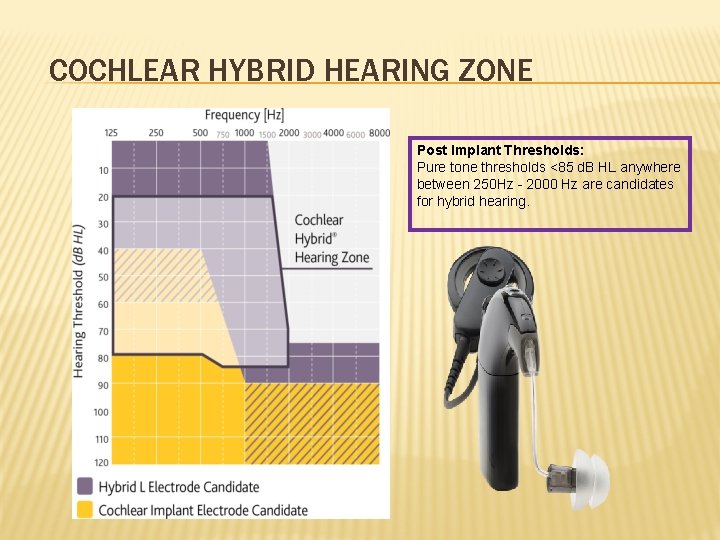
COCHLEAR HYBRID HEARING ZONE Post Implant Thresholds: Pure tone thresholds <85 d. B HL anywhere between 250 Hz - 2000 Hz are candidates for hybrid hearing.
WHAT ABOUT FREQUENCY LOWERING TECHNOLOGY Over 30 years of research with FLT –Multiple variations of FLT • Little to no benefit (< 10 -percentage points) for: –Phonemes –Consonants –Plurals –Vowels • Few reported significance at the group level • Did not use same measures as CI studies –Does not allow for across-technology comparison Glistaet al. , (2009). Int. J Audiol. , 48: 632 -644. Simpson et al. , (2005) Int. J Audiol. , 44: 632 -644. Robinson et al. , (2007). Int. J Audiol, 46: 293 -308. Kuket al. , (2009). Jnl. Am Acad. Aud, 20: 465 -479
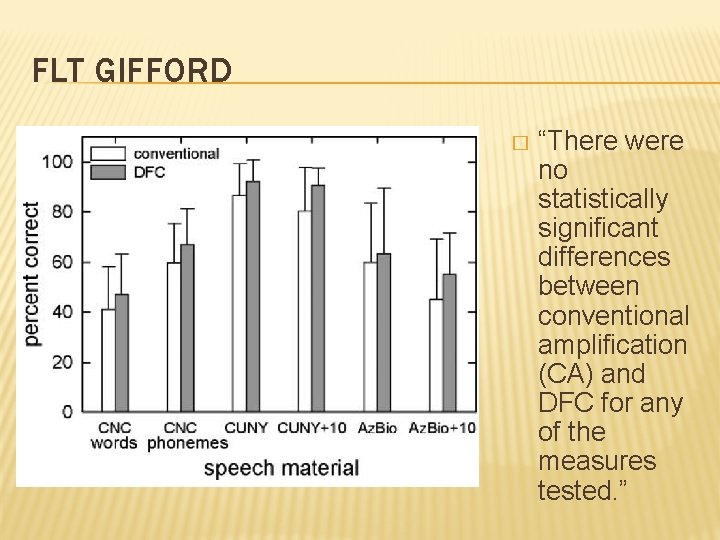
FLT GIFFORD � “There were no statistically significant differences between conventional amplification (CA) and DFC for any of the measures tested. ”
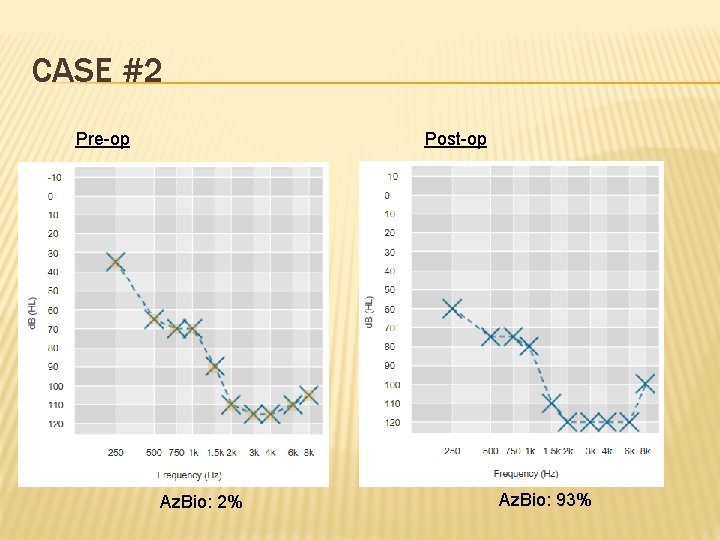
CASE #2 Pre-op Post-op Az. Bio: 2% Az. Bio: 93%
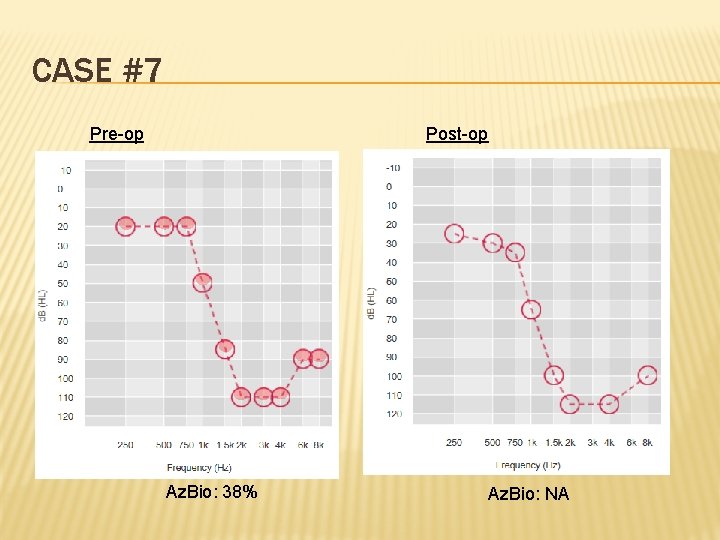
CASE #7 Pre-op Post-op Az. Bio: 38% Az. Bio: NA
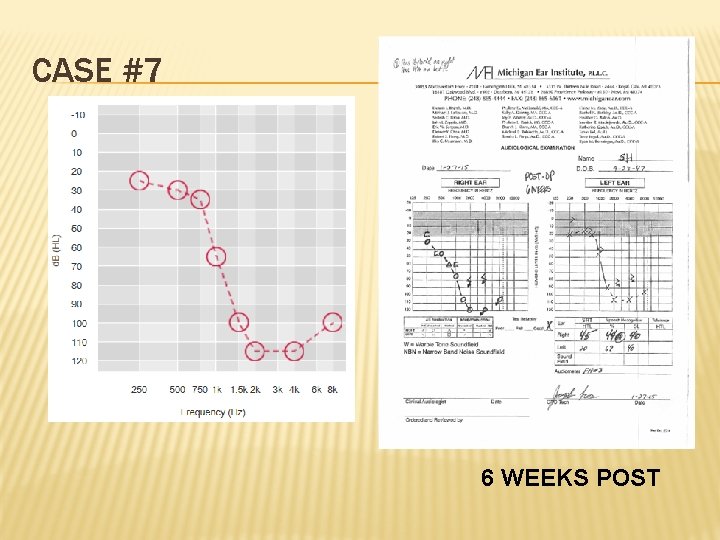
CASE #7 6 WEEKS POST
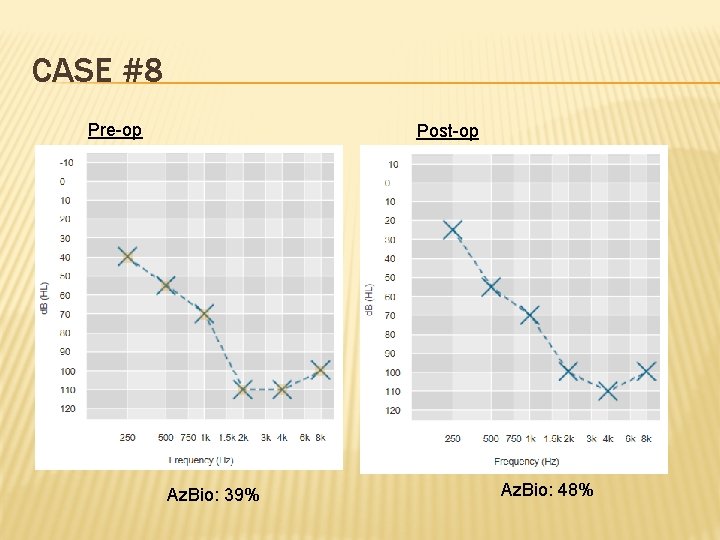
CASE #8 Pre-op Post-op Az. Bio: 39% Az. Bio: 48%
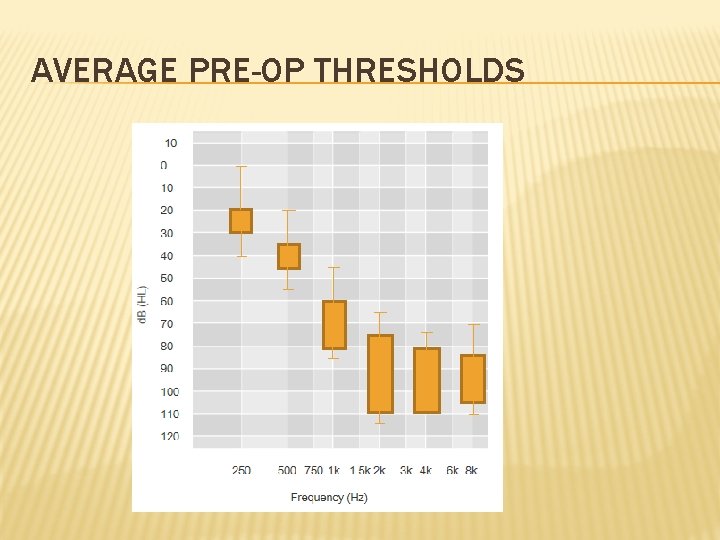
AVERAGE PRE-OP THRESHOLDS
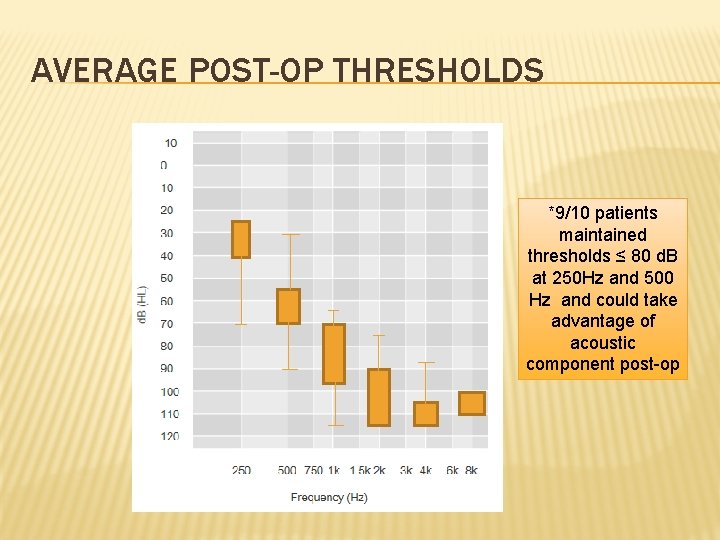
AVERAGE POST-OP THRESHOLDS *9/10 patients maintained thresholds ≤ 80 d. B at 250 Hz and 500 Hz and could take advantage of acoustic component post-op
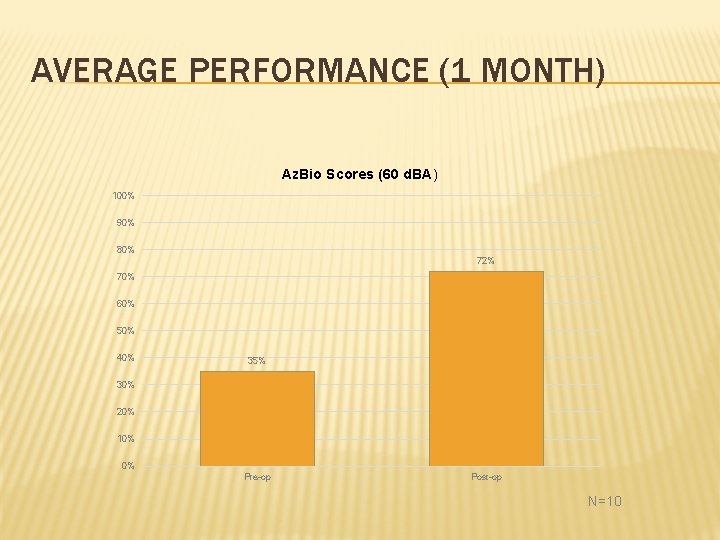
AVERAGE PERFORMANCE (1 MONTH) Az. Bio Scores (60 d. BA) 100% 90% 80% 72% 70% 60% 50% 40% 35% 30% 20% 10% 0% Pre-op Post-op N=10
POST OP HEARING RESULTS Combined electro-acoustic stimulation: a beneficial union? K N Talbot, D E H Hartley, Clinical Otolaryngology 2008 Dec; 33 (6) : 536 -45 Is electric acoustic stimulation better than conventional cochlear implantation for speech perception in quiet? Adunka OF 1, Pillsbury HC, Adunka MC, Buchman CA. , Otol Neurotology. 2010 Sep; 31(7): 1049 -54. Electric-acoustic stimulation of the auditory system: a review of the first decade. von Ilberg CA 1, Baumann U, Kiefer J, Tillein J, Adunka OF. , Audiol Neurootol. 2011; 16 Suppl 2: 1 -30. United States multicenter clinical trial of the cochlear nucleus hybrid implant system. Roland JT Jr 1, Gantz BJ 2, Waltzman SB 1, Parkinson AJ 3; Multicenter Clinical Trial Group, Laryngoscope. 2016 Jan; 126(1): 175 -81.
CONCLUSIONS Hybrid provides an option for a severe high frequency hearing loss Hybrid implant is able to preserve residual in most patients Even if hearing thresholds fall off the patients are likely to perform better than they did prior to implantation Functional residual hearing is more important than measured thresholds post-op.

THERE IS ALWAYS BASKETBALL THANK YOU !
- Slides: 37