
Hybrid and Embedded Systems Generalized Hybrid Systems Edward
Hybrid and Embedded Systems: Generalized Hybrid Systems Edward A. Lee Robert S. Pepper Distinguished Professor UC Berkeley CPS Action Webs Meeting July 23, 2010 Berkeley, CA
Online interactive versions of many of the examples in this talk can be accessed by clicking on the figures in the second paper here: http: //www. eecs. berkeley. edu/Pubs/Tech. Rpts/2009/EECS-2009 -151. html Lee, Berkeley 2
In a sense, the work here aims to generalize: ¢ ¢ ¢ ¢ ¢ Statecharts [Harel 87] Argos [Maraninchi 91] Esterel [Berry & Gonthier 92] Abstract state machines [Gurevich 93] Hybrid systems [Puri & Varaiya 94, Henzinger 99] Timed automata [Alur & Dill 94] Sync. Charts [Andre 96] I/O Automata [Lynch 96] *Charts [Girault, Lee, & Lee 99] Lee, Berkeley 3
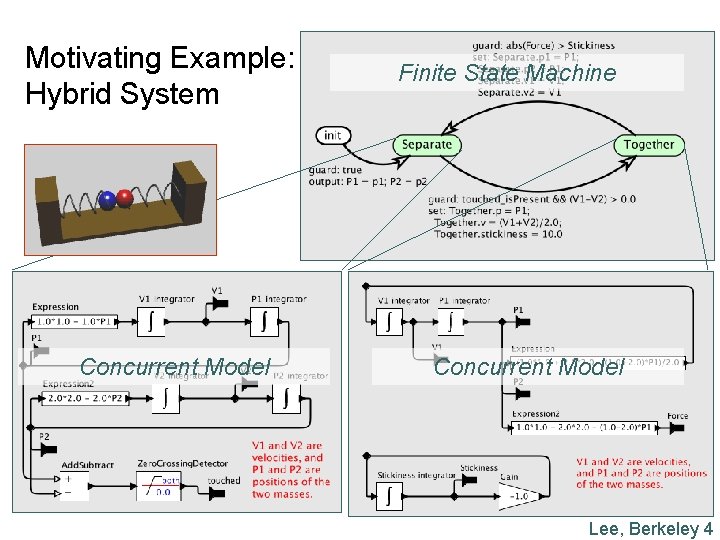
Motivating Example: Hybrid System Concurrent Model Finite State Machine Concurrent Model Lee, Berkeley 4
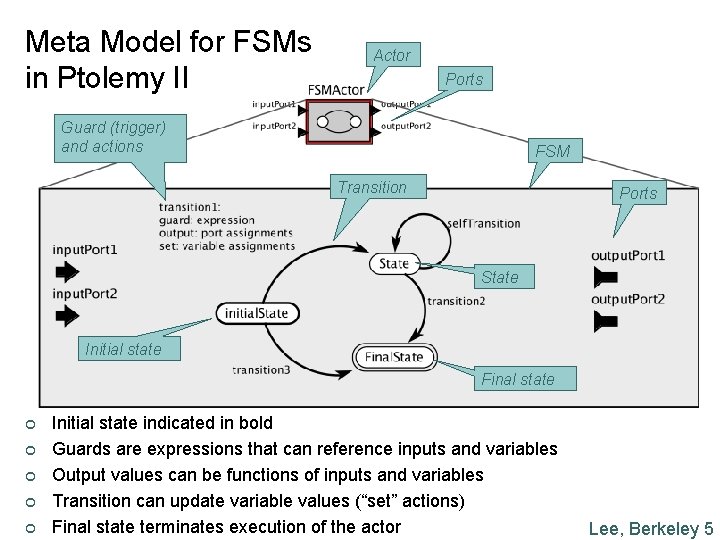
Meta Model for FSMs in Ptolemy II Actor Ports Guard (trigger) and actions FSM Transition Ports State Initial state Final state ¢ ¢ ¢ Initial state indicated in bold Guards are expressions that can reference inputs and variables Output values can be functions of inputs and variables Transition can update variable values (“set” actions) Final state terminates execution of the actor Lee, Berkeley 5

Extended State Machines Reference and manipulate variables on guards and transitions. Extended state machines can operate on variables in the model, like “count” in this example. 0, 1, 2, 3, 4, 5, 5, 5, · · · Variable “Set” actions are distinct from “output” actions. We will see why. Lee, Berkeley 6
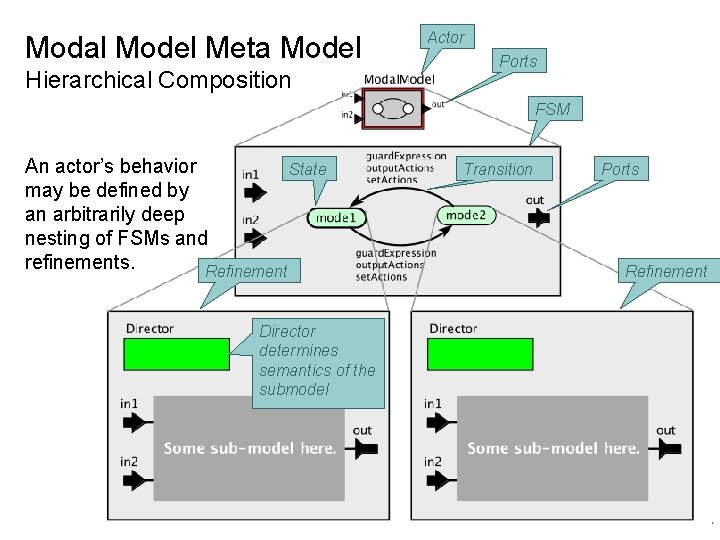
Modal Model Meta Model Hierarchical Composition Actor Ports FSM An actor’s behavior State may be defined by an arbitrarily deep nesting of FSMs and refinements. Refinement Transition Ports Refinement Director determines semantics of the submodel Lee, Berkeley 7
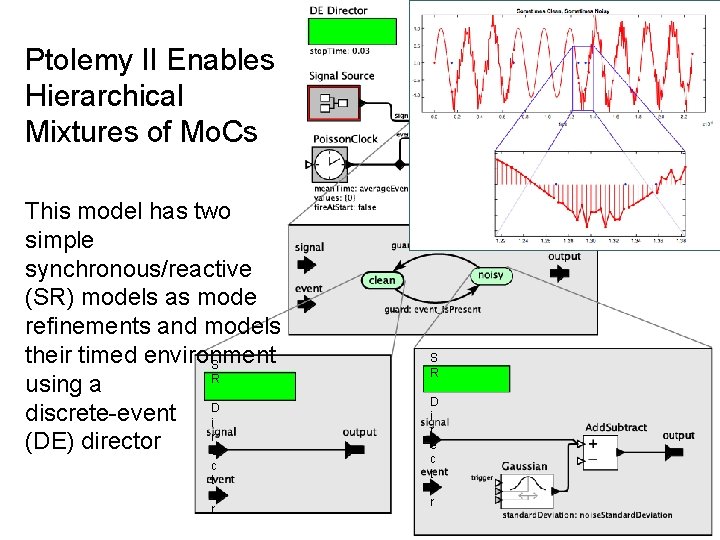
Ptolemy II Enables Hierarchical Mixtures of Mo. Cs This model has two simple synchronous/reactive (SR) models as mode refinements and models their timed environment S R using a discrete-event Di r (DE) director e c t o r S R D i r e c t o r Lee, Berkeley 8
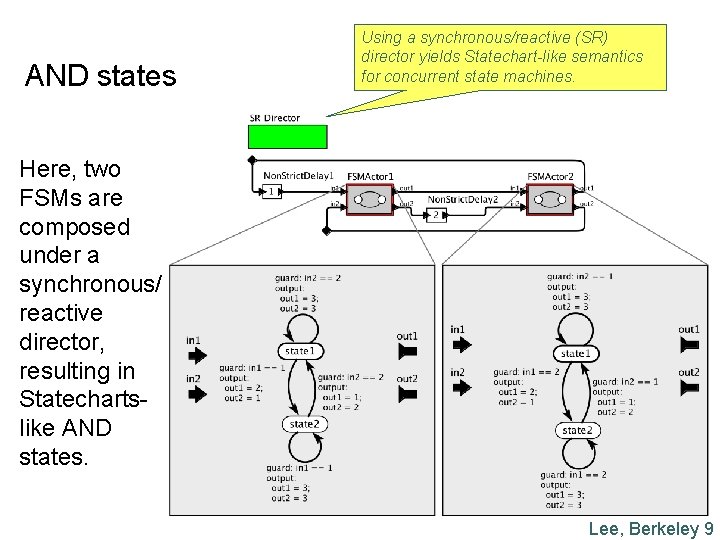
AND states Using a synchronous/reactive (SR) director yields Statechart-like semantics for concurrent state machines. Here, two FSMs are composed under a synchronous/ reactive director, resulting in Statechartslike AND states. Lee, Berkeley 9
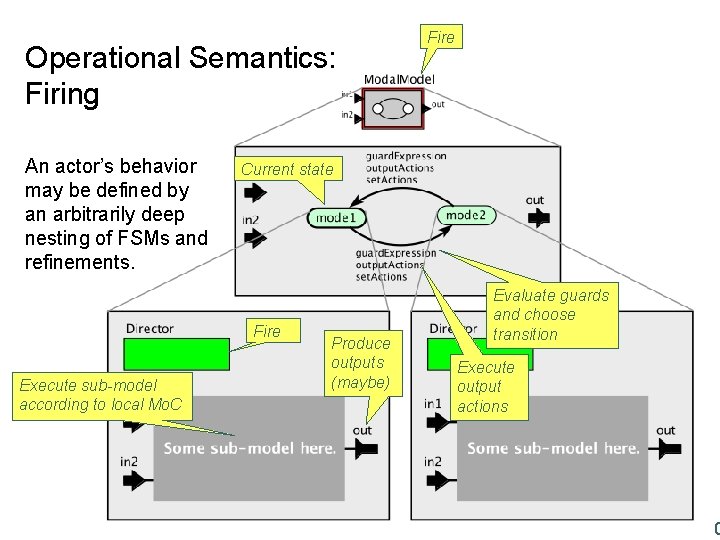
Operational Semantics: Firing An actor’s behavior may be defined by an arbitrarily deep nesting of FSMs and refinements. Current state Fire Execute sub-model according to local Mo. C Fire Produce outputs (maybe) Evaluate guards and choose transition Execute output actions Lee, Berkeley 10
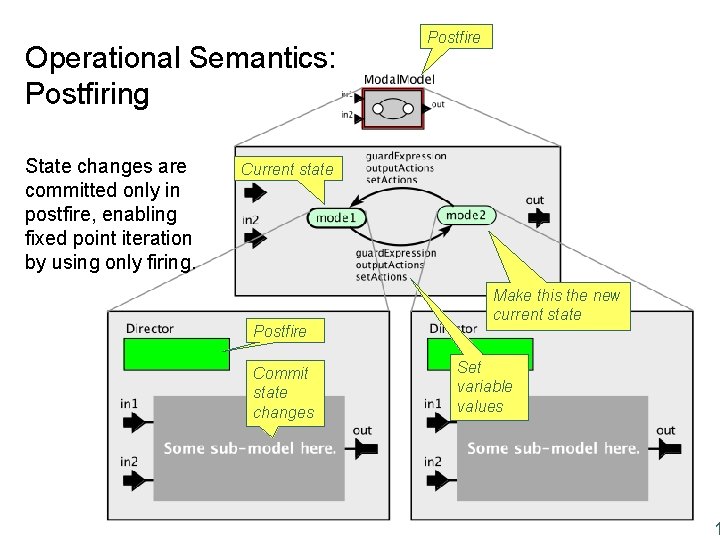
Operational Semantics: Postfiring State changes are committed only in postfire, enabling fixed point iteration by using only firing. Postfire Current state Postfire Commit state changes Make this the new current state Set variable values Lee, Berkeley 11
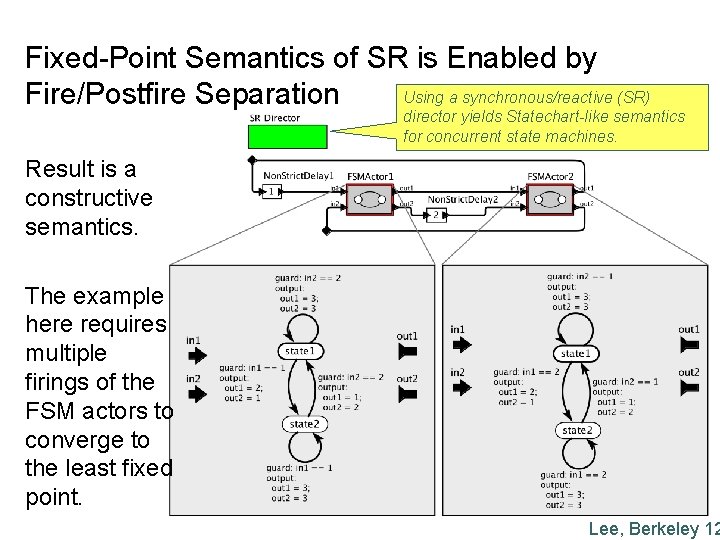
Fixed-Point Semantics of SR is Enabled by Using a synchronous/reactive (SR) Fire/Postfire Separation director yields Statechart-like semantics for concurrent state machines. Result is a constructive semantics. The example here requires multiple firings of the FSM actors to converge to the least fixed point. Lee, Berkeley 12
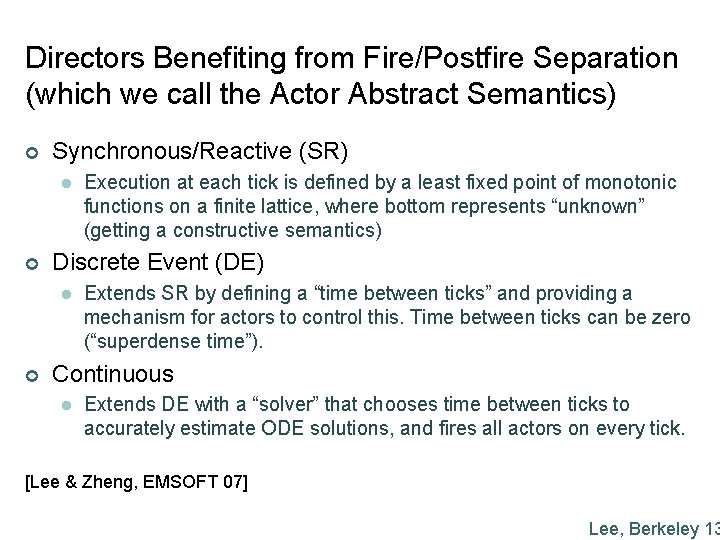
Directors Benefiting from Fire/Postfire Separation (which we call the Actor Abstract Semantics) ¢ Synchronous/Reactive (SR) l ¢ Discrete Event (DE) l ¢ Execution at each tick is defined by a least fixed point of monotonic functions on a finite lattice, where bottom represents “unknown” (getting a constructive semantics) Extends SR by defining a “time between ticks” and providing a mechanism for actors to control this. Time between ticks can be zero (“superdense time”). Continuous l Extends DE with a “solver” that chooses time between ticks to accurately estimate ODE solutions, and fires all actors on every tick. [Lee & Zheng, EMSOFT 07] Lee, Berkeley 13
The Modal Model Muddle It’s about time After trying several variants on the semantics of modal time, we settled on this: A mode refinement has a local notion of time. When the mode refinement is inactive, local time does not advance. Local time has a monotonically increasing gap relative to global time. Lee, Berkeley 14
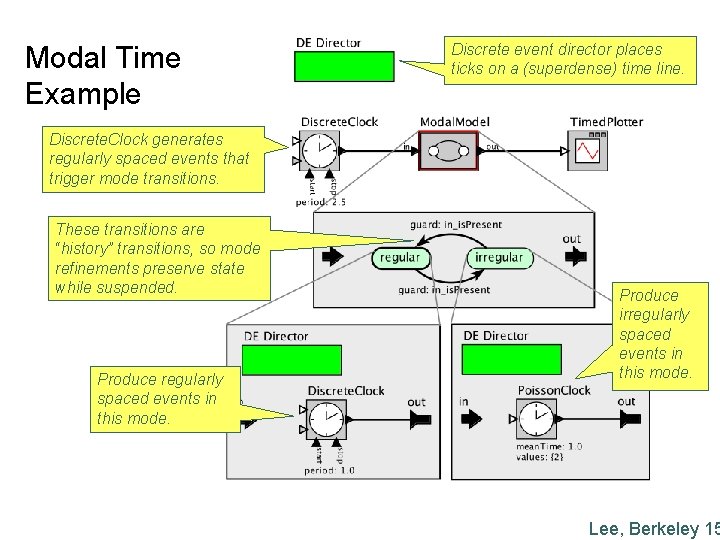
Modal Time Example Discrete event director places ticks on a (superdense) time line. Discrete. Clock generates regularly spaced events that trigger mode transitions. These transitions are “history” transitions, so mode refinements preserve state while suspended. Produce regularly spaced events in this mode. Produce irregularly spaced events in this mode. Lee, Berkeley 15
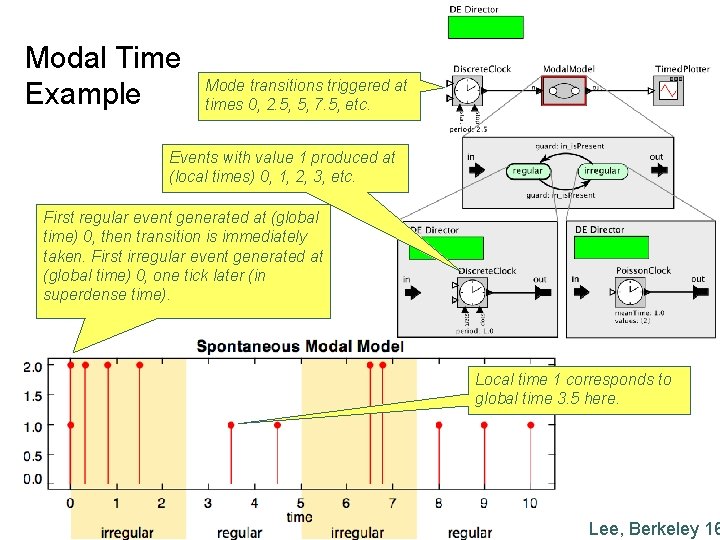
Modal Time Example Mode transitions triggered at times 0, 2. 5, 5, 7. 5, etc. Events with value 1 produced at (local times) 0, 1, 2, 3, etc. First regular event generated at (global time) 0, then transition is immediately taken. First irregular event generated at (global time) 0, one tick later (in superdense time). Local time 1 corresponds to global time 3. 5 here. Lee, Berkeley 16
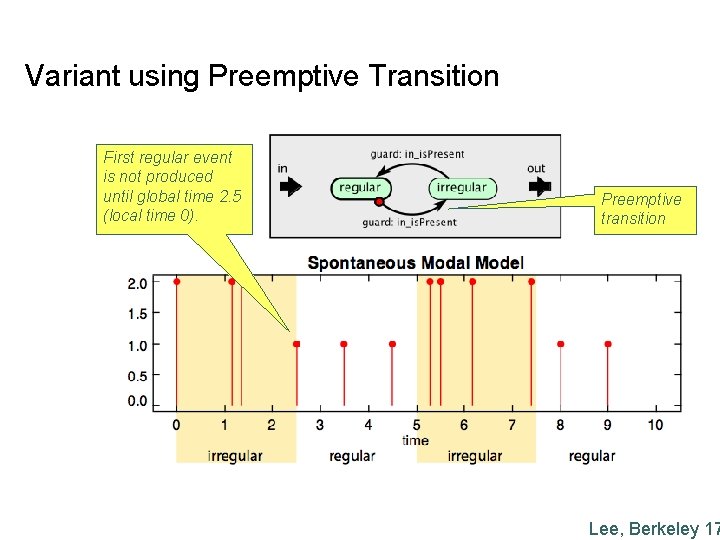
Variant using Preemptive Transition First regular event is not produced until global time 2. 5 (local time 0). Preemptive transition Lee, Berkeley 17
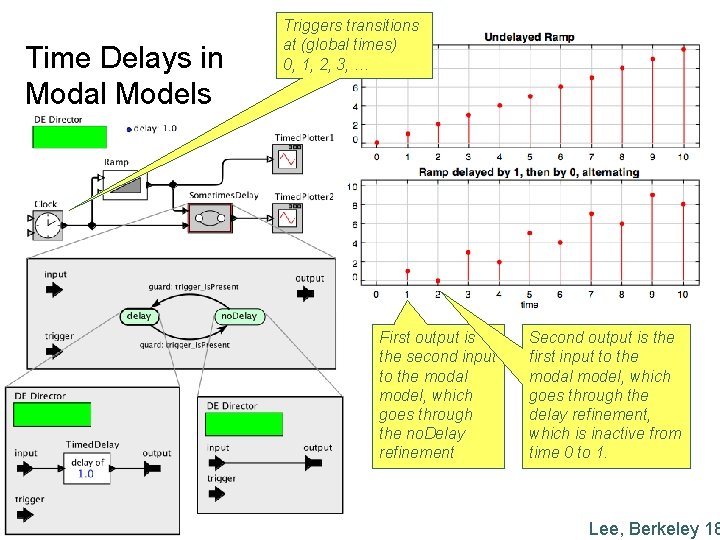
Time Delays in Modal Models Triggers transitions at (global times) 0, 1, 2, 3, … First output is the second input to the modal model, which goes through the no. Delay refinement Second output is the first input to the modal model, which goes through the delay refinement, which is inactive from time 0 to 1. Lee, Berkeley 18
Variants for the Semantics of Modal Time that we Tried or Considered, but that Failed ¢ ¢ Mode refinement executes while “inactive” but inputs are not provided and outputs are not observed. Time advances while mode is inactive, and mode refinement is responsible for “catching up. ” Mode refinement is “notified” when it has requested time increments that are not met because it is inactive. When a mode refinement is re-activated, it resumes from its first missed event. All of these led to some very strange models… Final solution: Local time does not advance while a mode is inactive. Growing gap between local time and global time. Lee, Berkeley 19
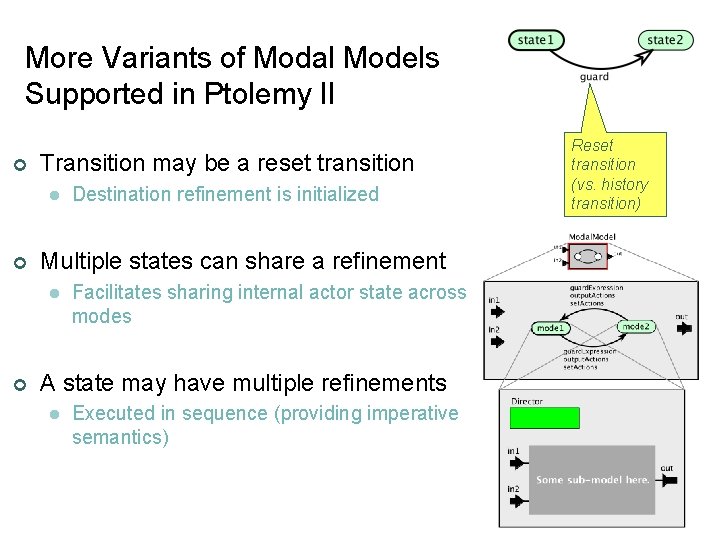
More Variants of Modal Models Supported in Ptolemy II ¢ Transition may be a reset transition l ¢ Multiple states can share a refinement l ¢ Destination refinement is initialized Reset transition (vs. history transition) Facilitates sharing internal actor state across modes A state may have multiple refinements l Executed in sequence (providing imperative semantics) Lee, Berkeley 20
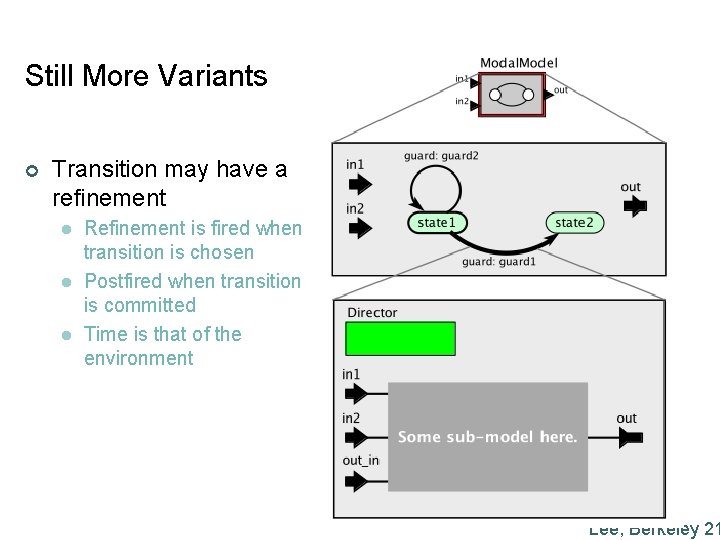
Still More Variants ¢ Transition may have a refinement l l l Refinement is fired when transition is chosen Postfired when transition is committed Time is that of the environment Lee, Berkeley 21
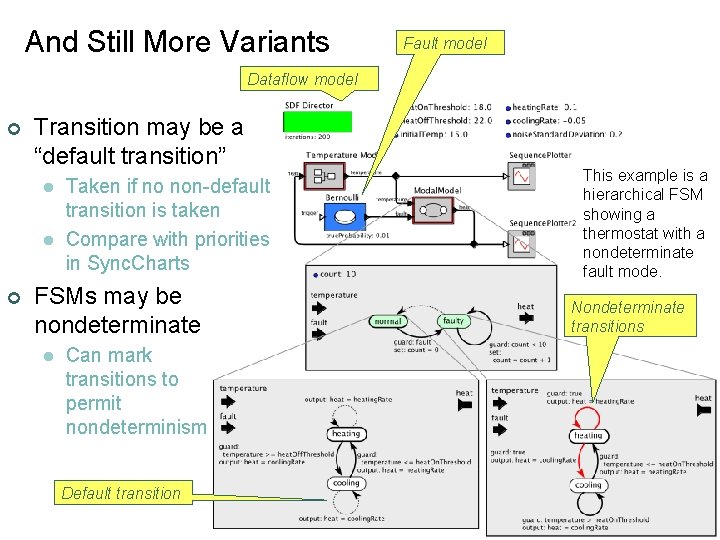
And Still More Variants Fault model Dataflow model ¢ Transition may be a “default transition” l l ¢ Taken if no non-default transition is taken Compare with priorities in Sync. Charts FSMs may be nondeterminate l This example is a hierarchical FSM showing a thermostat with a nondeterminate fault mode. Nondeterminate transitions Can mark transitions to permit nondeterminism Default transition Lee, Berkeley 22
Conclusion Modal models (in Ptolemy II, Statecharts, Sync. Charts, Argos, etc. ) provide a hierarchical mixture of imperative logic and declarative composition. Humans are very capable of reasoning both imperatively (algorithms, recipes, etc. ) and declaratively (equations, synchronous composition, etc. ). We use these reasoning tools for different (complementary) tasks. Hybrid systems combine such reasoning: Declarative differential equations, Imperative FSMs. The abstract semantics given here generalizes them to other Mo. Cs. Lee, Berkeley 23
Acknowledgments ¢ Contributors to the modal model mechanisms in Ptolemy II: l l l ¢ Graphical editor in Vergil for state machines: l l ¢ l Joern Janneck Stavros Tripakis Online interactive examples and Ptolemy II infrastructure: l ¢ Stephen Neuendorffer Hideo John Reekie Semantics of modal time: l ¢ Thomas Huining Feng Xiaojun Liu Haiyang Zheng Christopher Brooks Other: l l l David Hermann & Zoltan Kemenczy (from RIM): transition refinements Jie Liu: hybrid systems Ye Zhou: modal dataflow models Lee, Berkeley 24
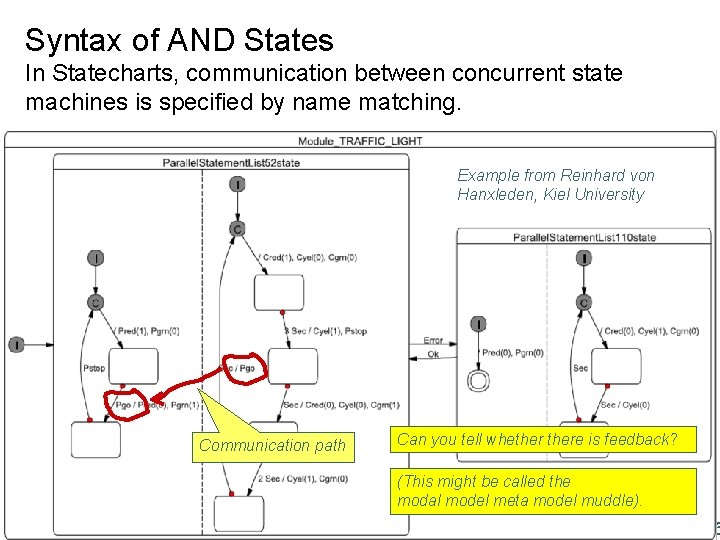
Syntax of AND States In Statecharts, communication between concurrent state machines is specified by name matching. Example from Reinhard von Hanxleden, Kiel University Communication path Can you tell whethere is feedback? (This might be called the modal model meta model muddle). Lee, Berkeley 25
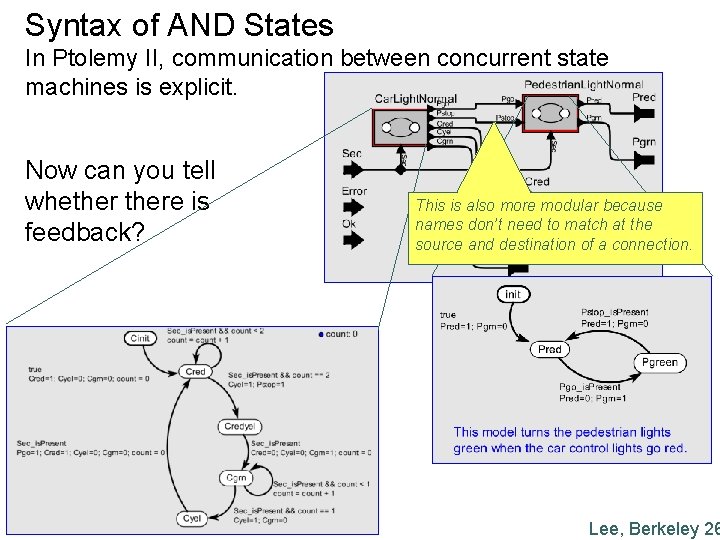
Syntax of AND States In Ptolemy II, communication between concurrent state machines is explicit. Now can you tell whethere is feedback? This is also more modular because names don’t need to match at the source and destination of a connection. Lee, Berkeley 26
- Slides: 26