
Hybrid AF Convergent Therapy Procedure for the Treatment
Hybrid AF™ Convergent Therapy Procedure for the Treatment of Long-Standing Persistent Atrial Fibrillation Set-Up Guide PE-US-0004 C-0322 -G
![Hybrid AF Convergent Therapy Procedure: Room Setup [2] PE-US-0004 C-0322 -G](http://slidetodoc.com/presentation_image_h2/99d2c343d45b20d4905f4579ffe3bcc4/image-2.jpg "Hybrid AF Convergent Therapy Procedure: Room Setup [2] PE-US-0004 C-0322 -G")
Hybrid AF Convergent Therapy Procedure: Room Setup [2] PE-US-0004 C-0322 -G
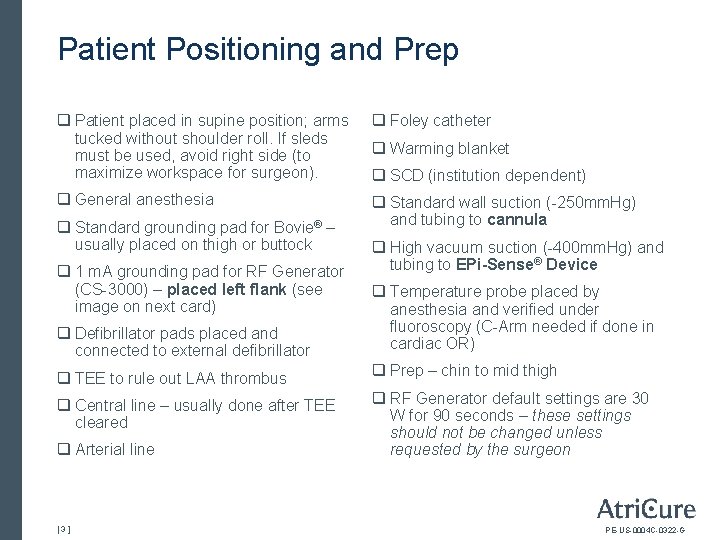
Patient Positioning and Prep q Patient placed in supine position; arms tucked without shoulder roll. If sleds must be used, avoid right side (to maximize workspace for surgeon). q Foley catheter q General anesthesia q Standard wall suction (-250 mm. Hg) and tubing to cannula q Standard grounding pad for Bovie® – usually placed on thigh or buttock q 1 m. A grounding pad for RF Generator (CS-3000) – placed left flank (see image on next card) q Warming blanket q SCD (institution dependent) q High vacuum suction (-400 mm. Hg) and tubing to EPi-Sense® Device q Defibrillator pads placed and connected to external defibrillator q Temperature probe placed by anesthesia and verified under fluoroscopy (C-Arm needed if done in cardiac OR) q TEE to rule out LAA thrombus q Prep – chin to mid thigh q Central line – usually done after TEE cleared q RF Generator default settings are 30 W for 90 seconds – these settings should not be changed unless requested by the surgeon q Arterial line [3] PE-US-0004 C-0322 -G
![1 m. A Grounding Pad Placement [4] PE-US-0004 C-0322 -G](http://slidetodoc.com/presentation_image_h2/99d2c343d45b20d4905f4579ffe3bcc4/image-4.jpg "1 m. A Grounding Pad Placement [4] PE-US-0004 C-0322 -G")
1 m. A Grounding Pad Placement [4] PE-US-0004 C-0322 -G
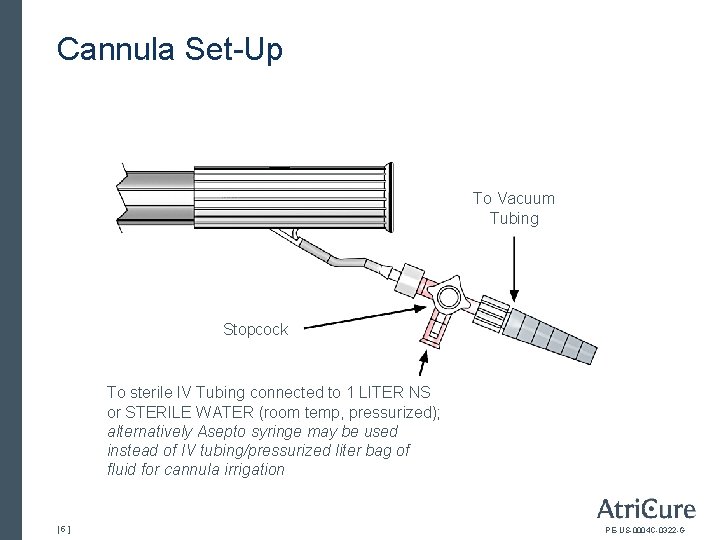
Cannula Set-Up To Vacuum Tubing Stopcock To sterile IV Tubing connected to 1 LITER NS or STERILE WATER (room temp, pressurized); alternatively Asepto syringe may be used instead of IV tubing/pressurized liter bag of fluid for cannula irrigation [5] PE-US-0004 C-0322 -G
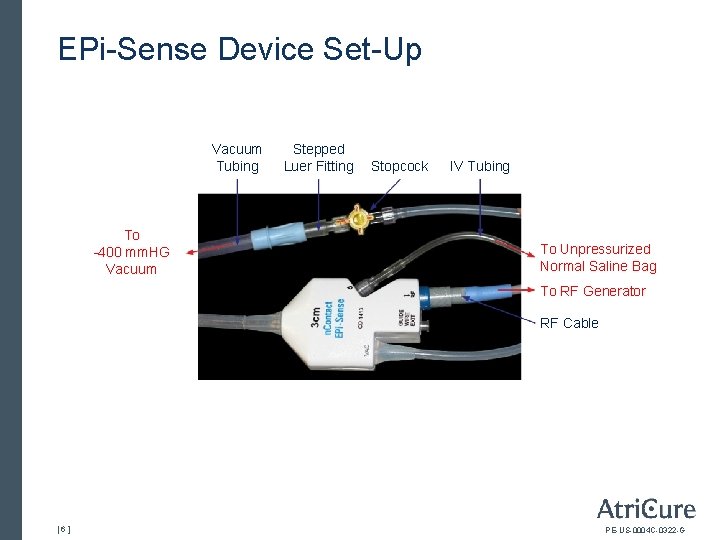
EPi-Sense Device Set-Up Vacuum Tubing To -400 mm. HG Vacuum Stepped Luer Fitting Stopcock IV Tubing To Unpressurized Normal Saline Bag To RF Generator RF Cable [6] PE-US-0004 C-0322 -G

Hybrid AF Convergent Therapy Procedure: Device Set-Up q Prepare the Vacuum q Attach one end of the sterile vacuum tubing to the graduated fitting where indicated on device handle by the vacuum symbol (‘VAC’) and the other to the vacuum trap. Use the stopcock to apply and release the vacuum to the distal assembly. q Ensure the vacuum unit pressure is set to – 400 mm. Hg q Prepare the 0. 9% Normal Saline Bag q Place unpressurized saline IV bag at patient height or above. q Connect perfusion tubing to female Luer connection where indicated on device handle by the perfusion “droplet” symbol. Verify IV line is fully open. [7] PE-US-0004 C-0322 -G
Hybrid AF Convergent Therapy Procedure: Device Set-Up continued q Insert IV tubing set into 0. 9% normal saline bag. q Turn on vacuum pressure and prime device by engaging the suction with a sterile surface (gloved hand). q Ensure perfusion flow is functioning by observing drops in IV tubing drip chamber. Make sure the device is primed by observing perfusion at distal end of coagulation device before starting operation of device. Ensure IV line is fully open. q Insert device into cannula and advance to target tissue q Confirm arrows point toward target tissue and apply vacuum q Irrigate field (1 L NS pressurized connected to cannula or with sterile irrigated bulb syringe) [8] PE-US-0004 C-0322 -G
Hybrid AF Convergent Therapy Procedure: Procedural Steps q Surgeon makes small (2 -3 cm) incision over xiphoid process – surgeon may elect to remove some/all of xiphoid process q Surgeon establishes sub-xiphoid (Sub-X) pericardial window q Atri. Cure cannula placed behind heart within pericardial window q Introduce 0º 5 mm scope through cannula q Through scope, identify landmarks on posterior left atrium q Ready to ablate [9] PE-US-0004 C-0322 -G
Hybrid AF Convergent Therapy Procedure: Optional LAA Management q 12 mm trocar, quantity of one q 5 mm trocar, quantity of two or three (physician preference) q 5 mm 30° scope q Insufflation tubing q Harmonic® scalpel, Ligasure™ device, Endoseal™ or L-hook cautery q Inflatable patient positioning device, placed under left scapula • Assess for optimal placement by inflating and deflating prior to prepping q Laproscopic graspers q Endoscopic Kittner q Endoscopic retention stitch (hold) and suction/irrigator (hold) [ 10 ] PE-US-0004 C-0322 -G
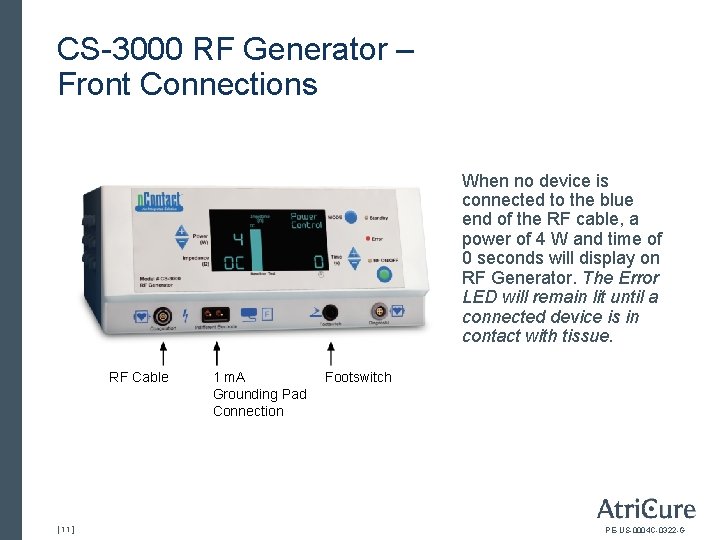
CS-3000 RF Generator – Front Connections When no device is connected to the blue end of the RF cable, a power of 4 W and time of 0 seconds will display on RF Generator. The Error LED will remain lit until a connected device is in contact with tissue. RF Cable [ 11 ] 1 m. A Grounding Pad Connection Footswitch PE-US-0004 C-0322 -G
![CS-3000 RF Generator Unit-Front Connections continued Cables Used with EPi-Sense Device [ 12 ]](http://slidetodoc.com/presentation_image_h2/99d2c343d45b20d4905f4579ffe3bcc4/image-12.jpg "CS-3000 RF Generator Unit-Front Connections continued Cables Used with EPi-Sense Device [ 12 ]")
CS-3000 RF Generator Unit-Front Connections continued Cables Used with EPi-Sense Device [ 12 ] CSK-2030 Connections CSK-2010 Connections CSK-2000 CSK-2030 CSK-2010 PE-US-0004 C-0322 -G
Reference: PM-US-0045 A-1020 -G Closed Chest Access Using Cannula and EPi-Sense Coagulation Device EPi-Sense® Guided Coagulation System U. S. Indications: The EPi-Sense Guided Coagulation System is intended for the treatment of symptomatic long-standing persistent atrial fibrillation (continuous atrial fibrillation greater than 12 months duration) when augmented in a hybrid procedure with an endocardial catheter listed in the instructions for use, in patients (1) who are refractory or intolerant to at least one Class I and/or III antiarrhythmic drug (AAD); and (2) in whom the expected benefit from rhythm control outweighs the potential known risks associated with a hybrid procedure such as delayed post-procedure inflammatory pericardial effusions. Contraindications include patients with Barrett’s Esophagitis, left atrial thrombus, a systemic infection, active endocarditis, or a localized infection at the surgical site at the time of surgery. Adverse Events: Reported adverse events associated with epicardial ablation procedure may include, but are not limited to, the following: pericardial effusion/cardiac tamponade, pericarditis, excessive bleeding, phrenic nerve injury, stroke/TIA/neurologic complication. Please review the Instructions for Use for a complete listing of contraindications, warnings, precautions and potential adverse events located at the following Atri. Cure web address: https: //www. Atri. Cure. com/EPi-Sense-Coagulation-Device. Warnings: Physicians should consider post-operative anti-inflammatory medication to decrease the potential for post-operative pericarditis. and/or delayed post-procedure inflammatory pericardial effusions. Physicians should consider postprocedural imaging (i. e. 1 -3 weeks post-procedure) for detection of post-procedure inflammatory pericardial effusions. Precautions: Precautionary measures should be taken prior to considering treatment of patients: (1) Deemed to be high risk and who may not tolerate a potential delayed post-procedure inflammatory pericardial effusion. (2) Who may not be compliant with needed follow-ups to identify potential safety risks. To ensure patients undergoing treatment with the EPi-Sense device are well informed, the benefits, potential risks and procedural outcomes associated with the EPi-Sense Hybrid Convergent procedure should be discussed with the patient. Physicians should document accordingly in the medical record. Qualified operators are physicians authorized by their institution to perform surgical sub-xyphoid pericardial access. The coagulation devices should be used by physicians trained in the techniques of minimally invasive endoscopic surgical procedures and in the specific approach to be used. Operators should undergo training on the use of EPi-Sense device before performing the procedure. Safety and effectiveness of concomitant left atrial appendage closure was not evaluated in the CONVERGE study. Follow-up should be conducted at approximately 30 days post-procedure to monitor for signs of delayed onset pericarditis or pericardial effusion. Rx Only. ATRICURE, INC. 7555 Innovation Way Mason, OH 45040 USA Customer Service: +1 (866) 349 -2342 Customer. Service@Atri. Cure. com www. Atri. Cure. com [ 13 ] PE-US-0004 C-0322 -G
- Slides: 13