
HWTP 1 How many distinguishable arrangements are there
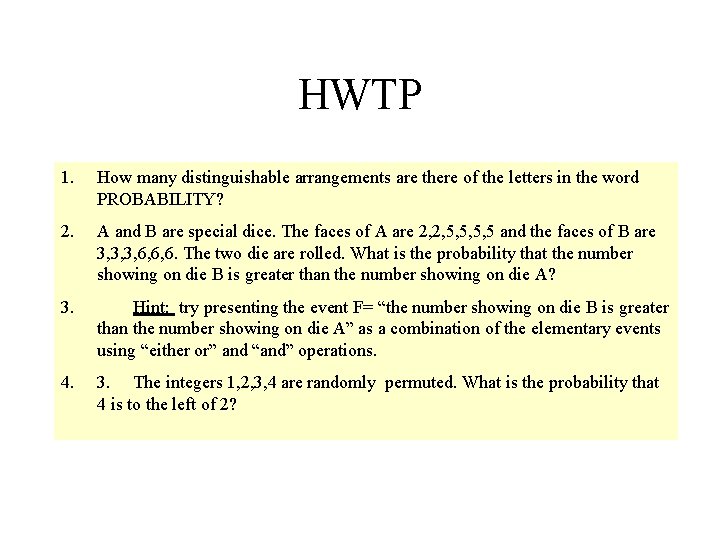
HWTP 1. How many distinguishable arrangements are there of the letters in the word PROBABILITY? 2. A and B are special dice. The faces of A are 2, 2, 5, 5 and the faces of B are 3, 3, 3, 6, 6, 6. The two die are rolled. What is the probability that the number showing on die B is greater than the number showing on die A? 3. Hint: try presenting the event F= “the number showing on die B is greater than the number showing on die A” as a combination of the elementary events using “either or” and “and” operations. 4. 3. The integers 1, 2, 3, 4 are randomly permuted. What is the probability that 4 is to the left of 2?
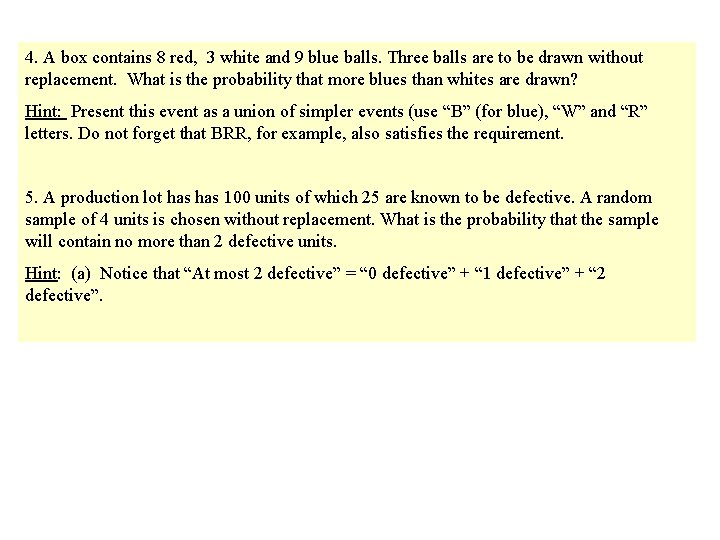
4. A box contains 8 red, 3 white and 9 blue balls. Three balls are to be drawn without replacement. What is the probability that more blues than whites are drawn? Hint: Present this event as a union of simpler events (use “B” (for blue), “W” and “R” letters. Do not forget that BRR, for example, also satisfies the requirement. 5. A production lot has 100 units of which 25 are known to be defective. A random sample of 4 units is chosen without replacement. What is the probability that the sample will contain no more than 2 defective units. Hint: (a) Notice that “At most 2 defective” = “ 0 defective” + “ 1 defective” + “ 2 defective”.
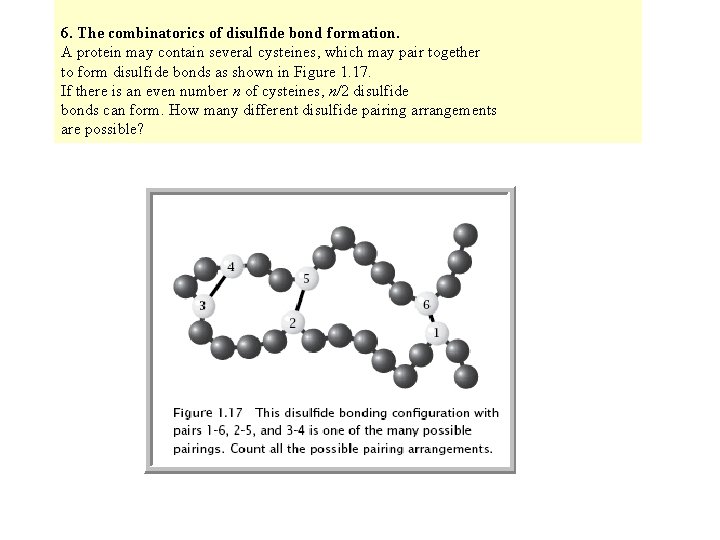
6. The combinatorics of disulfide bond formation. A protein may contain several cysteines, which may pair together to form disulfide bonds as shown in Figure 1. 17. If there is an even number n of cysteines, n/2 disulfide bonds can form. How many different disulfide pairing arrangements are possible?
- Slides: 3