
HVM Crash Testing Standards Explained Regulations Evaluating Impact
- Slides: 18
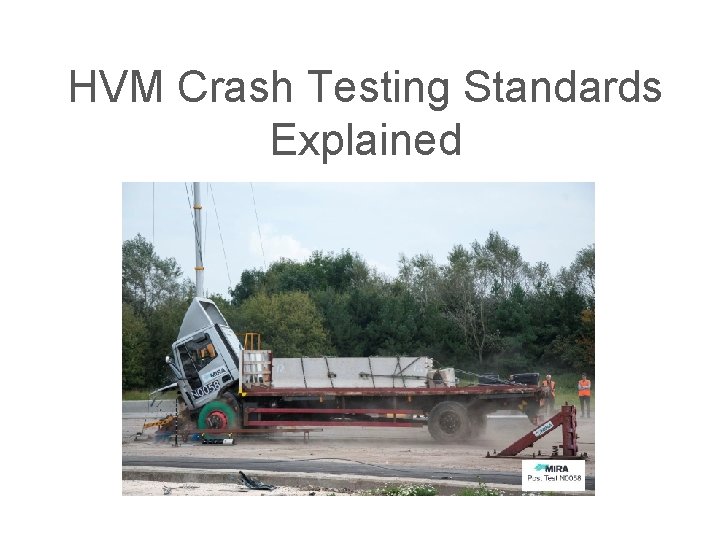
HVM Crash Testing Standards Explained
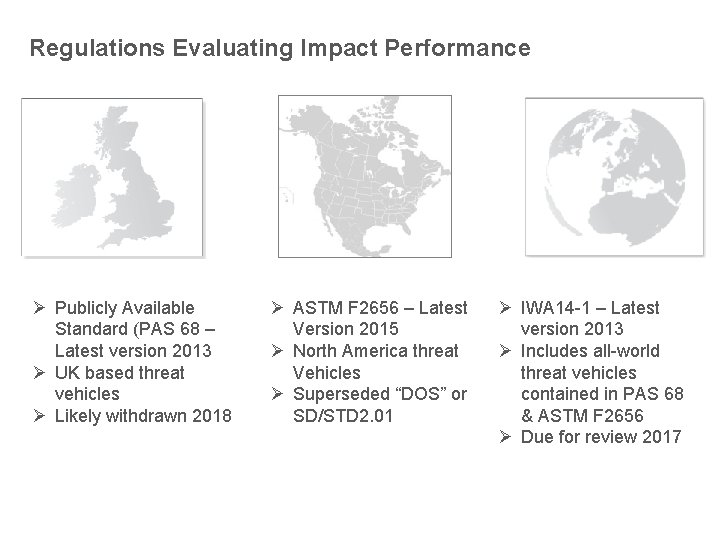
Regulations Evaluating Impact Performance Ø Publicly Available Standard (PAS 68 – Latest version 2013 Ø UK based threat vehicles Ø Likely withdrawn 2018 Ø ASTM F 2656 – Latest Version 2015 Ø North America threat Vehicles Ø Superseded “DOS” or SD/STD 2. 01 Ø IWA 14 -1 – Latest version 2013 Ø Includes all-world threat vehicles contained in PAS 68 & ASTM F 2656 Ø Due for review 2017
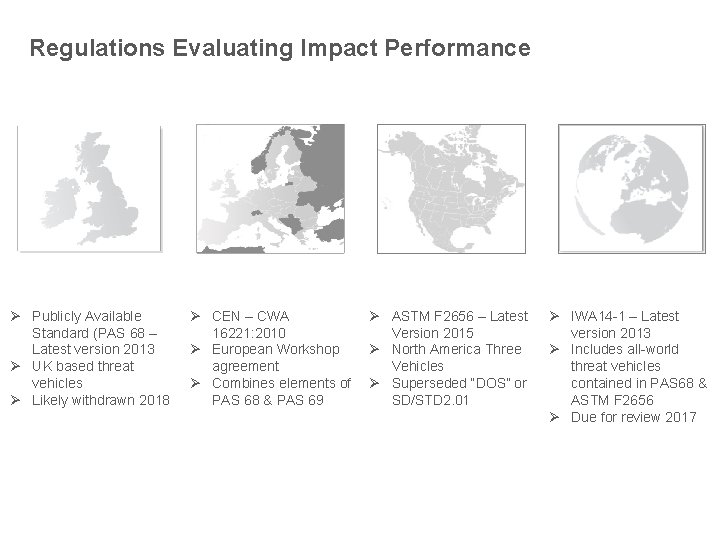
Regulations Evaluating Impact Performance Ø Publicly Available Standard (PAS 68 – Latest version 2013 Ø UK based threat vehicles Ø Likely withdrawn 2018 Ø CEN – CWA 16221: 2010 Ø European Workshop agreement Ø Combines elements of PAS 68 & PAS 69 Ø ASTM F 2656 – Latest Version 2015 Ø North America Three Vehicles Ø Superseded “DOS” or SD/STD 2. 01 Ø IWA 14 -1 – Latest version 2013 Ø Includes all-world threat vehicles contained in PAS 68 & ASTM F 2656 Ø Due for review 2017
Current HVM Standards Ø ASTM F 2656 -15 § US standard issued by ASTM (American Society for Testing & Materials) § Updated in 2015 § Replaces SD/STD 2. 01 Rev A, US Department of State Standard § “K” Ratings no longer exist replaced by vehicle categories C, P, M, H Ø PAS 68: 2013 § UK standard prepared in conjunction with CPNI / BSI § Recently undergone 2 nd update § Updated in 2015 Ø IWA 14 -1: 2013 § World Standard prepared in conjunction with CPNI /BSI with input from US Department of State § Combines aspects of ASTM & PAS 68 § All these tests can be conducted at a variety of impact speeds
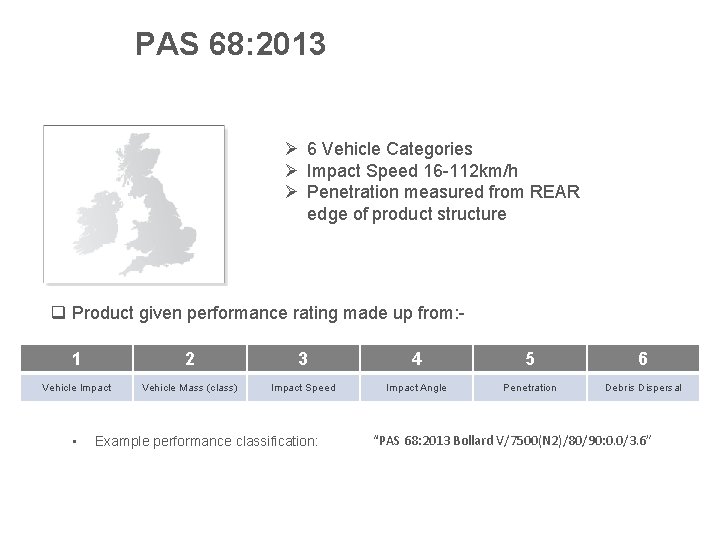
PAS 68: 2013 Ø 6 Vehicle Categories Ø Impact Speed 16 -112 km/h Ø Penetration measured from REAR edge of product structure q Product given performance rating made up from: 1 2 3 4 5 6 Vehicle Impact Vehicle Mass (class) Impact Speed Impact Angle Penetration Debris Dispersal • Example performance classification: “PAS 68: 2013 Bollard V/7500(N 2)/80/90: 0. 0/3. 6”
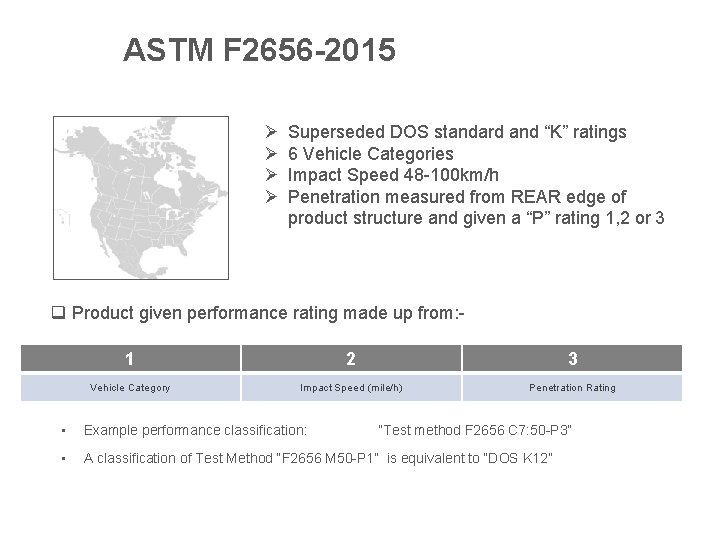
ASTM F 2656 -2015 Ø Ø Superseded DOS standard and “K” ratings 6 Vehicle Categories Impact Speed 48 -100 km/h Penetration measured from REAR edge of product structure and given a “P” rating 1, 2 or 3 q Product given performance rating made up from: 1 2 3 Vehicle Category Impact Speed (mile/h) Penetration Rating • Example performance classification: • A classification of Test Method “F 2656 M 50 -P 1” is equivalent to “DOS K 12” “Test method F 2656 C 7: 50 -P 3”
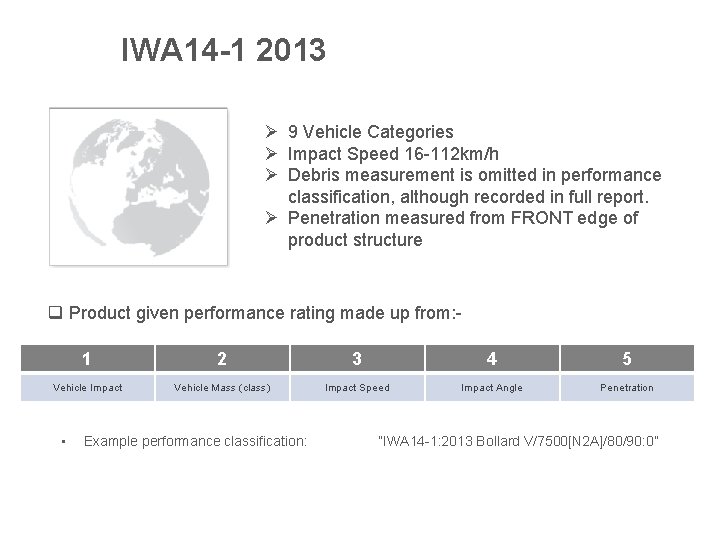
IWA 14 -1 2013 Ø 9 Vehicle Categories Ø Impact Speed 16 -112 km/h Ø Debris measurement is omitted in performance classification, although recorded in full report. Ø Penetration measured from FRONT edge of product structure q Product given performance rating made up from: 1 2 3 4 5 Vehicle Impact Vehicle Mass (class) Impact Speed Impact Angle Penetration • Example performance classification: “IWA 14 -1: 2013 Bollard V/7500[N 2 A]/80/90: 0”
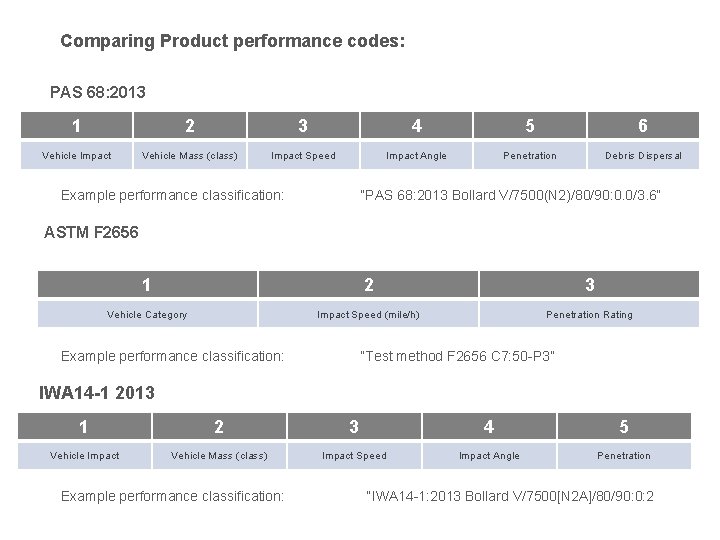
Comparing Product performance codes: PAS 68: 2013 1 2 3 4 5 6 Vehicle Impact Vehicle Mass (class) Impact Speed Impact Angle Penetration Debris Dispersal “PAS 68: 2013 Bollard V/7500(N 2)/80/90: 0. 0/3. 6” Example performance classification: ASTM F 2656 1 2 3 Vehicle Category Impact Speed (mile/h) Penetration Rating Example performance classification: “Test method F 2656 C 7: 50 -P 3” IWA 14 -1 2013 1 2 3 4 5 Vehicle Impact Vehicle Mass (class) Impact Speed Impact Angle Penetration Example performance classification: “IWA 14 -1: 2013 Bollard V/7500[N 2 A]/80/90: 0: 2
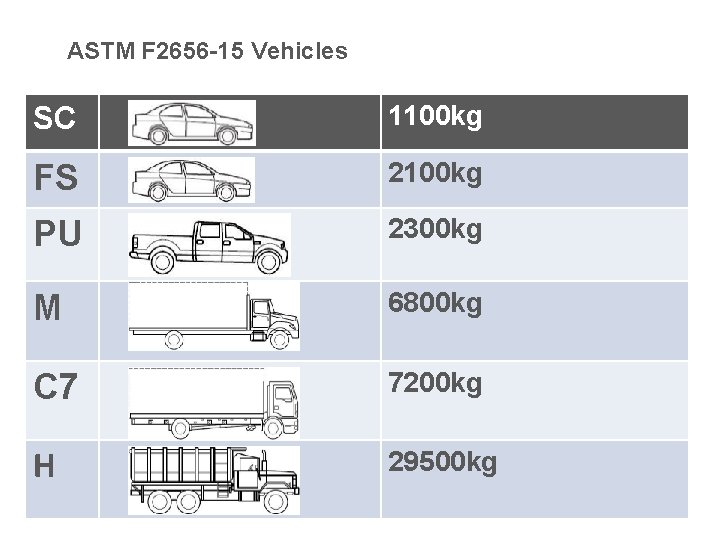
ASTM F 2656 -15 Vehicles SC 1100 kg FS 2100 kg PU 2300 kg M 6800 kg C 7 7200 kg H 29500 kg
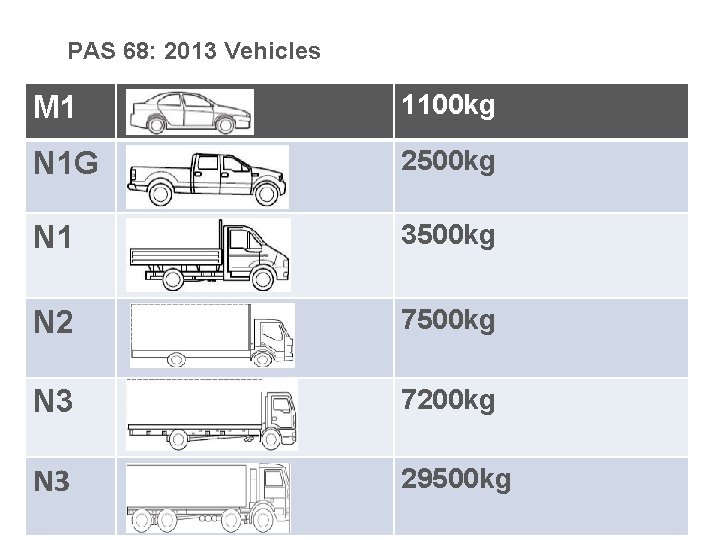
PAS 68: 2013 Vehicles M 1 1100 kg N 1 G 2500 kg N 1 3500 kg N 2 7500 kg N 3 7200 kg N 3 29500 kg
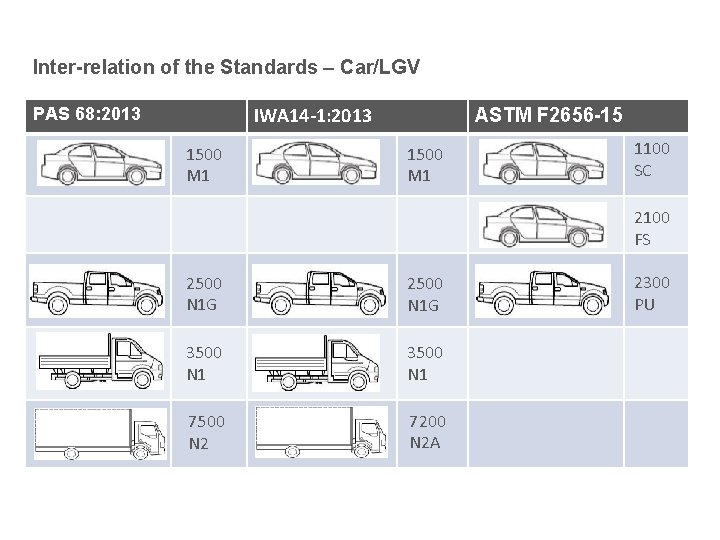
Inter-relation of the Standards – Car/LGV IWA 14 -1: 2013 PAS 68: 2013 1500 M 1 ASTM F 2656 -15 1500 M 1 1100 SC 2100 FS 2500 N 1 G 3500 N 1 7500 N 2 7200 N 2 A 2300 PU
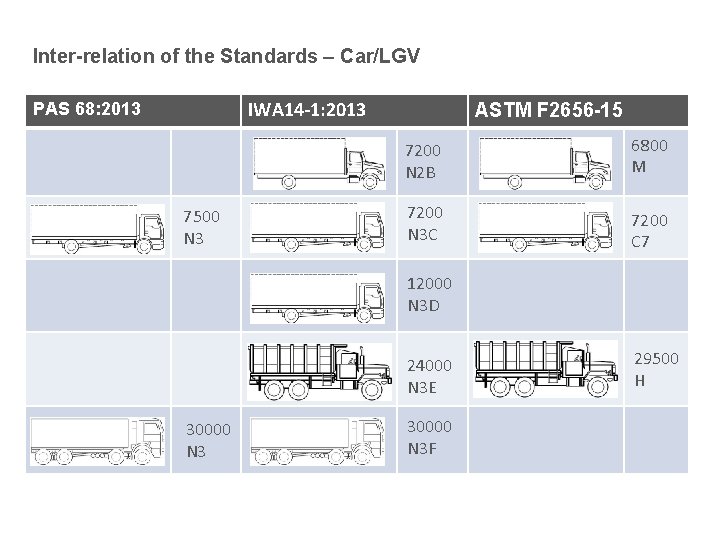
Inter-relation of the Standards – Car/LGV IWA 14 -1: 2013 PAS 68: 2013 7500 N 3 ASTM F 2656 -15 7200 N 2 B 6800 M 7200 N 3 C 7200 C 7 12000 N 3 D 24000 N 3 E 30000 N 3 F 29500 H
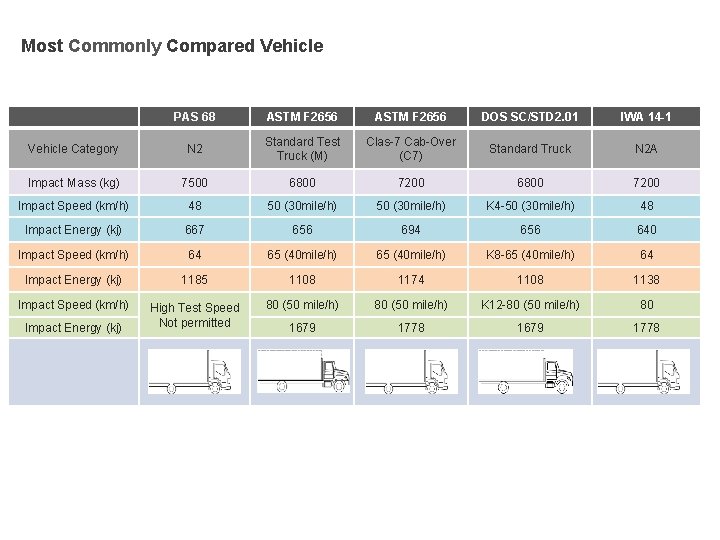
Most Commonly Compared Vehicle PAS 68 ASTM F 2656 DOS SC/STD 2. 01 IWA 14 -1 Vehicle Category N 2 Standard Test Truck (M) Clas-7 Cab-Over (C 7) Standard Truck N 2 A Impact Mass (kg) 7500 6800 7200 Impact Speed (km/h) 48 50 (30 mile/h) K 4 -50 (30 mile/h) 48 Impact Energy (kj) 667 656 694 656 640 Impact Speed (km/h) 64 65 (40 mile/h) K 8 -65 (40 mile/h) 64 Impact Energy (kj) 1185 1108 1174 1108 1138 Impact Speed (km/h) High Test Speed Not permitted 80 (50 mile/h) K 12 -80 (50 mile/h) 80 1679 1778 Impact Energy (kj)
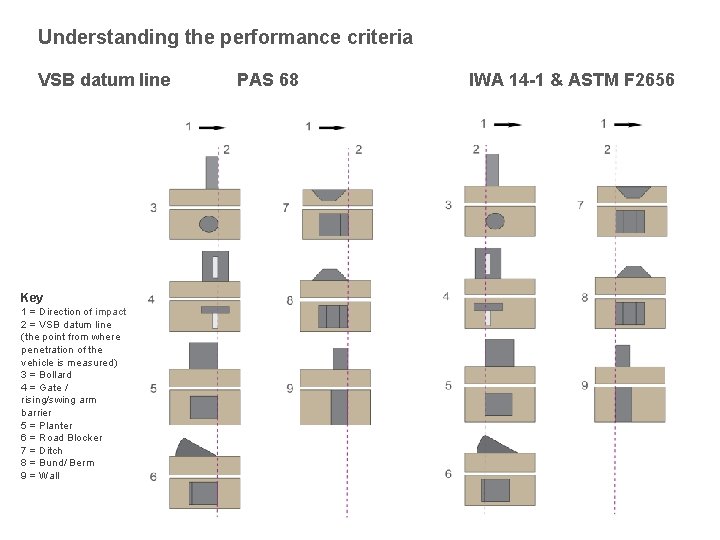
Understanding the performance criteria VSB datum line Key 1 = Direction of impact 2 = VSB datum line (the point from where penetration of the vehicle is measured) 3 = Bollard 4 = Gate / rising/swing arm barrier 5 = Planter 6 = Road Blocker 7 = Ditch 8 = Bund/ Berm 9 = Wall PAS 68 IWA 14 -1 & ASTM F 2656
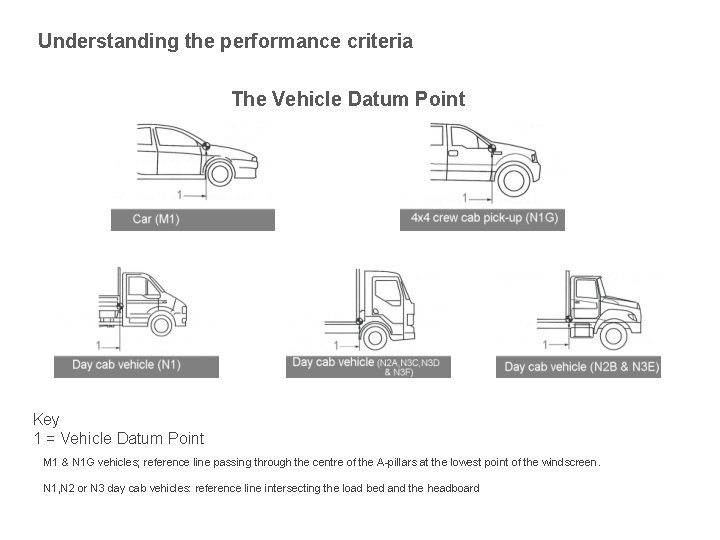
Understanding the performance criteria The Vehicle Datum Point Key 1 = Vehicle Datum Point M 1 & N 1 G vehicles; reference line passing through the centre of the A-pillars at the lowest point of the windscreen. N 1, N 2 or N 3 day cab vehicles: reference line intersecting the load bed and the headboard
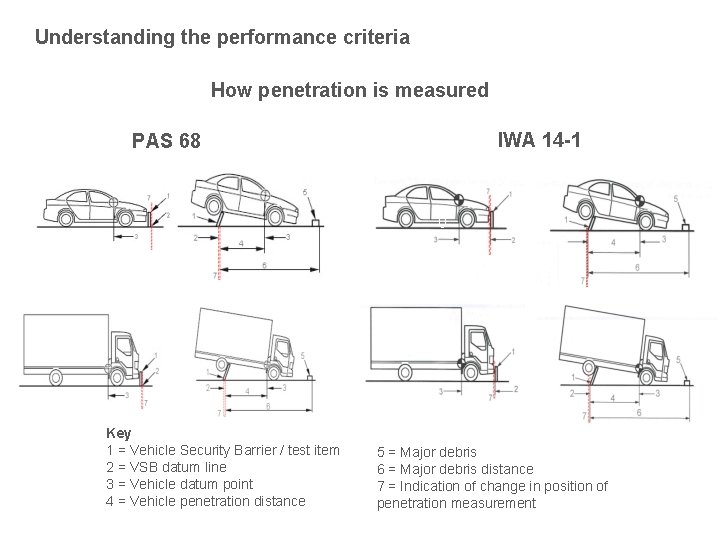
Understanding the performance criteria How penetration is measured IWA 14 -1 PAS 68 0 Key 1 = Vehicle Security Barrier / test item 2 = VSB datum line 3 = Vehicle datum point 4 = Vehicle penetration distance 5 = Major debris 6 = Major debris distance 7 = Indication of change in position of penetration measurement
FAQ / Misconceptions regarding vehicles / tests § “My client wants an ASTM K 12 test” “K” ratings have never existed in ASTM. “K” ratings were superseded in 2007 by the introduction of ASTM 2656. The Department of State K 12 should correctly be referred to as an ASTM M 50. § What is the equivalent of an ASTM M 50 test in PAS 68/IWA 14 -1? The closest equivalent test is V/7500(N 3)/80/90 or IWA 14 -1: 2013 V/7200[N 3]/80/90. This is N 3 (18 T rated vehicle massed to 7500 kg or 7200 kg) at 80 km/h and 90 deg. § What is the difference between an IWA 14 -1, ASTM and PAS 68 tests? In addition to the vehicle dimensions and impact energy variances, there is a difference in test conditions. Under ASTM the product must be installed into a low cohesive compacted soil. PAS 68 does not define and installation configuration. IWA 14 describes both in soil or “site specific”/“rigid” installation.
§ Does the introduction of IWA 14 -1 obsolete or negate previous testing standards? No, IWA 14 -1 does not negate or obsolete testing carried out to the PAS 68 or CWA 16221 criteria. IWA 14 -1 is a progression of these testing standards and combines elements of the ASTM standard & PAS 68 to produce a cohesive standard.