
Hurry Sickness Burnout and WellBalanced Remedies Dr Terry
Hurry Sickness, Burnout, and Well-Balanced Remedies Dr. Terry L. Correll Chief of Aerospace Psychiatric Consultation Aerospace Medicine Consultation Division United States Air Force School of Aerospace Medicine Clinical Professor of Psychiatry, Boonshoft School of Medicine Distinguished Fellow of the American Psychiatric Association

• Teach at medical school, psychiatric residency, various institutions, USAF School of Aerospace Medicine, NATO, Kings College in London… • Work with USAF aviators, special forces, substance-abusing incarcerated individuals, women escaping the sex industry (Oasis House), FAA, NASA… • I am truly humbled and grateful for the outstanding opportunities available in my career
• As a general/academic/aerospace/forensic psychiatrist, I emphasize • Psychotherapy • Healthy lifestyle • Conservative diagnosis • Conservative medication • Body-Mind-Soul-Spirit holism • I am unfortunately unable to see any extra patients
How Common are Stress-Related Illnesses in Primary Care Medicine? • 10 -20% • 30%-40% • 50 -60% • 60 -80% • 99. 9%
How Common are Stress-Related Illnesses in Primary Care Medicine? • 10 -20% • 30%-40% • 50 -60% • ****** 60 -80% of visits have a stressrelated component ****** • 99. 9%
What is one of the best performance enhancers known and well-studied? • Anabolic steroids • Creatine • Erythropoietin • Adderall • Relaxation Response
What is one of the best performance enhancers known and well-studied? • Anabolic steroids • Creatine • Erythropoietin • Adderall • ***** Relaxation Response *****
Terms of Endearment • Busyness • Frenetic • Frenzied • Frantic • Frazzling • Hectic • Mad Dash • Time Pressure • Time Urgency • Running in Overdrive • “I am busy as a onearmed paper hanger…” • Hurry Sickness

• In 2005, researcher Richard Jolly from the London School of Business and Finance noted an alarming increase in a new pandemic: • Hurry Sickness is a compulsive need to do more and to go faster… even when there’s no real need for urgency • For example, in one study it was noted how people using a microwave start to look for something else to do if the food is going to take longer than 30 seconds to heat up
• Yep… I’ve done that • Definition: • Hurry sickness is the compulsive feeling that you must incessantly hustle or else you will fall further behind, or miss out on something
• Do you have hurry sickness? • How quickly do you get restless when you have to wait in line? • How long can you go without checking your phone or looking at email? • Are you sizing up this lesson so far to see if you have chosen to spend your time well?
• Professor Jolly (ironic? ) noted in 2015 that ____% of the people he interviewed showed signs of having hurry sickness • 25% • 55% • 95% • ****** 95% *******
• What Is Hurry Sickness? • Cardiologists Meyer Friedman and Ray Rosenman coined the term "hurry sickness" after noticing that many of their patients suffered from a "harrying sense of time urgency" • They defined hurry sickness as "a continuous struggle and unremitting attempt to accomplish or achieve more and more things or participate in more and more events in less and less time" • People with hurry sickness think fast, talk fast, and act fast • They multitask and rush against the clock, feeling pressured to get things done and getting flustered by any sign of a problem
• What Causes Hurry Sickness? • Hurry-sick people are conscientious and work hard • They habitually over-commit • With our 24/7 state of connectedness, we increasingly suffer from FOMO – fear of missing out – so we're reluctant to disconnect and slow down • Even on vacation • USAFA - “ 25/8” - $20 bill
• This need to stay available means that hurry-sick people remain constantly “switched on” • May be running from insecurities, insignificance, boredom, loneliness, or a host of other negative feelings • Once we've begun this cycle of panic, it's easy to get used to it, accept it, and become addicted to it, even though it damages us • Addicted to adrenalin, very similar to cocaine (procrastinators, disorganized/ADHD individuals)
• What Are the Consequences of Hurry Sickness? • Being busy is usually seen as a virtue, a “badge of honor” • We lose the ability to think clearly, and we become less effective • Errors creep into our work, we lose sight of the "big picture, " and the quality of our work starts to fall • Hurry sickness increases our body's output of the stress hormone cortisol, which can cause longterm health problems, such as decreased immunity and depression
• What Are the Consequences of Hurry Sickness? • It can affect our personal relationships, too • "Go-fast" working habits travel home with us • Our mind stays locked in a state of overstimulation, making us tired, anxious and prone to irritability, but unable to relax
Other Clues to Hurry Sickness • We indulge in self-destructive escapes: • Watching too much TV • Eating too much • Abusing alcohol • Scanning the internet too much (porn) • Other addictive behaviors…
Other Clues to Hurry Sickness • We rush around in life even when there's no reason to • Speak sharp words to our loved ones • We hurry our children along • We set up mock races ("Okay kids, let's see who can take a bath fastest"), which are really about our own need to get through it • Assure ourselves that everything will slow down in just a week or two • We flop into bed fatigued
Reflection - Does this apply to… • Your friends • Acquaintances • Loved ones • Colleagues • Go ahead, look to the right and the left • Yourself
• More ways to know if you’re suffering from “hurry sickness”: • Sunset Fatigue • This is when we come home from a full-day’s work, but have nothing left for those we love the most • Unable to Love • “Love and hurry are fundamentally incompatible. Love always takes time and time is one thing hurried people don’t have. ” John Ortberg
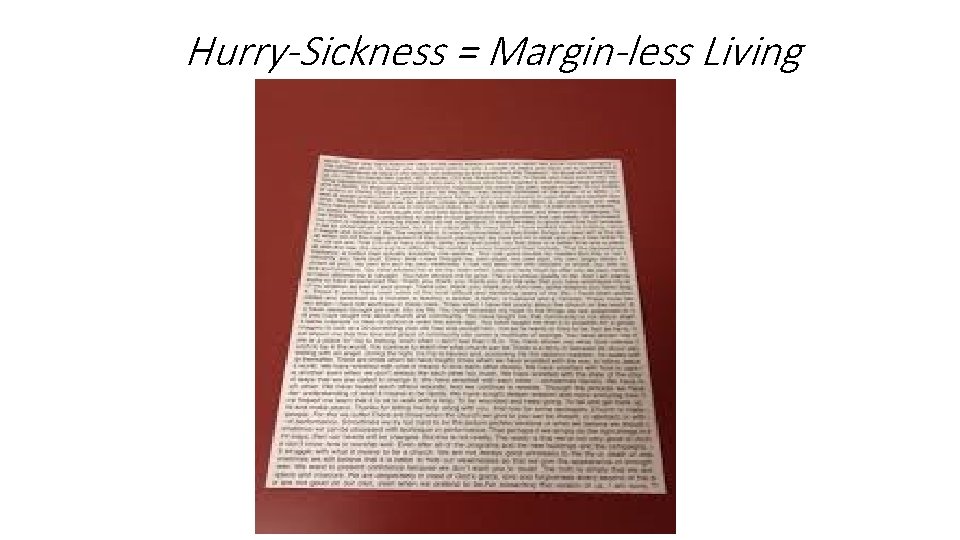
Hurry-Sickness = Margin-less Living
Rate Yourself • On a scale of 1 to 10, please rate your own “hurry sickness” where 10 is the maximum
Please Allow me to Interject - For The Health of It… • Everybody wants to improve themselves • Especially with the new year • Lots of great intentions • Rarely are limited in “know how” • Limited results • That are often demoralizing and guilt-producing • Wouldn’t it be nice to make significant improvements in our lives with only a few moments of attention at a time? • Let’s be open-minded and try this “For The Health of It” technique
For The Health of It… • Basic premise is that our sympathetic nervous system is “amped up” too much to our detriment • Parasympathetic nervous system (which causes calming) is under-utilized • Adrenalin and cortisol are flowing – we “stew” in “stress juices” • We are routinely in sympathetic overdrive • Would you agree? • What if we could calm our sympathetic nervous system more effectively than with Xanax, alcohol, heroin… • An easy fix • Something you already do • Quicker, better, stronger, faster… • Enhance our ability to cope with stressors and build our overall resilience • Sounds almost too good to be true, right?
For The Health of It… • Couple sympathetic calming (AKA parasympathetic activation) with a healthy thought or behavior • Powerful one, two punch • Slowed deep breathing is the best way to calm the body and mind • Breathing is like an energy dial for calming or activation • Slowed deep breathing slows heart rate, body, and mind • Rapid breathing energizes like a cup of coffee (better than coffee – don’t have to pee as much) • Rapid and shallow breathing common, especially when we are “keyed up” • If you haven’t already done so, please focus on your breathing • It usually works unnoticed • It is one of the rare involuntary body systems that we can consciously control
For The Health of It… • Paced breathing (3 part breathing) • Utilized by premier athletes, special forces, snipers… • Breathe deeply into lower abdomen first • Fill and expand rib cage and then lungs until full capacity next • Pause for few seconds • Then exhale air from “top down” in reverse order • Upper to lower lungs, rib cage, then abdomen
For The Health of It… • Counting slowly is helpful while doing this to keep mind clear of other thoughts • 10 count during inhalation • 5 count pause • 10 count during exhalation • Modify count as it best works for you • When do you think snipers take their shot? • Some prefer to think of meaningful word or phrase • Peace, wholeness, the Lord is my Shepherd…
For The Health of It… • Paced breathing (breath practice) on a regular basis can be enormously helpful (all by its self) • Pair this sympathetic calming with a healthy idea/action • Think holistically • What simple healthy thing can I do right now for my body, mind, and/or spirit • What little healthy thing can I do, think, or imagine right now? • Be grateful, thankful, prayerful, hopeful, optimistic, reframe a negative feeling or situation, allow deep breathing to reduce my stress and blow out toxins…
For The Health of It… • Utilize free association • As you think about this, what is the first healthy thing that comes forward in your mind? • Life Change through Relaxation Response paired with Healthy Idea/Action • One small step towards health – repeated often • Helps to rebalance our lives • A little more health to offset unhealthy conditions
For The Health of It… Healthy Pause… • Do this on a regular basis and change will happen • Reminders from phone, Apple watch, One Moment for Meditation app, carry a token in your pocket, Post It note • We make ~10, 000 decisions daily • Making a few more healthy decisions regularly can revamp our entire lives • The Israelites asked God how they were going to take the land that was promised to them • God let them know that they would do so little by little… • In our retirement accounts, we invest money on a regular basis to allow compounding interest to help in grow • Personal growth is like this
For The Health of It… Healthy Pause… • Let’s practice – this is safe – no tricks – no “trust falls” • High strung boss who “guaranteed” my catch ( eliminating “trust”) • Quite helpful for my big body • This will last only 60 seconds • Close or downcast your eyes • Notice your breathing • Allow it to go deep into your belly • Count slowly as you fill your abdomen, rib cage, and then lungs, from the “bottom up” • Count during your pause • Exhale and admire how easily the air from upper chest to the lower abdomen
For The Health of It… Healthy Pause… • Continue counting while breathing if that is helpful to you • Repeat this several times • Notice the calm space at the end of the exhale before you draw more air in • Permit your mind and body to be calm • Relax • Allow distress and tension to drain away • Continue breathing and calming until I call your attention at the end of 60 seconds • How was that? • How long did that feel?
Re-rate Yourself • On a scale of 1 to 10, please rate your own “hurried feeling” where 10 is the maximum
For The Health of It… Healthy Pause… • That was one minute to “reboot your computer” • Doing a mini reset (moments and seconds) multiple times daily can have enormous benefits • Please practice this throughout the rest of our time together (and this conference) • Invoking the relaxation response that Herbert Benson studied at Harvard • Relaxation response calms down the sympathetic system and enhances performance
For The Health of It… Healthy Pause… • Relaxation Response is known by many names… • Meditation, mindfulness, deep breathing/relaxation, autogenic training, selfhypnosis, prayer, solitude, doing nothing… • Pair with healthy thought or action • Focus, intentionality, goal seeking, prayer, personal investment, reset your GPS, personal investment time…
For The Health of It… • Pair deep breathing with another healthy thought or behavior that you want to work on: • Reduce stress or a feeling of “dis-ease” • Reducing tension in your muscles • Increased focus or energy • Feeling peaceful or calm • As a substitute for a negative behavior • Biofeedback
Quick Review – For the Health of It • Become aware of your breathing • Slow it down • Breath deep into you abdomen • Slow heart and mind • Notice increased focus and many other benefits • Pair with healthy thought or action • Consider making this a daily anchoring habit – a very healthy habit • To reset your health focus and compass • For rebalancing • For wholeness – body, mind, and spirit
Love Impaired by Hurry Sickness • The most serious sign of hurry sickness, though, is a diminished capacity to love and be our best selves • For love and hurry are fundamentally incompatible • Love always takes time, and time is the one thing hurried people don't have • We become relationally distant…
Hurry Sickness “Hurry is not just a disordered schedule. Hurry is a disordered heart. ” -- John Ortberg, The Life You’ve Always Wanted
Hurry is Silently Ruining the Life We Want • Research has now revealed a disturbing dark side to all this go, go… even beyond the physical toll it takes • In fact, the effects of busyness are actually MUCH WORSE than we think … if we desire a life of greater impact and significance • Here’s why: It is actually preventing us from living the life we really want
• How Our Busy Life is Crippling the Life We Want • Sense of urgency is undermining the very priorities and values we embrace • Princeton University social psychologists John Darley and Dan Batson wanted to see the effects on a person who is being hurried • The unknowing test subjects were conscientious, caring Princeton Seminary students • They were asked to prepare a sermon from the parable of the Good Samaritan (Luke 10: 29 -37) • Then, they would deliver the sermon to their professors for evaluation
• The (Clever) Experiment • The students were brought into a room to prepare their messages • At some point, they were given one of three time impacting instructions: • A high-hurry condition: “You’re late. They were expecting you a few minutes ago…You’d better hurry. It shouldn’t take but just a minute to get there. ” • An intermediate-hurry condition: “They are ready for you, so please go right over. ” • A low-hurry condition: “It’ll be a few minutes before they’re ready for you, but you might as well head on over. If you have to wait over there, it shouldn’t be long. ”
• The (Clever) Experiment • As each student was heading from the preparation room to the auditorium to present their message, they encountered a “victim” in a deserted area • This victim (who was part of the experiment) appeared destitute, slumped over and coughing, clearly in need of assistance • Hmm… that sounds coincidentally just like the wounded traveler in the parable of the Good Samaritan
• The (Clever) Experiment • Here’s the test • The seminarians, who were not only familiar with the story (and the lesson Jesus applied about “loving your neighbor”), they were about to teach it (thus, it was top of mind) • Bottom line • Would the values they know, embrace and be top of mind be impacted by hurry?
What do you predict happened? (What happens when we are hurried? )
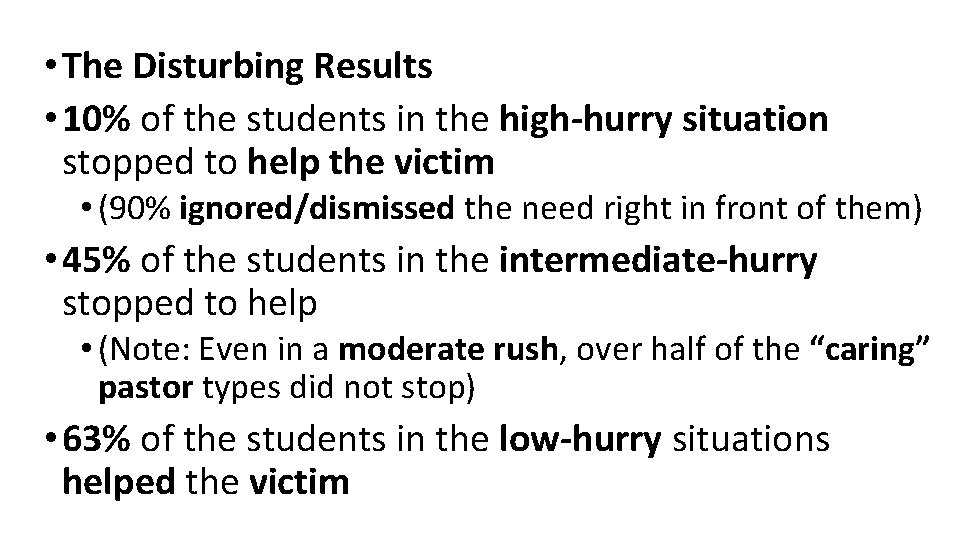
• The Disturbing Results • 10% of the students in the high-hurry situation stopped to help the victim • (90% ignored/dismissed the need right in front of them) • 45% of the students in the intermediate-hurry stopped to help • (Note: Even in a moderate rush, over half of the “caring” pastor types did not stop) • 63% of the students in the low-hurry situations helped the victim
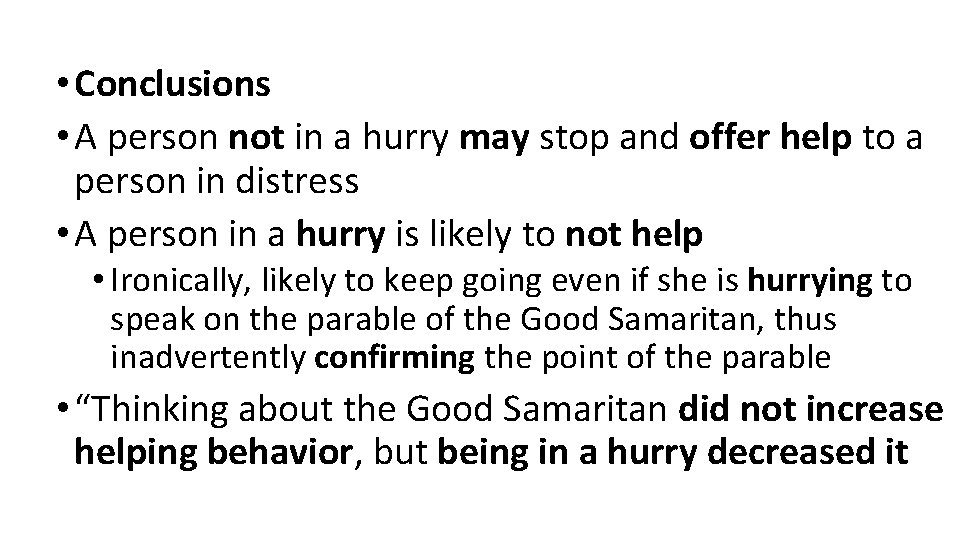
• Conclusions • A person not in a hurry may stop and offer help to a person in distress • A person in a hurry is likely to not help • Ironically, likely to keep going even if she is hurrying to speak on the parable of the Good Samaritan, thus inadvertently confirming the point of the parable • “Thinking about the Good Samaritan did not increase helping behavior, but being in a hurry decreased it
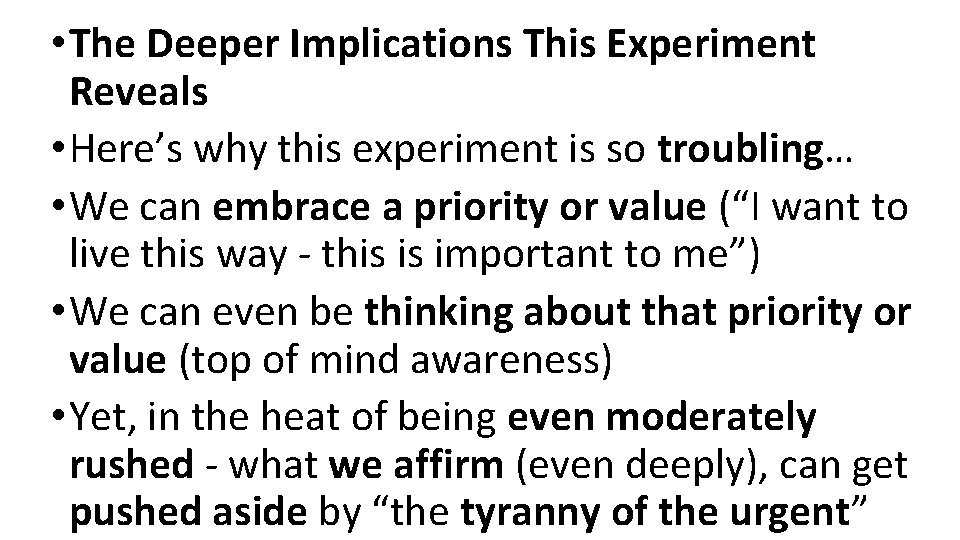
• The Deeper Implications This Experiment Reveals • Here’s why this experiment is so troubling… • We can embrace a priority or value (“I want to live this way - this is important to me”) • We can even be thinking about that priority or value (top of mind awareness) • Yet, in the heat of being even moderately rushed - what we affirm (even deeply), can get pushed aside by “the tyranny of the urgent”
• Important Note • We can also experience similar distorting effects from being • Hungry • Annoyed/angry • Lonely • Tired… (HALT)
Maybe we start a New Acronym • Hurry • Hungry • Annoyed/angry • Lonely • Tired… (HHALT)
“The greatest danger is letting the urgent things crowd out the important” -- Charles Hummel The Tyranny of the Urgent
• Hurry undermines the life I say I want to live • In an excellent essay on the Princeton experiment, Nagesh Belludi notes that when we feel time pressure… • We experience a phenomenon known as “narrowing of the cognitive map” • That is, we miss details, we are not present enough in the moment to notice what is really important and we do not make the most beneficial choices for ourselves • Hurry is like a drug that distorts all we hold dear, causing us to become the person you don’t want to be… and we don’t even realize it
• The effects of hurry can impact so many areas of life • A few of the countless examples include: • Wanting to lose weight or get fit… yet we end up eating the wrong foods, and not having time to exercise… all because “I don’t have the time” • Pursue an important goal we have put off (get your degree, take that class, volunteer at the non-profit, etc. )
• The effects of hurry can impact so many areas of life • Rarely go on a date with our spouse • Fill in the blank: a good thing (something really important) that keeps getting putting off or erratically pursued because of time pressure
• I’ve seen this in my own life (time to be vulnerable) • I value my family • Really, I do • I want to be “present” with them when I am around them • That means they get my undivided attention • Yet too many times I am NOT fully there
• I’ve seen this in my own life (time to be vulnerable) • They only get bits and pieces of my attention… because I am trying to multi-task, and get more stuff done • “Once I get this or that done… then will I give you my full attention!” • Hurry sickness deceives and hijacks me again • It’s tragic: what I value, affirm and even seek to prioritize evaporates when I am in a hurry
Reflection Time • What have you learned so far? • Apply to you? • Your friends? • Family? • Tell your neighbor, “This really applies to you”

• A few words about how chronic hurry sickness can lead to Burnout
• What is Burnout? • The chronic effects of hurry sickness • The term burnout was coined by rocket scientists to describe shutting down a jet or rocket engine by exhausting or shutting off its fuel • Dr. Herbert J. Freudenberg, in his 1974 book Burnout: The High Cost of High Achievement, was the first psychologist to use this term • He defined burnout as “the extinction of motivation or incentive, especially where one’s devotion to a cause or relationship fails to produce the desired results” • His short definition – “an erosion of the soul” soul
• Burnout can be experienced in a variety of ways • Physical burnout can be triggered by a lack of exercise, physical effects of stress, and sleeplessness • Forget exercise, eat unhealthy foods, and sleep less • Relational burnout is related to emotional burnout and can be caused by strained relationships • Energy draining people • Drama, drama…
• Emotional burnout • We tend to isolate more • Emotional burnout can numb your ability have normal emotions and have a sense of failure and self-doubt • Spiritual burnout • Spiritual pursuits include solitude, service towards others, learning/reading, music, art, nature…
• What are some of the consequences of burnout? • Decreased coping • Decreased resilience • Decreased immunity • Somatic symptoms • Suffering • Lack of abundant living
• Lettie Cowman’s classic daily devotional, Springs in the Valley, tells a story about a person traveling through the jungles of Africa • He arranged for coolies from one tribe to carry the loads • The first day they marched rapidly and traveled far • The traveler anticipated a speedy journey • But the next morning the coolies refused to move • They just sat and rested • Upon inquiry the traveler learned from the coolies that they had gone too fast the first day, and now they needed to wait for their souls to catch up with their bodies • Cowman reflects, “This whirling rushing life which so many of us live does for us what the first march did for those poor jungle tribesmen. The difference: they knew what they needed to restore life’s balance; too often we do not. ” • Remarkably, she wrote this 70 years ago…
Example of Burnout • The prayer of the fourth-century church father Saint Gregory of Nazianzus, who prayed: • I am spent, O my Christ, Breath of my life • Perpetual stress and surge, in league together, make long, oh long this life, this business of living • Grappling with foes within and foes without, my soul hath lost its beauty, and blurred your image
Normal -> -> -> Abnormal • Cross line into clinical anxiety and/or depression • Hurry sickness -> clinical anxiety • Burnout -> clinical depression
Why Do We Burn Out? • Take notes as anything here applies to you • Might help to talk about “our friends” here • “Workaholism” is applauded • Hurry sickness • Overwhelming responsibility • External locus of control • “I’m not in control. Forces outside me are…”
External LOC = Blame Game • What excuse did Adam give to his children as to why he no longer lived in Eden? • Your mother ate us out of house and home
Why Do We Burn Out? • Unable to say “No” • Overwhelmed coping and resilience • Lack of meaning/significance • Perfectionism • High expectations/discontent • Poor limits/boundaries
How NOT to Fix Burnout • Coronary and Ulcer Club • Bits & Pieces, January 7, 1993, pp. 9 -10 • The "Coronary and Ulcer Club" lists the following rules for members… • 1. Your job comes first. Forget everything else. • 2. Saturdays, Sundays, and holidays are fine times to be working at the office. There will be nobody else there to bother you. • 3. Always have your briefcase with you when not at your desk. This provides an opportunity to review completely all the troubles and worries of the day. • 4. Never say "no" to a request. Always say "yes. "
How NOT to Fix Burnout • Coronary and Ulcer Club • Bits & Pieces, January 7, 1993, pp. 9 -10 • The "Coronary and Ulcer Club" lists the following rules for members… • 5. Accept all invitations to meetings, banquets, committees, etc. • 6. All forms of recreation are a waste of time. • 7. Never delegate responsibility to others; carry the entire load yourself. • 8. If your work calls for traveling, work all day and travel at night to keep that appointment you made for the next morning. • 9. No matter how many jobs you already are doing, remember you always can take on more.
What CAN Fix Hurry Sickness and Burnout? • How to Change and Grow in Life • Awareness • Choice (intentionality) • Change (or not) • Therapeutic model – awareness, make conscious/intentional decision, institute small and gradual improvements (or not)
What CAN Fix Hurry Sickness and Burnout? • Make it your goal to work smarter – not harder – by finding strategies that will create lasting change
What CAN Fix Hurry Sickness and Burnout? • How to Change and Grow in Life • Awareness • Choice (intentionality) • Change (or not) • Therapeutic model – awareness, make conscious/intentional decision, institute small and gradual improvements (or not)
Whole Life Balance • Make healthy habits routine • Storms of life will hit encouraging unhealthy behaviors • Work more and harder, playing less, eating more, sleeping and exercising less, isolation… • If persist long enough, will throw us out of balance • Must intentionally counterbalance difficult times with routine healthy behaviors specific to each one of us
Quick Review – For the Health of It • Become aware of your breathing • Slow it down • Breath deep into you abdomen • Slow heart and mind • Notice increased focus and many other benefits • Pair with healthy thought or action • Consider making this a daily anchoring habit – a very healthy habit • To reset your health focus and spiritual compass • For rebalancing • For wholeness – body, mind, and spirit
• Ways to help you cure “Hurry Sickness” • From John Ortberg’s book, The Life You’ve Always Wanted • Embrace delays • Like a game, choose the slow lane on the road or long line at the grocery store • Embrace delays and cultivate patience • Resist the impulse to hit the "door close" button in elevators • Solitude • Solitude can be done in brief, regular periods (1 minute at a time, 5 minutes beginning and end of day) and longer, less frequent periods (an entire day once or twice or year) • Develop this important skill of doing nothing (without guilt)
• Intentionally Add/Create Margin In Your Schedule • Dr. Richard Swenson in his book Margin prescribes the need to add margin in our lives • Margin is like elbow room in your schedule • For example, your daily schedule needs to be filled at no more than 80% capacity (leaving 20% margin) since there always time demands we didn’t anticipate • It’s why you don’t fill a glass to the very top with Coca Cola • If you do, it will invariably overflow and make a mess • Just like life
• Say “No” Often (or I’ll need to think about that) • One of the reasons we find ourselves being too busy and stressed out is because we too quickly and easily say yes to things (because we hate saying no) • Sometimes we say yes because we are people pleasers and we don’t want to disappoint anyone… even when it is harming us • We must learn to say NO to some things so we can say YES to the BEST things (good ≠ best)
What Can Fix Burnout? • Setting limits without guilt • Making healthy behaviors a priority • Embracing interpersonal support • Sharing feelings openly in a safe setting with others
• Burnout Prevention and Recovery Tips • Regain lost vision for your career • Have FUN • Cut off draining relationships • Express gratitude • Do activities that energize you • Get in better physical shape • Serve others (AT&T study)
• Prioritize things that are life giving to you • Prioritize time with key friends, family (for emotional strength), exercise for physical health, hobbies, good music and literature for mental renewal • Prioritize yourself!
• Bottom line: • Ban feeling “hurried” and not being at our best! • The hurried life is not a requirement to living a full, meaningful life • In fact, it often hinders it
What Have We Covered Today • Hurry Sickness is pandemic • Can lead to Burnout • A Well-Balanced Life with lots of healthy behaviors can keep us “firing on all cylinders” • Paced Breathing + Healthy Action/Behavior can become a great and helpful habit • Discussed lots of potentially helpful concepts and strategies • Awareness allows us to choose healthier decisions and make gradual and lasting improvements over time
Final thoughts, questions, or comments before we close?

I appreciate your kind attention and participation terry. correll. 1@us. af. mil terry. correll@wright. edu 88
How Common are Stress-Related Illnesses in Primary Care Medicine? • 10 -20% • 30%-40% • 50 -60% • 60 -80% • 99. 9%
How Common are Stress-Related Illnesses in Primary Care Medicine? • 10 -20% • 30%-40% • 50 -60% • ****** 60 -80% of visits have a stressrelated component ****** • 99. 9%
What is one of the best performance enhancers known and well-studied? • Anabolic steroids • Creatine • Erythropoietin • Adderall • Relaxation Response
What is one of the best performance enhancers known and well-studied? • Anabolic steroids • Creatine • Erythropoietin • Adderall • ***** Relaxation Response *****
- Slides: 92