
Hunger and the Global Environment Introduction One person

Hunger and the Global Environment
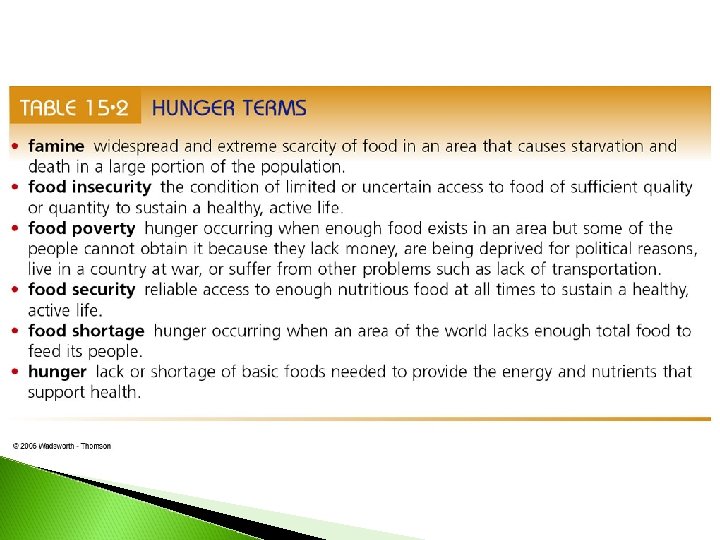
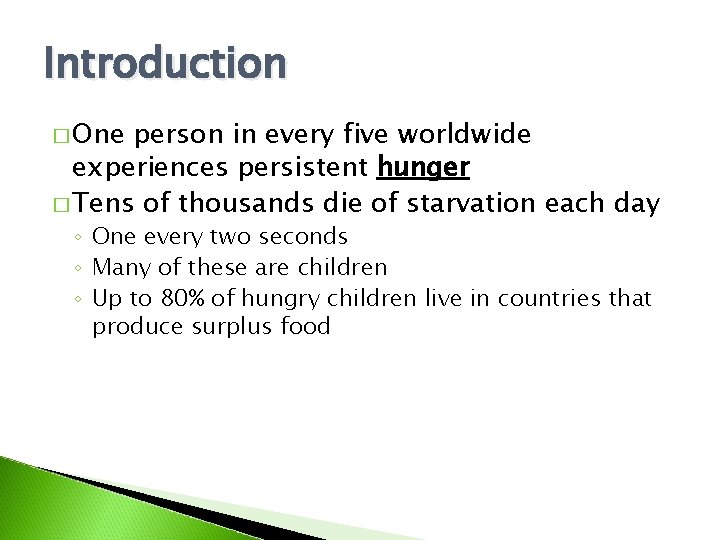
Introduction � One person in every five worldwide experiences persistent hunger � Tens of thousands die of starvation each day ◦ One every two seconds ◦ Many of these are children ◦ Up to 80% of hungry children live in countries that produce surplus food
Hunger The chronically hungry suffer from undernutrition ◦ Energy and nutrient deficit ◦ Greater susceptibility to health risks ◦ Undernutrition slows mental and physical development in children �Increased susceptibility to potentially fatal infections such as dysentery, whooping cough, and tuberculosis
Hunger � The more severe their circumstances, the more likely children are to be in poor health ◦ And the greater the likelihood that they will be hospitalized ◦ Many children consume calories from inexpensive foods but not micronutrients �Such as white bread, fats, and crackers �With few of the fruits, vegetables, milk, and other nutritious foods children need to be healthy
Hunger is not always easy to recognize � In the U. S. millions of children are hungry at least some of the time ◦ Under the broad definition of food insecurity, over 13 million U. S. children do not know where their next meal is coming from or when it will come
Hunger � The primary cause of hunger is food poverty ◦ More than 12% of the US lives in poverty ◦ The likelihood of food poverty increases with problems such as �Abuse of alcohol and other drugs �Mental or physical illness �Depression �Lack of awareness of or access to available food programs, and the reluctance of people to accept what they perceive as “government handouts” or charity
Causes of Hunger & Food Insecurity Concerns for the present and future ◦ Many forces threaten world food production and distribution in the next decade; we may face more global food insecurity because of them �Population growth ◦ Millions of the world’s people are starving ◦ Fifteen children die of malnutrition every 30 seconds � 125 children are born in that same 30 seconds �Every day, the earth gains another 220, 000 new residents to feed, most of them born in impoverished areas
Causes of Hunger & Food Insecurity Poverty causes hunger ◦ Hunger worsens poverty by robbing a person of the good health and the physical and mental energy needed to be active and productive �The less active and productive people become, the lower their pay �Hungry people cannot work hard enough to get themselves out of poverty �Most have no borrowing power to obtain credit
Causes of Hunger & Food Insecurity � Loss of food-producing land ◦ Food-producing land is becoming saltier, eroding, and being paved over ◦ Each year, the world’s farmers try to feed some 85 million additional people with 24 billion fewer tons of topsoil �This loss threatens overall food security
Causes of Hunger & Food Insecurity � Accelerating fossil fuel use ◦ With attendant pollution of air, soil and water; ozone depletion; and global climate changes � Increasing air pollution ◦ As populations and human activities increase, air quality diminishes in many areas around the globe
Causes of Hunger & Food Insecurity � Atmosphere and floods and climate changes, droughts, ◦ The concentration of carbon dioxide is now 26% higher than 200 years ago �Climate changes cause droughts and floods that destroy crops and people’s homelands �Diseases such as malaria are expected to spread to other climate zones as they warm
Causes of Hunger & Food Insecurity � Ozone loss from the outer atmosphere ◦ Permitting harmful radiation from the sun to penetrate �Increases the likelihood of skin cancers and cataracts in people and animals and potentially may damage crops and ecosystems � Water shortages ◦ Supplies of fresh water are dwindling and becoming polluted
Causes of Hunger & Food Insecurity � Deforestation and desertification � Ocean pollution ◦ Is killing fish in large “dead zones” along the world’s coasts ◦ Overfishing is depleting the fish that remain ◦ The U. S. Commission on Ocean Policy has deemed the U. S. systems of managing oceans ad coasts fragmented and insufficient for the task �Many other nations have weaker policies or no policies at all
Causes of Hunger & Food Insecurity � Extinctions of species ◦ More than 140 species of animals and plants are becoming extinct each day ◦ Another 20% are expected to die out in the next 10 years
Food Programs Directed at Stopping Domestic Hunger � One of every six Americans receives food assistance of some kind ◦ At a total cost of almost $33 billion per year � The programs are not fully successful at preventing hunger ◦ Even among those who receive their benefits � Programs ◦ ◦ include Age specific programs Life stage specific Children’s programs School programs
Food Programs Directed at Stopping Domestic Hunger � WIC is effective at improving the health of mothers and their infants ◦ Participation during pregnancy is associated with increased weight and longer gestation �Which result in healthier infants in a low-income population ◦ Children of WIC families have higher intakes of iron, folate, and vitamin B 6 than children in nonparticipating but eligible families
Food Programs Directed at Stopping Domestic Hunger � Supplemental Nutrition Assistance Program (SNAP) Food Stamp Program ◦ Centerpiece of U. S. food programs for low-income people ◦ U. S. Department of Agriculture (USDA) ◦ Provides assistance to more than 20 million people at a cost of over $20 billion per year �Over half of the recipients are children

U. S. Food Programs � Children’s include Programs ◦ Children’s school lunch ◦ School breakfast programs ◦ Afterschool Snack Program ◦ Summer Meal Program
Food Programs Directed at Stopping Domestic Hunger � Food banks � Food pantries ◦ Facilities that collect and distribute food donations to authorized organizations feeding the hungry ◦ Community food collection programs that provide groceries to be prepared and eaten at home � Emergency kitchens ◦ Programs that provide prepared meals to be eaten on site ◦ Often called soup kitchens
U. S. Food Programs � Food recovery programs make a dramatic difference ◦ Collecting wholesome surplus foods for distribution to low-income people who are hungry ◦ The largest program, Second Harvest, coordinates the efforts of more than 250 food banks, food pantries, emergency kitchens, and homeless shelters �Providing more than 1 billion pounds of food to 45, 000 local agencies that feed over 23 million people per year
Food Programs Directed at Stopping Domestic Hunger � Each year, an estimated one-fifth of our food supply is wasted in �Fields �commercial kitchens �grocery stores �restaurants ◦ Enough food to feed 49 million people ◦ Food recovery programs collect and distribute good food that would otherwise go to waste �Those donating the food often qualify for tax deductions
Food Programs Directed at Stopping Domestic Hunger � Food recovery methods ◦ Field gleaning �Collecting crops from fields that either have already been harvested or are not profitable to harvest ◦ Perishable food rescue or salvage �Collecting perishable produce from wholesalers and markets ◦ Prepared food rescue �Collecting prepared foods from commercial kitchens ◦ Nonperishable food collection �Collecting processed foods from wholesalers and markets
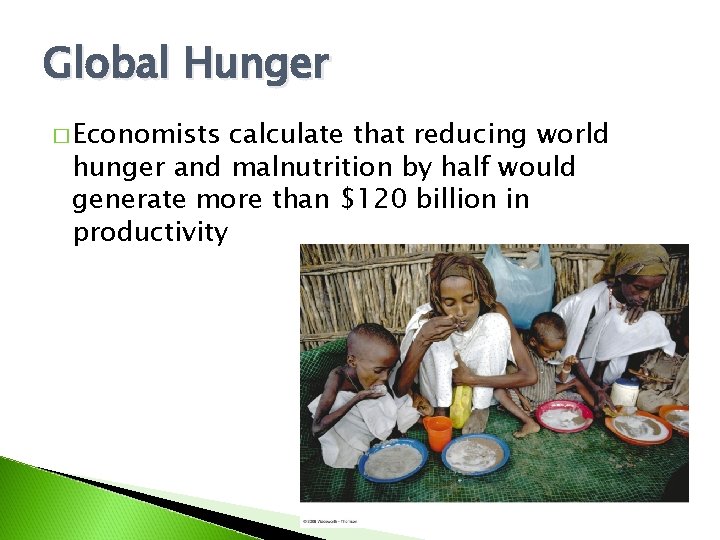
Global Hunger � Economists calculate that reducing world hunger and malnutrition by half would generate more than $120 billion in productivity © 2006 Thomson-Wadsworth
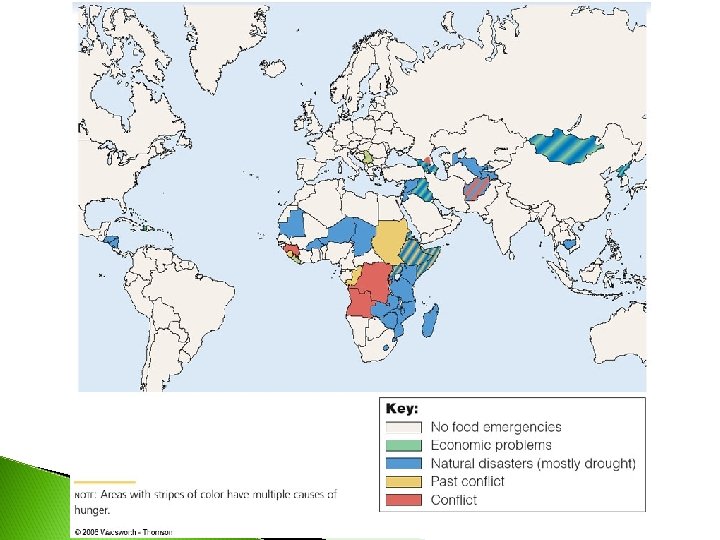
What is the State of World Hunger? � The number of hungry people continues to increase ◦ ◦ ◦ Hunger Poverty Population growth Political strife, armed conflicts Natural disasters Environmental degradation are all linked �They tend to worsen each other
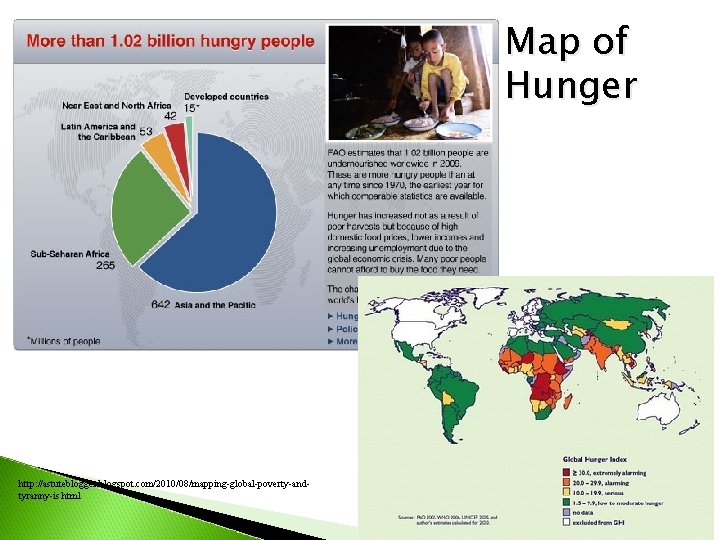
Map of Hunger http: //astuteblogger. blogspot. com/2010/08/mapping-global-poverty-andtyranny-is. html
© 2006 Thomson-Wadsworth
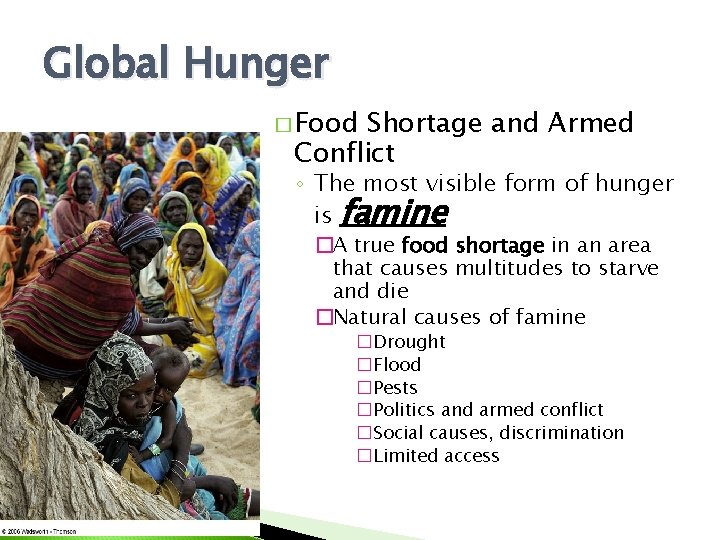
Global Hunger � Food Shortage and Armed Conflict ◦ The most visible form of hunger is famine �A true food shortage in an area that causes multitudes to starve and die �Natural causes of famine �Drought �Flood �Pests �Politics and armed conflict �Social causes, discrimination �Limited access
Global Hunger Chronic Hunger � Those affected by famine are relatively small compared with those suffering from chronic hunger ◦ ◦ Over 800 million people facing chronic hunger Affects mostly women and children Lack micronutrients: iron, iodine, and vitamin A Greater susceptibility to infections & preventable illness
Global Hunger Focus on Women’s Health � Malnourished women in poverty bear sickly infants who cannot fend off the diseases of poverty � Breastfeeding helps prolong an infant’s life ◦ Child must be weaned to thin gruels made with unclean water ◦ Children sicken and die soon after weaning � When crops fail or violence erupts in an already impoverished area, women are first to suffer ◦ 7 out of 10 of the world’s hungry people are women and girls ◦ They receive only about half of the available food aid and must use it to feed their children as well as themselves
Global Hunger Focus on Women’s Health � World Food Program (WFP) targets women as direct recipients of food relief ◦ Even when women are starving, they are likely to give what food is available to their hungry children �When food is delivered to government agencies, much of it may be diverted from its intended recipients ◦ In Asia and Africa, 60%-80% of women are engaged in farming
Global Hunger Focus on Women’s Health � Worldwide, women are the sole breadwinner in 1/3 of households � Advancing women: ◦ ◦ Low-interest loans Basic equipment Access to land ownership along with Supports such as child care and education � Women can engage in sustainable activities that improve conditions in the community � Universal education for girls and women is also a high priority
The Environment and Nutrition Climate, Air, and Fresh Water ◦ Air pollution and the resulting climate change reduce food outputs ◦ Changes in climate are expected to result from a buildup of so-called greenhouse gases �Such as carbon dioxide, methane, and nitrous oxide, and airborne particles �These pollutants are produced by human industry, agriculture, and transportation activities
The Environment and Nutrition � Environmental degradation and dwindling water supplies may ultimately prevent further growth in the world’s food output in many agricultural areas
The Environment and Nutrition Hunger and poverty often interact with environmental degradation ◦ Destroying resources needed for survival �Desperate to obtain money for food, they sell everything they own �Even the seeds that would have produced next year’s crops �They cut the available trees for firewood or timber to sell �Then lose the soil to erosion
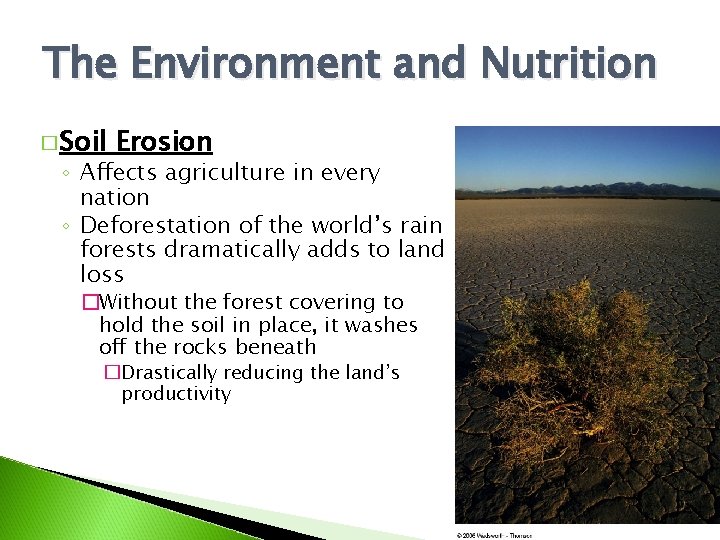
The Environment and Nutrition � Soil Erosion ◦ Affects agriculture in every nation ◦ Deforestation of the world’s rain forests dramatically adds to land loss �Without the forest covering to hold the soil in place, it washes off the rocks beneath �Drastically reducing the land’s productivity
Environmental Degradation and Hunger � Irrigation and fertilizer can no longer compensate for these losses by improving crop yields ◦ All the land that can benefit from these measures is already receiving them ◦ Compounding the problem, continuous irrigation leaves deposits of salt in the soil �Rising salt concentrations are lowering yields on close to a quarter of the world’s irrigated crop land
Environmental Degradation and Hunger �A rise of only a degree or so in average global temperature may ◦ reduce soil moisture, ◦ impair pollination of major food crops such as rice and corn, ◦ slow growth, ◦ weaken crops’ resistance to disease, ◦ and disrupt many other factors affecting crop yields
Environmental Degradation and Hunger �Dwindling supplies of fresh water are now limiting the numbers of people who can survive in some areas ◦ Poor water management ◦ Waste enters rivers, lakes, and streams
Environmental Degradation Overpopulation � Overpopulation ◦ The world’s population reached 6 billion in 1999 ◦ The rate of growth has begun to taper off ◦ By 2033 the human population will exceed the earth’s estimated carrying capacity �The total number of living organisms that a given environment can support without deteriorating in quality ◦ Overpopulation may be the most serious threat that humankind faces today
Environmental Degradation Overpopulation Each month world adds “another New York City” ◦ During 6 months of the 1992 famine in Somalia, an estimated 300, 000 people starved to death �It took the world only 29 hours to replace their numbers � Population stabilization-- the only option ◦ Matching the world’s food output to keep up with demands ◦ Without population stabilization, the world can neither support the lives of people already born nor halt environmental deterioration around the globe
Environmental Degradation Overpopulation � Before the population problem can be resolved, it may be necessary to remedy the poverty problem ◦ Of the many millions added to the population each year, 98% are born in the most poverty-stricken areas of the world � Poverty and hunger drive people to bear more children
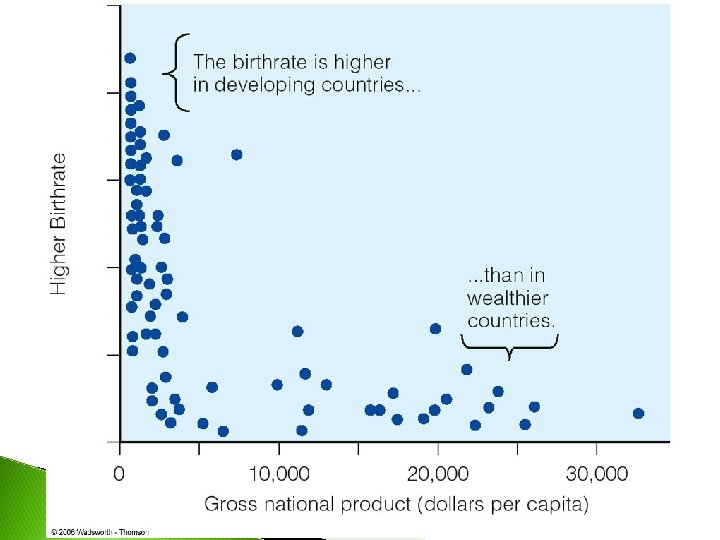
© 2006 Thomson-Wadsworth
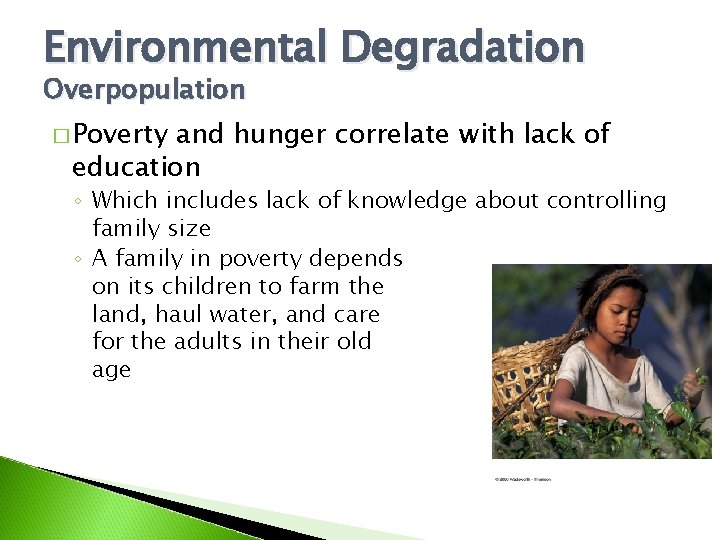
Environmental Degradation Overpopulation � Poverty and hunger correlate with lack of education ◦ Which includes lack of knowledge about controlling family size ◦ A family in poverty depends on its children to farm the land, haul water, and care for the adults in their old age
Solutions: � Government Action ◦ Government policies can change to promote sustainability ◦ Encourage energy and fuel sustainability ◦ Limit pollution ◦ Provide health care
Solutions: � Private and Community Enterprises ◦ Anti-hunger programs ◦ Gleaning effort ◦ Food producers must produce their goods sustainably
Solutions: � Educators and Students ◦ Educators can teach about the underlying social and political causes of poverty ◦ Share knowledge ◦ Become active in the community ◦ And take action at local and national levels
Solutions: � Food and Nutrition Professionals ◦ Dieticians and foodservice managers can promote sustainable production of food ◦ Saving of resources through reuse, recycling (including composting), energy conservation, and water conservation ◦ Promote learning and community programs
Soluntions: � Individuals ◦ All individuals can become involved in these large trends ◦ Many small decisions each day add up to large impacts on the environment ◦ Increase awareness ◦ Give back to community
- Slides: 50