
HUNG UP TREE AWARENESS CHAINSAW FELLING FATAL ACCIDENT
- Slides: 31
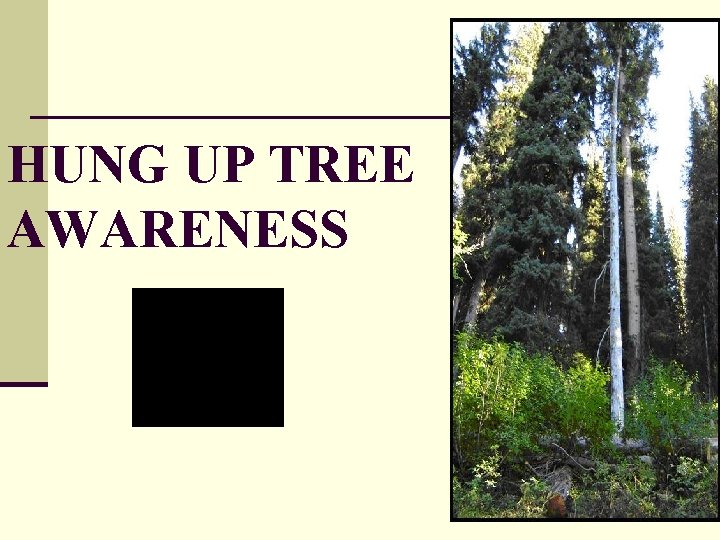
HUNG UP TREE AWARENESS
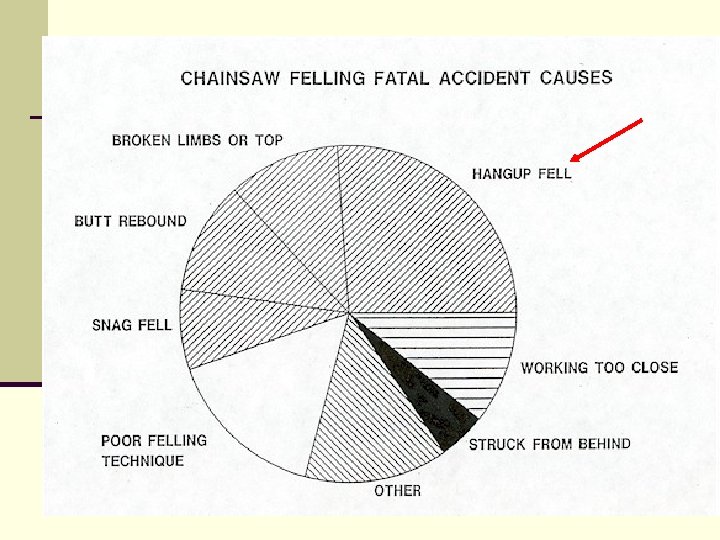
CHAINSAW FELLING FATAL ACCIDENT CAUSES n Hang-up fell: A little over 25% n Broken limbs or top: About 12% n Agency trends: n The majority of near miss reports we receive concern hang-ups and are related to the top coming out or the snag not falling where they thought it would. n We have had serious injuries because the top came out while removing hang-ups.
Size up n When assessing a hang-up you are confronted with one of the most complex situations there is. The first question you must answer is: Does the hang up really need to come down or can it be safely mitigated?
SITUATIONAL AWARENESS n Key words: n THOROUGH – EXECUTED WITHOUT NEGLIGENCE OR OMISSIONS. n COMPLEX – CLOSELY CONNECTED; A WEAVING OR TWINING TOGETHER. 1. CONSISTING OF TWO OR MORE RELATED PARTS. n COMPLEXITY – THE CONDITION OR QUALITY OF BEING COMPLEX.
SITUATIONAL AWARNESS INDIVIDUAL COMPLEXITY n THE COMPLEXITY OF THE ASSIGNMENT MUST BE DETERMINED BY THE INDIVIDUAL SAWYER. n This is based on his/her individual skill, knowledge and understanding of personal capabilities and limitations. n The final decision to cut any tree is left up to the individual sawyer; therefore, giving him/her the choice to say “NO” and walk away from any sawing situation they have determined to be beyond their capabilities.
SITUATIONAL AWARNESS INDIVIDUAL COMPLEXITY If a thorough job assessing the complexity of the individual situation has been completed, the decision to cut or not to cut will be determined by the GO-NO-GO process. Straight forward-”I FEEL COMFORTABLE WITH THE SAWING SITUATION, I WILL CUT IT” or “I DON’T FEEL COMFORTABLE WITH THE SITUATION, I WILL WALK AWAY FROM IT” Do not base your decision on “I THINK I CAN DO IT”
TAKING DOWN A HANG UP – IS IT FALLING OR BUCKING? What is the difference between falling a tree and removing a hang-up?
FALLING Falling – Constructing a hinge to control and direct a tree to a predetermined lay. The tree is connected to the stump by the hinge which is the controlling force.
BUCKING Bucking – Cutting a fallen tree into sections. The tree is on the ground at foot level. The movement of the tree is limited by contact with the ground which is the controlling force.
HANG-UP REMOVAL Hang-up removal – Cutting a fallen tree (That hasn’t hit the ground) into sections for removal. Being in a vertical position gravity and the tree that is hung are the controlling force’s. The trees movement is uncontrolled and unlimited after you release it.
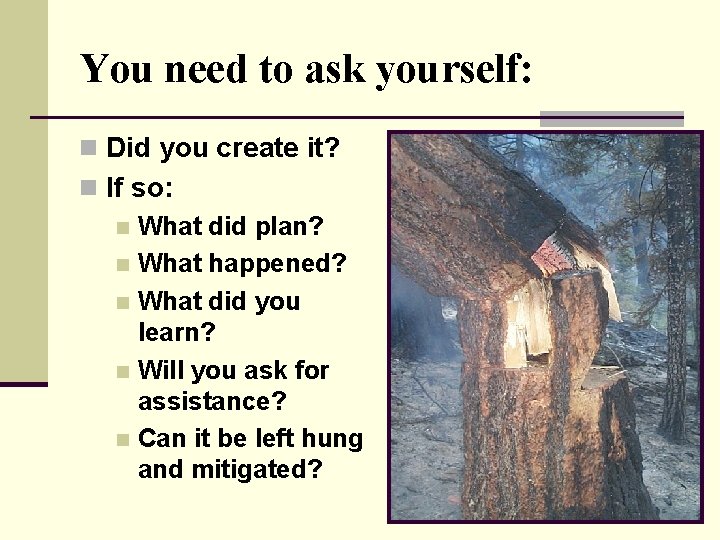
You need to ask yourself: n Did you create it? n If so: n What did plan? n What happened? n What did you learn? n Will you ask for assistance? n Can it be left hung and mitigated?
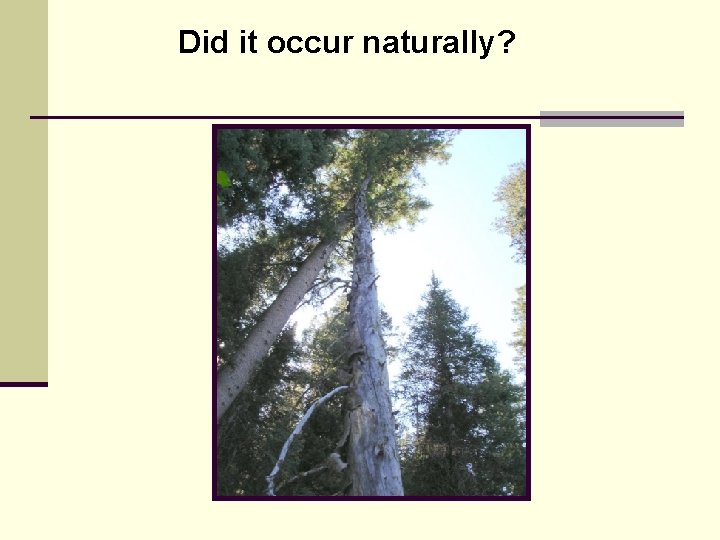
Did it occur naturally?
Is it truly a hazard? n How solid is it? n Will cutting on it make it a hazard? n Bole hung or limb hung? n Do we really have to work around or under it? n If so, are there alternatives to falling it? n Mechanical, blasting, equipment. n Creating a no work zone. Link to Hazard tree Assessment_03_20_06. zip
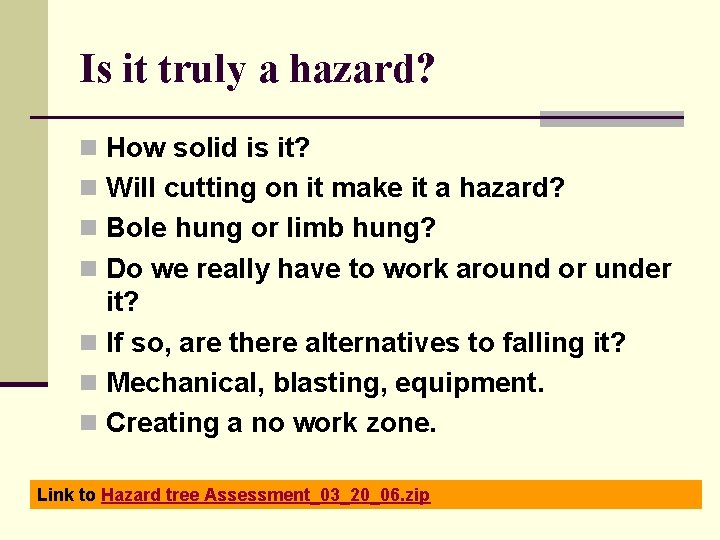
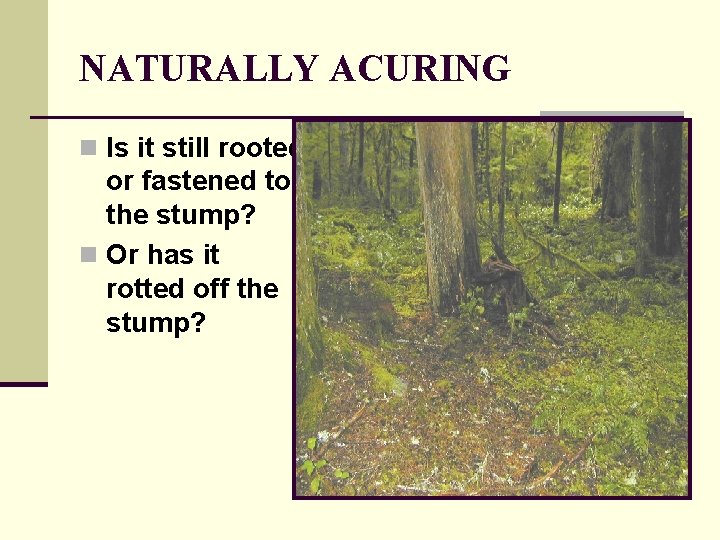
NATURALLY ACURING n Is it still rooted or fastened to the stump? n Or has it rotted off the stump?
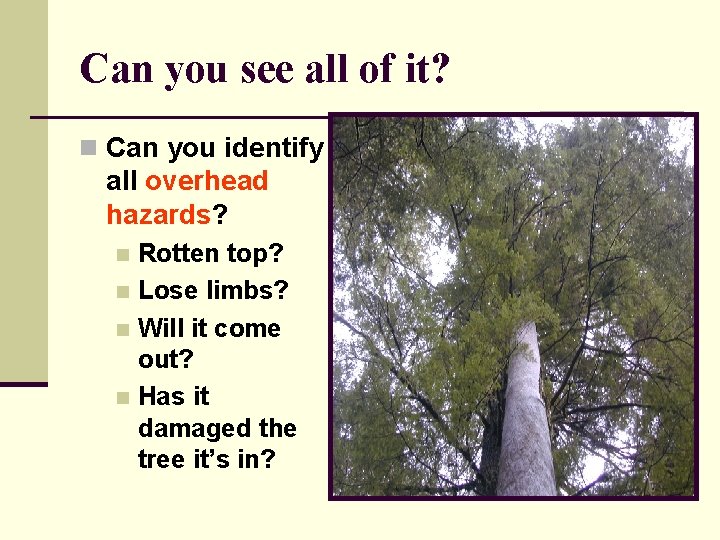
Can you see all of it? n Can you identify all overhead hazards? Rotten top? n Lose limbs? n Will it come out? n Has it damaged the tree it’s in? n
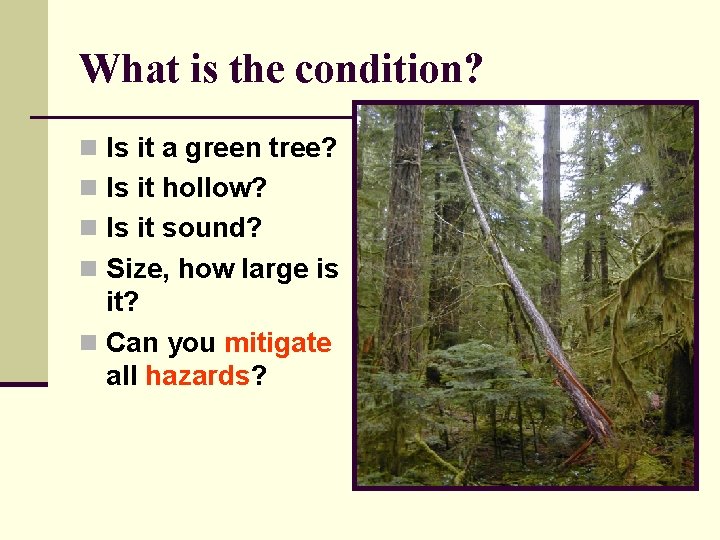
What is the condition? n Is it a green tree? n Is it hollow? n Is it sound? n Size, how large is it? n Can you mitigate all hazards?
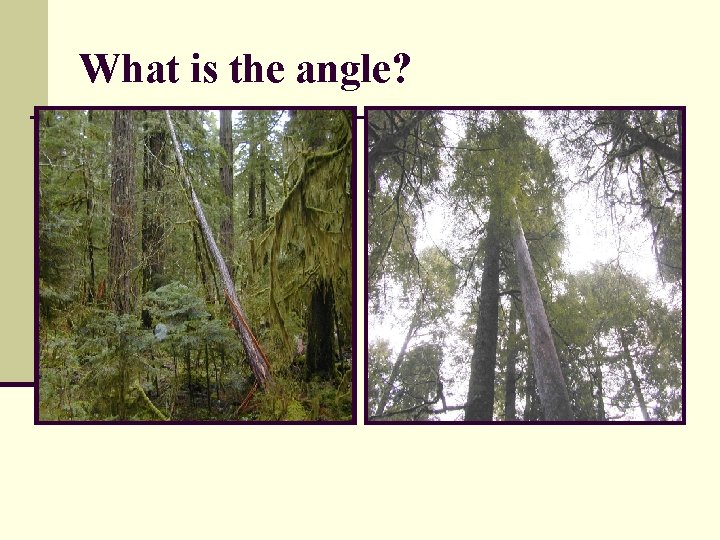
What is the angle?
ANGLE CONSIDERATIONS n The closer to vertical the more dangerous it is due to: n n n Harder to control. Creates extreme end bind. Need to work directly under hazards. Potential exposure to overhead hazards. Harder to determine where it may fall.
ANGLE CONSIDERATIONS n The greater the angle, the greater the tension and usually: n n Closer to the ground. Less exposure to overhead hazards. Easier to determine where it may fall. Easier to construct a hinge to control and slow the fall.
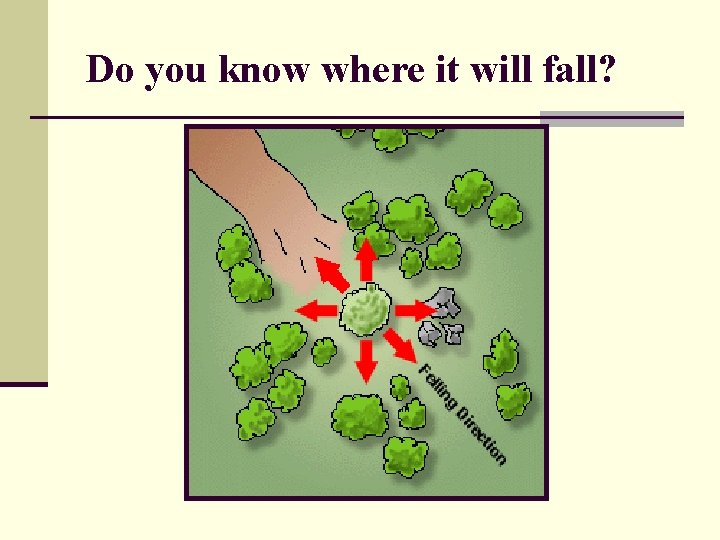
Do you know where it will fall?
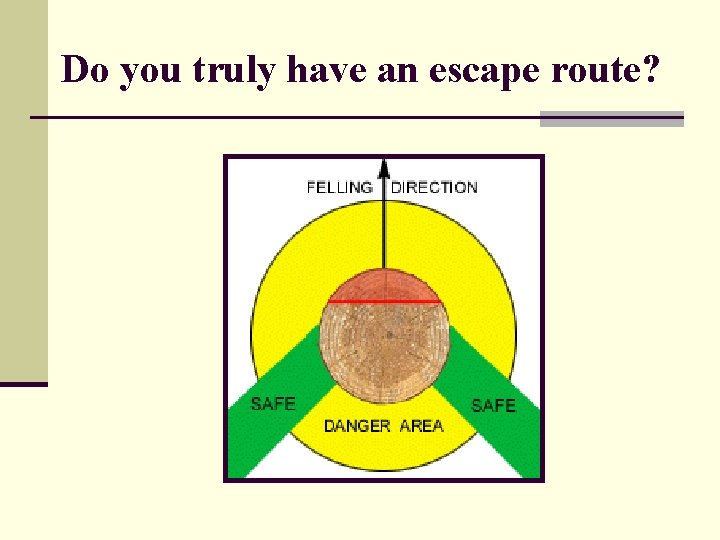
Do you truly have an escape route?
ESCAPE ROUTE CONSIDERATIONS n The most over looked part of the evaluation process when dealing with hang-ups. n Consider how fast a hang-up hits the ground compared to a normal falling situation. n Can you even get one step away? n Would you stand at the base of a tree while it fell? So, why would you accept the risk when falling a hang-up?
CUTTING CONSIDERATIONS n Does it really need to be cut? n Have you identified all overhead hazards? n Is there a place to work without standing under any overhead hazards? n Do you have an escape route? n Do not practice a stand dodge escape tactic. n Do you have the proper equipment? n Have you done a thorough assessment? n Is your gut telling you this is unsafe?
CUTTING CONSIDERATIONS n Avoid kerf cutting! (Single saw cut for relief) n Why? n Easy to get bar pinched. n Difficult to make cuts match. n Stalls then releases fast, limited time to step back. n May not release.
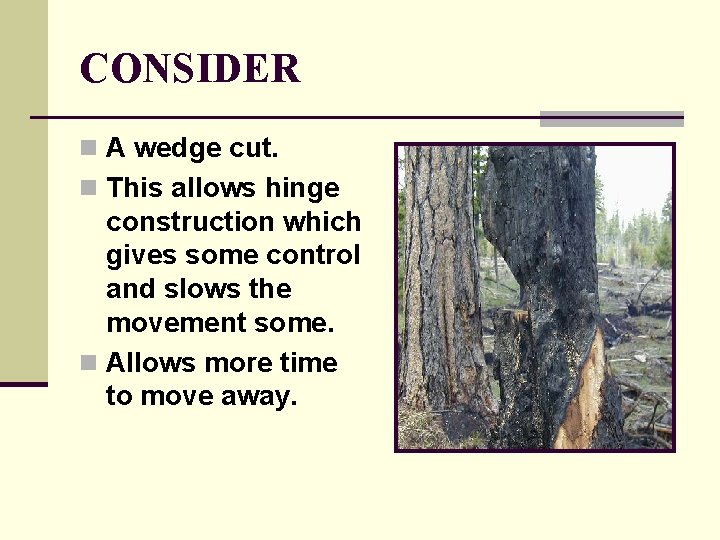
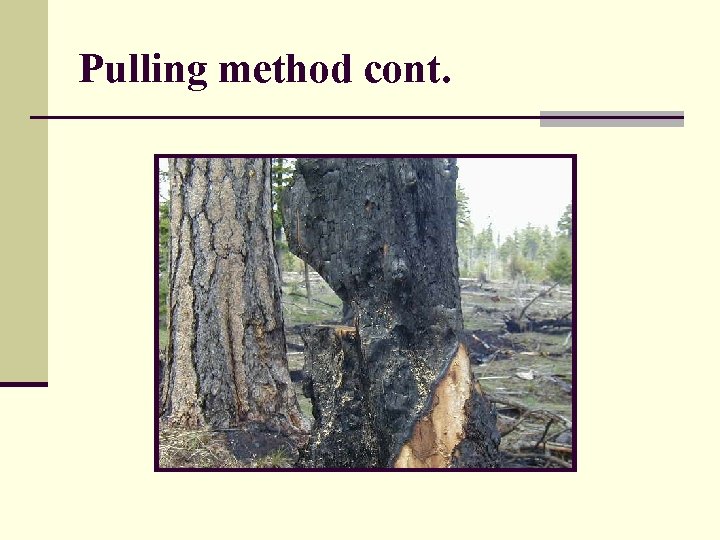
CONSIDER n A wedge cut. n This allows hinge construction which gives some control and slows the movement some. n Allows more time to move away.
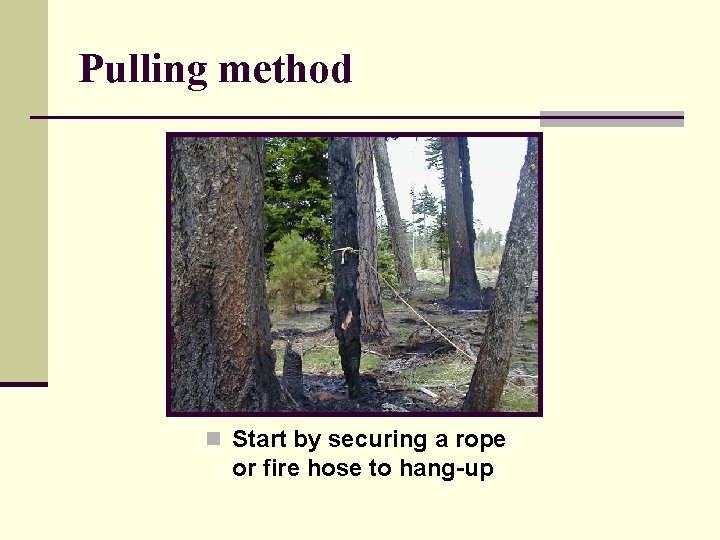
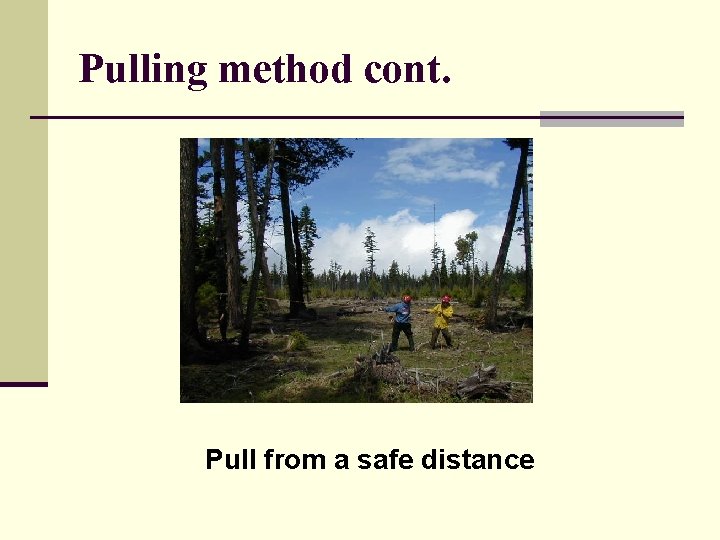
Pulling method n Start by securing a rope or fire hose to hang-up
Pulling method cont.
Pulling method cont. Pull from a safe distance
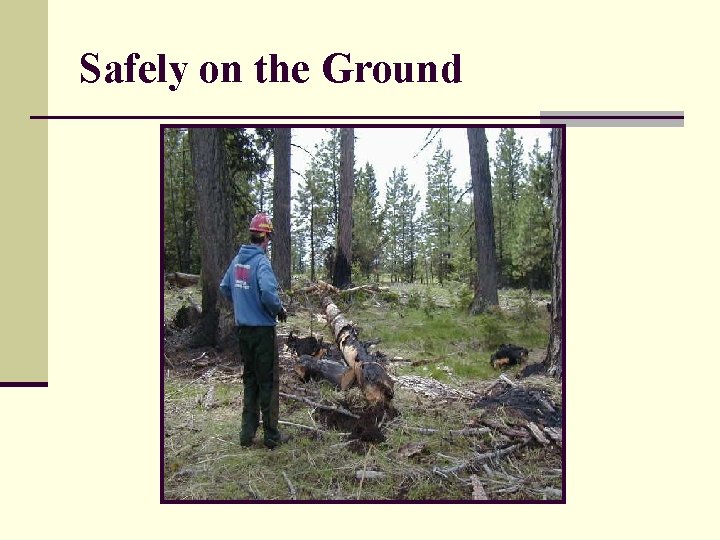
Safely on the Ground
HUNG UP TREE AWARENESS