
Humidity Monitoring U Johannesburg Simulation Software SH Connell
Humidity Monitoring U Johannesburg: Simulation, Software SH Connell 1, F Pieterse 1, D Boye 1, 2, M Bhamjee 1, P Takisa 2, L Leeuw 2 1. University of Johannesburg (UJ), 2. University of South Africa (UNISA) Assisted by A Cusano, G Berruti + Group Universita degli Studi del Sannio (Opto. Electronics group) P Petagnia + Group CERN, Experimental Physics Department, Detector technology Group A Borriello + Group Institute for Polymers, Composites and Biomaterials (IPCB) of the Italian CNR Many others Susanne Kersten, Paolo Petagnia, Georg Viehhauser, Danilo Giugni, Marco Oriunno Simon Connell : 10 July 2019 Humidity Monitoring - Status 1
Humidity Monitoring in the ATLAS ITK Simulation Project 1. Team at UJ 1. Dr. M Bhamjee (Expert in ANSYS CFD) Mechanical Engineering 2. Prof L Leeuw (Particle Physics) Qualification task 3. Prof S Connell (Physics) 4. Post Doc – Dr Pedro Takisa 50% (existing) 5. Ph. D Student : Currently being registered 2. Multiple ANSYS CFX site licenses. Installed. 1. Light systems on laptops 2. Power Servers 3. National Cluster (CHPC) 3. Now are working with the Oriunno files as a starting point Simon Connell : 10 July 2019 Humidity Monitoring - Status 2
Humidity Monitoring in the ATLAS ITK 5. Technical Coordinations of ATLAS and CMS are funding one year of activity of a Professor “on long-term leave” from his country to Europe. Specialist of CFD simulations with Fluent/Ansys (CFX). 6. Proposed collaboration (Paolo Petagnia) 1. UJ team is involved in ATLAS only 2. New Professor works for both ATLAS and CMS Technical Coordinations 3. Liaise with UJ team in order to agree on a common computational and meshing approach 4. New Professor concentrates on CMS and finally be ready to a rational comparison and a critical discussion between the results coming from the two experiments (ATLAS from your parametric calculations vs. CMS from his) 7. Technical Drawings acquired 1. Simon was at CERN, met with Martin Janda 2. Granted access to technical drawing repository 3. Discussed mechanical geometry, placement, feedtroughs etc. Simon Connell : 10 July 2019 Humidity Monitoring - Status 3
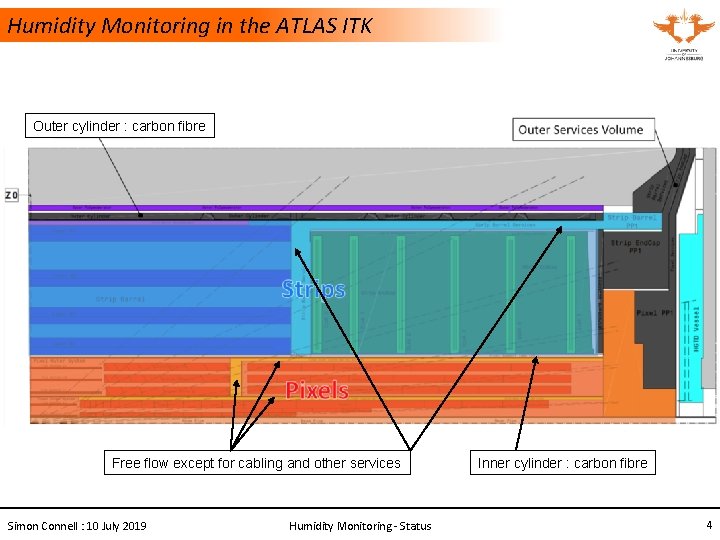
Humidity Monitoring in the ATLAS ITK Outer cylinder : carbon fibre Free flow except for cabling and other services Simon Connell : 10 July 2019 Humidity Monitoring - Status Inner cylinder : carbon fibre 4

Humidity Monitoring in the ATLAS ITK End view of previous slides side view. Corresponds to the inner part of the OSV. It is radially stepped. 1. 2. 3. 4. 1 doublet of in pipes to Strip sector at top 1 doublet of in pipes to Pixel sector at top Simon Connell : 10 July 2019 Humidity Monitoring - Status 5
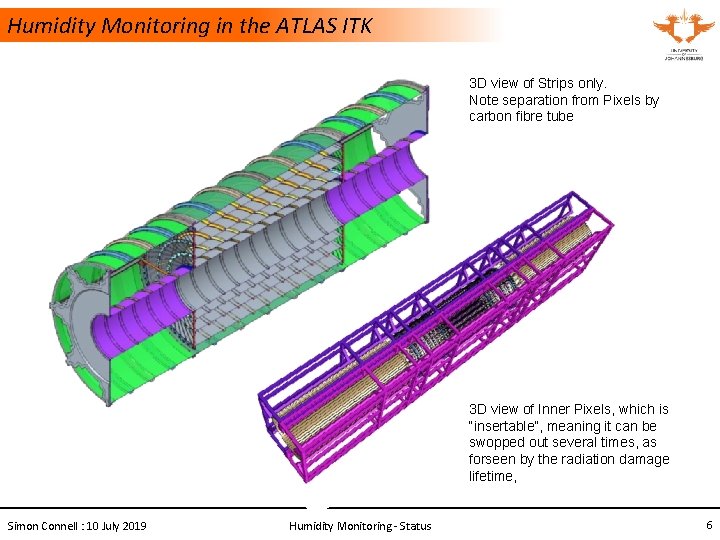
Humidity Monitoring in the ATLAS ITK 3 D view of Strips only. Note separation from Pixels by carbon fibre tube 3 D view of Inner Pixels, which is “insertable”, meaning it can be swopped out several times, as forseen by the radiation damage lifetime, Simon Connell : 10 July 2019 Humidity Monitoring - Status 6
Humidity Monitoring in the ATLAS ITK Interrogator Readout and spectrum processing 1. Test Sensor project : FOS in the ID 2. Team at UJ 1. Prof S Connell (Physics) 2. Ph. D Student : Diallo Boye 3. Transfer of work. 1. Lorenzo Scherino Diallo Boye 2. Several Meetings, skype and on-site 3. Spectra read-in and plotting 4. Signal filtering, Valley minimum by centroid detection 4. Converted codes from MATLAB to C++ 5. Busy cross benchmarking these codes to previous MATLAB codes 6. Preparing them for running on Linux PC at the Interrogator 7. Develop analysis to template fits from modelling Simon Connell : 10 July 2019 Humidity Monitoring - Status 7
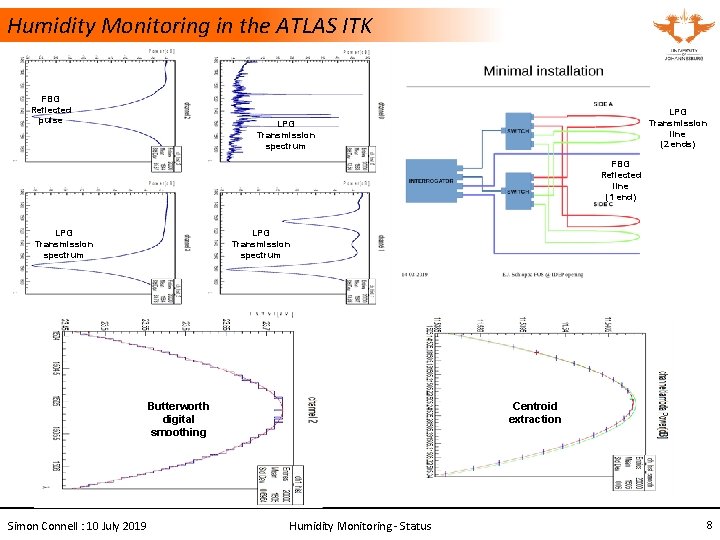
Humidity Monitoring in the ATLAS ITK FBG Reflected pulse LPG Transmission line (2 ends) LPG Transmission spectrum FBG Reflected line (1 end) LPG Transmission spectrum Butterworth digital smoothing Simon Connell : 10 July 2019 Centroid extraction Humidity Monitoring - Status 8
Humidity Monitoring in the ATLAS ITK Connections to DCS 1. Team at UJ 1. Prof S Connell (Physics) 2. Ph. D Student : Diallo Boye 2. Transfer of work. 1. Enrico Junior Schioppa Diallo Boye 2. Diallo to learn WINCC 3. Diallo to shadow Enrico for next 3 weeks. 4. Reviewed a lot of material together 3. Data currently stored and PC near Interrogator. 4. Enrico and Diallo produce first Humidity Dashboard in WINCC 5. Connect Spectrum signal processing, polled at 1 minute intervals, to Dashboard. 6. Implement configuration management and control of humidity system by Dashboard. 7. Benchmark FOS Temperature Sensors (Humidity and Temp) to conventional sensors (CS) co-installed and already in the STRIPS DCS. 1. Once FOS readouts are in DCS, can find the CS readouts and start benchmarking studies Simon Connell : 10 July 2019 Humidity Monitoring - Status 9
Humidity Monitoring in the ATLAS ITK STATUS of connection to DCS (Enrico) Current status: - 2 hyperion units are installed in USA 15 - each hyperion is connected to a subset of FOS channels, a few splitters are also used - each hyperion is readout by a laptop How it's going to change for development: - 1 hyperion + laptop pair (SIDE A) stays as it is - the other hyperion will be connected to a GPN network (so no laptop, and no data from SIDE C) - we (me, Diallo, Michal) will start developing the OPC server by remotely connecting to the hyperion via the GPN - from there, we'll start with the DCS (placeholders already put by Koichi within the ID environmental sensors panel) In parallel: - the optical switch should be shipped this week or the next - we ordered a bunch of adapters to allow for the connection to the switch - I will end my stay at CERN next week (12/7), so I hope we can start developing the OPC+DCS soon (currently waiting for the GPN connection to be activated) What it should look like at the end: - only one hyperion stays in USA 15 - using the switch, we will connect all the FOS channel to the single hyperion - the OPC+DCS is deployed into the dedicated machine in USA 15 - we take data smoothly Simon Connell : 10 July 2019 Humidity Monitoring - Status 10
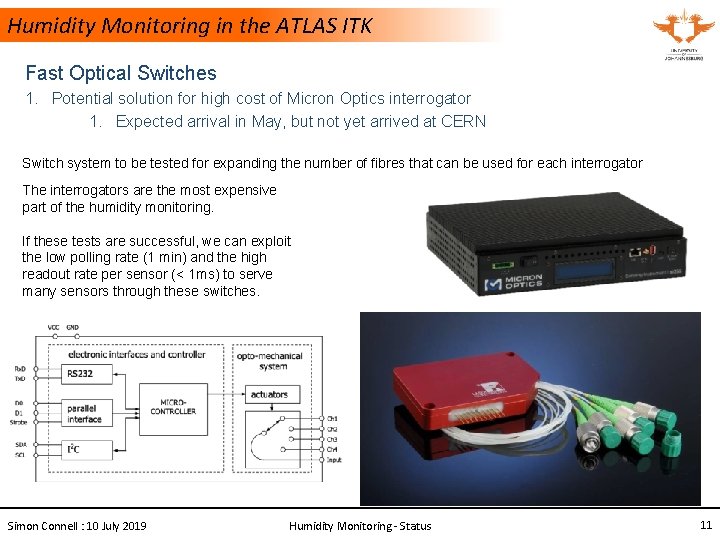
Humidity Monitoring in the ATLAS ITK Fast Optical Switches 1. Potential solution for high cost of Micron Optics interrogator 1. Expected arrival in May, but not yet arrived at CERN Switch system to be tested for expanding the number of fibres that can be used for each interrogator The interrogators are the most expensive part of the humidity monitoring. If these tests are successful, we can exploit the low polling rate (1 min) and the high readout rate per sensor (< 1 ms) to serve many sensors through these switches. Simon Connell : 10 July 2019 Humidity Monitoring - Status 11
Backup …. . Previous slides Simon Connell : 10 July 2019 Humidity Monitoring - Status 12
Humidity Monitoring in the ATLAS ITK Simon Connell : 10 July 2019 Humidity Monitoring - Status 13
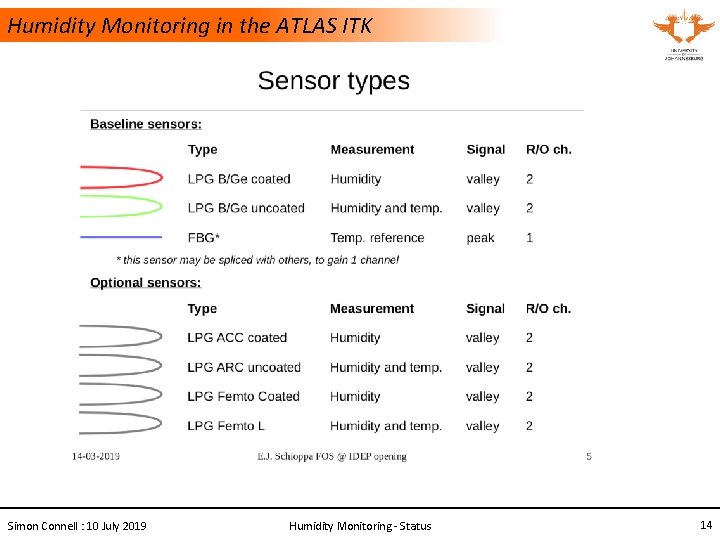
Humidity Monitoring in the ATLAS ITK Simon Connell : 10 July 2019 Humidity Monitoring - Status 14
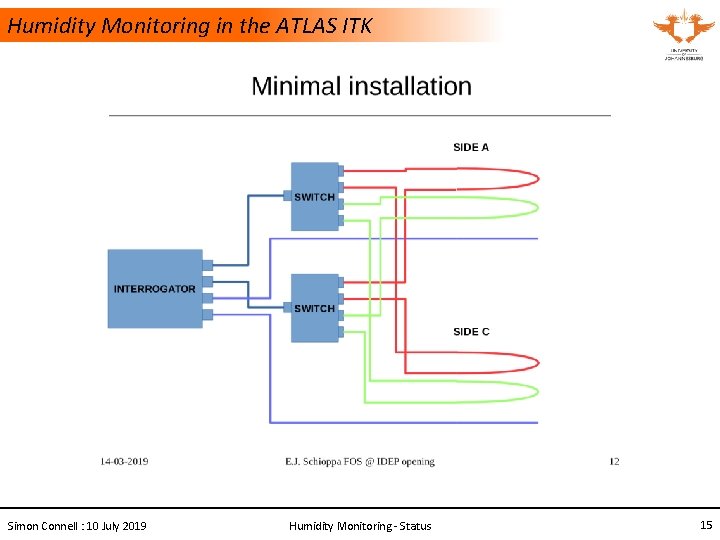
Humidity Monitoring in the ATLAS ITK Simon Connell : 10 July 2019 Humidity Monitoring - Status 15
Humidity Monitoring in the ATLAS ITK Simulation Project The Humidity Sensors planned for the ITK Upgrade are expensive and therefore there are constraints on the number that can be deployed. This will also require the available sensors to be optimally positioned. The expected performance of the sensors needs to be well understood, considering that their role could evolve from monitoring to interlock. There is currently an existing simulation of the dry nitrogen gas fluid flow in the ITK volumes. This simulation must be developed further to include diffusion modelling of additional chemical species, for example, water vapour from leaks. The aim is to understand the spatial region protected by a sensor, dead spaces of low atmosphere renewal rates and timescales for the propagation of vapours from leak events to sensors. The existing simulation must therefore be revised in terms of accuracy of geometry, materials, thermal sources and sinks, the capacity to model multiple gaseous chemical species and also multi-phase capacity, incorporating the modelling of known leak rates at specific sites, and also anticipated hazard and accident modelling. Simon Connell : 10 July 2019 Humidity Monitoring - Status 16
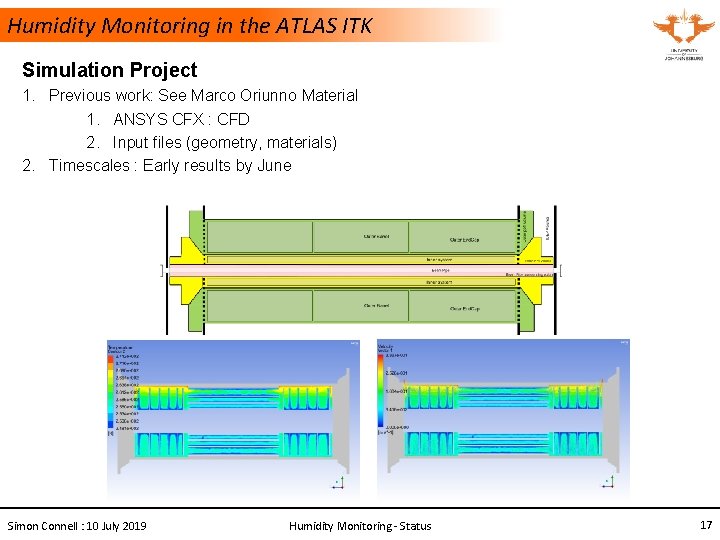
Humidity Monitoring in the ATLAS ITK Simulation Project 1. Previous work: See Marco Oriunno Material 1. ANSYS CFX : CFD 2. Input files (geometry, materials) 2. Timescales : Early results by June Simon Connell : 10 July 2019 Humidity Monitoring - Status 17
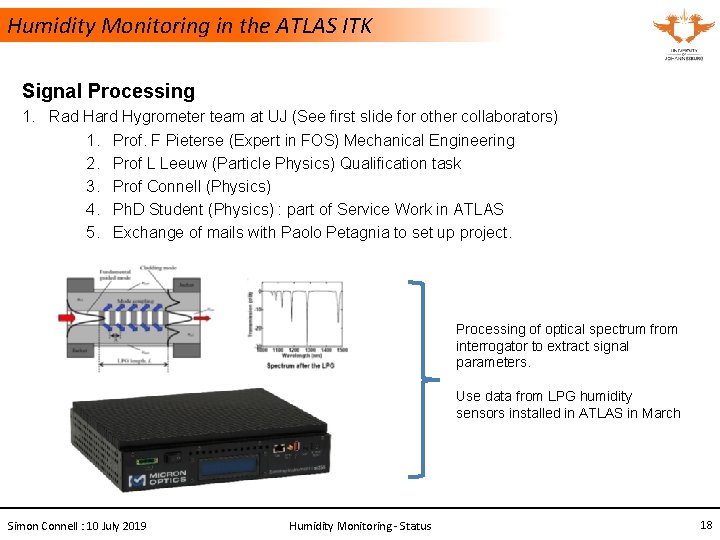
Humidity Monitoring in the ATLAS ITK Signal Processing 1. Rad Hard Hygrometer team at UJ (See first slide for other collaborators) 1. Prof. F Pieterse (Expert in FOS) Mechanical Engineering 2. Prof L Leeuw (Particle Physics) Qualification task 3. Prof Connell (Physics) 4. Ph. D Student (Physics) : part of Service Work in ATLAS 5. Exchange of mails with Paolo Petagnia to set up project. Processing of optical spectrum from interrogator to extract signal parameters. Use data from LPG humidity sensors installed in ATLAS in March Simon Connell : 10 July 2019 Humidity Monitoring - Status 18
- Slides: 18