
HUMIDITY A Fresh Look Definition HUMIDITY n Moisture



- Slides: 28
HUMIDITY A Fresh Look
Definition • HUMID'ITY, n. Moisture; dampness; a moderate degree of wetness which is perceptible to the eye or touch, occasioned by the absorption of a fluid, or its adherence to the surface of a body. – Webster’s 1828 Dictionary • Humidity is the amount of water vapor in the air – USA Today
Relative Humidity • Relative humidity is the amount of water vapor in the air compared with the amount of vapor needed to make the air saturated at the air's current temperature. – USA Today • Weather for USA for June 1, 2003 showed relative humidity ranging from 13 to 86% RH
From Surviving Humidity – A Pragmatic Approach • Humidity has always been an enigmatic problem for many engineers to grasp because: • Temperature – you can feel • Vibration – you can both see and feel • Humidity – may be invisible to the naked eye
Humidity Testing • High Humidity – Higher than is seen in real life situations – Purposely apply stressful situation – Temperatures higher than normal – Easiest to get temperature to set point and then raise humidity – Often the final test after thermal only
Environments to Remember • Use • Transportation • Storage
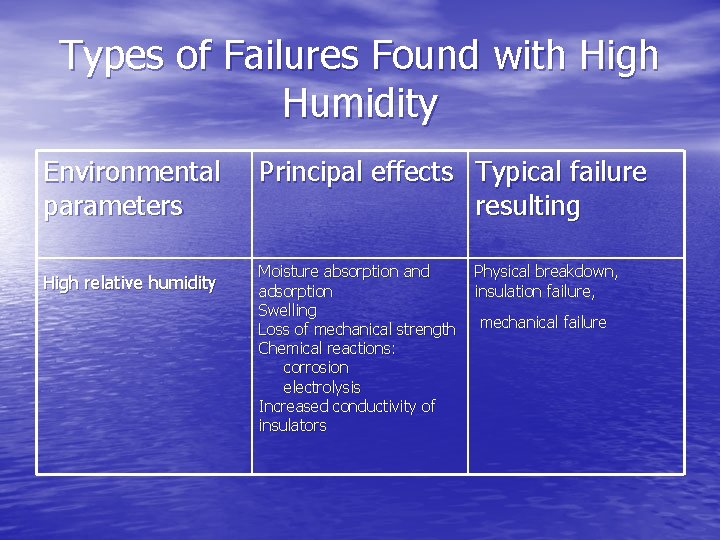
Types of Failures Found with High Humidity Environmental parameters Principal effects Typical failure resulting High relative humidity Moisture absorption and adsorption Swelling Loss of mechanical strength Chemical reactions: corrosion electrolysis Increased conductivity of insulators Physical breakdown, insulation failure, mechanical failure
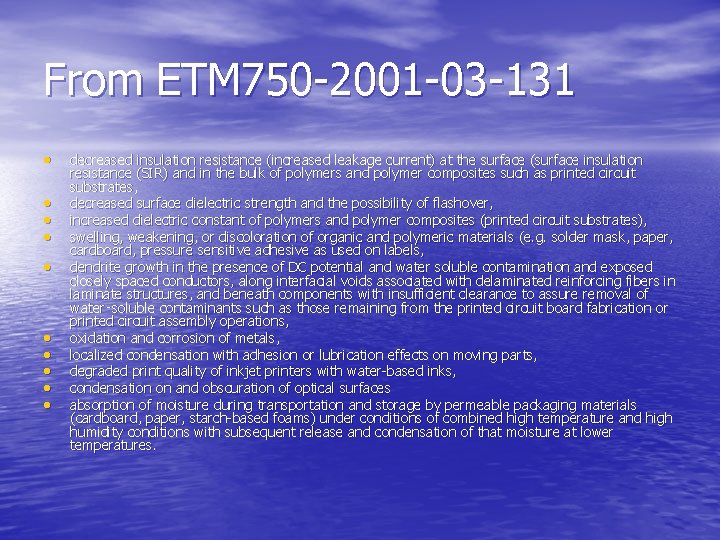
From ETM 750 -2001 -03 -131 • • • decreased insulation resistance (increased leakage current) at the surface (surface insulation resistance (SIR) and in the bulk of polymers and polymer composites such as printed circuit substrates, decreased surface dielectric strength and the possibility of flashover, increased dielectric constant of polymers and polymer composites (printed circuit substrates), swelling, weakening, or discoloration of organic and polymeric materials (e. g. solder mask, paper, cardboard, pressure sensitive adhesive as used on labels, dendrite growth in the presence of DC potential and water soluble contamination and exposed closely spaced conductors, along interfacial voids associated with delaminated reinforcing fibers in laminate structures, and beneath components with insufficient clearance to assure removal of water‑soluble contaminants such as those remaining from the printed circuit board fabrication or printed circuit assembly operations, oxidation and corrosion of metals, localized condensation with adhesion or lubrication effects on moving parts, degraded print quality of inkjet printers with water-based inks, condensation on and obscuration of optical surfaces absorption of moisture during transportation and storage by permeable packaging materials (cardboard, paper, starch-based foams) under conditions of combined high temperature and high humidity conditions with subsequent release and condensation of that moisture at lower temperatures.
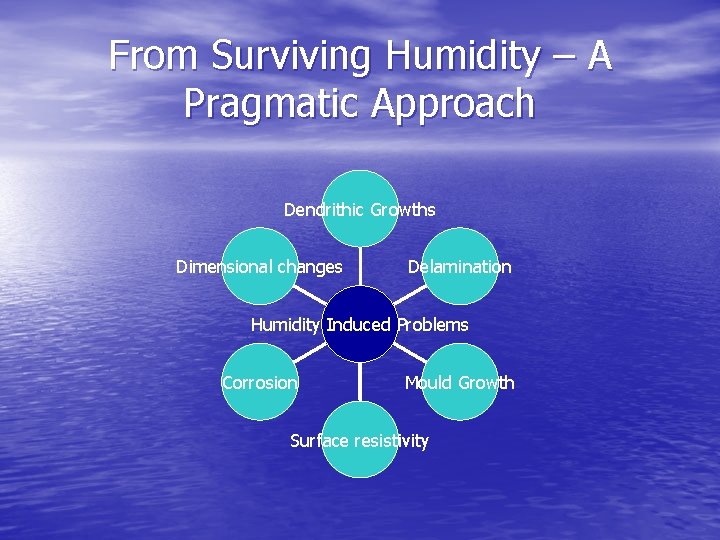
From Surviving Humidity – A Pragmatic Approach Dendrithic Growths Dimensional changes Delamination Humidity Induced Problems Corrosion Mould Growth Surface resistivity
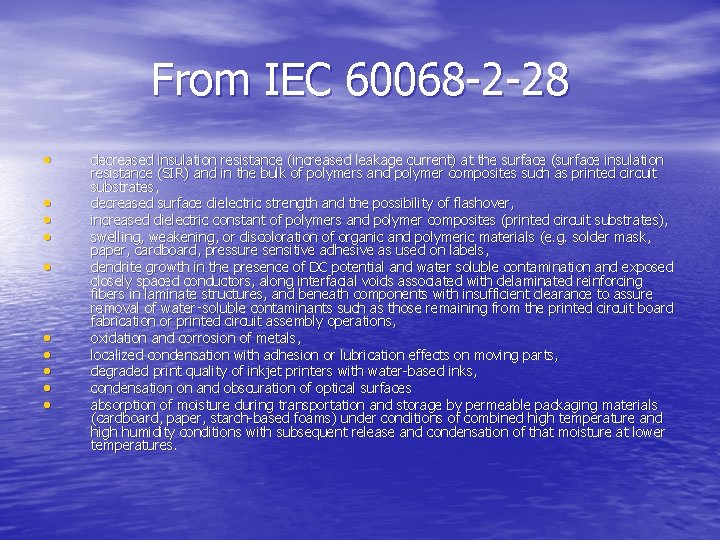
From IEC 60068 -2 -28 • • • decreased insulation resistance (increased leakage current) at the surface (surface insulation resistance (SIR) and in the bulk of polymers and polymer composites such as printed circuit substrates, decreased surface dielectric strength and the possibility of flashover, increased dielectric constant of polymers and polymer composites (printed circuit substrates), swelling, weakening, or discoloration of organic and polymeric materials (e. g. solder mask, paper, cardboard, pressure sensitive adhesive as used on labels, dendrite growth in the presence of DC potential and water soluble contamination and exposed closely spaced conductors, along interfacial voids associated with delaminated reinforcing fibers in laminate structures, and beneath components with insufficient clearance to assure removal of water‑soluble contaminants such as those remaining from the printed circuit board fabrication or printed circuit assembly operations, oxidation and corrosion of metals, localized condensation with adhesion or lubrication effects on moving parts, degraded print quality of inkjet printers with water-based inks, condensation on and obscuration of optical surfaces absorption of moisture during transportation and storage by permeable packaging materials (cardboard, paper, starch-based foams) under conditions of combined high temperature and high humidity conditions with subsequent release and condensation of that moisture at lower temperatures.
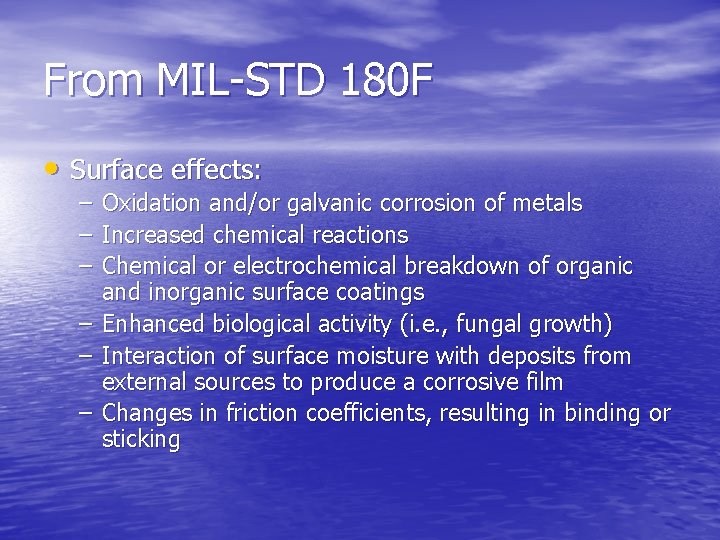
From MIL-STD 180 F • Surface effects: – – – Oxidation and/or galvanic corrosion of metals Increased chemical reactions Chemical or electrochemical breakdown of organic and inorganic surface coatings Enhanced biological activity (i. e. , fungal growth) Interaction of surface moisture with deposits from external sources to produce a corrosive film Changes in friction coefficients, resulting in binding or sticking
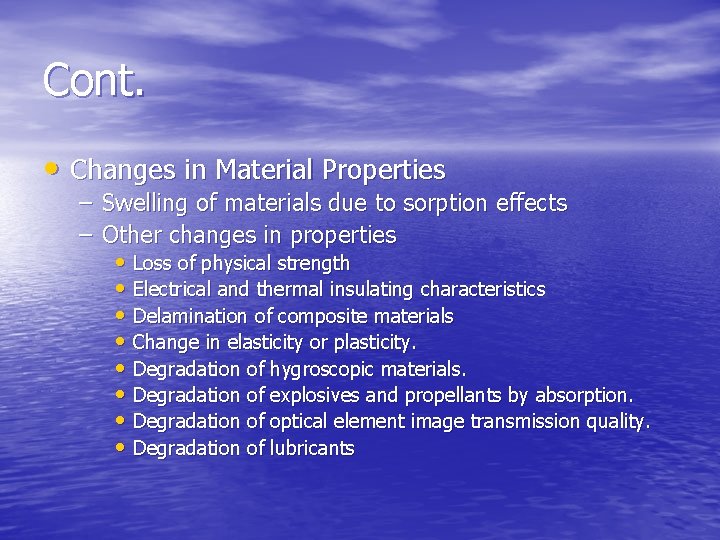
Cont. • Changes in Material Properties – Swelling of materials due to sorption effects – Other changes in properties • Loss of physical strength • Electrical and thermal insulating characteristics • Delamination of composite materials • Change in elasticity or plasticity. • Degradation of hygroscopic materials. • Degradation of explosives and propellants by absorption. • Degradation of optical element image transmission quality. • Degradation of lubricants
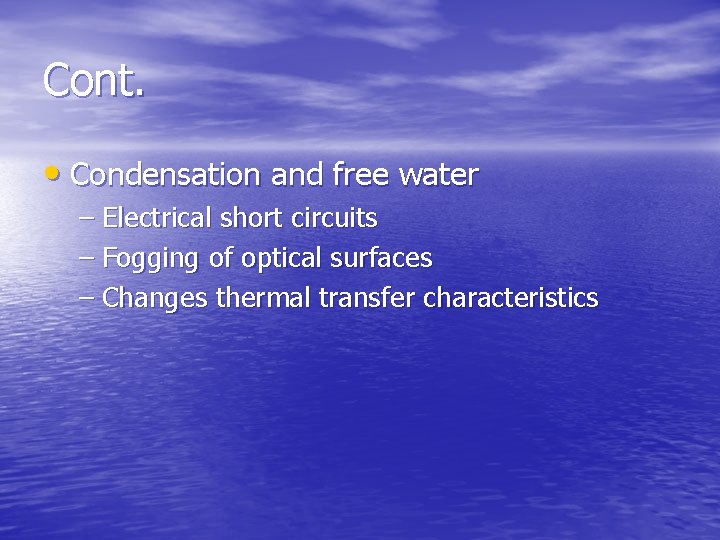
Cont. • Condensation and free water – Electrical short circuits – Fogging of optical surfaces – Changes thermal transfer characteristics
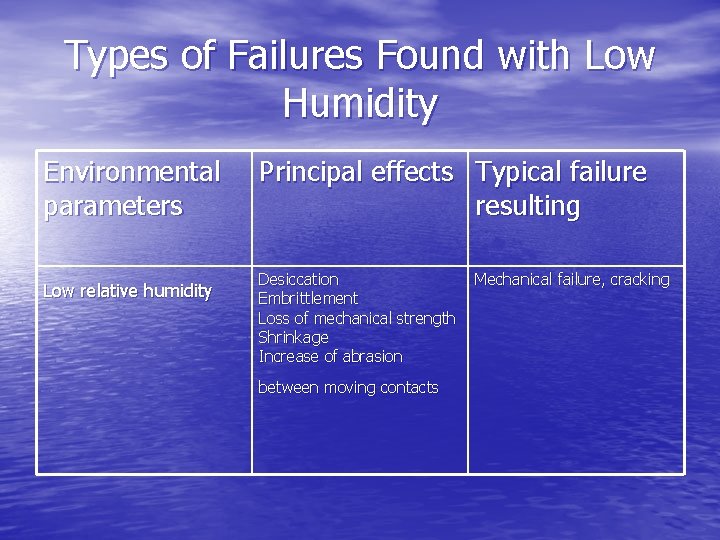
Types of Failures Found with Low Humidity Environmental parameters Principal effects Typical failure resulting Low relative humidity Desiccation Embrittlement Loss of mechanical strength Shrinkage Increase of abrasion between moving contacts Mechanical failure, cracking
From ETM 750 -2001 -03 -131 • embrittlement of paper, • loss of lubricity of lamellar graphite particles (at very low humidity), • decreased available time to use or to transfer water-based solutions and gels, • increased buildup of electrostatic charge.
From IEC 60068 -2 -28 • embrittlement of paper, • loss of lubricity of lamellar graphite • • particles (at very low humidity), decreased available time to use or to transfer water-based solutions and gels, increased buildup of electrostatic charge.
From Nortec (sensor mfr. ) • static electricity • surface cracking • weight loss • shrinkage • embrittlement • cooling efficiency • ESD risk
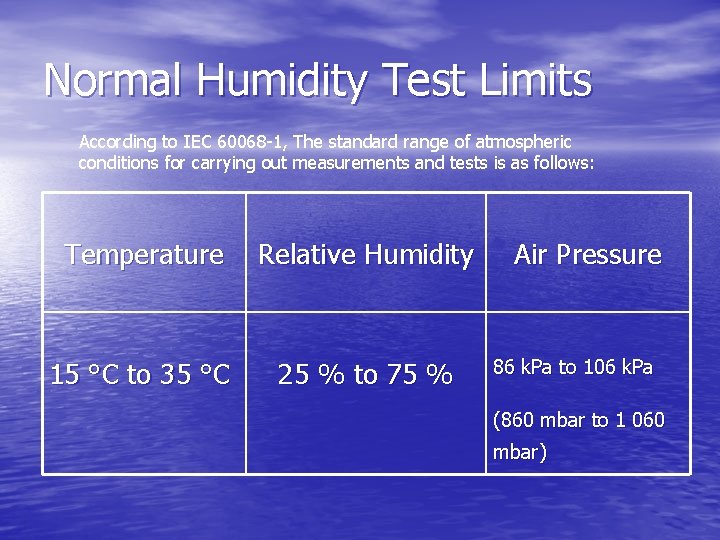
Normal Humidity Test Limits According to IEC 60068 -1, The standard range of atmospheric conditions for carrying out measurements and tests is as follows: Temperature Relative Humidity 15 °C to 35 °C 25 % to 75 % Air Pressure 86 k. Pa to 106 k. Pa (860 mbar to 1 060 mbar)
Additional Notes on Humidity Testing • IEC – 60068 -1 – A damp heat, steady-state test is often applied at the end of the whole sequence of tests or, where not included in the sequence, on separate specimens in order to determine the long-term behaviour of the component in a humid atmosphere. • MIL-STD 810 F – Humidity testing may produce irreversible effects. If these effects could unrealistically influence the results of subsequent tests on the same item(s) perform humidity testing following those tests.
Motorola Findings • With all of this discussion, it must be pointed out that humidity is considered a very weak stress in general for electronic devices. It does have its uses for specific component failure modes, and verification of cleaning processes. It is typically combined with high temperature and may also be used in conjunction with altitude and electrical power effects. – From Motorola Web Site
More Findings • Humidity, in an indirect inject chamber, has been determined to have an ageing factor in the range of 4: 1 to 10: 1. On the average, TX 14 ALT can age a unit the equivalent of six (6) years in four (4) days. This means that the DUT has aged the equivalent of only 16 to 40 days from the humidity stimulant, while the other stimulants have aged the DUT about 2, 190 days. This is an ageing factor of 547: 1 vs. 10: 1 for humidity. – Motorola Advanced Life Testing
Other Considerations • Humidity Sensor – Wet bulb/Dry bulb – Mirror – Capacitance • Airflow • Temperature Sensor • Chamber Size
Humidity Sensor Considerations • Before the age of the transistor, horse hair was used as a humidity sensor. A group of horse hairs were attached [glued] to two holders and as they stretched and contracted with the humidity, the change in their length was taken as a measure of relative humidity. – Mad. Sci Network
Cont. • Acting as a variable capacitor, the dielectric layer is only a few microns in thickness for quick equilibrium with the surrounding water vapour pressure and the corresponding value is displayed on the meter in Dewpoint temperature. The pores of gold film and the dielectric layer are precisely controlled by special processes during manufacturer, so that the reading is specific to water vapour regardless of other gas which may be present. – www. shawmoisture. com. my
Ways of Introducing Humidity • Steam Generator • Direct Injection • Indirect Injection
Notes on Working Space • It must be realized that %RH will vary across the working space irrespective of the design. – Surviving Humidity – A Pragmatic Approach • “Working space” is not necessarily the entire open area of your chamber – Temperature measurements – Humidity measurements
Special Cases • Ford Electronics (now Visteon) uses • turkey roasting bags in their nitrogen chambers to keep humidity higher during testing Siemens purposely drives their chamber below freezing when humidity is high to see if they can create ice in their circuit cards
During HALT • Can be used as an additional stress • It is useful to at least know the humidity level, so it is good to have a sensor