
Humble ISD TELPAS Fall Foundational Awareness Training 2013
Humble ISD TELPAS Fall Foundational Awareness Training (2013)
Module 1 TELPAS Fall Foundational Awareness Training (2013) TELPAS BASICS
• • • TELPAS ELPS ELL LEP PLD SE BICS CALP TAC Definitions
• • • TELPAS ELPS ELL LEP PLD SE BICS CALP TAC • • • Limited English Proficiency English Language Proficiency Standards Proficiency Level Descriptors Texas Administrative Code Basic Interpersonal Communication Skills TEXAS English Language Proficiency Assessment System • Cognitive Academic Language Proficiency • Student Expectations • English Language Learner Definitions
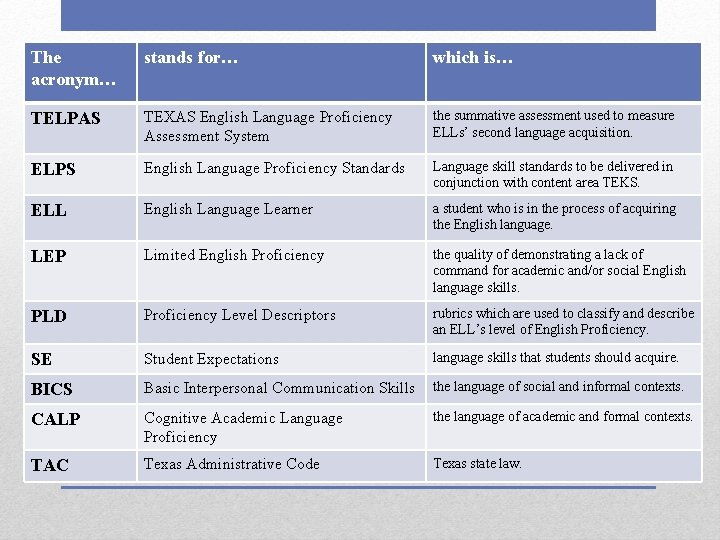
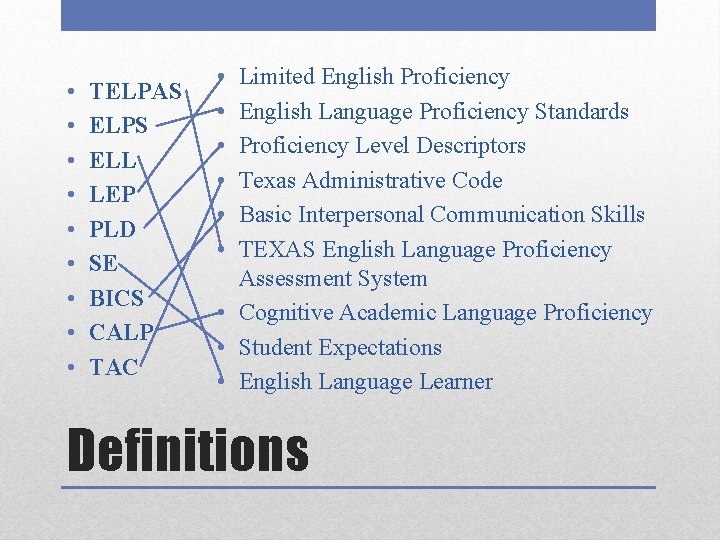
The acronym… stands for… which is… TELPAS TEXAS English Language Proficiency Assessment System the summative assessment used to measure ELLs’ second language acquisition. ELPS English Language Proficiency Standards Language skill standards to be delivered in conjunction with content area TEKS. ELL English Language Learner a student who is in the process of acquiring the English language. LEP Limited English Proficiency the quality of demonstrating a lack of command for academic and/or social English language skills. PLD Proficiency Level Descriptors rubrics which are used to classify and describe an ELL’s level of English Proficiency. SE Student Expectations language skills that students should acquire. BICS Basic Interpersonal Communication Skills the language of social and informal contexts. CALP Cognitive Academic Language Proficiency the language of academic and formal contexts. TAC Texas Administrative Code Texas state law.
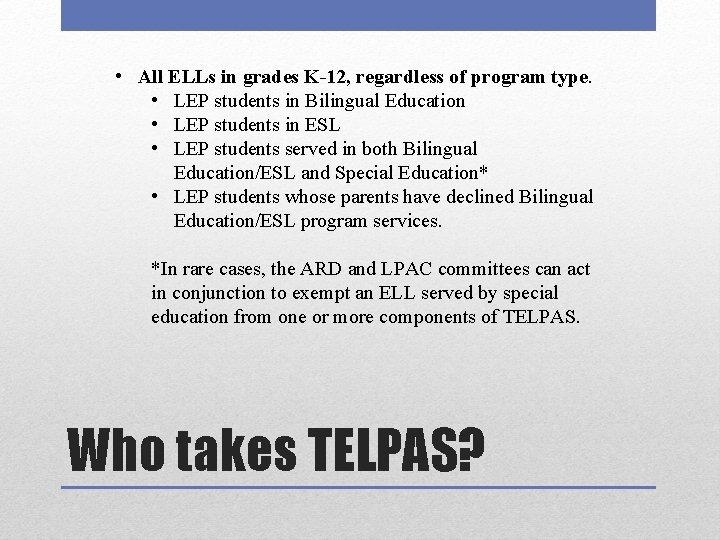
• All ELLs in grades K-12, regardless of program type. • LEP students in Bilingual Education • LEP students in ESL • LEP students served in both Bilingual Education/ESL and Special Education* • LEP students whose parents have declined Bilingual Education/ESL program services. *In rare cases, the ARD and LPAC committees can act in conjunction to exempt an ELL served by special education from one or more components of TELPAS. Who takes TELPAS?
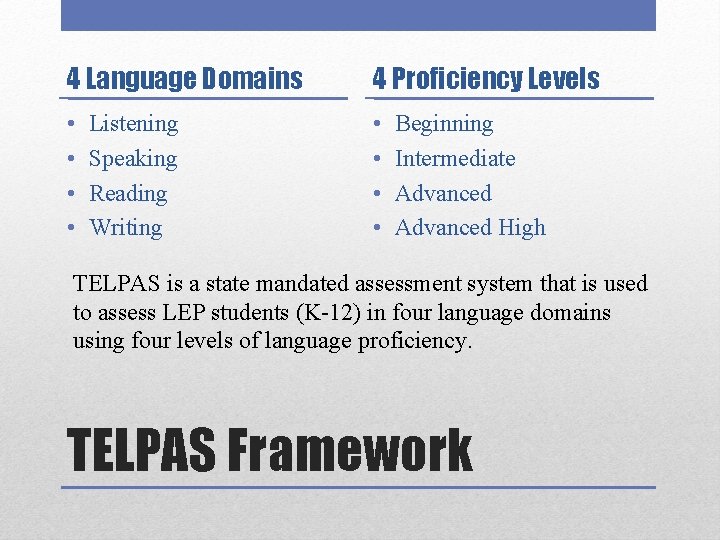
4 Language Domains 4 Proficiency Levels • • Listening Speaking Reading Writing Beginning Intermediate Advanced High TELPAS is a state mandated assessment system that is used to assess LEP students (K-12) in four language domains using four levels of language proficiency. TELPAS Framework
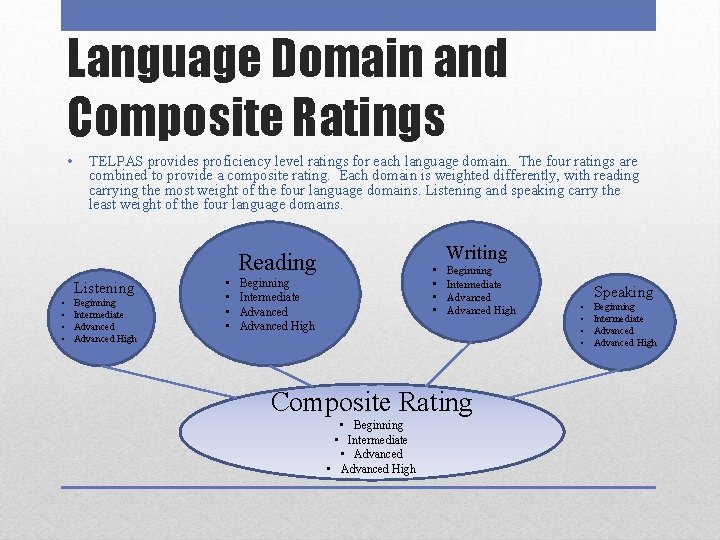
Language Domain and Composite Ratings • TELPAS provides proficiency level ratings for each language domain. The four ratings are combined to provide a composite rating. Each domain is weighted differently, with reading carrying the most weight of the four language domains. Listening and speaking carry the least weight of the four language domains. Writing Reading Listening • • Beginning Intermediate Advanced High • • Beginning Intermediate Advanced High Composite Rating • Beginning • Intermediate • Advanced High Speaking • • Beginning Intermediate Advanced High
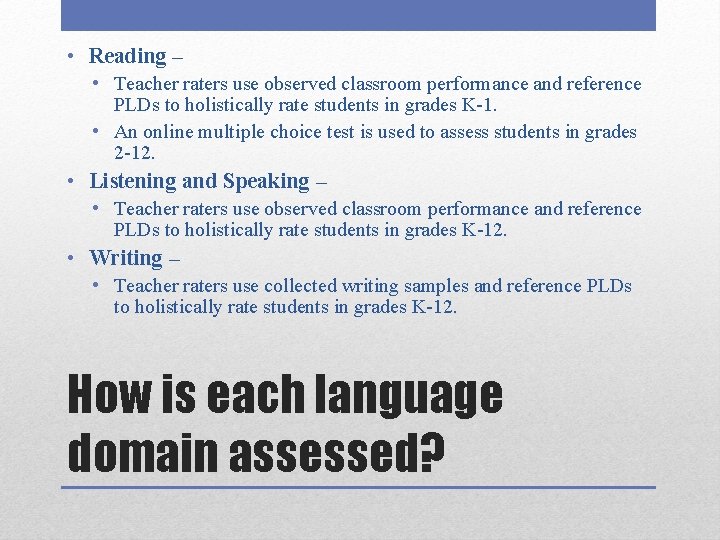
• Reading – • Teacher raters use observed classroom performance and reference PLDs to holistically rate students in grades K-1. • An online multiple choice test is used to assess students in grades 2 -12. • Listening and Speaking – • Teacher raters use observed classroom performance and reference PLDs to holistically rate students in grades K-12. • Writing – • Teacher raters use collected writing samples and reference PLDs to holistically rate students in grades K-12. How is each language domain assessed?
• The Holistic Rating Process • is a direct and authentic way to assess English Language Proficiency. • utilizes rubrics (PLDs) to evaluate language ability as a whole during a window of time, not skills in isolation at a single point in time. • focuses on the overall ability of the student to understand use English in grade-appropriate academic settings. • is used informally, and in an on-going manner, as a formative assessment to guide instruction throughout the year. • is used as part of the official summative assessment (TELPAS) in the spring of the year. Holistic Rating Process
• TELPAS results are used to • set learning goals for ELLs • keep parents and students aware of annual progress in language acquisition. • direct instruction planning. • help in determining appropriate bilingual/ESL program exit. • Evaluate programs, resources, and staffing patterns • Evaluate districts and campuses in federal and state accountability and monitoring indicators • Report performance to the public. How do we use TELPAS results?
• Districts and campuses should determine in the fall of the year which teachers will be a TELPAS raters in the spring. • TELPAS raters should • have the LEP student to be rated in class • Possess knowledge of the student’s ability to use English in instructional and informal settings. • Hold a valid teaching certificate • Be appropriately trained, as required by TEA. Responsibilities of the TELPAS rater
• A student’s TELPAS rater is the teacher designated by the district as the official rater of the student’s English language proficiency. • The student’s rater must rate the student in all domains for which the student is eligible. • A student is not permitted to have one rater for some domains and another rater for other domains. Responsibilities of the TELPAS rater
Various measures are in place to ensure the validity and reliability of TELPAS ratings • On the Campus Level: • In determining the proficiency ratings of their assigned students, raters are required to collaborate with other teachers who have knowledge of the students’ English proficiency. • Campus level audits are conducted on a random sampling of writing collections • At the District Level: • Districts are required to implement procedures that ensure validity and reliability of holistic rating process. • Procedures may vary by campus, at district’s discretion. • At the State Level: • The Texas Education Agency conducts periodic audits of the TELPAS holistic assessment process. The goals of the audits are to examine whether • • the ratings of teachers reflect appropriate and consistent application of the PLD rubrics school district personnel follow training and test administration procedures Ensuring Validity and Reliability of TELPAS ratings
• A New TELPAS rater is someone who has never participated in TELPAS training, calibration, or rating. • Experienced TELPAS raters who have not rated within the previous three TELPAS administrations are also considered new raters. • New TELPAS raters must complete Fall Foundational Training (this training) and online basic training, in addition to the requirements of experienced TELPAS raters. RATER TRAINING
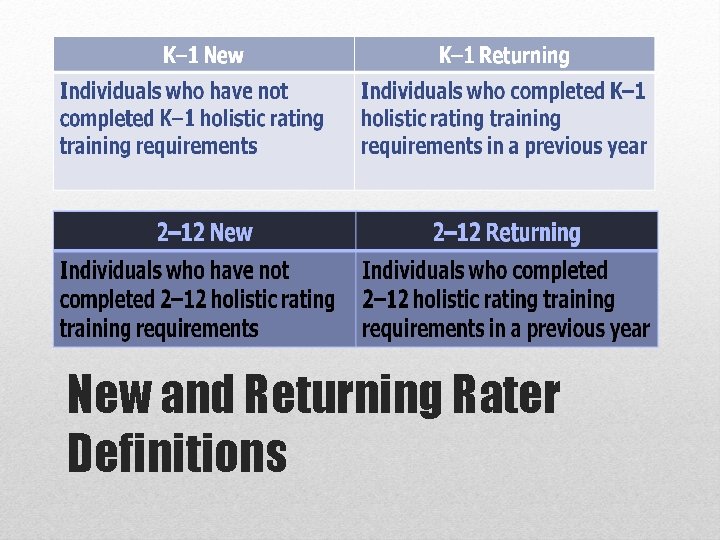
New and Returning Rater Definitions
• Online Basic Training: • For new raters • Provides instruction on using PLD rubrics • Gives new raters an opportunity to practice rating students in each language domain • Separate courses for K-1 and 2 -12 • Online Calibration: • This is for all raters, regardless of previous rating experience. • Raters use PLDs to rate students in each language domain. • Raters must rate 70% of the students correctly in order to calibrate successfully. • Raters have three opportunities to calibrate on the assigned grade cluster. Two Types of Training
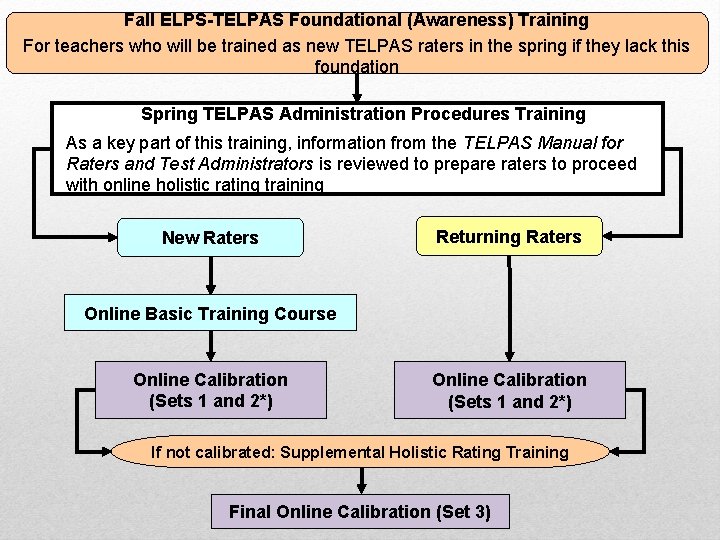
Fall ELPS-TELPAS Foundational (Awareness) Training For teachers who will be trained as new TELPAS raters in the spring if they lack this foundation Spring TELPAS Administration Procedures Training As a key part of this training, information from the TELPAS Manual for Raters and Test Administrators is reviewed to prepare raters to proceed with online holistic rating training New Raters Returning Raters Online Basic Training Course Online Calibration (Sets 1 and 2*) If not calibrated: Supplemental Holistic Rating Training Final Online Calibration (Set 3)
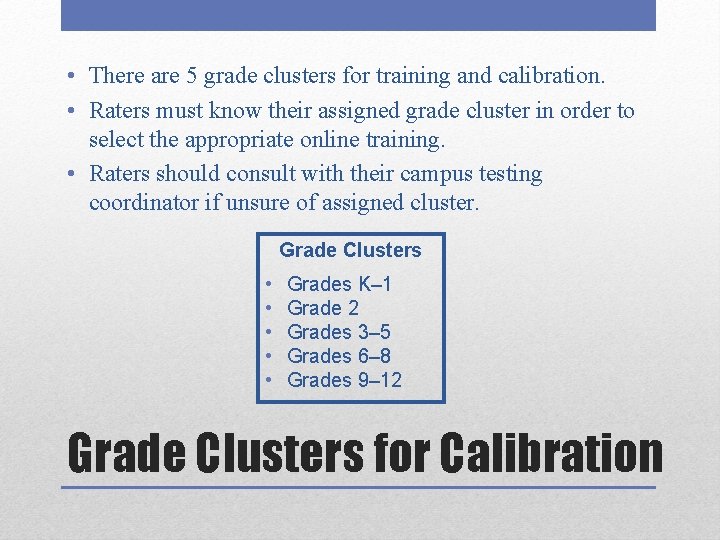
• There are 5 grade clusters for training and calibration. • Raters must know their assigned grade cluster in order to select the appropriate online training. • Raters should consult with their campus testing coordinator if unsure of assigned cluster. Grade Clusters • • • Grades K– 1 Grade 2 Grades 3– 5 Grades 6– 8 Grades 9– 12 Grade Clusters for Calibration
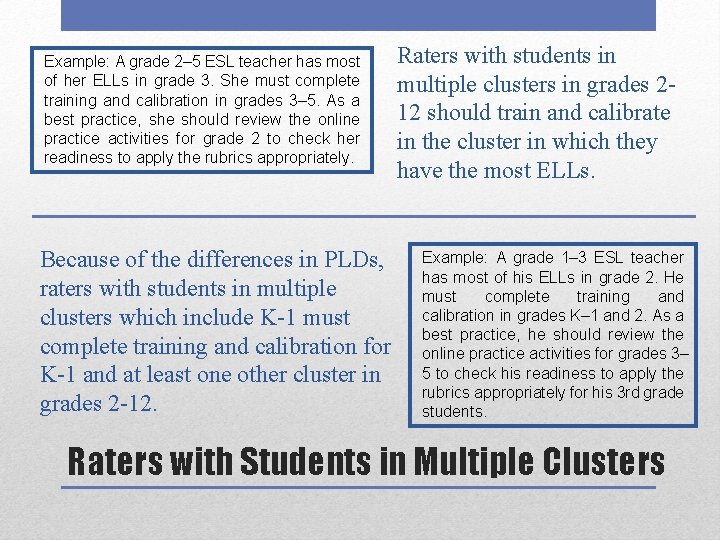
Example: A grade 2– 5 ESL teacher has most of her ELLs in grade 3. She must complete training and calibration in grades 3– 5. As a best practice, she should review the online practice activities for grade 2 to check her readiness to apply the rubrics appropriately. Because of the differences in PLDs, raters with students in multiple clusters which include K-1 must complete training and calibration for K-1 and at least one other cluster in grades 2 -12. Raters with students in multiple clusters in grades 212 should train and calibrate in the cluster in which they have the most ELLs. Example: A grade 1– 3 ESL teacher has most of his ELLs in grade 2. He must complete training and calibration in grades K– 1 and 2. As a best practice, he should review the online practice activities for grades 3– 5 to check his readiness to apply the rubrics appropriately for his 3 rd grade students. Raters with Students in Multiple Clusters
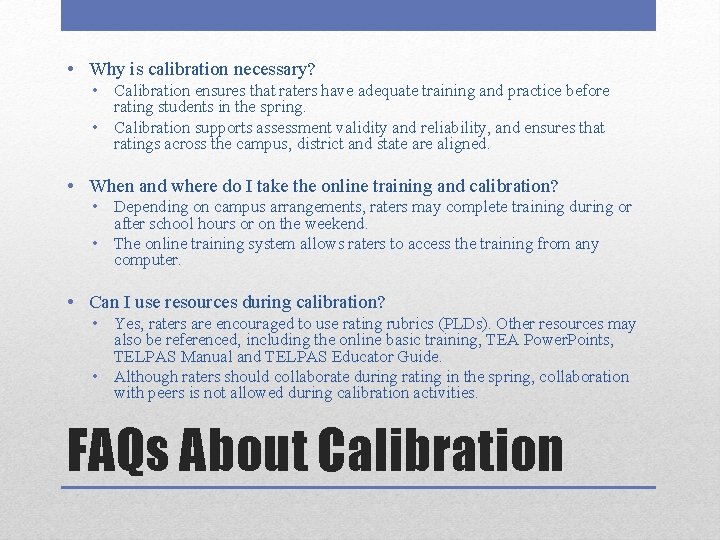
• Why is calibration necessary? • Calibration ensures that raters have adequate training and practice before rating students in the spring. • Calibration supports assessment validity and reliability, and ensures that ratings across the campus, district and state are aligned. • When and where do I take the online training and calibration? • Depending on campus arrangements, raters may complete training during or after school hours or on the weekend. • The online training system allows raters to access the training from any computer. • Can I use resources during calibration? • Yes, raters are encouraged to use rating rubrics (PLDs). Other resources may also be referenced, including the online basic training, TEA Power. Points, TELPAS Manual and TELPAS Educator Guide. • Although raters should collaborate during rating in the spring, collaboration with peers is not allowed during calibration activities. FAQs About Calibration
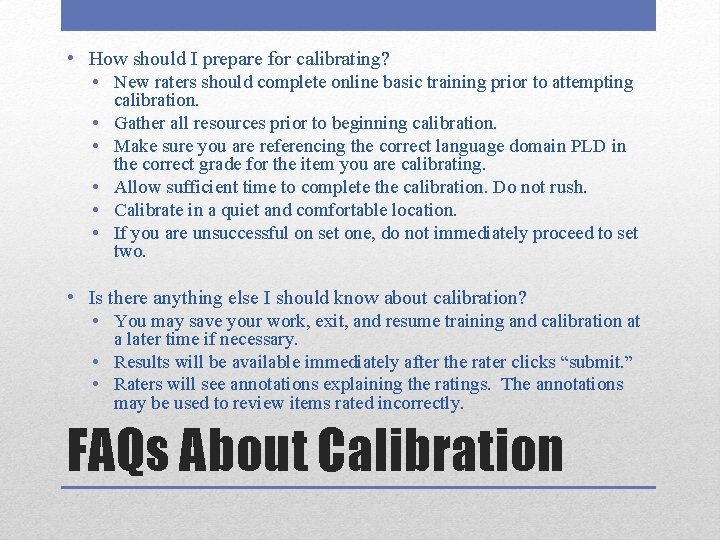
• How should I prepare for calibrating? • New raters should complete online basic training prior to attempting • • • calibration. Gather all resources prior to beginning calibration. Make sure you are referencing the correct language domain PLD in the correct grade for the item you are calibrating. Allow sufficient time to complete the calibration. Do not rush. Calibrate in a quiet and comfortable location. If you are unsuccessful on set one, do not immediately proceed to set two. • Is there anything else I should know about calibration? • You may save your work, exit, and resume training and calibration at a later time if necessary. • Results will be available immediately after the rater clicks “submit. ” • Raters will see annotations explaining the ratings. The annotations may be used to review items rated incorrectly. FAQs About Calibration
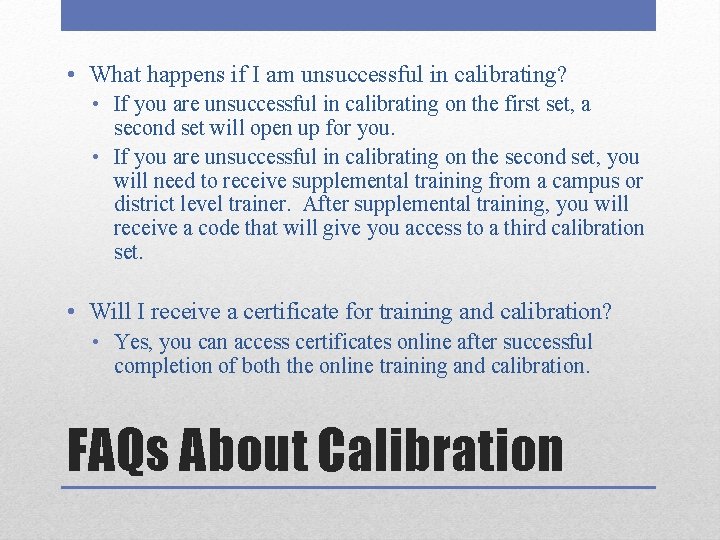
• What happens if I am unsuccessful in calibrating? • If you are unsuccessful in calibrating on the first set, a second set will open up for you. • If you are unsuccessful in calibrating on the second set, you will need to receive supplemental training from a campus or district level trainer. After supplemental training, you will receive a code that will give you access to a third calibration set. • Will I receive a certificate for training and calibration? • Yes, you can access certificates online after successful completion of both the online training and calibration. FAQs About Calibration
Module 2 TELPAS Fall Foundational Awareness Training (2013) ELPS/TELPAS CONNECTION
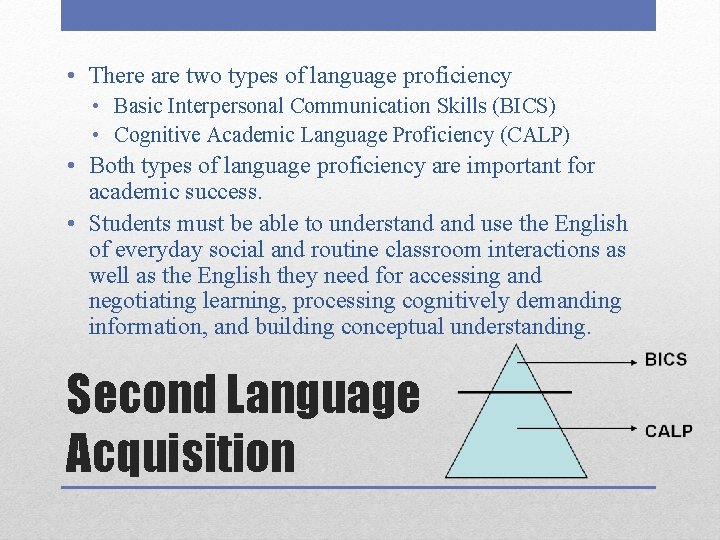
• There are two types of language proficiency • Basic Interpersonal Communication Skills (BICS) • Cognitive Academic Language Proficiency (CALP) • Both types of language proficiency are important for academic success. • Students must be able to understand use the English of everyday social and routine classroom interactions as well as the English they need for accessing and negotiating learning, processing cognitively demanding information, and building conceptual understanding. Second Language Acquisition
• BICS are the everyday language needed for social interactions. • BICS are usually acquired more quickly than CALP and are easy to observe. • Examples of BICS: • Listening and Speaking – routine classroom interactions, communication with peers in the hallway, at recess, or at lunch. • Reading and Writing – notes to/from a friend, emails, announcements, lists, text messages. BICS
• CALP is the language needed to access learning in academic settings. • CALP is needed to think critically, understand learn new concepts, and interact in academic contexts. • CALP has more depth and takes a longer period of time to develop. • Examples of CALP: • Listening and Speaking – Participating in class discussions, listening to presentations, presenting results of science experiments. • Reading and Writing – Reading a book or article, writing an essay. CALP
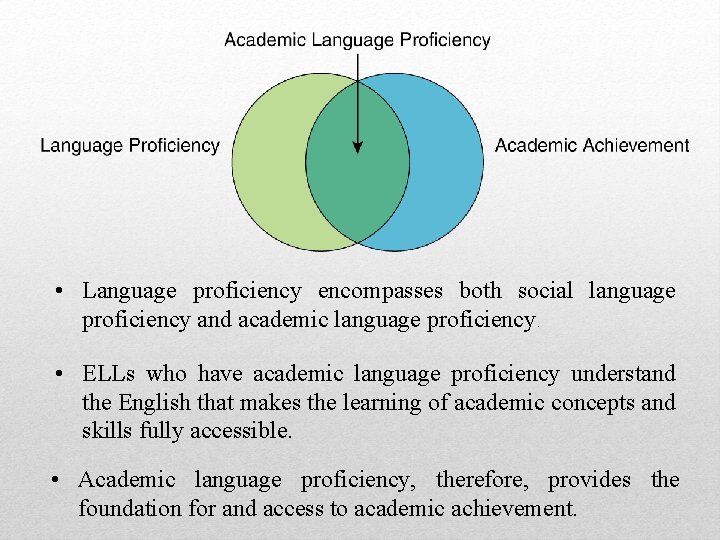
• Language proficiency encompasses both social language proficiency and academic language proficiency. • ELLs who have academic language proficiency understand the English that makes the learning of academic concepts and skills fully accessible. • Academic language proficiency, therefore, provides the foundation for and access to academic achievement.
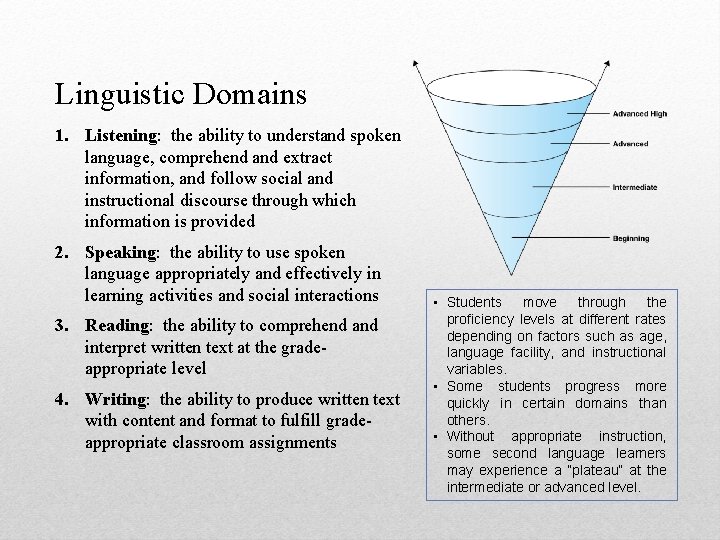
Linguistic Domains 1. Listening: the ability to understand spoken language, comprehend and extract information, and follow social and instructional discourse through which information is provided 2. Speaking: the ability to use spoken language appropriately and effectively in learning activities and social interactions 3. Reading: the ability to comprehend and interpret written text at the gradeappropriate level 4. Writing: the ability to produce written text with content and format to fulfill gradeappropriate classroom assignments • Students move through the proficiency levels at different rates depending on factors such as age, language facility, and instructional variables. • Some students progress more quickly in certain domains than others. • Without appropriate instruction, some second language learners may experience a “plateau” at the intermediate or advanced level.
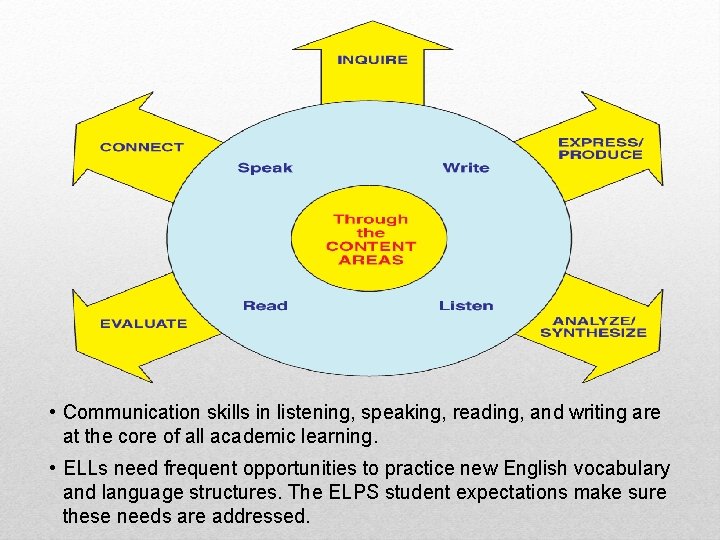
• Communication skills in listening, speaking, reading, and writing are at the core of all academic learning. • ELLs need frequent opportunities to practice new English vocabulary and language structures. The ELPS student expectations make sure these needs are addressed.
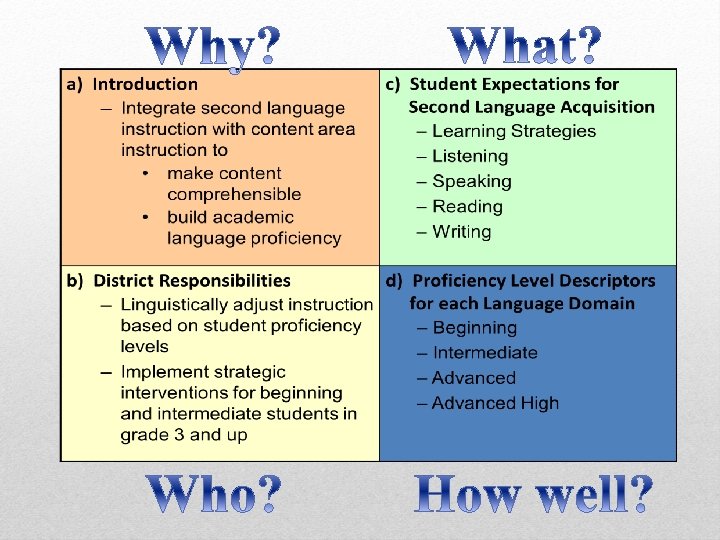
• ELPS include language instruction that teachers must provide to give ELLs an opportunity to learn English and succeed academically. • The ELPS add to content area TEKS and help ELLs become English proficient. • The ELPS framework includes information about language acquisition, district responsibilities, student expectations, and proficiency level descriptors which are aligned to TELPAS. Overview of the ELPS
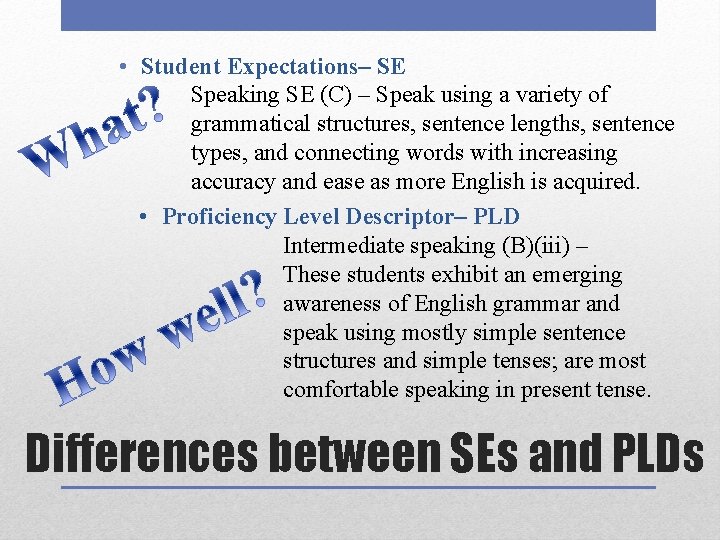
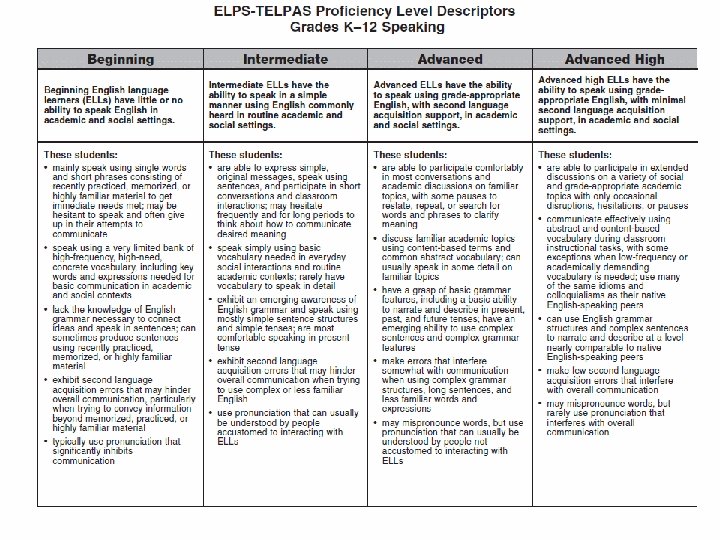
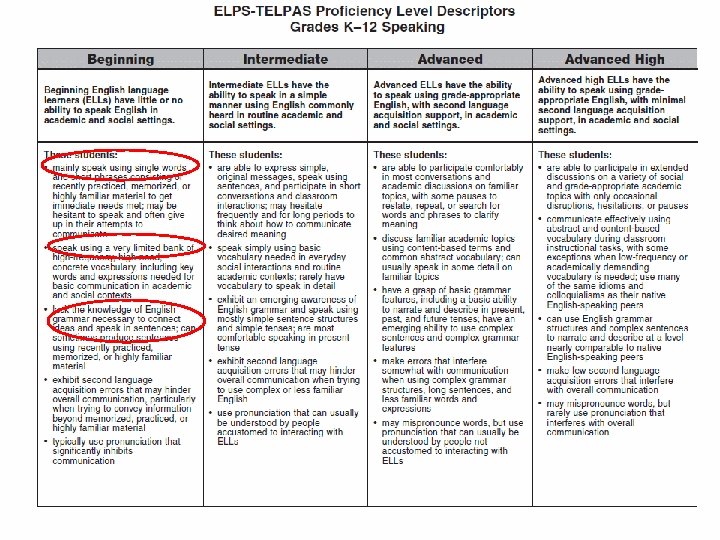
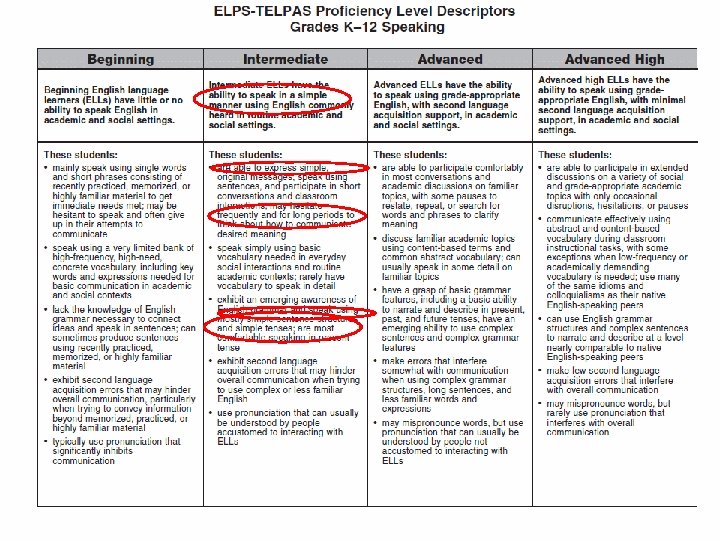
• Student Expectations– SE Speaking SE (C) – Speak using a variety of grammatical structures, sentence lengths, sentence types, and connecting words with increasing accuracy and ease as more English is acquired. • Proficiency Level Descriptor– PLD Intermediate speaking (B)(iii) – These students exhibit an emerging awareness of English grammar and speak using mostly simple sentence structures and simple tenses; are most comfortable speaking in present tense. Differences between SEs and PLDs
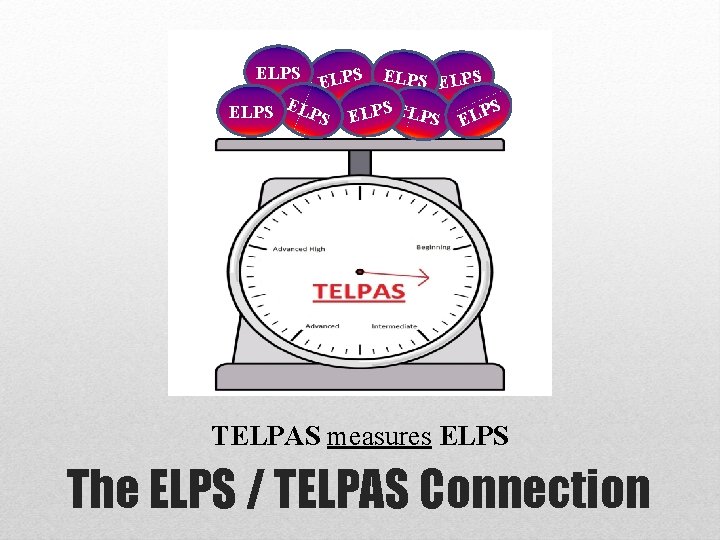
ELPS S ELPS ELP EL ELPS PS TELPAS measures ELPS The ELPS / TELPAS Connection
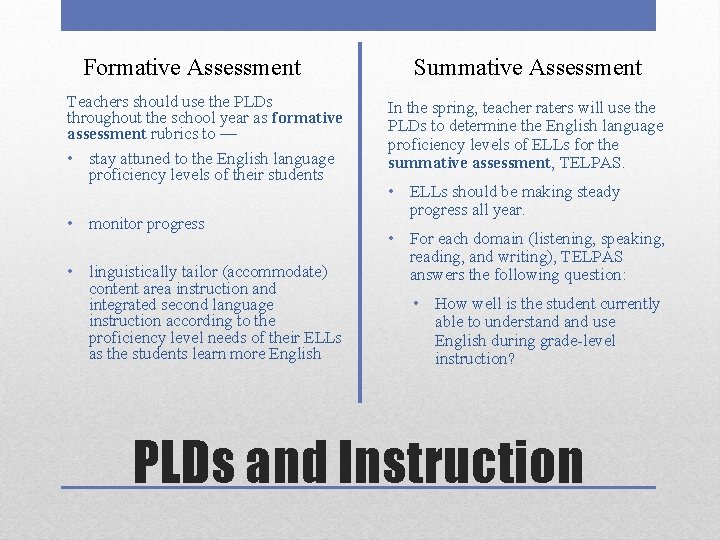
Formative Assessment Teachers should use the PLDs throughout the school year as formative assessment rubrics to — • stay attuned to the English language proficiency levels of their students • monitor progress • linguistically tailor (accommodate) content area instruction and integrated second language instruction according to the proficiency level needs of their ELLs as the students learn more English Summative Assessment In the spring, teacher raters will use the PLDs to determine the English language proficiency levels of ELLs for the summative assessment, TELPAS. • ELLs should be making steady progress all year. • For each domain (listening, speaking, reading, and writing), TELPAS answers the following question: • How well is the student currently able to understand use English during grade-level instruction? PLDs and Instruction
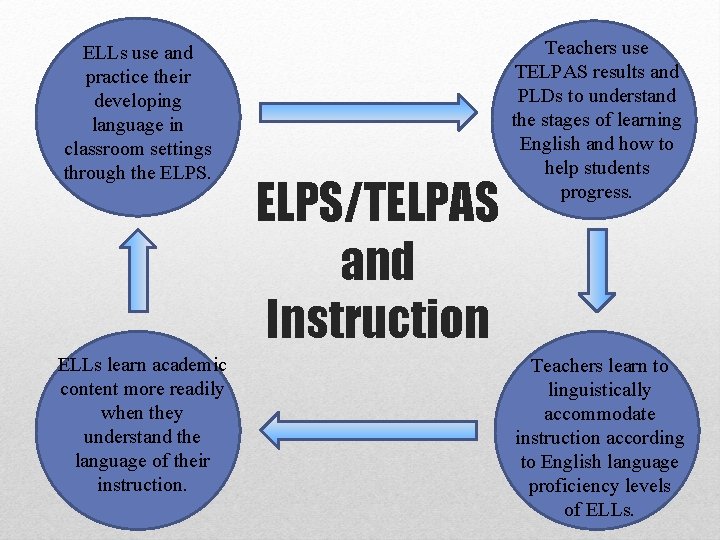
ELLs use and practice their developing language in classroom settings through the ELPS. ELLs learn academic content more readily when they understand the language of their instruction. ELPS/TELPAS and Instruction Teachers use TELPAS results and PLDs to understand the stages of learning English and how to help students progress. Teachers learn to linguistically accommodate instruction according to English language proficiency levels of ELLs.
Effective implementation of ELPS and TELPAS assessment approach throughout the school year helps ELLs • learn English more quickly • grasp academic concepts and skills more readily To Summarize
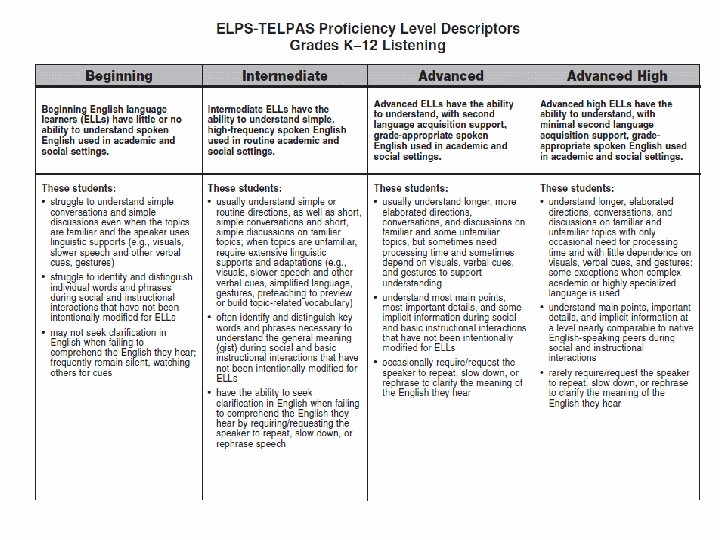
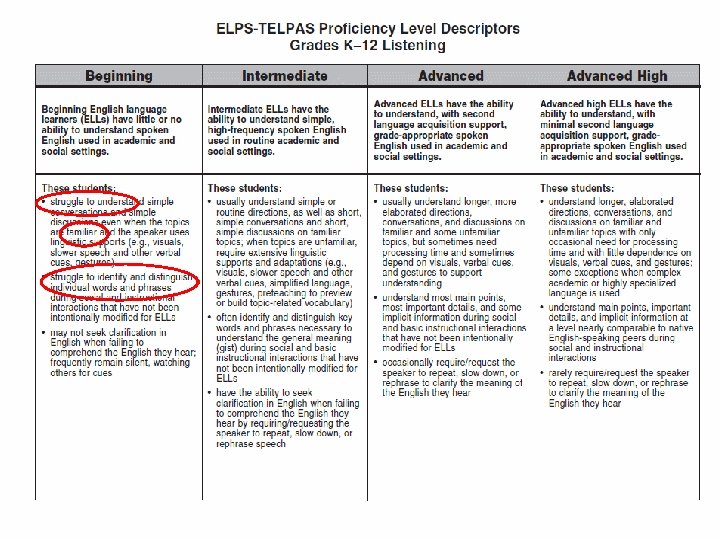
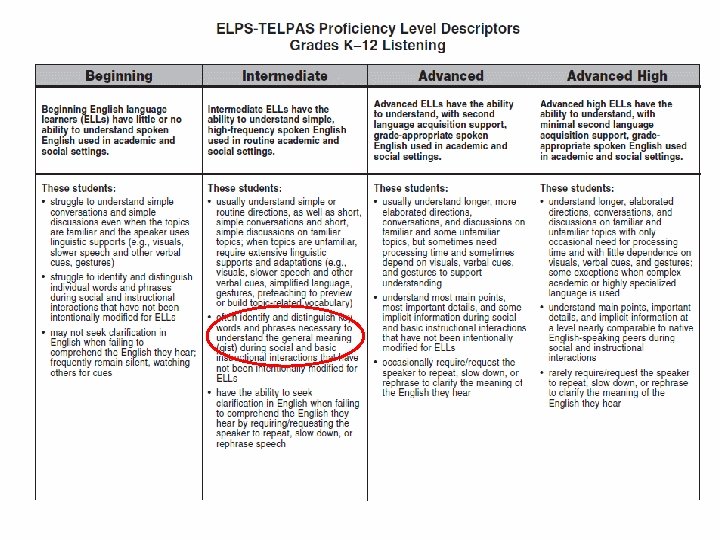
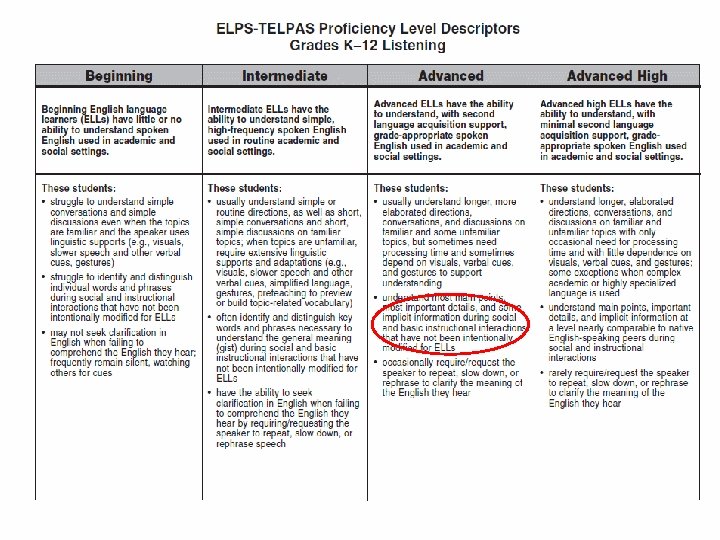
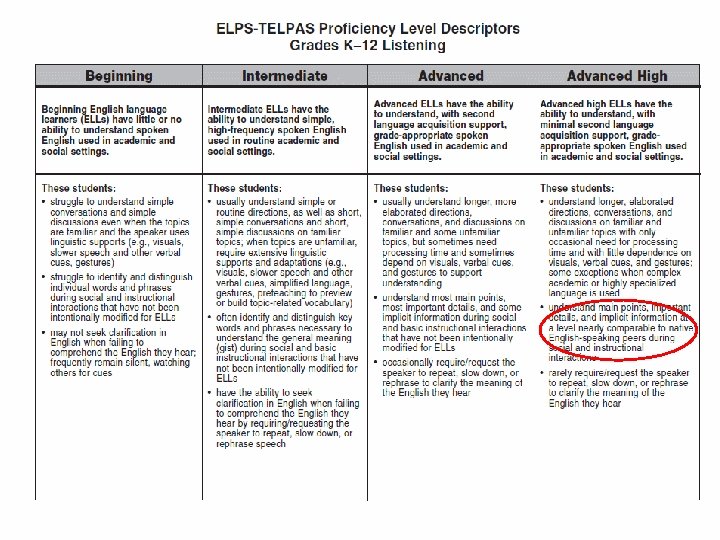
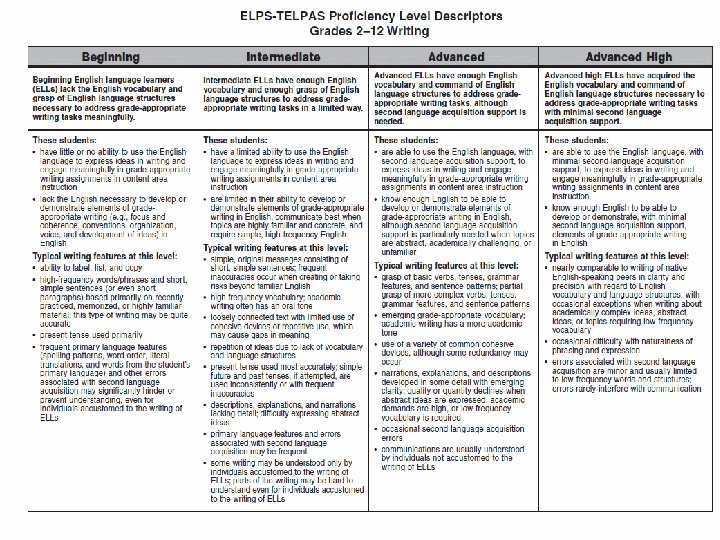
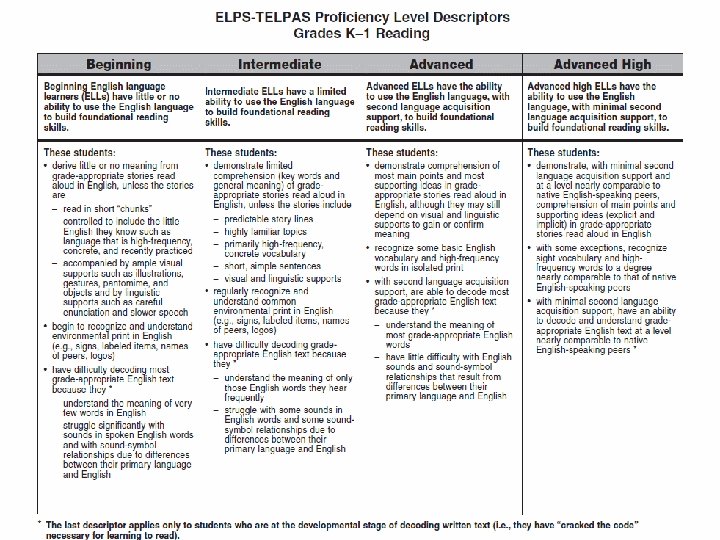
• The PLDs are the rubrics teachers use to determine students’ English language proficiency for ongoing formative assessment and the spring TELPAS administration. • There are six sets of PLDs. Listening Speaking PLDs for Grades K-12 Reading Writing PLDs for Grades K-1 PLDs for Grades 2 -12 Proficiency Level Descriptors
• Beginning • Little or no English ability • Intermediate • Limited ability, simple language structures, high-frequency vocabulary, routine contexts • Advanced • Grade appropriate, with second language acquisition support • Advanced High • Grade appropriate, with minimal second language acquisition support Key Features of Proficiency Levels
• Raters should reflect on how well the student understands the English he/she hears during activities such as: • • Reacting to oral presentations Responding to text read aloud Following directions Cooperative group work Informal interactions with peers Large-group and small-group instructional interactions One-on-one interviews Individual student conferences Listening
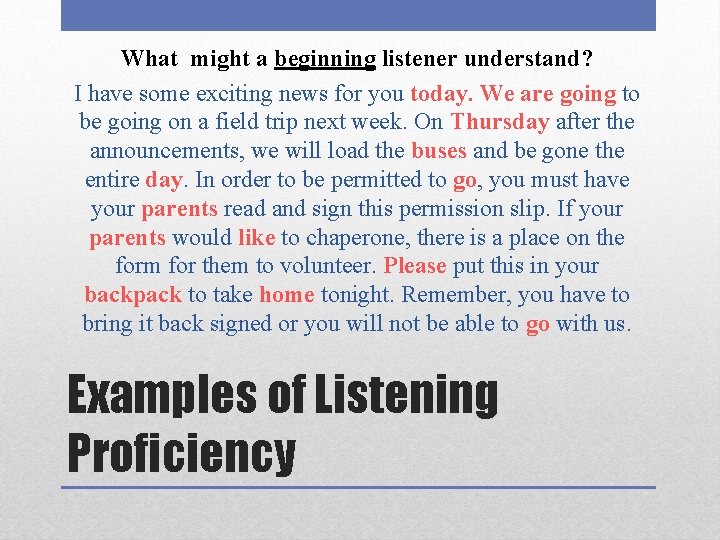
What might a beginning listener understand? I have some exciting news for you today. We are going to be going on a field trip next week. On Thursday after the announcements, we will load the buses and be gone the entire day. In order to be permitted to go, you must have your parents read and sign this permission slip. If your parents would like to chaperone, there is a place on the form for them to volunteer. Please put this in your backpack to take home tonight. Remember, you have to bring it back signed or you will not be able to go with us. Examples of Listening Proficiency
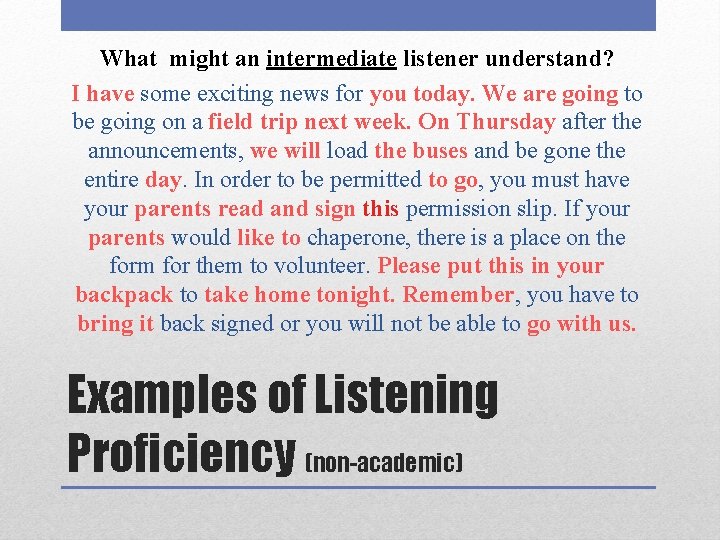
What might an intermediate listener understand? I have some exciting news for you today. We are going to be going on a field trip next week. On Thursday after the announcements, we will load the buses and be gone the entire day. In order to be permitted to go, you must have your parents read and sign this permission slip. If your parents would like to chaperone, there is a place on the form for them to volunteer. Please put this in your backpack to take home tonight. Remember, you have to bring it back signed or you will not be able to go with us. Examples of Listening Proficiency (non-academic)
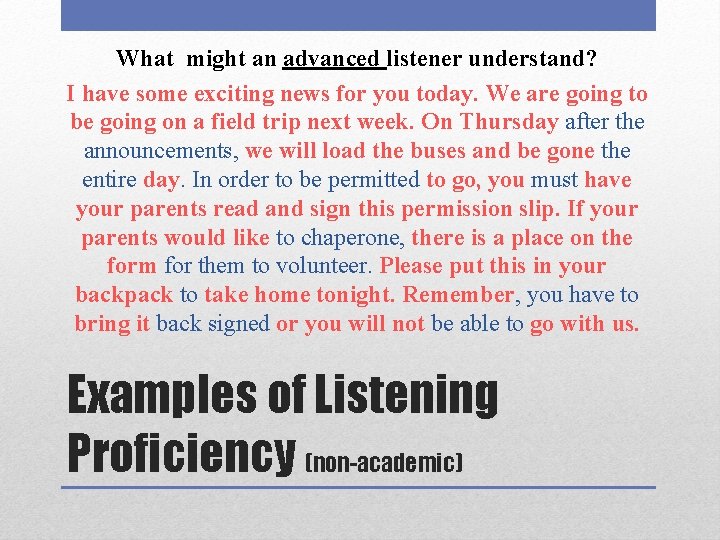
What might an advanced listener understand? I have some exciting news for you today. We are going to be going on a field trip next week. On Thursday after the announcements, we will load the buses and be gone the entire day. In order to be permitted to go, you must have your parents read and sign this permission slip. If your parents would like to chaperone, there is a place on the form for them to volunteer. Please put this in your backpack to take home tonight. Remember, you have to bring it back signed or you will not be able to go with us. Examples of Listening Proficiency (non-academic)
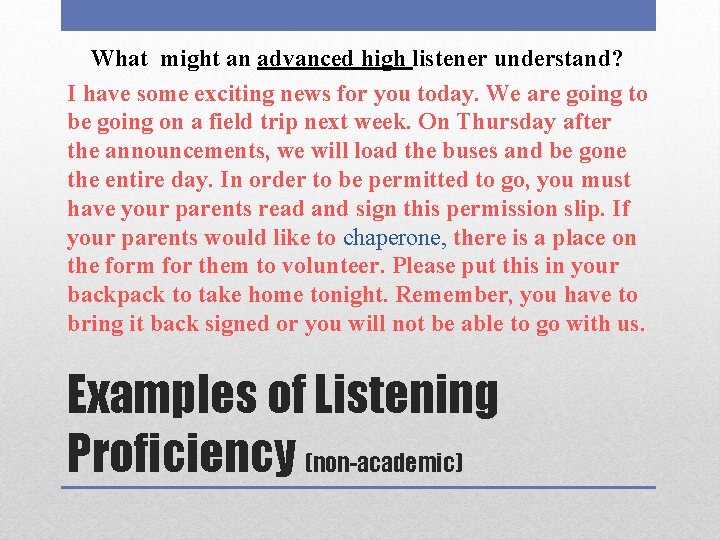
What might an advanced high listener understand? I have some exciting news for you today. We are going to be going on a field trip next week. On Thursday after the announcements, we will load the buses and be gone the entire day. In order to be permitted to go, you must have your parents read and sign this permission slip. If your parents would like to chaperone, there is a place on the form for them to volunteer. Please put this in your backpack to take home tonight. Remember, you have to bring it back signed or you will not be able to go with us. Examples of Listening Proficiency (non-academic)
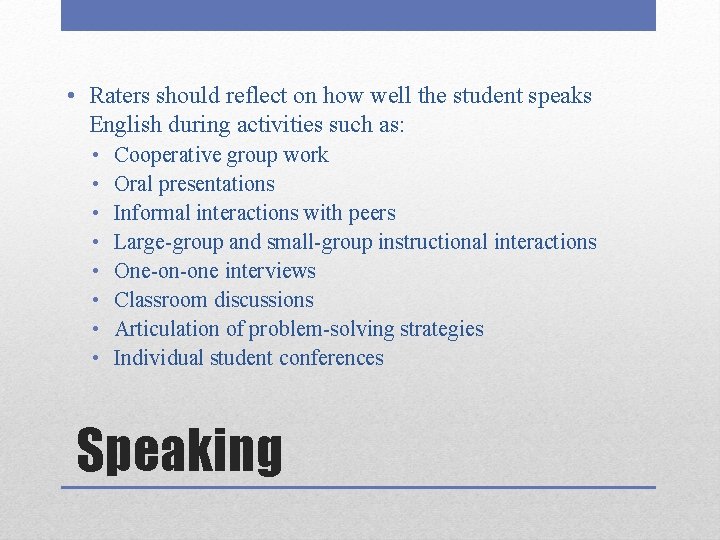
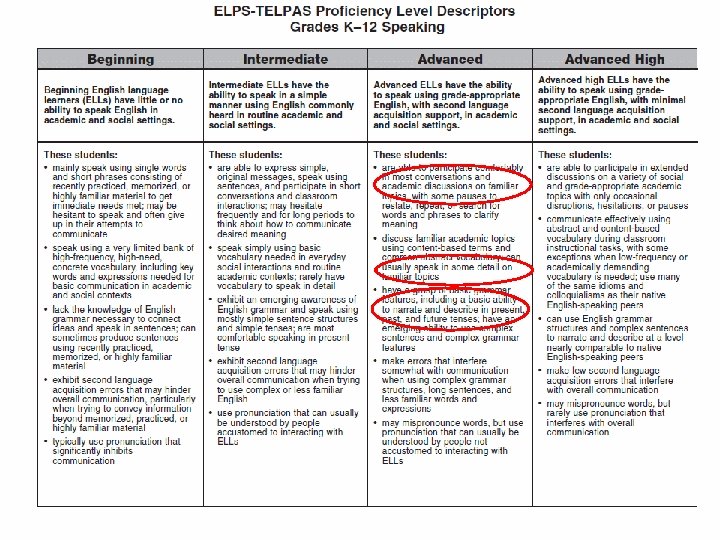
• Raters should reflect on how well the student speaks English during activities such as: • • Cooperative group work Oral presentations Informal interactions with peers Large-group and small-group instructional interactions One-on-one interviews Classroom discussions Articulation of problem-solving strategies Individual student conferences Speaking
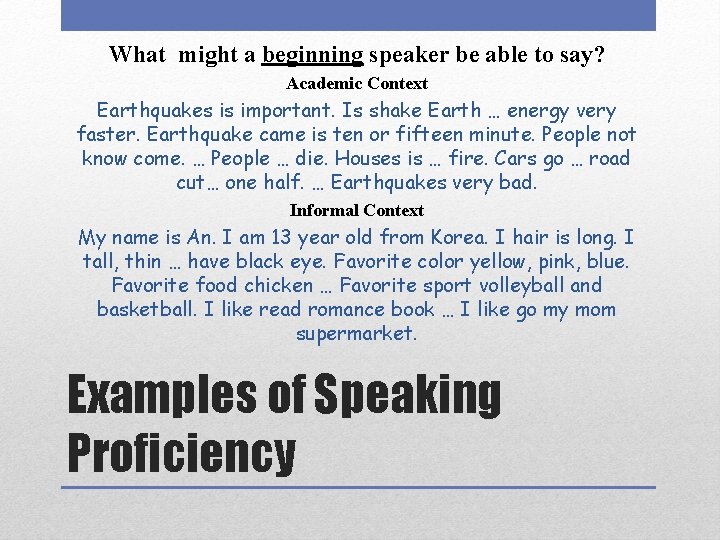
What might a beginning speaker be able to say? Academic Context Earthquakes is important. Is shake Earth … energy very faster. Earthquake came is ten or fifteen minute. People not know come. … People … die. Houses is … fire. Cars go … road cut… one half. … Earthquakes very bad. Informal Context My name is An. I am 13 year old from Korea. I hair is long. I tall, thin … have black eye. Favorite color yellow, pink, blue. Favorite food chicken … Favorite sport volleyball and basketball. I like read romance book … I like go my mom supermarket. Examples of Speaking Proficiency
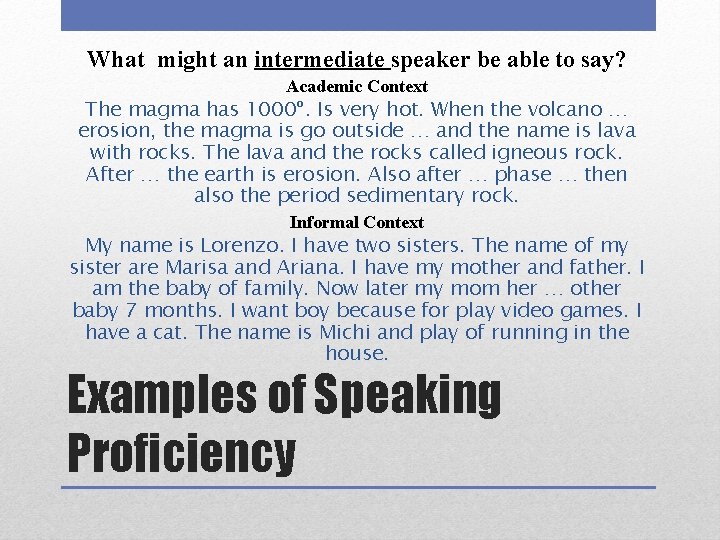
What might an intermediate speaker be able to say? Academic Context The magma has 1000º. Is very hot. When the volcano … erosion, the magma is go outside … and the name is lava with rocks. The lava and the rocks called igneous rock. After … the earth is erosion. Also after … phase … then also the period sedimentary rock. Informal Context My name is Lorenzo. I have two sisters. The name of my sister are Marisa and Ariana. I have my mother and father. I am the baby of family. Now later my mom her … other baby 7 months. I want boy because for play video games. I have a cat. The name is Michi and play of running in the house. Examples of Speaking Proficiency
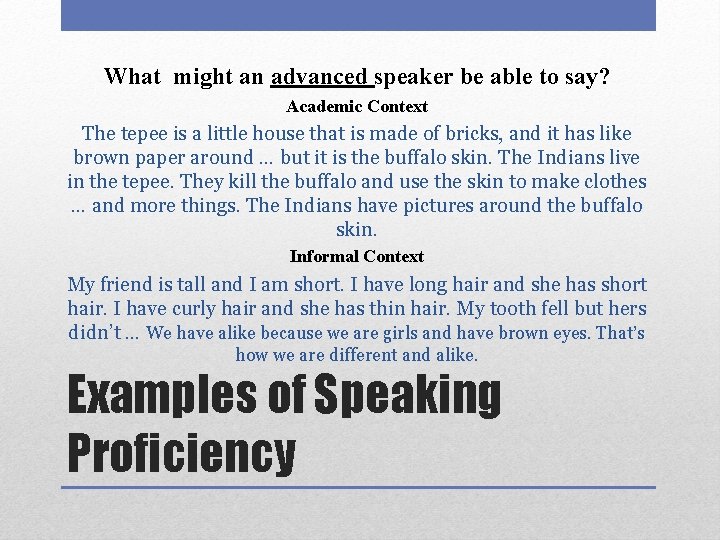
What might an advanced speaker be able to say? Academic Context The tepee is a little house that is made of bricks, and it has like brown paper around … but it is the buffalo skin. The Indians live in the tepee. They kill the buffalo and use the skin to make clothes … and more things. The Indians have pictures around the buffalo skin. Informal Context My friend is tall and I am short. I have long hair and she has short hair. I have curly hair and she has thin hair. My tooth fell but hers didn’t … We have alike because we are girls and have brown eyes. That’s how we are different and alike. Examples of Speaking Proficiency
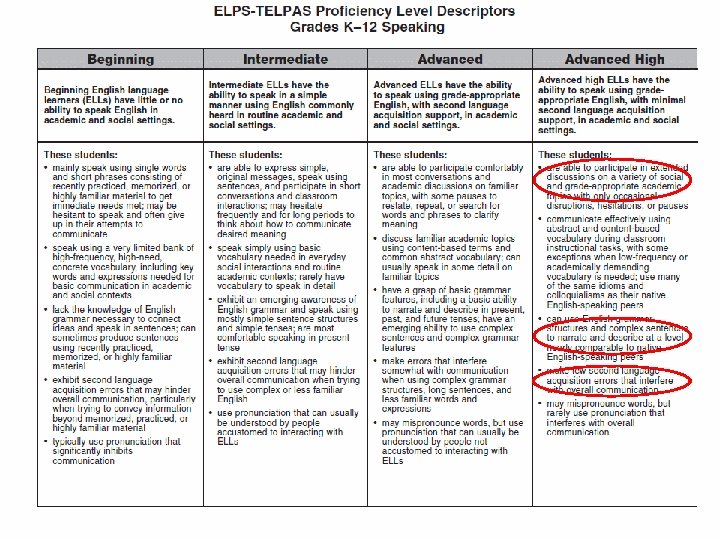
What might an advanced high speaker be able to say? Academic Context Most male dinosaurs mostly ate other dinosaurs to feed the female dinosaurs. I learned that their babies didn’t have to learn how to walk. This is a difference of other baby animals. Most flying dinosaurs got food in the water and ate only fish. They dive down in the water and then went back up. Most female dinosaurs picked some leaves to keep them warm over the night. Informal Context Well, at our school we have a lot of rules. Most rules are not fair. For example, people run to the lunch line because it gets full really fast. Some people come out of the restroom with their shirts tucked out, and if a teacher sees you, you have to do jump squads. Examples of Speaking Proficiency
• Raters should reflect on how well the student writes in English during activities such as: • Grades 2 -12 • Journal writing for personal reflections • Shared writing for literacy and content area development • First drafts • Grades K-1 • Language experience dictation • Organization of thoughts and ideas through prewriting strategies • Labeling pictures, objects, and items from projects • Making lists for specific purposes Writing
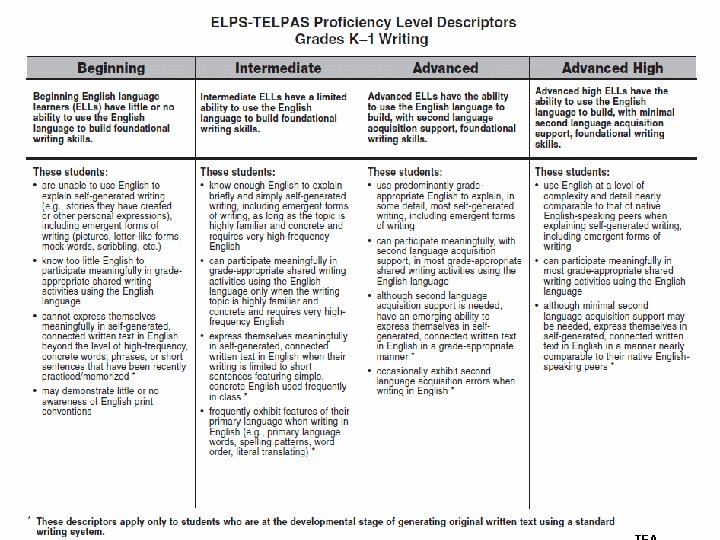
ELPS-TELPAS Proficiency Level Descriptors Grades K– 1 Writing
• Remember that the writing ratings of students in grades 2– 12 are based on collections of their writing from a variety of content areas. • TELPAS does not measure whether students have attained a particular level of academic writing achievement. • Do not attempt to equate the advanced high level of English language proficiency with a particular STAAR written composition score or with passing the STAAR writing/ELA test. Writing
• Reflect on how well the K-1 student understands the English used during activities such as: • Paired reading • Sing-alongs and read-alongs, including chants and poems • Shared reading with big books, charts, overhead transparencies, other displays • Guided reading with leveled readers • Reading subject-area texts and related materials • Independent reading • Cooperative group work • Reading response journals Reading
• For all language domains, remember to read each proficiency level as a whole to determine the proficiency level at which the student performs most consistently. • For students near the border between two levels, determine the level at which the student performs most consistently overall. • To do this, step back and read both proficiency levels from top to bottom, making sure to go back and review the summary statement for each level. Students Between Levels
Module 3 TELPAS Fall Foundational Awareness Training (2013) WRITING COLLECTIONS
• Writing is assessed by using writing collections and referencing writing PLDs. • Raters assemble a collection of each student’s writing from a variety of content areas during a specified window of time. • Raters base the English writing proficiency ratings on the contents of the collections. • Additional classroom observations are not used. • Collections portray the students’ overall English language writing proficiency • TELPAS writing samples should be taken from authentic classroom activities grounded in • content area TEKS • ELPS Writing Collections 2 -12
• At least 5 total samples are required in each collection. • In each collection there must be - at least 1 narrative about a past event - at least 2 writing samples from math, science, or social studies Writing Collection Requirements
• Descriptive writing on a familiar topic • Writing about a familiar process • Narrative writing about a past event • Personal narratives and reflective pieces • Expository and other extended writing from language arts classes • Expository or procedural writing from science, math, and social studies classes Eligible types of Writing
• Papers containing copied language • Papers in which student relies heavily on resources (dictionary, thesaurus, etc. ) • Papers showing teacher comments and corrections • Worksheets and question-answer assignments • Papers that have been polished with help from peers or teachers • Papers written primarily in student’s native language • Papers that are brief, incomplete, or rushed Ineligible types of Writing
• Collections should contain some papers in which students showcase English they know and feel comfortable using. • Collections should also include papers in which students are stretched and pushed beyond their comfort zone. • If a student is near the border between two proficiency levels, consider including samples written in the latter part of the TELPAS assessment window. • Consider students’ English-language proficiency levels in determining whether papers are too brief to be included. Notes about Collections
• Before raters rate writing collection, campuses will follow procedures outlined in the TELPAS test administration manual to ensure that the writing collections are assembled correctly and include the necessary number and types of writing. • Raters will also participate in online “assembling and verifying” training in addition to online basic training (for new raters) and calibration (for all raters). Collection Verification
- Slides: 73