
Humans Effect On The Norwegian Environment By Emilie
Humans Effect On The Norwegian Environment By Emilie Andersen
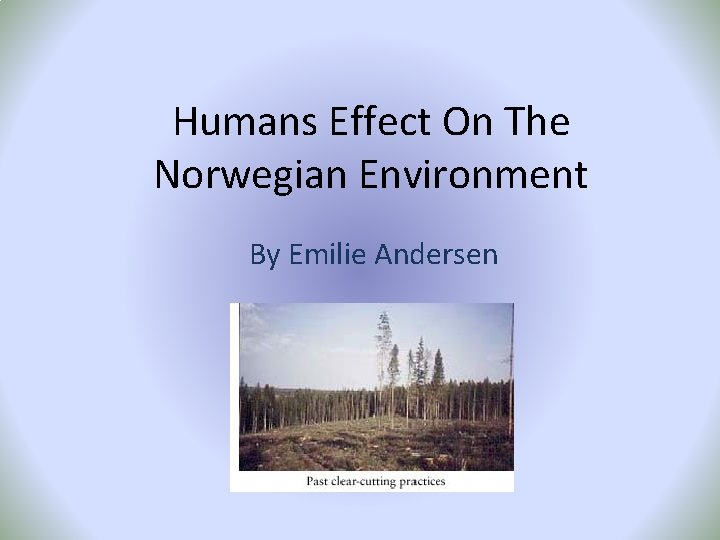
What Do Humans Do To Affect The Scandinavian Forests? • Up until the end of the last century humans in Scandinavia have thought that our forests has been a never-ending resource for timber, fuel wood, houses, etc. . Trees were cut down freely without any form for limit, and most people relied on natural re-growing of the trees. In addition to that, lots of forest area was to be used as fields and grazing areas. But finally, when tree resources were running short the politicians and foresters realized that they had to do something. About 100 years ago the countries of Scandinavia finally put a limit on how many trees were allowed to be cut down, and also made it an obligation to people owning wood areas to plant new trees in place of the ones just cut down. Since then the forest resources have doubled!
What Do Humans Use The Forests For? • • • Fuel Construction material Boats Paper Resources Energy
Facts About The World Forests • Forests contain the largest amount of the worlds threatened species. • About 2400 of the Norwegian species are threatened. Half of these are connected to forests. • 1. 6 billion people in the world are depending on forests for their livelihood. • Since 1950 half of the worlds natural forests have disappeared. That is half of our forests on less than a generation!
The Year Of The Forest http: //www. wwf. no/ • More than 30% of the Earth is covered by forests. FN (United Nations in English) has chosen 2011 to be marked as The Year Of The Forest, and chooses to put their focus on the forests’ enormous role and importance for life on Earth. But since 1950 half of the natural forests in the world have disappeared!
The Year Of The Forest • As many as 80% of all land animals and plants live in the forests. The forests give us food, fuel, construction materials, and medicine, and they help keep balance in the atmosphere, clean the air, help the water cycle, and take in huge amounts of CO 2 through photo synthesis.
Fairytale forests disappear • On a world basis deforestation today covers about the same area as Switzerland Austria together. Most of these forests are used to produce fresh wares for the Western part of the world. In Norway’s forests deforestation has led to big changes too. Today there is a long distance between each untouched fairytale forest in Norway, and this development has also led to many species of animals. The Norwegian red list shows that almost half of the endangered species here are connected to forests, especially old forests.
Forests and Politics • In Norway WWF (World Wide Fund for Nature) proposed to norwegian politicians to give protection to important forests, but still, today Norway only has around 2 percent of their forests protected and they have no goal for the future.
WWF’s requirements for the Norwegian government • 1. Protect more forests and make an action plan that focuses on the scientists recommendations. • 2. Get different kinds of plants and trees to represent norwegian forests. South-Norway is especially underrepresented. • 3. Increase funding forest protection over the state budget. The price for increased forest protection to researchers' minimum recommendation for the short-term (4. 6 percent), is 3 -4 billion kroner. The government budget for 2012 must contain at least 800 million kroner for the protection of forests. Current funding is far from such a commitment. More forests are also in line for protection, but will not be known as protected areas due to lack of funding.
WWF’s requirements for the Norwegian government • 4. Get rid of or change subsidies given to building roads in forests, operation in steep terrain, etc. These are actions that destroy biologically important areas that before has been left untouched because of non-profitable operations. • 5. Support the development of a national FSC standard. Forest Stewardship Council (FSC) is the most credible international certification scheme forestry. Sweden, Finland Denmark have national FSC standards, while Norway lags far behind.
WWF’s requirements for the Norwegian government • 6. Support measures prioritizing species and habitats selected by the Nature Conservation Act - also in the forest. The evaluation of nature conservation in Norway concludes that the lower-lying forest areas in southern Norway are little represented. The new flexible instruments become even more important to help preserve threatened areas that aren’t protected yet. • 7. Ensure strict regulation of spreading strange species through the regulation on the deployment of foreign trees. There is little professional disagreement about how strange species can pose a major threat to native species in Norway. Permission for the planting of foreign species in Norway will lead to negative impacts on the natural diversity. Norway needs a strict regulatory framework, in line with the Act's intentions biodiversity and international obligations.
WWF’s requirements for the Norwegian government • 8. The upcoming climate- and agriculture message must be seen in context. The government has stressed that the climate policy should be balanced against biodiversity. Mitigation that has positive effects on climate and protection of biodiversity should be prioritized. If the agriculture is going to be a part of the climate solution, action in Klimakur, as well as planting new forests and increasing the use of bioenergy, must be considered carefully in relation to positive and negative effects for biodiversity.
Agriculture and Forests • Trees are a renewable resource that produce energy, materials and industrial materials in an environmentally friendly way. At the same time forestry activity can be a threat to biodiversity. Bellona, for example, is trying to raise the use of trees without harming the rest of the forests and plants.
A Historical Review • When the ice melted in Norway between 9, 000 to 11, 000 years ago and revealed all the seeds that had been stored in the soil under the ice, many plant communities were formed that later developed into ecosystems. The warmest period after the last ice-age was when all the glaciers were completely melted away. The glaciers have been a major part of forming the Norwegian landscape and nature, as well as with climatic, biological, and geological processes. …
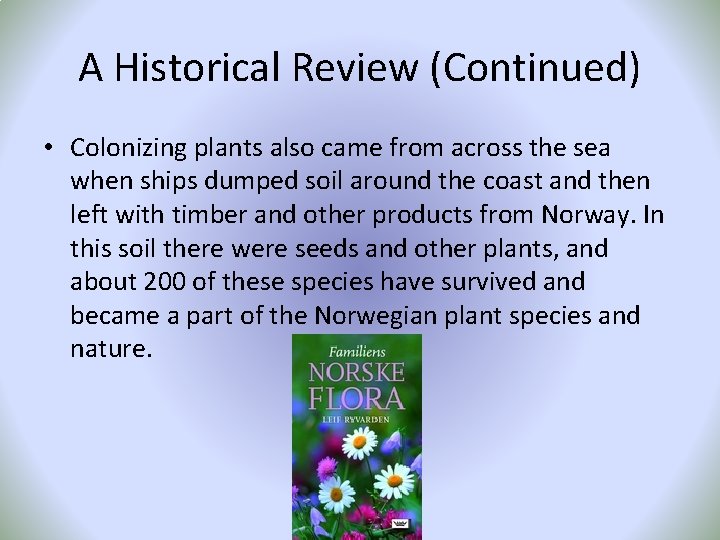
A Historical Review (Continued) • Colonizing plants also came from across the sea when ships dumped soil around the coast and then left with timber and other products from Norway. In this soil there were seeds and other plants, and about 200 of these species have survived and became a part of the Norwegian plant species and nature.
Changes in Vegetation Patterns • More rain and milder winters are moving the tree line both upwards and downwards, and a few lichen species that play an important part for the reindeers’ winter food are slowly replaced by vascular plants. New research show that these kinds of climate changes can significantly lessen the reindeer population and their reproduction cycle, because the females prepare themselves for a hard winter by building up fat instead of getting ready to bring up a calf. Reindeers are important for the meat production up in the north, as well as they are of strong, cultural, meaning.
Changes in Vegetation Patterns (Continued) • Many of Norway’s large predators have reindeer on their menu, but so far it is not an endangered species. But lemmings are also important in the tundra, and they affect the whole ecosystem, from vegetation to predators. When the winter conditions are like they should be, their tunnels under the snow are vitally important for them. Here they can live the whole winter thanks to protection from weather and predators, as well as access to food. Changes in the climate will almost definitely affect these creatures something that will affect the rest of the ecosystem too. Really good “lemming years” haven’t been observed since 1994, and we do know from research that mountain foxes, snowy owls and many other tundra-predators completely stop breeding in the years when there are few lemmings.
Climate Change’s Effect on Humans • With warmer climate the circumstances are perfect for both farming and human settlements. An increase of industrial agriculture will be necessary to be able to keep up with the population growth, but this can also lead to more diseases and pests, which then again can make us use more chemicals against insects and weeds. From before, we already know that flying taxon (a group of one or more organisms) like insects and birds are very important bio indicators and risk analyzers because they easily spread. In certain ecosystems that already exist bats fill the roles of pollinating birds and insects, as well as being fruit eating mammals when it comes to seed- and pollen spreading.
The Effect on Humans (Followed) • Can you imagine future ecosystems where animals like bats spreads to the far north and push away the local populations of insect eating birds? Such considerations can at best be discussed, as previous studies show that bats in far greater numbers are better at accumulating contaminants than birds. Contaminants like DDT connect with fat, and can during the winter lead to fatal poisoning as bats, as well as many other mammals deplete the fat reserves gathered up. So even though the climate is perfect for increased human population, an increase in environmental substances will cause decreased bio diversity. The trends are already evident in the polar regions, where the largest predators accumulate toxins in living tissue, and where toxic concentrations increase up the food chain.
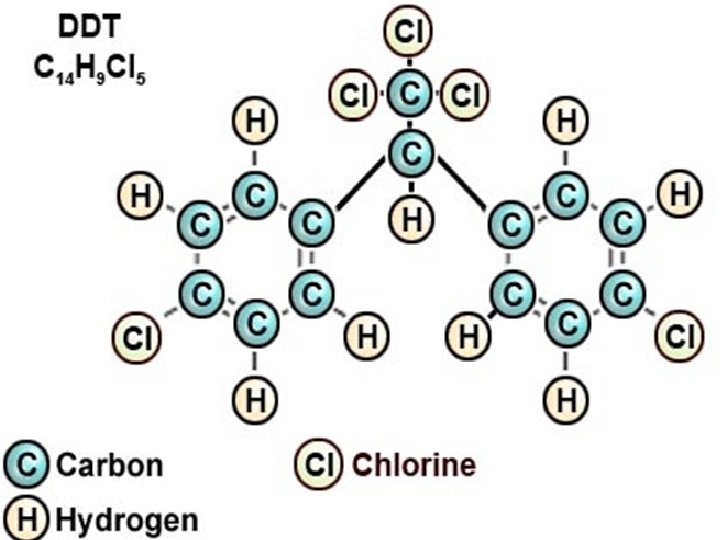
What is DDT? • Why DDT was Used • DDT (dichlor-diphenyl-trichlorethylene C 14 H 9 Cl 5) was a pesticide used on crops to kill mosquitoes worldwide. At the time people were afraid of getting malaria from mosquitoes. People thought DDT did not hurt any animals because it did not effect humans, but they were wrong.
What is DDT? The Effects of DDT was affecting many animals other than mosquitoes, such as: Bats, Fireflies, Sperrys, Brown pelicans, and the peregrine falcon. The birds ate the insects, small birds and fish that contained DDT. Calcium Carbonate is an essential chemical in egg shells. When mother birds ate the animals exposed to DDT, it concentrated or accumulated in her body and caused her eggs to be formed with a very thin shell. Also, since their shells were too thin the eggs got over heated when incubated or the egg shells would crack before the chicks were fully developed.
The Banning of DDT Bird watchers and scientists found a decrease in nests and got suspicious. Scientists discovered DDE which is the remaining chemical after DDT breaks down. As soon as it could be scientifically proven that DDT was harmful, it was banned. Rachel Carson's book Silent Spring helped make people want to ban DDT.
- Slides: 23