
Humans and Water Humans and Water Objectives Explain
Humans and Water
Humans and Water Objectives: Explain why fresh water in one of Earth’s limited resources. Describe the relationship between groundwater and surface water in a watershed. Identify how water is used in homes, industry, and agriculture. Describe water management practices. Identify ways that water can be conserved. Compare point source pollution and non-point source pollution. Explain groundwater pollution. Explain eutrophication
Humans and Water Important Vocabulary: • • Surface water Watershed Groundwater Aquifer Recharge zone Irrigation Canals Dams • • Desalination Point Source Pollution Non-point Source Pollution Runoff Eutrophication Thermal Pollution Wastewater
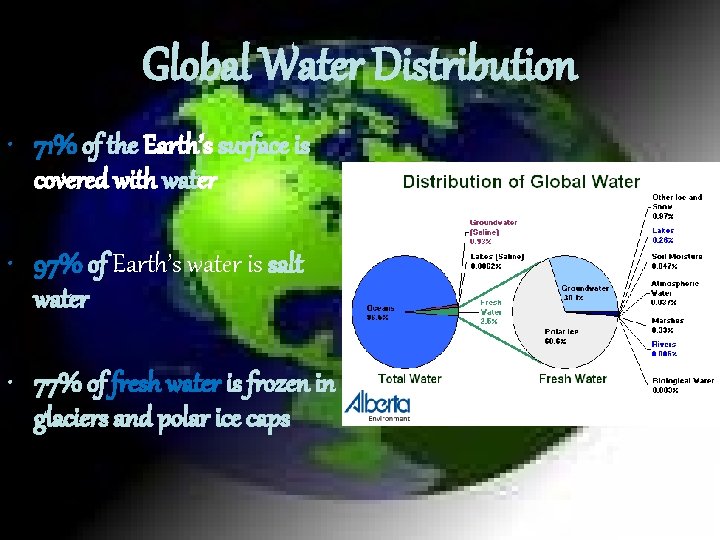
Global Water Distribution • 71% of the Earth’s surface is covered with water • 97% of Earth’s water is salt water • 77% of fresh water is frozen in glaciers and polar ice caps
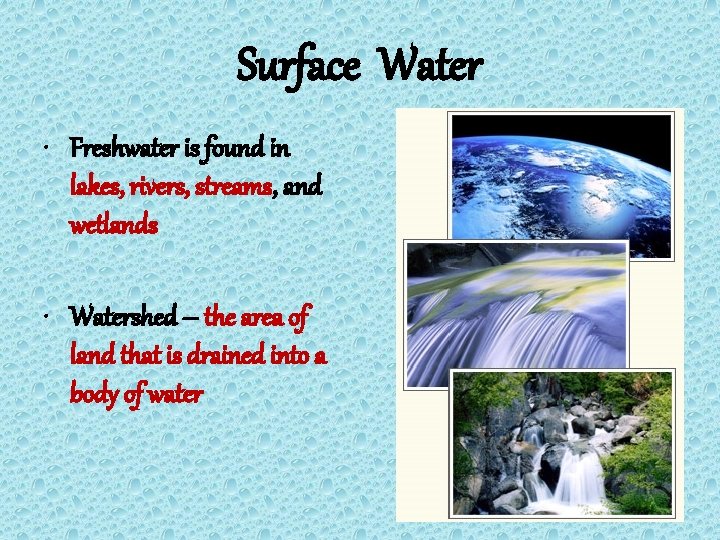
Surface Water • Freshwater is found in lakes, rivers, streams, and wetlands • Watershed – the area of land that is drained into a body of water
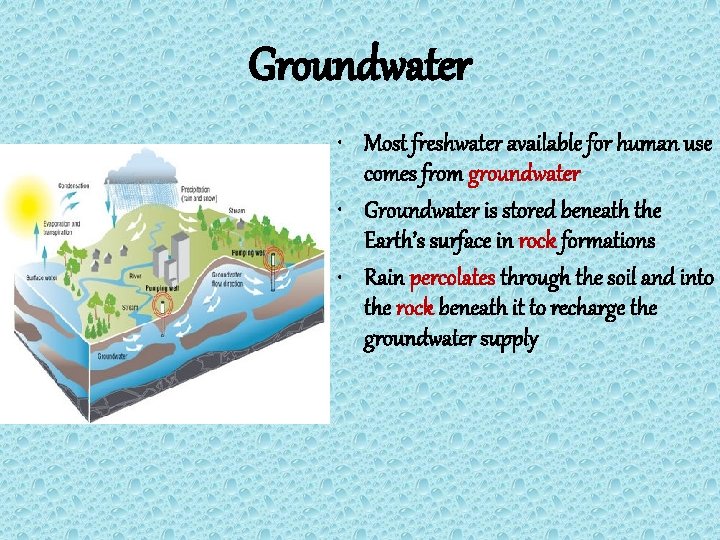
Groundwater • Most freshwater available for human use comes from groundwater • Groundwater is stored beneath the Earth’s surface in rock formations • Rain percolates through the soil and into the rock beneath it to recharge the groundwater supply
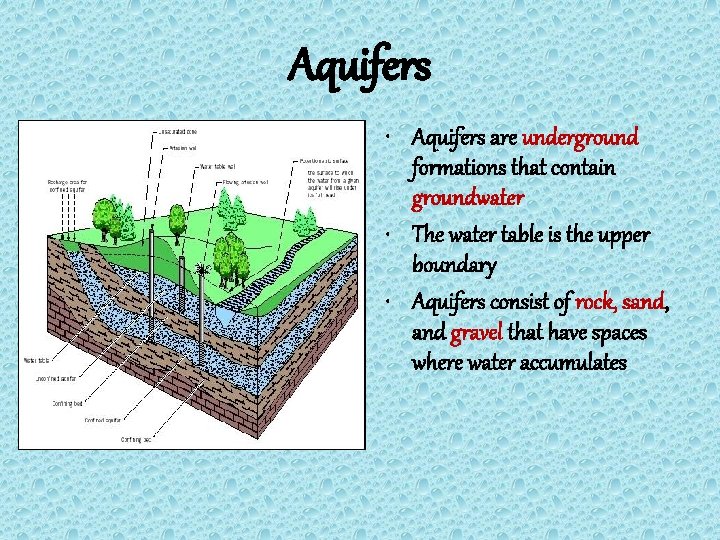
Aquifers • Aquifers are underground formations that contain groundwater • The water table is the upper boundary • Aquifers consist of rock, sand, and gravel that have spaces where water accumulates
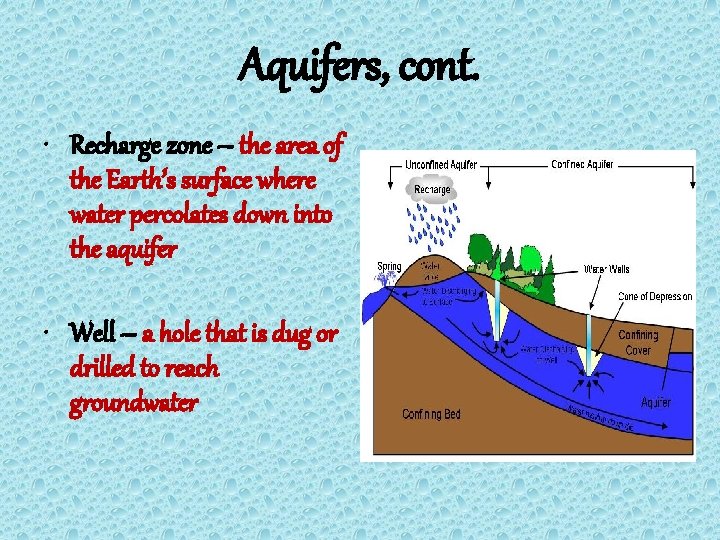
Aquifers, cont. • Recharge zone – the area of the Earth’s surface where water percolates down into the aquifer • Well – a hole that is dug or drilled to reach groundwater
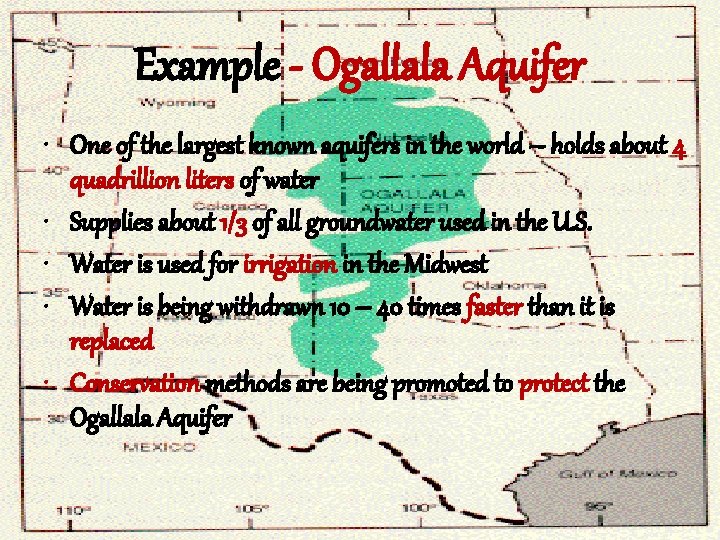
Example - Ogallala Aquifer • One of the largest known aquifers in the world – holds about 4 quadrillion liters of water • Supplies about 1/3 of all groundwater used in the U. S. • Water is used for irrigation in the Midwest • Water is being withdrawn 10 – 40 times faster than it is replaced • Conservation methods are being promoted to protect the Ogallala Aquifer
REMEMBER THIS!!! • Only 3% of the world’s water is freshwater! • Most freshwater for human use comes from groundwater! • In some areas, water from aquifers is being withdrawn faster than it is being replaced!
Questions? ? ? Question 1: What is the main source of water for human use? Question 2: The area of land drained by a river is known as a ________. Question 3: What is the largest known aquifer in the U. S. ?
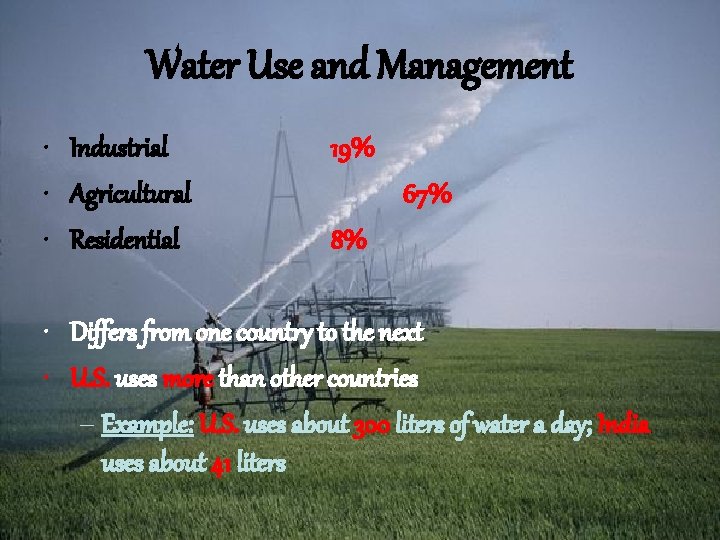
Water Use and Management • Industrial • Agricultural • Residential 19% 67% 8% • Differs from one country to the next • U. S. uses more than other countries – Example: U. S. uses about 300 liters of water a day; India uses about 41 liters
Industrial Use • Used to: – Manufacture goods – Dispose of waste – Generate power/cool power plants Example: Calvert Cliffs Nuclear Power Plant pumps water from the Bay, carries the water through pipes to use during energy production before it is sent to a cooling tower, and then pumps it back into the Bay
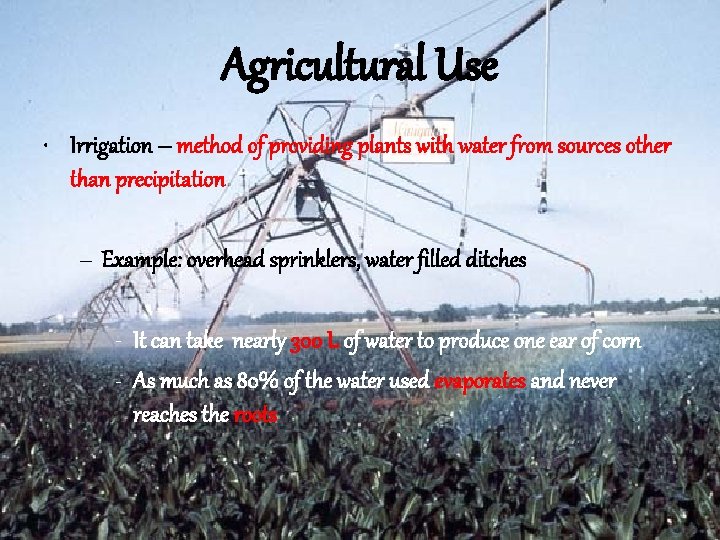
Agricultural Use • Irrigation – method of providing plants with water from sources other than precipitation – Example: overhead sprinklers, water filled ditches - It can take nearly 300 L of water to produce one ear of corn - As much as 80% of the water used evaporates and never reaches the roots
REMEMBER THIS!!! • The U. S. uses much more water than many other countries! • Agriculture uses the most water! • It takes hundreds of gallons to produce food because crops must be irrigated!
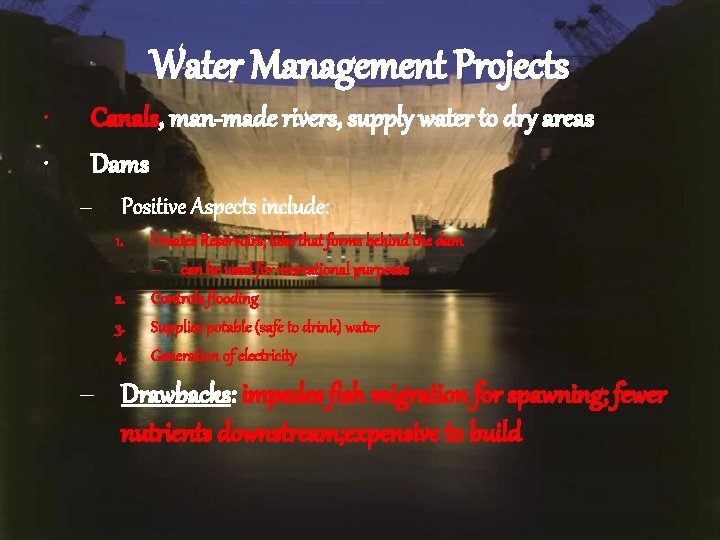
Water Management Projects • • Canals, man-made rivers, supply water to dry areas Dams – Positive Aspects include: 1. 2. 3. 4. Creates Reservoirs; lake that forms behind the dam – can be used for recreational purposes Controls flooding Supplies potable (safe to drink) water Generation of electricity – Drawbacks: impedes fish migration for spawning; fewer nutrients downstream; expensive to build
Water Conservation • Drip irrigation system – reduces evaporation • Recycling cooling water in power plants • Things you can do to conserve water: – – – Take shorter showers Low-flow shower heads and toilets Turn off water while brushing teeth Wash only full loads of laundry Water lawns late in the day to reduce evaporation
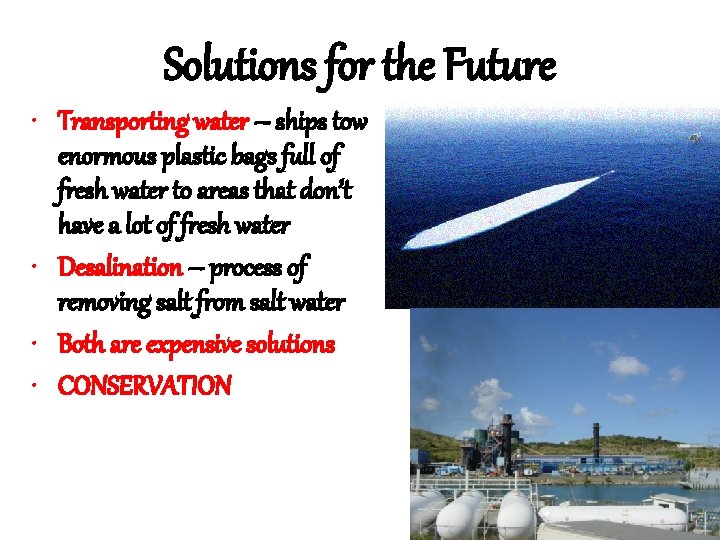
Solutions for the Future • Transporting water – ships tow enormous plastic bags full of fresh water to areas that don’t have a lot of fresh water • Desalination – process of removing salt from salt water • Both are expensive solutions • CONSERVATION
REMEMBER THIS!!! • Dams can be used to create electricity, provide recreation, potable water, and control flooding! • There are many simple things you can do to conserve water! • Water conservation is the best way to ensure that people have enough water in the future!
Questions? ? ? Question 4: What are three major uses of water? Which uses the most water? Question 5: List three benefits of a dam. Question 6: List three ways you can conserve water.
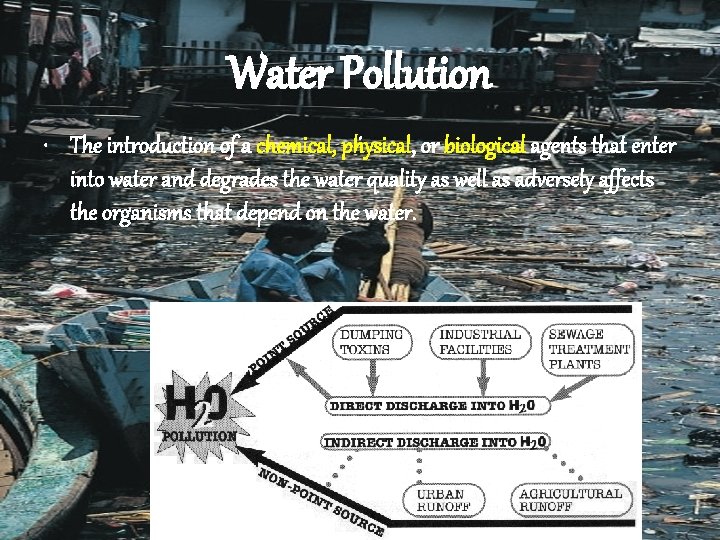
Water Pollution. or biological agents that enter • The introduction of a chemical, physical, into water and degrades the water quality as well as adversely affects the organisms that depend on the water.
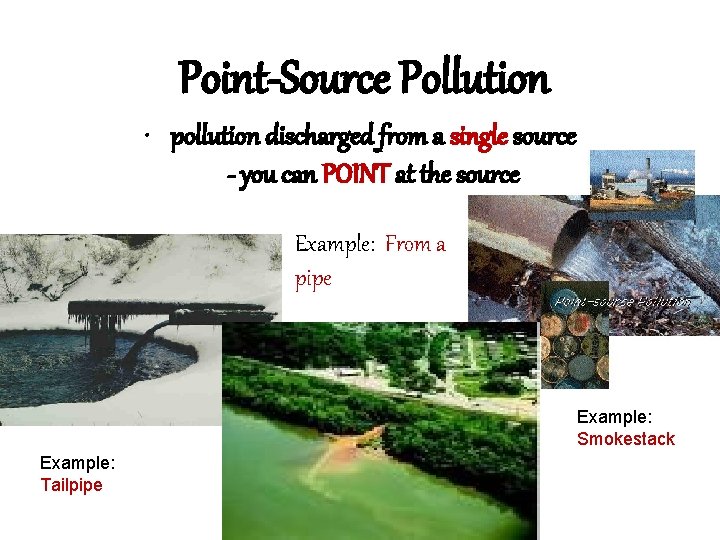
Point-Source Pollution • pollution discharged from a single source - you can POINT at the source Example: From a pipe Example: Smokestack Example: Tailpipe
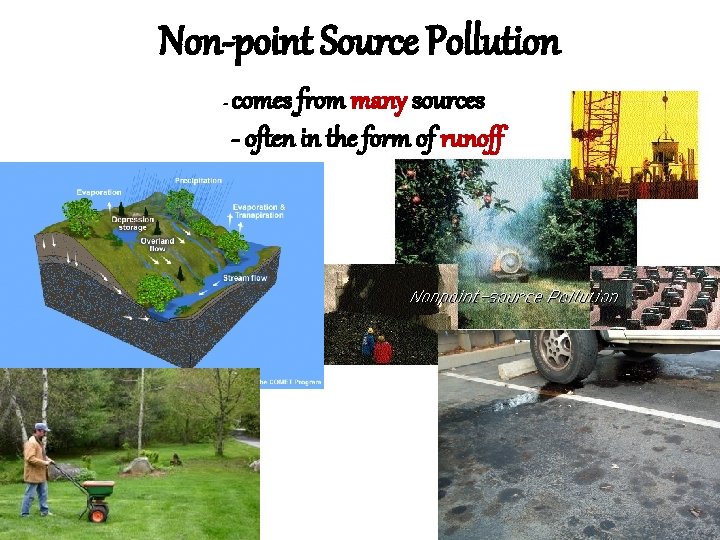
Non-point Source Pollution - comes from many sources - often in the form of runoff
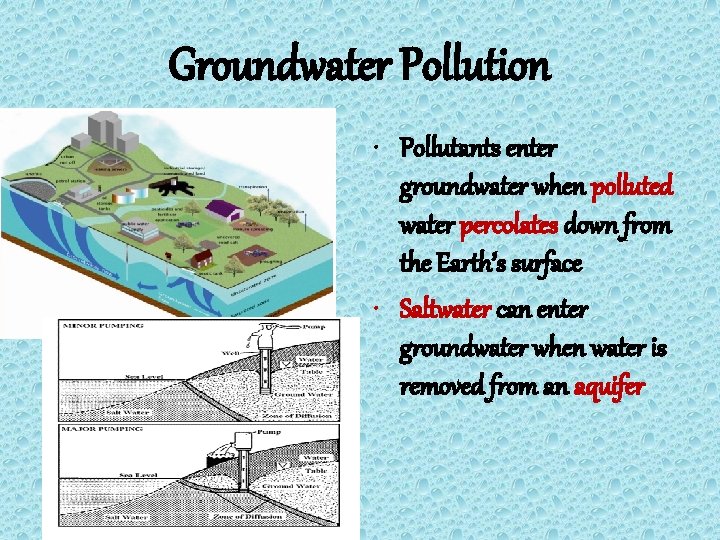
Groundwater Pollution • Pollutants enter groundwater when polluted water percolates down from the Earth’s surface • Saltwater can enter groundwater when water is removed from an aquifer
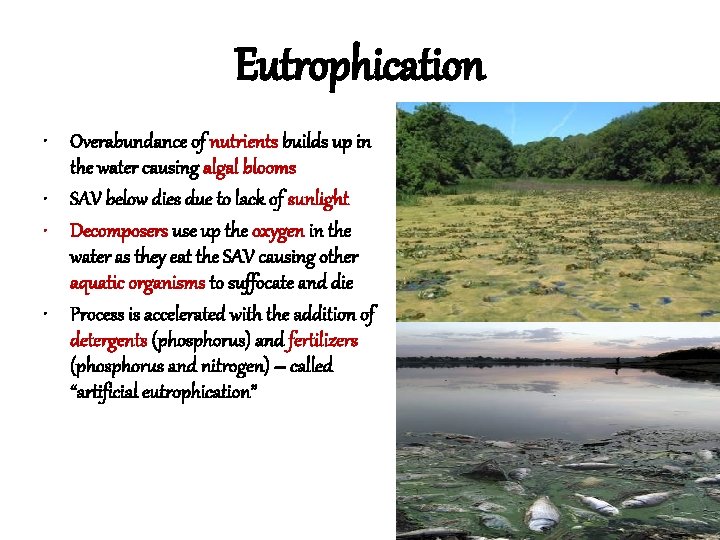
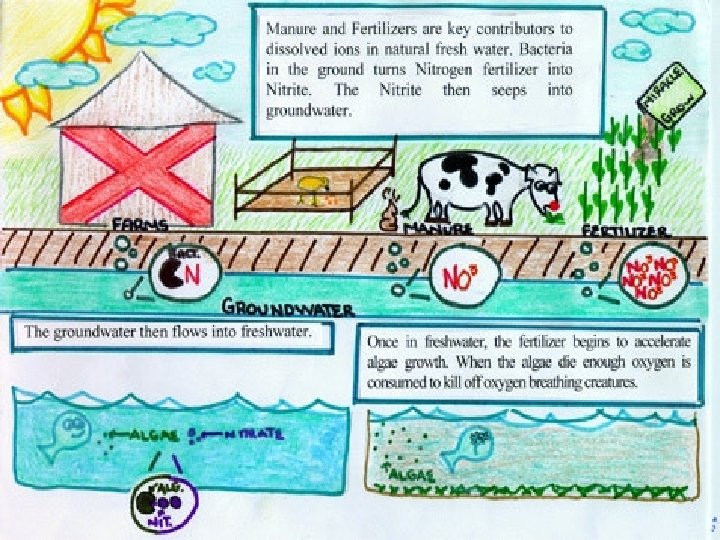
Eutrophication • Overabundance of nutrients builds up in the water causing algal blooms • SAV below dies due to lack of sunlight • Decomposers use up the oxygen in the water as they eat the SAV causing other aquatic organisms to suffocate and die • Process is accelerated with the addition of detergents (phosphorus) and fertilizers (phosphorus and nitrogen) – called “artificial eutrophication”
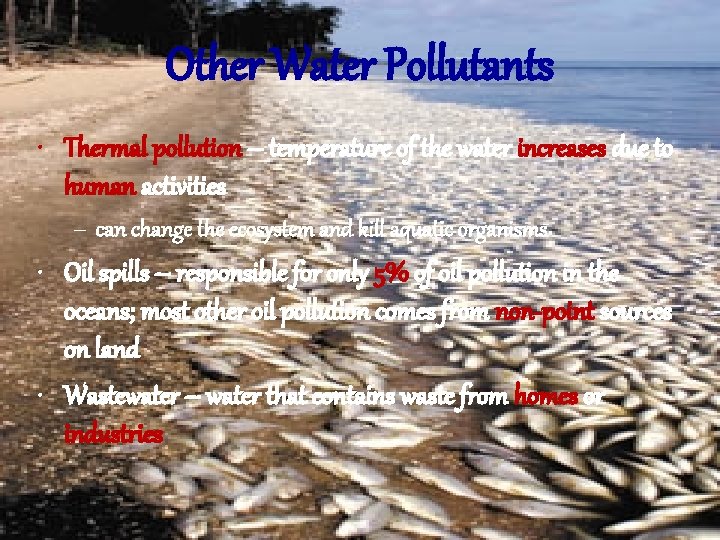
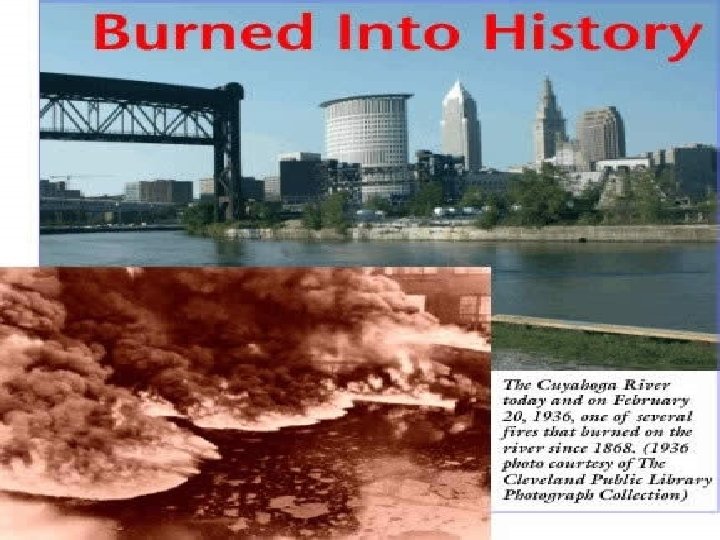
Other Water Pollutants • Thermal pollution – temperature of the water increases due to human activities – can change the ecosystem and kill aquatic organisms • Oil spills – responsible for only 5% of oil pollution in the oceans; most other oil pollution comes from non-point sources on land • Wastewater – water that contains waste from homes or industries
REMEMBER THIS!!! • Point Source pollution comes from a single source! • Non-point Source pollution comes from many sources in the form of runoff. • Saltwater can enter an aquifer from excessive pumping of groundwater! • Eutrophication may cause dead zones that are initiated by excessive nutrients being added to an aquatic ecosystem!
Questions? ? ? Question 7: Describe point source pollution. Question 8: Provide an example of non-point source pollution. Question 9: Artificial eutrophication is caused by excess __________ and ________. Question 10: Where does most oil pollution come from?
THE END!!!
- Slides: 31