
Humans and The Environment Concept Map Section 6
- Slides: 54
Humans and The Environment
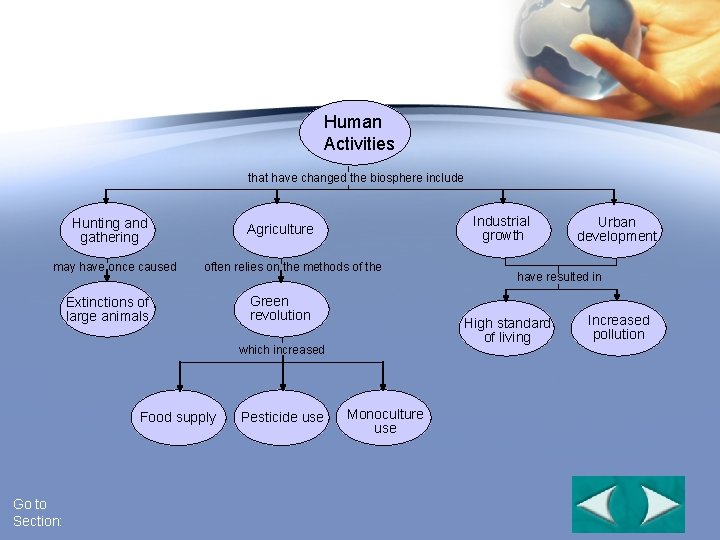
Concept Map Section 6 -1 Human Activities that have changed the biosphere include Hunting and gathering may have once caused Industrial growth Agriculture often relies on the methods of the Extinctions of large animals Green revolution Food supply Go to Section: Pesticide use have resulted in High standard of living which increased Monoculture use Urban development Increased pollution
Interest Grabber Leaving Section 6 -1 a Mark on the World • Have you ever seen very old photographs of the town or city in which you now live? Has your area changed? Perhaps there are more buildings or roads than there were many years ago. Maybe your town or city has more trees and flowers now than it had years ago. Humans, like all organisms, have an effect on their environment. Go to Section:
• • • Earth is a kind of island Limited resources Nature must sustain the resources Human populations is growing The planet is not
• Demands on – – Air Water Land Living things
• We must protect these resources • What human activities do you think have an impact on the earth’s natural resources? – – Hunting and gathering Agriculture Industry Urban development
• Recent study concluded that human activity uses as much energy as all of earth’s other multicellular species combined • Humans are the most influential in changing the environments of the planet
• HUNTING AND GATHERING • Hunting and gathering has been the primary means of human survival for most of human history • Fished, gathered seeds, fruits, and nuts • Lived in small groups
• Early man – Built dams – burned grasslands to encourage growth of certain plants
• Some scientists hypothesize that humans are responsible for the mass extinction of – – – woolly mammoths giant ground sloths sabertooth cats cheetahs zebras yaks
Agriculture • Early humans learned how plants grew, which were edible, and which were good medicines • They began to plant those that were important near their settlements • 11, 000 years ago, humans started farming (Agriculture)
Agriculture • Agriculture spread • With dependable food supply, people started living in larger settlements – towns and cities • Domestication of Animals • Over time, people started keeping herds of domesticated animals
• List 3 reasons people keep animals
Agriculture • Milk, meat, hides, wool, companionship, perform work • Overgrazing changed grasslands ecosystems – eroded soils, large demand on water • Human population grew at an increasing rate.
Green Revolution • By 1950’s food supply was straining • Green Revolution – to increase food supply, governments and scientists introduced new farming techniques to increase yields of crops (rice, wheat, corn) • Relied on new, highly productive strains of crops
Green Revolution • Monoculture – large fields plowed, and planted with a single crop year after year • Irrigation, fertilization, and pesticides were relied on to sustain the crops • Animal and human power was replaced with machine power • Within 20 years, Mexican farmers increased production of wheat 10 times
Green Revolution • Problems have been introduced by the green revolution. Can you name a few? • Depletion of water supplies • Pollution of water by pesticides and fertilizers
Industrial growth and Urban Development • Wastes from manufacturing and energy production have been poured into the air, water, and soil • Tied to high standard of living that we all enjoy
• The question is: How do we control the harmful effects of human activity on the environment?
Tragedy of the Commons • Resource is something that can be used to take care of a need • When an environmental resource is owned by many people, or no one, but no one is responsible for it, it is called a “common resource”.
Tragedy of the Commons • The Tragedy of the Commons – any resource open to everyone will eventually be destroyed because although everyone owns the resource, no one is responsible for it. • Air, Water – shared by many countries, but no one is responsible.
• Whaling – if some countries attempt to protect whales, but others continue to hunt whales to extinction, what will eventually happen?
2 types of resources – Renewable and Nonrenewable • Renewable resources can be regenerated (but not necessarily limitless) – – Sunlight Fresh water A tree Fish
2 types of resources – Renewable and Nonrenewable • Nonrenewable – cannot be replenished by natural resources – Fossil fuels – Coal – Oil
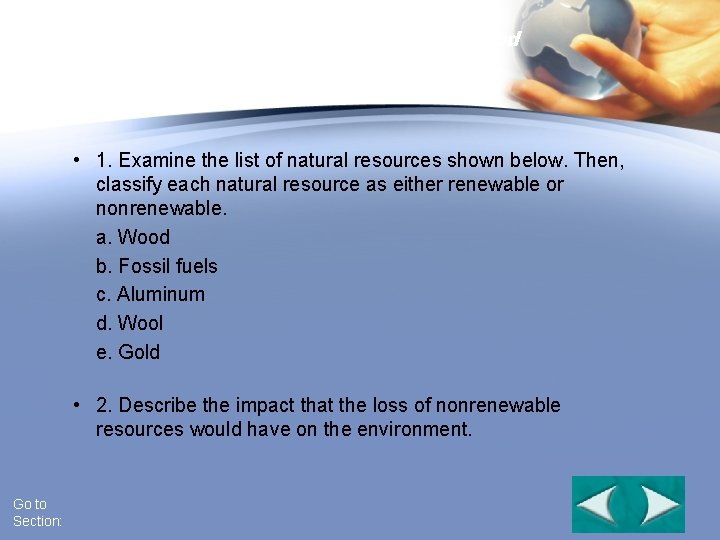
Interest Grabber continued Section 6 -2 • 1. Examine the list of natural resources shown below. Then, classify each natural resource as either renewable or nonrenewable. a. Wood b. Fossil fuels c. Aluminum d. Wool e. Gold • 2. Describe the impact that the loss of nonrenewable resources would have on the environment. Go to Section:
Interest Grabber Section 6 -2 Where Do Natural Resources Come From? • Natural resources are materials that are supplied by nature. A renewable resource is one that is replaceable. A nonrenewable resource is one that cannot be replenished by natural processes. Once a nonrenewable resource is used up, it is gone forever. Go to Section:
Land Resources • Land is a resource • Provides space for living, raw materials for building, and industry • Important for soils crops grow on
Land Resources • Soil is a renewable resource that can be damaged by human activities • Best fertile soil is a mixture of humus, sand, clay, and rock particles
• Most of the humus is in the top layers called “Topsoil” – Absorbs and retains moisture, but allows drainage – Lots of nutrients – Low in salts
• Different plants add and use different amounts of nutrients • Plowing the land removes the roots that prevent erosion • Erosion – the wearing away of the surface soil by water and wind • Combinations of farming, overgrazing, and drought can cause productive areas to become deserts • Process is desertification
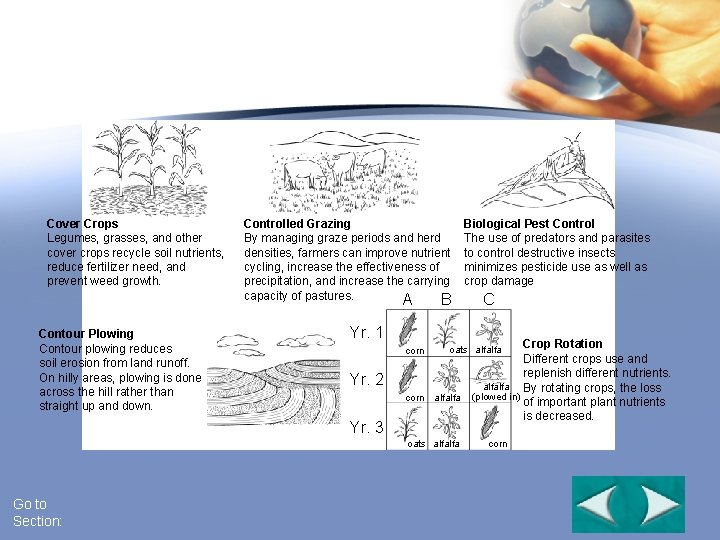
• Practices that can maintain the soil include – Contour plowing – Planting crops that maintain the soil while primary crops are harvested – rye for example – Leaving roots and stems of previous year’s crops
Sustainable Agriculture Section 6 -4 Cover Crops Legumes, grasses, and other cover crops recycle soil nutrients, reduce fertilizer need, and prevent weed growth. Contour Plowing Contour plowing reduces soil erosion from land runoff. On hilly areas, plowing is done across the hill rather than straight up and down. Controlled Grazing By managing graze periods and herd densities, farmers can improve nutrient cycling, increase the effectiveness of precipitation, and increase the carrying capacity of pastures. A B Yr. 1 Yr. 3 oats alfalfa Go to Section: C Crop Rotation Different crops use and replenish different nutrients. alfalfa By rotating crops, the loss corn alfalfa (plowed in) of important plant nutrients is decreased. corn Yr. 2 Biological Pest Control The use of predators and parasites to control destructive insects minimizes pesticide use as well as crop damage corn
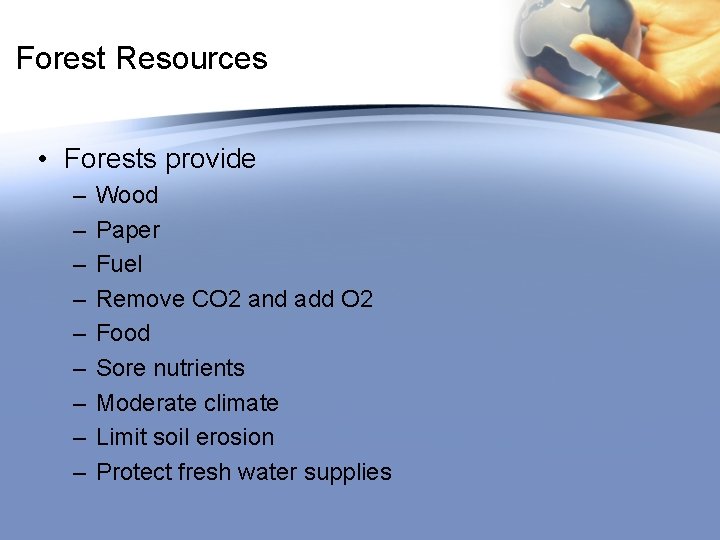
Forest Resources • Forests provide – – – – – Wood Paper Fuel Remove CO 2 and add O 2 Food Sore nutrients Moderate climate Limit soil erosion Protect fresh water supplies
Forest Resources • Deforestation – Loss of forests • Soil erosion – topsoil and nutrients washed away • Grazing and plowing after deforestation can add to problems • Sustainable use strategies • Harvesting mature trees selectively • Plant, manage, harvest, and replant tree farms • Geneticists breeding faster growing varieties
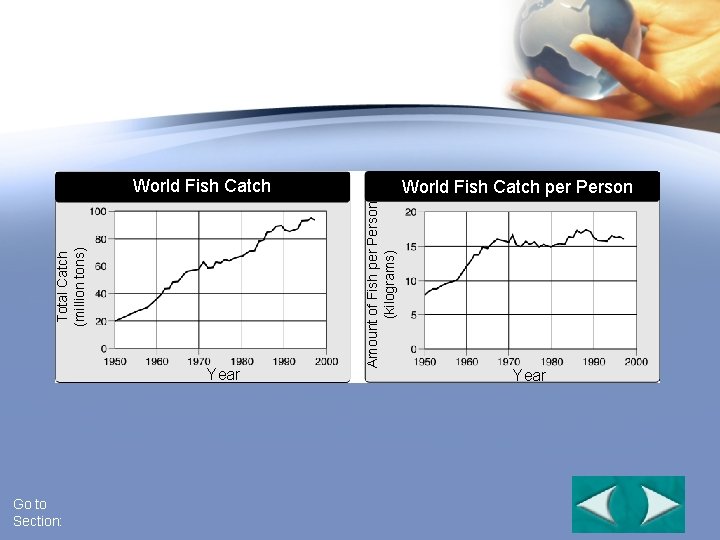
Ocean Resources • Food • Fish catch has risen from 20 million tons/year to over 90 million tons / year • As fish catches rose, fish stocks declined • Overfishing • Techniques to moderate include – Limits – Aquaculture – Temporary closing of areas to fishing
Growth of Fish Catch Section 6 -2 Year Go to Section: World Fish Catch per Person Amount of Fish per Person (kilograms) Total Catch (million tons) World Fish Catch Year
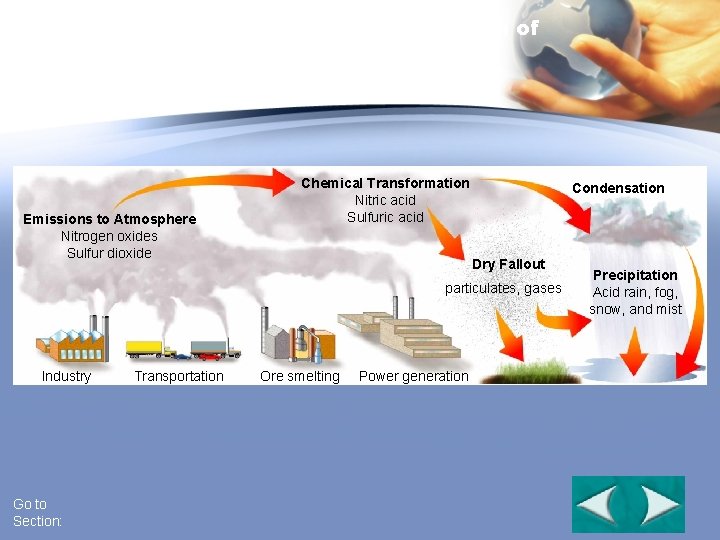
Air Resources • Air is a resource – we breath it • Smog – smoke and fog • Auto and industrial exhaust include Nitrogen oxides and sulfur dioxides that are transformed into nitric and sulfuric acids • Cause acid rain • Pollutant – a harmful material that can enter the biosphere through land, air, or water • Acid rain can kill plants, and cause soil chemistry to change • May release Hg, or other dissolved toxic elements
Figure 6 -12 The Formation of Acid Rain Section 6 -2 Emissions to Atmosphere Nitrogen oxides Sulfur dioxide Chemical Transformation Nitric acid Sulfuric acid Condensation Dry Fallout particulates, gases Industry Go to Section: Transportation Ore smelting Power generation Precipitation Acid rain, fog, snow, and mist
Water Resources • • • Water is a resource Drinking, washing, watering crops, industry 71% of the earth is covered by water 97% of the water is sea water (salty) 2% more is frozen 1% of all water is liquid fresh water
Pollution • Wastes discarded (on purpose or not) can • Seep into water supplies • Sewage – Contains nitrogen and phosphorus – Cause algal and bacterial growth – Spread disease
Pollution • Wetlands such as swamps and estuaries can help to protect water supplies • Purifies water as it passes through • Holds soil in place
What Is Interest Grabber Biodiversity? • Biodiversity is the sum total of the variety of organisms in the biosphere. Sometimes humans can reduce biodiversity, which is considered a natural resource. Go to Section:
Biodiversity • • 1. 5 million species identified so far Food medicine – painkillers, heart drugs, antibiotics industrial products
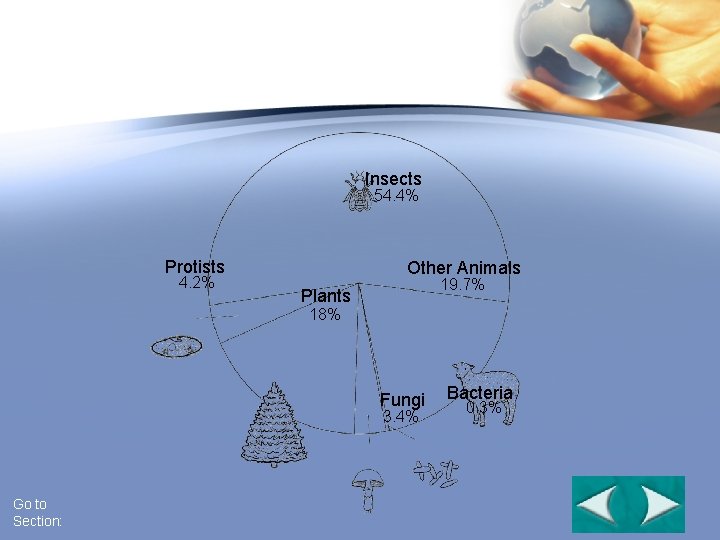
Species Diversity Section 6 -3 Insects 54. 4% Protists 4. 2% Other Animals 19. 7% Plants 18% Fungi 3. 4% Go to Section: Bacteria 0. 3%
Biodiversity • Human activity can reduce biodiversity • May cause extinction
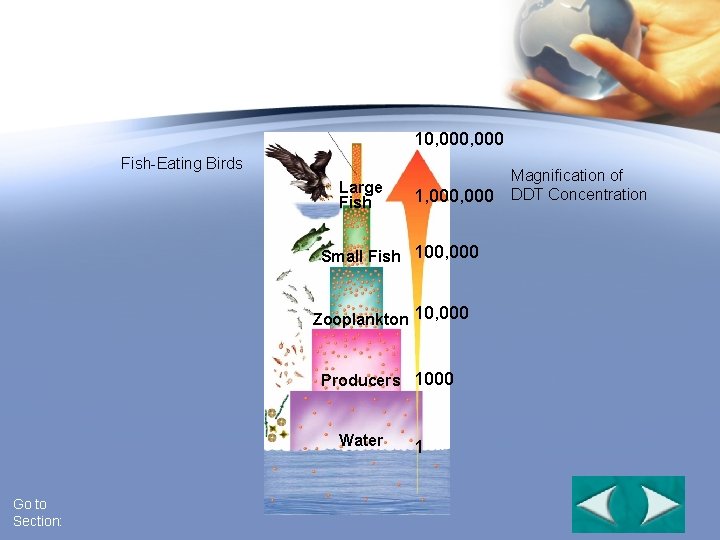
Biological magnification • Biological magnification– toxins may be concentrated from one trophic level to the next. • DDT is an example • DDT is a pesticide that was used extensively • DDT is not biodegradable • Organisms do not eliminate it
Figure 6 -16 Biological Magnification of DDT Section 6 -3 10, 000 Fish-Eating Birds Large Fish 1, 000 Small Fish 100, 000 Zooplankton 10, 000 Producers 1000 Water Go to Section: 1 Magnification of DDT Concentration
Biological magnification • Concentrates as herbivores eat plants sprayed with DDT, then carnivores eat the herbivores etc…
Introduced species • Organisms transferred from one area to another that did not have them before • Zebra Mussel, Phragmites, Japanese shore crab
Interest Grabber continued Section 6 -1 • 1. Choose an animal other than a human and describe at least two ways in which it may change its environment. • 2. What events might have led to the changes that occurred in your town or city? • 3. What positive effect have humans had on their environment? What negative effect have humans had on their environment? Go to Section:
Interest Grabber continued Section 6 -3 • 1. List three ways in which other organisms have proved to be a benefit to humans. • 2. Compare biodiversity with other natural resources, such as wood and fossil fuels. Do you think biodiversity is a renewable or a nonrenewable resource? Explain your answer. • 3. What can be done to preserve the biodiversity of organisms? Go to Section:
Interest Grabber How Much Should It Cost? • You may have read that when something becomes hard to obtain, its price usually increases. Such is the case for materials like gold and diamonds, which are nonrenewable resources. Using similar thinking, some researchers believe that all the valuable services provided by a healthy ecosystem should be assigned a dollar value. Go to Section:
Interest Grabber continued Section 6 -4 • Rank the following items in order of their importance to you. Then, next to each item, write down how much you would be willing to pay for it. • 1. Fresh, clean drinking water • 2. Clean air to breathe • 3. An endangered plant containing a substance that can cure cancer • 4. Gas for your family car Go to Section:
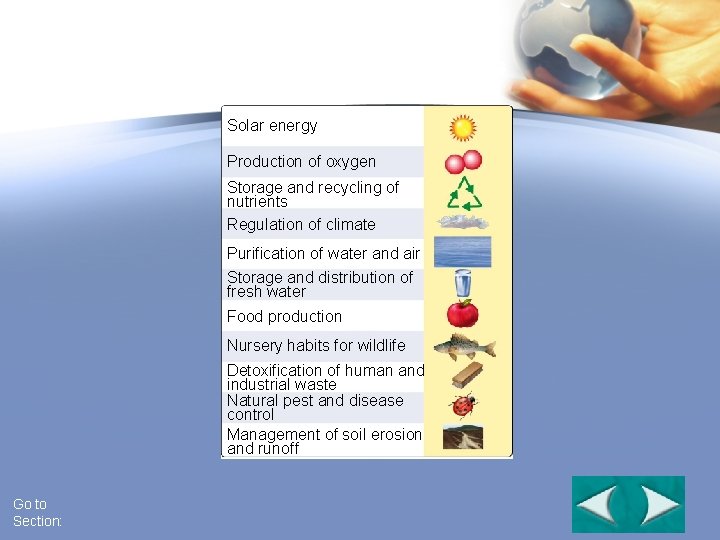
Section 6 -4 Figure 6 -22 Ecosystem Services Solar energy Production of oxygen Storage and recycling of nutrients Regulation of climate Purification of water and air Storage and distribution of fresh water Food production Nursery habits for wildlife Detoxification of human and industrial waste Natural pest and disease control Management of soil erosion and runoff Go to Section: