
HUMANS AND EARLY HOMINIDS By Edward Zhu David
HUMANS AND EARLY HOMINIDS By Edward Zhu, David Flores, and Hammad Ahmed
Major features that make us human � Upright posture and bipedal movement � Reduced jawbone and shortened digestive tract � Larger brain � Tool use � Symbolic thought and use of language
Hominoids and Hominids � Hominoids are a clade including gibbons, orangutans, gorillas, chimpanzees, bonobos, and humans, along with extinct species that descended from the same ancestor. Hominids are a clade including humans and all species more closely related to humans than other living hominoids. � A species on the human branch of the evolutionary tree; a member of the family Hominidae, including Homo sapiens and our ancestors. � DKPCOFGS
Paleoanthropology � The study of human origins and evolution. � Paleoanthropologists have found 20 extinct that are more closely related to humans than to chimpanzees. �Those of which are called hominids
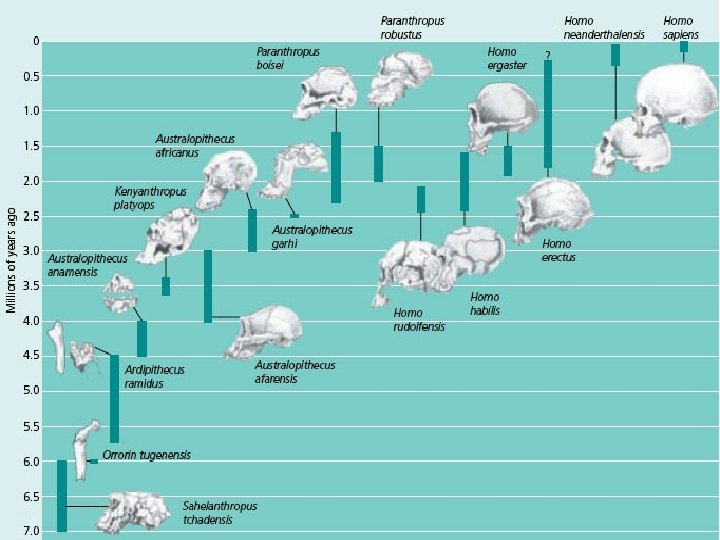

Earliest Hominid � The oldest hominid is Sahelanthropus tchandensis, which lived 7 million years ago. � Sahelanthropus and other early hominids shared some characteristics of humans. �Flat canine teeth and flat faces �More upright and bipedal �However had smaller brain
Misconceptions � Our hominid ancestors were not chimpanzees or any modern apes. �Chimpanzees and humans are two divergent branches from a common ancestor that wasn’t a chimpanzee or a human.
Misconceptions � Human evolution is not a progressive ladder with steps of ancestral hominoids. �If human evolution is a parade, then many splinter groups traveled down dead ends, and several different human species coexisted.
Misconceptions � Various human characteristics such as upright position, enlarged brain, did not evolve together at once. �Differing rates of evolution in different features is known as mosaic evolution.
Australopiths � The various pre-Homo hominids are classified in the genus Australopithecus (“southern ape”) and are known as australopiths. �They are a paraphyletic assemblage of hominids that lived between 4 million to 2 million years ago.
Australopiths � Australopithecus africanus walked fully erect and had human-like hands and teeth. � However had one-third the brain size of a present-day human.
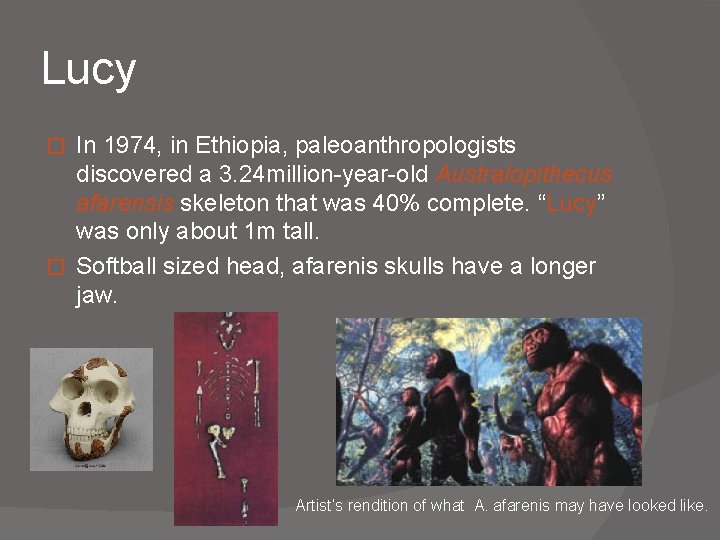
Lucy In 1974, in Ethiopia, paleoanthropologists discovered a 3. 24 million-year-old Australopithecus afarensis skeleton that was 40% complete. “Lucy” was only about 1 m tall. � Softball sized head, afarenis skulls have a longer jaw. � Artist’s rendition of what A. afarenis may have looked like.
Bipedalism � Hominids most likely became bipedal due to the increase of a savanna environment with fewer trees. � Hominids began to walk long distances on two legs around 1. 9 million years ago.
Tool Use � Other hominoids can use tools. �Orangutans use sticks to retrieve insects from nests. Chimps use rocks to smash open food. � The oldest evidence of tool use are cut marks found on bones, 2. 5 million years ago.
Early Homo � The earliest fossils that paleoanthropologists place in our genus Homo are those of the species Homo habilis, ranging in age from about 2. 4 to 1. 6 million years � Stone tools have been found with this species �Giving this species its name “handy man” � Compared to australopiths, H. habilis have a shorter jaw and a larger brain.
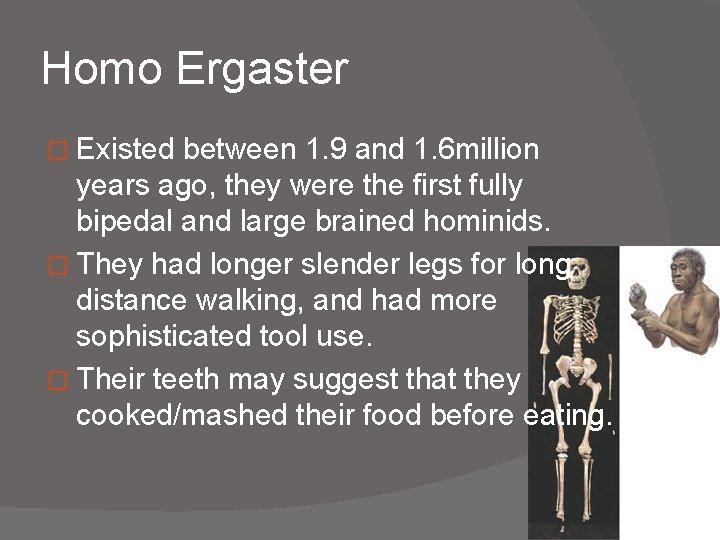
Homo Ergaster � Existed between 1. 9 and 1. 6 million years ago, they were the first fully bipedal and large brained hominids. � They had longer slender legs for long distance walking, and had more sophisticated tool use. � Their teeth may suggest that they cooked/mashed their food before eating.
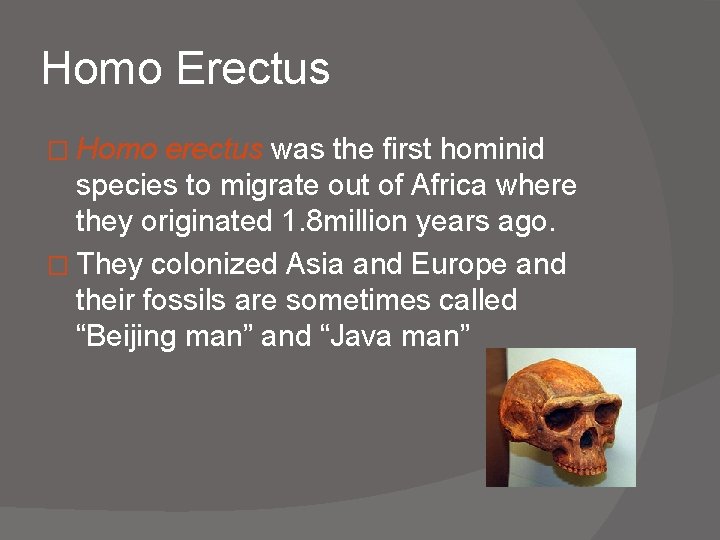
Homo Erectus � Homo erectus was the first hominid species to migrate out of Africa where they originated 1. 8 million years ago. � They colonized Asia and Europe and their fossils are sometimes called “Beijing man” and “Java man”
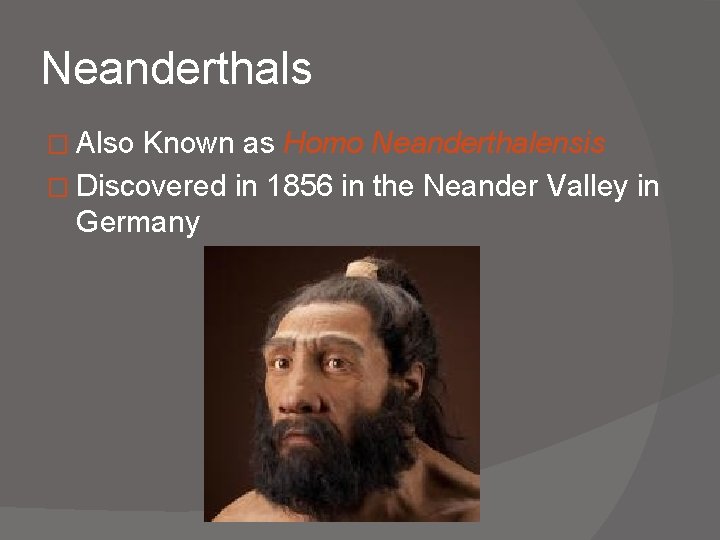
Neanderthals � Also Known as Homo Neanderthalensis � Discovered in 1856 in the Neander Valley in Germany
(Cont. . . ) � At first thought to be considered a stage in evolution of Homo erectus into Homo sapiens � Discovered actually descended from Homo heidelbergensis �Originated in Africa (600, 000 years ago) then spread to Europe �Appeared in Europe and the Near East (200, 000 years ago)
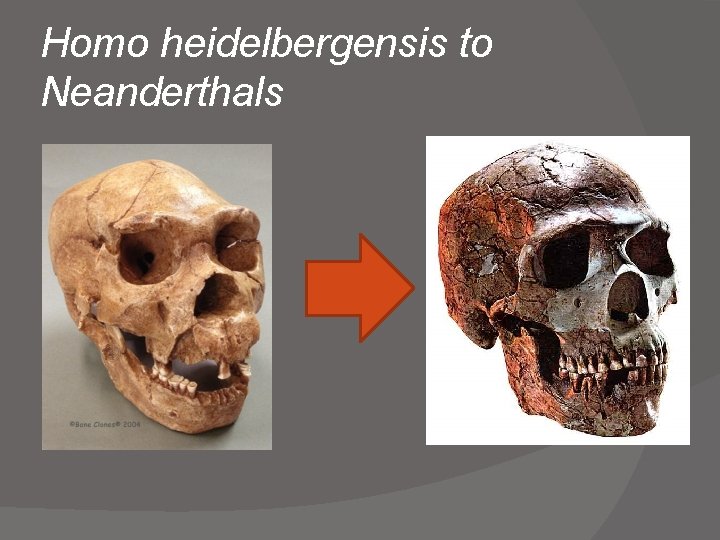
Homo heidelbergensis to Neanderthals
(Cont…) � Similarity to humans �Brain same size as present day humans � Went extinct 30, 000 years ago �Did not contribute to gene pool of present day humans �Proof is found in their DNA ○ Compared their DNA to the DNA of Europe, Africa, and Asia ○ Analysis shows that the Neanderthals form a clad ○ The Europeans are more closely related to Africans, and Asians
(Cont…) � Differences to humans �large middle part of the face, angled cheek bones, and a huge nose for humidifying and warming cold, dry air �bodies were shorter �Had thick bones and prominent brow � Some reasons for this � Lived in cold areas
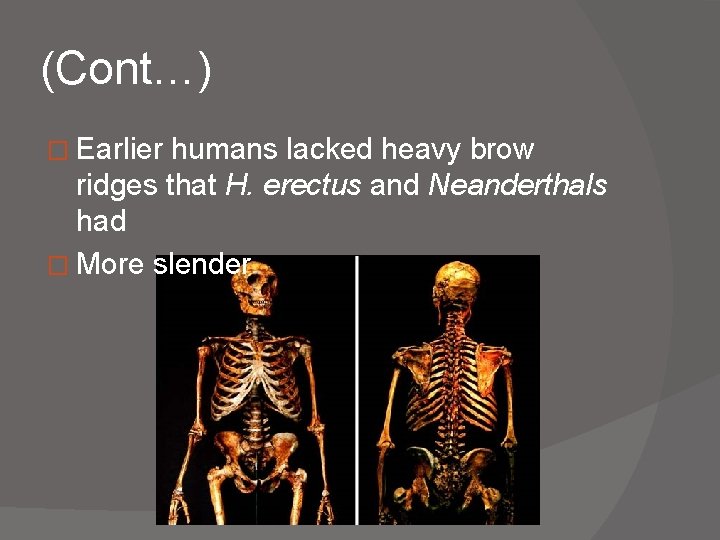
(Cont…) � Earlier humans lacked heavy brow ridges that H. erectus and Neanderthals had � More slender
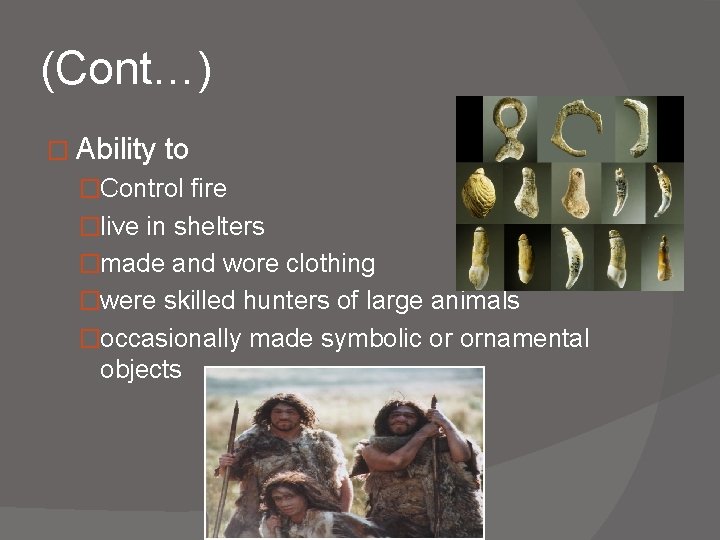
(Cont…) � Ability to �Control fire �live in shelters �made and wore clothing �were skilled hunters of large animals �occasionally made symbolic or ornamental objects
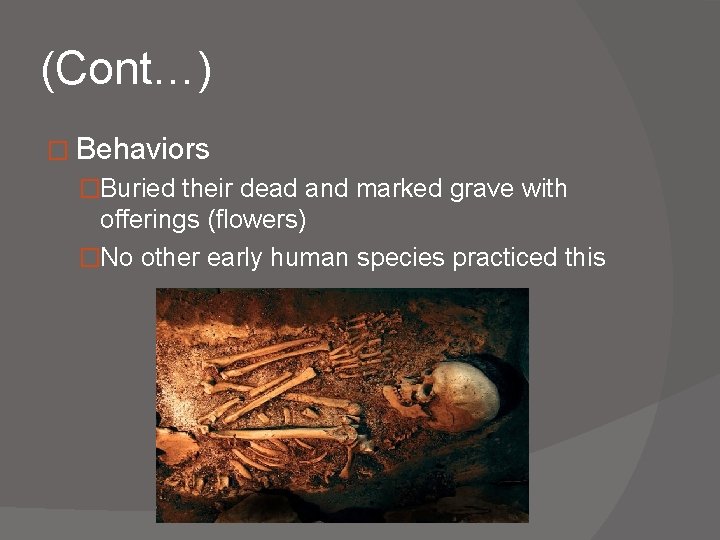
(Cont…) � Behaviors �Buried their dead and marked grave with offerings (flowers) �No other early human species practiced this
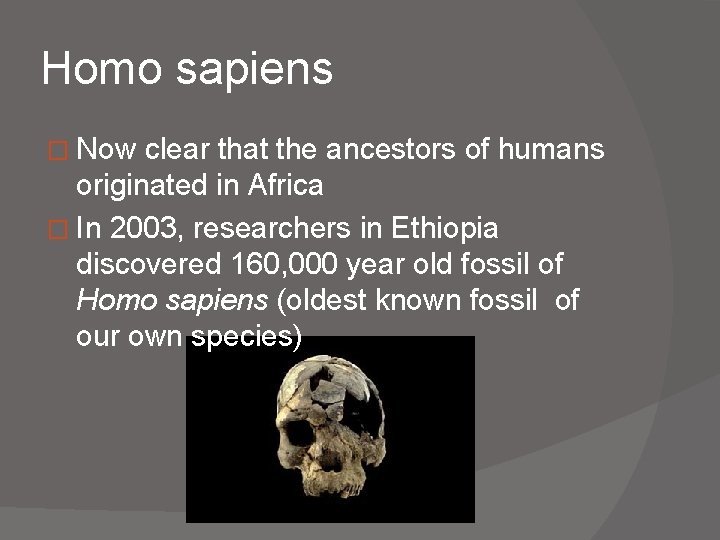
Homo sapiens � Now clear that the ancestors of humans originated in Africa � In 2003, researchers in Ethiopia discovered 160, 000 year old fossil of Homo sapiens (oldest known fossil of our own species)
(Cont…) � Based on research �DNA analysis shows that all living humans are closely related besides Neanderthals �Europeans and Asians have a common ancestor �African lineages branched off more ancient positions on human tree �This suggests that all humans have ancestors that originated from Africa ○ Supported by analysis of mitochondrial DNA and Y chromosomes from members of various populations
(Cont…) � Study of the y chromosome show that humans spread beyond Africa in 1 or more waves �First into Asia then to Europe and Australia � October 2004 �Peter Brown, and Thomas Sutikna discovered skeleton of adult hominid that dated 18, 000 years ago (Homo florensis) ○ Had smaller brain and was shorter (similar to Australopith) ○ similar to Homo sapiens � Skull thickness, proportions and teeth shape � Suggests that it descended from H. erectus
(Cont…) � “Shrinkage” occurred which isolation on the island resulted in selection for greatly reduced size. � Rapid expansion of Homo sapiens may have occurred by our mental process �Example: using tools �Found more evidence of sophistication ○ Geometric markings on pieces of ochre (77, 000 years old in South Africa) ○ 36, 000 year old painting found in caves
(Cont…) � Gene FOXP 2 was identified in 2001 being essential for language � If mutated, suffer a range of impediments and reduced activity � Compared to homologous gene of other mammals �Concluded that it experienced intense natural selection
Features that are lost/emphasized as humans evolved. � Spinal cord placement is right under the skull to accommodate the bipedalism. � Larger brain with capabilities of tool use and cognitive thought. � Flatter face, less protruded jaw.


Sources � http: //humanorigins. si. edu/research
- Slides: 33