
HumanRobot Dynamic Social Interaction MIT Rodney A Brooks
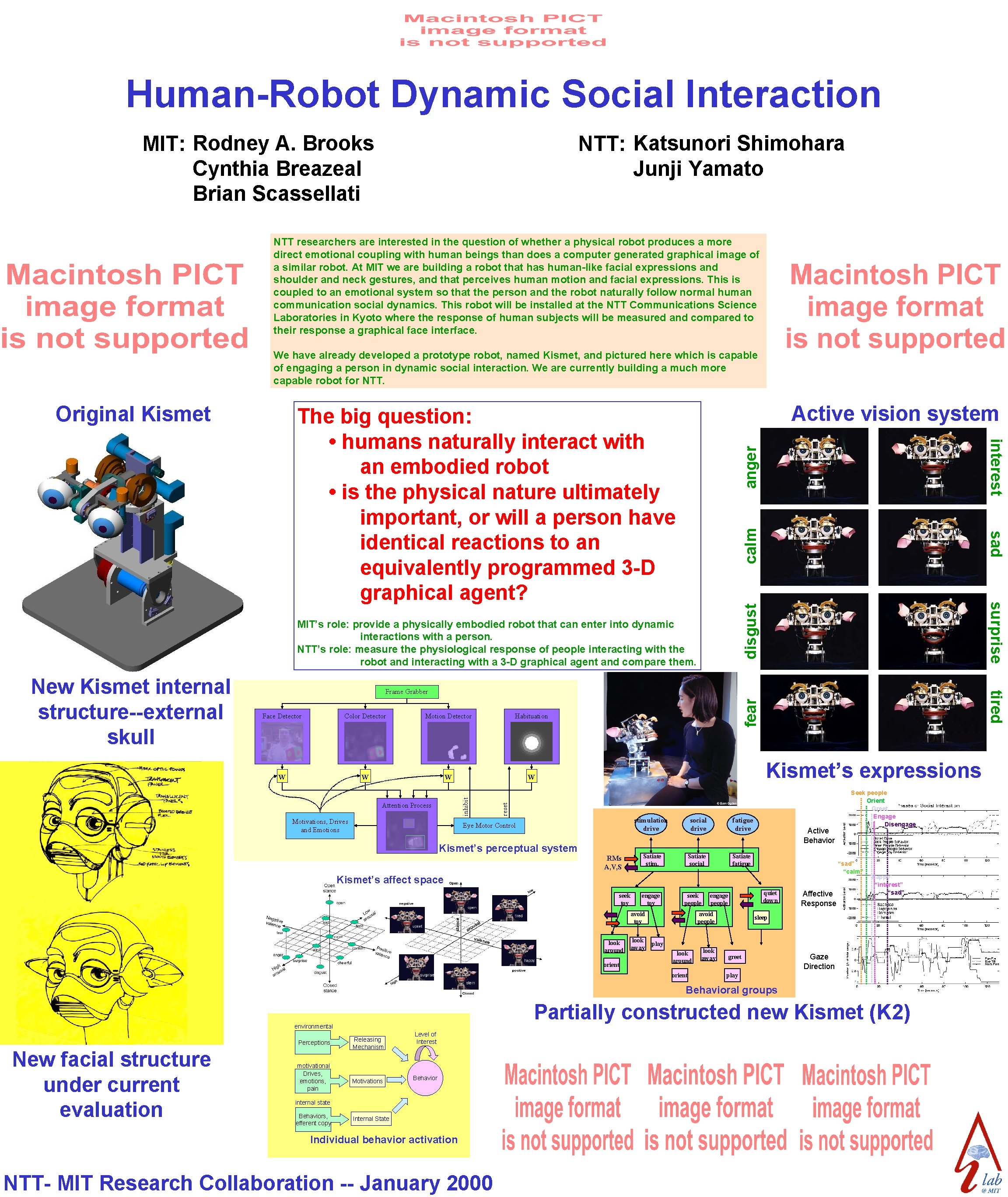
Human-Robot Dynamic Social Interaction MIT: Rodney A. Brooks Cynthia Breazeal Brian Scassellati NTT: Katsunori Shimohara Junji Yamato NTT researchers are interested in the question of whether a physical robot produces a more direct emotional coupling with human beings than does a computer generated graphical image of a similar robot. At MIT we are building a robot that has human-like facial expressions and shoulder and neck gestures, and that perceives human motion and facial expressions. This is coupled to an emotional system so that the person and the robot naturally follow normal human communication social dynamics. This robot will be installed at the NTT Communications Science Laboratories in Kyoto where the response of human subjects will be measured and compared to their response a graphical face interface. We have already developed a prototype robot, named Kismet, and pictured here which is capable of engaging a person in dynamic social interaction. We are currently building a much more capable robot for NTT. Original Kismet Active vision system anger calm sad disgust surprise MIT’s role: provide a physically embodied robot that can enter into dynamic interactions with a person. NTT’s role: measure the physiological response of people interacting with the robot and interacting with a 3 -D graphical agent and compare them. Frame Grabber Habituation w w Attention Process Motivations, Drives and Emotions fear Motion Detector Kismet’s expressions reset Color Detector inhibit Face Detector tired New Kismet internal structure--external skull interest The big question: • humans naturally interact with an embodied robot • is the physical nature ultimately important, or will a person have identical reactions to an equivalently programmed 3 -D graphical agent? Eye Motor Control Kismet’s perceptual system RMs A, V, S stimulation drive social drive fatigue drive Satiate stim. Satiate social Satiate fatigue Active Behavior “sad” “calm” Kismet’s affect space seek toy engage toy seek people avoid toy look around orient look away quiet down engage people avoid people Seek people Orient Greet Engage Disengage Affective Response “happy” “interest” “sad” sleep play look around orient look away greet Gaze Direction play Behavioral groups Partially constructed new Kismet (K 2) environmental Perceptions New facial structure under current evaluation motivational Drives, emotions, pain Releasing Mechanism Motivations Level of Interest Behavior internal state Behaviors, efferent copy Internal State Individual behavior activation NTT- MIT Research Collaboration -- January 2000
- Slides: 1