
Humanoid Robot Head AbstractProblem Statement The purpose of
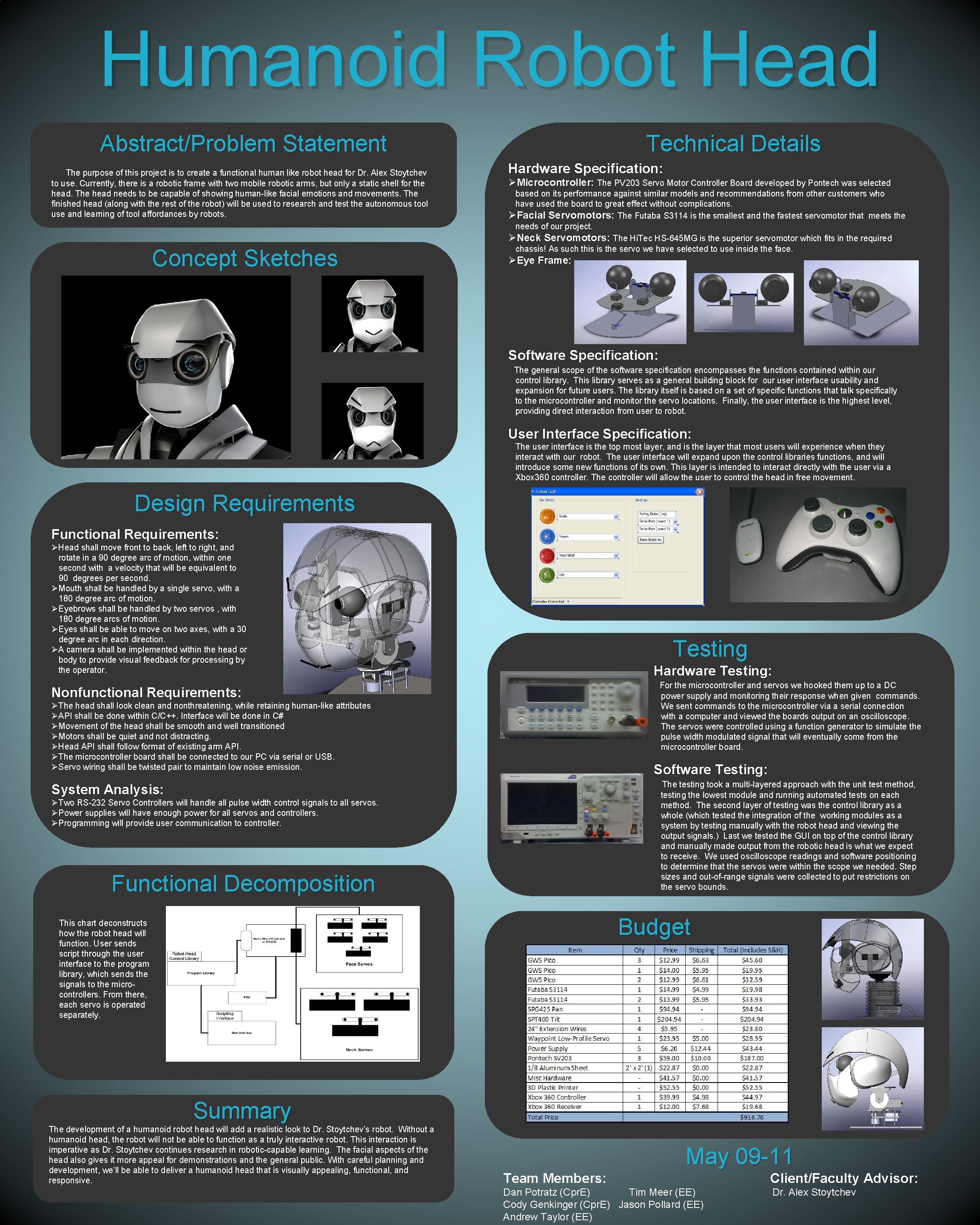
Humanoid Robot Head Abstract/Problem Statement The purpose of this project is to create a functional human like robot head for Dr. Alex Stoytchev to use. Currently, there is a robotic frame with two mobile robotic arms, but only a static shell for the head. The head needs to be capable of showing human-like facial emotions and movements. The finished head (along with the rest of the robot) will be used to research and test the autonomous tool use and learning of tool affordances by robots. Concept Sketches Technical Details Hardware Specification: ØMicrocontroller: The PV 203 Servo Motor Controller Board developed by Pontech was selected based on its performance against similar models and recommendations from other customers who have used the board to great effect without complications. ØFacial Servomotors: The Futaba S 3114 is the smallest and the fastest servomotor that meets the needs of our project. ØNeck Servomotors: The Hi. Tec HS-645 MG is the superior servomotor which fits in the required chassis! As such this is the servo we have selected to use inside the face. ØEye Frame: Software Specification: The general scope of the software specification encompasses the functions contained within our control library. This library serves as a general building block for our user interface usability and expansion for future users. The library itself is based on a set of specific functions that talk specifically to the microcontroller and monitor the servo locations. Finally, the user interface is the highest level, providing direct interaction from user to robot. User Interface Specification: The user interface is the top most layer, and is the layer that most users will experience when they interact with our robot. The user interface will expand upon the control libraries functions, and will introduce some new functions of its own. This layer is intended to interact directly with the user via a Xbox 360 controller. The controller will allow the user to control the head in free movement. Design Requirements Functional Requirements: ØHead shall move front to back, left to right, and rotate in a 90 degree arc of motion, within one second with a velocity that will be equivalent to 90 degrees per second. ØMouth shall be handled by a single servo, with a 180 degree arc of motion. ØEyebrows shall be handled by two servos , with 180 degree arcs of motion. ØEyes shall be able to move on two axes, with a 30 degree arc in each direction. ØA camera shall be implemented within the head or body to provide visual feedback for processing by the operator. Testing Hardware Testing: For the microcontroller and servos we hooked them up to a DC power supply and monitoring their response when given commands. We sent commands to the microcontroller via a serial connection with a computer and viewed the boards output on an oscilloscope. The servos were controlled using a function generator to simulate the pulse width modulated signal that will eventually come from the microcontroller board. Nonfunctional Requirements: ØThe head shall look clean and nonthreatening, while retaining human-like attributes ØAPI shall be done within C/C++. Interface will be done in C# ØMovement of the head shall be smooth and well transitioned ØMotors shall be quiet and not distracting. ØHead API shall follow format of existing arm API. ØThe microcontroller board shall be connected to our PC via serial or USB. ØServo wiring shall be twisted pair to maintain low noise emission. Software Testing: The testing took a multi-layered approach with the unit test method, testing the lowest module and running automated tests on each method. The second layer of testing was the control library as a whole (which tested the integration of the working modules as a system by testing manually with the robot head and viewing the output signals. ) Last we tested the GUI on top of the control library and manually made output from the robotic head is what we expect to receive. We used oscilloscope readings and software positioning to determine that the servos were within the scope we needed. Step sizes and out-of-range signals were collected to put restrictions on the servo bounds. System Analysis: ØTwo RS-232 Servo Controllers will handle all pulse width control signals to all servos. ØPower supplies will have enough power for all servos and controllers. ØProgramming will provide user communication to controller. Functional Decomposition Budget This chart deconstructs how the robot head will function. User sends script through the user interface to the program library, which sends the signals to the microcontrollers. From there, each servo is operated separately. Summary The development of a humanoid robot head will add a realistic look to Dr. Stoytchev’s robot. Without a humanoid head, the robot will not be able to function as a truly interactive robot. This interaction is imperative as Dr. Stoytchev continues research in robotic-capable learning. The facial aspects of the head also gives it more appeal for demonstrations and the general public. With careful planning and development, we’ll be able to deliver a humanoid head that is visually appealing, functional, and responsive. May 09 -11 Team Members: Client/Faculty Advisor: Dan Potratz (Cpr. E) Tim Meer (EE) Cody Genkinger (Cpr. E) Jason Pollard (EE) Andrew Taylor (EE) Dr. Alex Stoytchev
- Slides: 1