
Humanities Professional Development Close Reading of Informational Text
- Slides: 31
Humanities Professional Development “Close Reading” of Informational Text – Shark Attack Presented by: Kelley Webb, CLC Humanities Program Specialist
Agenda • • Essential Questions / TKES Unpacking Reading Standards 1 -9 Informational Text – A Deeper Look Model Lesson – Informational/ Close Reading / HOTs • Focus on Anchor Standards 4 -6 • Lesson Recap – Standards 1 -3 / Standards 7 -9 • Text Resources – Variety / Digital / Leveled / Text Sets • PBA – Based on Informational / Model Lesson / Shark Attack
Today’s Essential Questions Teacher EQs: How can teachers model rigorous analysis of informational texts? How can teachers help students analyze informational text rather than just addressing the facts? How can teachers help students understand that informational is only one version of the truth? What resources can teachers use to show students different perspectives of authors about the same topic or historical event? Student EQs: How can “close reading” of texts enhance student understanding of Common Core standards? How does an author’s choices (word choice, figurative language, text structure, point of view) convey his/her message?
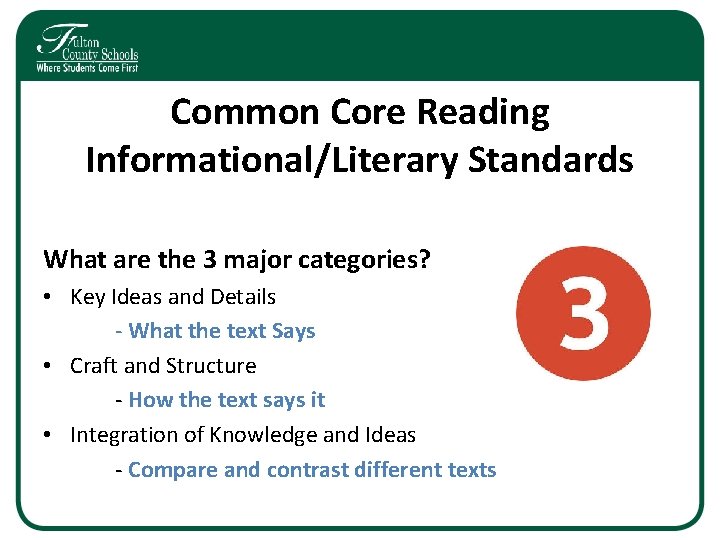
Common Core Reading Informational/Literary Standards What are the 3 major categories? • Key Ideas and Details - What the text Says • Craft and Structure - How the text says it • Integration of Knowledge and Ideas - Compare and contrast different texts
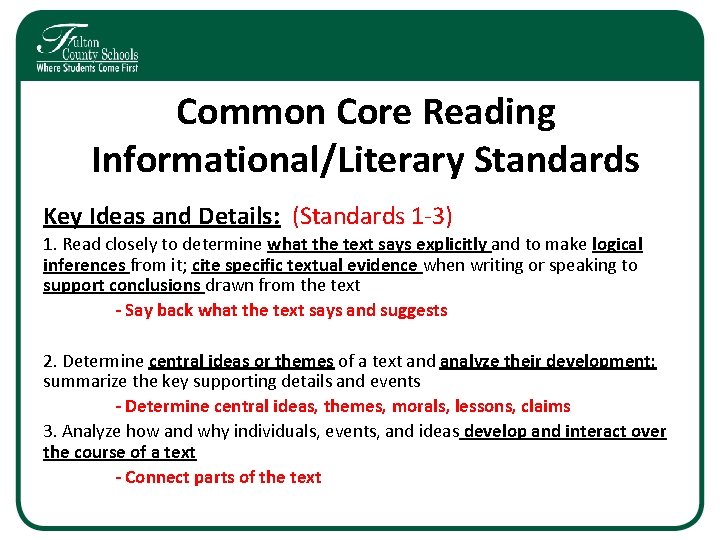
Common Core Reading Informational/Literary Standards Key Ideas and Details: (Standards 1 -3) 1. Read closely to determine what the text says explicitly and to make logical inferences from it; cite specific textual evidence when writing or speaking to support conclusions drawn from the text - Say back what the text says and suggests 2. Determine central ideas or themes of a text and analyze their development; summarize the key supporting details and events - Determine central ideas, themes, morals, lessons, claims 3. Analyze how and why individuals, events, and ideas develop and interact over the course of a text - Connect parts of the text
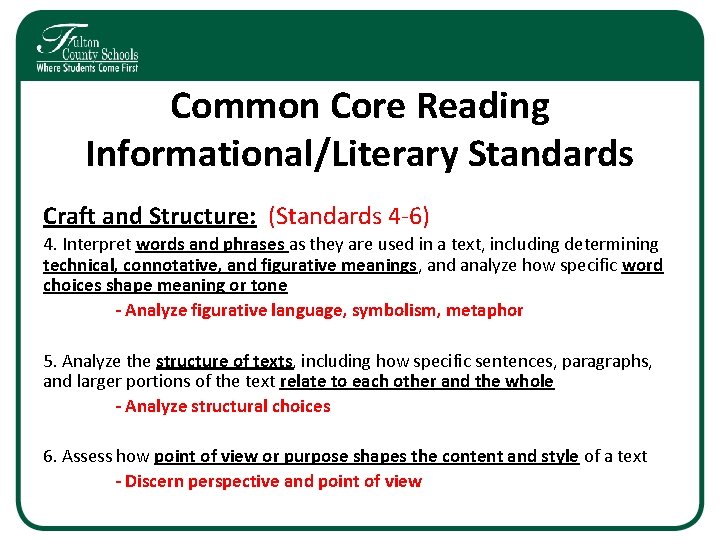
Common Core Reading Informational/Literary Standards Craft and Structure: (Standards 4 -6) 4. Interpret words and phrases as they are used in a text, including determining technical, connotative, and figurative meanings, and analyze how specific word choices shape meaning or tone - Analyze figurative language, symbolism, metaphor 5. Analyze the structure of texts, including how specific sentences, paragraphs, and larger portions of the text relate to each other and the whole - Analyze structural choices 6. Assess how point of view or purpose shapes the content and style of a text - Discern perspective and point of view
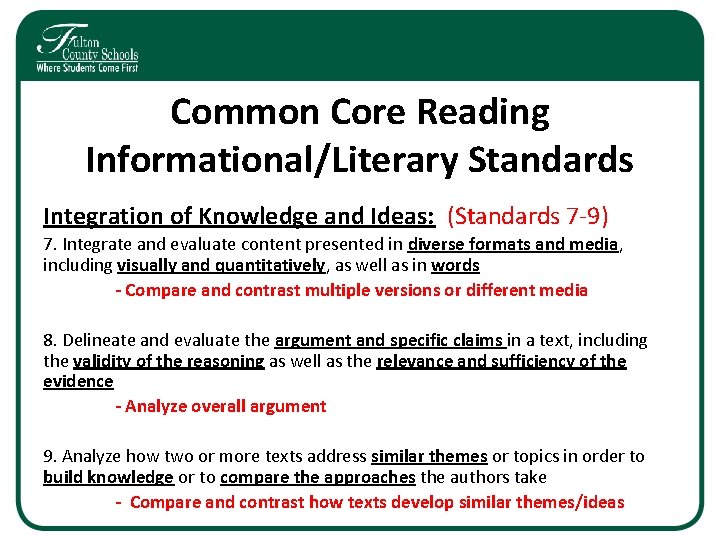
Common Core Reading Informational/Literary Standards Integration of Knowledge and Ideas: (Standards 7 -9) 7. Integrate and evaluate content presented in diverse formats and media, including visually and quantitatively, as well as in words - Compare and contrast multiple versions or different media 8. Delineate and evaluate the argument and specific claims in a text, including the validity of the reasoning as well as the relevance and sufficiency of the evidence - Analyze overall argument 9. Analyze how two or more texts address similar themes or topics in order to build knowledge or to compare the approaches the authors take - Compare and contrast how texts develop similar themes/ideas
Informational/Nonfiction Text What is your definition of nonfiction? What are some examples of informational/nonfiction texts?
Literary -vs- Informational • Literary Standards Focus on… - themes, characters, figurative language, symbolism • Informational Standards Focus on… – investigating ideas, claims, reasoning, evidence
Nonfiction is not just about one “truth” • Currently, most informational reading is focused on recalling facts • We must shift focus to analyzing the claims the texts make and the soundness of their evidence • We must remember that informational text is someone’s perspective on the truth • We must analyze the way a text’s language and craft reveal points of view
Informational Shift -- Multiple Perspectives • Focus is not on reading to accumulate information, BUT rather reading to discern ideas and concepts and analyze texts critically for their reasoning and perspective • Informational reading is not about reading to memorize, BUT rather reading to think
Multiple Perspectives • You really don’t have information about a topic or event unless you have read several texts on the same topic/event • Teachers need to assemble text sets to provide students with multiple texts (digital and print) on the same topic/event
Key Ideas and Details (1 -3) -- HOTs Through close reading students should be able to: Standard 1: Say back what the text suggest Standard 2: Determine central ideas, themes, morals, lessons Standard 3: Connect parts of the text Questions to assess these standards: • What are some of the central ideas of this text? (1 and 2) • What other hidden messages can you find within the text? (1 and 2) • What evidence in the text supports these ideas? (3)
Craft and Structure (4 -6) -- HOTs Through close reading students should be able to: Standard 4: Analyze figurative language, symbolism, metaphors Standard 5: Analyze structural choices Standard 6: Discern perspective and point of view Questions to assess these standards: • • • How does the author convey his message and get the reader to care about them? (all) Which words in the text call our attention to the author’s perspective? (4 and 6) How does the structure of the text convey the author’s message? (5 and 6)
Integration of Knowledge and Ideas (7 -9) - HOTS Through close reading students should be able to: Standard 7: Compare and contrast multiple versions or different media Standard 8: Analyze overall argument Standard 9: Compare and contrast how texts develop similar themes and ideas Questions to assess these standards: • How do the ideas, information, and perspective in this text compare to those in other texts on this same topic? (all) • How does the historical account of this event by author A different from author B’s account? (all)
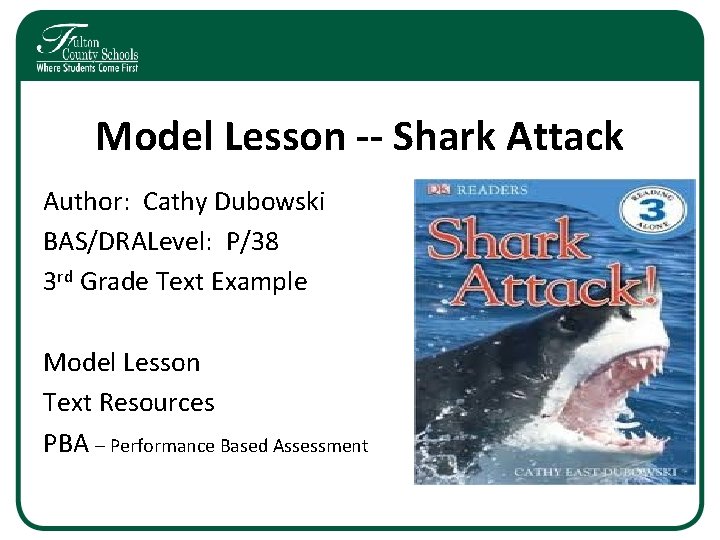
Model Lesson -- Shark Attack Author: Cathy Dubowski BAS/DRALevel: P/38 3 rd Grade Text Example Model Lesson Text Resources PBA – Performance Based Assessment
Key Ideas and Details (Standards 1 -3) Prior to reading the text aloud to students: This week we have been learning that informational text is not just about facts and that it is not necessarily the only one truth but rather someone’s perspective about the truth. Using your graphic organizer, look at the title and the picture on the front of this book, “What message do you think the author is trying to convey? ” “What evidence supports your prediction? ” As we read the text, I want you to confirm or refine your prediction based on the evidence in the text. Chances are that this book, like so many, teaches more than one thing, and some of the things may not be obvious at first. As we are reading the text, ask yourself, “What else does this text teach? ”
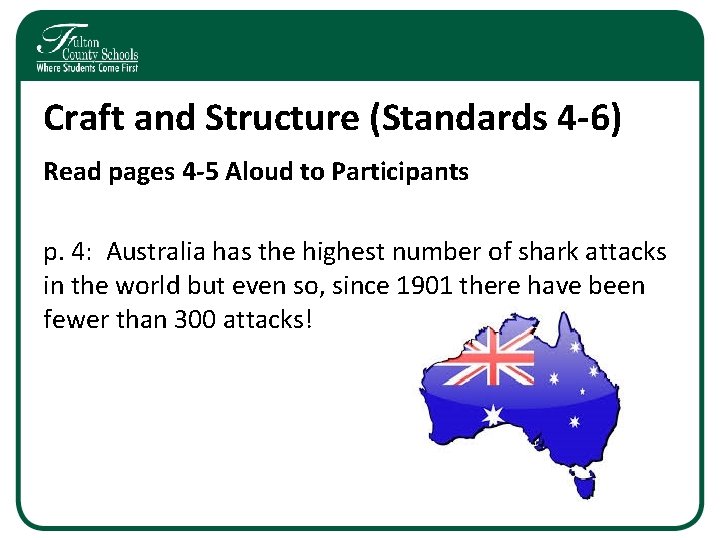
Craft and Structure (Standards 4 -6) Read pages 4 -5 Aloud to Participants p. 4: Australia has the highest number of shark attacks in the world but even so, since 1901 there have been fewer than 300 attacks!
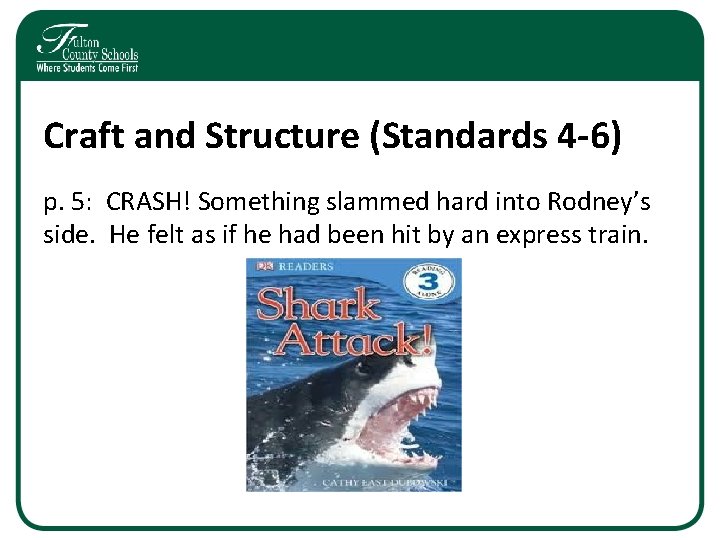
Craft and Structure (Standards 4 -6) p. 5: CRASH! Something slammed hard into Rodney’s side. He felt as if he had been hit by an express train.
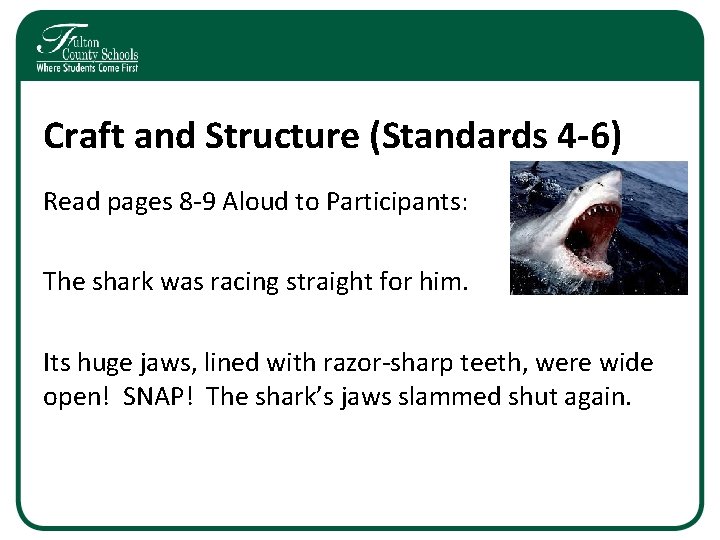
Craft and Structure (Standards 4 -6) Read pages 8 -9 Aloud to Participants: The shark was racing straight for him. Its huge jaws, lined with razor-sharp teeth, were wide open! SNAP! The shark’s jaws slammed shut again.
Craft and Structure (Standards 4 -6) Now let’s review text on page. 14: If you’re terrified of sharks, you’re not alone. In fact, many people are scared just by the thought of sharks. But the truth is that shark attacks are actually very rare. A person is far more likely to be hit by a car or struck by lightning than be attacked by a shark.
Craft and Structure (Standards 4 -6) Now let’s review text on page. 17: But even in a very bad year, sharks attack no more than 80 to 100 people in the whole world. Even then, sharks don’t usually set out to attack people. Often they ignore people in the water.
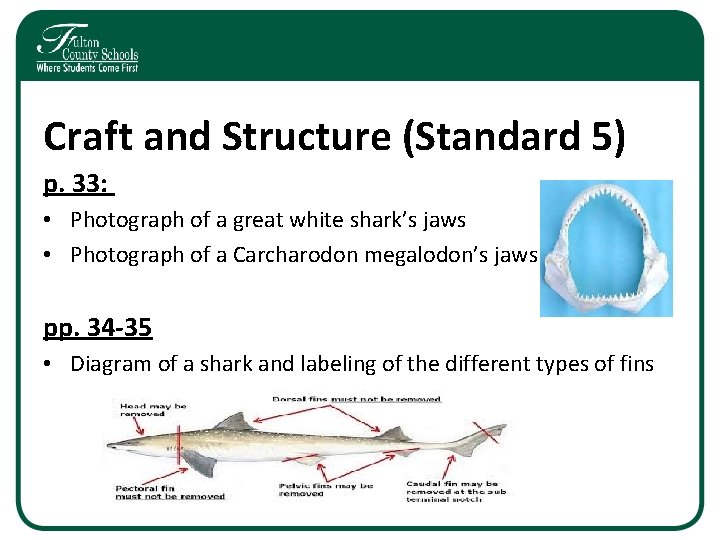
Craft and Structure (Standard 5) p. 33: • Photograph of a great white shark’s jaws • Photograph of a Carcharodon megalodon’s jaws pp. 34 -35 • Diagram of a shark and labeling of the different types of fins
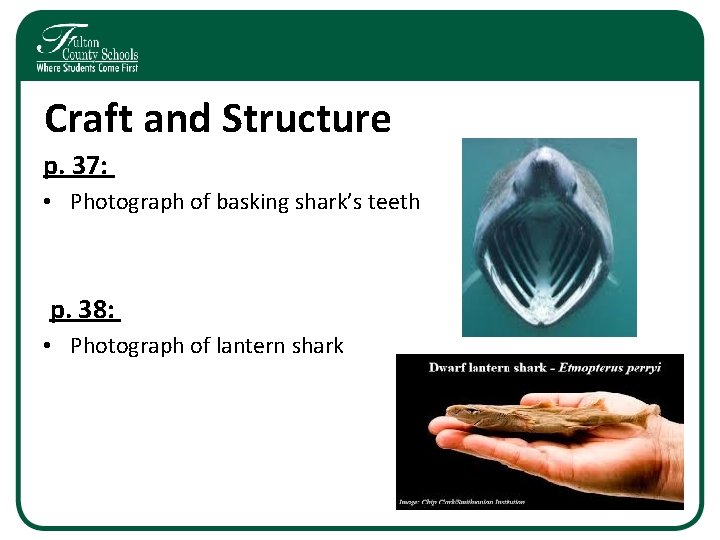
Craft and Structure p. 37: • Photograph of basking shark’s teeth p. 38: • Photograph of lantern shark
Anchor Reading Standards 1 -3 • Anchor Standards 1 and 2: • Q: What is the author’s central message about sharks? What other messages are hidden? • A: Sharks are dangerous. Other messages: Even expert athletes can make mistakes. Animals have weaknesses. • • • Anchor Standard 3: Q: What evidence in the text supports these ideas? Q: What in the text makes you say that? Q: What other ideas does the text suggest? Q: What details support those texts?
Integration of Knowledge and Ideas (Standards 7 -9) In order to see additional perspectives, we must read other texts about sharks. It is also helpful use other nonfiction text about sharks to learn more about these animals - videos, news articles, a variety of media types, etc. Compare the messages of different texts read on same topic/themes Compare how the author used different literary devices in each of the texts - narrator’s voice, music, word choice, bold print, illustrations
Digital Resources National Geographic: “World’s Deadliest: Hammerhead Sharks” (2: 15) http: //video. nationalgeographic. com/video/animals/fis h-animals/sharks-and-rays/deadliest-hammerheadshark/ Shark Week: What Would Happen if Sharks Disappeared? (2: 02) http: //www. discovery. com/tv-shows/sharkweek/videos/saving-the-sharks. htm
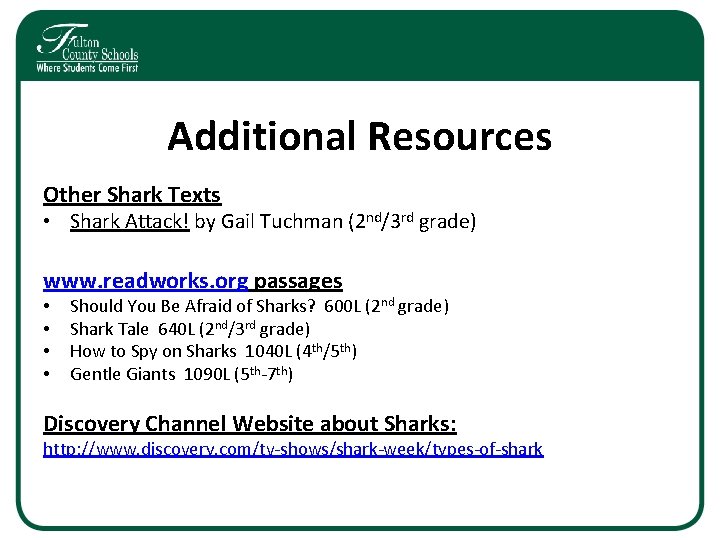
Additional Resources Other Shark Texts • Shark Attack! by Gail Tuchman (2 nd/3 rd grade) www. readworks. org passages • • Should You Be Afraid of Sharks? 600 L (2 nd grade) Shark Tale 640 L (2 nd/3 rd grade) How to Spy on Sharks 1040 L (4 th/5 th) Gentle Giants 1090 L (5 th-7 th) Discovery Channel Website about Sharks: http: //www. discovery. com/tv-shows/shark-week/types-of-shark
Additional Resources • Text Sets Teachers College Reading and Writing Project Nonfiction Digital Text Sets: http: //readingandwritingproject. com/resources/book-lists-classroom-librariesand-text-sets-for-students/text-sets. html • Picture Books • Podcast/Video about Informational Text: http: //bit. ly/1 gf. Vm. UW • Handouts – Motion Picture (Close Read) Worksheet -- Portaportal – Standards 1 -9 Information – HOTs Standards/Question Chart