
HUMANITARIAN OPENSTREETMAP TEAM WHAT WE DO We make
- Slides: 9
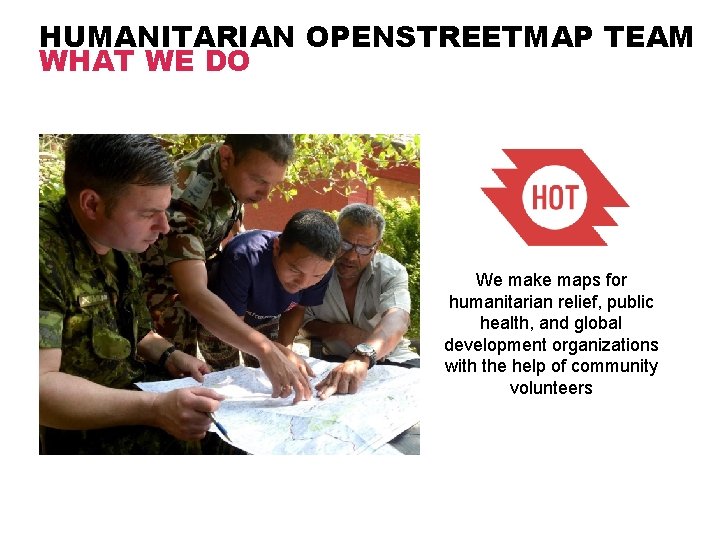
HUMANITARIAN OPENSTREETMAP TEAM WHAT WE DO We make maps for humanitarian relief, public health, and global development organizations with the help of community volunteers
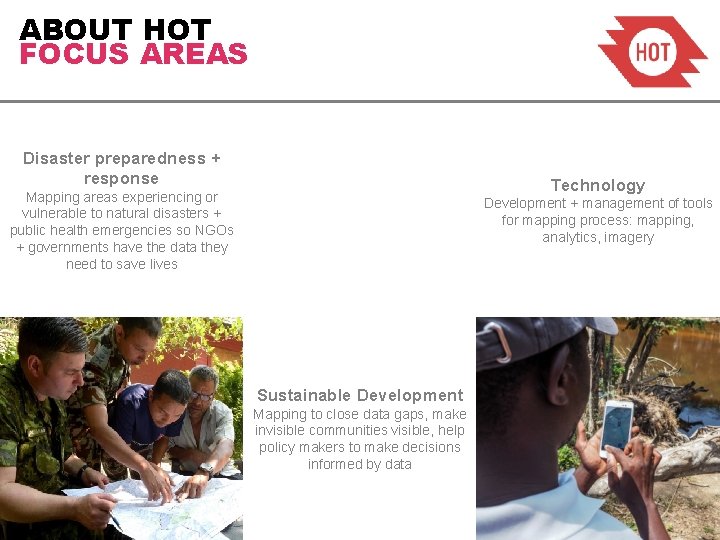
ABOUT HOT FOCUS AREAS Disaster preparedness + response Technology Mapping areas experiencing or vulnerable to natural disasters + public health emergencies so NGOs + governments have the data they need to save lives Development + management of tools for mapping process: mapping, analytics, imagery Sustainable Development Mapping to close data gaps, make invisible communities visible, help policy makers to make decisions informed by data
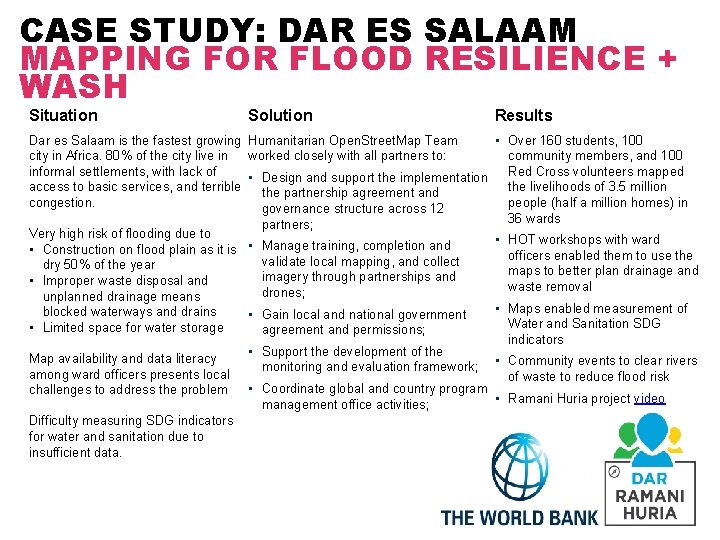
CASE STUDY: DAR ES SALAAM MAPPING FOR FLOOD RESILIENCE + WASH Situation Solution Results Dar es Salaam is the fastest growing Humanitarian Open. Street. Map Team • Over 160 students, 100 city in Africa. 80% of the city live in worked closely with all partners to: community members, and 100 informal settlements, with lack of Red Cross volunteers mapped • Design and support the implementation access to basic services, and terrible the livelihoods of 3. 5 million the partnership agreement and congestion. people (half a million homes) in governance structure across 12 36 wards partners; Very high risk of flooding due to • HOT workshops with ward • Construction on flood plain as it is • Manage training, completion and officers enabled them to use the validate local mapping, and collect dry 50% of the year maps to better plan drainage and imagery through partnerships and • Improper waste disposal and waste removal drones; unplanned drainage means • Maps enabled measurement of blocked waterways and drains • Gain local and national government Water and Sanitation SDG • Limited space for water storage agreement and permissions; indicators • Support the development of the Map availability and data literacy monitoring and evaluation framework; • Community events to clear rivers among ward officers presents local of waste to reduce flood risk • Coordinate global and country program challenges to address the problem • Ramani Huria project video management office activities; Difficulty measuring SDG indicators for water and sanitation due to insufficient data.
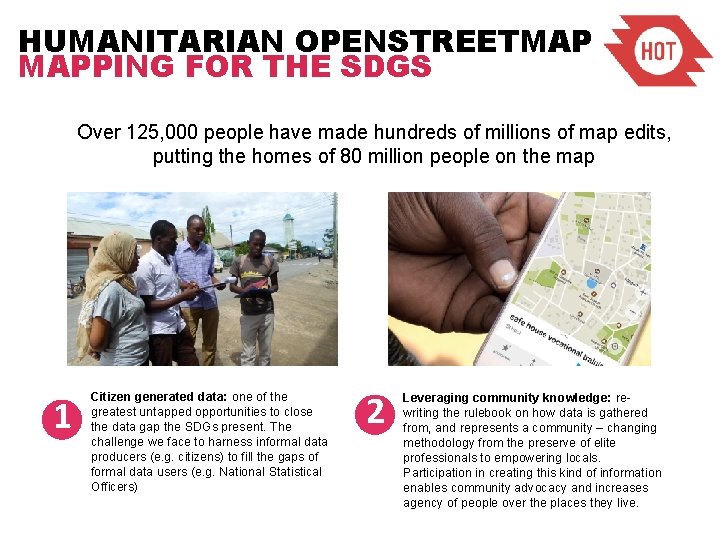
HUMANITARIAN OPENSTREETMAP MAPPING FOR THE SDGS Over 125, 000 people have made hundreds of millions of map edits, putting the homes of 80 million people on the map 1 Citizen generated data: one of the greatest untapped opportunities to close the data gap the SDGs present. The challenge we face to harness informal data producers (e. g. citizens) to fill the gaps of formal data users (e. g. National Statistical Officers) 2 Leveraging community knowledge: rewriting the rulebook on how data is gathered from, and represents a community – changing methodology from the preserve of elite professionals to empowering locals. Participation in creating this kind of information enables community advocacy and increases agency of people over the places they live.
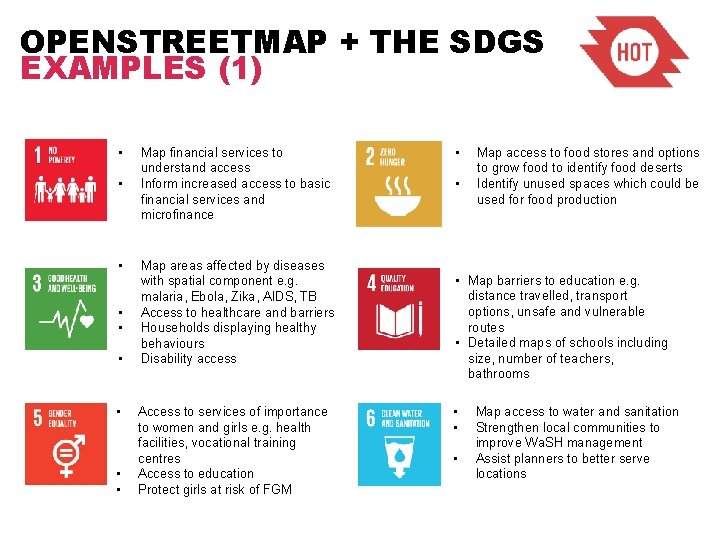
OPENSTREETMAP + THE SDGS EXAMPLES (1) • • • Map financial services to understand access Inform increased access to basic financial services and microfinance Map areas affected by diseases with spatial component e. g. malaria, Ebola, Zika, AIDS, TB Access to healthcare and barriers Households displaying healthy behaviours Disability access Access to services of importance to women and girls e. g. health facilities, vocational training centres Access to education Protect girls at risk of FGM • • Map access to food stores and options to grow food to identify food deserts Identify unused spaces which could be used for food production • Map barriers to education e. g. distance travelled, transport options, unsafe and vulnerable routes • Detailed maps of schools including size, number of teachers, bathrooms • • • Map access to water and sanitation Strengthen local communities to improve Wa. SH management Assist planners to better serve locations
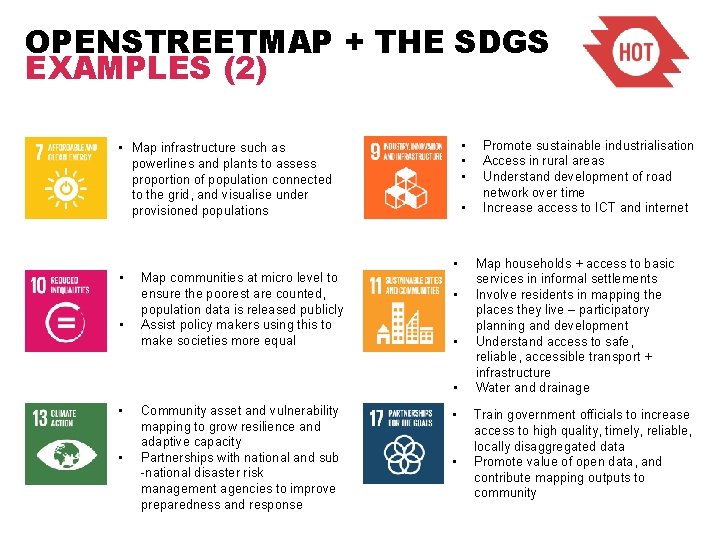
OPENSTREETMAP + THE SDGS EXAMPLES (2) • • Map infrastructure such as powerlines and plants to assess proportion of population connected to the grid, and visualise under provisioned populations • • Map communities at micro level to ensure the poorest are counted, population data is released publicly Assist policy makers using this to make societies more equal • • • Community asset and vulnerability mapping to grow resilience and adaptive capacity Partnerships with national and sub -national disaster risk management agencies to improve preparedness and response • • Promote sustainable industrialisation Access in rural areas Understand development of road network over time Increase access to ICT and internet Map households + access to basic services in informal settlements Involve residents in mapping the places they live – participatory planning and development Understand access to safe, reliable, accessible transport + infrastructure Water and drainage Train government officials to increase access to high quality, timely, reliable, locally disaggregated data Promote value of open data, and contribute mapping outputs to community
GEO COMMUNITY OVERLAPS AND OPPORTUNITIES Use the huge quantity of open geo data available (download via Geo portal ) – export. hotosm. org Leverage the Global Open. Street. Map community network – 4 million users, strong local communities in many countries Replicable, scalable, community based methodology using open source tools – online and mobile based Contribute your data to the map through our imports process, and benefit from community support keeping it up to date info@hotosm. org
MAPPING 200 MILLION PEOPLE BY 2021