
Humanistic Educational Philosophy Sidekick Maslows theory of selfactualization


- Slides: 3
Humanistic Educational Philosophy Sidekick: Maslow’s theory of self-actualization influenced humanistic philosophy. --Carl Rogers (Born in 1902 in Oak Park, Illinois) The Five basic principles of humanistic education are: 1) Students should be able to choose what they want to learn. Humanistic teachers believe that students will be motivated to learn a subject if it’s something they need and want to know. 2) The goal of education should be to foster students' desire to learn and teach them how to learn. Students should be self-motivated in their studies and desire to learn on their own. 3) Humanistic educators believe that grades are irrelevant and that only self-evaluation is meaningful. Grading encourages students to work for a grade and not for personal satisfaction. In addition, humanistic educators are opposed to objective tests because they test a student's ability to memorize and do not provide sufficient educational feedback to the teacher and student. Playbook Style: Empathetic disposition A humanistic approach is highly based on empathy; teachers who can put themselves in their students’ shoes and look at a situation in their point of view have a better chance of relaying the content to their students successfully. 4) Humanistic educators believe that both feelings and knowledge are important to the learning process. Unlike traditional educators, humanistic teachers do not separate the cognitive and affective domains. 5) Humanistic educators insist that schools need to provide students with nonthreatening environment so that they will feel secure to learn. Once students feel secure, learning becomes easier and more meaningful.
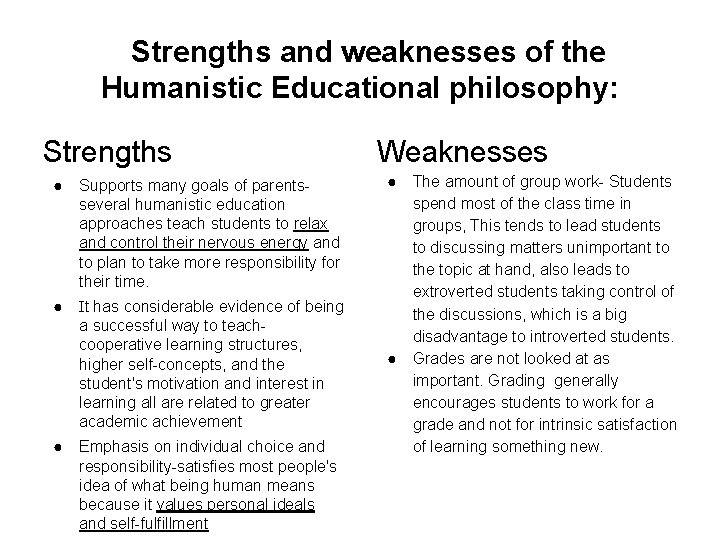
Strengths and weaknesses of the Humanistic Educational philosophy: Strengths ● Supports many goals of parentsseveral humanistic education approaches teach students to relax and control their nervous energy and to plan to take more responsibility for their time. ● It has considerable evidence of being a successful way to teachcooperative learning structures, higher self-concepts, and the student's motivation and interest in learning all are related to greater academic achievement ● Emphasis on individual choice and responsibility-satisfies most people's idea of what being human means because it values personal ideals and self-fulfillment Weaknesses ● The amount of group work- Students spend most of the class time in groups, This tends to lead students to discussing matters unimportant to the topic at hand, also leads to extroverted students taking control of the discussions, which is a big disadvantage to introverted students. ● Grades are not looked at as important. Grading generally encourages students to work for a grade and not for intrinsic satisfaction of learning something new.
Sources- http: //web. cortland. edu/andersmd/HUMAN/PRINC. HTML http: //www. humanistsofutah. org/1994/art 2 jun 94. html http: //www. ehow. com/list_7691322_disadvantages-humanist-approach-classroom. html http: //web. cortland. edu/andersmd/HUMAN/CRITIC. HTML Picture: http: //www. psmag. com/news/todays-college-students-lacking-in-empathy-16642/