
HUMANISTIC APPROACH MOTIVATION HUMANISTIC SCHOOL OF PSYCHOLOGY It



- Slides: 33
HUMANISTIC APPROACH MOTIVATION
HUMANISTIC SCHOOL OF PSYCHOLOGY • It believes in the goodness of man and • It has optimistic confidence in man’s positive nature • It is contrary to psychoanalytical theory of personality • It does not consider that personality is governed by biological forces.
HUMANISTIC SCHOOL OF PSYCHOLOGY Humanistic psychology points out that every one of us has the potential for self actualization through spontaneity, creativity and personal growth.
ABRAHAM MASLOW SELF ACTUALIZATION THEORY
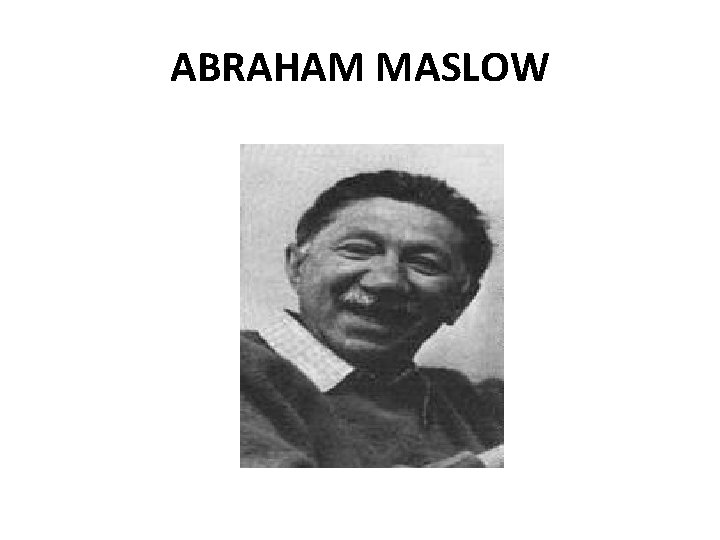
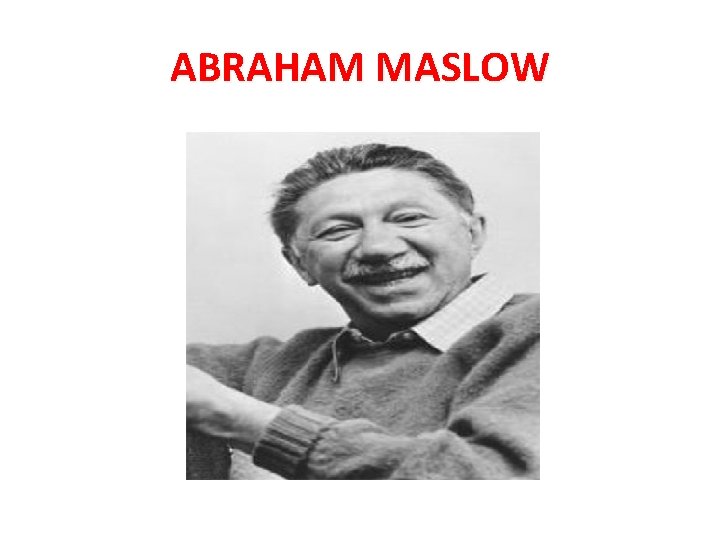
ABRAHAM MASLOW • He is an American psychologist • And • A major theorist in humanistic psychology
ABRAHAM MASLOW
SELF ACTUALIZATION THEORY Maslow • To Maslow • Human beings are basically good or neutral • There is an impulse of craving for growth or fulfillment of one’s potentials
SELF ACTUALIZATION THEORY • • Maslow The goal of life is to seek self actualization in Pursuit of knowledge Appreciation of beauty Playfulness Self sufficiency Insight in to the truth or Other constructive and creative expression
SELF ACTUALIZATION THEORY Maslow • The behaviour of an individual depends on his style of striving for self actualization • The path towards self actualization may have sub goals of lower- order needs to be satisfied.
SELF ACTUALIZATION THEORY Maslow • Conclusion • The goal of personality development is self actualization • i. e. realization of one’s basic human potential to the maximum extent and as effectively as possible
SELF ACTUALIZATION THEORY Maslow • Criticism • It is not objective and scientific especially in the subjective criteria for self actualization
Abraham Maslow • Human needs arrange themselves in hierarchies of prepotency. • i. e. , the appearance of one need generally depends on the satisfaction of others. • These are closely related to each other. • They can be arranged in the order of importance from the lowest to the highest.
Abraham Maslow • He proposed five sets of basic needs that can be arranged in a definite hierarchical order.
MASLOW’S HIERARCHY OF NEEDS • Abraham Maslow was born in New York in 1908 and died in 1970 • Abraham Maslow developed the Hierarchy of Needs model in 1940 -50 s.
ABRAHAM MASLOW NEED HIERARCHY
ABRAHAM MASLOW
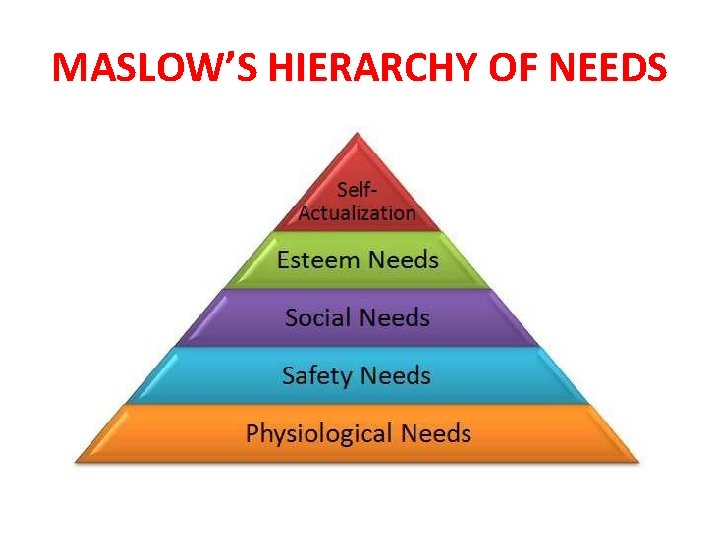
MASLOW’S HIERARCHY OF NEEDS
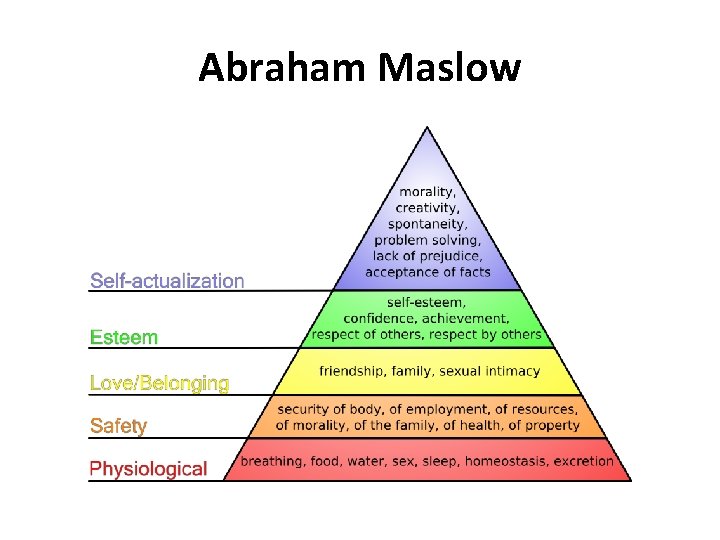
MASLOW’S HIERARCHY OF NEEDS • • • Physiological needs Safety and Security needs Love and belongingness needs Esteem needs Self actualization needs
MASLOW’S HIERARCHY OF NEEDS • Physiological needs air, food, drink, sex, sleep, etc. • Safety and Security needs ; shelter, protection from animals , security, order, law, etc.
MASLOW’S HIERARCHY OF NEEDS • Love and belongingness needs ; • need to be considered in work group, family, and need for affection, relationships etc. • Esteem needs; • self-esteem, achievement, mastery, independence, status, dominance, prestige, managerial responsibility, etc.
MASLOW’S HIERARCHY OF NEEDS • Self actualization needs; • realising personal potential, self-fulfillment, seeking personal growth and peak experiences.
MASLOW’S HIERARCHY OF NEEDS “A musician must make music, an artist must paint, a poet must write poetry, If he is to be ultimately at peace with himself. What a man can be, he must be. He must be true to his own nature. This need we may call self actualization” MASLOW
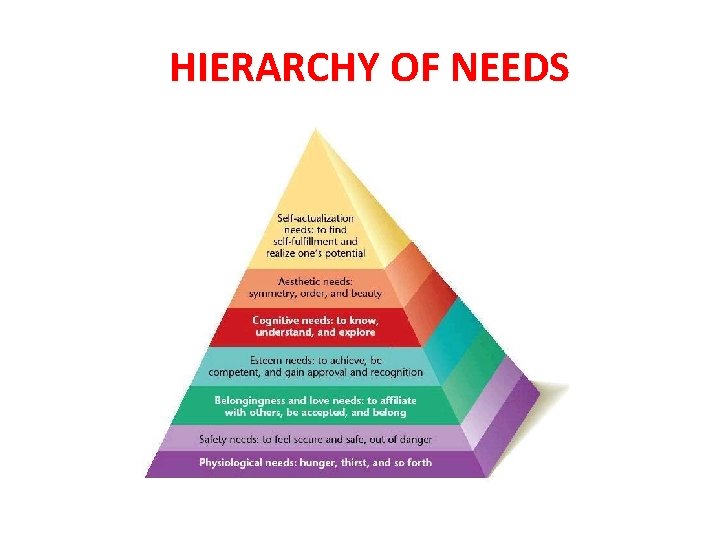
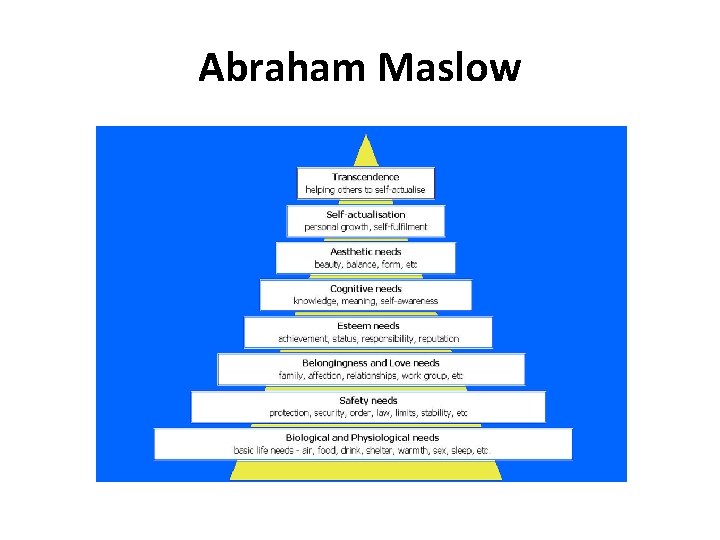
HIERARCHY OF NEEDS • Adapted hierarchy of needs model (1970 s) including cognitive and aesthetic needs. • Although these aspects were referred to as additional aspects of motivation, • Maslow did not include them as levels or stages within his own expression of the Hierarchy of Needs. •
HIERARCHY OF NEEDS
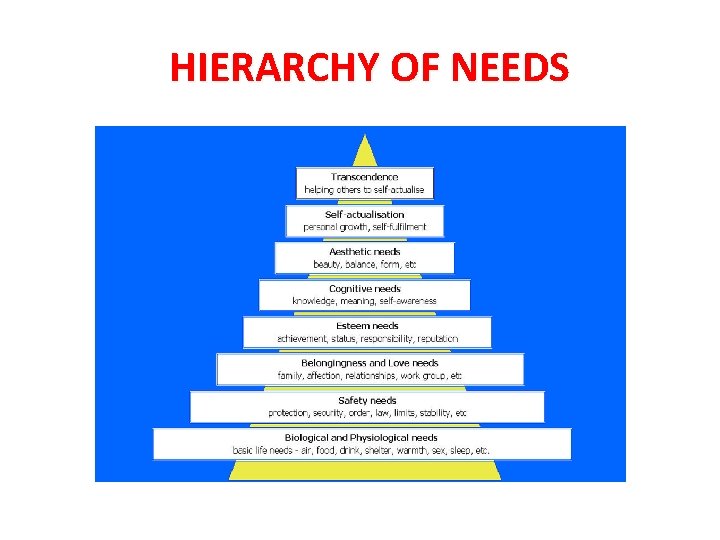
HIERARCHY OF NEEDS • Adapted hierarchy of needs (1990 s) including transcendence needs • Although these aspects were referred to as additional aspects of motivation, • Maslow did not include them as levels or stages within his own expression of the Hierarchy of Needs. •
HIERARCHY OF NEEDS
HIERARCHY OF NEEDS • 5. Cognitive needs - knowledge, meaning, etc. • 6. Aesthetic needs - appreciation and search for beauty, balance, form, • 8. Transcendence needs - helping others to achieve self actualization.
HIERARCHY OF NEEDS • The Maslow's Hierarchy of Needs five-stage model below is clearly and directly attributable to Maslow; • Later versions of theory with added motivational stages are not so clearly attributable to Maslow. • These extended models have been inferred by others from Maslow's work.
Need revision? • Yes? • Or • No?
Abraham Maslow
Abraham Maslow
Need Revision? • Yes? • Or • No?
SO THANK YOU VERY MUCH