
Humanist perspective War and peace Humanist beliefs and
Humanist perspective: War and peace
Humanist beliefs and values Humanists try to use reason, experience, evidence, and respect for the dignity of others when thinking about ethical questions. When deciding what is the right thing to do they consider the particular situation and the potential consequences. They try to promote happiness and fulfilment in this life because they believe it is the only one we have. The absence of belief in an afterlife and the importance placed on the one life we know we have makes many humanists think very carefully before supporting any war, both because of the loss of life involved and because of the potential impact on the survivors.
Humanist perspective There is no universally agreed humanist perspective on war. • • • Many think we should always seek non-violent solutions first and will work to promote peace. Some are pacifists and believe violence should always be avoided. Others believe that to resort to violence in self-defence or for altruistic reasons (to protect the lives and the rights of others) can sometimes be justified on a national level, just as it can on an individual level. War can, on occasion, represent human beings’ ability to act communally in the interests of all. Overall, many humanists believe we need to look at all the available evidence and carefully consider the consequences before any decision to go to war. The horrors of war make many humanists, as well as many other people, question the likelihood of the existence of a benevolent and omnipotent deity.
Causes of war Wars throughout history have often been influenced by the tribal instinct, the desire to protect our territory or tribe, or the desire to gain an advantage over a different group. Humanists believe we can use our natural capacities of reason and empathy to overcome some of our less desirable natural instincts. Many wars have also been fought across the centuries over religious differences, and organised religions have occasionally supported or even encouraged wars. Humanists do not believe that religion provides an appropriate motive for war. Many wars apparently fought over religion are also motivated by other factors. However, any ‘holy war’ fought purely for the achievement of some religious goal, or motivated by some notion of a spiritual reward for those who take part, is likely to be disapproved of by most humanists. Some of the most destructive regimes in the past century have been atheist (e. g. Stalinism, Mao’s Communism, the Khmer Rouge). However, they were also largely authoritarian, totalitarian, and built on a system of unquestioned doctrines. They were very different from the liberal democracies that many humanists support and that have a very good record for not starting wars.
‘Just war’ theory evolved through Greek, Roman, and Christian thinking and has become the dominant way of thinking about war in the modern world. We should avoid the killing of innocents. However, this raises difficult questions: 1) Virtually all modern warfare involves weaponry and tactics that lead to the death of innocent civilians. Are all wars today therefore unjustifiable? 2) Can we really make the distinction between those who are ‘innocent’ and those who are not? Many soldiers have not chosen to go to war; they are forced to fight. Aren’t their deaths just as unjustifiable as those of civilians (some of whom may have supported the war)?
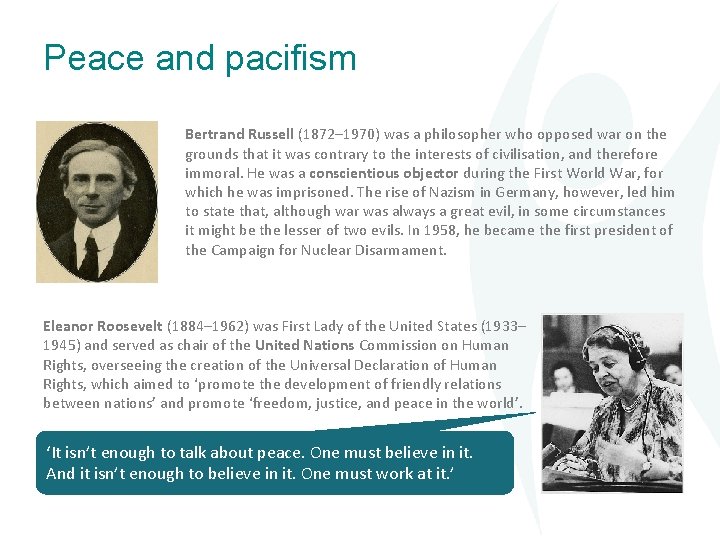
Peace and pacifism Bertrand Russell (1872– 1970) was a philosopher who opposed war on the grounds that it was contrary to the interests of civilisation, and therefore immoral. He was a conscientious objector during the First World War, for which he was imprisoned. The rise of Nazism in Germany, however, led him to state that, although war was always a great evil, in some circumstances it might be the lesser of two evils. In 1958, he became the first president of the Campaign for Nuclear Disarmament. Eleanor Roosevelt (1884– 1962) was First Lady of the United States (1933– 1945) and served as chair of the United Nations Commission on Human Rights, overseeing the creation of the Universal Declaration of Human Rights, which aimed to ‘promote the development of friendly relations between nations’ and promote ‘freedom, justice, and peace in the world’. ‘It isn’t enough to talk about peace. One must believe in it. And it isn’t enough to believe in it. One must work at it. ’
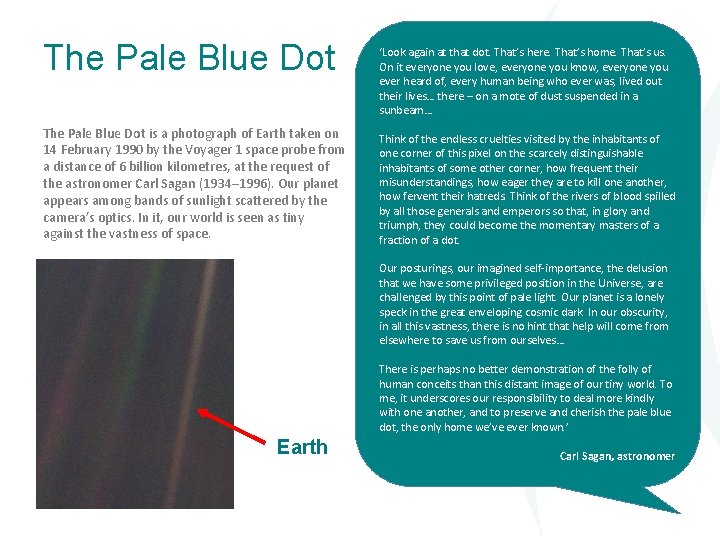
The Pale Blue Dot is a photograph of Earth taken on 14 February 1990 by the Voyager 1 space probe from a distance of 6 billion kilometres, at the request of the astronomer Carl Sagan (1934– 1996). Our planet appears among bands of sunlight scattered by the camera’s optics. In it, our world is seen as tiny against the vastness of space. ‘Look again at that dot. That’s here. That’s home. That’s us. On it everyone you love, everyone you know, everyone you ever heard of, every human being who ever was, lived out their lives… there – on a mote of dust suspended in a sunbeam… Think of the endless cruelties visited by the inhabitants of one corner of this pixel on the scarcely distinguishable inhabitants of some other corner, how frequent their misunderstandings, how eager they are to kill one another, how fervent their hatreds. Think of the rivers of blood spilled by all those generals and emperors so that, in glory and triumph, they could become the momentary masters of a fraction of a dot. Our posturings, our imagined self-importance, the delusion that we have some privileged position in the Universe, are challenged by this point of pale light. Our planet is a lonely speck in the great enveloping cosmic dark. In our obscurity, in all this vastness, there is no hint that help will come from elsewhere to save us from ourselves… There is perhaps no better demonstration of the folly of human conceits than this distant image of our tiny world. To me, it underscores our responsibility to deal more kindly with one another, and to preserve and cherish the pale blue dot, the only home we’ve ever known. ’ Earth Carl Sagan, astronomer
Questions for discussion 1) 2) 3) 4) 5) 6) 7) 8) 9) 10) How many wars in the 20 th and 21 st centuries involved religious differences? How many examples can you find of wars begun by liberal democracies? What can peace-keeping organisations such as the UN do to prevent war? What action should we take about wars in faraway places? What responsibilities do we have? (For example, should we send troops to keep the peace? Should we send help and weapons to one side? Should we send aid to the civilian population? Should we take in refugees from war-torn countries? ) Is violence ever acceptable? Is war ever acceptable? Is pacifism always the best policy? Should we have nuclear/chemical weapons? Should conscientious objection be allowed? Should humanists be represented (as religious groups are) at the national Remembrance Day celebration? How are you deciding your answers to these questions? What principles and arguments influence your answers? How is the humanist view on this issue similar to that of other worldviews you have come across? How is it different?
What rules should we have for war? Can you write a set of rules you think should apply when countries are at war? Consider: • Justification for declaring war • Appropriate conduct • Recruiting soldiers • The use of weapons • The treatment of civilians • The treatment of prisoners of war • Treating the wounded

understandinghumanism. org. uk Understanding Humanism 39 Moreland Street London EC 1 V 8 BB British Humanist Association (registered charity 285987) © 2017
- Slides: 10