
Humanist perspective Families and relationships Humanist beliefs and
Humanist perspective: Families and relationships

Humanist beliefs and values Humanists base their moral decisions on empathy, reason, evidence, and respect for the dignity of each person. Humanists will consider the evidence and the potential consequences of their actions, trying to find the course of action that leads to the least harm. Humanists do not believe in an afterlife and so place great value on happiness in this life. Humanists believe we should have the freedom to live our lives however we wish, as long as our choices do not interfere with anyone else's freedom or cause them any harm.

The Harm Principle ‘The only purpose for which power can be rightfully exercised over any member of a civilised community, against his will, is to prevent harm to others. ’ John Stuart Mill
What is a family and what is it for? • A family is any unit that defines itself as a family and is committed to sharing resources and to mutual love and support. • Today, throughout history, and across the world there and have been an enormous diversity of family structures. We should celebrate this diversity. • We should be free to build the kind of family that suits us. • We should not confine support to our immediate family. All human beings are part of one extended family. Is it time we got rid of the idea of a ‘traditional’ family?
‘Family values’ Is there anything special about ‘family values’? Are they different from other moral values? Most humanists would say not. ‘Family values’ is a phrase often used to invoke a very traditional and unrealistic version of the family, and to try to impose restrictive standards of behaviour on other people. ‘Traditional values’, though they may be good, are not necessarily good. Humanists believe that people should be free to decide for themselves about how they want to live their lives, not have it imposed upon them.
Should we put our families first? • Many humanists feel loyalty towards their family. • They also recognise all human beings are part of an extended family. • We need to take into account the consequences of our actions on all people and the natural world. • We can extend our circle of empathy and concern beyond our families and appreciate our responsibilities towards the wider human race and the animal world. ‘Feelings of right and wrong that at first have their locus within the family gradually develop into a pattern for the tribe or city, then spread to the much larger unit of the nation, and finally from the nation to mankind as a whole. ’ Corliss Lamont, humanist and philosopher (1902 – 1995) Does charity begin at home? Home may be the place we learn how to be charitable to others, but that should be only the beginning of our journey towards charity towards our wider family.
Should we put our families first? Questions: 1) Should we always put our families first? 2) If a member of your family and a stranger were both trapped in a burning building, who would you rescue first? Why? Is it morally acceptable to prioritise one person over another? 3) Parents have a moral obligation to protect their children because they brought them into the world, but do children have a moral obligation to look after their parents? Does it make a difference if your parents were not good parents? 4) If you knew a member of your family had committed a crime, would you report them to the police? 5) Should we prioritise our family when making moral decisions? Can we prioritise them over the whole human race?
Marriage I promise to allow our marriage and each other to change and develop, supporting you in happiness and sorrows, health and illness. I promise to live with you as equal and different individuals and to recognise and accept each other’s strengths and weaknesses. I promise to learn from our shared experiences and to build from them a full and caring friendship based on trust and on respect. I promise to work together with you for the good of the community to which we belong and for the good of humanity as a whole. Vows from a humanist wedding
Marriage Both parties should be equal partners in a marriage. Everyone should be free to make their own choice about whom they are going to marry and be happy with that choice. Nobody should be forced to marry somebody they do not wish to. We should have the freedom to live our own lives the way we want to.
Cohabitation Many humanists approve of the idea of marriage; many others believe that marriage is not necessarily an essential part of a good relationship. Many humanists therefore also approve of cohabitation (unmarried couples living together). Cohabitation can be an opportunity to see if we are really compatible with the person before we decide to commit further, perhaps through marriage or having children together. A couple, should not, however, feel forced to get married if it is not something they wish to do. People should be free to make mutually agreeable decisions about how they wish to live their lives without interference or pressure from others or the state.
Human rights Universal Declaration of Human Rights - Article 16: (1) Men and women of full age, without any limitation due to race, nationality or religion, have the right to marry and to found a family. They are entitled to equal rights as to marriage, during marriage and at its dissolution. (2) Marriage shall be entered into only with the free and full consent of the intending spouses. (3) The family is the natural and fundamental group unit of society and is entitled to protection by society and the State. Does this declaration say anything about what a family should look like?
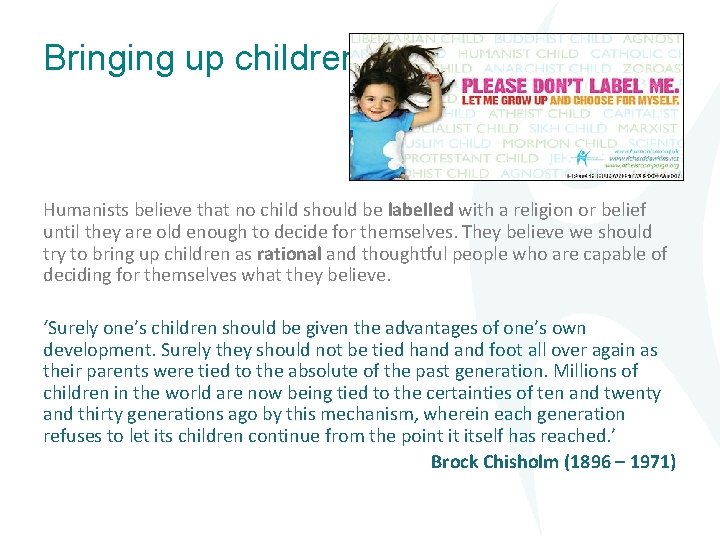
Bringing up children Humanists believe that no child should be labelled with a religion or belief until they are old enough to decide for themselves. They believe we should try to bring up children as rational and thoughtful people who are capable of deciding for themselves what they believe. ‘Surely one’s children should be given the advantages of one’s own development. Surely they should not be tied hand foot all over again as their parents were tied to the absolute of the past generation. Millions of children in the world are now being tied to the certainties of ten and twenty and thirty generations ago by this mechanism, wherein each generation refuses to let its children continue from the point it itself has reached. ’ Brock Chisholm (1896 – 1971)
Bringing up children Questions: 1) 2) 3) 4) 5) 6) 7) 8) Should any guidelines be followed when bringing up a child? Should parents be free to bring their children up however they please? Should parents be allowed to teach their children their religion as though it were the truth? In what ways might parents encourage their children to follow their religion? Is this acceptable? At what age is it appropriate to label ourselves as members of a religion of belief? What rights should children have? Should children be allowed to ‘divorce’ their family or sue their parents for ignoring their rights? Take a look at the UN Declaration of the Rights of the Child. Do you agree or disagree with these rights? Do any conflict with any of your beliefs? Does it restrict our freedom of belief?
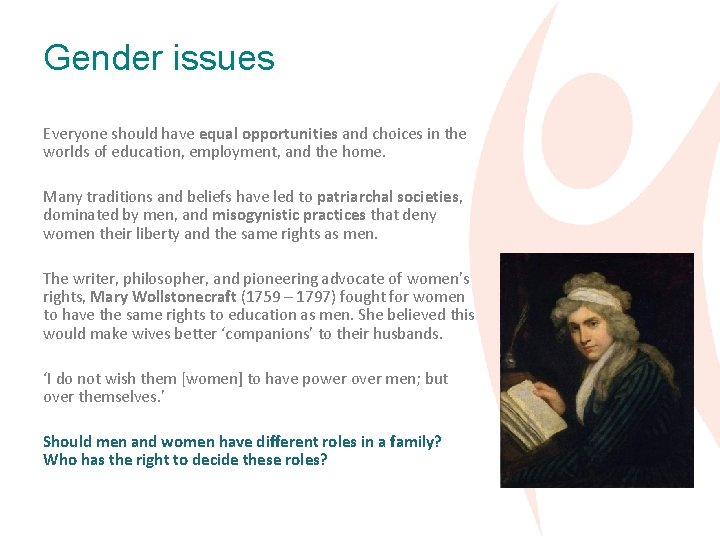
Gender issues Everyone should have equal opportunities and choices in the worlds of education, employment, and the home. Many traditions and beliefs have led to patriarchal societies, dominated by men, and misogynistic practices that deny women their liberty and the same rights as men. The writer, philosopher, and pioneering advocate of women’s rights, Mary Wollstonecraft (1759 – 1797) fought for women to have the same rights to education as men. She believed this would make wives better ‘companions’ to their husbands. ‘I do not wish them [women] to have power over men; but over themselves. ’ Should men and women have different roles in a family? Who has the right to decide these roles?
Same-sex marriage and parenting The British Humanist Association successfully campaigned for the introduction of same-sex marriage in England, Scotland, and Wales. (Humanist celebrants had already conducted same-sex ‘weddings’ for decades before they held any legal status. ) Humanists believe in equal rights. For humanists the question is simply whether same-sex marriages cause anybody any harm. The answer is no. Humanists believe there is no reason to suspect that a same-sex couple would be worse parents than two parents of the opposite sex. The best way to deal with any problems children might face is not to deny same-sex parenting but to work to make society in general more open-minded and tolerant of difference.
What is marriage? Marriage has always been a bond between one man and one woman. ‘This declaration ignores the legally married gay couples in Canada, Spain, Portugal, Argentina, Denmark, Sweden, Norway, Iceland, Belgium, Netherlands, and South Africa. It conveniently forgets the 48 countries where polygamy is still practised. It also omits from history the married gay couples of ancient China and Rome. . . The assertion is obviously false. ’ Jason Wakefield, New Humanist magazine (2012)
Humanist marriages Legal in Scotland since 2005 (now more humanist marriages than Church of Scotland Roman Catholic marriages). Not legally recognised in England, Wales, or Northern Ireland. Humanists believe this is unfair discrimination against the nonreligious and that non-religious people should be able to have a meaningful ceremony conducted by someone who shares their values and approach to life. Should humanist marriages be given the same legal recognition as religious marriages?
Divorce Marriage is not a commitment to be entered into lightly. Married couples should try to work through problems in their relationship and friends and family should support them. Humanists believe that we only know we have one life and so quality of life is important. Humanists consider the consequences of their actions and aim to minimise suffering. Many humanists therefore believe divorce can be acceptable if it reduces overall unhappiness. Many humanists disapprove of infidelity but strongly oppose severe and violent punishment for such behaviour. Which is worse: divorce or an unhappy marriage?
Questions for discussion 1) Do humanist principles inevitably lead to liberal ideas about family values? 2) Should religious people be allowed to impose their moral and social principles on non-religious people? 3) How is the humanist view on this issue similar to that of other worldviews you have come across? How is it different? 4) How are you deciding your answers to these questions? What principles and arguments influence your answers?
understandinghumanism. org. uk Understanding Humanism 39 Moreland Street London EC 1 V 8 BB British Humanist Association (registered charity 285987) © 2015
- Slides: 20