
Humanism What is the meaning of life What





- Slides: 24
Humanism
§ What is the meaning of life? What is the right way to behave? Do you ever think about questions like these? In earlier chapters, you saw that many people in the Middle Ages looked to religious beliefs, especially ideas about the afterlife, for answers to such questions. Renaissance thinkers – people we refer to as “humanists” today – reintroduced ideas from pre-Christian time to this religious foundations. They encouraged people to develop their minds and talents, and to use them for the good of society as well as the glory of God. How did these humanists express their ideas and how did these ideas spread? What was the impact of humanist thinking on European society. In This Chapter Page 59
Vocabulary Humanist Philosopher Patrons Vernacular Civic Scholar Aqueduct Petroglyphs Pieta Ten Commandments Classical Democracy Facade Sonnet Rhetoric Civic Humanism Colosseum Pictographs Symmetry
Humanism § Began most prominently in Italy § Influenced by Classical civilizations § Ancient Greece and Rome § Much of the knowledge was preserved within the Islamic World § Main focus/goal = Active Citizenship § The rise of the Individual § Higher education § Inspiration through the arts § Petrarch known as the “Father of Humanism”
§Civic comes from the Latin word to mean “citizen” §Civic Humanists believed in: §Educating yourself about history and political issues §Helping to Improve Society
I § “ find that we have spent a large sum of money from 1434 to 1471, as appears from an account book covering that period. It shows an incredible sum. . Spent in building, charities and taxes, not counting other expenses; not would I complain about this, for though many a man would like to have even part of that sum in his purse I think it gave great luster to the state and this money seems to be well spent. ” - Lorenzo de Medici How does this express Lorenzo de Medici’s civic humanism?
Read the achievements of the Greeks and the Romans (Page 62) and using a mind map like the one below list the many accomplishments of the Roman and Greek Civilizations Accomplishments of Roman Civilization… Accomplishments of Greek Civilization… Zoom In
§Discuss: §How can thinkers and philosophers bring about change in society? §Why is being an informed citizen important today?
§ Spread new ideas and educate broader society to think and contribute as a citizen § Add new dimensions to society, such as an appreciation for the Arts § They often held high/important positions in courts, government, and the Church § Encouraged education, and as dedicated teachers would encourage students to be curious and to question the status quo, which could lead to debate and discrepancy on ideals, which could lead to social activist movements, which would lead to change
§ Most important way a humanist could create change was through education § Many humanists were teachers who ran their own schools. They believed it was important to: § Train young people to have good character , good bodies and minds (educating the whole-child approach) § Encourage people to be curious and to question things
• Taught during the Middle Ages • Grammar • Public Speaking • Logic • Arithmetic • Geometry • Astronomy • Music • Religion (theology) • Scripture (theology, religion) • Medicine • Taught during the Renaissance • Greek and Roman writings • Physical training • Ethics and morality (knowing what is the right way to treat people) • Aesthetics (beliefs about beauty, pleasing the mind) • Learning good manners and behavior • History • How to speak well (eloquence) Think It Through What programs exist in your school that reflect a whole-child approach? What additional programs would you suggest?
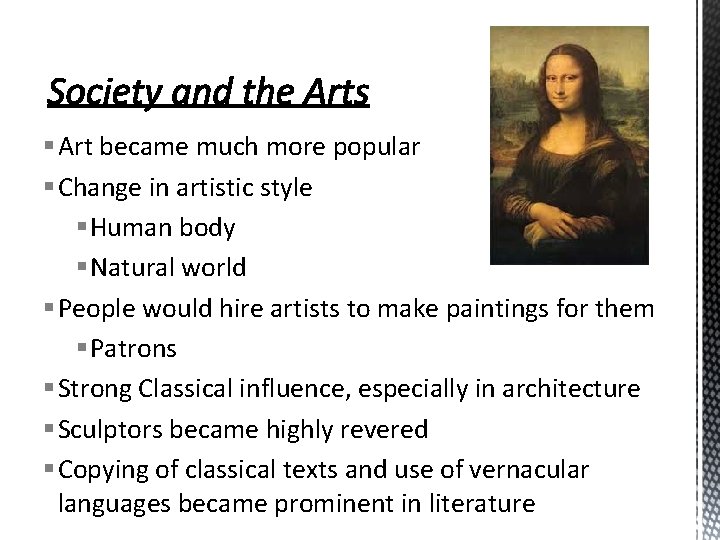
§ Art became much more popular § Change in artistic style § Human body § Natural world § People would hire artists to make paintings for them § Patrons § Strong Classical influence, especially in architecture § Sculptors became highly revered § Copying of classical texts and use of vernacular languages became prominent in literature
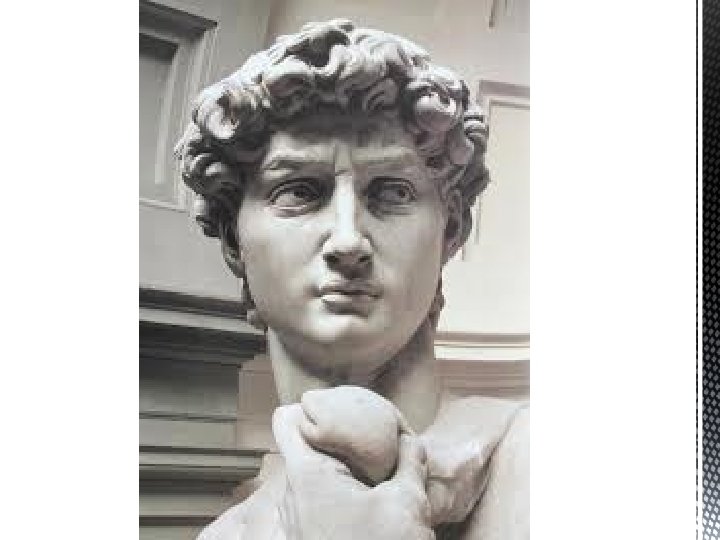
Sculpture § In the middle ages sculptors were seen as craftspeople rather than artists. § They were part of a construction team and usually didn’t even sign their work § Role changed dramatically during the renaissance § Artistic genius raised the status of artists, sculptors like Michelangelo became celebrities with international reputations
Literature § In the early renaissance writers focused on translating the works of Roman and Greek writers and copying their styles. § Books or texts written in the vernacular became more accessible § Much of the writing during the Renaissance questioned the traditional ways of seeing the world Vernacular- the language commonly spoken by the people who live in that region
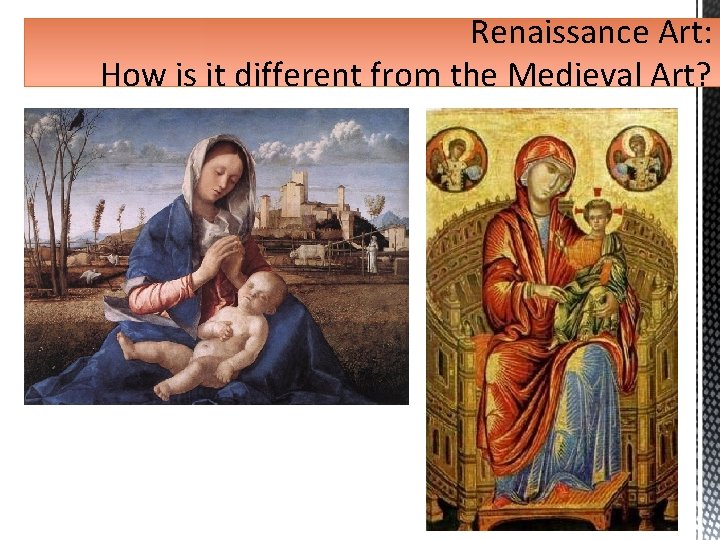
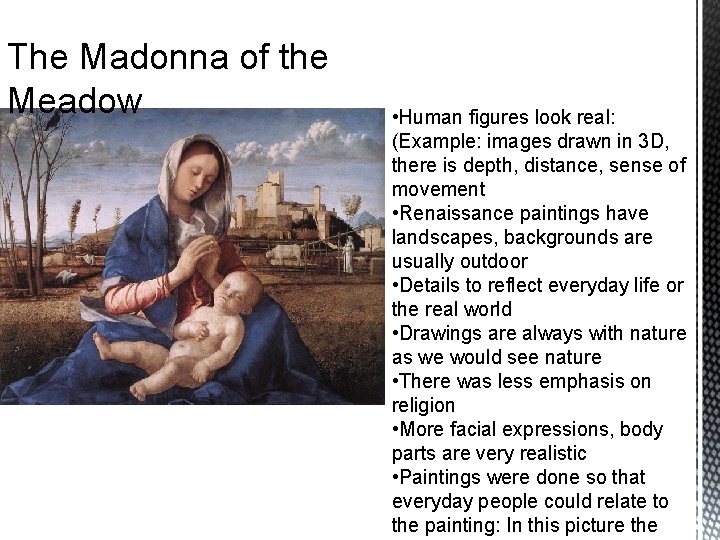
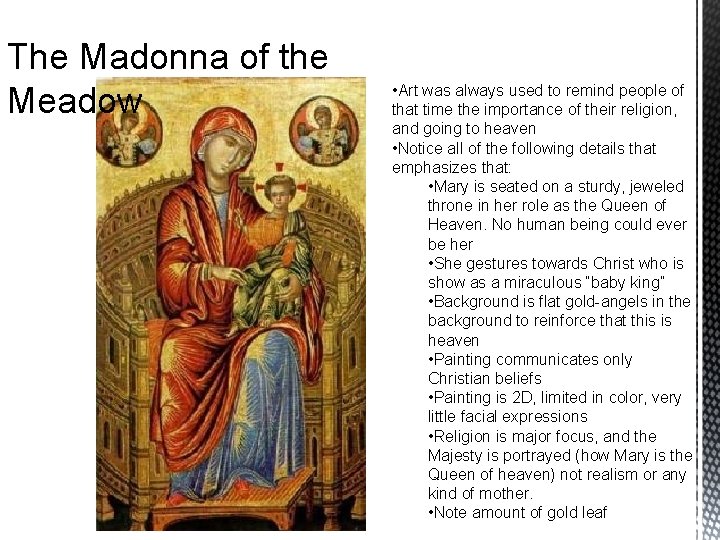
Renaissance Art: How is it different from the Medieval Art?
The Madonna of the Meadow • Human figures look real: (Example: images drawn in 3 D, there is depth, distance, sense of movement • Renaissance paintings have landscapes, backgrounds are usually outdoor • Details to reflect everyday life or the real world • Drawings are always with nature as we would see nature • There was less emphasis on religion • More facial expressions, body parts are very realistic • Paintings were done so that everyday people could relate to the painting: In this picture the
The Madonna of the Meadow • Art was always used to remind people of that time the importance of their religion, and going to heaven • Notice all of the following details that emphasizes that: • Mary is seated on a sturdy, jeweled throne in her role as the Queen of Heaven. No human being could ever be her • She gestures towards Christ who is show as a miraculous “baby king” • Background is flat gold-angels in the background to reinforce that this is heaven • Painting communicates only Christian beliefs • Painting is 2 D, limited in color, very little facial expressions • Religion is major focus, and the Majesty is portrayed (how Mary is the Queen of heaven) not realism or any kind of mother. • Note amount of gold leaf
§ “An architect should be a good writer, a skillful draftsman, versed in geometry and optics, expert at figures, acquainted with history, informed on the principles of natural and moral philosophy, somewhat of a musician, not ignorant of the law and of physics, nor of the motions, laws, and relations to each of the heavenly bodies” - Adapted from The Architecture of Marcus Vitruvius Pollio in Ten Books Think It Through What connections can you make between Vitruvius’s description of an architect and the renaissance view of the individual?
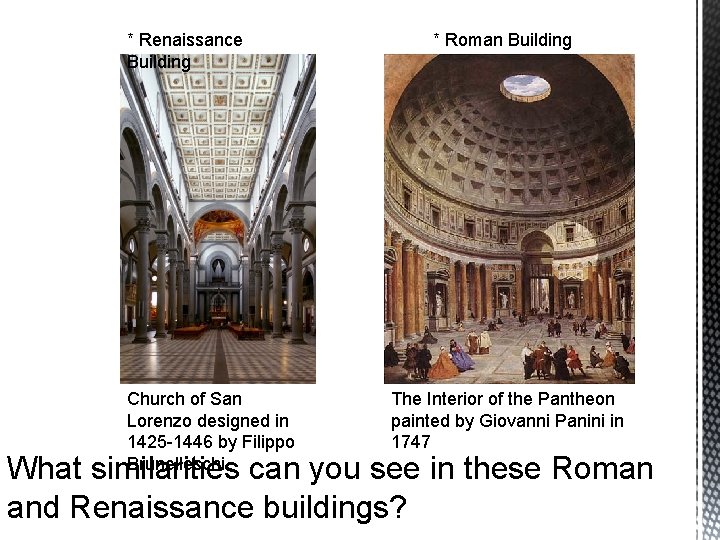
* Renaissance Building Church of San Lorenzo designed in 1425 -1446 by Filippo Brunelleschi * Roman Building The Interior of the Pantheon painted by Giovanni Panini in 1747 What similarities can you see in these Roman and Renaissance buildings?
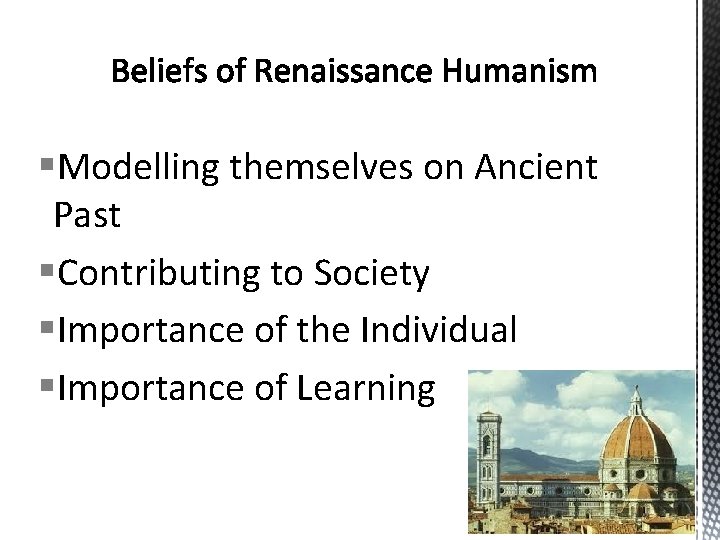
§Modelling themselves on Ancient Past §Contributing to Society §Importance of the Individual §Importance of Learning