
HUMANENVIRONMENT INTERACTIONS Human Adaptations Modifications Rural Networks Urbanization
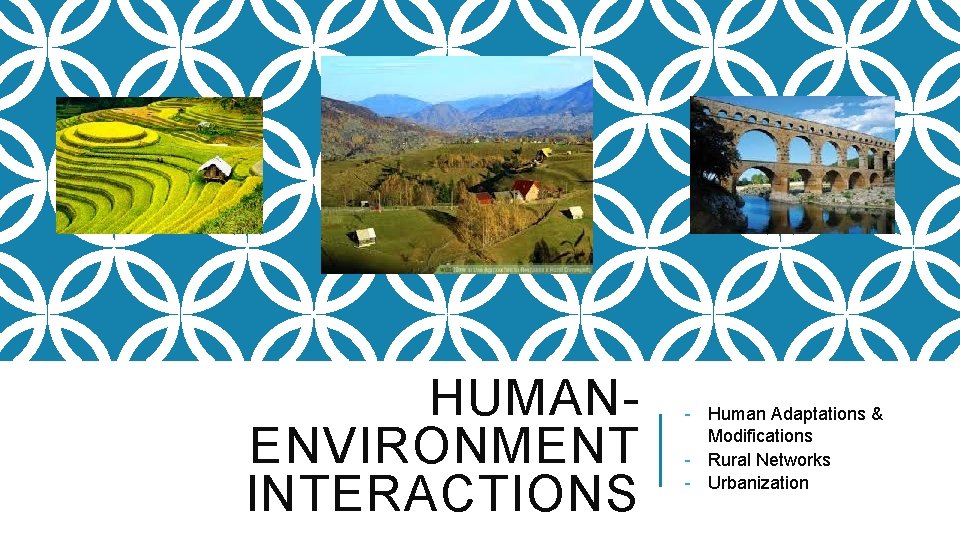
HUMANENVIRONMENT INTERACTIONS - Human Adaptations & Modifications - Rural Networks - Urbanization
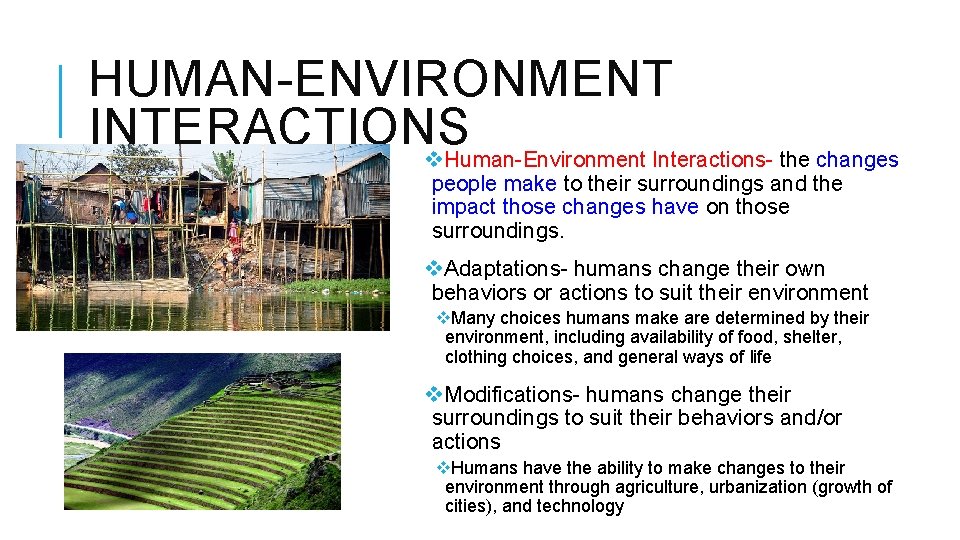
HUMAN-ENVIRONMENT INTERACTIONS v. Human-Environment Interactions- the changes people make to their surroundings and the impact those changes have on those surroundings. v. Adaptations- humans change their own behaviors or actions to suit their environment v. Many choices humans make are determined by their environment, including availability of food, shelter, clothing choices, and general ways of life v. Modifications- humans change their surroundings to suit their behaviors and/or actions v. Humans have the ability to make changes to their environment through agriculture, urbanization (growth of cities), and technology
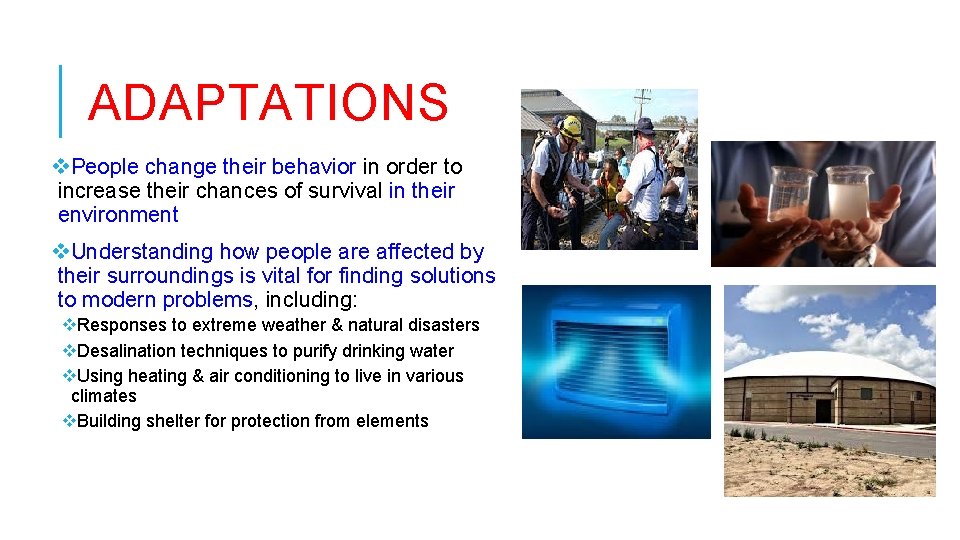
ADAPTATIONS v. People change their behavior in order to increase their chances of survival in their environment v. Understanding how people are affected by their surroundings is vital for finding solutions to modern problems, including: v. Responses to extreme weather & natural disasters v. Desalination techniques to purify drinking water v. Using heating & air conditioning to live in various climates v. Building shelter for protection from elements
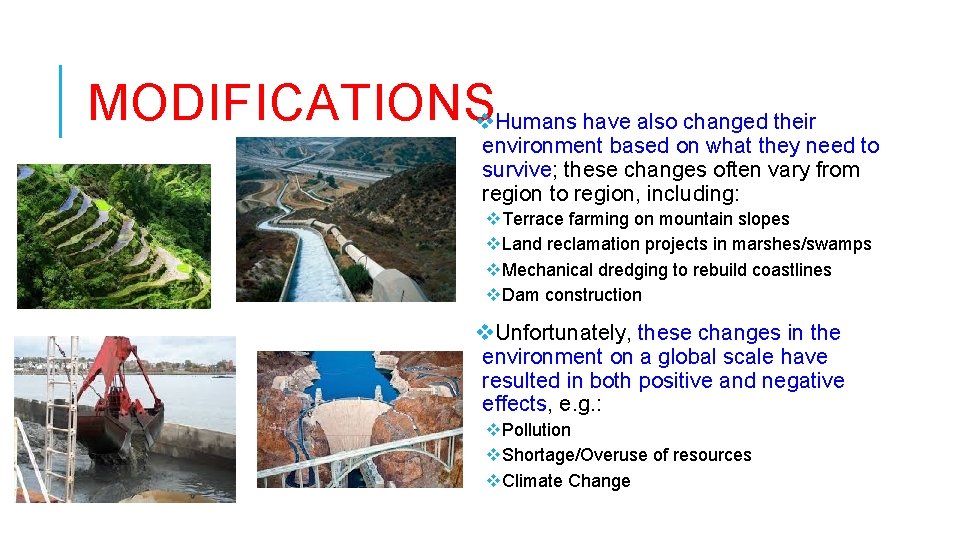
MODIFICATIONSv. Humans have also changed their environment based on what they need to survive; these changes often vary from region to region, including: v. Terrace farming on mountain slopes v. Land reclamation projects in marshes/swamps v. Mechanical dredging to rebuild coastlines v. Dam construction v. Unfortunately, these changes in the environment on a global scale have resulted in both positive and negative effects, e. g. : v. Pollution v. Shortage/Overuse of resources v. Climate Change
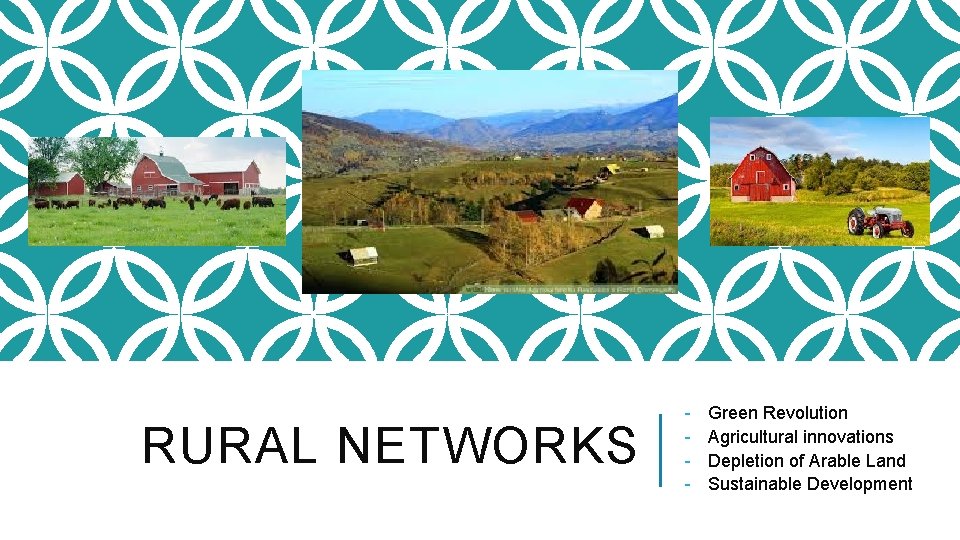
RURAL NETWORKS - Green Revolution Agricultural innovations Depletion of Arable Land Sustainable Development
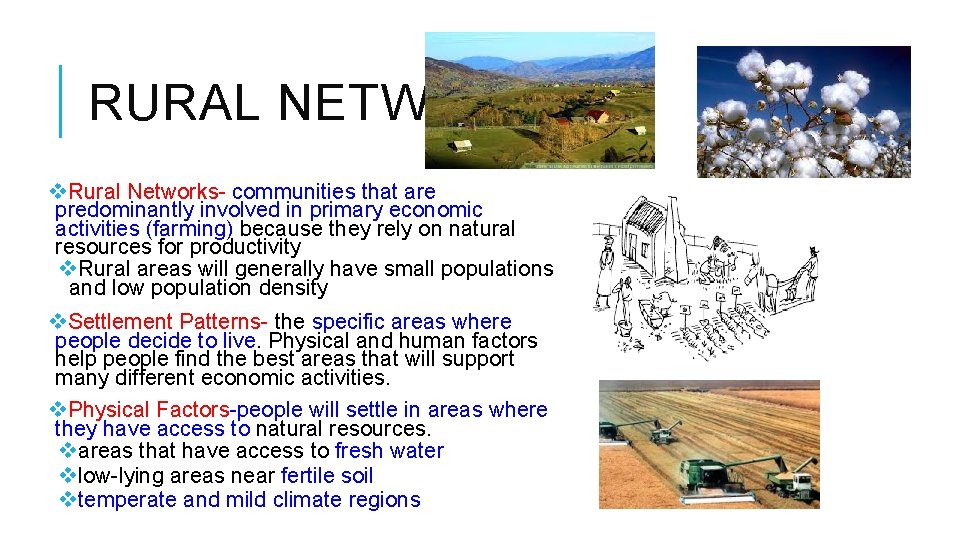
RURAL NETWORKS v. Rural Networks- communities that are predominantly involved in primary economic activities (farming) because they rely on natural resources for productivity v. Rural areas will generally have small populations and low population density v. Settlement Patterns- the specific areas where people decide to live. Physical and human factors help people find the best areas that will support many different economic activities. v. Physical Factors-people will settle in areas where they have access to natural resources. vareas that have access to fresh water vlow-lying areas near fertile soil vtemperate and mild climate regions
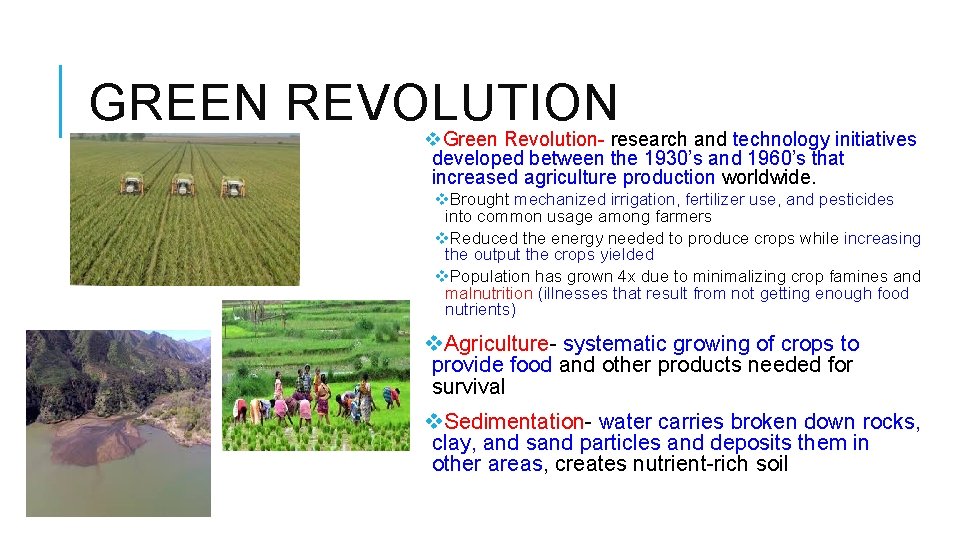
GREEN REVOLUTION v. Green Revolution- research and technology initiatives developed between the 1930’s and 1960’s that increased agriculture production worldwide. v. Brought mechanized irrigation, fertilizer use, and pesticides into common usage among farmers v. Reduced the energy needed to produce crops while increasing the output the crops yielded v. Population has grown 4 x due to minimalizing crop famines and malnutrition (illnesses that result from not getting enough food nutrients) v. Agriculture- systematic growing of crops to provide food and other products needed for survival v. Sedimentation- water carries broken down rocks, clay, and sand particles and deposits them in other areas, creates nutrient-rich soil
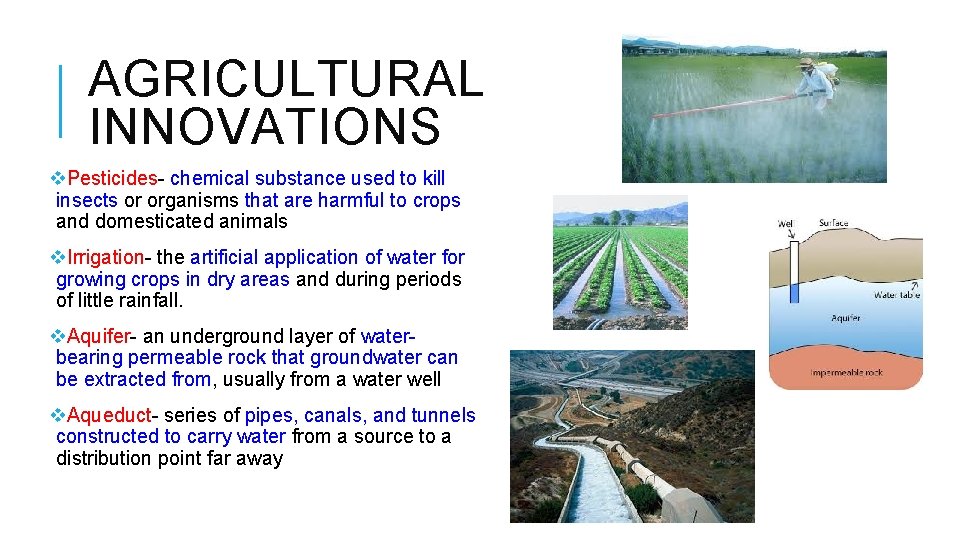
AGRICULTURAL INNOVATIONS v. Pesticides- chemical substance used to kill insects or organisms that are harmful to crops and domesticated animals v. Irrigation- the artificial application of water for growing crops in dry areas and during periods of little rainfall. v. Aquifer- an underground layer of waterbearing permeable rock that groundwater can be extracted from, usually from a water well v. Aqueduct- series of pipes, canals, and tunnels constructed to carry water from a source to a distribution point far away
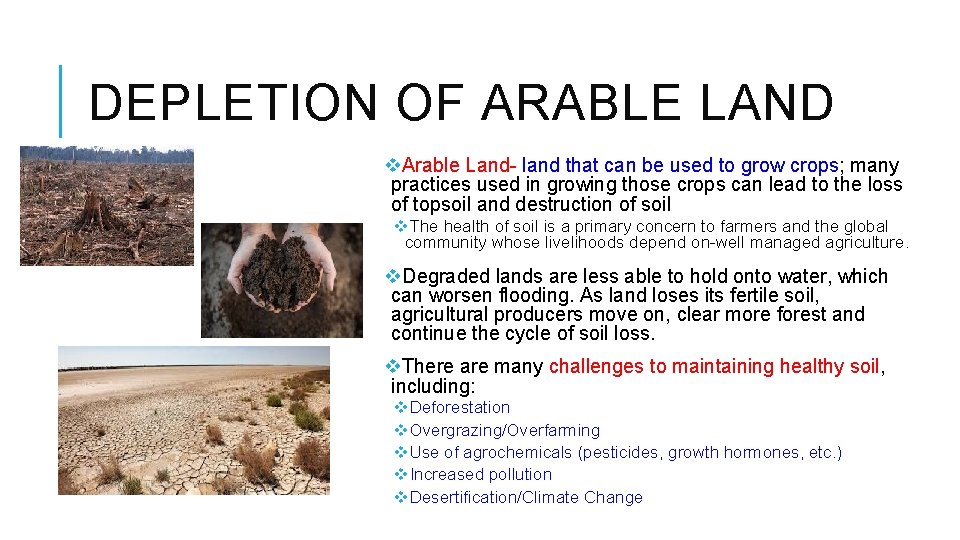
DEPLETION OF ARABLE LAND v. Arable Land- land that can be used to grow crops; many practices used in growing those crops can lead to the loss of topsoil and destruction of soil v. The health of soil is a primary concern to farmers and the global community whose livelihoods depend on-well managed agriculture. v. Degraded lands are less able to hold onto water, which can worsen flooding. As land loses its fertile soil, agricultural producers move on, clear more forest and continue the cycle of soil loss. v. There are many challenges to maintaining healthy soil, including: v. Deforestation v. Overgrazing/Overfarming v. Use of agrochemicals (pesticides, growth hormones, etc. ) v. Increased pollution v. Desertification/Climate Change
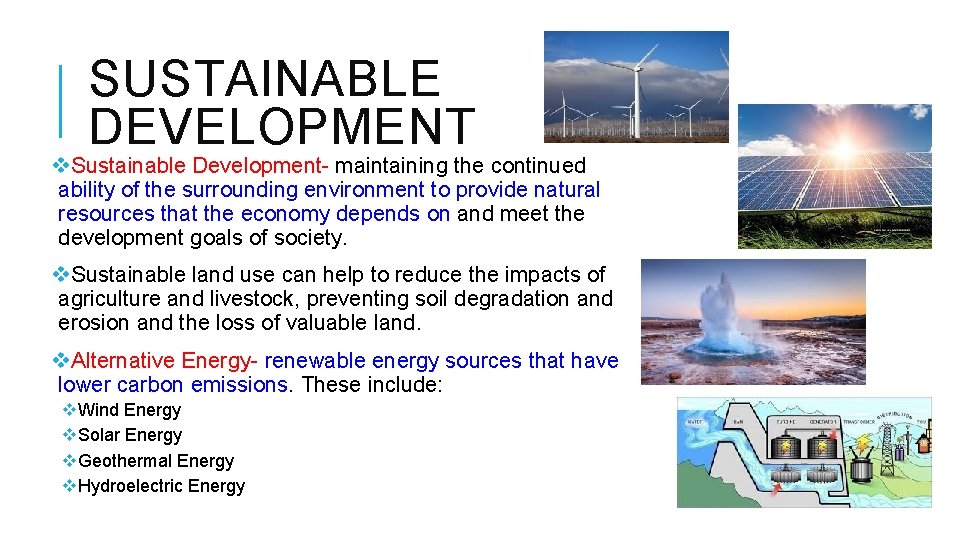
SUSTAINABLE DEVELOPMENT v. Sustainable Development- maintaining the continued ability of the surrounding environment to provide natural resources that the economy depends on and meet the development goals of society. v. Sustainable land use can help to reduce the impacts of agriculture and livestock, preventing soil degradation and erosion and the loss of valuable land. v. Alternative Energy- renewable energy sources that have lower carbon emissions. These include: v. Wind Energy v. Solar Energy v. Geothermal Energy v. Hydroelectric Energy
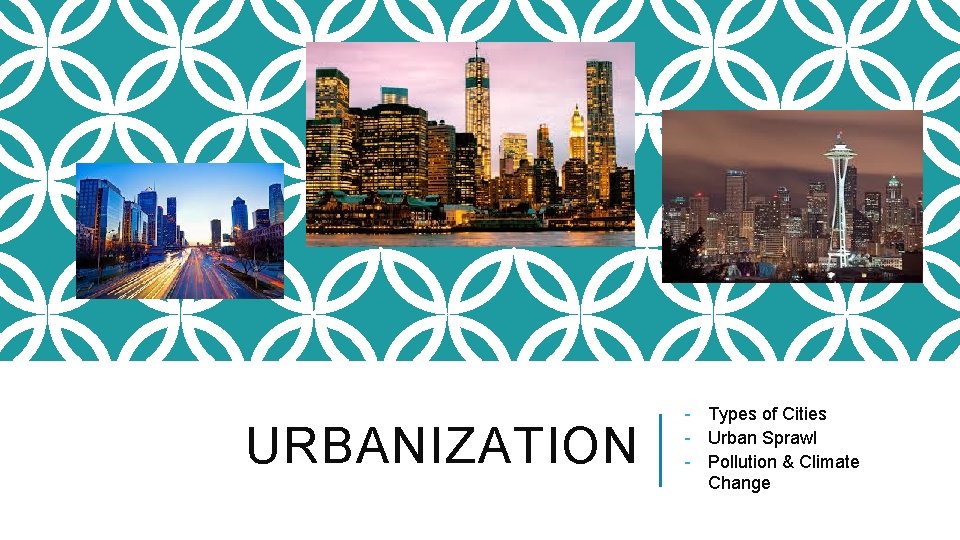
URBANIZATION - Types of Cities - Urban Sprawl - Pollution & Climate Change
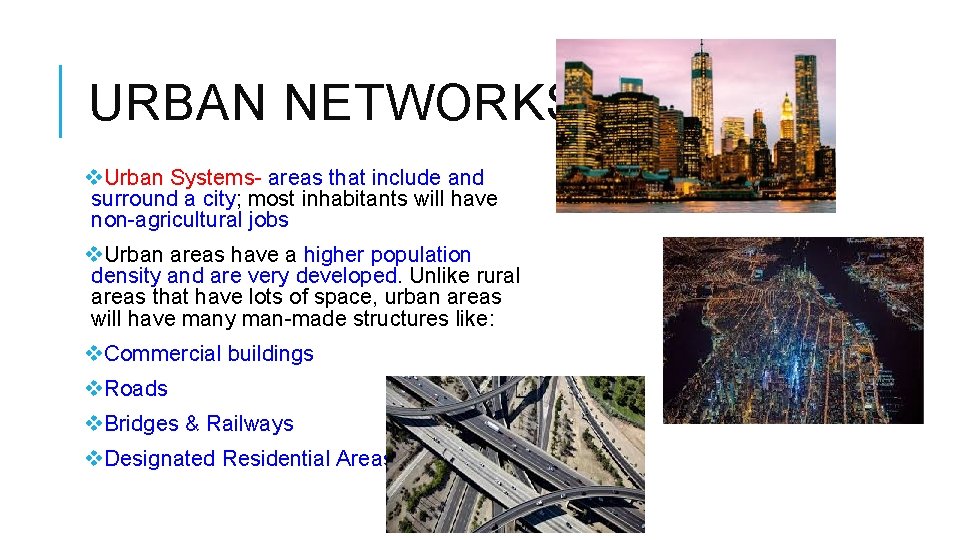
URBAN NETWORKS v. Urban Systems- areas that include and surround a city; most inhabitants will have non-agricultural jobs v. Urban areas have a higher population density and are very developed. Unlike rural areas that have lots of space, urban areas will have many man-made structures like: v. Commercial buildings v. Roads v. Bridges & Railways v. Designated Residential Areas
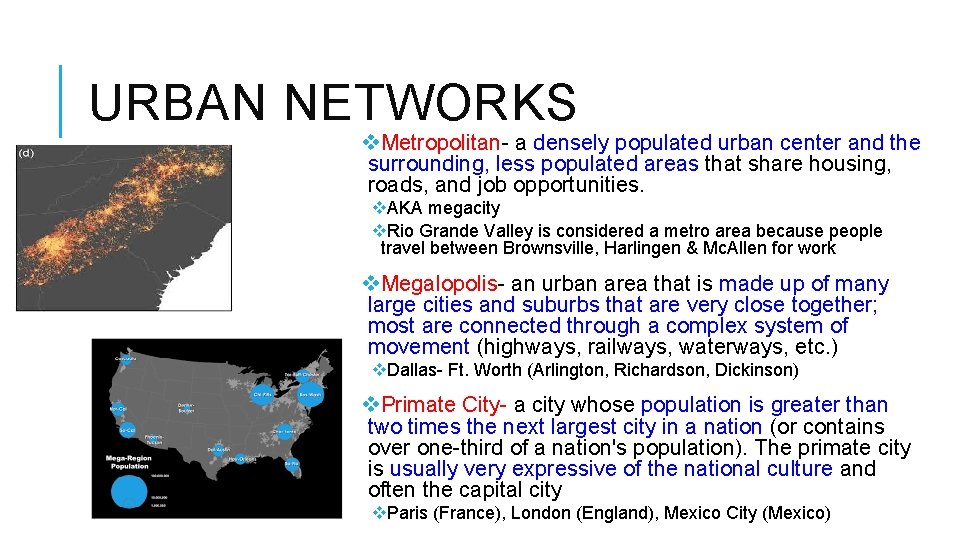
URBAN NETWORKS v. Metropolitan- a densely populated urban center and the surrounding, less populated areas that share housing, roads, and job opportunities. v. AKA megacity v. Rio Grande Valley is considered a metro area because people travel between Brownsville, Harlingen & Mc. Allen for work v. Megalopolis- an urban area that is made up of many large cities and suburbs that are very close together; most are connected through a complex system of movement (highways, railways, waterways, etc. ) v. Dallas- Ft. Worth (Arlington, Richardson, Dickinson) v. Primate City- a city whose population is greater than two times the next largest city in a nation (or contains over one-third of a nation's population). The primate city is usually very expressive of the national culture and often the capital city v. Paris (France), London (England), Mexico City (Mexico)
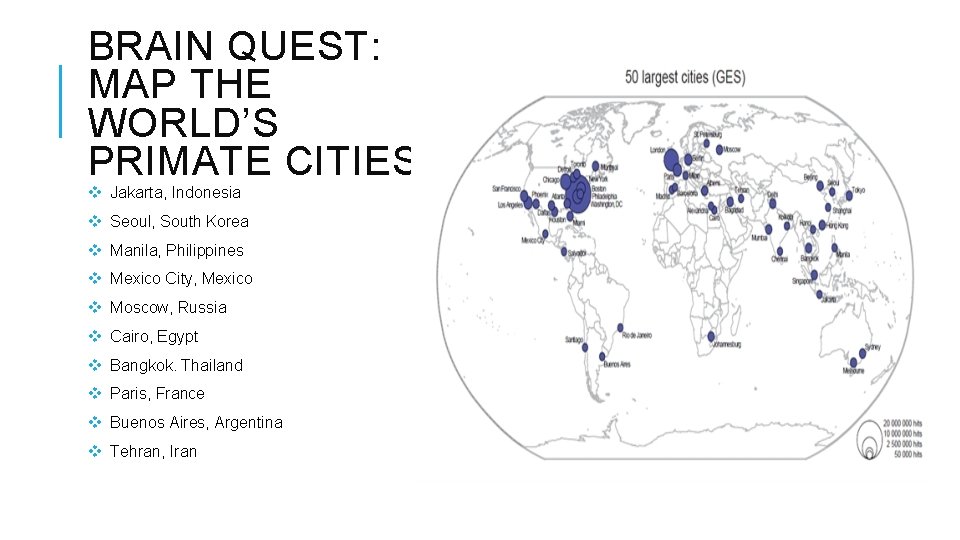
BRAIN QUEST: MAP THE WORLD’S PRIMATE CITIES v Jakarta, Indonesia v Seoul, South Korea v Manila, Philippines v Mexico City, Mexico v Moscow, Russia v Cairo, Egypt v Bangkok. Thailand v Paris, France v Buenos Aires, Argentina v Tehran, Iran
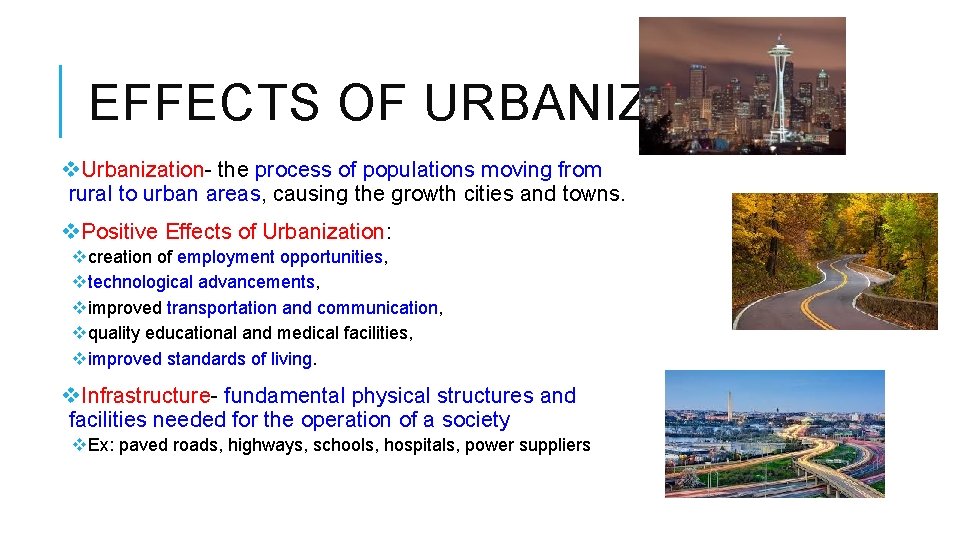
EFFECTS OF URBANIZATION v. Urbanization- the process of populations moving from rural to urban areas, causing the growth cities and towns. v. Positive Effects of Urbanization: vcreation of employment opportunities, vtechnological advancements, vimproved transportation and communication, vquality educational and medical facilities, vimproved standards of living. v. Infrastructure- fundamental physical structures and facilities needed for the operation of a society v. Ex: paved roads, highways, schools, hospitals, power suppliers
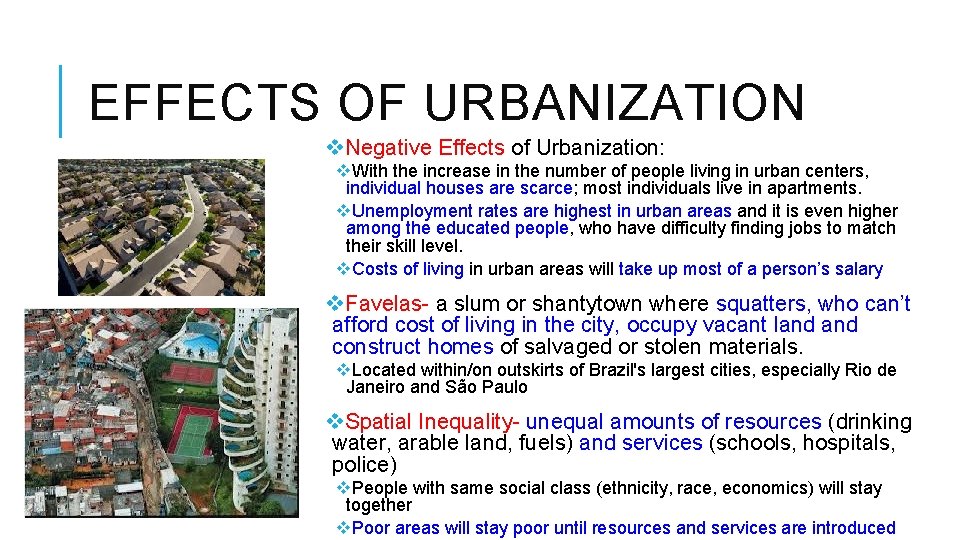
EFFECTS OF URBANIZATION v. Negative Effects of Urbanization: v. With the increase in the number of people living in urban centers, individual houses are scarce; most individuals live in apartments. v. Unemployment rates are highest in urban areas and it is even higher among the educated people, who have difficulty finding jobs to match their skill level. v. Costs of living in urban areas will take up most of a person’s salary v. Favelas- a slum or shantytown where squatters, who can’t afford cost of living in the city, occupy vacant land construct homes of salvaged or stolen materials. v. Located within/on outskirts of Brazil's largest cities, especially Rio de Janeiro and São Paulo v. Spatial Inequality- unequal amounts of resources (drinking water, arable land, fuels) and services (schools, hospitals, police) v. People with same social class (ethnicity, race, economics) will stay together v. Poor areas will stay poor until resources and services are introduced
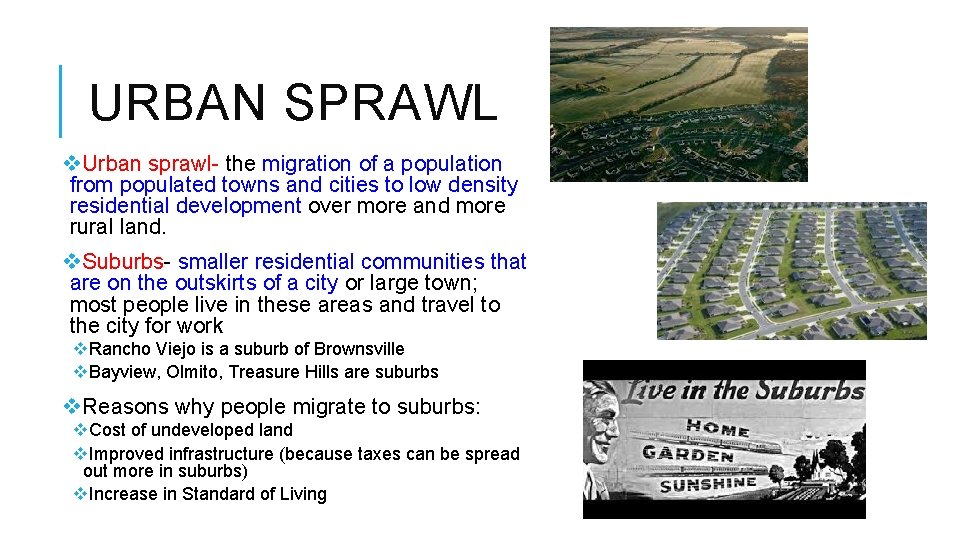
URBAN SPRAWL v. Urban sprawl- the migration of a population from populated towns and cities to low density residential development over more and more rural land. v. Suburbs- smaller residential communities that are on the outskirts of a city or large town; most people live in these areas and travel to the city for work v. Rancho Viejo is a suburb of Brownsville v. Bayview, Olmito, Treasure Hills are suburbs v. Reasons why people migrate to suburbs: v. Cost of undeveloped land v. Improved infrastructure (because taxes can be spread out more in suburbs) v. Increase in Standard of Living
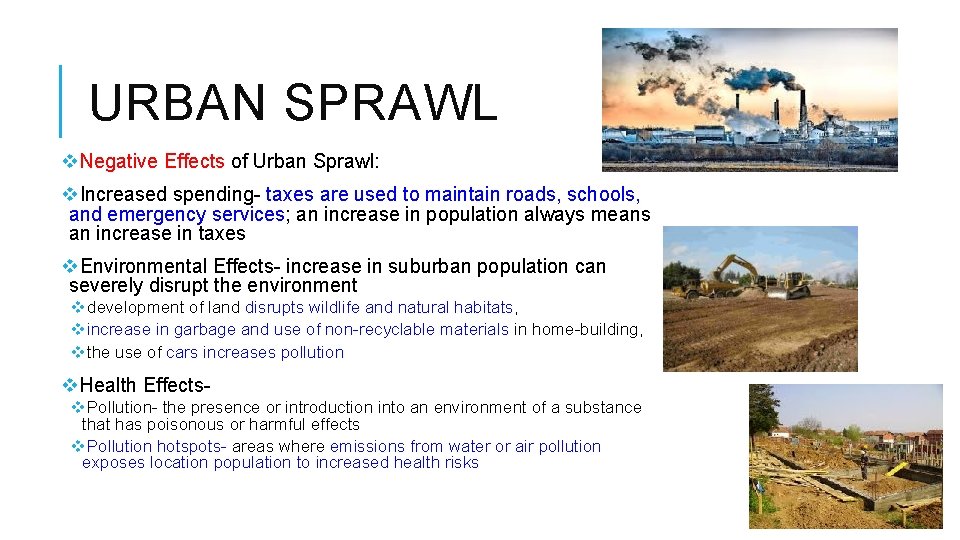
URBAN SPRAWL v. Negative Effects of Urban Sprawl: v. Increased spending- taxes are used to maintain roads, schools, and emergency services; an increase in population always means an increase in taxes v. Environmental Effects- increase in suburban population can severely disrupt the environment vdevelopment of land disrupts wildlife and natural habitats, vincrease in garbage and use of non-recyclable materials in home-building, vthe use of cars increases pollution v. Health Effectsv. Pollution- the presence or introduction into an environment of a substance that has poisonous or harmful effects v. Pollution hotspots- areas where emissions from water or air pollution exposes location population to increased health risks
- Slides: 18