
Human Visual Attention Lecture 2 CS 510 Spring



- Slides: 26
Human Visual Attention Lecture #2 CS 510, Spring 2018
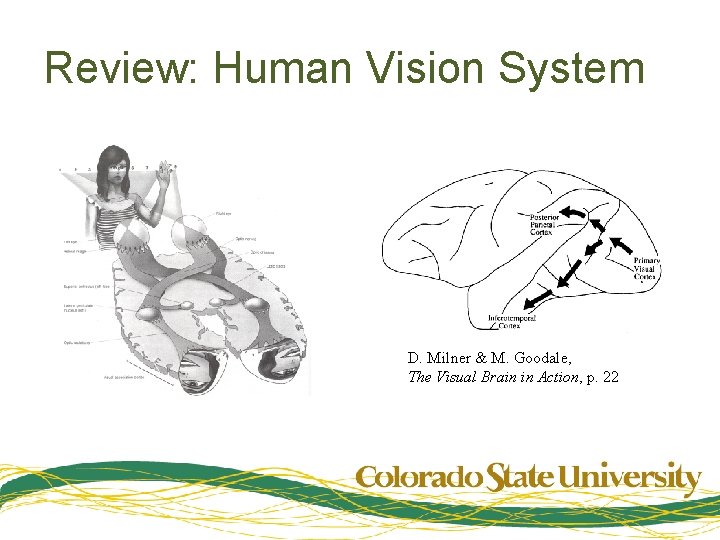
Review: Human Vision System D. Milner & M. Goodale, The Visual Brain in Action, p. 22
What is attention? • “The selective aspect of processing” – Kosslyn 1 • “processes that enable an observer to recruit resources for processing selected aspects of the retinal image more fully than nonselected aspects” – Palmer 2
Overt vs. Covert Attention 3 • Overt attention: observable movements of eyes, head & body to orient eyes – Foveas: 90% of receptors, 2° – Allocation to 3 D point in space • Vergence & focus – Average dwell time: ~300 ms 4 – Saccadic movement • Very fast: ~30 ms, up to 900°/sec • Suppression: no input during saccade – World appears as sequence of displaced, small, high resolution, stereo images with low resolution peripheries
Overt vs. Covert Attention (II) • You don’t process all the data in your foveal image • Covert attention: selection of retinal data to process (“inner eye”) – – Cannot be observed directly Its existence is not in dispute Its form is a matter of intense debate Assumption: insufficient resources necessitate covert attention. • Covert attention is the subject of this talk
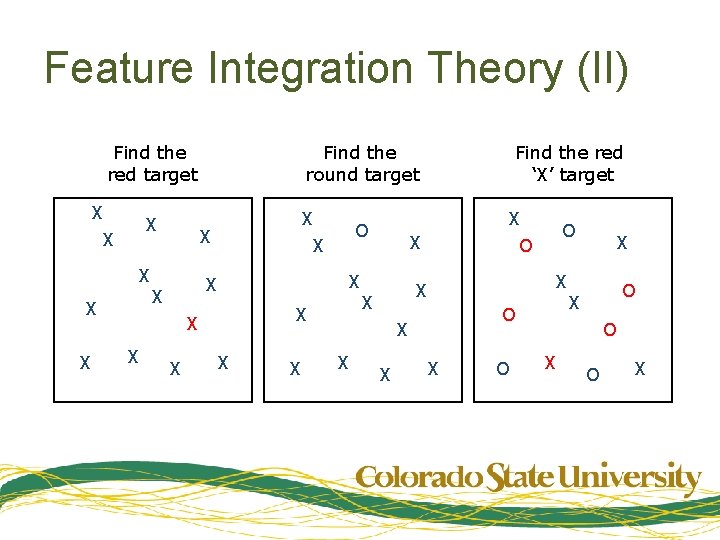
3 Models of Covert Attention 1. Feature Integration Theory 5 ¡ “Pre-attentive” low-level features computed in parallel across the image • E. g. color, edge orientations, motion ¡ In visual search, attention can jump to locations based on pre-attentive features (“pop-out”) ¡ Conjunctions of features or complex features require sequential search ¡ Implicitly assumes attention is like a spotlight
Feature Integration Theory (II) Find the red target X X X Find the round target X X X X X O X X Find the red ‘X’ target X O X X X O X O X O X
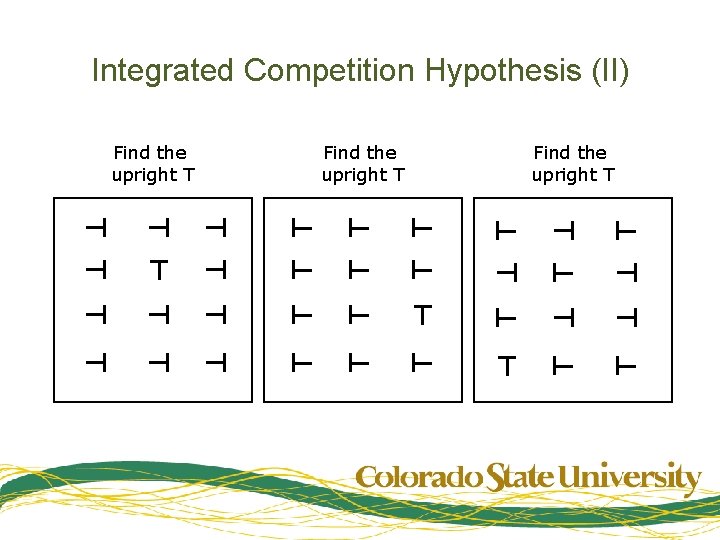
3 Models (II) 2. Integrated Competition Hypothesis 6 ¡ “Pop-out” effect depends on: • Homogeneity of distractors • Homogeneity of targets (seq. pres. ) ¡ Primary role of attention is segmentation (or grouping) ¡ Low-level features important as the basis of segmentation
Integrated Competition Hypothesis (II) Find the upright T
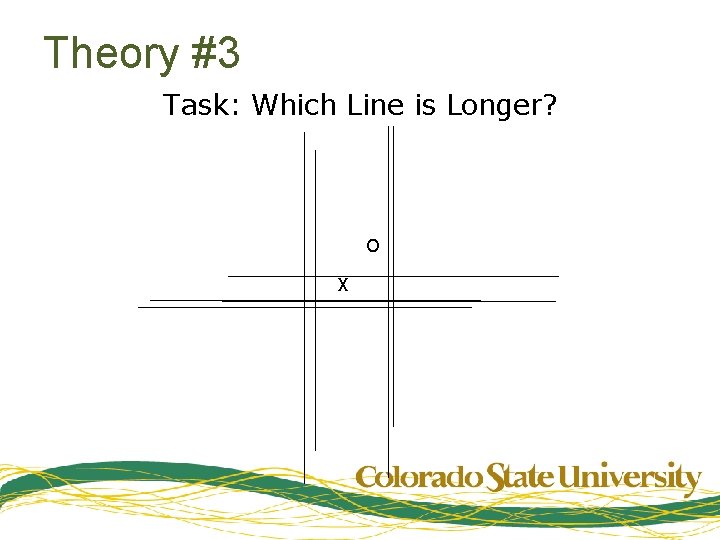
Theory #3 Task: Which Line is Longer? O X
3 Models (III) • Inattentional Blindness Theory 7 – When concentrating on the task, most subjects will not see additional objects • Depends on semantics of additional object – Additional objects are interpreted • Cause priming effects – Hypothesis: all objects in visual field are interpreted • Attention is a late effect, caused by attentional bottleneck
Gorilla • Category Example • Memorable • Worth knowing
Temple Grandin Quoting from pages 299 -300 That's why autistic savants can make perspective drawings without being taught how. They're drawing what they see, which is all the little changes in size and texture that tell you one object is closer up and another object is farther away. Normal people can't see a. U those little changes without a lot of training and effort, because their brains process them unconsciously. So normal people are drawing what they "see, " which is the finished object, after their brains have put it all together. Normal people don't draw a dog, they draw a concept of a dog. Autistic people draw the dog. It's ironic that we always say autistic children are in their own little worlds, because if Dr. Snyder is right it's normal people who are living inside their heads. Autistic people are experiencing the actual world much more directly and accurately than normal people, with all their inattentional blindness and their change blindness and their every-other-kind-of-blindness.
Whose right? • Most likely explanation: everyone! • Vision is a multi-stage process – Every stage is coarsely parallel – Every stage is resource limited – Every stage attends based on data, task • There is evidence for attention at the level of: – – Windows (spatial)8 Features 9, 11 Objects 10, 20 Awareness 7
Capacity Theory 12 • Vision is a resource-limited pipeline (or conveyer belt 13) • Data and task demands determine where and how attention occurs – Psychological support for shifting from spatial to feature-based attention 14 – ERP support for spatial attention preceding feature-based attention 15
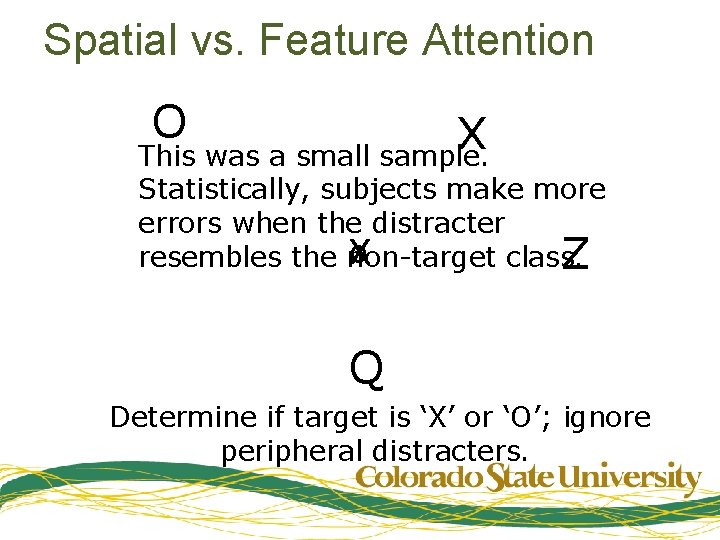
Spatial vs. Feature Attention O X This was a small sample. Statistically, subjects make more errors when the distracter o X resembles the non-target class. Z Q Determine if target is ‘X’ or ‘O’; ignore peripheral distracters.
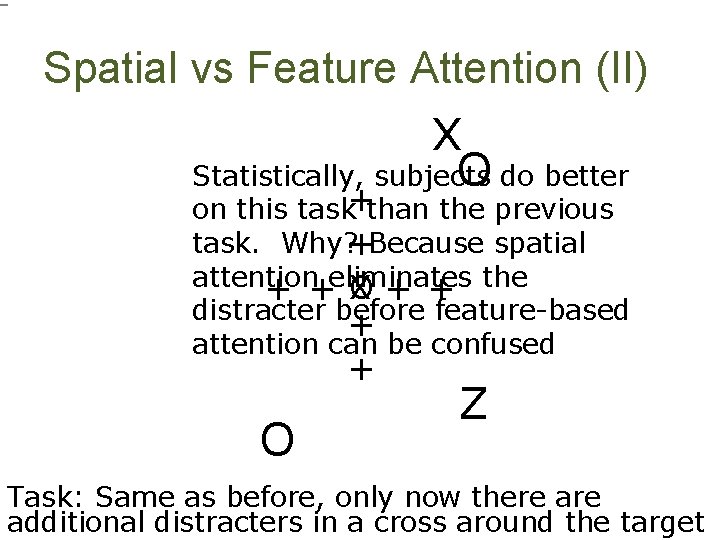
Spatial vs Feature Attention (II) + + X O do better Statistically, subjects + + on this task than the previous task. Why? Because spatial attention + +eliminates O + + the X distracter before feature-based attention can be confused O Z Task: Same as before, only now there additional distracters in a cross around the target
Relation to Human Object Recognition • • Attention occurs at every processing stage Human object recognition can be modeled as a four stage pipeline: 1. 2. 3. 4. Early vision (spatial attention) Feature extraction (feature attention) Categorization (object category att. ) Expertise (object attention) l What do we know about these types of visual attention?
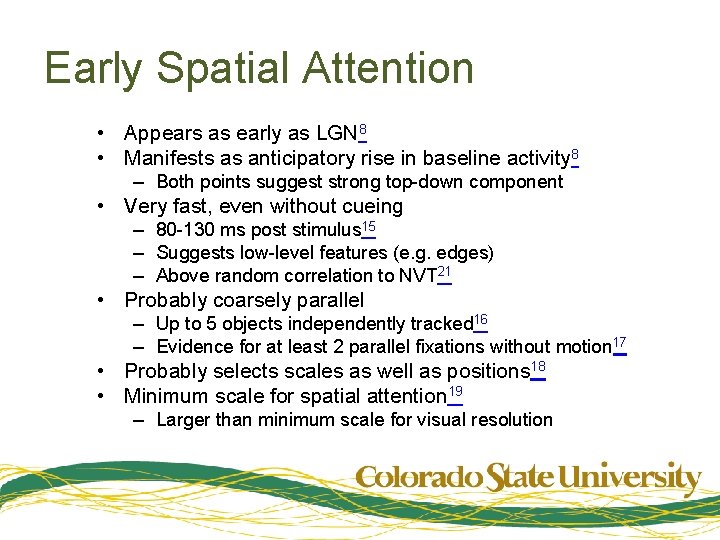
Early Spatial Attention • Appears as early as LGN 8 • Manifests as anticipatory rise in baseline activity 8 – Both points suggest strong top-down component • Very fast, even without cueing – 80 -130 ms post stimulus 15 – Suggests low-level features (e. g. edges) – Above random correlation to NVT 21 • Probably coarsely parallel – Up to 5 objects independently tracked 16 – Evidence for at least 2 parallel fixations without motion 17 • Probably selects scales as well as positions 18 • Minimum scale for spatial attention 19 – Larger than minimum scale for visual resolution
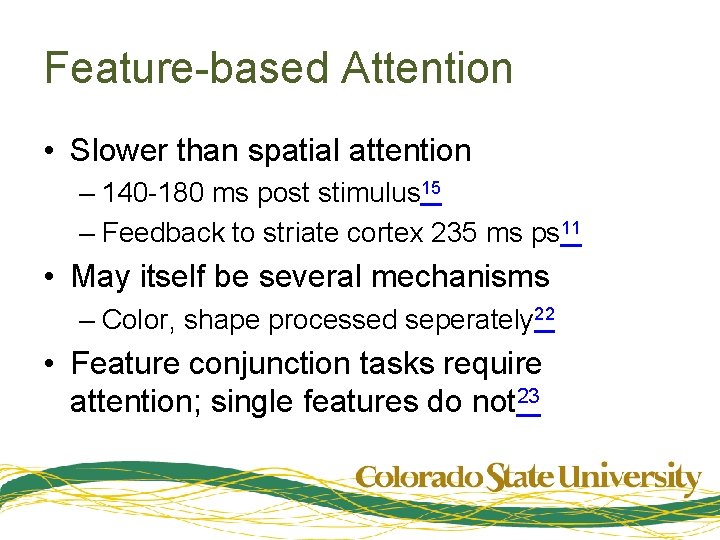
Feature-based Attention • Slower than spatial attention – 140 -180 ms post stimulus 15 – Feedback to striate cortex 235 ms ps 11 • May itself be several mechanisms – Color, shape processed seperately 22 • Feature conjunction tasks require attention; single features do not 23
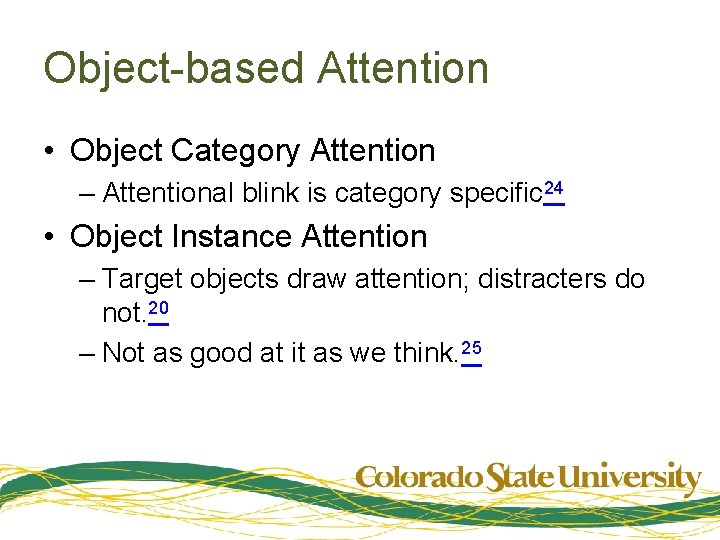
Object-based Attention • Object Category Attention – Attentional blink is category specific 24 • Object Instance Attention – Target objects draw attention; distracters do not. 20 – Not as good at it as we think. 25
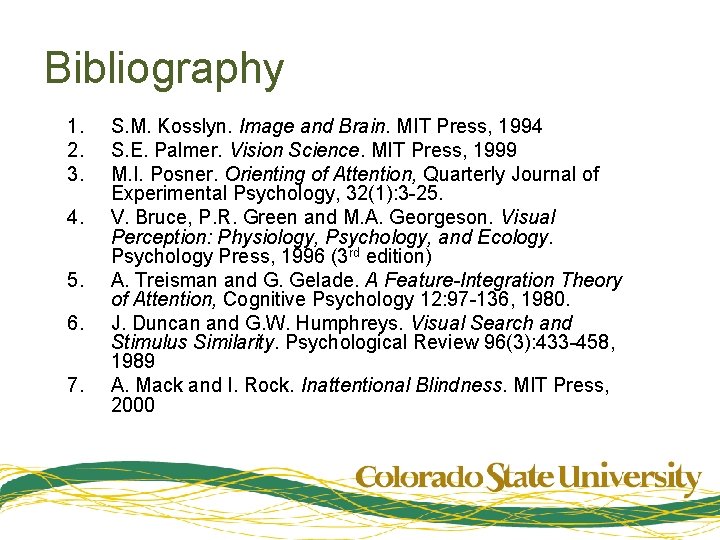
Bibliography 1. 2. 3. 4. 5. 6. 7. S. M. Kosslyn. Image and Brain. MIT Press, 1994 S. E. Palmer. Vision Science. MIT Press, 1999 M. I. Posner. Orienting of Attention, Quarterly Journal of Experimental Psychology, 32(1): 3 -25. V. Bruce, P. R. Green and M. A. Georgeson. Visual Perception: Physiology, Psychology, and Ecology. Psychology Press, 1996 (3 rd edition) A. Treisman and G. Gelade. A Feature-Integration Theory of Attention, Cognitive Psychology 12: 97 -136, 1980. J. Duncan and G. W. Humphreys. Visual Search and Stimulus Similarity. Psychological Review 96(3): 433 -458, 1989 A. Mack and I. Rock. Inattentional Blindness. MIT Press, 2000
Bibliography (II) 8. O'Connor, D. H. , et al. , Attention modulates responses in the human lateral geniculate nucleus. Nature Neuroscience, 2002. 5(11): p. 1203 -1209. 9. Duncan, J. , Target and nontarget grouping in visual search. Perception & Psychophysics, 1995. 57(1): p. 117120. 10. Awh, E. , et al. , Evidence against a central bottleneck during the attentional blink: Multiple channels for configural and featural processing. Cognitive Psychology, 2004. 48: p. 95 -126. 11. Roelfsema, P. R. , V. A. F. Lamme, and H. Spekreijse, Objectbased Attention in the Primary Visual Cortex of the Macaque Monkey. Nature, 1998. 395: p. 376 -381. 12. Handy, T. C. , Capacity Theory as a Model of Cortical Behavior. Journal of Cognitive Neuroscience, 2000. 12(6): p. 1066 -1069.
Bibliography (III) 13. Chun, M. M. and J. M. Wolfe, Visual Attention, in Blackwell Handbook of Perception, E. B. Goldstein, Editor. 2001, Blackwell: Oxford, UK. p. 272 -310. 14. Lavie, N. , Perceptual Load as a Necessary Condition for Selective Atention. Journal of Experimental Psychology: Human Perception and Performance, 1995. 21(3): p. 451 -468. 15. Hillyard, S. A. and L. Anllo-Vento, Event-related brain potentials in the study of visual selective attention. Proceedings of the National Academy of Science (USA), 1998. 95: p. 781 -787. 16. Pylyshyn, Z. W. and R. W. Storm, Tracking multiple independent targets: Evidence for a parallel tracking mechanism. Spatial Vision, 1988. 3: p. 179 -193.
Bibliography (IV) 17. Bichot, N. P. , K. R. Cave, and H. Pashler, Visual selection mediated by location: Feature-based selection of noncontiguous locations. Perception & Psychophysics, 1999. 61(3): p. 403 -423. 18. Oliva, A. and P. G. Schyns, Coarse Blobs or Fine Edges? Evidence That Information Diagnoticity Changes the Perception of Complex Visual Stimuli. Cognitive Psychology, 1997. 34: p. 72 -107. 19. Intriligator, J. and P. Cavanaugh, The Spatial Resolution of Visual Attention. Cognitive Psychology, 2001. 43: p. 171 -216. 20. Downing, P. E. , Interactions Between Visual Working Memory and Selective Attention. Psychological Science, 2000. 11(6): p. 467 -473. 21. Parkhurst, D. , K. Law and E. Neibur. Modeling the role of salience in the allocation of overt visual attention. Vision Research 42(1): p. 107 -123, 2002.
Bibliography (V) 22. Kourtzi, Z. and N. Kanwisher. Cortical Regions Involved in Perceiving Object Shape. The Journal of Neuroscience, 20(9): p. 3310 -3318, 2000. 23. Luck, S. J. and M. A. Ford, On the Role of Selective Attention in Visual Perception. Proceedings of the National Academy of Science (USA), 1998. 95: p. 825 -830. 24. Awh, E. , et al. , Evidence against a central bottleneck during the attentional blink: Multiple channels for configural and featural processing. Cognitive Psychology, 2004. 48: p. 95 -126. 25. Rensink, R. A. , J. K. O’Regan and J. J. Clark. To see or not to see: The need for attention to perceive changes in scenes. Psychological Science, 8: p. 368 -373, 1997.