
Human Vision Perception CS 498 Virtual Reality UNIVERSITY








- Slides: 40
Human Vision: Perception CS 498: Virtual Reality UNIVERSITY OF ILLINOIS AT URBANA-CHAMPAIGN Eric Shaffer
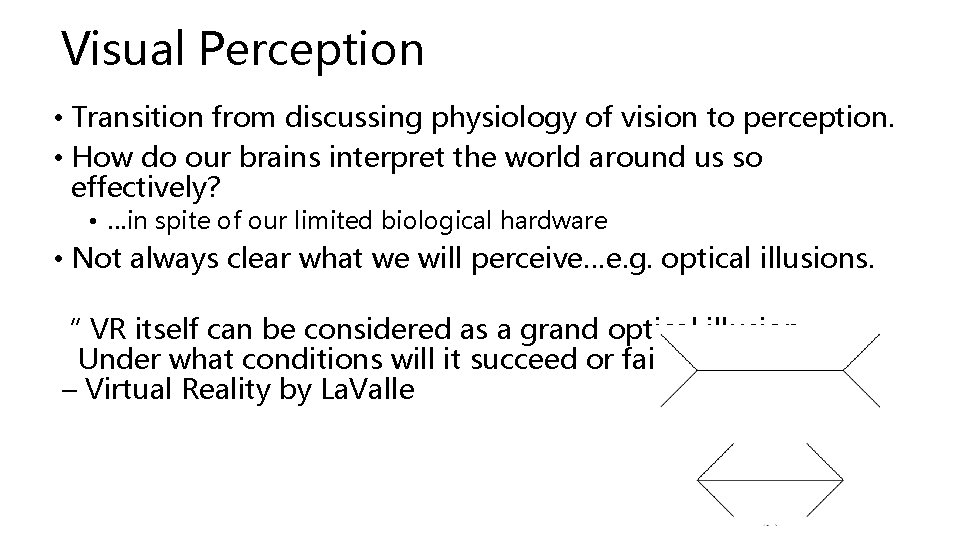
Visual Perception • Transition from discussing physiology of vision to perception. • How do our brains interpret the world around us so effectively? • …in spite of our limited biological hardware • Not always clear what we will perceive…e. g. optical illusions. “ VR itself can be considered as a grand optical illusion. Under what conditions will it succeed or fail? ” – Virtual Reality by La. Valle
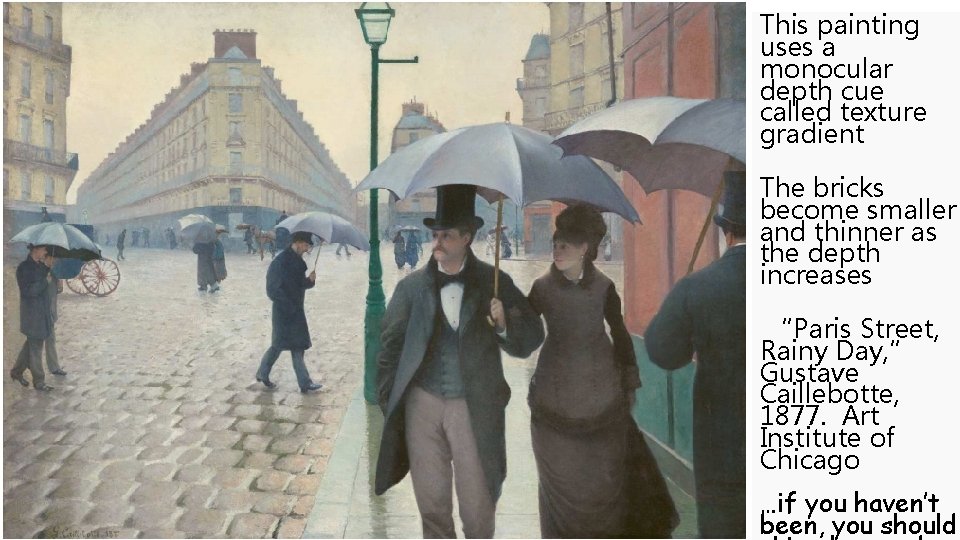
This painting uses a monocular depth cue called texture gradient The bricks become smaller and thinner as the depth increases “Paris Street, Rainy Day, ” Gustave Caillebotte, 1877. Art Institute of Chicago …if you haven’t been, you should
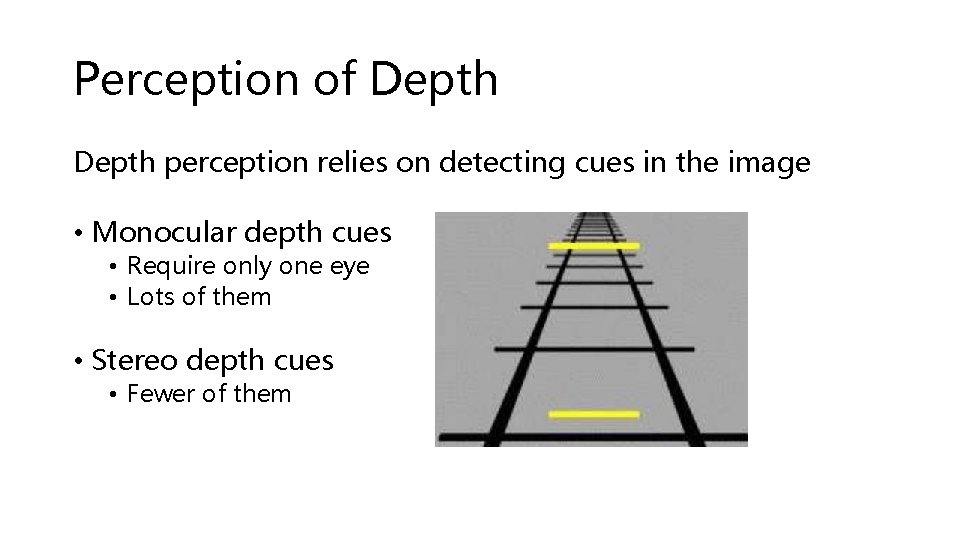
Perception of Depth perception relies on detecting cues in the image • Monocular depth cues • Require only one eye • Lots of them • Stereo depth cues • Fewer of them
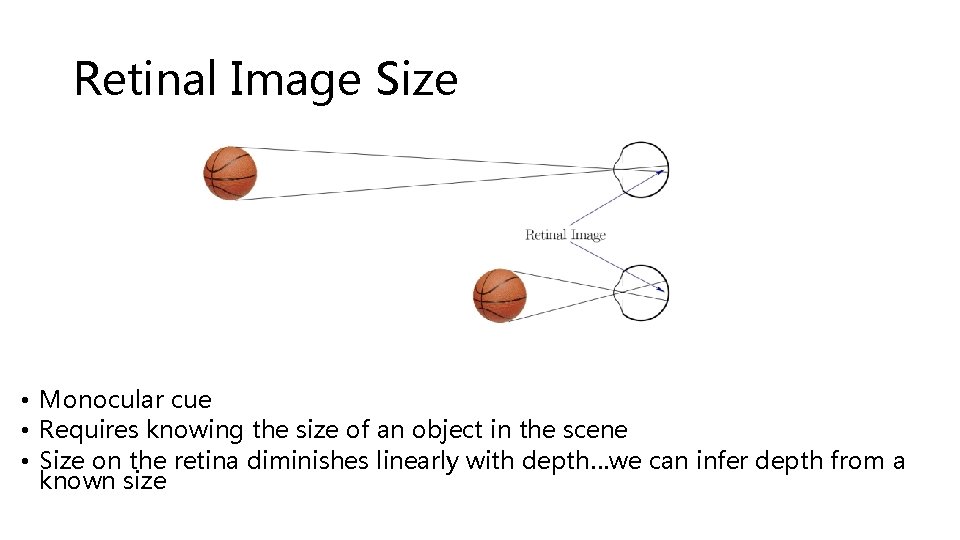
Retinal Image Size • Monocular cue • Requires knowing the size of an object in the scene • Size on the retina diminishes linearly with depth…we can infer depth from a known size
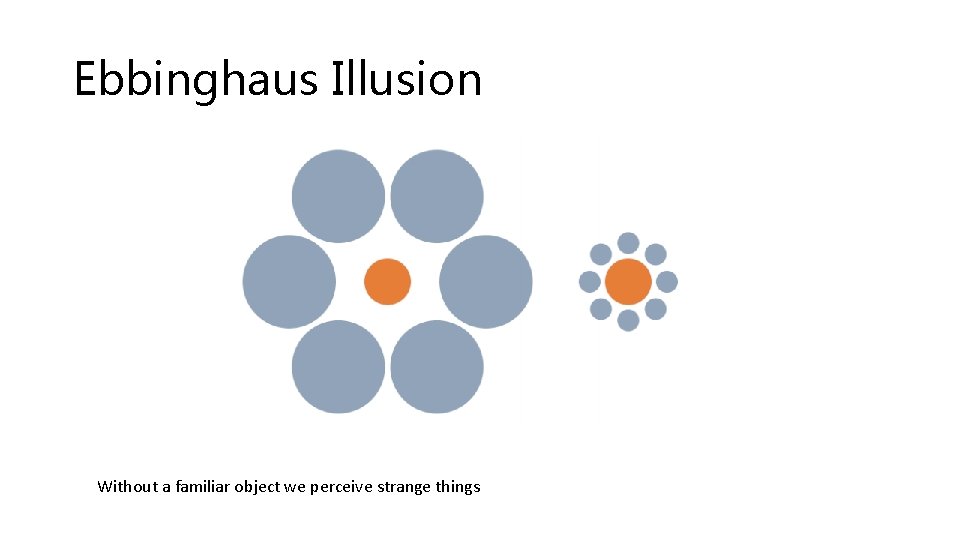
Ebbinghaus Illusion Without a familiar object we perceive strange things
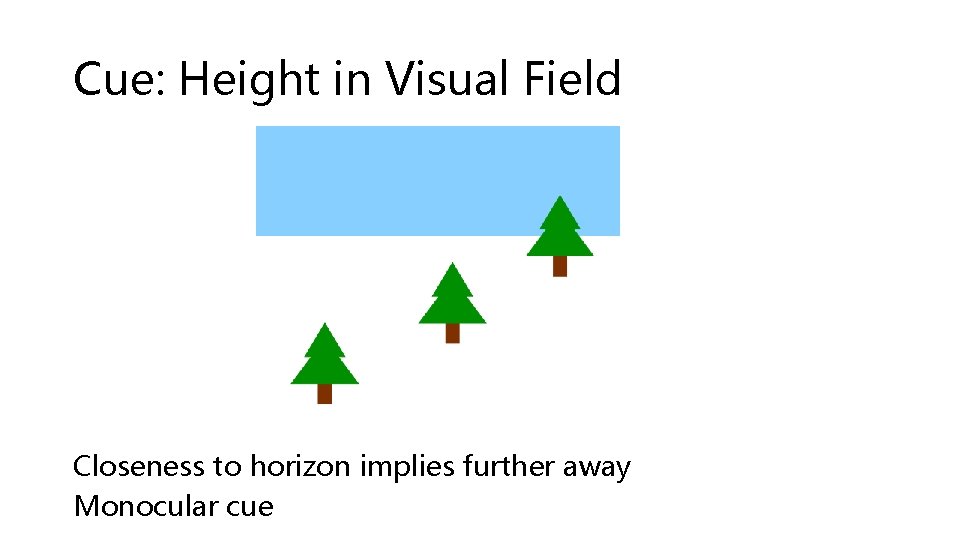
Cue: Height in Visual Field Closeness to horizon implies further away Monocular cue
Accommodation We can sense how much the ciliary muscles are contracting Greater contraction yields an sense object is closer… Does not rely on photoreceptors…at least not directly
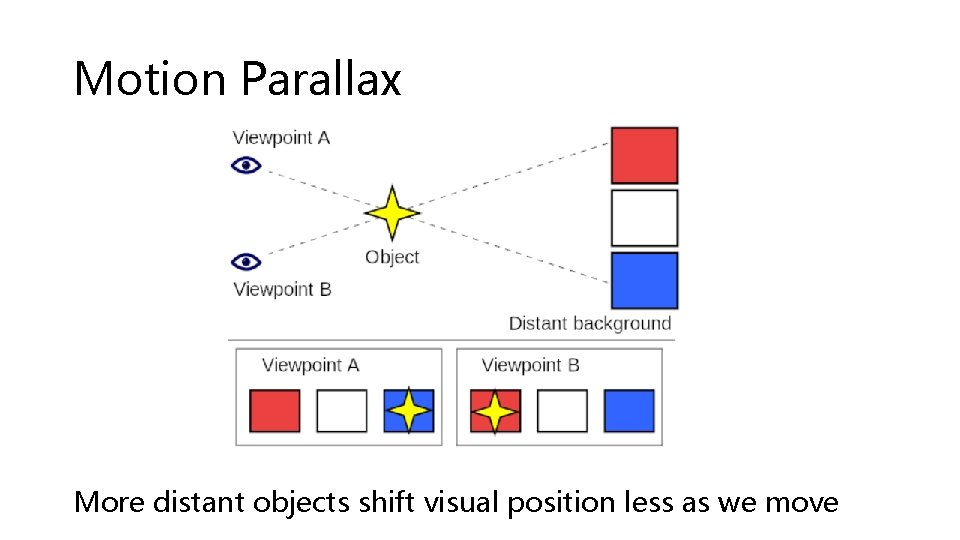
Motion Parallax More distant objects shift visual position less as we move
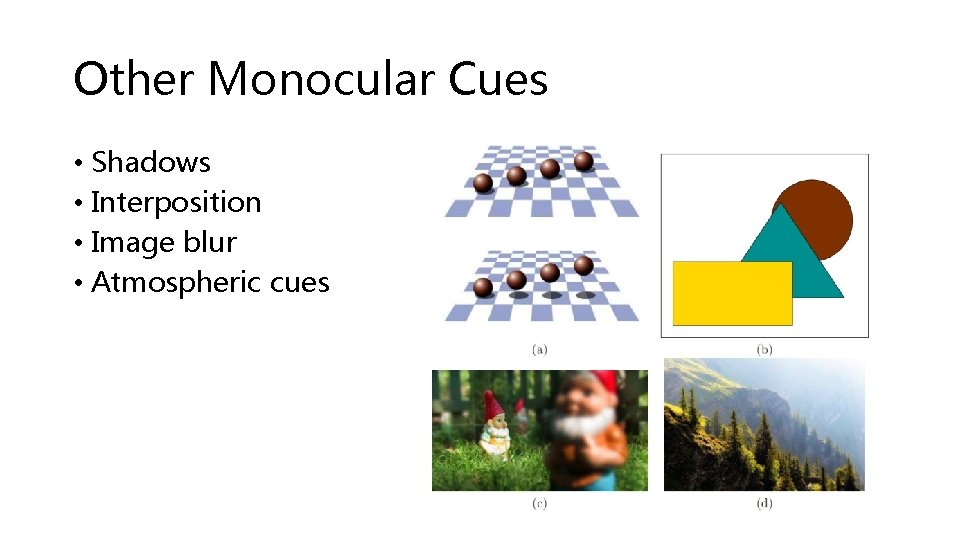
Other Monocular Cues • Shadows • Interposition • Image blur • Atmospheric cues
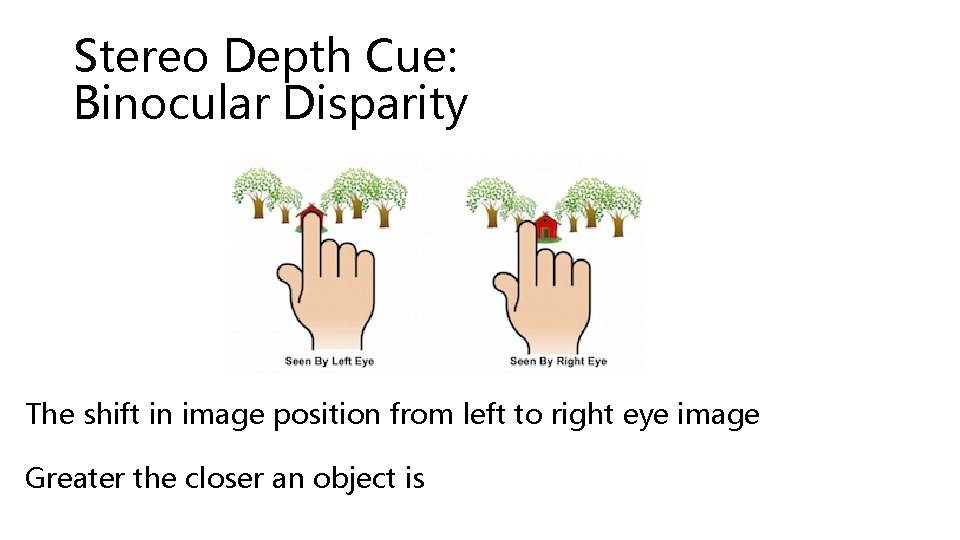
Stereo Depth Cue: Binocular Disparity The shift in image position from left to right eye image Greater the closer an object is
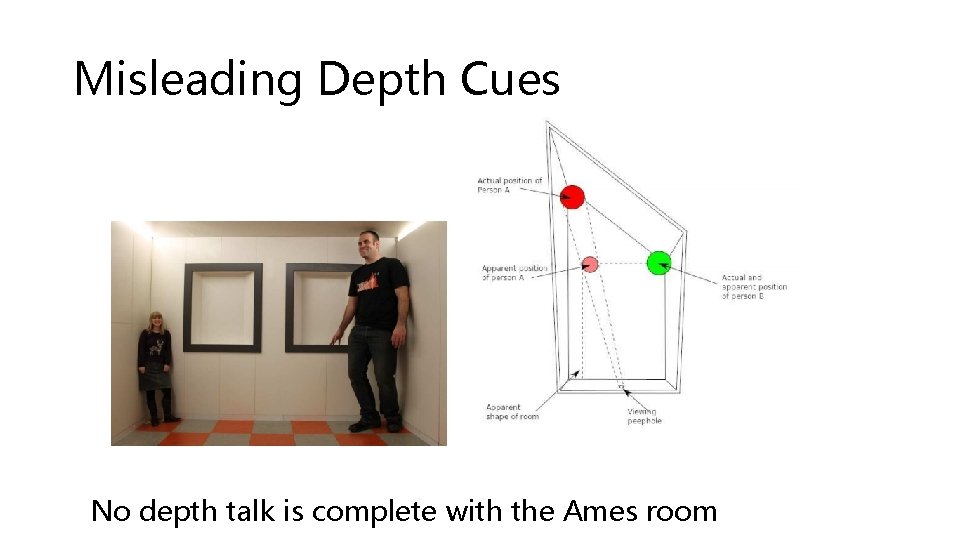
Misleading Depth Cues No depth talk is complete with the Ames room
Implications for VR • Easy to mess up viewers depth perception • if the user’s pupils are 64 mm apart in the real world but only 50 mm apart in the virtual world, then the virtual world will seem much larger… • Some tracking systems track the head orientation only. This makes it impossible to use motion parallax as a depth cue if the user moves from side to side without any rotation. To preserve most depth cues based on motion, it is important to track head position….
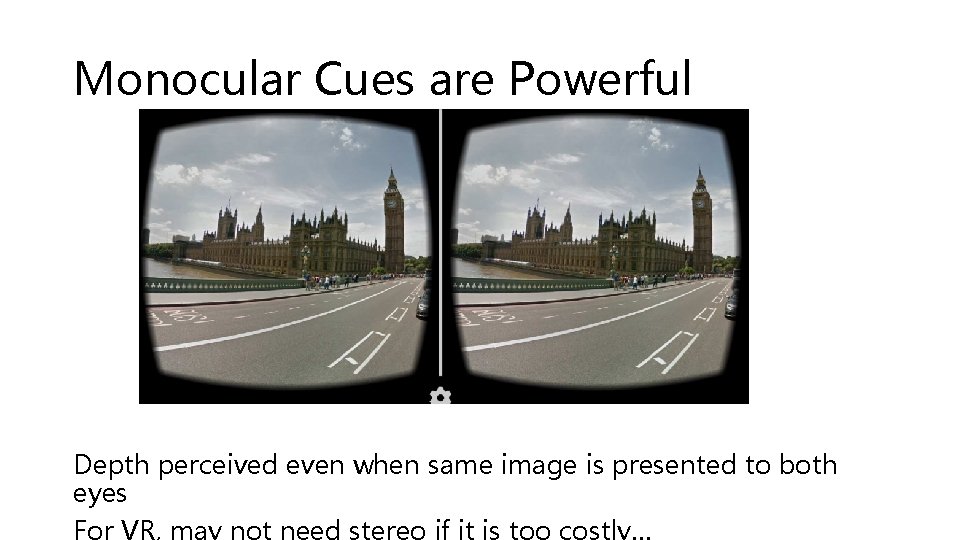
Monocular Cues are Powerful Depth perceived even when same image is presented to both eyes For VR, may not need stereo if it is too costly…
VR Developer Advice • Design your world in meters • Do not place objects closer than 1 meter away from viewer • Match virtual inter-pupillary distance (IPD) to actual IPD
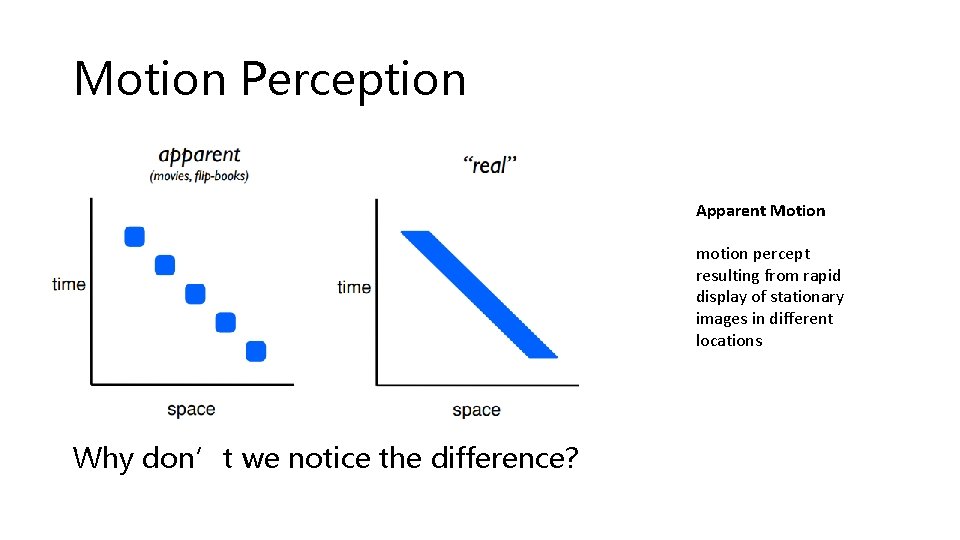
Motion Perception Apparent Motion motion percept resulting from rapid display of stationary images in different locations Why don’t we notice the difference?
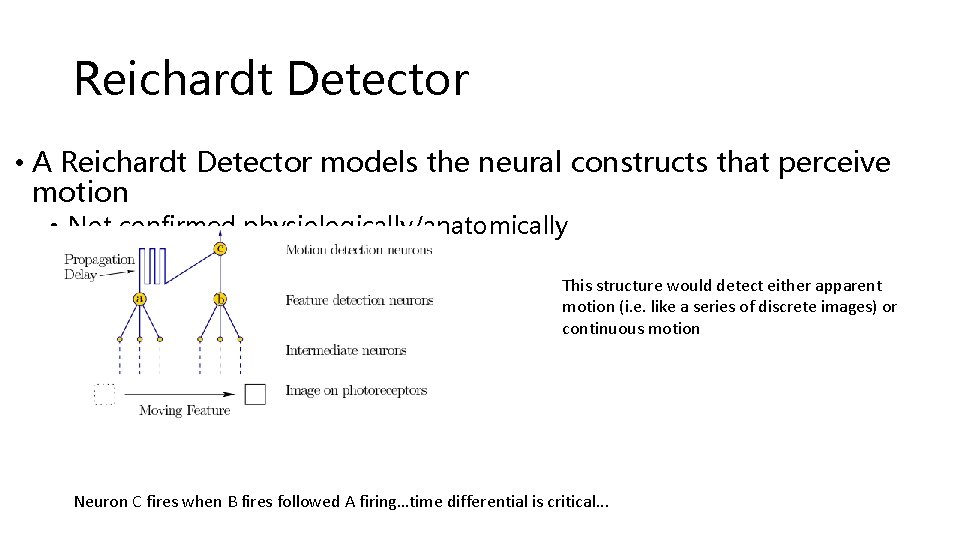
Reichardt Detector • A Reichardt Detector models the neural constructs that perceive motion • Not confirmed physiologically/anatomically This structure would detect either apparent motion (i. e. like a series of discrete images) or continuous motion Neuron C fires when B fires followed A firing…time differential is critical. . .
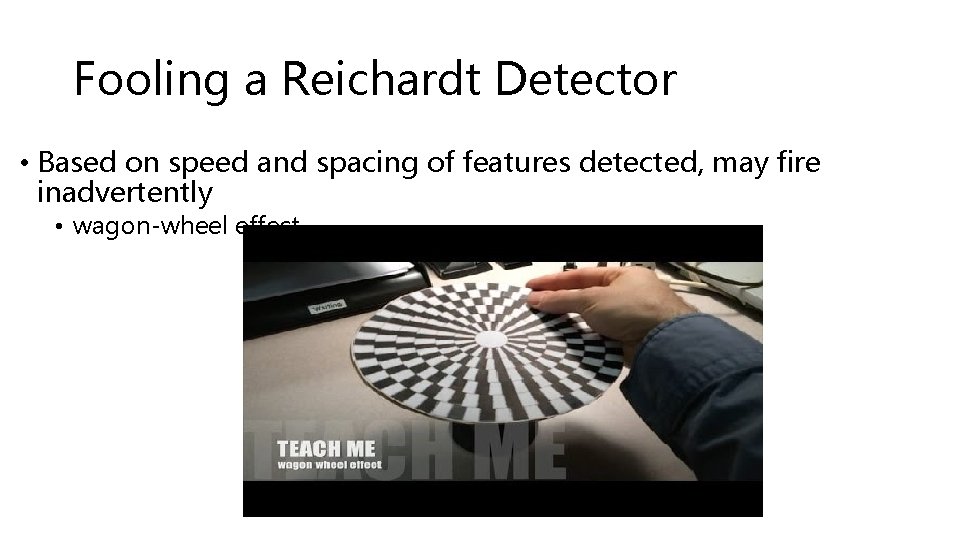
Fooling a Reichardt Detector • Based on speed and spacing of features detected, may fire inadvertently • wagon-wheel effect
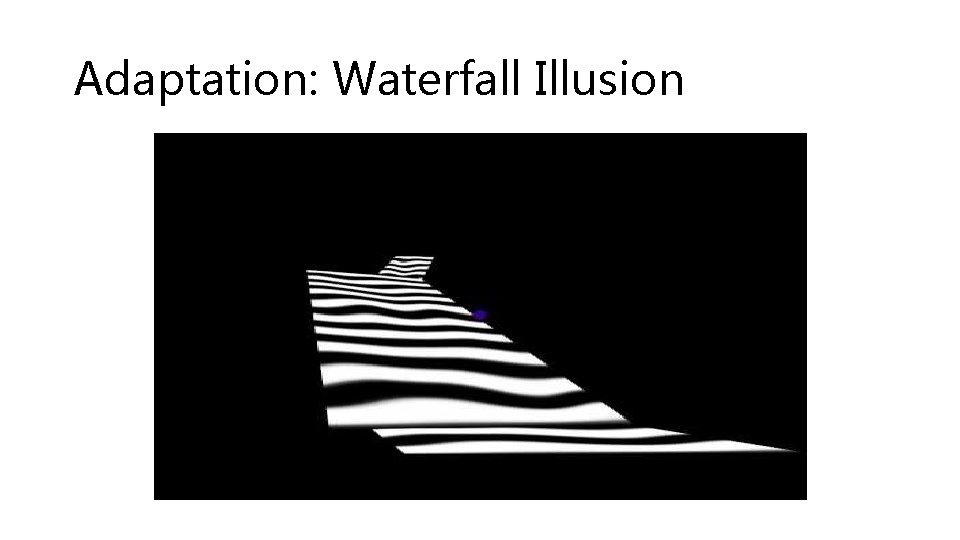
Adaptation: Waterfall Illusion
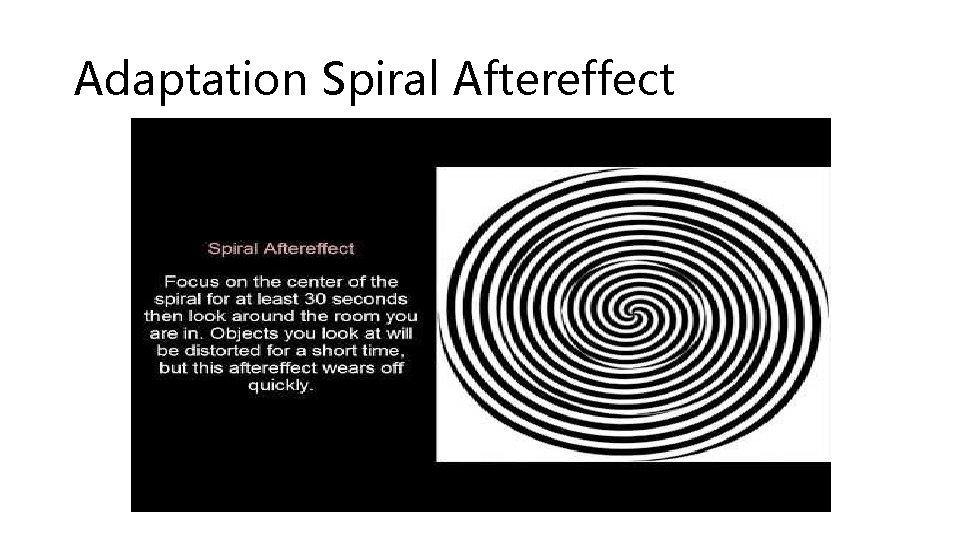
Adaptation Spiral Aftereffect
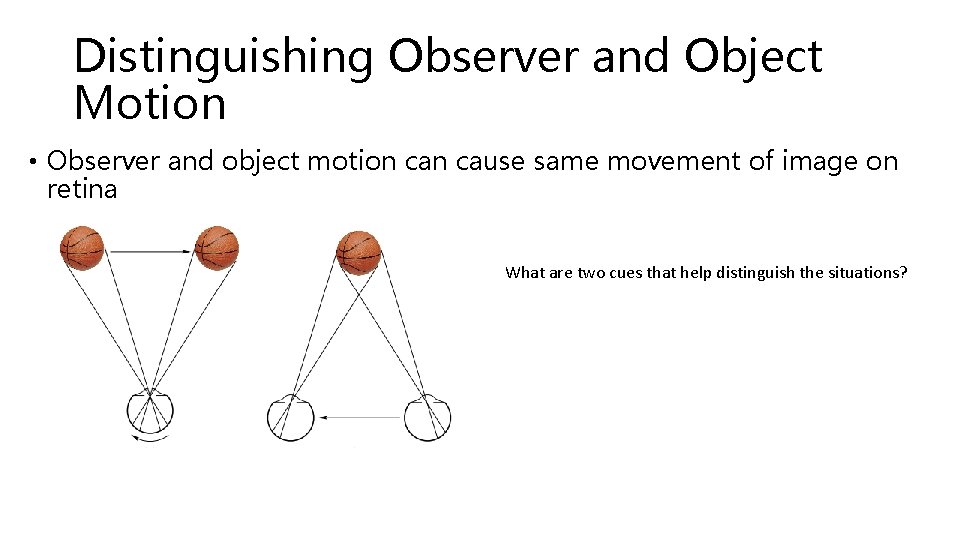
Distinguishing Observer and Object Motion • Observer and object motion cause same movement of image on retina What are two cues that help distinguish the situations?
Distinguishing Observer and Object Motion • Observer and object motion cause same movement of image on retina Two important cues to distinguish this 1. Proprioception (sense of body moving) 2. Global movement of scene
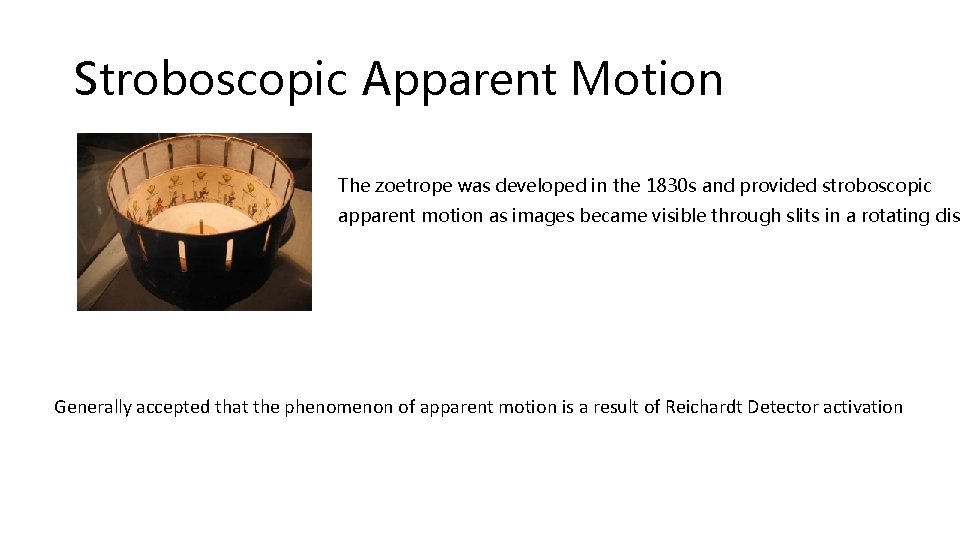
Stroboscopic Apparent Motion The zoetrope was developed in the 1830 s and provided stroboscopic apparent motion as images became visible through slits in a rotating dis Generally accepted that the phenomenon of apparent motion is a result of Reichardt Detector activation
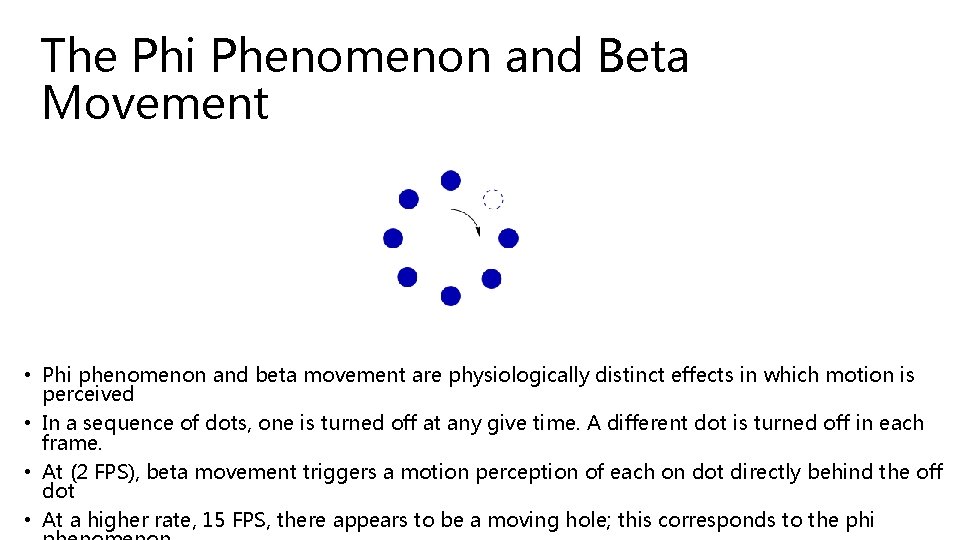
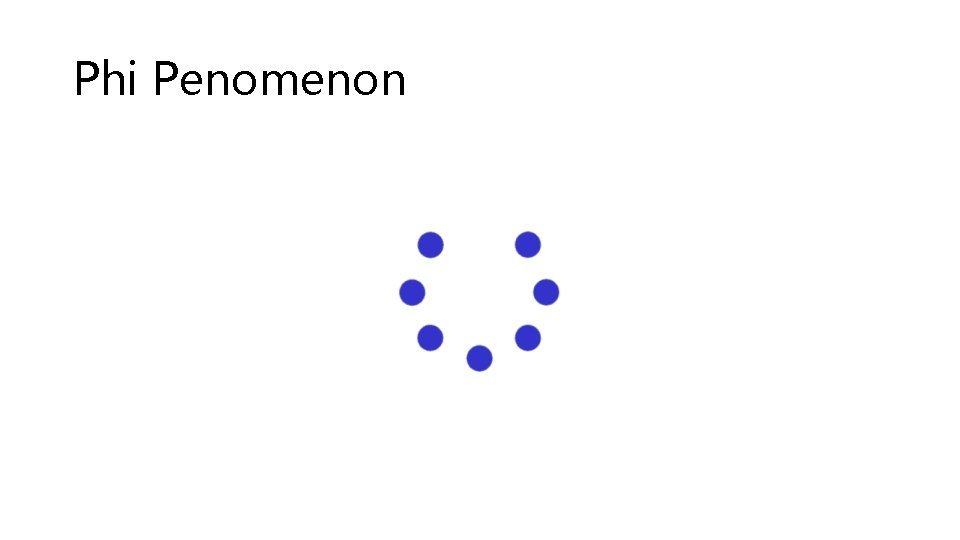
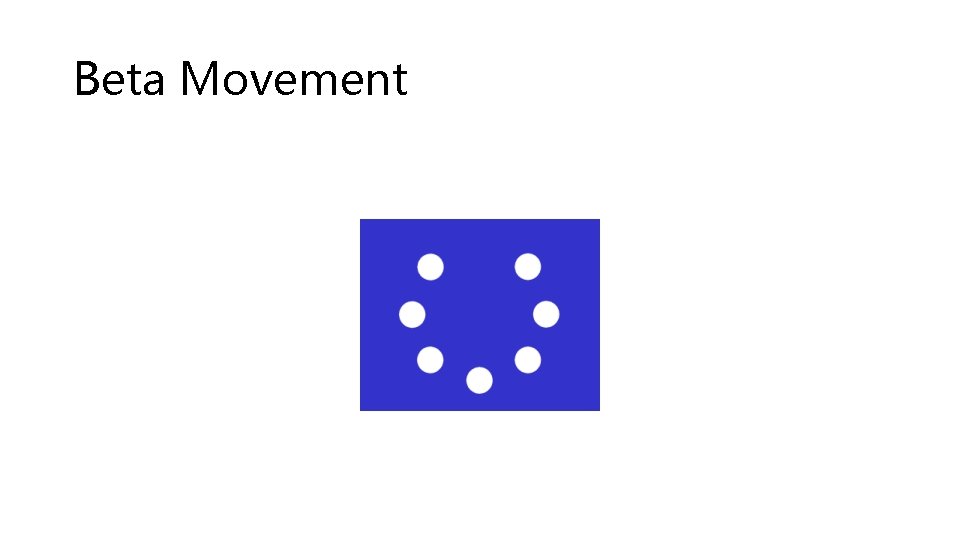
The Phi Phenomenon and Beta Movement • Phi phenomenon and beta movement are physiologically distinct effects in which motion is perceived • In a sequence of dots, one is turned off at any give time. A different dot is turned off in each frame. • At (2 FPS), beta movement triggers a motion perception of each on dot directly behind the off dot • At a higher rate, 15 FPS, there appears to be a moving hole; this corresponds to the phi
Phi Penomenon
Beta Movement
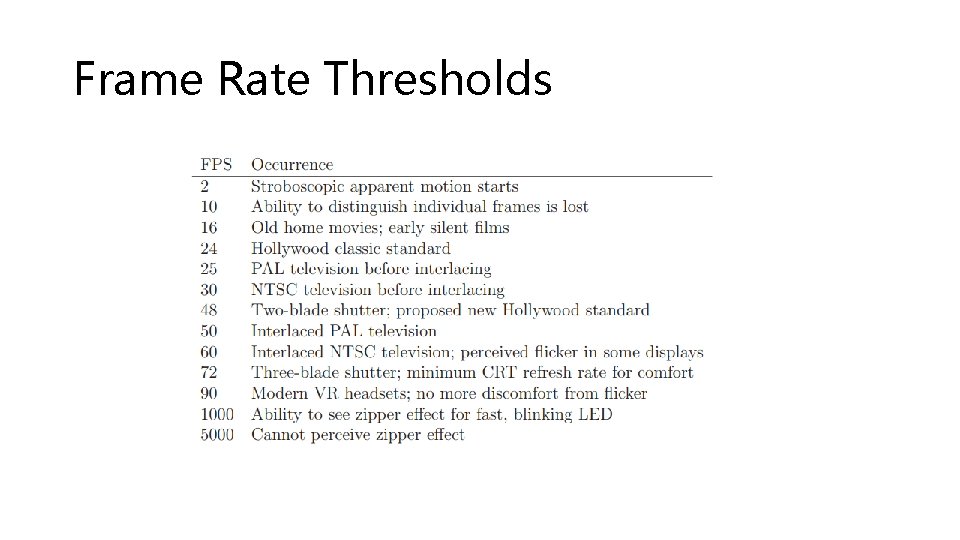
Frame Rate Thresholds
Flicker With a low enough framerate, jumps between frames are visible This is flicker In ancient times, 3 -Blade Shutters on projectors showed each frame 3 times Reduced perceived flicker
Flicker • NTSC and PAL were encodings for 20 th century analog television • Broadcast at 25 or 30 FPS • Displayed using x 2 that rate by interlacing frames • Used interlacing to double perceived framerate and reduce flicker • Update half the lines on the display per refresh
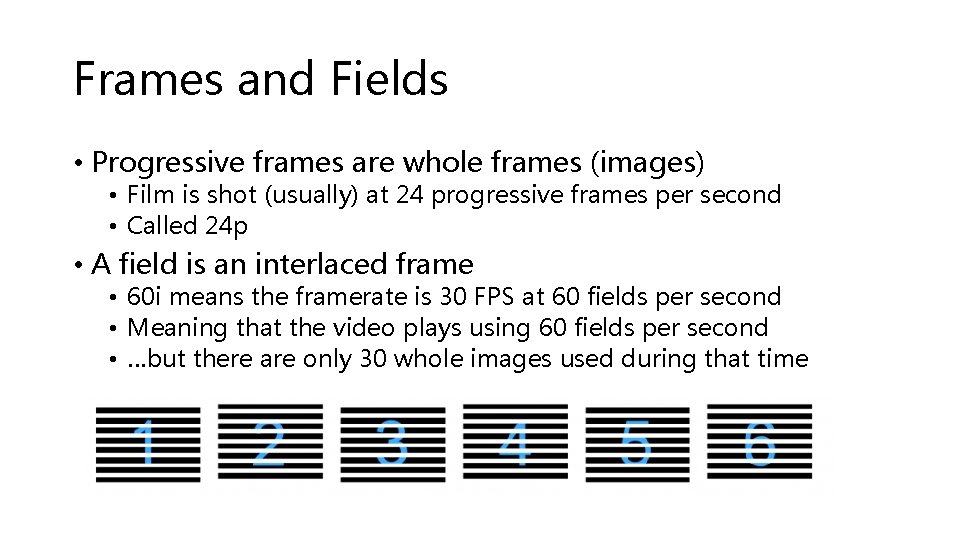
Frames and Fields • Progressive frames are whole frames (images) • Film is shot (usually) at 24 progressive frames per second • Called 24 p • A field is an interlaced frame • 60 i means the framerate is 30 FPS at 60 fields per second • Meaning that the video plays using 60 fields per second • …but there are only 30 whole images used during that time
Interlaced and Progressive Framerates
Digital Television in the United States The five main ATSC formats of DTV currently broadcast in the U. S. are: • Standard definition— 480 i to maintain compatibility with existing NTSC sets when a digital television broadcast is converted back to an analog one • Enhanced definition— 480 p, about the same quality as current DVDs • High definition— 720 p • High definition— 1080 i • High definition— 1080 p Most digital television sets sold in the U. S. use a display with a 16: 9 aspect ratio to optimally display HDTV-formatted content
Flicker and Distance to Display • Sensitivity to flicker increases the closer a display is to eyes • Even if flicker is not directly perceived, it can cause headaches • To solve this problem in the 1990 s, CRTs had 72, 85, or 90 FPS • Modern LCD and LED displays typically 120 FPS
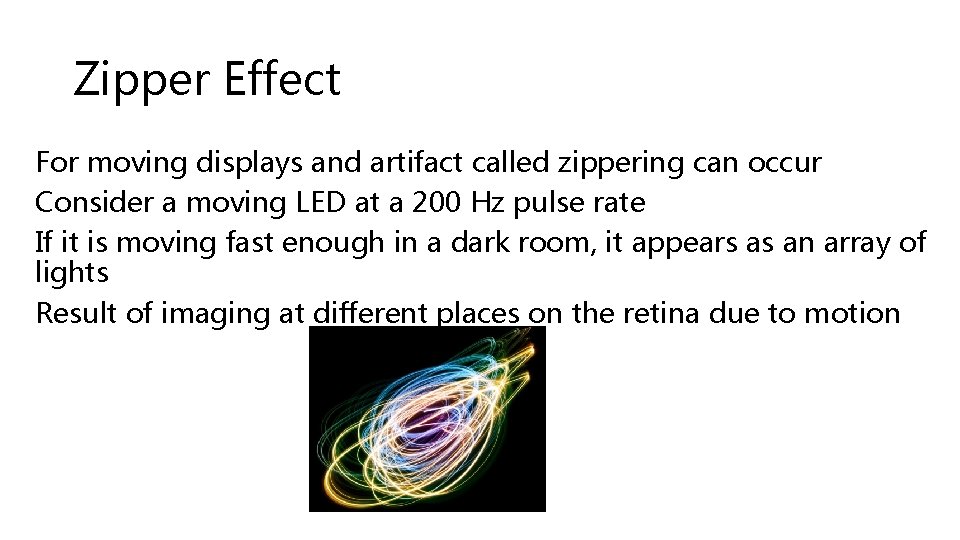
Zipper Effect For moving displays and artifact called zippering can occur Consider a moving LED at a 200 Hz pulse rate If it is moving fast enough in a dark room, it appears as an array of lights Result of imaging at different places on the retina due to motion
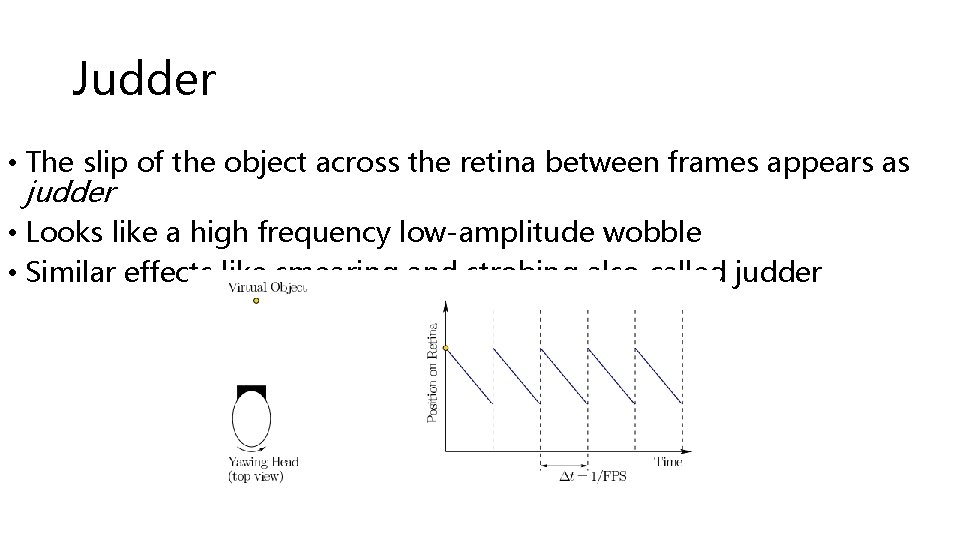
Implications for VR VR displays need higher frame rates than stationary displays Consider perception of stationarity: • Look at object while yawing head • In VR, object needs to shift across screen to appear motionless
Judder • The slip of the object across the retina between frames appears as judder • Looks like a high frequency low-amplitude wobble • Similar effects like smearing and strobing also called judder
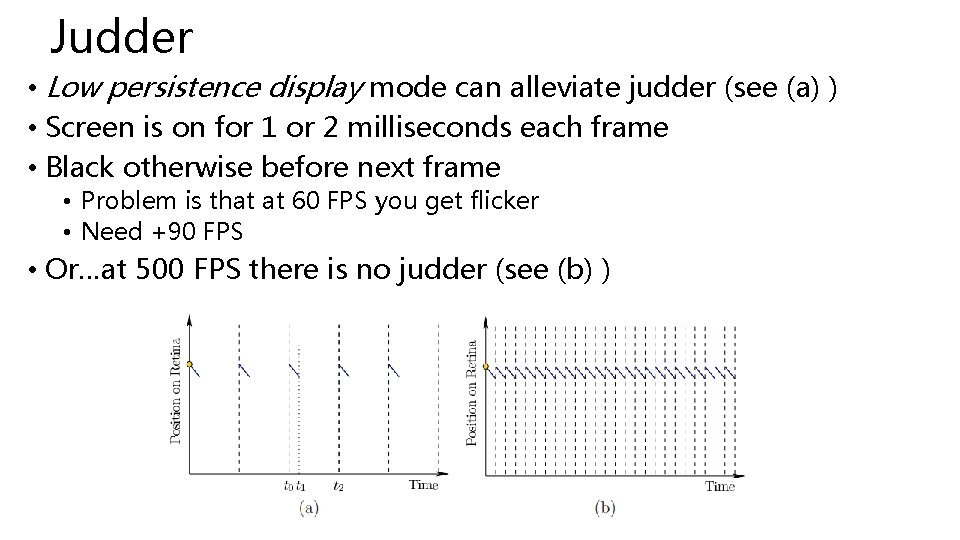
Judder • Low persistence display mode can alleviate judder (see (a) ) • Screen is on for 1 or 2 milliseconds each frame • Black otherwise before next frame • Problem is that at 60 FPS you get flicker • Need +90 FPS • Or…at 500 FPS there is no judder (see (b) )
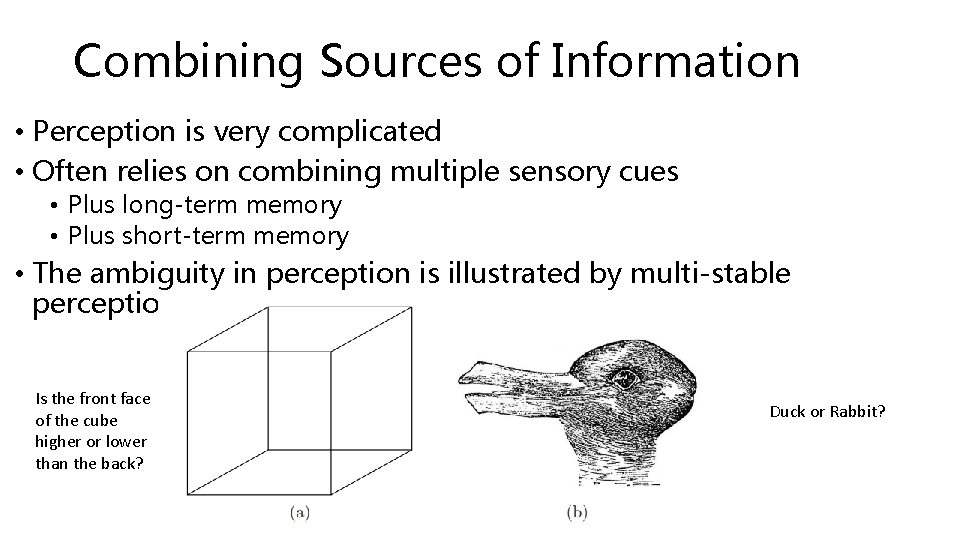
Combining Sources of Information • Perception is very complicated • Often relies on combining multiple sensory cues • Plus long-term memory • Plus short-term memory • The ambiguity in perception is illustrated by multi-stable perception Is the front face of the cube higher or lower than the back? Duck or Rabbit?
Mc. Gurk Effect
Implications for VR Many unintended perceptions may arise in a VR system Requires extensive testing to avoid Example: “One example, which actually occurred in the VR industry, involved designing a popup menu. Suppose that users are placed into a dark environment and a large menu comes rushing up to them. A user may perceive one of two cases: 1) the menu approaches the user, or 2) the user is rushing up to the menu. The vestibular sense should be enough to resolve whether the user is moving, but the visual sense is overpowering. Prior knowledge about which is happening helps yield the correct perception. Unfortunately, if the wrong interpretation is made, then VR sickness in increased due to the sensory conflict. ” -- Virtual Reality by La. Valle