
Human Subjects Research and the IRB Scott Katz
Human Subjects Research and the IRB Scott Katz, MS, CIP Office of Research Compliance Georgia Institute of Technology GTRC© 2016 Office of Research Compliance All rights reserved GTRC
The Evolution of Human Subject Research Protections GTRC© 2016 Office of Research Compliance All rights reserved GTRC
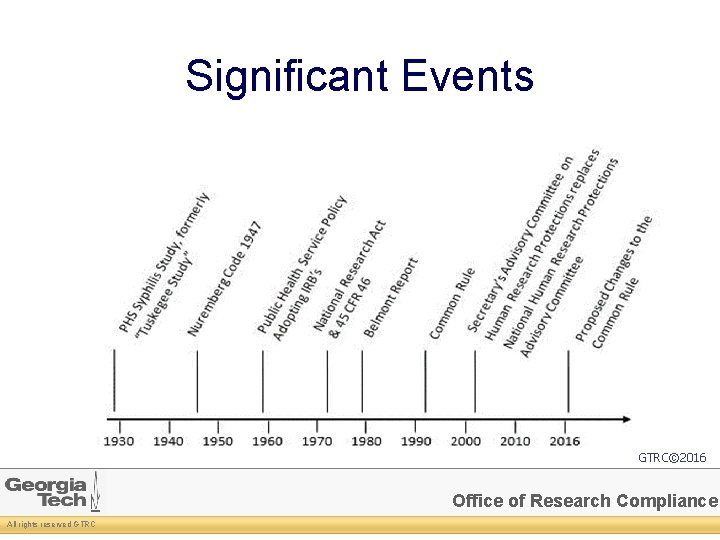
Significant Events GTRC© 2016 Office of Research Compliance All rights reserved GTRC
1932, Public Health Service study, in collaboration with the Tuskegee Institute in Macon County, Alabama, undertook a study of untreated syphilis in hopes of justifying treatment programs for blacks. 600 black men (399 with syphilis, 201 without) were told they had "bad blood, " a local term used to describe syphilis, anemia, and fatigue. Penicillin, treatment of choice, was discovered in 1940 s but was withheld. In exchange for taking part in the study, the men received free medical exams, free meals, and burial insurance. Although originally projected to last 6 months, the study actually went on for 40 years. GTRC© 2016 Office of Research Compliance All rights reserved GTRC
1940 s: Military Tribunal Led to the Enduring Nuremberg Code Voluntary consent Anticipate scientific benefits Benefits must outweigh risks Animal experiments first No intentional death or disability Subject may withdraw at any time Investigators must be qualified Investigation will stop if harm occurs GTRC© 2016 Office of Research Compliance All rights reserved GTRC
1950 s: Willowbrook State School Staten Island, New York 1960 s: Jewish Chronic Disease Hospital Cancer Experiments GTRC© 2016 Office of Research Compliance All rights reserved GTRC
The “Milgram Study” Dr. Stanley Milgram Yale University GTRC© 2016 Office of Research Compliance All rights reserved GTRC
National Research Act Upgraded Office for Protection from Research Risks’ policies to REGULATION Established a National Commission for Protection of Human Subjects of Biomedical and Behavioral Research 1975: HHS promulgates Title 45 of Federal Regulations, “Protection of Human Subjects” 1976: Held the now famous conference at Smithsonian’s Belmont Conference Center GTRC© 2016 Office of Research Compliance All rights reserved GTRC
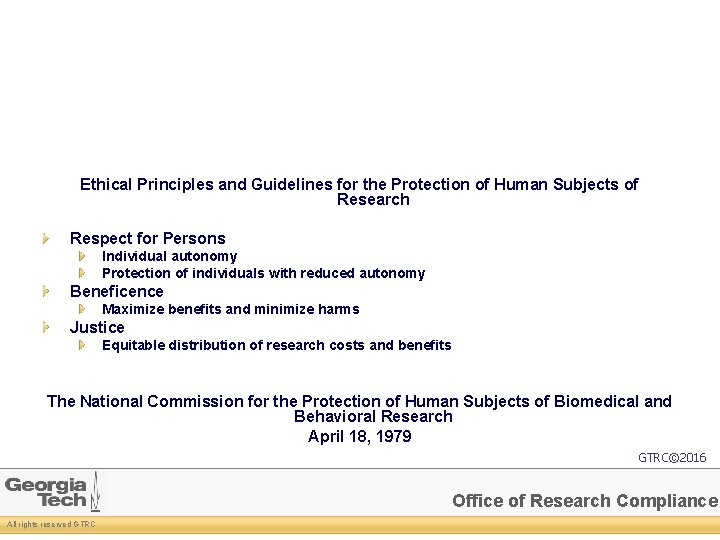
Ethical Principles and Guidelines for the Protection of Human Subjects of Research Respect for Persons Individual autonomy Protection of individuals with reduced autonomy Beneficence Maximize benefits and minimize harms Justice Equitable distribution of research costs and benefits The National Commission for the Protection of Human Subjects of Biomedical and Behavioral Research April 18, 1979 GTRC© 2016 Office of Research Compliance All rights reserved GTRC
The Regulations of Human Subject Research GTRC© 2016 Office of Research Compliance All rights reserved GTRC
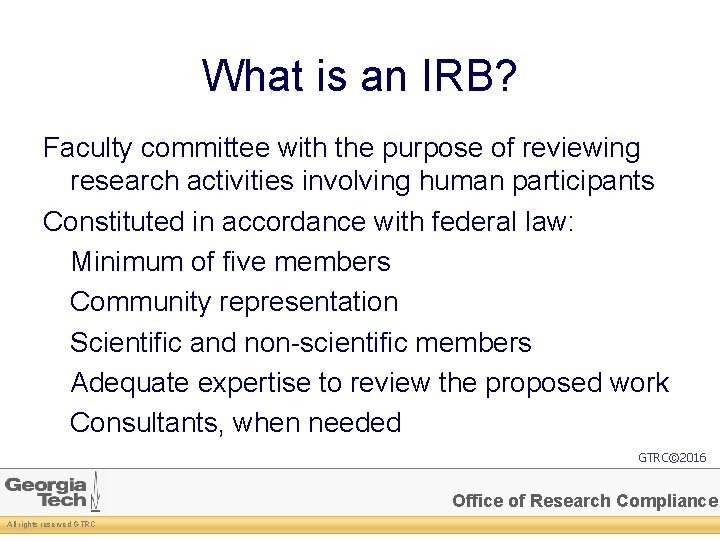
What is an IRB? Faculty committee with the purpose of reviewing research activities involving human participants Constituted in accordance with federal law: Minimum of five members Community representation Scientific and non-scientific members Adequate expertise to review the proposed work Consultants, when needed GTRC© 2016 Office of Research Compliance All rights reserved GTRC
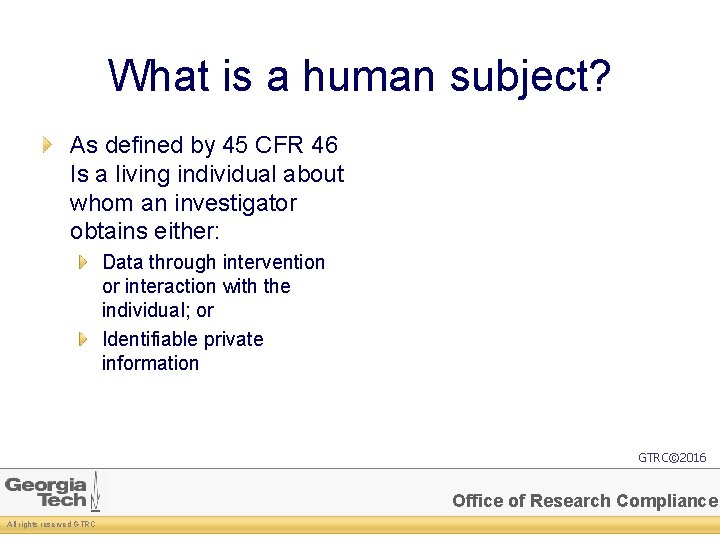
What is a human subject? As defined by 45 CFR 46 Is a living individual about whom an investigator obtains either: Data through intervention or interaction with the individual; or Identifiable private information GTRC© 2016 Office of Research Compliance All rights reserved GTRC
What is research? Research: As defined by 45 CFR 46, "a systematic investigation, including research development, testing and evaluation, designed to develop or contribute to generalizable knowledge" GTRC© 2016 Office of Research Compliance All rights reserved GTRC
Does the research activity involve human subjects covered by 45 CFR part 46? Is the proposed activity research? Does it contribute to generalizable knowledge? GTRC© 2016 Office of Research Compliance All rights reserved GTRC
Does the research activity involve human subjects covered by 45 CFR part 46? Does the research involve obtaining information about living individuals? Does the research involve intervention or interaction with the individuals? GTRC© 2016 Office of Research Compliance All rights reserved GTRC
Does the research activity involve human subjects covered by 45 CFR part 46? Activity is research involving human subjects. GTRC© 2016 Office of Research Compliance All rights reserved GTRC
When do the regulations apply? § 46. 101 Research that is conducted or supported by a federal department or agency, whether or not it is regulated, must comply with all sections of this policy. Research that is neither conducted nor supported by a federal department or agency but is subject to regulation must be reviewed and approved by an IRB. GTRC© 2016 Office of Research Compliance All rights reserved GTRC
Applying Ethics to the Regulations The Belmont Report Respect for persons Informed Consent Privacy and confidentiality Beneficence Study design Maximize benefits and minimize harms Justice Subject selection Vulnerable populations GTRC© 2016 Office of Research Compliance All rights reserved GTRC
Informed Consent is a PROCESS not a piece of paper GTRC© 2016 Office of Research Compliance All rights reserved GTRC
§ 46. 116 General requirements for informed consent Statement that it is research Purpose & procedures Health and financial risk Compensation/costs Confidentiality Contact Information Subjects rights Appropriate reading level GTRC© 2016 Office of Research Compliance All rights reserved GTRC
Categories of Research Exempt Expedited Full GTRC© 2016 Office of Research Compliance All rights reserved GTRC
Anything Else? All Amendments must be submitted for IRB review and approval prior to commencement. Annual Continuing Review All Adverse Events must be submitted for IRB review even if they are not study related. GTRC© 2016 Office of Research Compliance All rights reserved GTRC
Bottom Line The ability to conduct research using human subjects is a privilege granted to us by society for the advancement of knowledge and the bettering of the human condition. PUBLIC TRUST GTRC© 2016 Office of Research Compliance All rights reserved GTRC
How does this affect you? Do you or the organization that the research is being conducted for receive federal money? Do any federal organizations have oversight over this your study (e. g. , FDA, DOD, NIH, NSF, CDC, etc. )? GTRC© 2016 Office of Research Compliance All rights reserved GTRC
Applying the Regulations of Human Subject Research GTRC© 2016 Office of Research Compliance All rights reserved GTRC
Example 1 Data analysis of existing data. Identifiable De-identified GTRC© 2016 Office of Research Compliance All rights reserved GTRC
Example 2 Online survey Identifiable IP address Anonymous GTRC© 2016 Office of Research Compliance All rights reserved GTRC
Example 3 Interviews Identifiable Anonymous GTRC© 2016 Office of Research Compliance All rights reserved GTRC
The Possible Future of Human Subject Research GTRC© 2016 Office of Research Compliance All rights reserved GTRC
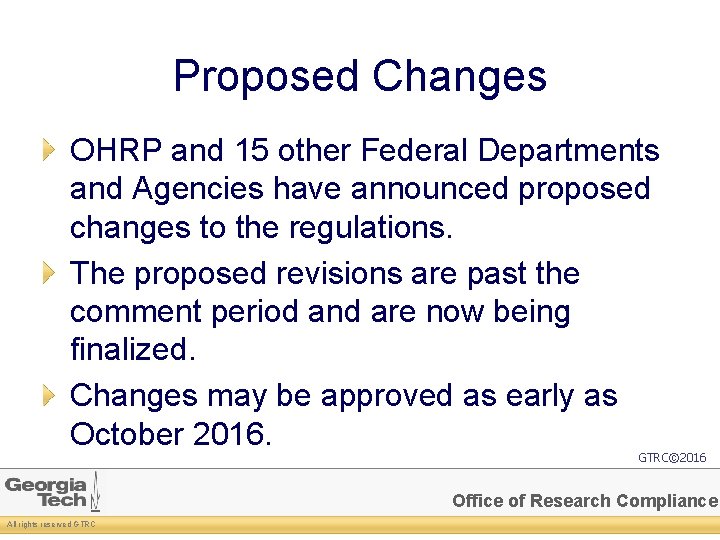
Proposed Changes OHRP and 15 other Federal Departments and Agencies have announced proposed changes to the regulations. The proposed revisions are past the comment period and are now being finalized. Changes may be approved as early as October 2016. GTRC© 2016 Office of Research Compliance All rights reserved GTRC
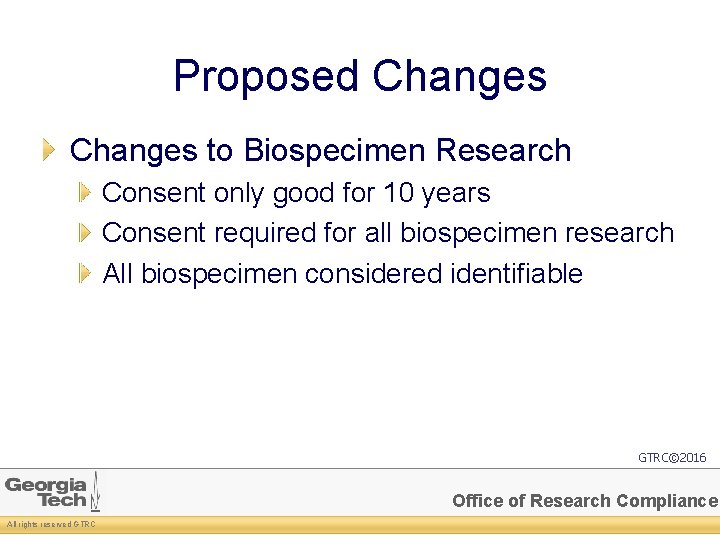
Proposed Changes to Biospecimen Research Consent only good for 10 years Consent required for all biospecimen research All biospecimen considered identifiable GTRC© 2016 Office of Research Compliance All rights reserved GTRC
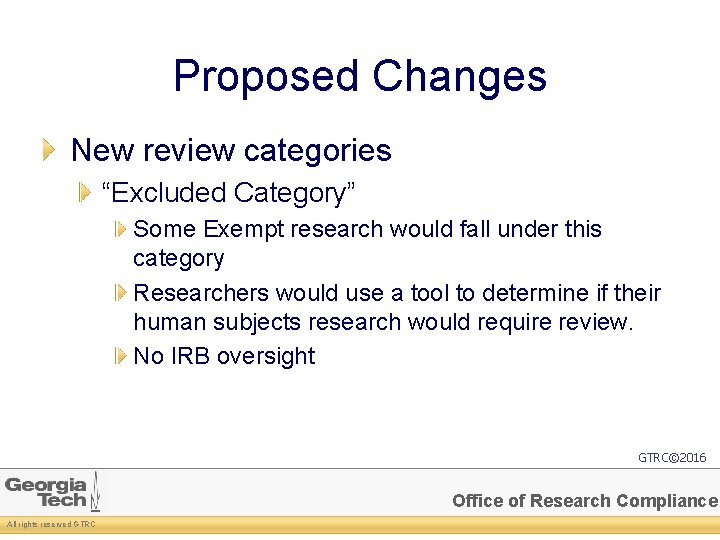
Proposed Changes New review categories “Excluded Category” Some Exempt research would fall under this category Researchers would use a tool to determine if their human subjects research would require review. No IRB oversight GTRC© 2016 Office of Research Compliance All rights reserved GTRC
Proposed Changes Informed Consent Changes to the format Consent would only be a few pages Appendices to consent with more detail GTRC© 2016 Office of Research Compliance All rights reserved GTRC
Proposed Changes National Academy of Sciences Released a statement disagreeing with changes Request that all changes be put on hold and re-evaluated Will changes be approved? GTRC© 2016 Office of Research Compliance All rights reserved GTRC
Important Information http: //www. hhs. gov/ohrp/regulations-andpolicy/regulations/45 -cfr-46/ IRBWISE information § 46. 101 § 46. 102 § 46. 111 § 46. 116 GTRC© 2016 Office of Research Compliance All rights reserved GTRC
Questions? GTRC© 2016 Office of Research Compliance All rights reserved GTRC
Contact Information Scott Katz, MS, CIP Compliance Officer Office of Research Integrity and Assurance Georgia Institute of Technology phone: 404 -385 -5208 email: scott. katz@gtrc. gatech. edu GT IRB website: http: //researchintegrity. gatech. edu/irb GT ORIA website: http: //researchintegrity. gatech. edu/ GTRC© 2016 Office of Research Compliance All rights reserved GTRC
- Slides: 37