
Human Sexual Reproductive System By the end of
Human Sexual Reproductive System
By the end of the lesson, we should be able to answer: • What is the importance of the human sexual reproductive system? • How do parts of the different human reproductive systems work together to create new life? • How can the introduction of contraceptives affect the ability to reproduce?

Human Sexual Reproductive System • Why is reproduction important? • What is sexual reproduction? • What are the parts that make up the male and female reproductive systems? • What do the male and the female reproductive cells look like?
Human Sexual Reproduction System • One thing that you would have noticed is that children look quite similar to their parents. • They might not look 100% exactly like either of their parent, but they definitely have gotten some features from both of their parents! • So, why do they look like their parents?
Human Sexual Reproductive System • Humans, like all other organisms, must produce new organisms like themselves for their kind to survive. • The process by which humans produce new organisms like themselves is called reproduction.
Human Sexual Reproductive System: Why is reproduction important? • Reproduction ensures the transfer of genetic information from one generation to another. (Heredity) • It ensures the continuity of a species. • Humans reproduce through sexual reproduction, which involves a male and a female adult. • For sexual reproduction to occur, both the male and female reproductive system must be present.
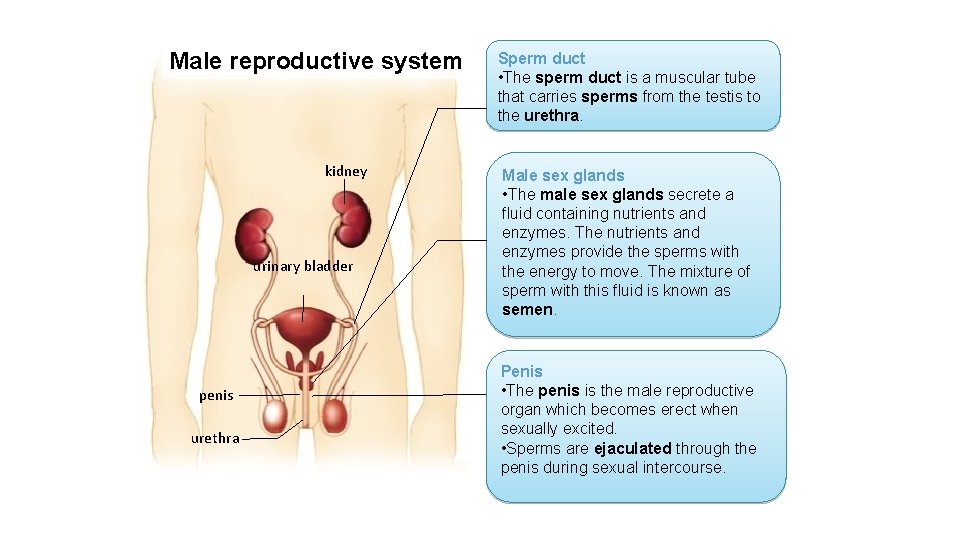
Male reproductive system kidney urinary bladder penis urethra Sperm duct • The sperm duct is a muscular tube that carries sperms from the testis to the urethra. Male sex glands • The male sex glands secrete a fluid containing nutrients and enzymes. The nutrients and enzymes provide the sperms with the energy to move. The mixture of sperm with this fluid is known as semen. Penis • The penis is the male reproductive organ which becomes erect when sexually excited. • Sperms are ejaculated through the penis during sexual intercourse.
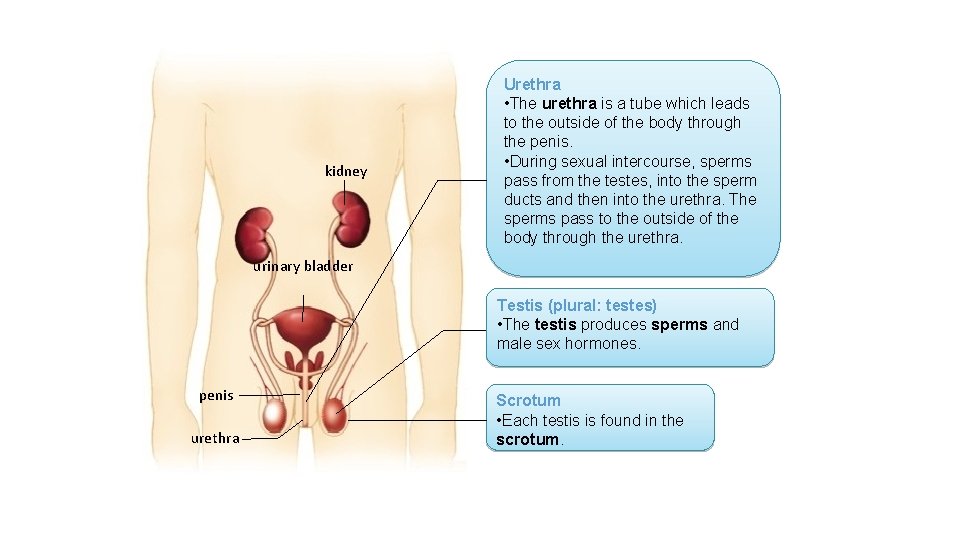
kidney Urethra • The urethra is a tube which leads to the outside of the body through the penis. • During sexual intercourse, sperms pass from the testes, into the sperm ducts and then into the urethra. The sperms pass to the outside of the body through the urethra. urinary bladder Testis (plural: testes) • The testis produces sperms and male sex hormones. penis urethra Scrotum • Each testis is found in the scrotum.
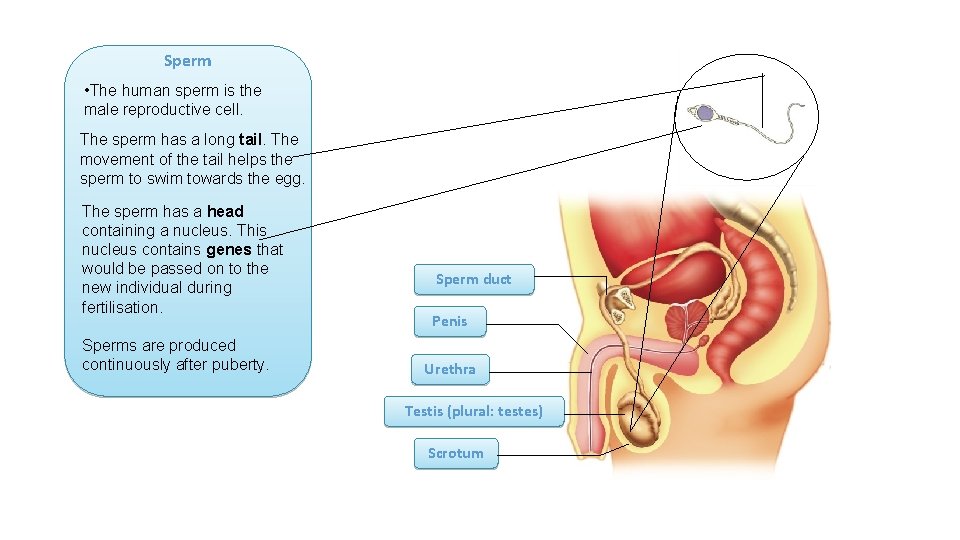
Sperm • The human sperm is the male reproductive cell. The sperm has a long tail. The movement of the tail helps the sperm to swim towards the egg. The sperm has a head containing a nucleus. This nucleus contains genes that would be passed on to the new individual during fertilisation. Sperms are produced continuously after puberty. Sperm duct Penis Urethra Testis (plural: testes) Scrotum
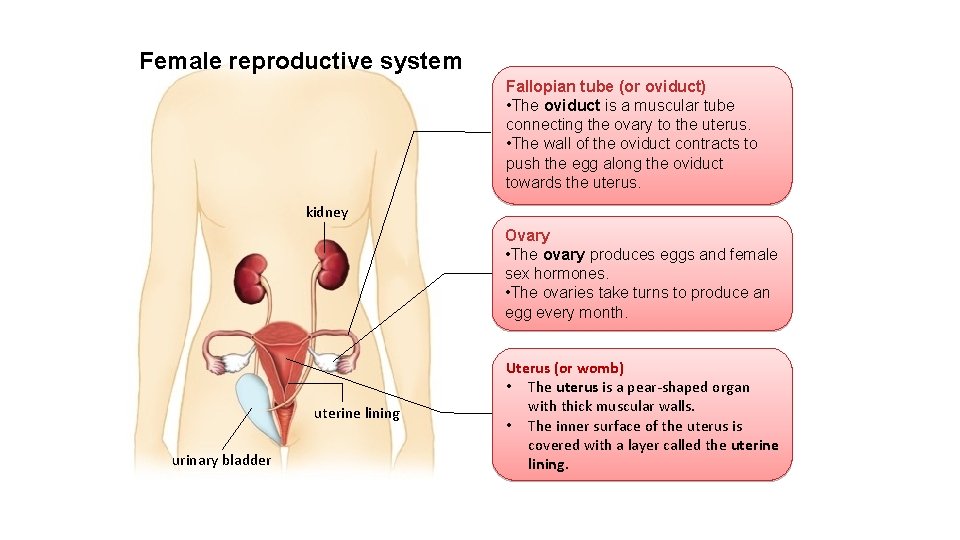
Female reproductive system Fallopian tube (or oviduct) • The oviduct is a muscular tube connecting the ovary to the uterus. • The wall of the oviduct contracts to push the egg along the oviduct towards the uterus. kidney Ovary • The ovary produces eggs and female sex hormones. • The ovaries take turns to produce an egg every month. uterine lining urinary bladder Uterus (or womb) • The uterus is a pear-shaped organ with thick muscular walls. • The inner surface of the uterus is covered with a layer called the uterine lining.
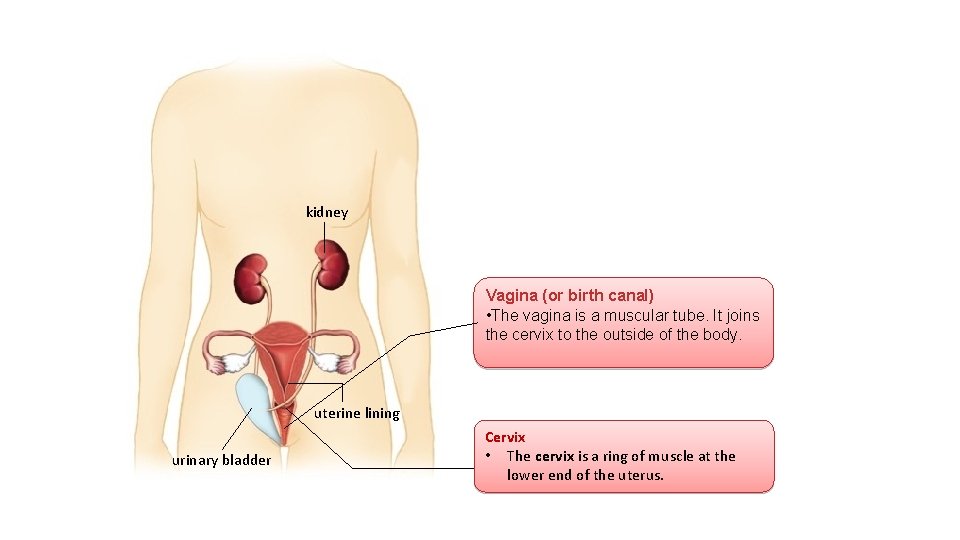
kidney Vagina (or birth canal) • The vagina is a muscular tube. It joins the cervix to the outside of the body. uterine lining urinary bladder Cervix • The cervix is a ring of muscle at the lower end of the uterus.
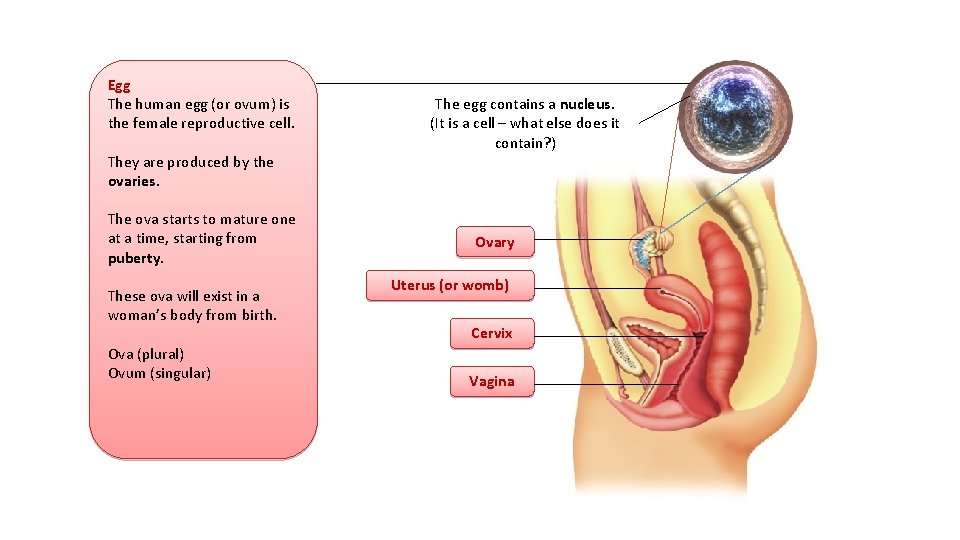
Egg The human egg (or ovum) is the female reproductive cell. They are produced by the ovaries. The ova starts to mature one at a time, starting from puberty. These ova will exist in a woman’s body from birth. Ova (plural) Ovum (singular) The egg contains a nucleus. (It is a cell – what else does it contain? ) Ovary Uterus (or womb) Cervix Vagina

Sexual Reproduction • How does human sexual reproduction happen? • What occurs when a human is sexually matured (Puberty)?
Sexual Reproduction • Sexual reproduction involves fertilisation. • Fertilisation is the fusion of the male reproductive cell (sperm) and the female reproductive cell (ovum). • Prior to fertilisation, sexual intercourse must occur.
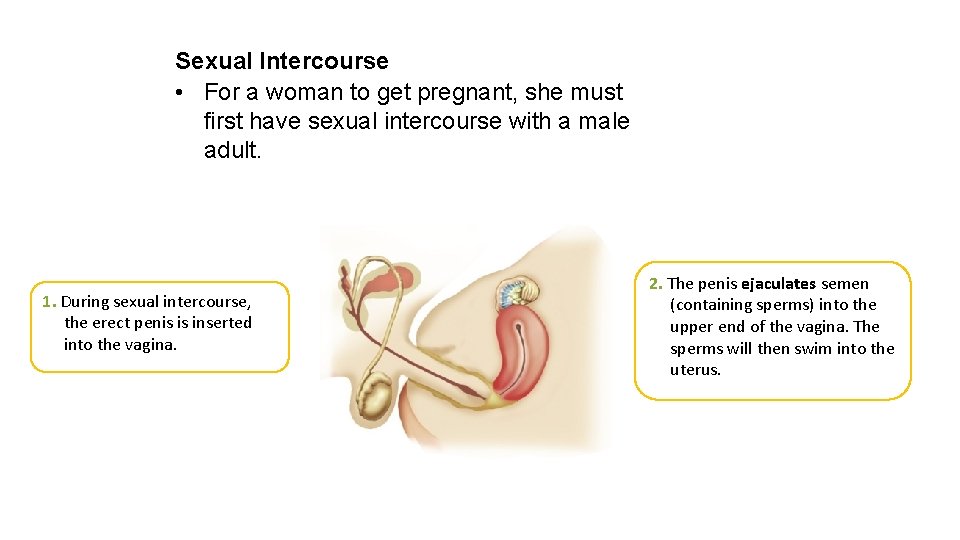
Sexual Intercourse • For a woman to get pregnant, she must first have sexual intercourse with a male adult. 1. During sexual intercourse, the erect penis is inserted into the vagina. 2. The penis ejaculates semen (containing sperms) into the upper end of the vagina. The sperms will then swim into the uterus.
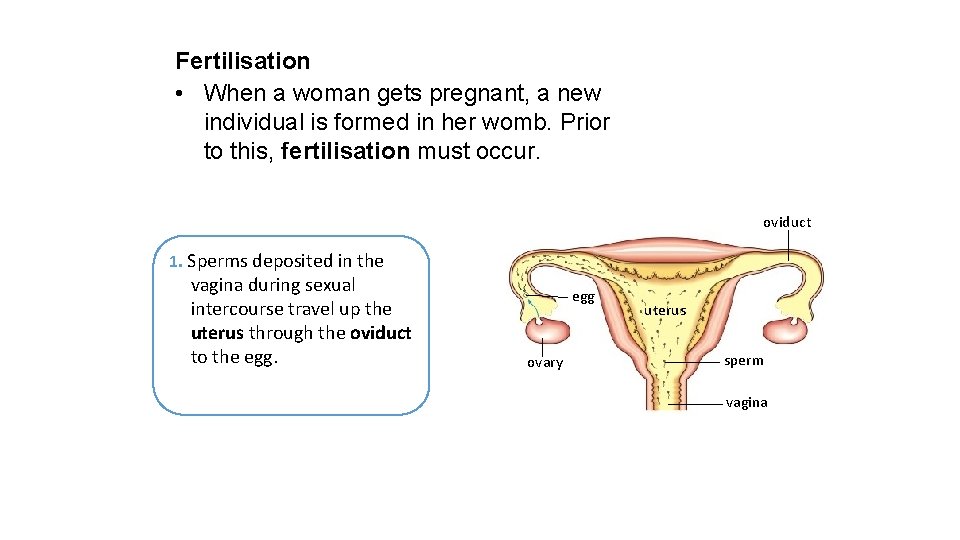
Fertilisation • When a woman gets pregnant, a new individual is formed in her womb. Prior to this, fertilisation must occur. oviduct 1. Sperms deposited in the vagina during sexual intercourse travel up the uterus through the oviduct to the egg ovary uterus sperm vagina
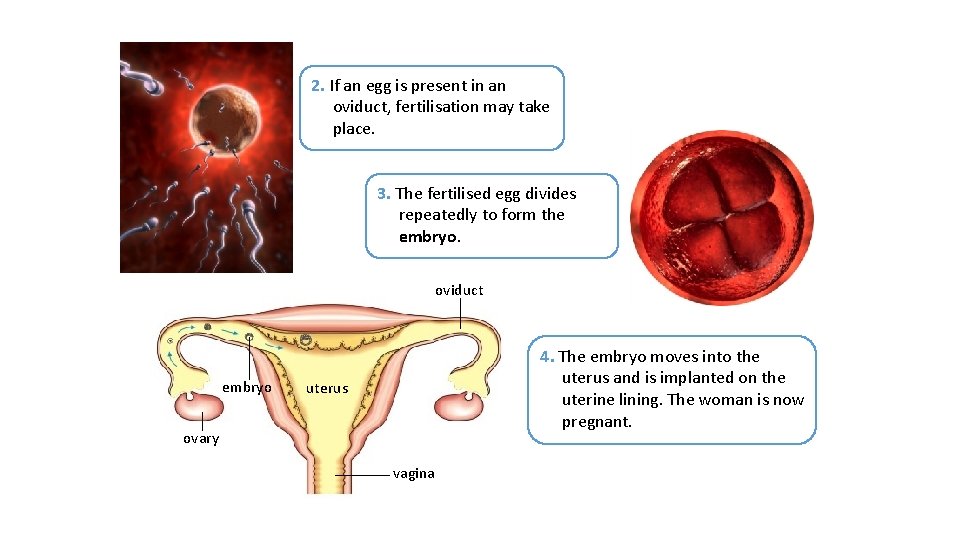
2. If an egg is present in an oviduct, fertilisation may take place. 3. The fertilised egg divides repeatedly to form the embryo. oviduct embryo 4. The embryo moves into the uterus and is implanted on the uterine lining. The woman is now pregnant. uterus ovary vagina
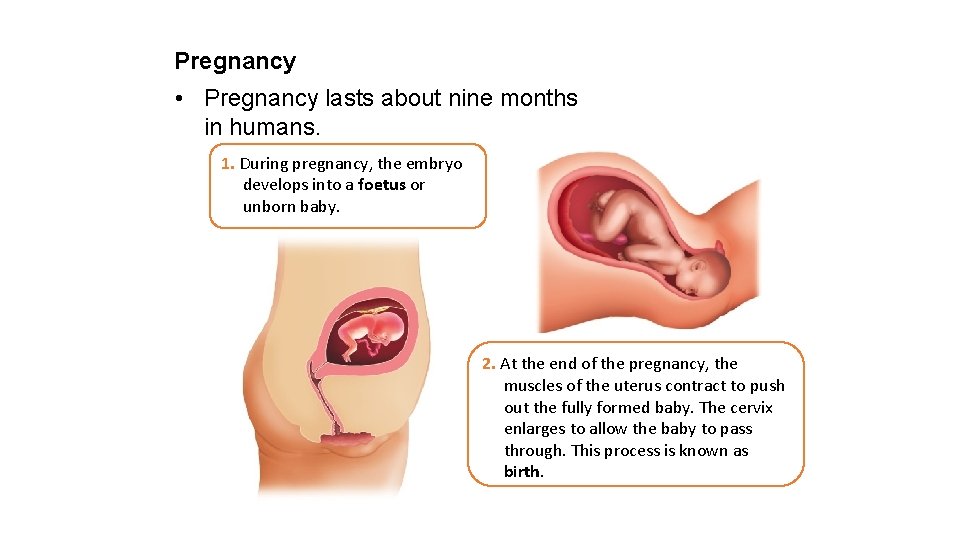
Pregnancy • Pregnancy lasts about nine months in humans. 1. During pregnancy, the embryo develops into a foetus or unborn baby. 2. At the end of the pregnancy, the muscles of the uterus contract to push out the fully formed baby. The cervix enlarges to allow the baby to pass through. This process is known as birth.
Heredity (What is the definition? ) • How many of us here actually resemble our parents? • You would notice that your siblings resemble your parents too! • A baby will grow up to look like his parents because the sperm and egg carry information that determines the baby’s look. • The nuclei of the sperm and egg contain genes. • Genes contain instructions that determine the basic characteristics of a person. • Genes are passed on to the new individual when the nucleus of the sperm fuses with the nucleus of the egg during fertilisation to form a fertilised egg.
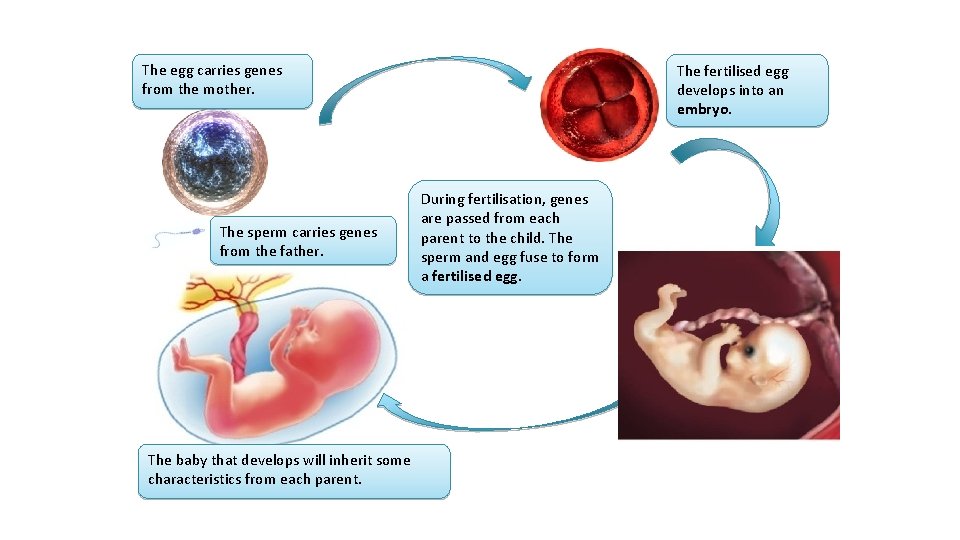
The egg carries genes from the mother. The sperm carries genes from the father. The baby that develops will inherit some characteristics from each parent. The fertilised egg develops into an embryo. During fertilisation, genes are passed from each parent to the child. The sperm and egg fuse to form a fertilised egg.

So, what have we learnt so far?
Puberty • Between the adolescent ages of 10 to 14, the human body starts to stimulate the production of certain sex hormones. • It also produces a higher amount of growth hormone that leads to growth spurts. • Sex hormones cause changes to the body and bodily functions.
Puberty • This period of bodily changes is called puberty. • Puberty is the period when an adolescent becomes capable of reproducing. The adolescent also experiences rapid growth and development during this period. • The person becomes physically mature. • Girls experience puberty earlier than boys.
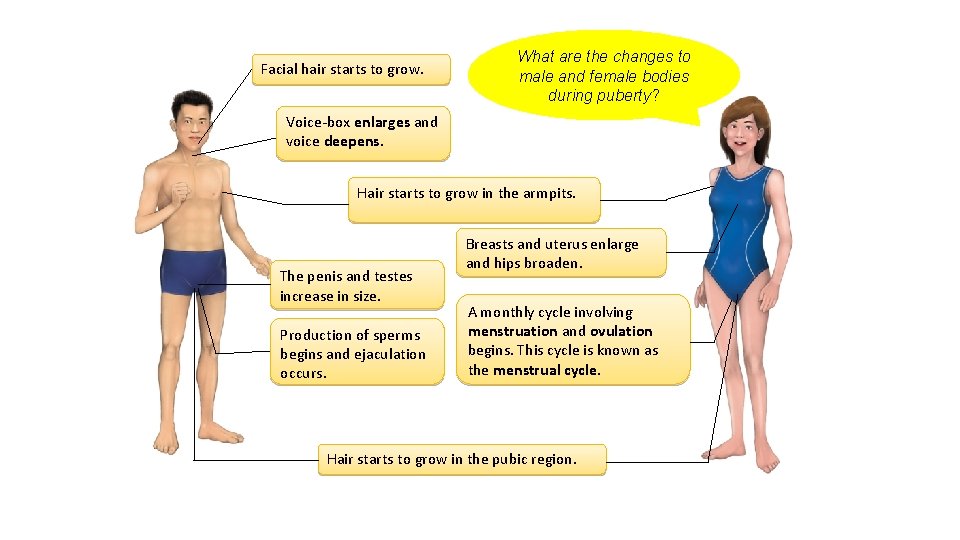
Facial hair starts to grow. What are the changes to male and female bodies during puberty? Voice-box enlarges and voice deepens. Hair starts to grow in the armpits. The penis and testes increase in size. Production of sperms begins and ejaculation occurs. Breasts and uterus enlarge and hips broaden. A monthly cycle involving menstruation and ovulation begins. This cycle is known as the menstrual cycle. Hair starts to grow in the pubic region.
Puberty • We become sexually mature during puberty and our body secretes hormones that attract us to the opposite sex. • We will also be able to reproduce by sexual reproduction. • During puberty, sex and growth hormones cause changes to other body systems such as the skeletal and muscular systems. • Boys will have heavier bones and an increase in muscle growth at the end of puberty. • Girls will experience an increase in the amount of fat tissues at the breasts, hips and pubic region at the end of puberty.
Menstruation • When a female reaches puberty, she will start to menstruate. • Menstruation marks the beginning of the menstrual cycle in a woman. • Menstruation is the discharge of the uterus tissues when an egg remains unfertilised.
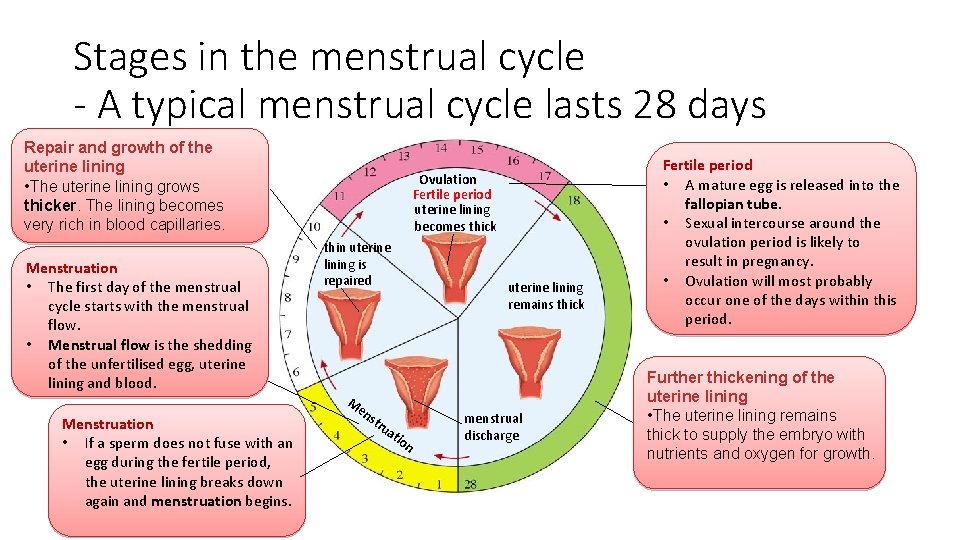
Stages in the menstrual cycle - A typical menstrual cycle lasts 28 days Repair and growth of the uterine lining • The uterine lining grows thicker. The lining becomes very rich in blood capillaries. Menstruation • The first day of the menstrual cycle starts with the menstrual flow. • Menstrual flow is the shedding of the unfertilised egg, uterine lining and blood. Menstruation • If a sperm does not fuse with an egg during the fertile period, the uterine lining breaks down again and menstruation begins. Ovulation Fertile period uterine lining becomes thick thin uterine lining is repaired M en str ua uterine lining remains thick tio n menstrual discharge Fertile period • A mature egg is released into the fallopian tube. • Sexual intercourse around the ovulation period is likely to result in pregnancy. • Ovulation will most probably occur one of the days within this period. Further thickening of the uterine lining • The uterine lining remains thick to supply the embryo with nutrients and oxygen for growth.
Pre-marital Sex and Abortion • Pre-marital sex is the act of having sexual intercourse before a couple is married. • Pre-marital sex often creates serious problems. Such problems include: • Sexually transmitted infections • Disrupts functionality of reproductive organs • May cause difficulty for couple trying to start a family • Unwanted pregnancy • Not emotionally/financially prepared • Social stigma • May lead to abortion
Abortion • Abortion is the termination of a pregnancy. • Consequences resulting from abortion: • Emotional problems such as depression • Health complications • Disruption of functions of sexual reproductive system • Even more difficult to get pregnant/ Unable to get pregnant
What are some reasons for having abortions? • Permanent harm to the mother if pregnancy continues. • Child may be born with a physical/mental disability. • Unwanted pregnancy resulted from rape. • Life of mother or/and fetus is/are in danger. • The mother is physically/mentally incapable of caring for the child. • Family is not financially ready to support the child.

Then again, we shouldn’t reach the stage where we even consider abortion.
Birth Control Methods • How do temporary and permanent methods of birth control affect the reproductive systems to prevent contraception? • What are some of the sexually transmitted infections? • How can we prevent the spread of sexually transmitted infections?
• When a country is overpopulated, it may have problems producing enough food and homes for its people. • One of the reasons of overpopulation is the lack of birth control. • Overpopulated countries have tried to control birth rates by educating their people on birth control and making it more accessible to their people.
Birth Control Methods • Birth control methods are used to prevent pregnancies. • Work by preventing ovulation, fertilisation or implantation of embryo. • Method used may be natural, chemical, mechanical or surgical. • Can be temporary or permanent.
Temporary birth control methods • Temporary birth control methods allow a couple to have children when the couple stop using the methods. • They include: • Not having sexual intercourse at all (abstinence) • Withdrawal of the penis just before ejaculation • The rhythm method • Use of chemicals such as spermicides, contraceptive pills • Use of mechanical devices such as condoms, diaphragms and intra -uterine devices
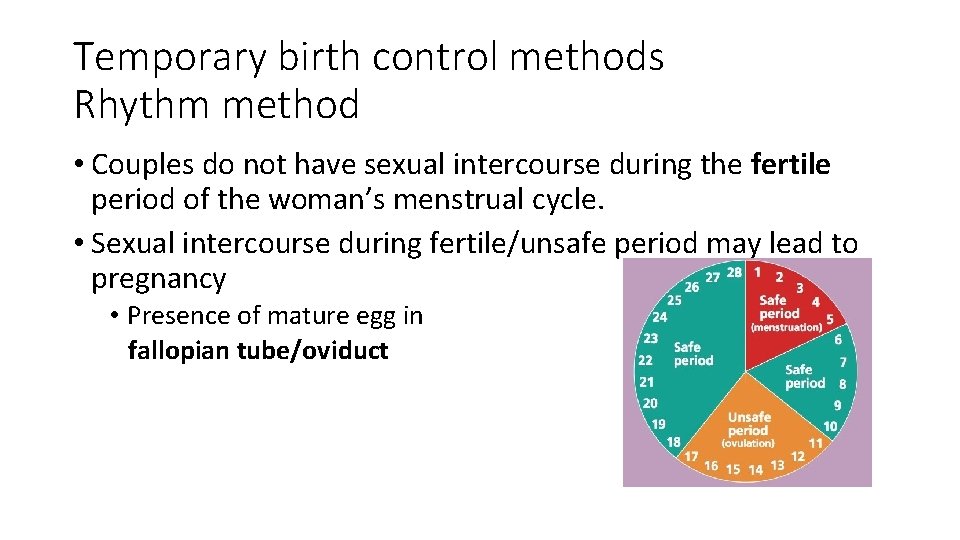
Temporary birth control methods Rhythm method • Couples do not have sexual intercourse during the fertile period of the woman’s menstrual cycle. • Sexual intercourse during fertile/unsafe period may lead to pregnancy • Presence of mature egg in fallopian tube/oviduct
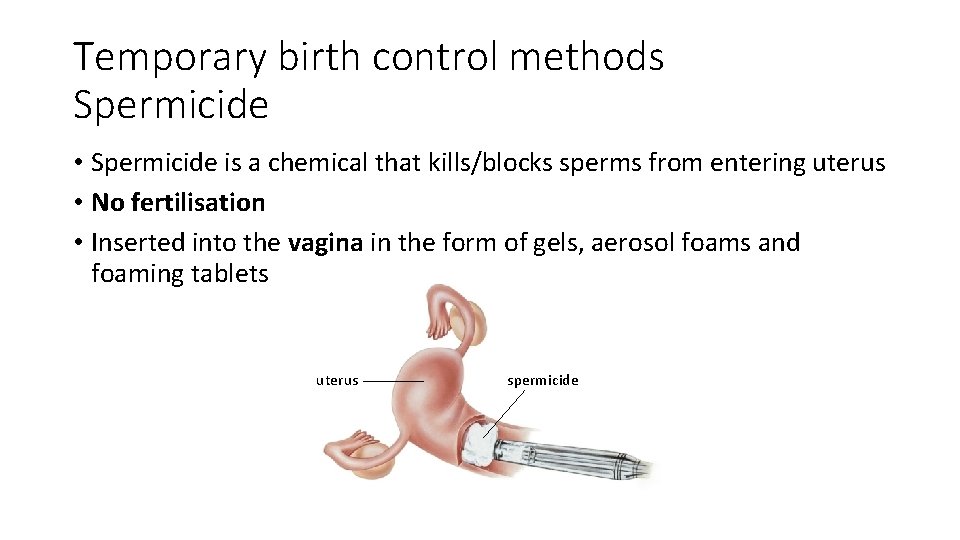
Temporary birth control methods Spermicide • Spermicide is a chemical that kills/blocks sperms from entering uterus • No fertilisation • Inserted into the vagina in the form of gels, aerosol foams and foaming tablets uterus spermicide
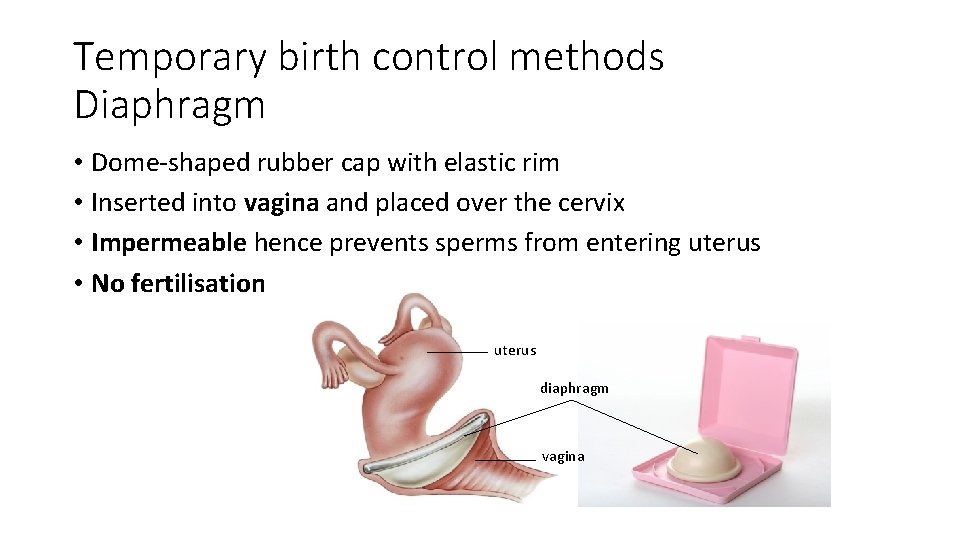
Temporary birth control methods Diaphragm • Dome-shaped rubber cap with elastic rim • Inserted into vagina and placed over the cervix • Impermeable hence prevents sperms from entering uterus • No fertilisation uterus diaphragm vagina
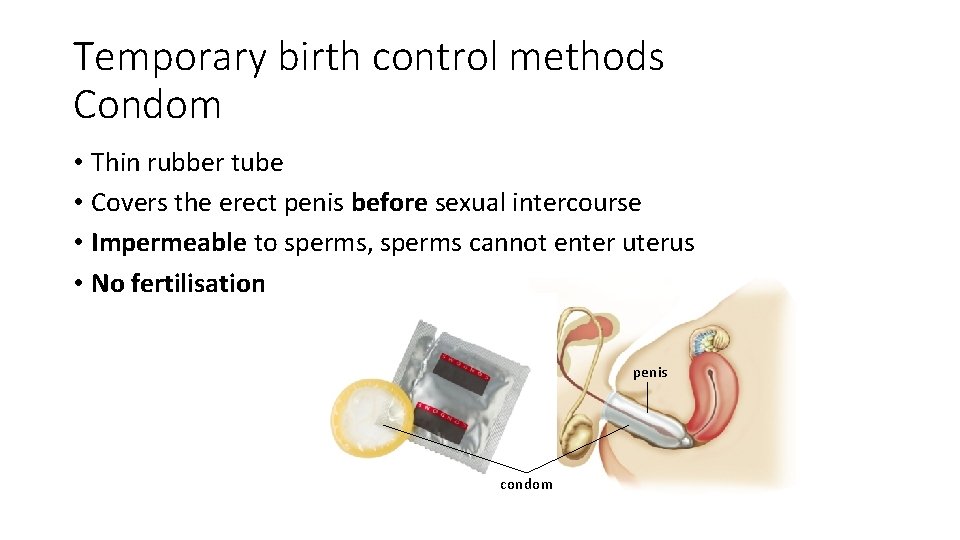
Temporary birth control methods Condom • Thin rubber tube • Covers the erect penis before sexual intercourse • Impermeable to sperms, sperms cannot enter uterus • No fertilisation penis condom
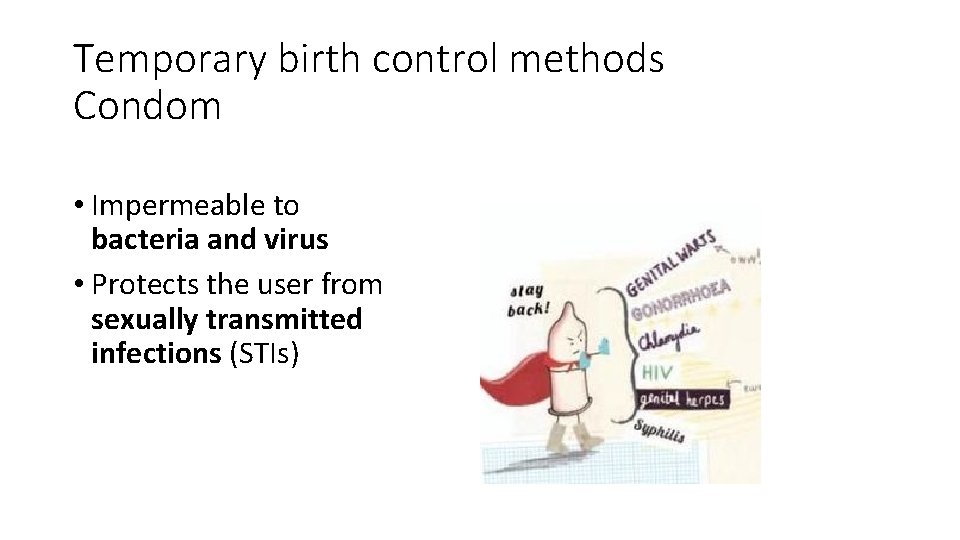
Temporary birth control methods Condom • Impermeable to bacteria and virus • Protects the user from sexually transmitted infections (STIs)
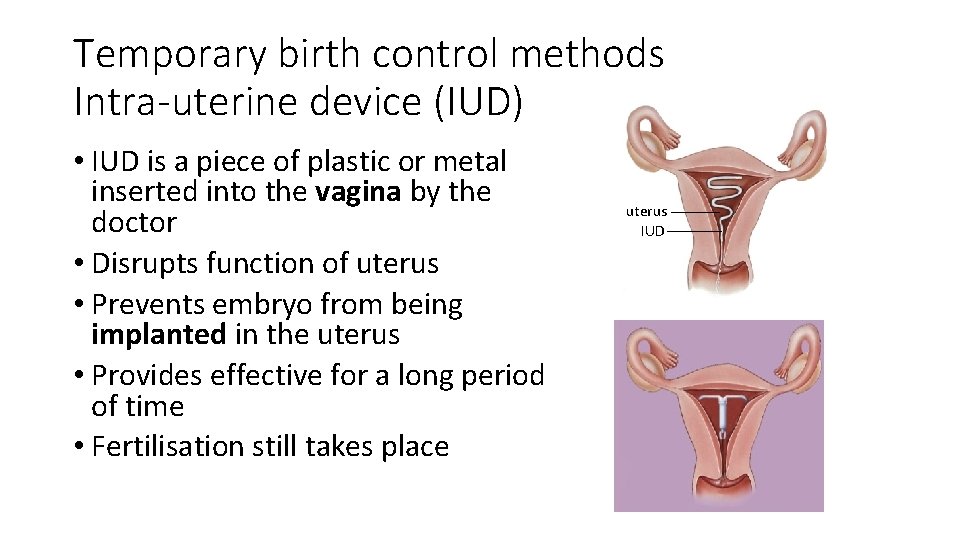
Temporary birth control methods Intra-uterine device (IUD) • IUD is a piece of plastic or metal inserted into the vagina by the doctor • Disrupts function of uterus • Prevents embryo from being implanted in the uterus • Provides effective for a long period of time • Fertilisation still takes place uterus IUD
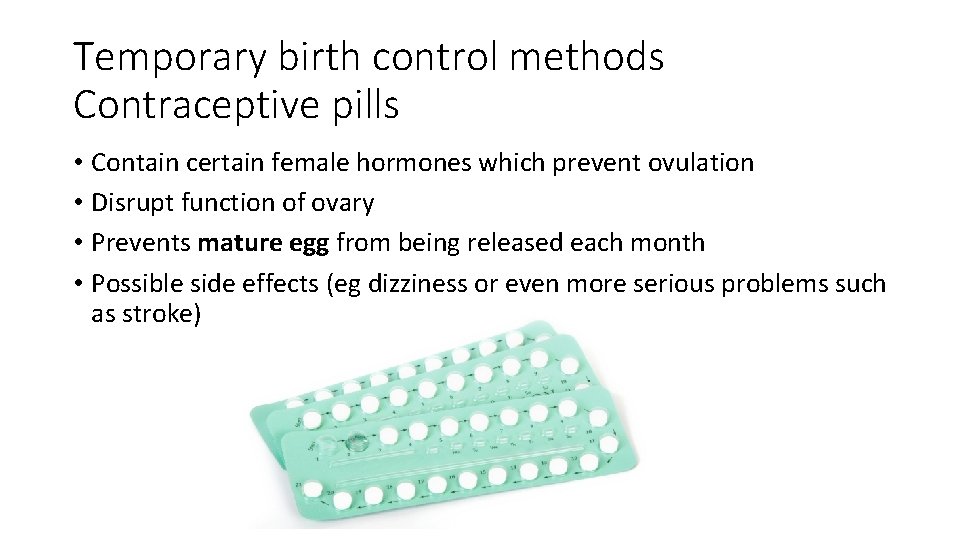
Temporary birth control methods Contraceptive pills • Contain certain female hormones which prevent ovulation • Disrupt function of ovary • Prevents mature egg from being released each month • Possible side effects (eg dizziness or even more serious problems such as stroke)
Permanent birth control methods • Requires surgery • Irreversible • Usually chosen by couples who are sure that they do not want anymore children Permanent methods include: • Vasectomy • Tubal ligation Permanently prevent fertilisation by disrupting functions of parts of reproductive system
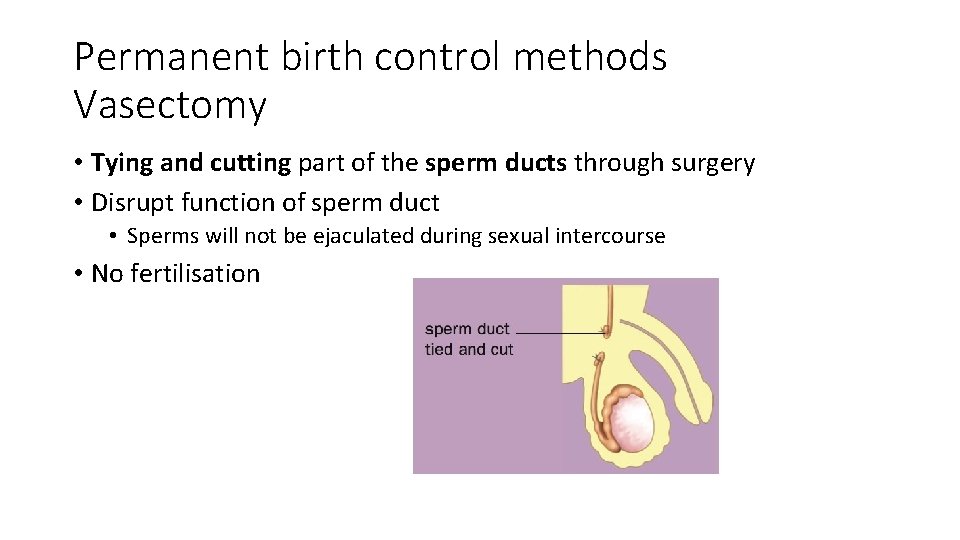
Permanent birth control methods Vasectomy • Tying and cutting part of the sperm ducts through surgery • Disrupt function of sperm duct • Sperms will not be ejaculated during sexual intercourse • No fertilisation
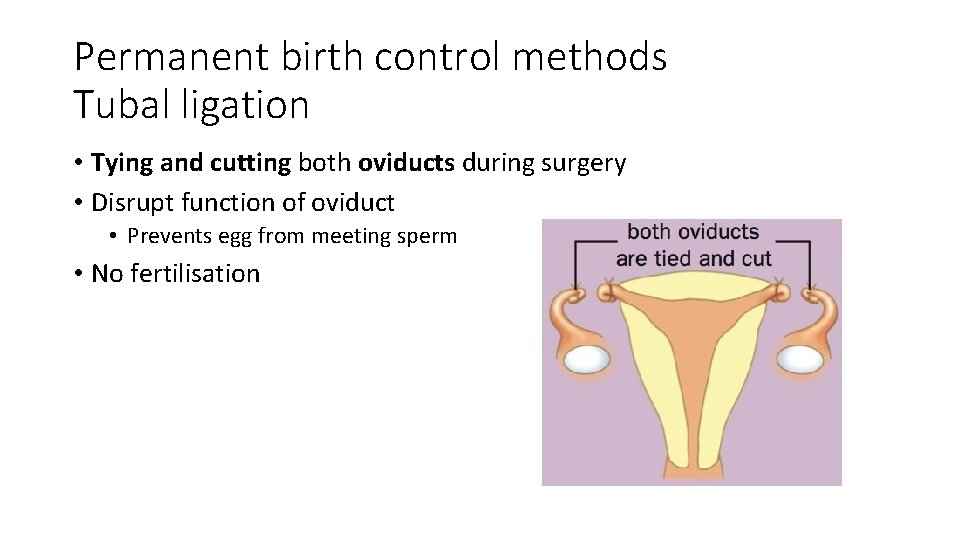
Permanent birth control methods Tubal ligation • Tying and cutting both oviducts during surgery • Disrupt function of oviduct • Prevents egg from meeting sperm • No fertilisation
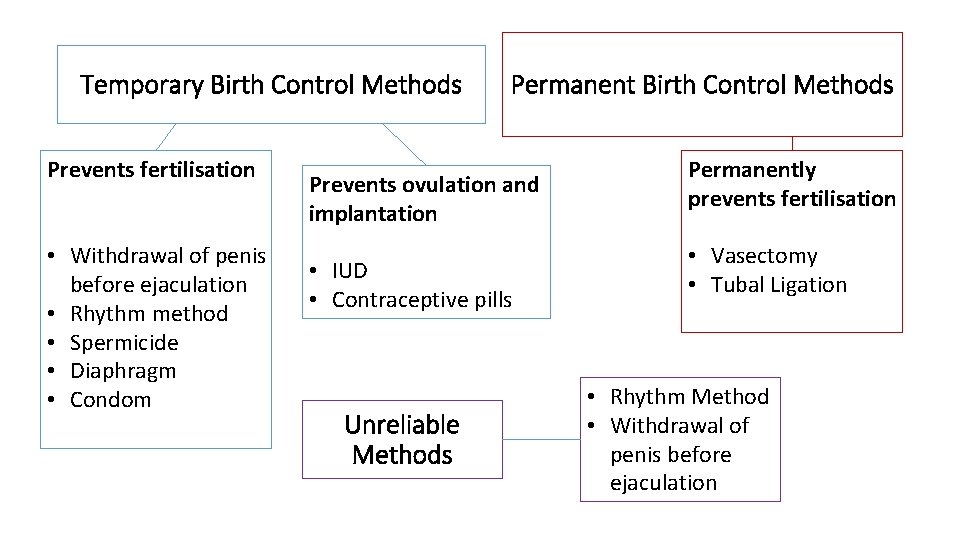
Temporary Birth Control Methods Prevents fertilisation • Withdrawal of penis before ejaculation • Rhythm method • Spermicide • Diaphragm • Condom Permanent Birth Control Methods Prevents ovulation and implantation • IUD • Contraceptive pills Unreliable Methods Permanently prevents fertilisation • Vasectomy • Tubal Ligation • Rhythm Method • Withdrawal of penis before ejaculation
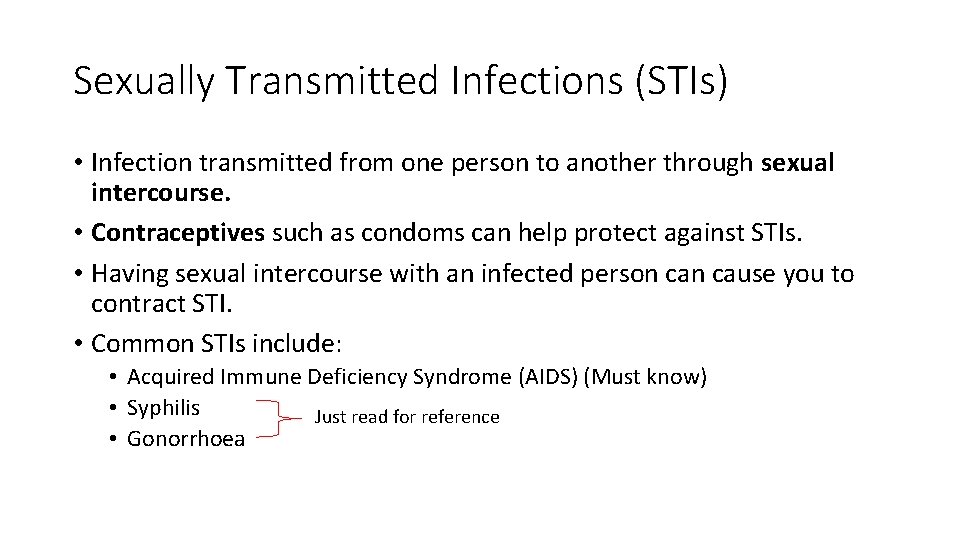
Sexually Transmitted Infections (STIs) • Infection transmitted from one person to another through sexual intercourse. • Contraceptives such as condoms can help protect against STIs. • Having sexual intercourse with an infected person cause you to contract STI. • Common STIs include: • Acquired Immune Deficiency Syndrome (AIDS) (Must know) • Syphilis Just read for reference • Gonorrhoea
Sexually Transmitted Infections (STIs) • Infected people may not show obvious signs or symptoms. • Unaware, they can spread the STI to their partners or unborn children. • Multiple sex partners can increase the rate of infection. • Annually, a few hundred teenagers in SG get infected with STI.
Sexually Transmitted Infections (STIs) • During sexual intercourse, body fluids are exchanged in the reproductive systems. • STI-causing bacteria or viruses are present in some of the body fluids of an infected person. • Bacteria/Virus can enter the circulatory system of the sexual partner through their sexual reproductive system. • STIs may also be spread through contaminated blood or childbirth.
Acquired Immune Deficiency Syndrome(AIDS) • Caused by the Human Immunodeficiency Virus (HIV). • HIV attacks the immune system: • Person loses immunity • Becomes vulnerable to common infections • AIDS is the final stage of HIV – Immune system is severely damaged. • Infected person suffers from severe weight loss, lung infections and brain infection.
Acquired Immune Deficiency Syndrome(AIDS) • AIDS is a viral STI which is incurable and fatal.
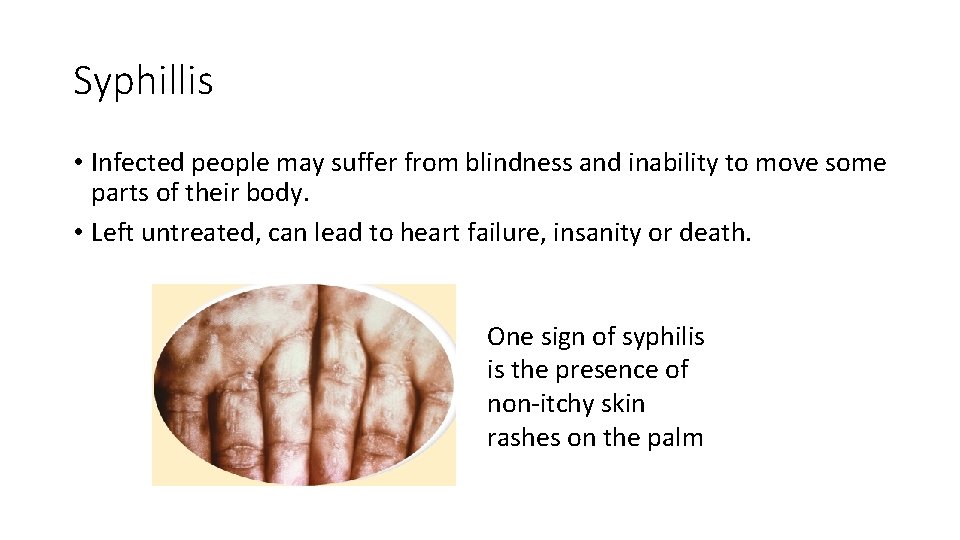
Syphillis • Infected people may suffer from blindness and inability to move some parts of their body. • Left untreated, can lead to heart failure, insanity or death. One sign of syphilis is the presence of non-itchy skin rashes on the palm
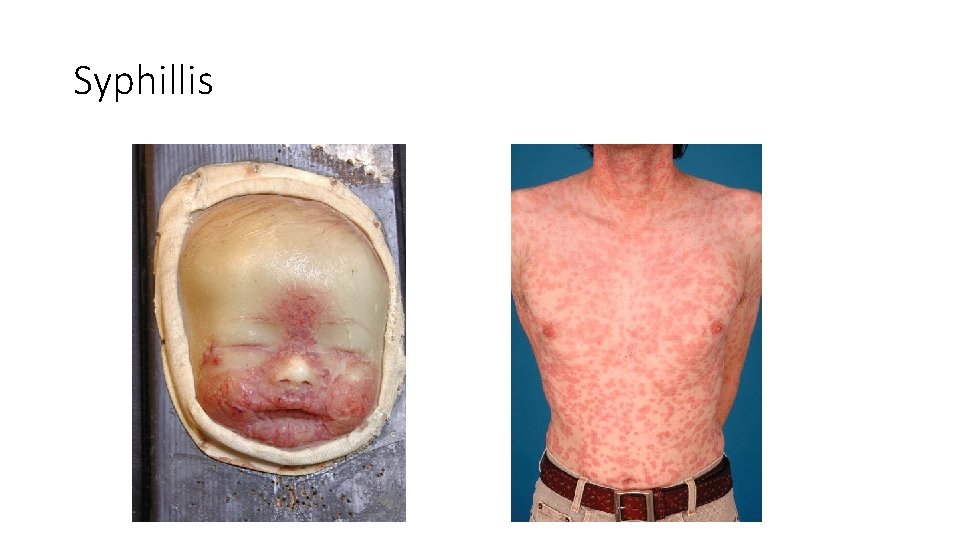
Syphillis
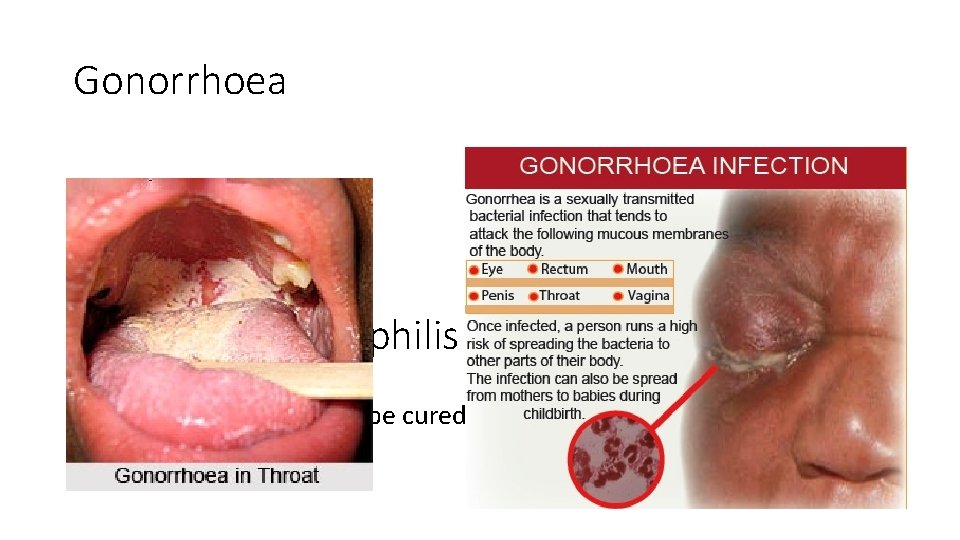
Gonorrhoea • Infected men and women may become unable to bear children if the disease spread to their reproductive system. • Babies may be born blind if the bacteria enters the baby’s eyes during birth. Treatment for syphilis and gonorrhoea • These bacterial STIs can be cured when treated with antibiotics.
Gonorrhoea Treatment for syphilis and gonorrhoea • These bacterial STIs can be cured when treated with antibiotics.
Prevention and control Important to prevent STIs as some are incurable. Ways to control the spread and prevent infection: • Avoid having multiple sex partners. • Avoid sharing instruments that are likely to break the skin and become contaminated with blood (eg razors and needles), use disposable and sterile ones instead.
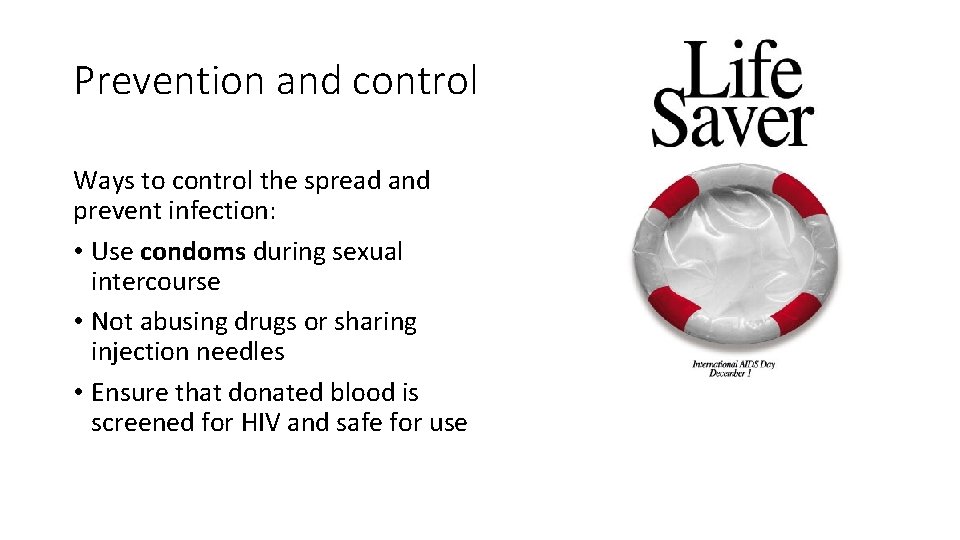
Prevention and control Ways to control the spread and prevent infection: • Use condoms during sexual intercourse • Not abusing drugs or sharing injection needles • Ensure that donated blood is screened for HIV and safe for use
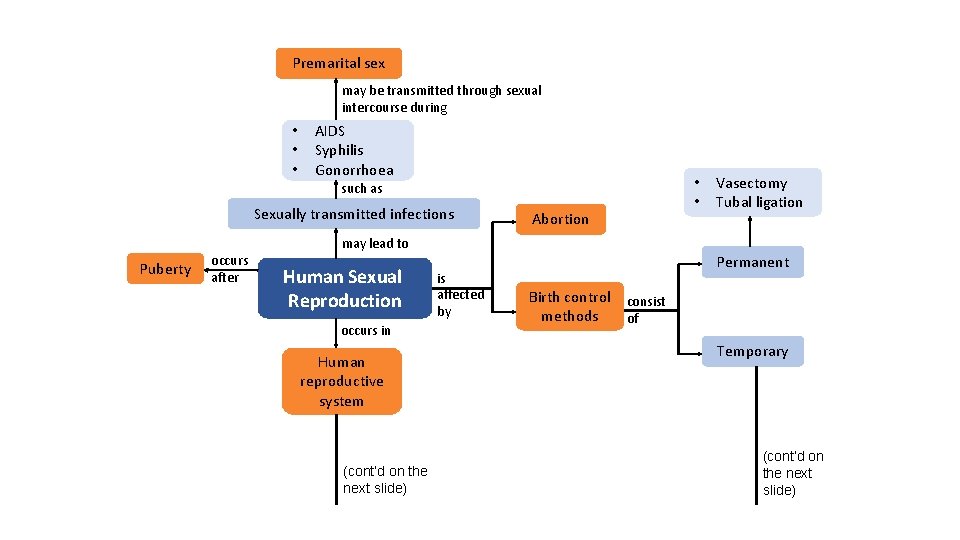
Map It Premarital sex may be transmitted through sexual intercourse during • • • AIDS Syphilis Gonorrhoea such as Sexually transmitted infections Puberty occurs after Abortion • • Vasectomy Tubal ligation may lead to Human Sexual Reproduction occurs in Human reproductive system (cont’d on the next slide) is affected by Permanent Birth control consist methods of Temporary (cont’d on the next slide)
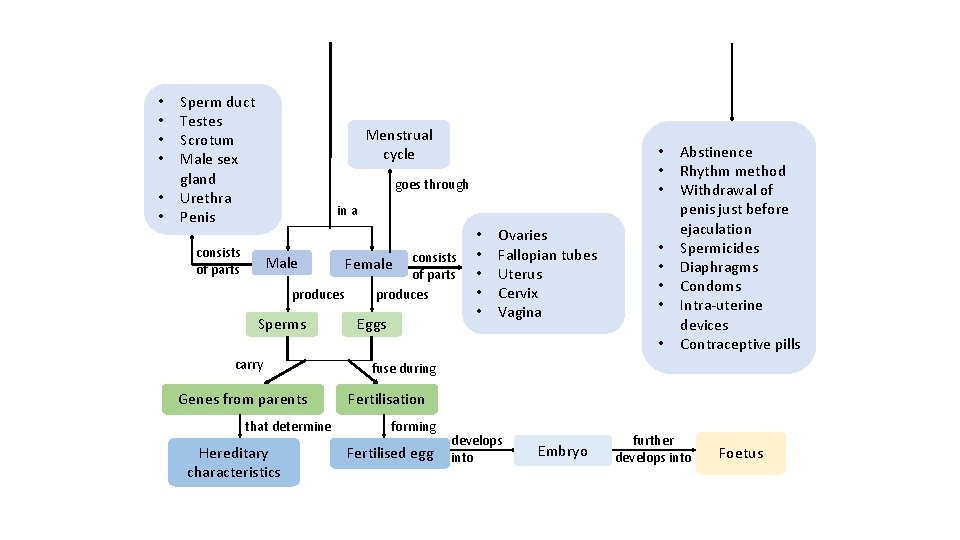
Map It • • • Sperm duct Testes Scrotum Male sex gland Urethra Penis Menstrual cycle • • • goes through in a consists of parts Male Female consists of parts produces Sperms Eggs • • • Ovaries Fallopian tubes Uterus Cervix Vagina • • • carry Genes from parents that determine Hereditary characteristics Abstinence Rhythm method Withdrawal of penis just before ejaculation Spermicides Diaphragms Condoms Intra-uterine devices Contraceptive pills fuse during Fertilisation forming Fertilised egg develops into Embryo further develops into Foetus
- Slides: 59