
Human Settlements Financing Division An overview of activities
- Slides: 28
Human Settlements Financing Division: An overview of activities Dr Graham Alabaster OIC Human Settlements Financing Division UN-HABITAT
Presentation Overview – Some Basic Statistics & UN-Habitat Mandates – Human Settlements Financing Division – Water Sanitation and Infrastructure Branch – Slum Upgrading Facility – Urban Finance Branch – Conclusions
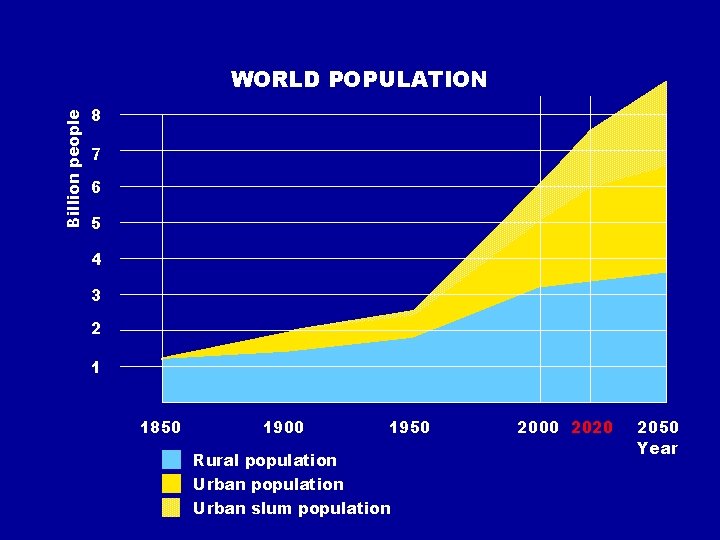
Billion people WORLD POPULATION 8 7 6 5 4 3 2 1 1850 1900 1950 Rural population Urban slum population 2000 2020 2050 Year
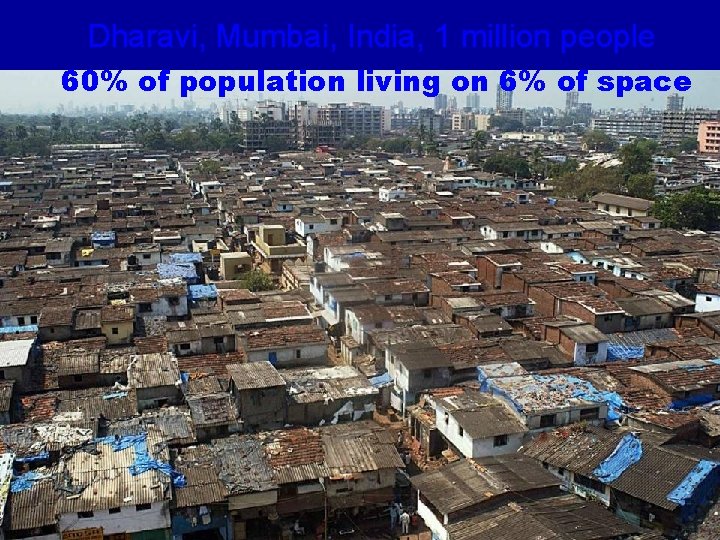
Dharavi, Mumbai, India, 1 million people 60% of population living on 6% of space
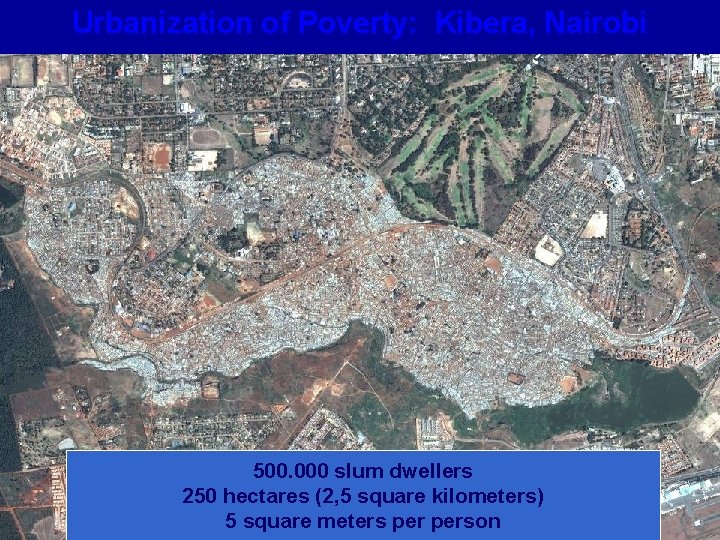
Urbanization of Poverty: Kibera, Nairobi 500. 000 slum dwellers 250 hectares (2, 5 square kilometers) 5 square meters person
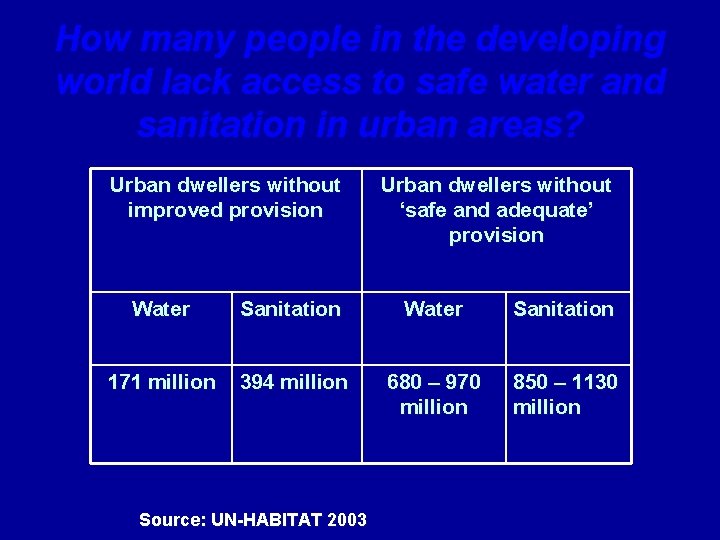
How many people in the developing world lack access to safe water and sanitation in urban areas? Urban dwellers without improved provision Urban dwellers without ‘safe and adequate’ provision Water Sanitation 171 million 394 million 680 – 970 million 850 – 1130 million Source: UN-HABITAT 2003
UN-HABITAT’s Mandate • • • The “City Agency” within the United Nations system, and the focal point for the implementation of the Habitat Agenda The United Nations General Assembly resolution 56/206 upgraded UNCHS (Habitat) into a fully fledged programme of the United Nations, designated as the United Nations Human Settlements Programme (UN-HABITAT). UN-HABITAT was a key member of both the Millennium Task Forces (7 and 8) and is responsible for monitoring the progress towards achievement of Target 11 related to improving the lives of the slum dwellers. The United Nations General Assembly, in its resolution 57/275, has also called upon UN-HABITAT to further support the implementation of the Water for African Cities Programme as requested by NEPAD Governing Council resolution 19/6 calls upon UN-HABITAT to further strengthen its water programme
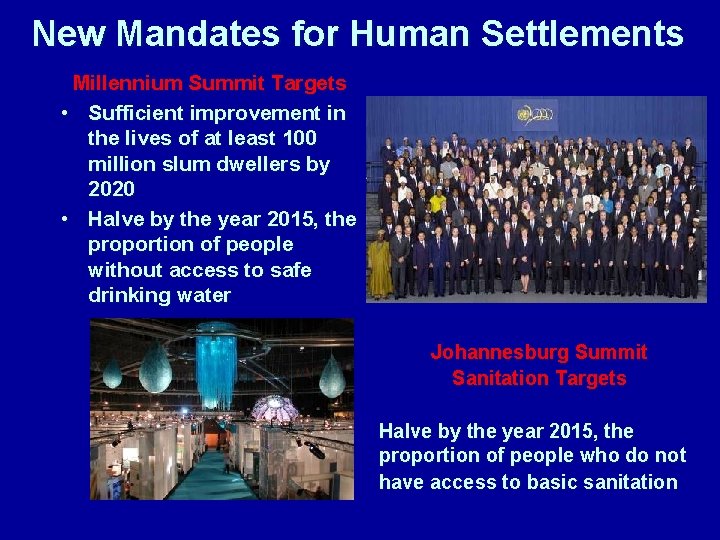
New Mandates for Human Settlements Millennium Summit Targets • Sufficient improvement in the lives of at least 100 million slum dwellers by 2020 • Halve by the year 2015, the proportion of people without access to safe drinking water Johannesburg Summit Sanitation Targets Halve by the year 2015, the proportion of people who do not have access to basic sanitation
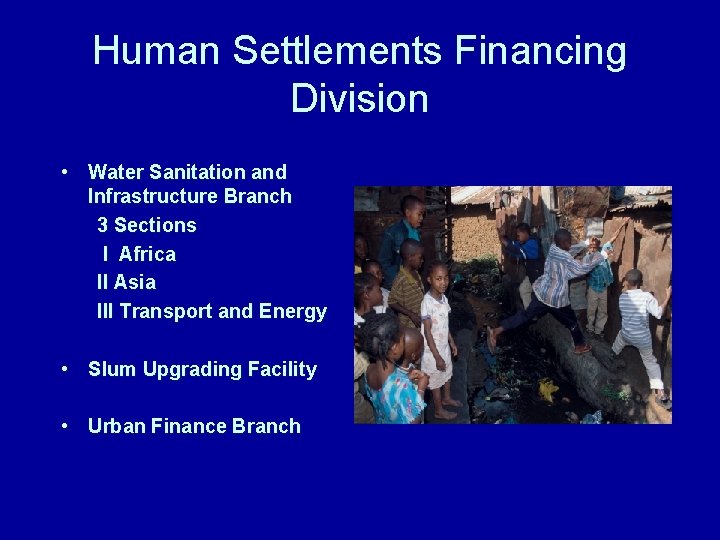
Human Settlements Financing Division • Water Sanitation and Infrastructure Branch 3 Sections I Africa II Asia III Transport and Energy • Slum Upgrading Facility • Urban Finance Branch
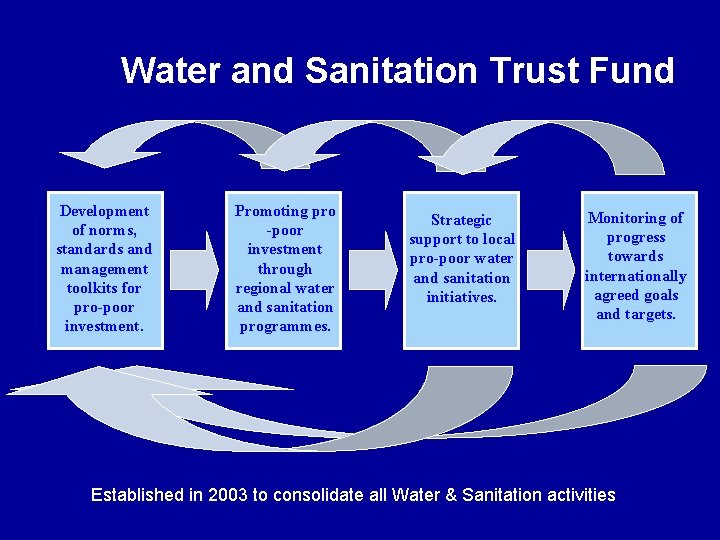
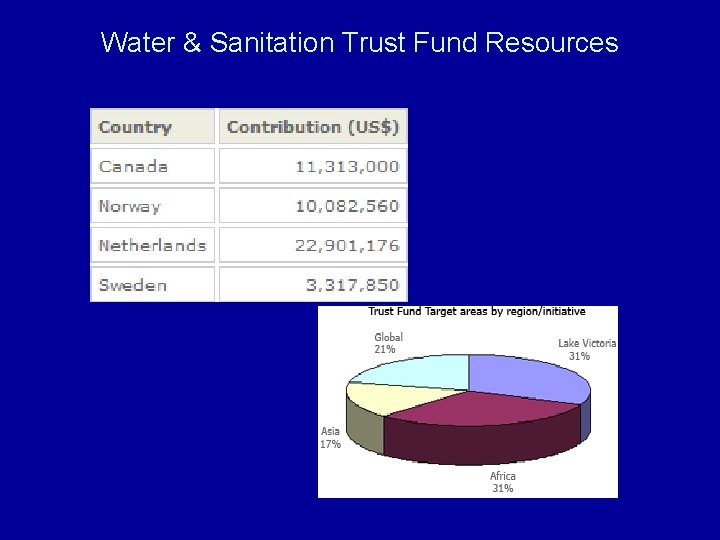
Water and Sanitation Trust Fund Development of norms, standards and management toolkits for pro-poor investment. Promoting pro -poor investment through regional water and sanitation programmes. Strategic support to local pro-poor water and sanitation initiatives. Monitoring of progress towards internationally agreed goals and targets. Established in 2003 to consolidate all Water & Sanitation activities
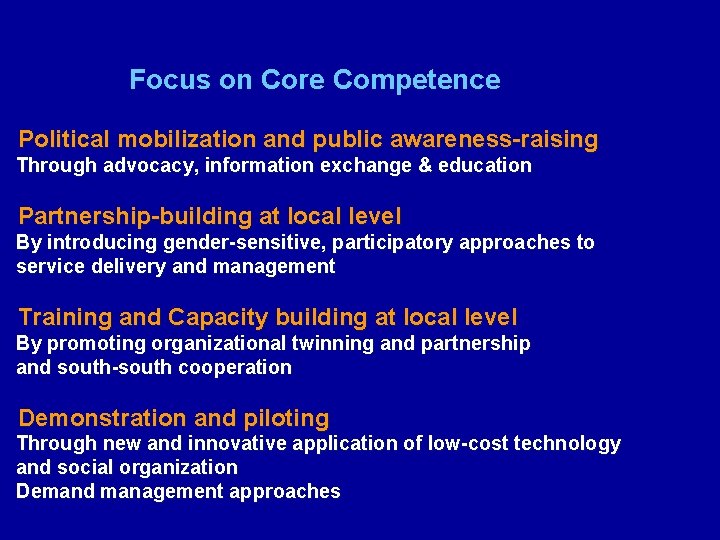
Focus on Core Competence Political mobilization and public awareness-raising Through advocacy, information exchange & education Partnership-building at local level By introducing gender-sensitive, participatory approaches to service delivery and management Training and Capacity building at local level By promoting organizational twinning and partnership and south-south cooperation Demonstration and piloting Through new and innovative application of low-cost technology and social organization Demand management approaches
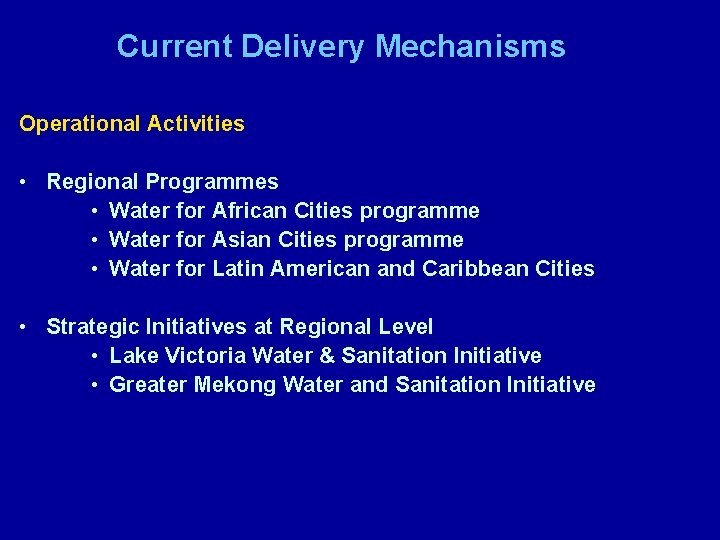
Current Delivery Mechanisms Operational Activities • Regional Programmes • Water for African Cities programme • Water for Asian Cities programme • Water for Latin American and Caribbean Cities • Strategic Initiatives at Regional Level • Lake Victoria Water & Sanitation Initiative • Greater Mekong Water and Sanitation Initiative
Current Delivery Mechanisms Normative Activities • Global Assessments: State of Water & Sanitation • Pro-poor Governance Toolkit • Rights-based Approach to water and Sanitation • Integrated Urban Water Resource Management & environmental Assessments • Monitoring Progress with Achievement of MDG • Global Water Operator Partnerships
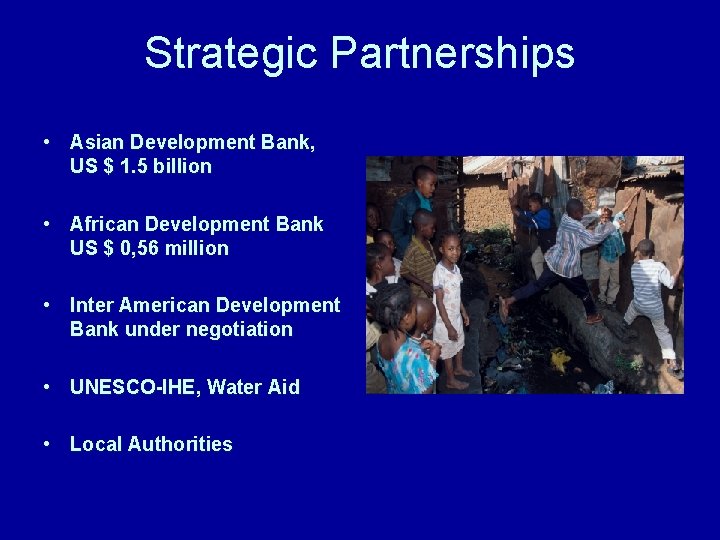
Strategic Partnerships • Asian Development Bank, US $ 1. 5 billion • African Development Bank US $ 0, 56 million • Inter American Development Bank under negotiation • UNESCO-IHE, Water Aid • Local Authorities
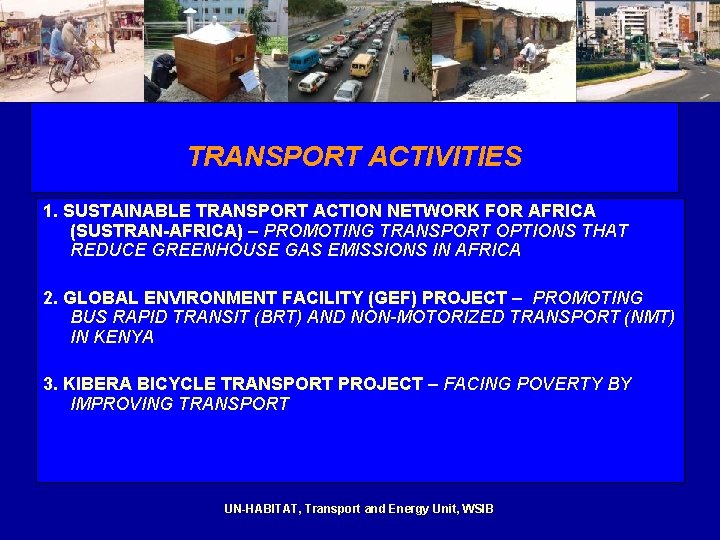
TRANSPORT ACTIVITIES 1. SUSTAINABLE TRANSPORT ACTION NETWORK FOR AFRICA (SUSTRAN-AFRICA) – PROMOTING TRANSPORT OPTIONS THAT REDUCE GREENHOUSE GAS EMISSIONS IN AFRICA 2. GLOBAL ENVIRONMENT FACILITY (GEF) PROJECT – PROMOTING BUS RAPID TRANSIT (BRT) AND NON-MOTORIZED TRANSPORT (NMT) IN KENYA 3. KIBERA BICYCLE TRANSPORT PROJECT – FACING POVERTY BY IMPROVING TRANSPORT UN-HABITAT, Transport and Energy Unit, WSIB
ENERGY ACTIVITIES 1. GLOBAL ENERGY NETWORK FOR THE URBAN SETTLEMENTS (GENUS) – PROMOTING ENERGY ACCESS FOR THE URBAN POOR WORLDWIDE 2. ENERGY EXPERT GROUP MEETING – ENERGY ACCESS FOR THE URBAN POOR (NAIROBI, 4 -6 DECEMBER 2006) 3. UN COMMISSION ON SUSTAINABLE DEVELOPMENT (CSD-15) – ENERGY FOR SUSTAINABLE DEVELOPMENT (NEW YORK, 30 APR – 12 MAY 2007) UN-HABITAT, Transport and Energy Unit, WSIB
Water & Sanitation Trust Fund Resources
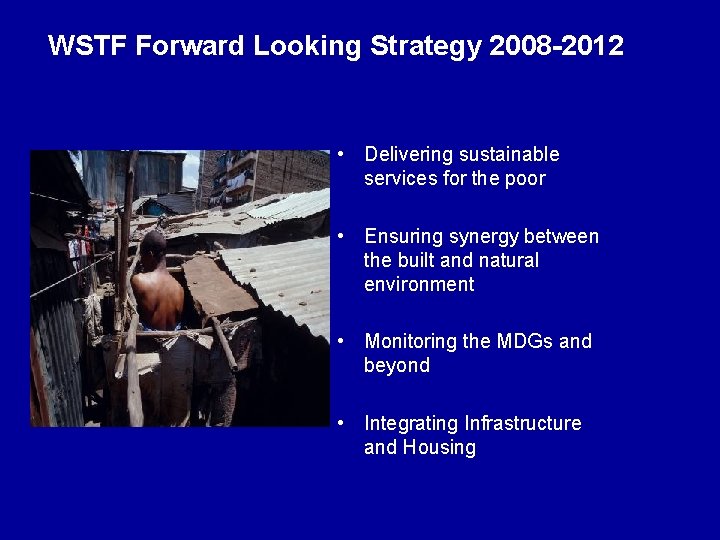
WSTF Forward Looking Strategy 2008 -2012 • Delivering sustainable services for the poor • Ensuring synergy between the built and natural environment • Monitoring the MDGs and beyond • Integrating Infrastructure and Housing
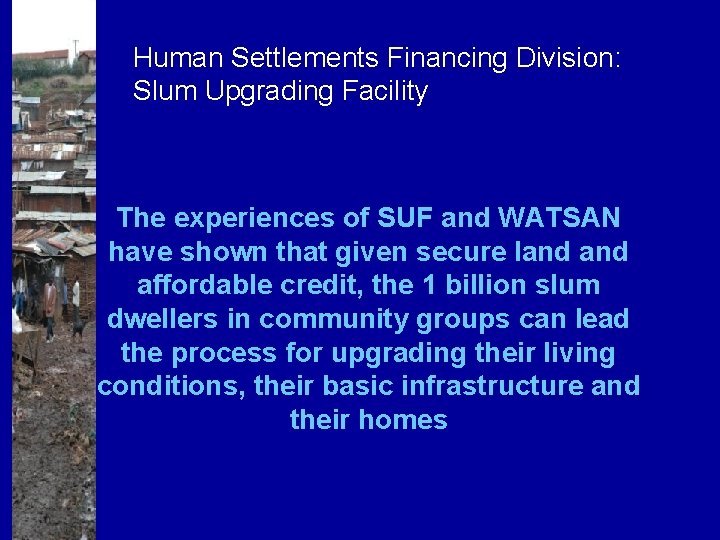
Human Settlements Financing Division: Slum Upgrading Facility The experiences of SUF and WATSAN have shown that given secure land affordable credit, the 1 billion slum dwellers in community groups can lead the process for upgrading their living conditions, their basic infrastructure and their homes
Slum Upgrading Facility SUF is established within the Human Settlements Financing Division of UN-HABITAT in Nairobi SUF is a technical cooperation and seed capital facility. It operates as a donor-supported Pilot Programme 2006 – 2009 SUF Objective: to mobilize domestic capital for slum upgrading projects and activities The four functions of SUF: 1. Advisory Services 2. Referral Functions 3. Financial Packaging 4. Development of Financial Products SUF has a Consultative Board, agreements with funding sources, an Operations Manual and various guidelines & frameworks
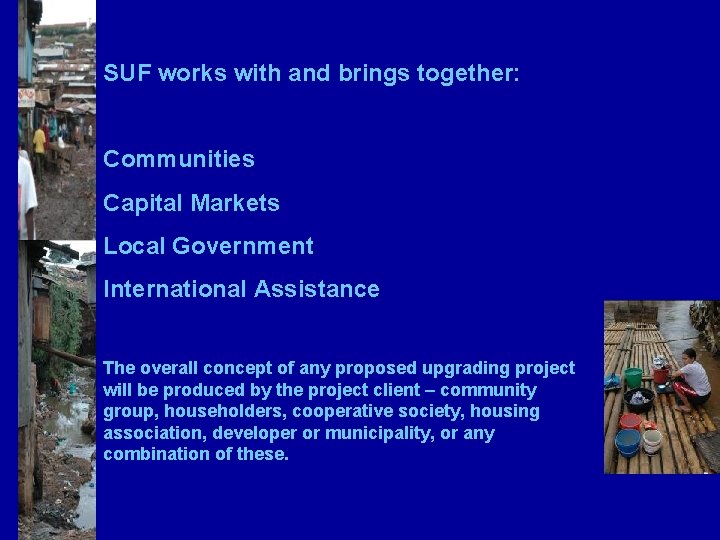
SUF works with and brings together: Communities Capital Markets Local Government International Assistance The overall concept of any proposed upgrading project will be produced by the project client – community group, householders, cooperative society, housing association, developer or municipality, or any combination of these.
Secure land affordable credit are not easy commodities to come by Locally, people can see the solutions but they tend to be ignored. Planning the processes for solutions from the bottom requires knowledge, persistence and local revolving funds that attract local domestic capital. For this to succeed, support in the form of revolving of fund flows and guarantees need to come from somewhere. As an international system, this is where it is envisaged that the foundation comes in with a strategic role.
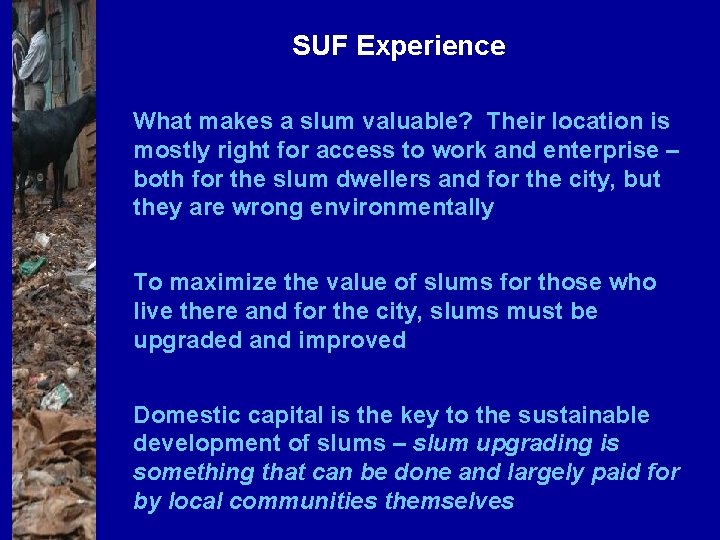
SUF Experience What makes a slum valuable? Their location is mostly right for access to work and enterprise – both for the slum dwellers and for the city, but they are wrong environmentally To maximize the value of slums for those who live there and for the city, slums must be upgraded and improved Domestic capital is the key to the sustainable development of slums – slum upgrading is something that can be done and largely paid for by local communities themselves
SUF Experience • If projects are “bankable”, private sector investment will come • Urban poor savings and lending groups demonstrate excellent repayment schemes (default repayment rates often less than 1%). Given a helping hand, they are suitable for private investment • Municipalities are best placed to lead the planning for capital investments in land services • Working together, slum dwellers, municipalities and the private sector can finance, implement & monitor slum upgrading
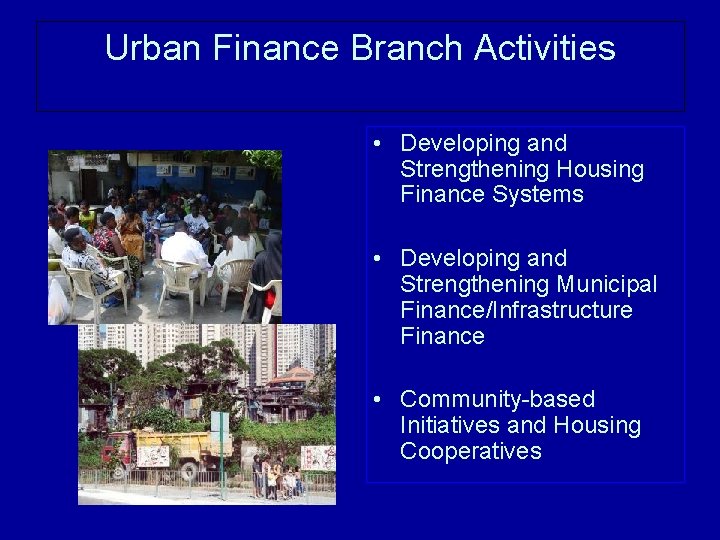
Urban Finance Branch Activities • Developing and Strengthening Housing Finance Systems • Developing and Strengthening Municipal Finance/Infrastructure Finance • Community-based Initiatives and Housing Cooperatives
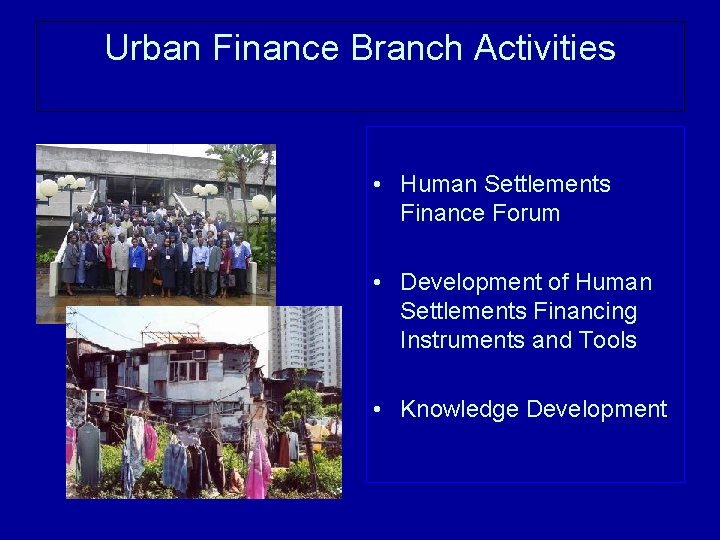
Urban Finance Branch Activities • Human Settlements Finance Forum • Development of Human Settlements Financing Instruments and Tools • Knowledge Development
Knowledge Development • To develop the knowledge infrastructure in housing and urban finance – Analysing and documenting good experiences and practices for low income housing and infrastructure finance; – Designing and developing innovative finance instruments and tools for low income housing, slum upgrading and urban/infrastructure development; – Providing technical and advisory support for the development of housing and urban finance mechanisms in developing countries; – Evaluating the progress in housing finance and urban and infrastructure finance, and the development of mechanisms and institutions and policy environments.
Conclusions • Consolidation of Water, Sanitation Transport and Energy, SUF, Urban Finance under “one-roof” gives greater synergy for integrated Human Settlements Planning and Management • Infrastructure-led slum upgrading presents new opportunities to reach the MDGs and promote sustainability beyond • The Division has a good balance of normative and operational activities, with many opportunities –.