
Human Rights for Education in Emergencies Objectives Awareness
Human Rights for Education in Emergencies
Objectives Awareness of. . . human rights as tools for achieving a life in dignity and the different legal frameworks for various types of emergencies (‘natural’ and man-made emergencies and armed conflict) a) key duty-bearers; b) key actions to support rights-holders; c) key lines of accountability available to affected populations the scope and limitations of human rights work, and the concept of ‘do no harm’ the IASC Education Cluster and other education actor’s potential role in assisting key mandated human rights actors INEE and Education Cluster
What are Human Rights Quick brainstorm - Why do we have them? - Where do they come from? - Why are they important? - When do they apply? - Who is responsible? INEE and Education Cluster
What are human rights Human rights are, amongst many things: - Not ends in themselves but means to a life in dignity - Right to life, non-discrimination, protection, participation, education in itself and as enabling right [a right that promotes other rights] - Key relationship between obligations and entitlements; duty-bearer and rights-holder - Binding legal entitlements, because they are written into national and international legislation - Immediate and interlinked; though some (but not education!) are derogable [can be postponed] in certain emergency situations - Mainstreamed into the 2010 edition of the INEE Minimum Standards and other materials by INEE and the Education Cluster INEE and Education Cluster
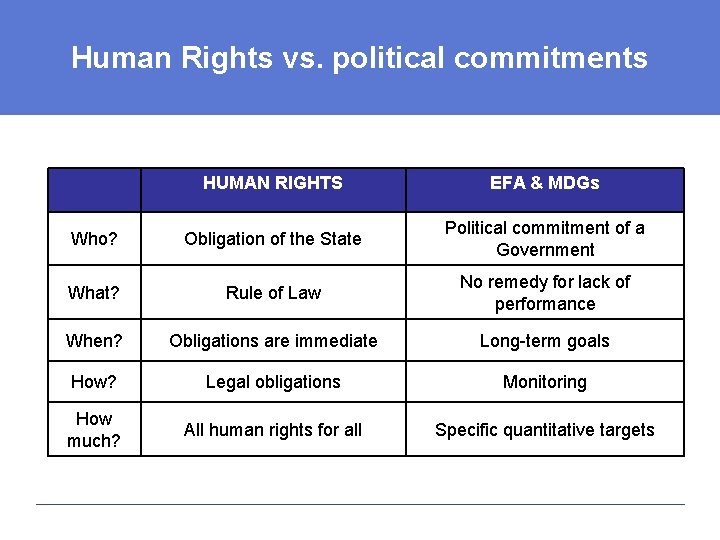
Human Rights vs. political commitments HUMAN RIGHTS EFA & MDGs Who? Obligation of the State Political commitment of a Government What? Rule of Law No remedy for lack of performance When? Obligations are immediate Long-term goals How? Legal obligations Monitoring How much? All human rights for all Specific quantitative targets
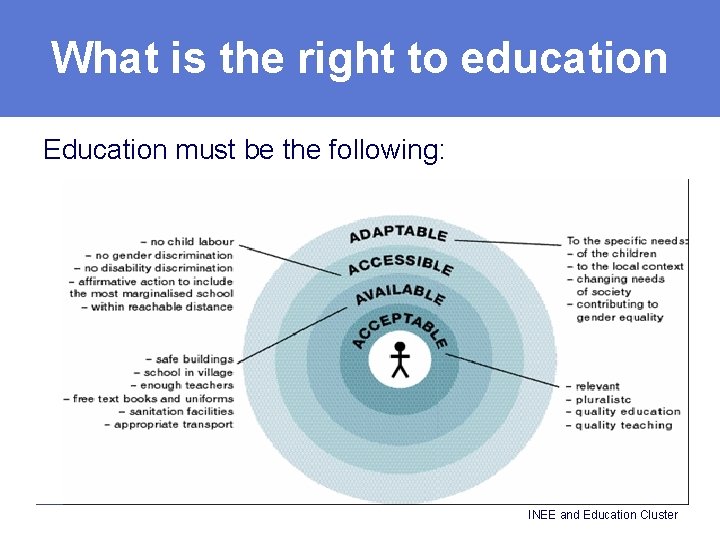
What is the right to education Education must be the following: INEE and Education Cluster
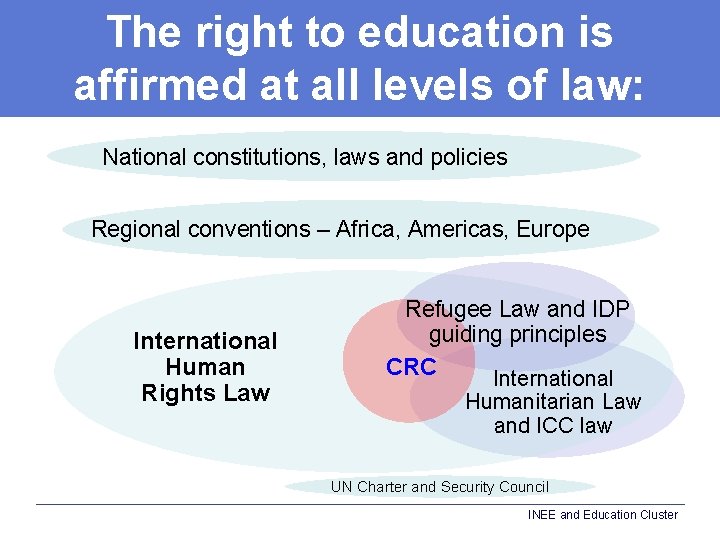
The right to education is affirmed at all levels of law: National constitutions, laws and policies Regional conventions – Africa, Americas, Europe International Human Rights Law Refugee Law and IDP guiding principles CRC International Humanitarian Law and ICC law UN Charter and Security Council INEE and Education Cluster
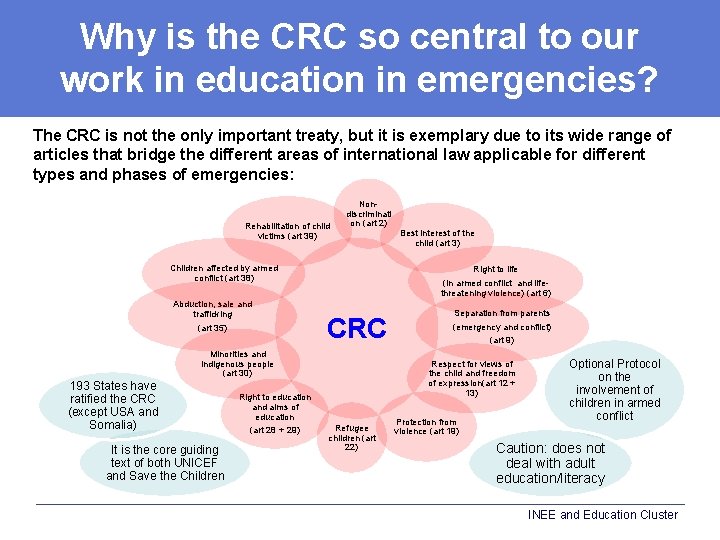
Why is the CRC so central to our work in education in emergencies? The CRC is not the only important treaty, but it is exemplary due to its wide range of articles that bridge the different areas of international law applicable for different types and phases of emergencies: Rehabilitation of child victims (art 39) Nondiscriminati on (art 2) Children affected by armed conflict (art 38) Abduction, sale and trafficking (art 35) Right to life (in armed conflict and lifethreatening violence) (art 6) CRC Minorities and indigenous people (art 30) 193 States have ratified the CRC (except USA and Somalia) It is the core guiding text of both UNICEF and Save the Children Right to education and aims of education (art 28 + 29) Best interest of the child (art 3) Separation from parents (emergency and conflict) (art 9) Respect for views of the child and freedom of expression(art 12 + 13) Refugee children (art 22) Protection from violence (art 19) Optional Protocol on the involvement of children in armed conflict Caution: does not deal with adult education/literacy INEE and Education Cluster
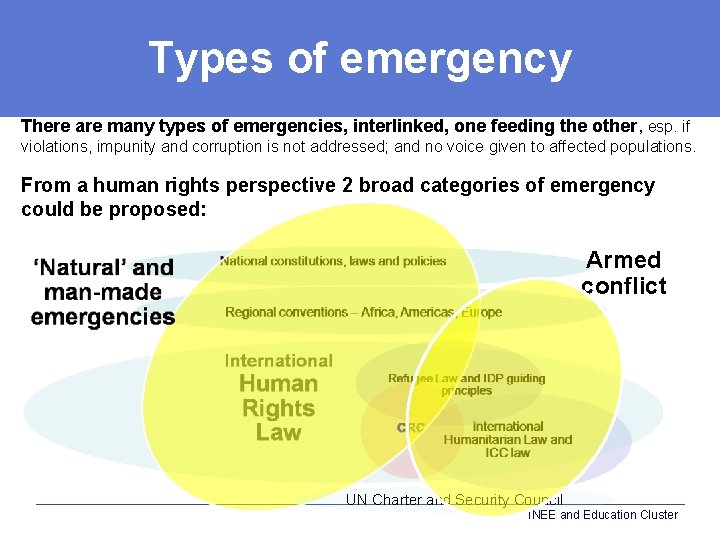
Types of emergency There are many types of emergencies, interlinked, one feeding the other, esp. if violations, impunity and corruption is not addressed; and no voice given to affected populations. From a human rights perspective 2 broad categories of emergency could be proposed: Armed conflict UN Charter and Security Council INEE and Education Cluster
Human Rights in the INEE Minimum Standards Human rights are mainstreamed into the INEE Minimum Standards Handbook as a cross-cutting issue Human rights are especially relevant in the Foundational Standards (Domain 1) and in Education Policy (Domain 5), demonstrating why and how to integrate human rights in emergency work The Handbook also builds on the Sphere Project’s Humanitarian Charter, which echoes the international legal frameworks governing emergencies, and underscore the legal obligation of States to allow humanitarian organisation to provide protection and assistance. INEE and Education Cluster
Human Rights Actors and obligations
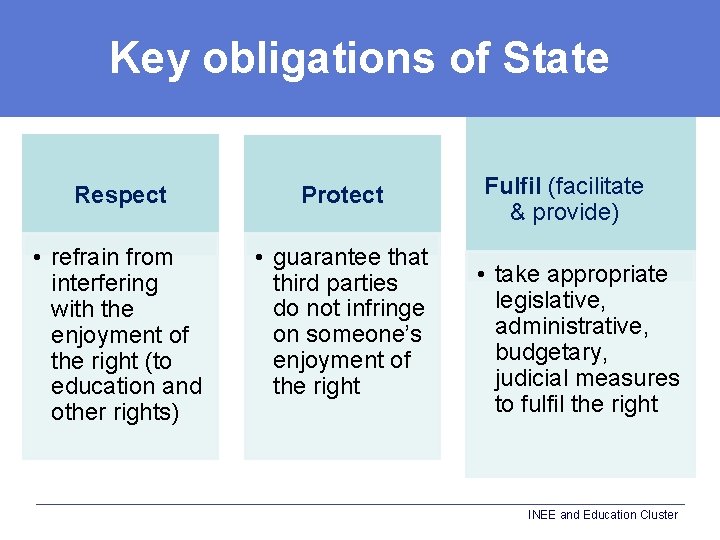
Key obligations of State Respect Protect • refrain from interfering with the enjoyment of the right (to education and other rights) • guarantee that third parties do not infringe on someone’s enjoyment of the right Fulfil (facilitate & provide) • take appropriate legislative, administrative, budgetary, judicial measures to fulfil the right INEE and Education Cluster
Duty-bearers Quick brainstorm Who are some of the State’s representatives (remember there can be many)? When the State fails or is absent, who then become the duty-bearer? Are they necessarily different for ‘natural’ and man-made emergencies and for armed conflict? NB: Don’t confuse legal with moral responsibility! INEE and Education Cluster
Duty-bearers - ideas The State: head of state, ministries (education and finance), parliament; judiciary, police, army; national human rights institutes/ombudsmen; district education officers, school leaders; teachers etc. Parents, guardians; camp management; civil society leaders; community and religious leaders(? ) Other armed groups in de-facto control of territory; occupying forces, either national or international; individual military commanders and soldiers United Nations; ‘international community’ [ie other states]; various NGOs acting on a UN mandate INEE and Education Cluster
Rights-holders A rights-holder is an individual, it is he or she who has the entitlement and who may be violated. Quick brainstorm For both ‘natural’ and man-made emergencies and for armed conflict: - Who are the potentially worst affected? - Are they also the most marginalised? - Are some more vulnerable than others? - Are some groups ‘created’ by the emergency? - Are some also duty-bearers? Duties to who? INEE and Education Cluster
Rights-holders in ‘natural’ and man-made emergencies- ideas Particularly vulnerable groups: Children and orphans: - in affected and high-risk areas; - in need of psychosocial support; - in rural areas and removed from power and from supply lines; Women, girls, marginalised, ethnic groups; Unemployed youth and others in danger of losing opportunities; Teachers undermined by untrained supply teachers; IDPs and refugees (the latter under UNHCR mandate) Poorest members of society often have the least capacity to recover INEE and Education Cluster
Rights-holders in armed conflict - ideas Particularly vulnerable groups: - children in conflict zones; - war-orphans; - child soldiers; - marginalised ethnic groups; - women and girls; - teachers and political activists; - aid-workers and human rights activists themselves; - refugees (under UNHCR mandate) and IDPs INEE and Education Cluster
Human Rights in emergencies Human Rights do not go away, on the contrary: -Concerns and violations increase, risks are higher - Legal framework is strong at national regional and international level - Human rights actions need to be prioritised: before/during/later - Actors become more numerous; risk of impunity grows - Human rights work become more dangerous Emergencies are also opportunities to address HR violations, build back better and re-engage/empower marginalised groups INEE and Education Cluster
Human Rights Time for Action
Human Rights actions for different emergencies Challenges to and violations of the right to education will differ according to emergency and time of intervention. Available and appropriate Human Rights actions will change too Quick brainstorm: What immediate and long-term human rights / legal actions can we (education actors) contribute to in: - ‘Natural’ and man-made emergencies - Armed conflicts Where are the major differences? Major overlaps? INEE and Education Cluster
Human rights actions for ‘natural’ and man-made emergencies - ideas Both immediate and long-term: - create safe learning spaces - promote inter-cluster work - assist government (but avoid supplanting it as duty-bearer) - fight to keep (or to install) education as free and compulsory - help build strong mechanisms for monitoring and evaluation - help NGOs address corruption, crime and misuse of power - lend education expertise to law and policy reform if needed - identify and empower most marginalised to voice and claim rights - promote DRR and build-back-better efforts INEE and Education Cluster
Human rights actions for armed conflict - ideas Both immediate and long-term: - create safe learning spaces - fight to keep (or to install) education as free and compulsory - prioritise the protection and safety of learners and schools - push for law and military codes to ban attacks on education - challenge impunity by assisting criminal investigations or UN in gathering evidence and reporting on attacks - promote conflict mitigation and peace-building dialogue - build capacity of institutions, local human rights defenders and judiciary INEE and Education Cluster
Human Rights and the education actors - ideas What you do may seem terribly insignificant, but it is terribly important that you do it anyway (Gandhi) Do no harm! An awareness of human rights help to ensure that no actions or partnerships are furthering violations Always prioritise impact on the most marginalised or worst affected Understand who local (Nat. HR Institute) or international human rights actors are (Amnesty, HRW etc). Reach out to them, learn from their legal and local expertise, share data where appropriate Understand who in the UN and ICRC are responsible for monitoring and reporting on human rights. Establish relationship, invite / attend meetings, support their work, share your assessment and data. For protection: work with the protection cluster and those mandated to report on UN Monitoring and Reporting Mechanism for Children For C/DRR: work with human rights organisations to jointly offer contextualised and locally adapted capacity building on education rights to judiciary, ministries, national and international partners INEE and Education Cluster
Limitations and challenges Securing the right to free quality education is what we and our partners try to do - we are therefore all human rights activist! But some situations call for greater caution: - Consult local UN resident/security before and during; do a risk analysis, pros vs’ cons. - Duty-bearer is the right term and donors encourage it, but at times it is better to say accountability rather than human rights, ie: be sensitive if you must. - Human rights activist may be targeted, their lives put at risk. Keep this always in mind when partnering with esp. local NGOs. - The national judiciary, set up to help people seek justice, may be corrupt and serve the powers it should hold to account. - The UN system is removed, slow and with little real power - and governments know it! INEE and Education Cluster
Accountability
Accountability Quick brainstorm Keep esp. obligations of duty-bearers in mind: - What does accountability mean? - What does legal accountability mean? - Who ensure accountability? State but who else? - How can rights-holders access transparent systems of accountability? - What mechanisms of accountability exists / should exist? INEE and Education Cluster
Accountability - ideas Accountability may in broad terms be defined as the responsible use of power that effects others. 3 keywords are: responsible, answerable, enforceable Legal accountability: the obligation/duty is defined in the law, and a court of law or a quasi-judicial mechanisms is the instrument to get re-dress The State must ensure an independent judiciary and justice should always first be pursued domestically – international courts, with their limitations, are for later. Rights-holders may need assistance: (free) legal aid and counselling; reassurance of safety; eased access through bureaucratic systems; etc Accountability is also political, administrative, social and public, through the use of democratic means: elections, a free press, naming and shaming. INEE and Education Cluster
EXERCISES – Accountability or Advocacy Analyse lines of accountability for claiming the right to safely access quality education in a) ‘Natural’ and man-made emergencies, or b) Armed conflict 1 – identify 1 heavily effected / marginalised group at 1 defined moment of the emergency 2 – what human rights violations may it be the victim of? 3 – what accountability mechanisms (legal/non-legal; national/international) can it access? 4 – what are opportunities and risks for the group? 5 – what role of Ed. Cluster and others in assisting or in ‘doing no harm’? Suggest advocacy strategies for claiming the right to safely access quality education in a) ‘Natural’ and man-made emergencies, or b) Armed conflict 1 – identify 1 heavily effected / marginalised group at 1 defined moment of an emergency 2 – what human rights violations may it be the victim of? 3 – what rights-based advocacy strategy/message can support this group? 4 – how is it carried out and who is the target audience? 5 – how can the Ed. Cluster and other education actors lead on this advocacy or contribute to ‘do no harm’? INEE and Education Cluster
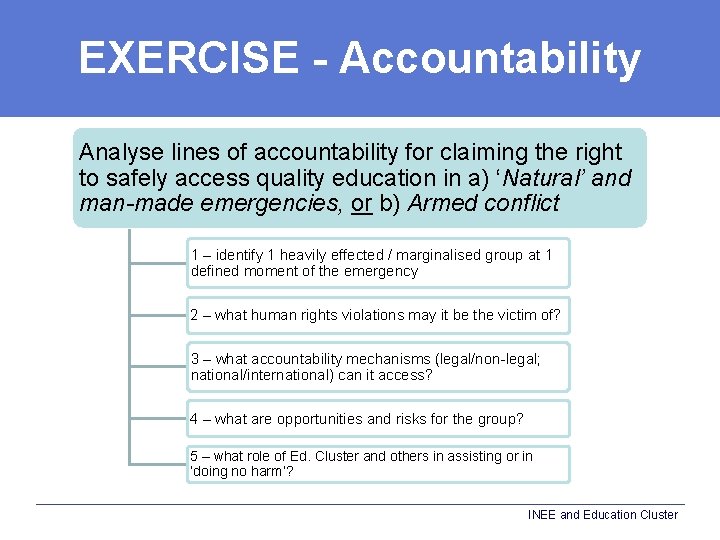
EXERCISE - Accountability Analyse lines of accountability for claiming the right to safely access quality education in a) ‘Natural’ and man-made emergencies, or b) Armed conflict 1 – identify 1 heavily effected / marginalised group at 1 defined moment of the emergency 2 – what human rights violations may it be the victim of? 3 – what accountability mechanisms (legal/non-legal; national/international) can it access? 4 – what are opportunities and risks for the group? 5 – what role of Ed. Cluster and others in assisting or in ‘doing no harm’? INEE and Education Cluster
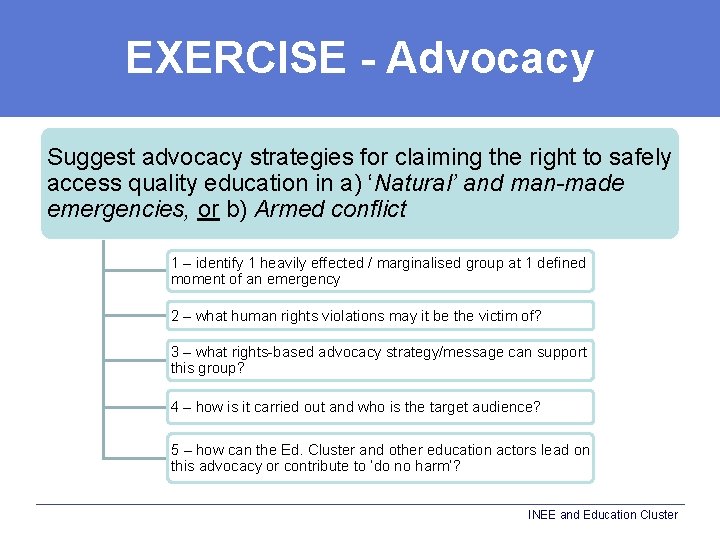
EXERCISE - Advocacy Suggest advocacy strategies for claiming the right to safely access quality education in a) ‘Natural’ and man-made emergencies, or b) Armed conflict 1 – identify 1 heavily effected / marginalised group at 1 defined moment of an emergency 2 – what human rights violations may it be the victim of? 3 – what rights-based advocacy strategy/message can support this group? 4 – how is it carried out and who is the target audience? 5 – how can the Ed. Cluster and other education actors lead on this advocacy or contribute to ‘do no harm’? INEE and Education Cluster
- Slides: 30