
HUMAN RESPIRATORY SYSTEM By Dr Soheir Hagras sarahagrasinaya

HUMAN RESPIRATORY SYSTEM By Dr. Soheir Hagras sarahagras@inaya. edu. sa INAYA COLLEGE, DR. SOHEIR HAGRAS

Human respiratory system, the system in humans that takes up oxygen and expels carbon dioxide. INAYA COLLEGE, DR. SOHEIR HAGRAS

The Respiratory Organs Conducting zone § Respiratory passages that carry air to the site of gas exchange § Filters, humidifies and warms air Respiratory zone § Site of gas exchange § Composed of § Respiratory bronchioles § Alveolar ducts § Alveolar sacs Conducting INAYA COLLEGE, DR. SOHEIR HAGRAS zone labeled

INAYA COLLEGE, DR. SOHEIR HAGRAS

INAYA COLLEGE, DR. SOHEIR HAGRAS

The goal of respiration is to provide oxygen to the tissues and to remove carbon dioxide. Respiration goal is achieved through: (1) Pulmonary ventilation : which means the inflow and outflow of air between the atmosphere and the lung alveoli. (2) Diffusion of oxygen and carbon dioxide between the alveoli and the blood. (3) Transport of oxygen and carbon dioxide in the blood and body fluids to and from the body’s tissue cells. (4) Regulation of ventilation other facets INAYA and COLLEGE, DR. SOHEIR HAGRAS of respiration.

Ventilation • Breathing = “pulmonary ventilation” – Pulmonary means related to the lungs • Two phases – Inspiration (inhalation) – air in – Expiration (exhalation) – air out INAYA COLLEGE, DR. SOHEIR HAGRAS
Air moves in and out of the lungs in response to differences in pressure. (Inspiration), When the air pressure within the alveolar spaces falls below atmospheric pressure, air enters the lungs provided the larynx is open; (Expiration). when the air pressure within the alveoli exceeds atmospheric pressure, air is blown from the lungs. The flow of air is rapid or slow in proportion to the magnitude of the pressure difference. Because atmospheric pressure remains relatively constant, flow is determined by how much above or below atmospheric pressure the pressure within the lungs rises. INAYA COLLEGE, DR. SOHEIR HAGRAS

Mechanics of Pulmonary Ventilation Muscles That Cause Lung Expansion and Contraction: (1) by downward and upward movement of the diaphragm to lengthen or shorten the chest cavity. (2) by elevation and depression of the intercostals muscle to increase and decrease the antero-posterior diameter of the chest cavity. INAYA COLLEGE, DR. SOHEIR HAGRAS

Muscles of Inspiration • During inspiration, the dome shaped diaphragm flattens as it contracts Together: – This increases the height of the thoracic cavity • The external intercostal muscles contract to raise the ribs – This increases the circumference of the thoracic cavity INAYA COLLEGE, DR. SOHEIR HAGRAS

Inspiration continued • Intercostals keep the thorax stiff so sides don’t collapse in with change of diaphragm • During deep or forced inspiration, additional muscles are recruited: – Scalenes – Sternocleidomastoid – Pectoralis minor – Quadratus lumborum on 12 th rib – Erector spinae (some of these “accessory muscles” of ventilation are visible to an observer; it usually tells you that there is respiratory distress – working hard to breathe) INAYA COLLEGE, DR. SOHEIR HAGRAS

Expiration • Quiet expiration in healthy people is chiefly passive Inspiratory muscles relax Rib cage drops under force of gravity Relaxing diaphragm moves superiorly (up) Elastic fibers in lung recoil Volumes of thorax and lungs decrease simultaneously, increasing the pressure – Air is forced out – – – INAYA COLLEGE, DR. SOHEIR HAGRAS

Expiration continued • Forced expiration is active – Contraction of abdominal wall muscles • Oblique and transversus predominantly – Increases intra-abdominal pressure forcing the diaphragm superiorly – Depressing the rib cage, decreases thoracic volume • Some help from internal intercostals and latissimus dorsi INAYA COLLEGE, DR. SOHEIR HAGRAS

Breathing Rate The rate at which we inhale and exhale is controlled by the respiratory centre, within the Medulla Oblongata in the brain. Inspiration occurs due to increased firing of inspiratory nerves and also the increased recruitment of motor units within the intercostals and diaphragm. Exhalation occurs due to a sudden stop in impulses along the inspiratory nerves. Our lungs are prevented from excess inspiration due to stretch receptors within the bronchi and bronchioles which send impulses to the Medulla Oblongata when stimulated. INAYA COLLEGE, DR. SOHEIR HAGRAS

Breathing Rate…cont Breathing rate is all controlled by chemoreceptors within the main arteries which monitor the levels of Oxygen and Carbon Dioxide within the blood. If oxygen saturation falls, ventilation accelerates to increase the volume of Oxygen inspired. If levels of Carbon Dioxide increase a substance known as carbonic acid is released into the blood which causes Hydrogen ions (H+) to be formed. An increased concentration of H+ in the blood stimulates increased ventilation rates. This also occurs when lactic acid is released into the blood following high intensity exercise. INAYA COLLEGE, DR. SOHEIR HAGRAS

Control of breathing …cont Breathing is an automatic and rhythmic act produced by networks of neurons in the hindbrain (the pons and medulla). The neural networks direct muscles that form the walls of the thorax and abdomen and produce pressure gradients that move air into and out of the lungs. The respiratory rhythm and the length of each phase of respiration are set by reciprocal stimulatory and inhibitory interconnection of these brain-stem neurons. An important characteristic of the human respiratory system is its ability to adjust breathing patterns to changes in both the internal milieu and the external environment. Ventilation INAYA COLLEGE, DR. SOHEIR HAGRAS

Respiratory Volumes Respiratory volumes: are the amount of air inhaled, exhaled and stored within the lungs at any given time Tidal Volume: The amount of air which enters the lungs during normal inhalation at rest. The average tidal volume is 500 ml. The same amount leaves the lungs during exhalation. Inspiratory Reserve Volume: The amount of extra air inhaled (above tidal volume) during a deep breath. This can be as high as 3000 ml. Expiratory Reserve Volume: The amount of extra air exhaled (above tidal volume) during a forceful breath out. . INAYA COLLEGE, DR. SOHEIR HAGRAS

Residual Volume: The amount of air left in the lungs following a maximal exhalation. There is always some air remaining to prevent the lungs from collapsing. Vital Capacity: The most air you can exhale after taking the deepest breath you can. It can be up to ten times more than you would normally exhale. Total Lung Capacity: This is the vital lung capacity plus the residual volume and is the total amount of air the lungs can hold. The average total lung capacity is 6000 ml, although this varies with age, height, sex and health. INAYA COLLEGE, DR. SOHEIR HAGRAS

Recording Changes in Pulmonary Volume—Spirometry INAYA COLLEGE, DR. SOHEIR HAGRAS

Gaseous Exchange §The main function of the respiratory system is gaseous exchange. This refers to the process of Oxygen and Carbon Dioxide moving between the lungs and blood. §Both alveoli and capillaries have walls which are only one cell thick and allow gases to diffuse across them. §Diffusion occurs when molecules move from an area of high concentration (of that molecule) to an area of low concentration. §This occurs during gaseous exchange as the blood in the capillaries surrounding the alveoli has a lower oxygen concentration of Oxygen than the air in the alveoli which has just been inhaled. §. INAYA COLLEGE, DR. SOHEIR HAGRAS

The same happens with Carbon Dioxide (CO 2). The blood in the surrounding capillaries has a higher concentration of CO 2 than the inspired air due to it being a waste product of energy production. Therefore CO 2 diffuses the other way, from the capillaries, into the alveoli where it can then be exhaled 21% of the air we inhale is O 2 and is used for energy production INAYA COLLEGE, DR. SOHEIR HAGRAS

VO 2 Max Defined as : the measure of the peak volume of Oxygen (VO 2) you can consume and use in a minute. It is measured in ml/kg/min and so you can see that it is also relative to body weight. Oxygen is needed to produce energy. The harder you exercise the more Oxygen you use in order to produce sufficient energy. However, everybody has a maximum level (their VO 2 Max), where Oxygen utilization is at its peak. If exercise intensity increases beyond this point then the anaerobic energy systems must be used to supply the additional energy. However, anaerobic metabolism produces lactic acid which causes fatigue and so cannot be sustained INAYA COLLEGE, DR. SOHEIR HAGRAS
Alveolar Ventilation the movement of air into and out of the lung reaching alveoli, alveolar sacs, alveolar ducts, and respiratory bronchioles. Importance : to continually renew the air in the gas exchange areas of the lungs, where air is in proximity to the pulmonary blood. INAYA COLLEGE, DR. SOHEIR HAGRAS

“Dead Space” and Its Effect on Alveolar Ventilation Part of minute ventilation that does not take part in gas exchange; it is also referred to as "wasted ventilation“, but simply fills respiratory passages INAYA COLLEGE, DR. SOHEIR HAGRAS

INAYA COLLEGE, DR. SOHEIR HAGRAS

The Ventilation-Perfusion (V/Q) ratio Ø The ratio between the amount of air getting to the alveoli (the alveolar ventilation, V, in ml/min) and the amount of blood being sent to the lungs (the cardiac output or Q - also in ml/min). ØIn other words, the balance between the ventilation (bringing oxygen in to /removing CO 2 from the alveoli) and the perfusion (removing O 2 from the alveoli and adding CO 2) ØUnder normal conditions, 4 L of ventilation each minute enter the respiratory tract while 5 L of blood go through the pulmonary capillaries. INAYA COLLEGE, DR. SOHEIR HAGRAS

Can be calculated as: V/Q = alveolar ventilation/cardiac output. V/Q = (4 l/min)/(5 l/min) INAYA COLLEGE, DR. SOHEIR HAGRAS

Variable Normal Value PAO 2 95 -100 mm Hg PACO 2 40 mm Hg INAYA COLLEGE, DR. SOHEIR HAGRAS

Pressures that cause the air movement within lungs Ø The lung “floats” in the thoracic cavity, surrounded by a thin layer of pleural fluid that lubricates movement of the lungs within the thoracic cavity. ØPleural pressure : is the pressure of the fluid in the thin space between the lung pleura and the chest wall pleura. ØAlveolar pressure is the pressure of the air inside the lung alveoli. Ø Transpulmonary Pressure: difference between the alveolar Pressure and the pleural pressure INAYA COLLEGE, DR. SOHEIR HAGRAS

Compliance of the Lungs Ø The extent to which the lungs will expand for each unit increase in transpulmonary pressure (if enough time is allowed to reach equilibrium). Ø The total compliance of both lungs together in the normal adult human being averages about 200 ml of air per centimeter of water transpulmonary pressure. Ø That is, every time the transpulmonary pressure increases 1 centimeter of water, the lung volume, after 10 to 20 seconds, will expand 200 ml. INAYA COLLEGE, DR. SOHEIR HAGRAS

Surfactant • Surfactant is a detergent-like substance , a complex mixture of several phospholipids, proteins, and ions. • which is secreted in fluid coating alveolar surfaces by Type II cuboidal epithelial cells. • It is Responsible for reducing the surface tension. • Without it the walls would stick together during exhalation. • Premature babies – problem breathing is largely because lack surfactant. INAYA COLLEGE, DR. SOHEIR HAGRAS

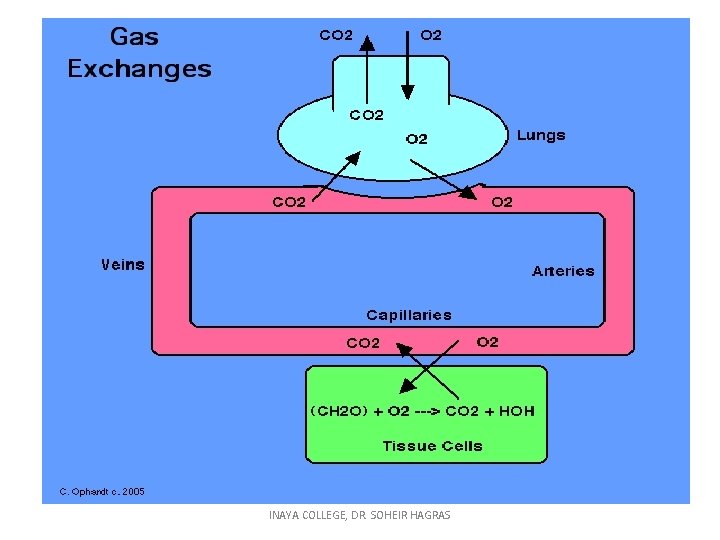
Oxygen and carbon dioxide Transport Ø The gas diffusion principle is: A gas diffuses from an area of higher partial pressure to an area of lower partial pressure. ØOxygen is needed by the cell and that carbon dioxide is produced as a waste product of the cell. Carbon dioxide must be expelled from the cells and the body. Ø The lungs serve to exchange the two gases in the blood. Oxygen enters the blood from the lungs and carbon dioxide is expelled out of the blood into the lungs. The blood serves to transport both gases. Oxygen is carried to the cells. Carbon dioxide is carried away from the cells. INAYA COLLEGE, DR. SOHEIR HAGRAS
INAYA COLLEGE, DR. SOHEIR HAGRAS

Oxygen Transport ØIn the lungs, oxygen diffuses from alveolar air into the blood because the venous blood has a lower partial pressure. Ø The oxygen dissolves in the blood. Only a small amount is carried as a physical solution (0. 31 ml per 100 ml). ØThe remainder of the oxygen is carried in chemical combination with the hemoglobin in red blood cells (erythrocytes). INAYA COLLEGE, DR. SOHEIR HAGRAS
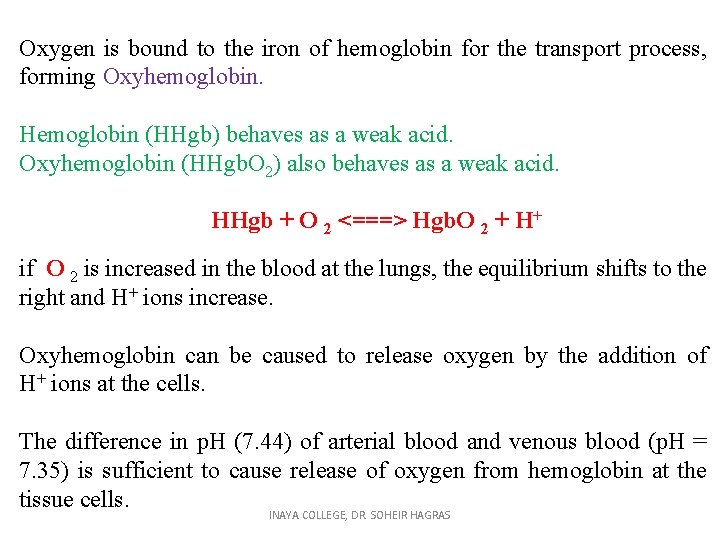
Oxygen is bound to the iron of hemoglobin for the transport process, forming Oxyhemoglobin. Hemoglobin (HHgb) behaves as a weak acid. Oxyhemoglobin (HHgb. O 2) also behaves as a weak acid. HHgb + O 2 <===> Hgb. O 2 + H+ if O 2 is increased in the blood at the lungs, the equilibrium shifts to the right and H+ ions increase. Oxyhemoglobin can be caused to release oxygen by the addition of H+ ions at the cells. The difference in p. H (7. 44) of arterial blood and venous blood (p. H = 7. 35) is sufficient to cause release of oxygen from hemoglobin at the tissue cells. INAYA COLLEGE, DR. SOHEIR HAGRAS

Affinity of hemoglobin under different conditions Region of body Oxygen Carbon Affinity of concentration dioxide haemoglobin concentration for oxygen Result Gas exchange surface High Low High Oxygen is attached Respiring tissues Low High Low Oxygen is released INAYA COLLEGE, DR. SOHEIR HAGRAS

Carbon Dioxide Transport Ø Carbon dioxide produced in the tissue cells diffuses into the blood plasma. Ø The largest fraction of carbon dioxide diffuses into the red blood cells as: dissolved CO 2, combined with hemoglobin, or as bicarbonate, (largest fraction). Ø Bicarbonate diffuses out of the red blood cells into the plasma in venous blood and visa versa in arterial blood. INAYA COLLEGE, DR. SOHEIR HAGRAS

Combined Oxygen and Carbon Dioxide Transport: Ø At the lungs, the diffusion of oxygen into the blood triggers the reactions. Ø The oxygen reacts with and attaches to hemoglobin. This oxygenation reaction with hemoglobin produces excess H+ ions which react with HCO 3 - to produce H 2 CO 3. ØThe carbonic acid decomposes to CO 2 which diffuses out of the blood. INAYA COLLEGE, DR. SOHEIR HAGRAS

The oxygen hemoglobin dissociation curve Plot a graph of PO 2 against the percentage saturation of hemoglobin. INAYA COLLEGE, DR. SOHEIR HAGRAS

Oxygen dissociation curves • S-shaped curve – because shape of molecule is altered as each O 2 molecule is taken up. • After binding of first molecule shape changes so the binding of the others is easier. • Steep part of the curve - small decrease in pp oxygen results in a big fall in Hb saturation, so that oxygen is released to the tissues where need is greatest. INAYA COLLEGE, DR. SOHEIR HAGRAS

Hypoxia Defined as: A deficiency in either the delivery or the utilization of oxygen at the tissue level, which can lead to changes in function, metabolism and even structure of the body. INAYA COLLEGE, DR. SOHEIR HAGRAS

Causes of hypoxia INAYA COLLEGE, DR. SOHEIR HAGRAS

Causes of hypoxia…cont Cyanide poisoning, in which the action of the enzyme cytochrome oxidase is completely blocked by the cyanide—to such an extent that the tissues simply cannot use oxygen even when plenty is available As in case of the disease beri due to deficiency of Vit B INAYA COLLEGE, DR. SOHEIR HAGRAS

Effects of Hypoxia on the Body ØIn Severe cases; Hypoxia can cause death of cells throughout the body. ØIn less severe degrees it causes principally Depressed mental activity, sometimes culminating in coma. Reduced work capacity of the muscles. INAYA COLLEGE, DR. SOHEIR HAGRAS

Hypoxia is corrected by Oxygen Therapy Oxygen can be administered by: (1) Placing the patient’s head in a “tent” that contains air fortified with oxygen. (2) Allowing the patient to breathe either pure oxygen or high concentrations of oxygen from a mask. (3) Administering oxygen through an intranasal tube. INAYA COLLEGE, DR. SOHEIR HAGRAS

Cyanosis Refers to : The bluish color of skin, nails, lips and mucous membranes when the deoxyhemoglobin concentration of the blood in the capillaries is more than 5 g/dl. INAYA COLLEGE, DR. SOHEIR HAGRAS

Reference Textbook of medical physiology. By Arthur C. Guyton and John E. Hall ISBN 0 -7216 -0240 -1. International edition ISBN 0 -8089 -2317 -x. INAYA COLLEGE, DR. SOHEIR HAGRAS

THANK YOU INAYA COLLEGE, DR. SOHEIR HAGRAS
- Slides: 48