
Human Resources Performance Evaluation Project Towards an Early
- Slides: 21
Human Resources Performance Evaluation Project: Towards an Early Adopter Solution Neil Barker Human Resources Director UCAR Management Forum March 19, 2018 Performance Evaluation Project
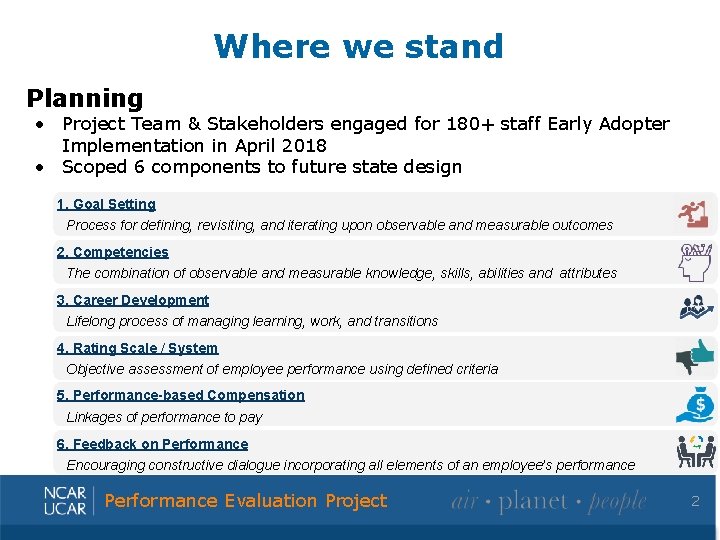
Where we stand Planning • Project Team & Stakeholders engaged for 180+ staff Early Adopter Implementation in April 2018 • Scoped 6 components to future state design 1. Goal Setting Process for defining, revisiting, and iterating upon observable and measurable outcomes 2. Competencies The combination of observable and measurable knowledge, skills, abilities and attributes 3. Career Development Lifelong process of managing learning, work, and transitions 4. Rating Scale / System Objective assessment of employee performance using defined criteria 5. Performance-based Compensation Linkages of performance to pay 6. Feedback on Performance Encouraging constructive dialogue incorporating all elements of an employee’s performance Performance Evaluation Project 2
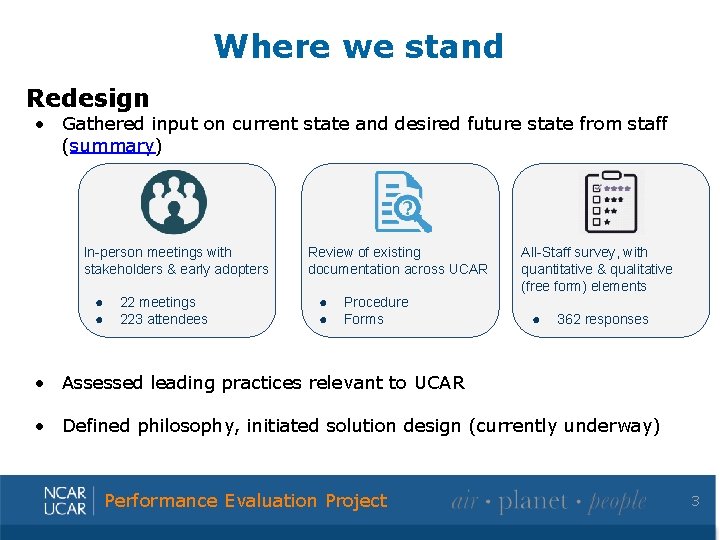
Where we stand Redesign • Gathered input on current state and desired future state from staff (summary) In-person meetings with stakeholders & early adopters ● ● 22 meetings 223 attendees Review of existing documentation across UCAR ● ● Procedure Forms All-Staff survey, with quantitative & qualitative (free form) elements ● 362 responses • Assessed leading practices relevant to UCAR • Defined philosophy, initiated solution design (currently underway) Performance Evaluation Project 3
Where we stand Implementation • Early Adopter Implementation in April 2018 to include – Training – Resources for employees & supervisors, for each of the components and the overall process • Templates • Definitions & Workflows • FAQ – Website – Feedback channel for us to improve upon future iterations (JIRA Help Desk) – Form • Planning for future implementations, to bring all of UCAR onto new Performance Evaluation system Performance Evaluation Project 4
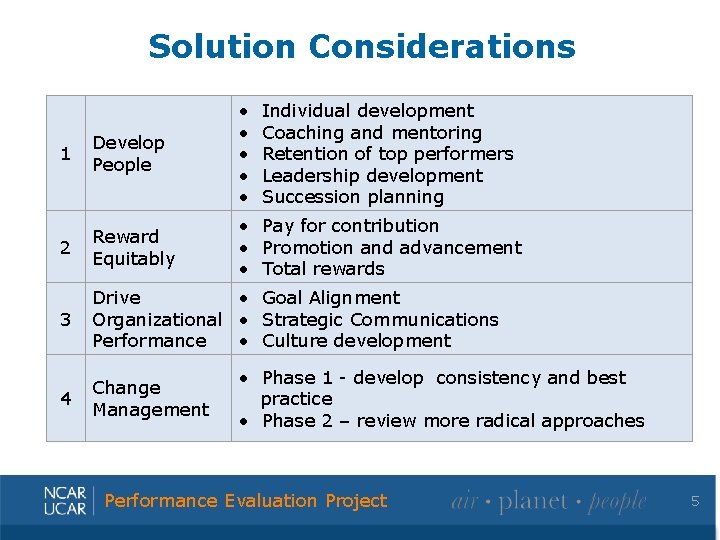
Solution Considerations 1 Develop People • • • Individual development Coaching and mentoring Retention of top performers Leadership development Succession planning 2 Reward Equitably • Pay for contribution • Promotion and advancement • Total rewards 3 Drive • Goal Alignment Organizational • Strategic Communications Performance • Culture development 4 Change Management • Phase 1 - develop consistency and best practice • Phase 2 – review more radical approaches Performance Evaluation Project 5
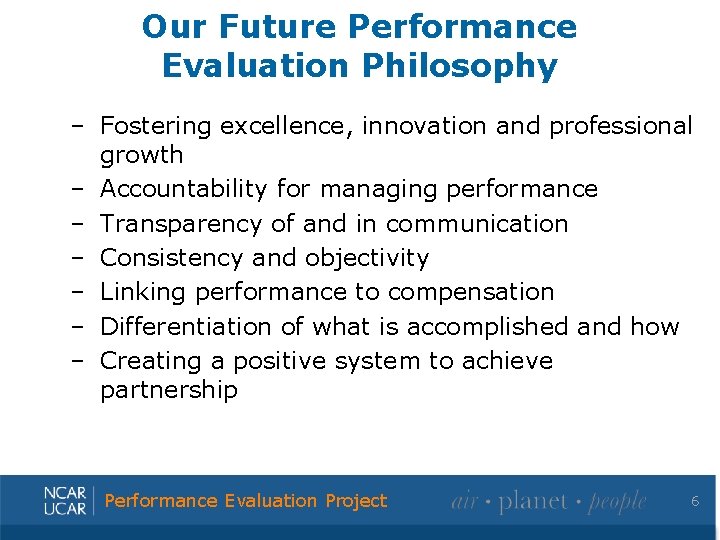
Our Future Performance Evaluation Philosophy – Fostering excellence, innovation and professional growth – Accountability for managing performance – Transparency of and in communication – Consistency and objectivity – Linking performance to compensation – Differentiation of what is accomplished and how – Creating a positive system to achieve partnership Performance Evaluation Project 6
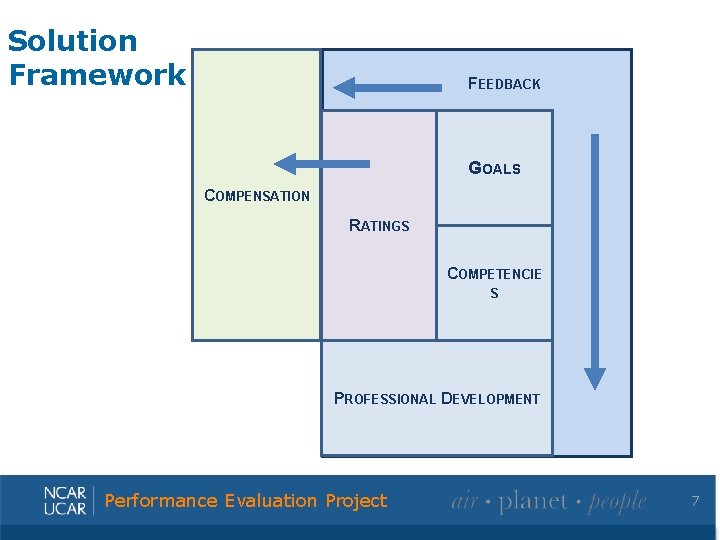
Solution Framework FEEDBACK GOALS COMPENSATION RATINGS COMPETENCIE S PROFESSIONAL DEVELOPMENT Performance Evaluation Project 7
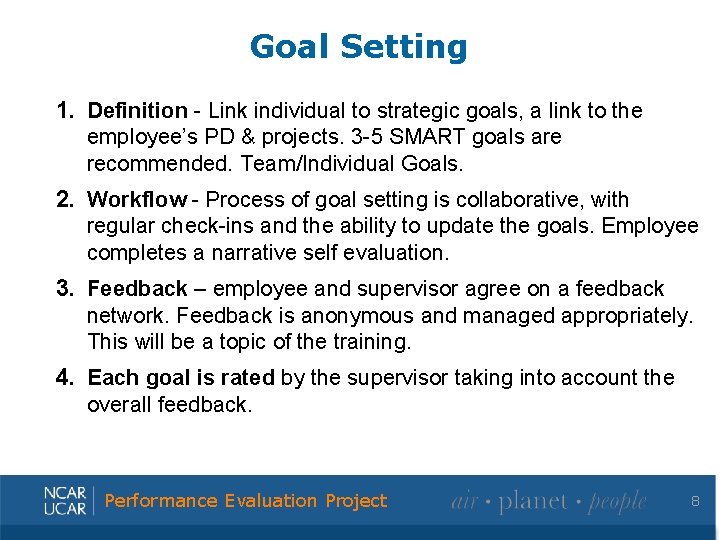
Goal Setting 1. Definition - Link individual to strategic goals, a link to the employee’s PD & projects. 3 -5 SMART goals are recommended. Team/Individual Goals. 2. Workflow - Process of goal setting is collaborative, with regular check-ins and the ability to update the goals. Employee completes a narrative self evaluation. 3. Feedback – employee and supervisor agree on a feedback network. Feedback is anonymous and managed appropriately. This will be a topic of the training. 4. Each goal is rated by the supervisor taking into account the overall feedback. Performance Evaluation Project 8
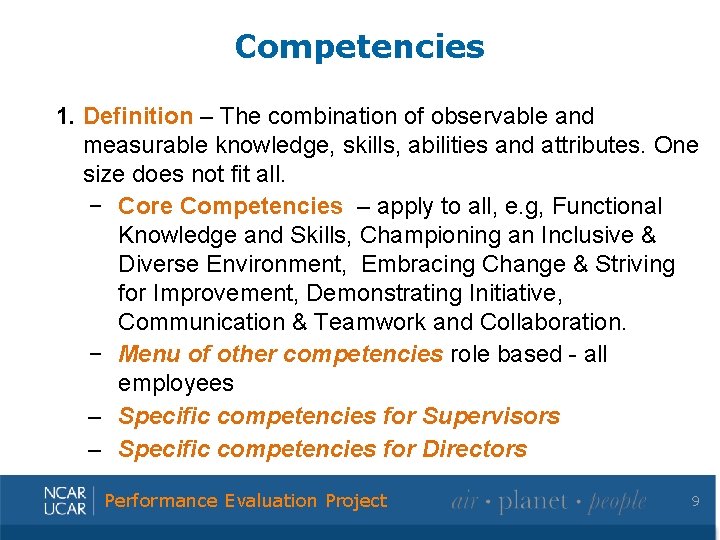
Competencies 1. Definition – The combination of observable and measurable knowledge, skills, abilities and attributes. One size does not fit all. – Core Competencies – apply to all, e. g, Functional Knowledge and Skills, Championing an Inclusive & Diverse Environment, Embracing Change & Striving for Improvement, Demonstrating Initiative, Communication & Teamwork and Collaboration. – Menu of other competencies role based - all employees – Specific competencies for Supervisors – Specific competencies for Directors Performance Evaluation Project 9
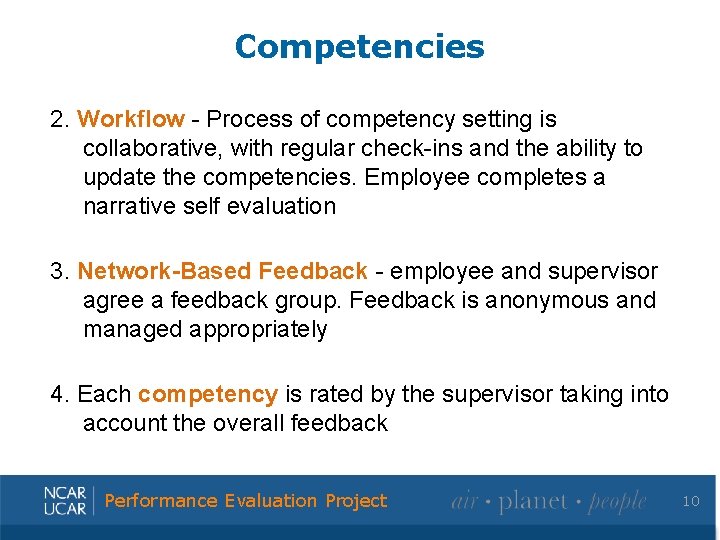
Competencies 2. Workflow - Process of competency setting is collaborative, with regular check-ins and the ability to update the competencies. Employee completes a narrative self evaluation 3. Network-Based Feedback - employee and supervisor agree a feedback group. Feedback is anonymous and managed appropriately 4. Each competency is rated by the supervisor taking into account the overall feedback Performance Evaluation Project 10
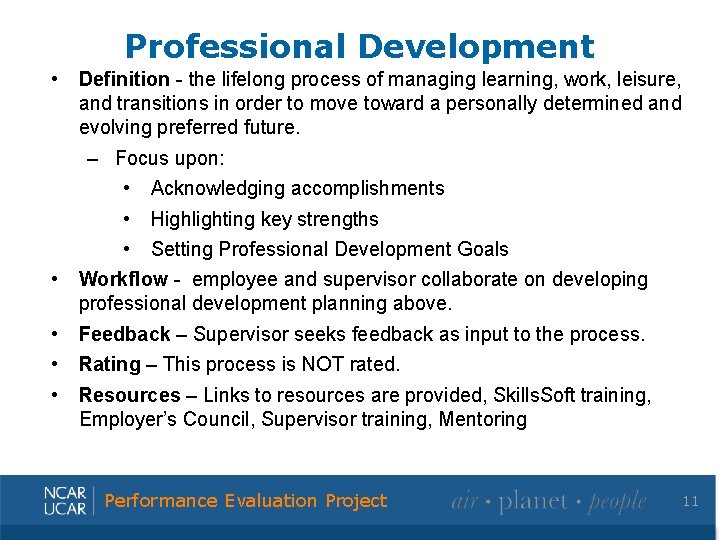
Professional Development • Definition - the lifelong process of managing learning, work, leisure, and transitions in order to move toward a personally determined and evolving preferred future. – Focus upon: • Acknowledging accomplishments • Highlighting key strengths • Setting Professional Development Goals • Workflow - employee and supervisor collaborate on developing professional development planning above. • Feedback – Supervisor seeks feedback as input to the process. • Rating – This process is NOT rated. • Resources – Links to resources are provided, Skills. Soft training, Employer’s Council, Supervisor training, Mentoring Performance Evaluation Project 11
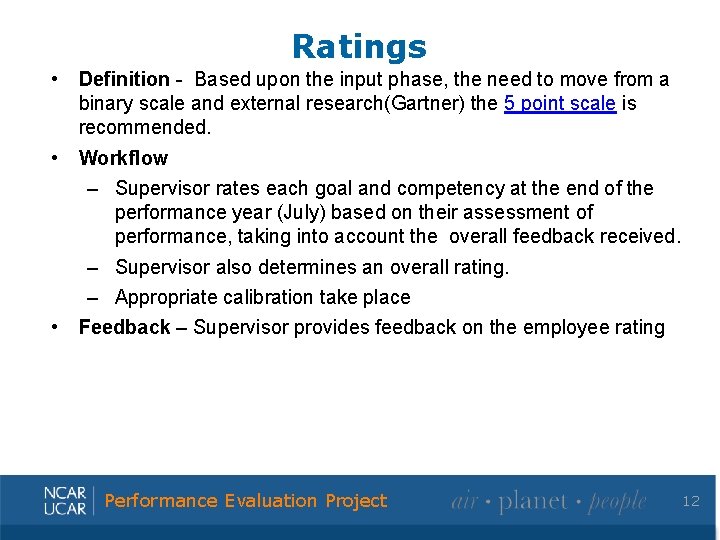
Ratings • Definition - Based upon the input phase, the need to move from a binary scale and external research(Gartner) the 5 point scale is recommended. • Workflow – Supervisor rates each goal and competency at the end of the performance year (July) based on their assessment of performance, taking into account the overall feedback received. – Supervisor also determines an overall rating. – Appropriate calibration take place • Feedback – Supervisor provides feedback on the employee rating Performance Evaluation Project 12
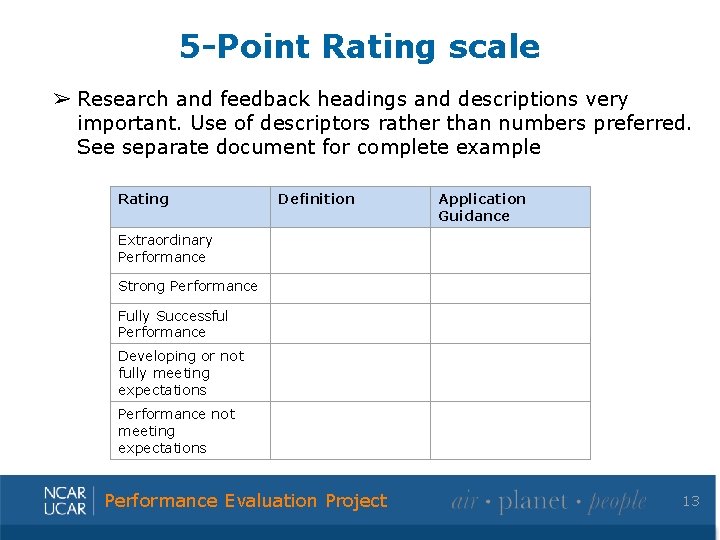
5 -Point Rating scale ➢ Research and feedback headings and descriptions very important. Use of descriptors rather than numbers preferred. See separate document for complete example Rating Definition Application Guidance Extraordinary Performance Strong Performance Fully Successful Performance Developing or not fully meeting expectations Performance not meeting expectations Performance Evaluation Project 13
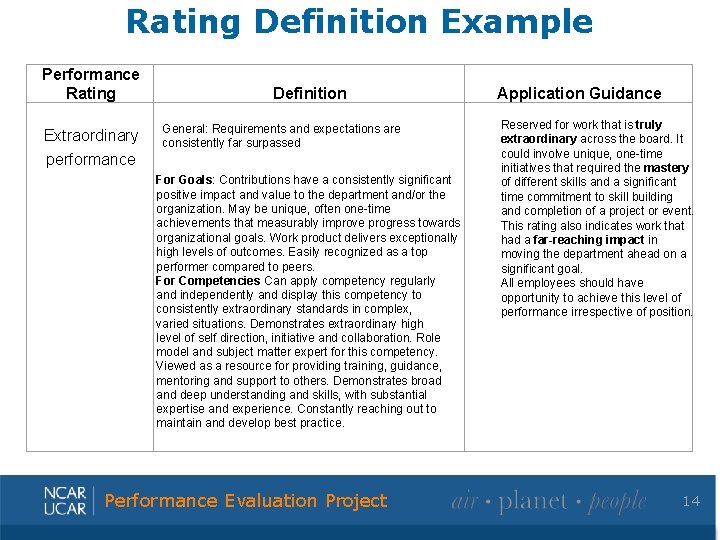
Rating Definition Example Performance Rating Definition Extraordinary performance General: Requirements and expectations are consistently far surpassed For Goals: Contributions have a consistently significant positive impact and value to the department and/or the organization. May be unique, often one-time achievements that measurably improve progress towards organizational goals. Work product delivers exceptionally high levels of outcomes. Easily recognized as a top performer compared to peers. For Competencies Can apply competency regularly and independently and display this competency to consistently extraordinary standards in complex, varied situations. Demonstrates extraordinary high level of self direction, initiative and collaboration. Role model and subject matter expert for this competency. Viewed as a resource for providing training, guidance, mentoring and support to others. Demonstrates broad and deep understanding and skills, with substantial expertise and experience. Constantly reaching out to maintain and develop best practice. Performance Evaluation Project Application Guidance Reserved for work that is truly extraordinary across the board. It could involve unique, one-time initiatives that required the mastery of different skills and a significant time commitment to skill building and completion of a project or event. This rating also indicates work that had a far-reaching impact in moving the department ahead on a significant goal. All employees should have opportunity to achieve this level of performance irrespective of position. 14
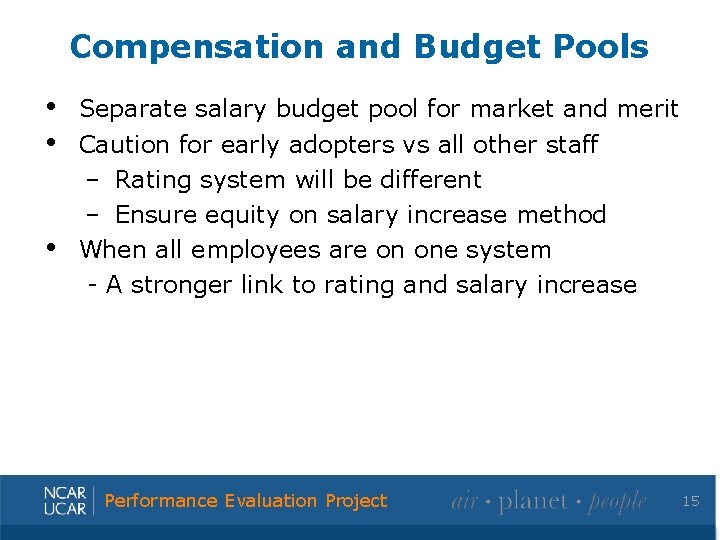
Compensation and Budget Pools • • • Separate salary budget pool for market and merit Caution for early adopters vs all other staff – Rating system will be different – Ensure equity on salary increase method When all employees are on one system - A stronger link to rating and salary increase Performance Evaluation Project 15
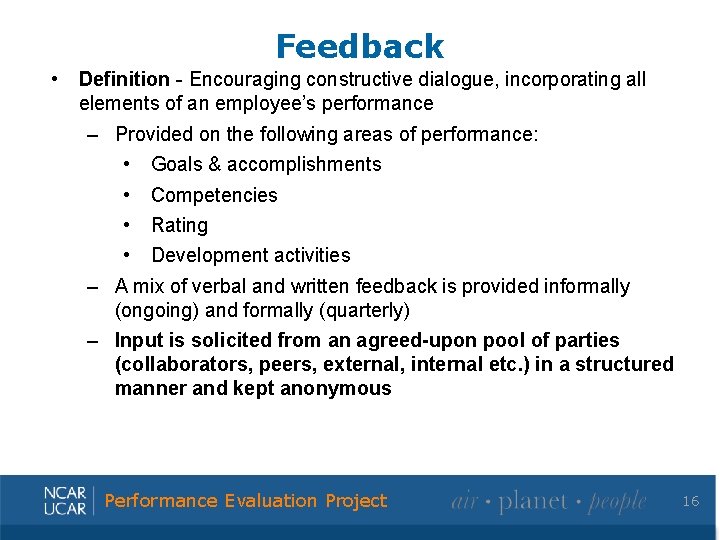
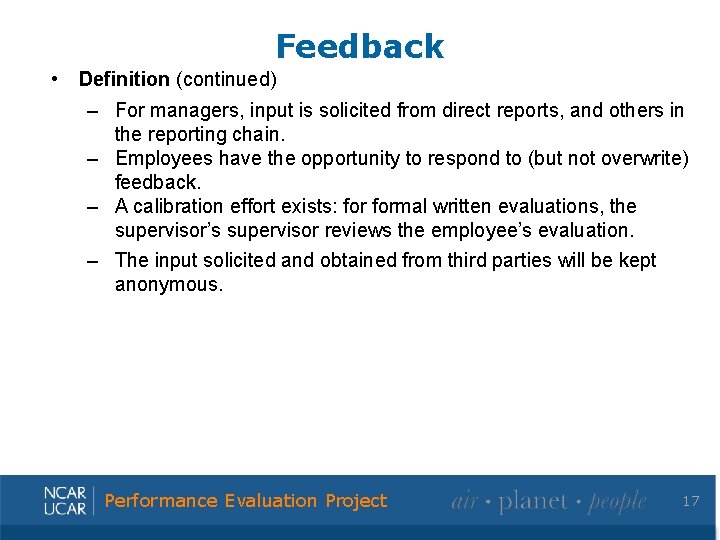
Feedback • Definition - Encouraging constructive dialogue, incorporating all elements of an employee’s performance – Provided on the following areas of performance: • Goals & accomplishments • Competencies • Rating • Development activities – A mix of verbal and written feedback is provided informally (ongoing) and formally (quarterly) – Input is solicited from an agreed-upon pool of parties (collaborators, peers, external, internal etc. ) in a structured manner and kept anonymous Performance Evaluation Project 16
Feedback • Definition (continued) – For managers, input is solicited from direct reports, and others in the reporting chain. – Employees have the opportunity to respond to (but not overwrite) feedback. – A calibration effort exists: formal written evaluations, the supervisor’s supervisor reviews the employee’s evaluation. – The input solicited and obtained from third parties will be kept anonymous. Performance Evaluation Project 17
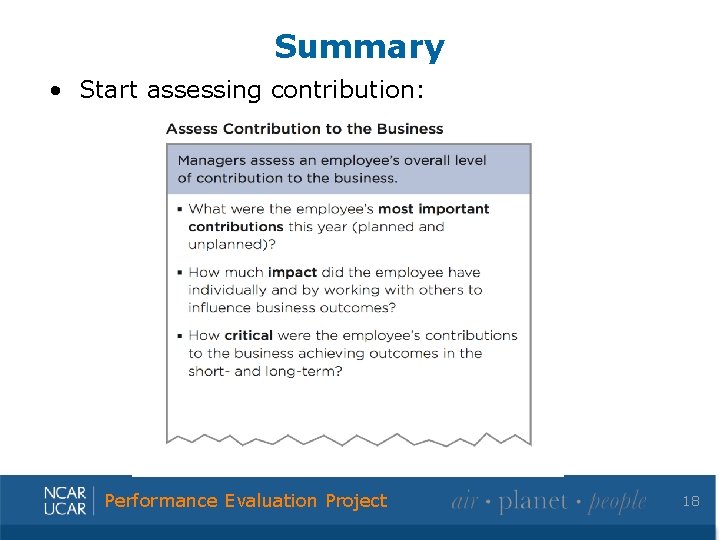
Summary • Start assessing contribution: Performance Evaluation Project 18
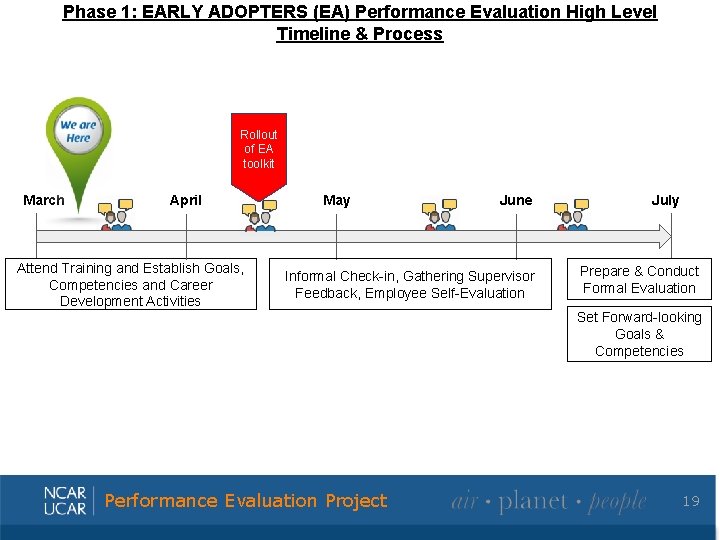
Phase 1: EARLY ADOPTERS (EA) Performance Evaluation High Level Timeline & Process Rollout of EA toolkit March April Attend Training and Establish Goals, Competencies and Career Development Activities May June Informal Check-in, Gathering Supervisor Feedback, Employee Self-Evaluation July Prepare & Conduct Formal Evaluation Set Forward-looking Goals & Competencies Performance Evaluation Project 19
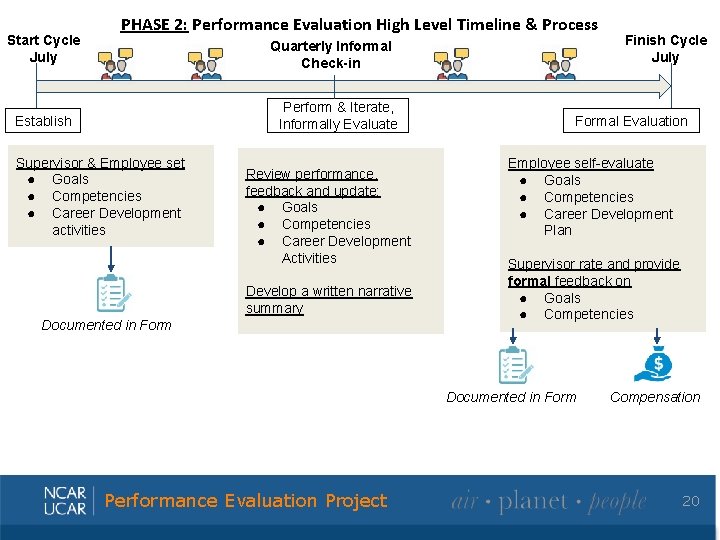
Start Cycle July PHASE 2: Performance Evaluation High Level Timeline & Process Quarterly Informal Check-in Perform & Iterate, Informally Evaluate Establish Supervisor & Employee set ● Goals ● Competencies ● Career Development activities Review performance, feedback and update: ● Goals ● Competencies ● Career Development Activities Develop a written narrative summary Documented in Formal Evaluation Employee self-evaluate ● Goals ● Competencies ● Career Development Plan Supervisor rate and provide formal feedback on ● Goals ● Competencies Documented in Form Performance Evaluation Project Finish Cycle July Compensation 20
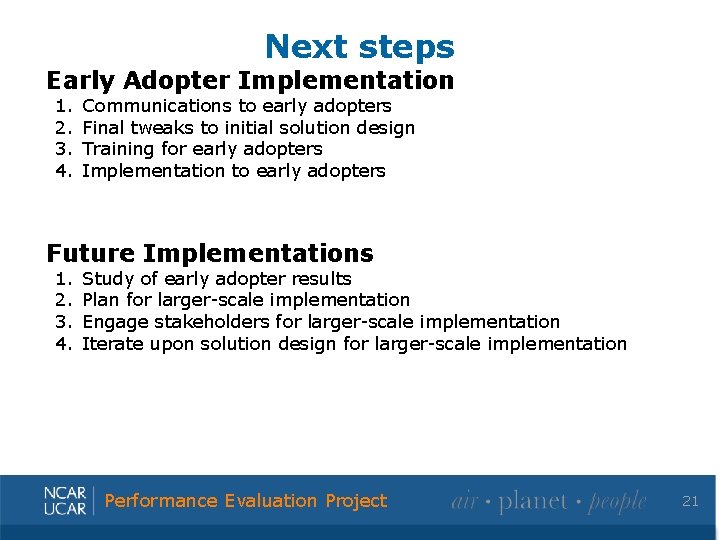
Next steps Early Adopter Implementation 1. 2. 3. 4. Communications to early adopters Final tweaks to initial solution design Training for early adopters Implementation to early adopters Future Implementations 1. 2. 3. 4. Study of early adopter results Plan for larger-scale implementation Engage stakeholders for larger-scale implementation Iterate upon solution design for larger-scale implementation Performance Evaluation Project 21