
Human Resources Job Design and Work Measurement 10
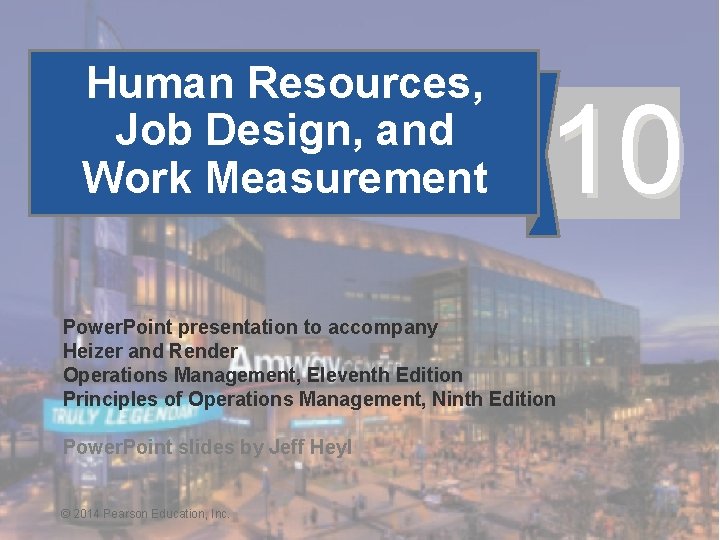
Human Resources, Job Design, and Work Measurement 10 Power. Point presentation to accompany Heizer and Render Operations Management, Eleventh Edition Principles of Operations Management, Ninth Edition Power. Point slides by Jeff Heyl © 2014 Pearson Education, Inc. 10 - 1
Outline ► ► ► Global Company Profile: Rusty Wallace’s NASCAR Racing Team Human Resource Strategy for Competitive Advantage Labor Planning Job Design Ergonomics and the Work Environment © 2014 Pearson Education, Inc. 10 - 2
Outline - Continued ► ► Methods Analysis The Visual Workplace Labor Standards Ethics © 2014 Pearson Education, Inc. 10 - 3
Learning Objectives When you complete this chapter you should be able to: 1. Describe labor planning policies 2. Identify the major issues in job design 3. Identify major ergonomic and work environment issues 4. Use the tools of methods analysis © 2014 Pearson Education, Inc. 10 - 4
Learning Objectives When you complete this chapter you should be able to: 5. Identify four ways of establishing labor standards 6. Compute the normal and standard times in a time study 7. Find the proper sample size for a time study © 2014 Pearson Education, Inc. 10 - 5

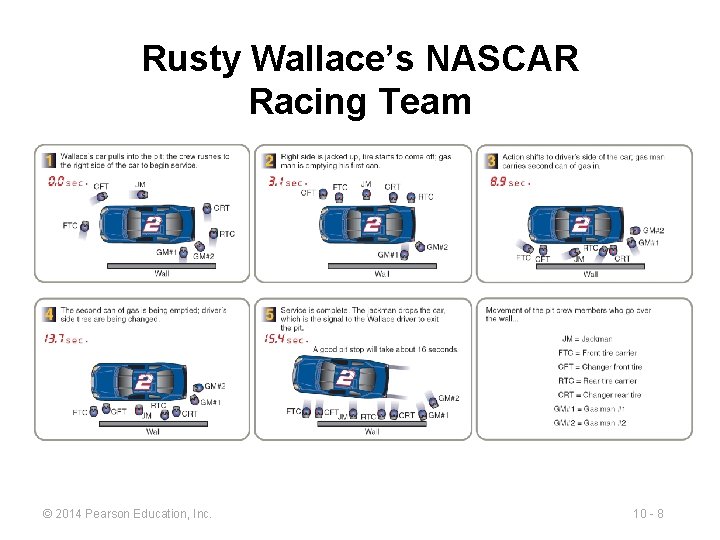
High-Performance Pit Crew Teamwork Makes the Difference between Winning and Losing ► ► NASCAR racing became very popular in the 1990 s with huge sponsorship and prize money High performance pit crews are a key element of a successful race team © 2014 Pearson Education, Inc. 10 - 6
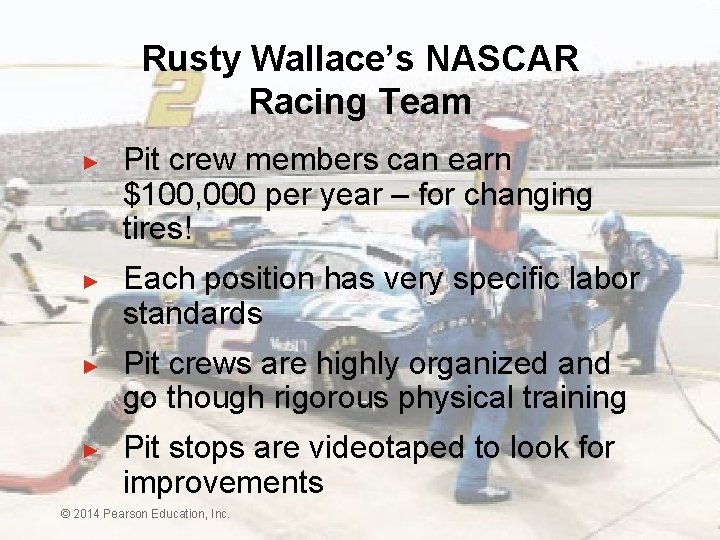
Rusty Wallace’s NASCAR Racing Team ► ► Pit crew members can earn $100, 000 per year – for changing tires! Each position has very specific labor standards Pit crews are highly organized and go though rigorous physical training Pit stops are videotaped to look for improvements © 2014 Pearson Education, Inc. 10 - 7
Rusty Wallace’s NASCAR Racing Team © 2014 Pearson Education, Inc. 10 - 8
Human Resource Strategy The objective of a human resource strategy is to manage labor and design jobs so people are effectively and efficiently utilized © 2014 Pearson Education, Inc. 10 - 9
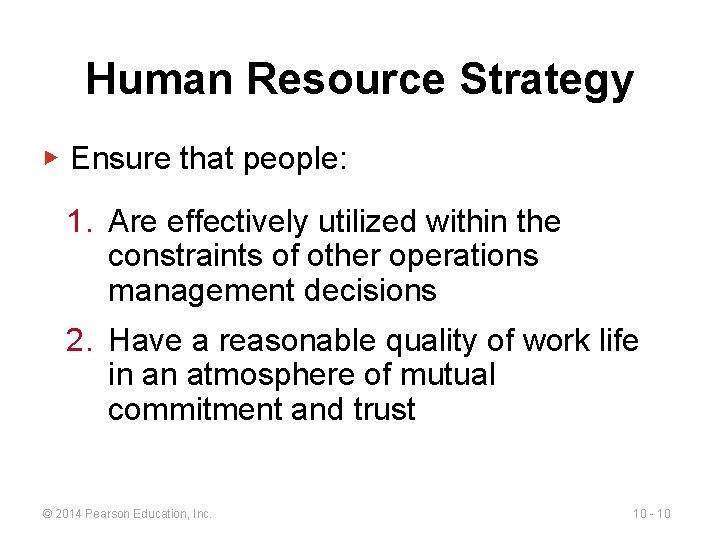
Human Resource Strategy ▶ Ensure that people: 1. Are effectively utilized within the constraints of other operations management decisions 2. Have a reasonable quality of work life in an atmosphere of mutual commitment and trust © 2014 Pearson Education, Inc. 10 - 10

When oc ed u Pr Who re HUMAN RESOURCE STRATEGY ow © 2014 Pearson Education, Inc. t H Location strategy • Climate • Temperature • Noise • Light • Air quality ha he Schedules • Time of day • Time of year (seasonal) • Stability of schedules W W Product strategy • Skills needed • Talents needed • Materials used • Safety re Constraints on Human Resource Strategy Figure 10. 1 Process strategy • Technology • Machinery and equipment used • Safety Individual differences • Strength and fatigue • Information processing and response Layout strategy • Fixed position • Process • Assembly line • Work cell • Product 10 - 11
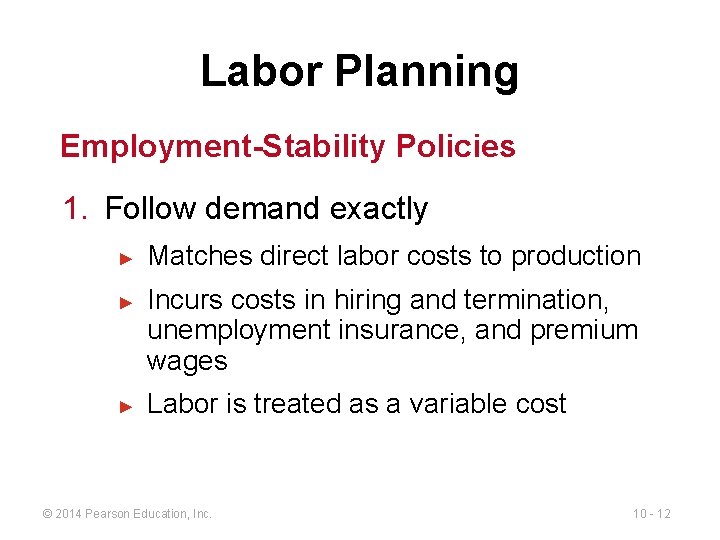
Labor Planning Employment-Stability Policies 1. Follow demand exactly ► ► ► Matches direct labor costs to production Incurs costs in hiring and termination, unemployment insurance, and premium wages Labor is treated as a variable cost © 2014 Pearson Education, Inc. 10 - 12
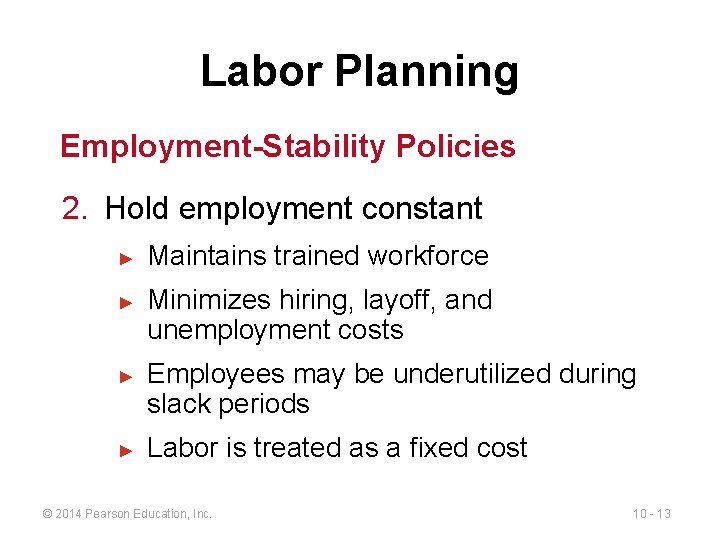
Labor Planning Employment-Stability Policies 2. Hold employment constant ► ► Maintains trained workforce Minimizes hiring, layoff, and unemployment costs Employees may be underutilized during slack periods Labor is treated as a fixed cost © 2014 Pearson Education, Inc. 10 - 13
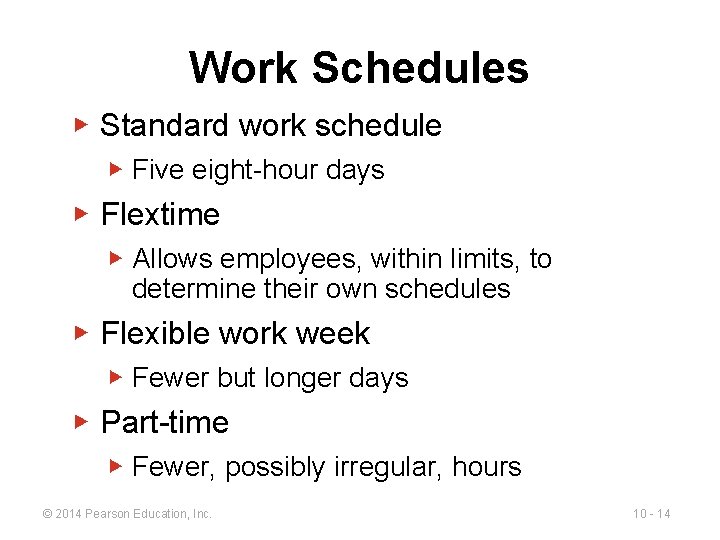
Work Schedules ▶ Standard work schedule ▶ Five eight-hour days ▶ Flextime ▶ Allows employees, within limits, to determine their own schedules ▶ Flexible work week ▶ Fewer but longer days ▶ Part-time ▶ Fewer, possibly irregular, hours © 2014 Pearson Education, Inc. 10 - 14
Job Classification and Work Rules ▶ Specify who can do what ▶ Specify when they can do it ▶ Specify under what conditions they can do it ▶ Often result of union contracts ▶ Restricts flexibility in assignments and consequently efficiency of production © 2014 Pearson Education, Inc. 10 - 15
Job Design ▶ Specifying the tasks that constitute a job for an individual or a group 1. 2. 3. 4. 5. Job specialization Job expansion Psychological components Self-directed teams Motivation and incentive systems © 2014 Pearson Education, Inc. 10 - 16
Labor Specialization ▶ The division of labor into unique tasks ▶ First suggested by Adam Smith in 1776 1. Development of dexterity 2. Less loss of time 3. Development of specialized tools ▶ Later Charles Babbage (1832) added another consideration 4. Wages exactly fit the required skill required © 2014 Pearson Education, Inc. 10 - 17
Job Expansion ▶ Adding more variety to jobs ▶ Intended to reduce boredom associated with labor specialization ▶ Job enlargement ▶ Job rotation ▶ Job enrichment ▶ Employee empowerment © 2014 Pearson Education, Inc. 10 - 18
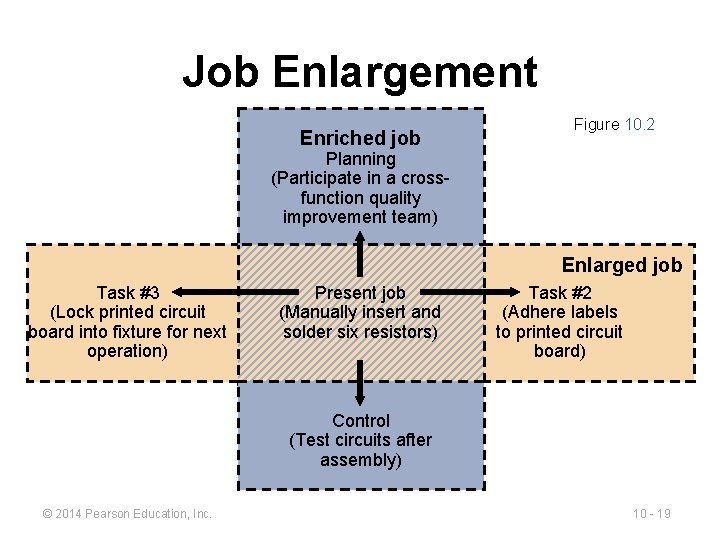
Job Enlargement Enriched job Figure 10. 2 Planning (Participate in a crossfunction quality improvement team) Enlarged job Task #3 (Lock printed circuit board into fixture for next operation) Present job (Manually insert and solder six resistors) Task #2 (Adhere labels to printed circuit board) Control (Test circuits after assembly) © 2014 Pearson Education, Inc. 10 - 19
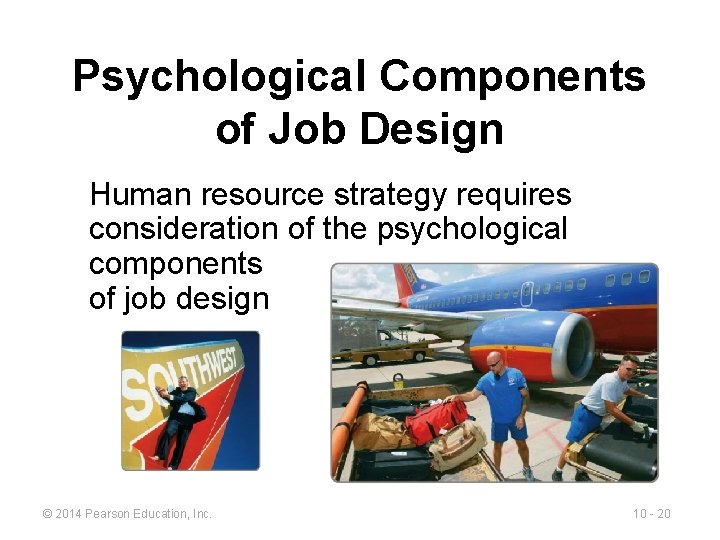
Psychological Components of Job Design Human resource strategy requires consideration of the psychological components of job design © 2014 Pearson Education, Inc. 10 - 20
Hawthorne Studies ► ► They studied light levels, but discovered productivity improvement was independent from lighting levels Introduced psychology into the workplace The workplace social system and distinct roles played by individuals may be more important than physical factors Individual differences may be dominant in job expectation and contribution © 2014 Pearson Education, Inc. 10 - 21
Core Job Characteristics Jobs should include the following characteristics 1. Skill variety 2. Job identity 3. Job significance 4. Autonomy 5. Feedback © 2014 Pearson Education, Inc. 10 - 22
Self-Directed Teams ▶ Group of empowered individuals working together to reach a common goal ▶ May be organized for long-term or short-term objectives ▶ Effective because ▶ Provide employee empowerment ▶ Ensure core job characteristics ▶ Meet individual psychological needs © 2014 Pearson Education, Inc. 10 - 23
Self-Directed Teams To maximize effectiveness, managers should ► Ensure those who have legitimate contributions are on the team ► Provide management support ► Ensure the necessary training ► Endorse clear objectives and goals ► Financial and non-financial rewards ► Supervisors must release control © 2014 Pearson Education, Inc. 10 - 24
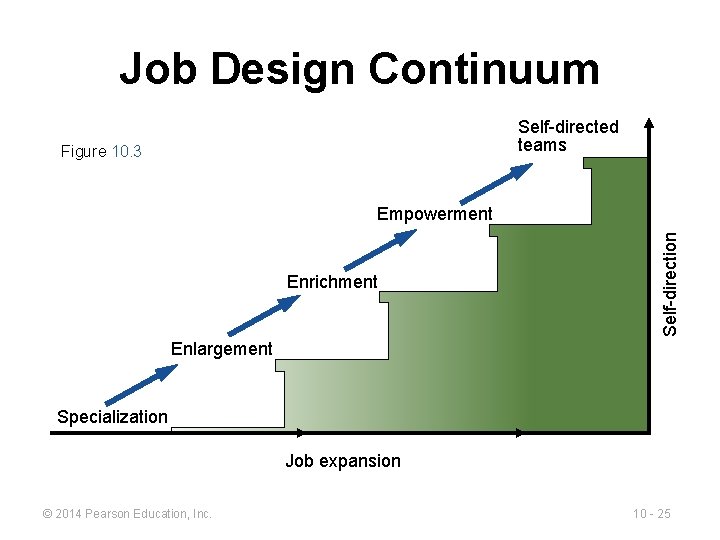
Job Design Continuum Self-directed teams Figure 10. 3 Enrichment Self-direction Empowerment Enlargement Specialization Job expansion © 2014 Pearson Education, Inc. 10 - 25
Benefits of Teams and Expanded Job Designs Improved quality of work life Improved job satisfaction Increased motivation Allows employees to accept more responsibility ▶ Improved productivity and quality ▶ Reduced turnover and absenteeism ▶ ▶ © 2014 Pearson Education, Inc. 10 - 26
Limitations of Job Expansion 1. Higher capital cost 2. Individuals may prefer simple jobs 3. Higher wage rates for greater skills 4. Smaller labor pool 5. Higher training costs © 2014 Pearson Education, Inc. 10 - 27
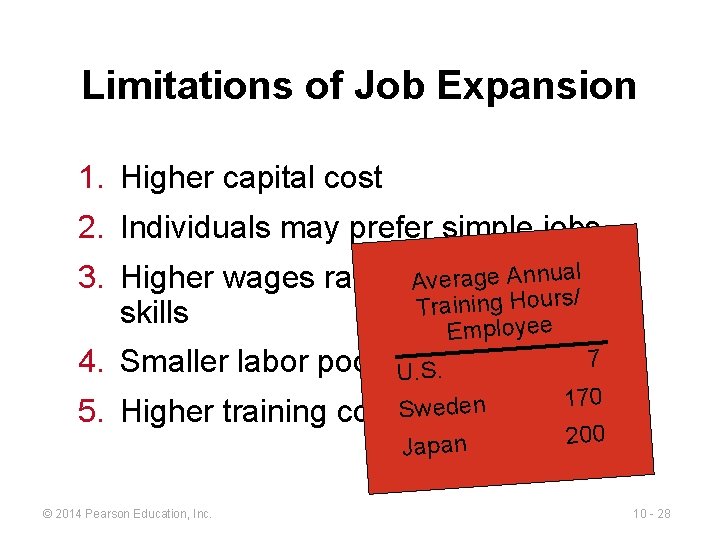
Limitations of Job Expansion 1. Higher capital cost 2. Individuals may prefer simple jobs rage Annual 3. Higher wages rates for Avegreater Hours/ g in in a r T skills mployee 4. Smaller labor pool 5. Higher training © 2014 Pearson Education, Inc. E U. S. costs. Sweden Japan 7 170 200 10 - 28
Motivation and Incentive Systems ▶ Bonuses - cash or stock options ▶ Profit-sharing - profits for distribution to employees ▶ Gain sharing - rewards for improvements ▶ Incentive plans - typically based on production rates ▶ Knowledge-based systems - reward for knowledge or skills © 2014 Pearson Education, Inc. 10 - 29
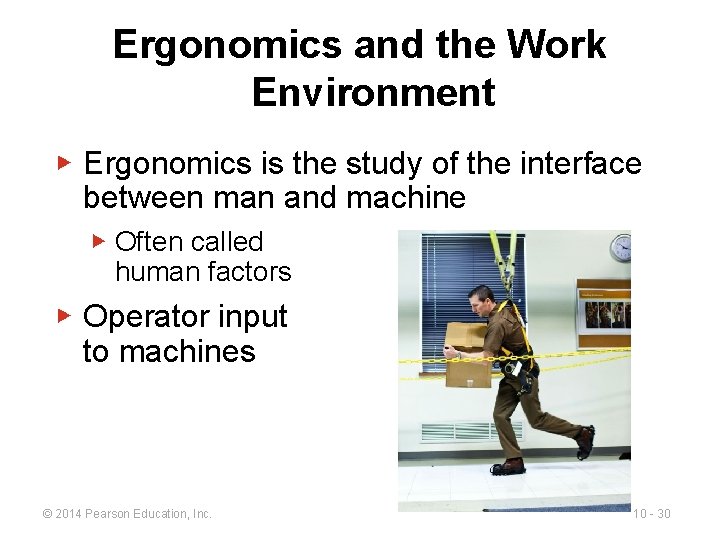
Ergonomics and the Work Environment ▶ Ergonomics is the study of the interface between man and machine ▶ Often called human factors ▶ Operator input to machines © 2014 Pearson Education, Inc. 10 - 30
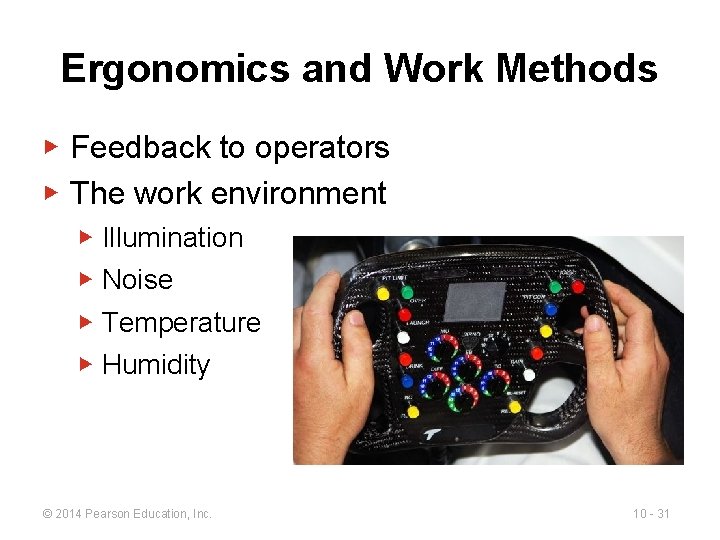
Ergonomics and Work Methods ▶ Feedback to operators ▶ The work environment ▶ Illumination ▶ Noise ▶ Temperature ▶ Humidity © 2014 Pearson Education, Inc. 10 - 31
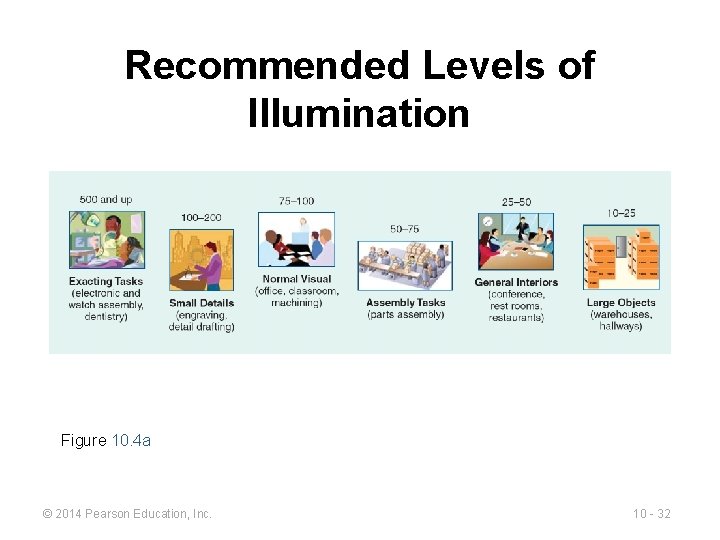
Recommended Levels of Illumination Figure 10. 4 a © 2014 Pearson Education, Inc. 10 - 32
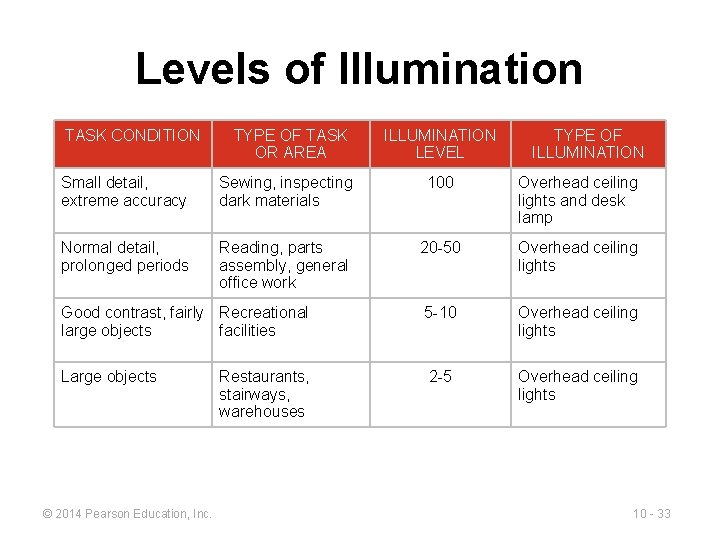
Levels of Illumination TASK CONDITION TYPE OF TASK OR AREA ILLUMINATION LEVEL TYPE OF ILLUMINATION Small detail, extreme accuracy Sewing, inspecting dark materials 100 Overhead ceiling lights and desk lamp Normal detail, prolonged periods Reading, parts assembly, general office work 20 -50 Overhead ceiling lights Good contrast, fairly Recreational large objects facilities 5 -10 Overhead ceiling lights Large objects 2 -5 Overhead ceiling lights © 2014 Pearson Education, Inc. Restaurants, stairways, warehouses 10 - 33
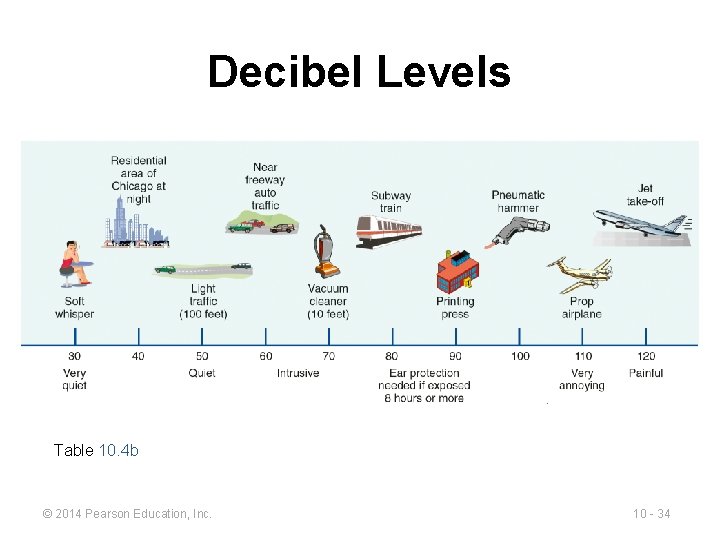
Decibel Levels Table 10. 4 b © 2014 Pearson Education, Inc. 10 - 34
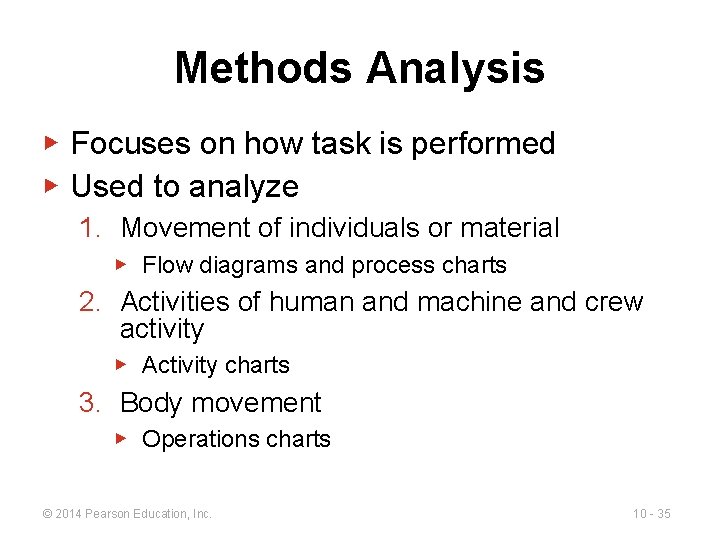
Methods Analysis ▶ Focuses on how task is performed ▶ Used to analyze 1. Movement of individuals or material ▶ Flow diagrams and process charts 2. Activities of human and machine and crew activity ▶ Activity charts 3. Body movement ▶ Operations charts © 2014 Pearson Education, Inc. 10 - 35

Flow Diagram Welding From press mach. Storage bins Mach. 3 Mach. 4 Paint shop Machine 1 Mach. 2 Figure 10. 5 (a) © 2014 Pearson Education, Inc. 10 - 36
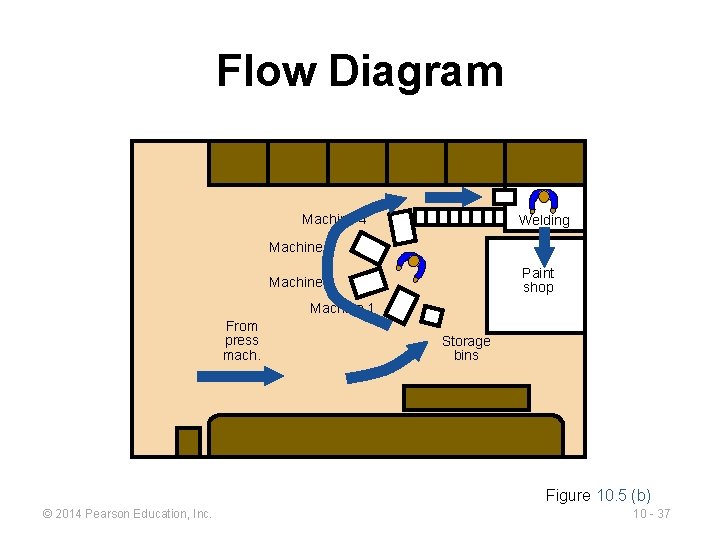
Flow Diagram Machine 4 Welding Machine 3 Paint shop Machine 2 Machine 1 From press mach. Storage bins Figure 10. 5 (b) © 2014 Pearson Education, Inc. 10 - 37
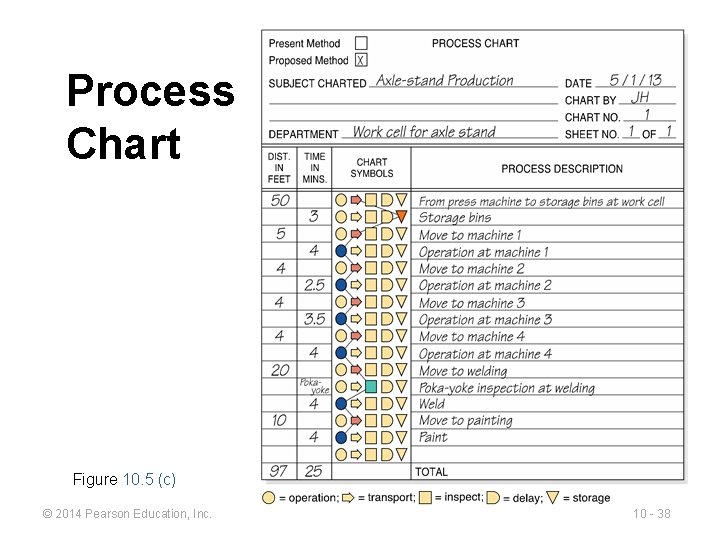
Process Chart Figure 10. 5 (c) © 2014 Pearson Education, Inc. 10 - 38
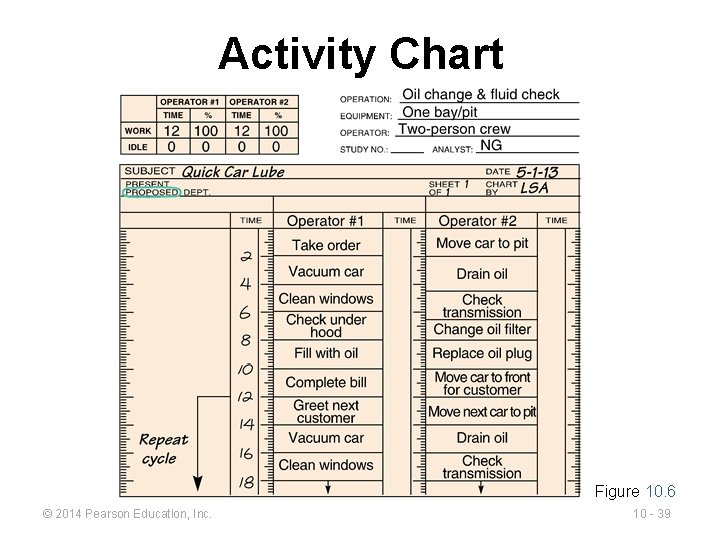
Activity Chart Figure 10. 6 © 2014 Pearson Education, Inc. 10 - 39
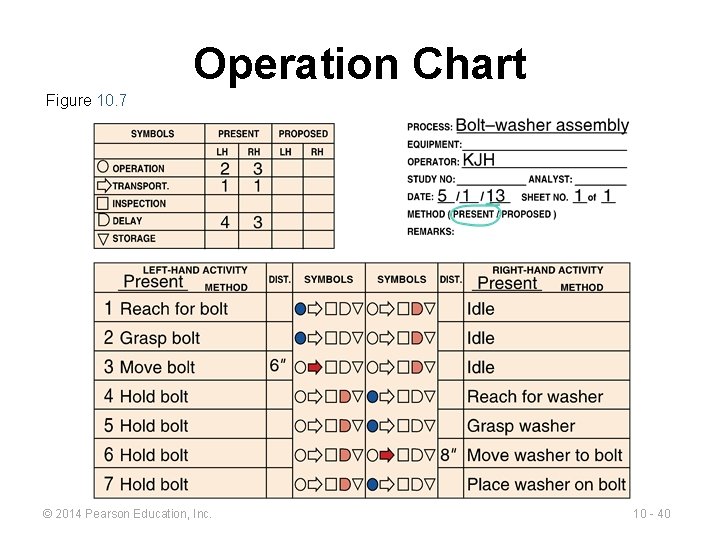
Operation Chart Figure 10. 7 © 2014 Pearson Education, Inc. 10 - 40
The Visual Workplace ▶ Use low-cost visual devices to share information quickly and accurately ▶ Displays and graphs replace printouts and paperwork ▶ Able to provide timely information in a dynamic environment ▶ System should focus on improvement © 2014 Pearson Education, Inc. 10 - 41
The Visual Workplace Visual signals can take many forms and serve many functions ► Present the big picture ► Performance ► Housekeeping © 2014 Pearson Education, Inc. 10 - 42
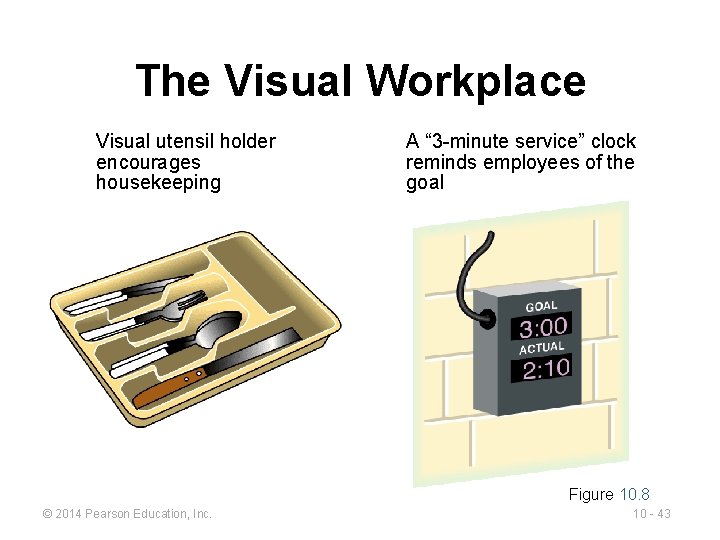
The Visual Workplace Visual utensil holder encourages housekeeping A “ 3 -minute service” clock reminds employees of the goal Figure 10. 8 © 2014 Pearson Education, Inc. 10 - 43
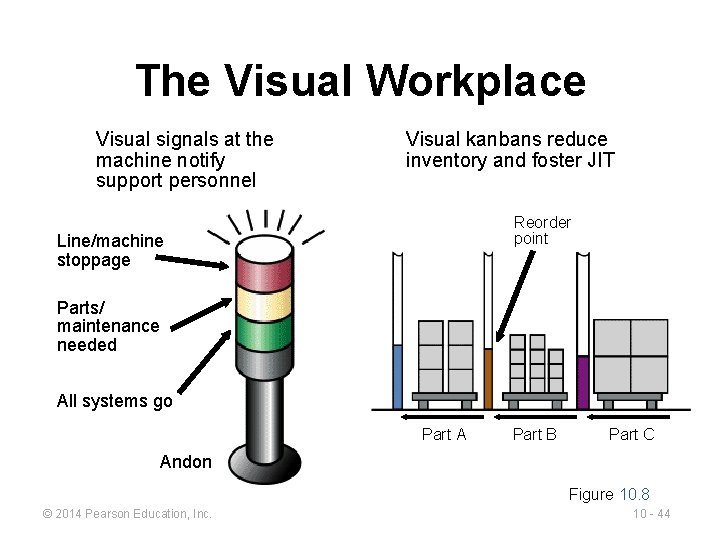
The Visual Workplace Visual signals at the machine notify support personnel Visual kanbans reduce inventory and foster JIT Reorder point Line/machine stoppage Parts/ maintenance needed All systems go Part A Part B Part C Andon Figure 10. 8 © 2014 Pearson Education, Inc. 10 - 44
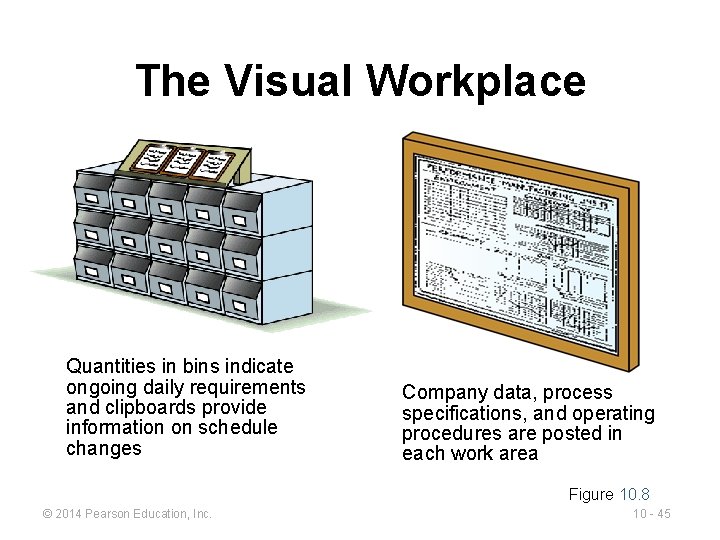
The Visual Workplace Quantities in bins indicate ongoing daily requirements and clipboards provide information on schedule changes Company data, process specifications, and operating procedures are posted in each work area Figure 10. 8 © 2014 Pearson Education, Inc. 10 - 45
Labor Standards ▶ Effective manpower planning is dependent on a knowledge of the labor required ▶ Labor standards are the amount of time required to perform a job or part of a job ▶ Accurate labor standards help determine labor requirements, costs, and fair work © 2014 Pearson Education, Inc. 10 - 46
Labor Standards ▶ Started early in the 20 th century ▶ Important to both manufacturing and service organizations ▶ Necessary for determining staffing requirements ▶ Important to labor incentive systems © 2014 Pearson Education, Inc. 10 - 47
Meaningful Standards Help Determine 1. Labor content of items produced 2. Staffing needs 3. Cost and time estimates 4. Crew size and work balance 5. Expected production 6. Basis of wage-incentive plans 7. Efficiency of employees © 2014 Pearson Education, Inc. 10 - 48
Labor Standards May be set in four ways: 1. Historical experience 2. Time studies 3. Predetermined time standards 4. Work sampling © 2014 Pearson Education, Inc. 10 - 49
Historical Experience ▶ How the task was performed last time ▶ Easy and inexpensive ▶ Data available from production records or time cards ▶ Data is not objective and may be inaccurate ▶ Not recommended © 2014 Pearson Education, Inc. 10 - 50
Time Studies ▶ Involves timing a sample of a worker’s performance and using it to set a standard ▶ Requires trained and experienced observers ▶ Cannot be set before the work is performed © 2014 Pearson Education, Inc. 10 - 51
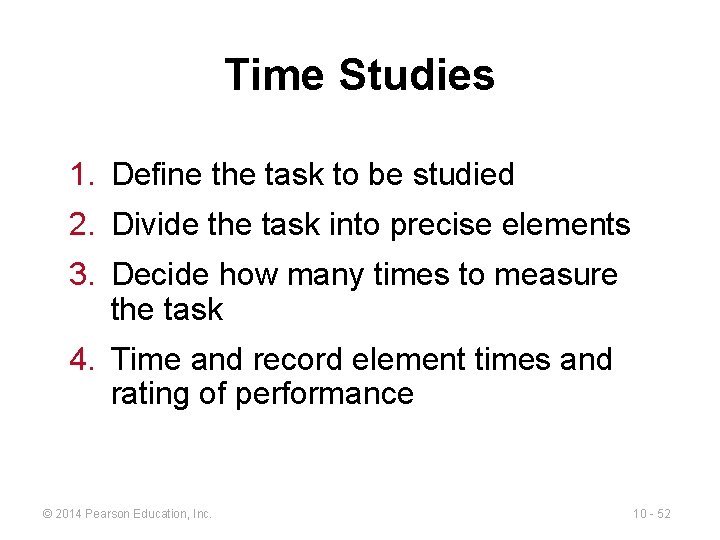
Time Studies 1. Define the task to be studied 2. Divide the task into precise elements 3. Decide how many times to measure the task 4. Time and record element times and rating of performance © 2014 Pearson Education, Inc. 10 - 52
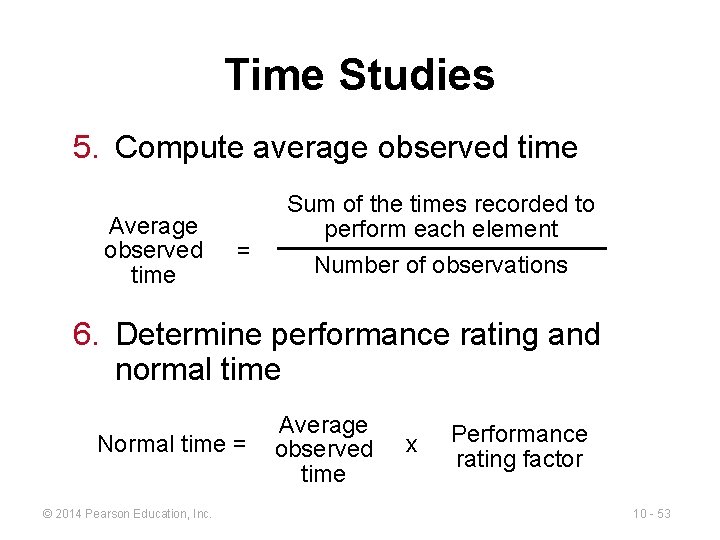
Time Studies 5. Compute average observed time Average observed time = Sum of the times recorded to perform each element Number of observations 6. Determine performance rating and normal time Normal time = © 2014 Pearson Education, Inc. Average observed time x Performance rating factor 10 - 53
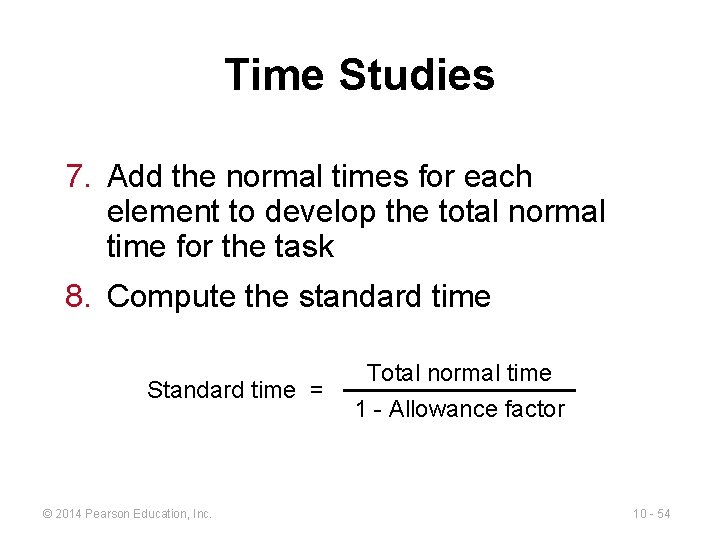
Time Studies 7. Add the normal times for each element to develop the total normal time for the task 8. Compute the standard time Standard time = © 2014 Pearson Education, Inc. Total normal time 1 - Allowance factor 10 - 54
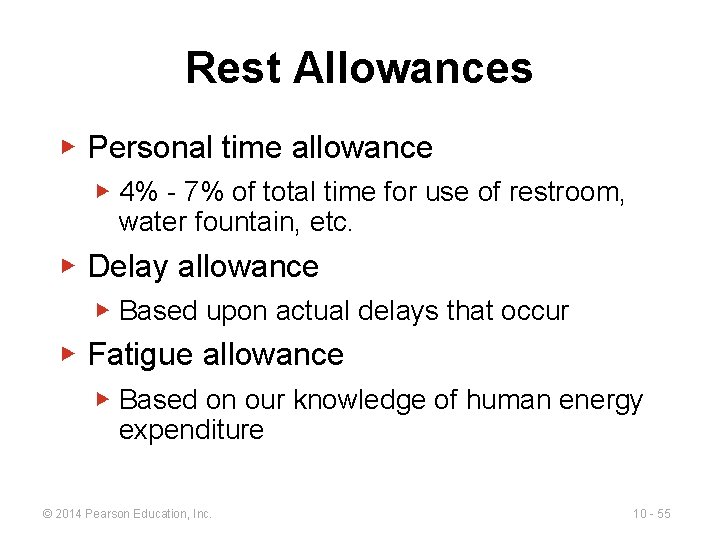
Rest Allowances ▶ Personal time allowance ▶ 4% - 7% of total time for use of restroom, water fountain, etc. ▶ Delay allowance ▶ Based upon actual delays that occur ▶ Fatigue allowance ▶ Based on our knowledge of human energy expenditure © 2014 Pearson Education, Inc. 10 - 55
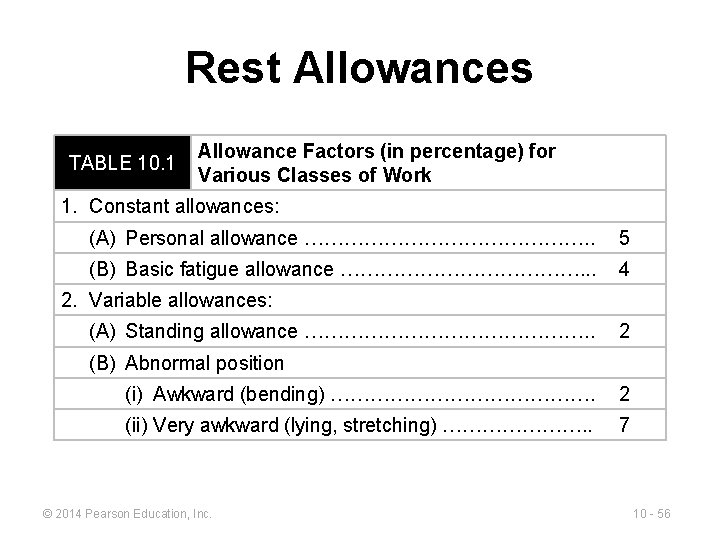
Rest Allowances TABLE 10. 1 Allowance Factors (in percentage) for Various Classes of Work 1. Constant allowances: (A) Personal allowance …………………. . 5 (B) Basic fatigue allowance ………………. . . 4 2. Variable allowances: (A) Standing allowance …………………. . 2 (B) Abnormal position (i) Awkward (bending) …………………. 2 (ii) Very awkward (lying, stretching) …………………. . 7 © 2014 Pearson Education, Inc. 10 - 56
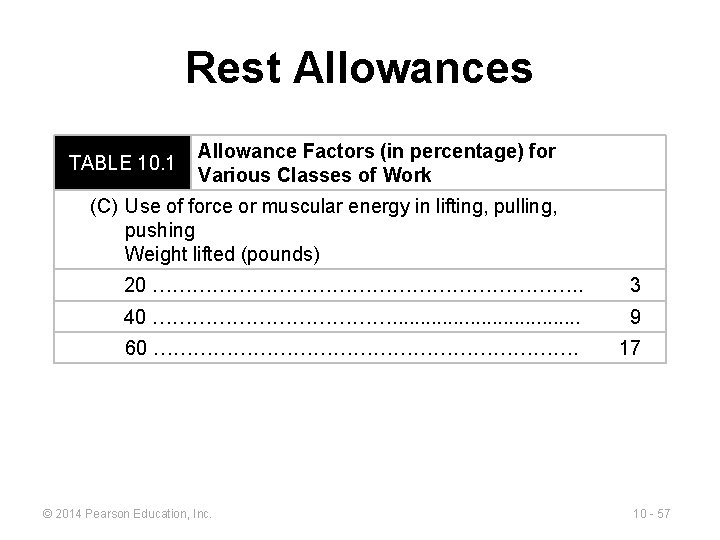
Rest Allowances TABLE 10. 1 Allowance Factors (in percentage) for Various Classes of Work (C) Use of force or muscular energy in lifting, pulling, pushing Weight lifted (pounds) 20 ……………………………. . 3 40 ………………. . . . 9 60 ……………………………. 17 © 2014 Pearson Education, Inc. 10 - 57
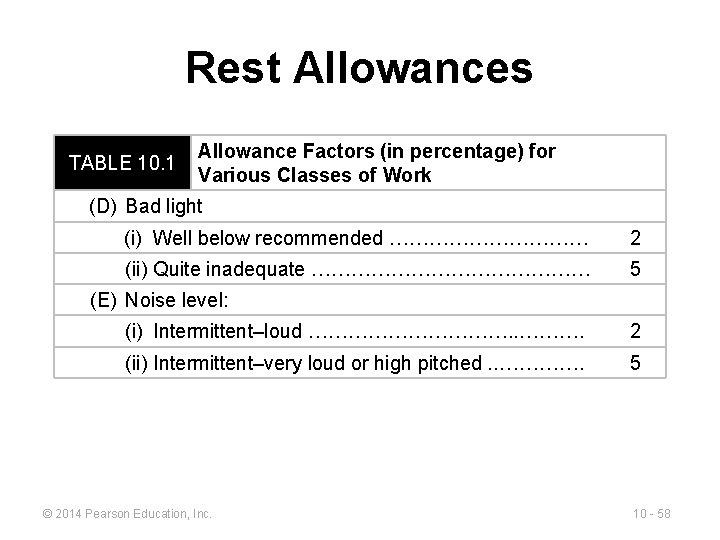
Rest Allowances TABLE 10. 1 Allowance Factors (in percentage) for Various Classes of Work (D) Bad light (i) Well below recommended …………… 2 (ii) Quite inadequate ………………… 5 (E) Noise level: (i) Intermittent–loud ……………. 2 (ii) Intermittent–very loud or high pitched. . …………. 5 © 2014 Pearson Education, Inc. 10 - 58
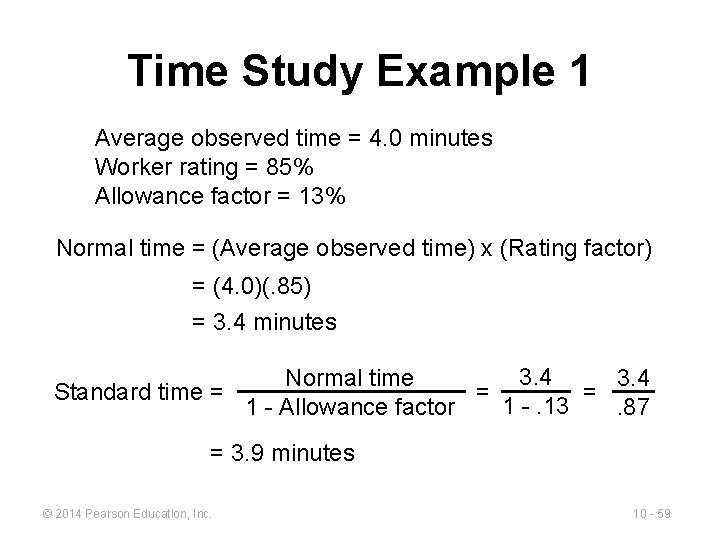
Time Study Example 1 Average observed time = 4. 0 minutes Worker rating = 85% Allowance factor = 13% Normal time = (Average observed time) x (Rating factor) = (4. 0)(. 85) = 3. 4 minutes 3. 4 Normal time 3. 4 Standard time = = = 1 -. 13 1 - Allowance factor. 87 = 3. 9 minutes © 2014 Pearson Education, Inc. 10 - 59
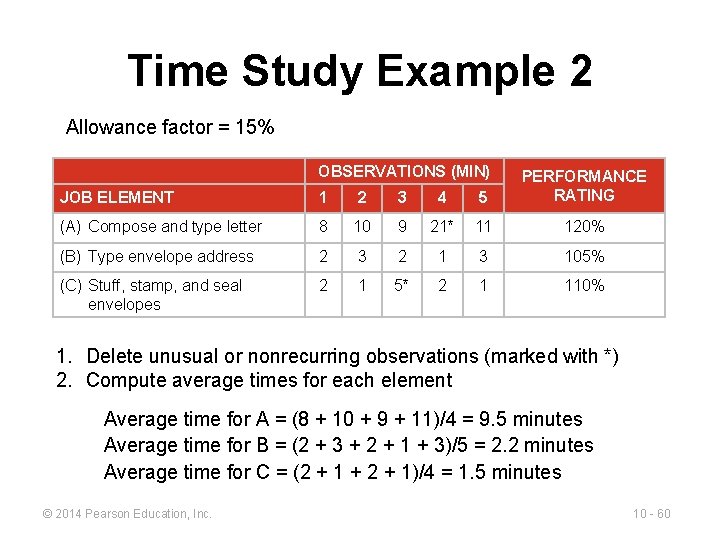
Time Study Example 2 Allowance factor = 15% OBSERVATIONS (MIN) JOB ELEMENT 1 2 3 4 5 PERFORMANCE RATING (A) Compose and type letter 8 10 9 21* 11 120% (B) Type envelope address 2 3 2 1 3 105% (C) Stuff, stamp, and seal envelopes 2 1 5* 2 1 110% 1. Delete unusual or nonrecurring observations (marked with *) 2. Compute average times for each element Average time for A = (8 + 10 + 9 + 11)/4 = 9. 5 minutes Average time for B = (2 + 3 + 2 + 1 + 3)/5 = 2. 2 minutes Average time for C = (2 + 1 + 2 + 1)/4 = 1. 5 minutes © 2014 Pearson Education, Inc. 10 - 60
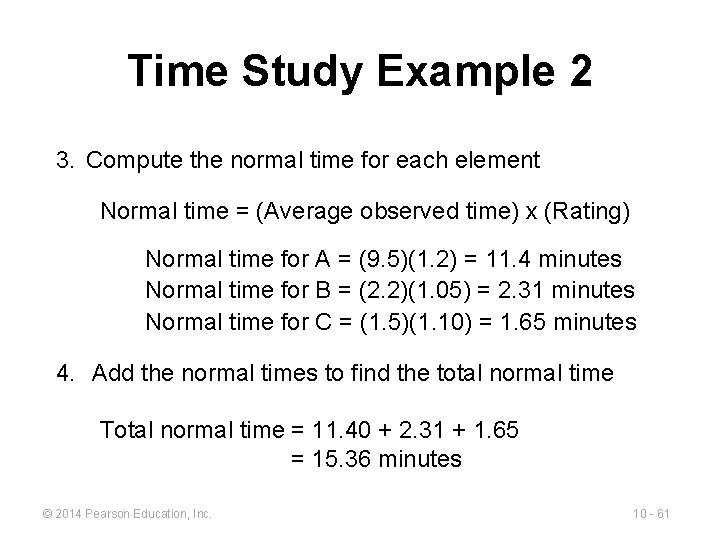
Time Study Example 2 3. Compute the normal time for each element Normal time = (Average observed time) x (Rating) Normal time for A = (9. 5)(1. 2) = 11. 4 minutes Normal time for B = (2. 2)(1. 05) = 2. 31 minutes Normal time for C = (1. 5)(1. 10) = 1. 65 minutes 4. Add the normal times to find the total normal time Total normal time = 11. 40 + 2. 31 + 1. 65 = 15. 36 minutes © 2014 Pearson Education, Inc. 10 - 61
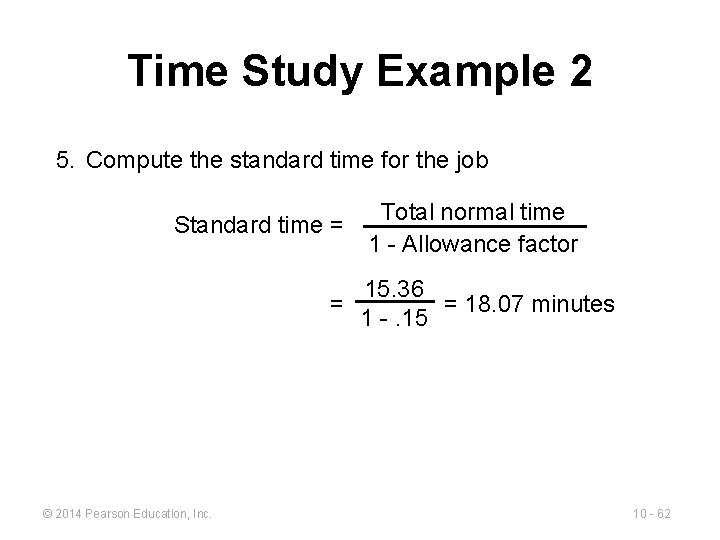
Time Study Example 2 5. Compute the standard time for the job Standard time = = © 2014 Pearson Education, Inc. Total normal time 1 - Allowance factor 15. 36 = 18. 07 minutes 1 -. 15 10 - 62
- Slides: 62