
Human Resources and Economic Aspects of Bangladesh Dr
Human Resources and Economic Aspects of Bangladesh Dr. Md. Golam Rahman Professor
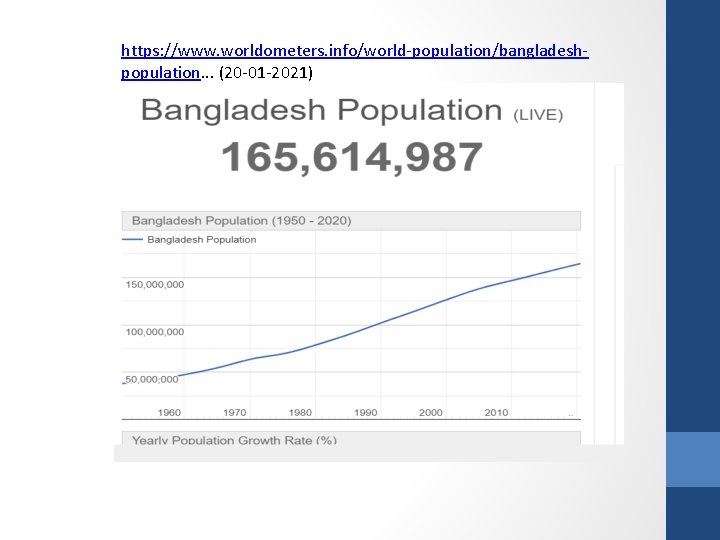
https: //www. worldometers. info/world-population/bangladeshpopulation. . . (20 -01 -2021)
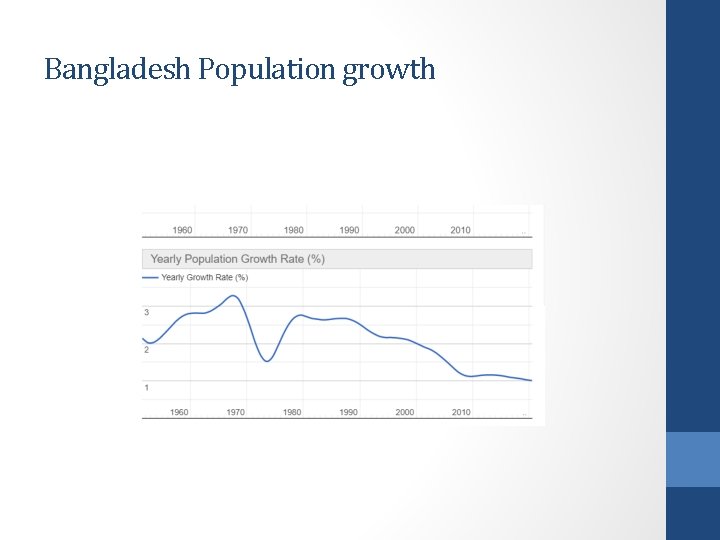
Bangladesh Population growth
Population https: //www. worldometers. info/world-population/bangladeshpopulation/#: ~: text=Bangladesh%202020%20 population%20 is%20 estimated, (a nd%20 dependencies)%20 by%20 population. (19 -01 -2021) • The current population of Bangladesh is 165, 590, 520 as of Tuesday, January 19, 2021, based on Worldometer elaboration of the latest United Nations data. • Bangladesh 2020 population is estimated at 164, 689, 383 people at mid year according to UN data.
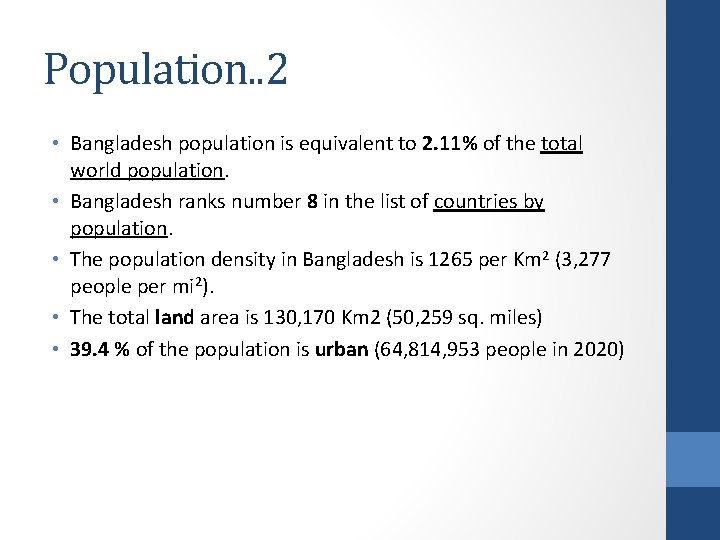
Population. . 2 • Bangladesh population is equivalent to 2. 11% of the total world population. • Bangladesh ranks number 8 in the list of countries by population. • The population density in Bangladesh is 1265 per Km 2 (3, 277 people per mi 2). • The total land area is 130, 170 Km 2 (50, 259 sq. miles) • 39. 4 % of the population is urban (64, 814, 953 people in 2020)
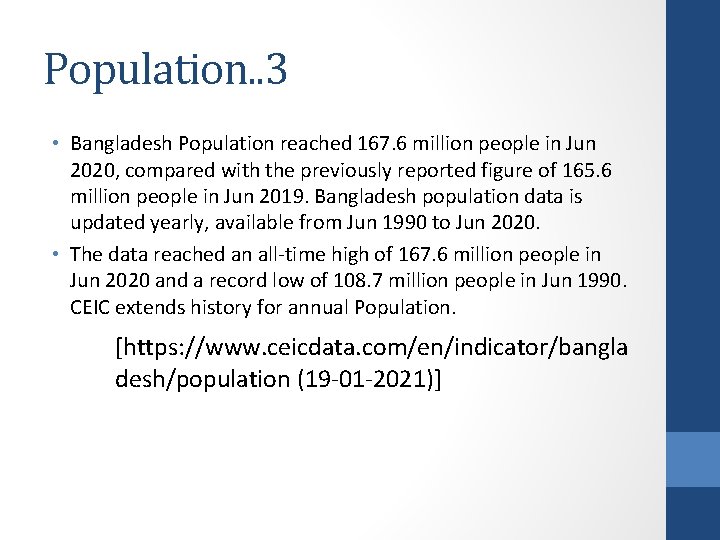
Population. . 3 • Bangladesh Population reached 167. 6 million people in Jun 2020, compared with the previously reported figure of 165. 6 million people in Jun 2019. Bangladesh population data is updated yearly, available from Jun 1990 to Jun 2020. • The data reached an all-time high of 167. 6 million people in Jun 2020 and a record low of 108. 7 million people in Jun 1990. CEIC extends history for annual Population. [https: //www. ceicdata. com/en/indicator/bangla desh/population (19 -01 -2021)]
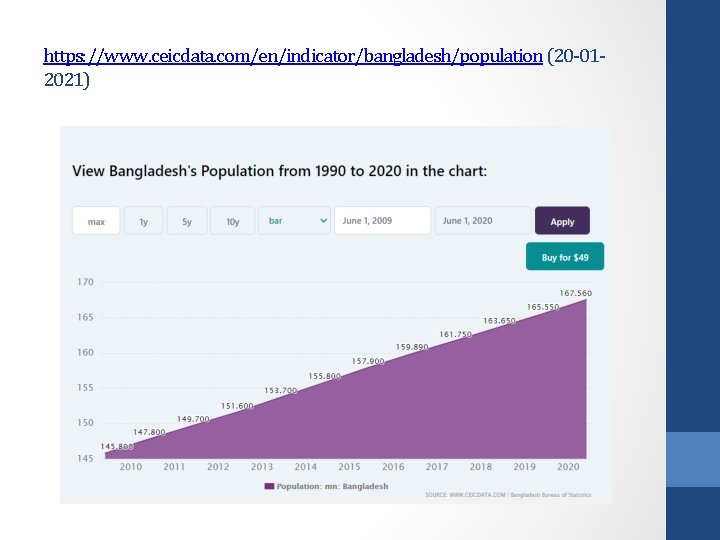
https: //www. ceicdata. com/en/indicator/bangladesh/population (20 -012021)
Human Resource • Human resources are the people who make up the workforce of an organization, business sector, or economy. "Human capital" is sometimes used synonymously with "human resources", although human capital typically refers to a more narrow view. • Likewise, other terms sometimes used include "manpower", "talent", "labor", "personnel", or simply "people".
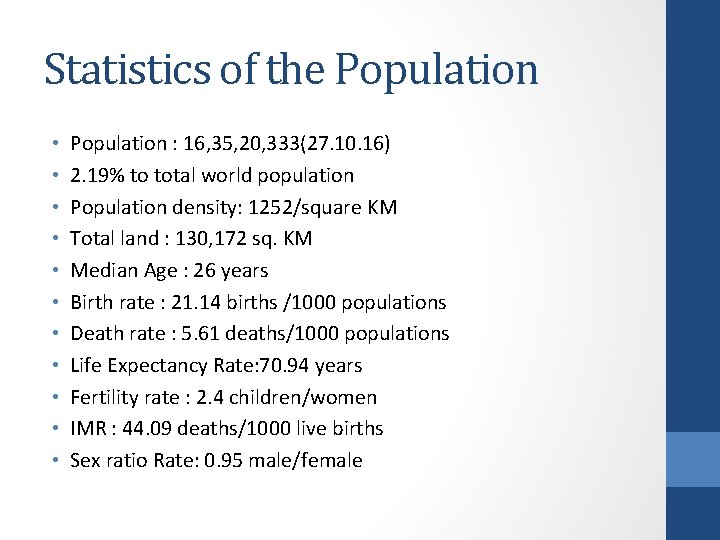
Statistics of the Population • • • Population : 16, 35, 20, 333(27. 10. 16) 2. 19% to total world population Population density: 1252/square KM Total land : 130, 172 sq. KM Median Age : 26 years Birth rate : 21. 14 births /1000 populations Death rate : 5. 61 deaths/1000 populations Life Expectancy Rate: 70. 94 years Fertility rate : 2. 4 children/women IMR : 44. 09 deaths/1000 live births Sex ratio Rate: 0. 95 male/female
HRM in Bangladesh - A Few Highlights. . 1 • • About 33 per cent of organizations used internal referral and word of mouth in the employee recruitment process. Use of social media and mobile applications are very limited (i. e. , less than 10 per cent) in the recruitment process. • • Around 40 per cent of the organizations use formal background or reference check in the selection process. • • About one-third of the organizations indicated outsourcing recruitment process sometimes in the past to recruitment managerial employees.
HRM in Bangladesh - A Few Highlights. . 2 • More than 25 per cent of the organizations do not conduct training need analysis and do not provide training to employees on regular basis. • • Performance appraisals indicators include mostly functional achievements rather than behavioural aspects of the jobs. However, IT and telecommunications sectors are leading to introduce structured performance appraisal system and employee training need identification process.
HRM in Bangladesh - A Few Highlights. . 3 • More than 55 per cent of the organizations do not have any defined employee reward and recognition programme. However, 66 per cent organizations of first moving consumer goods, pharmaceuticals sectors and telecommunications sectors reported to have short-term incentive programmes. • • About 95 per cent of the organizations do not provide longterm incentives to retain employees.
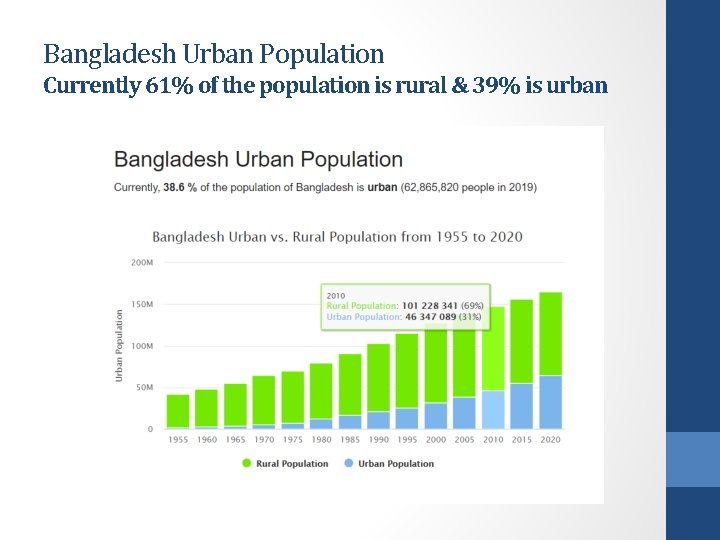
Bangladesh Urban Population Currently 61% of the population is rural & 39% is urban
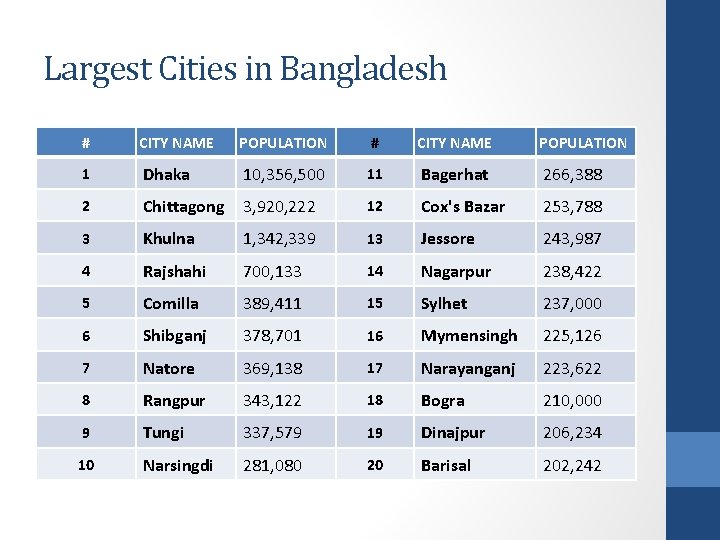
Largest Cities in Bangladesh # CITY NAME POPULATION 1 Dhaka 10, 356, 500 11 Bagerhat 266, 388 2 Chittagong 3, 920, 222 12 Cox's Bazar 253, 788 3 Khulna 1, 342, 339 13 Jessore 243, 987 4 Rajshahi 700, 133 14 Nagarpur 238, 422 5 Comilla 389, 411 15 Sylhet 237, 000 6 Shibganj 378, 701 16 Mymensingh 225, 126 7 Natore 369, 138 17 Narayanganj 223, 622 8 Rangpur 343, 122 18 Bogra 210, 000 9 Tungi 337, 579 19 Dinajpur 206, 234 10 Narsingdi 281, 080 20 Barisal 202, 242
Population Density • Based on United Nations Data 2020 figures for population (164, 689, 383) and land area (130, 170 km 2), Bangladesh has the highest population density among large countries, 1265 persons per square kilometre, and 10 th overall, when small countries and city-states are included. [ Wikipedia, Bangladesh Population 2020 (Live). Retrieved July 2020]
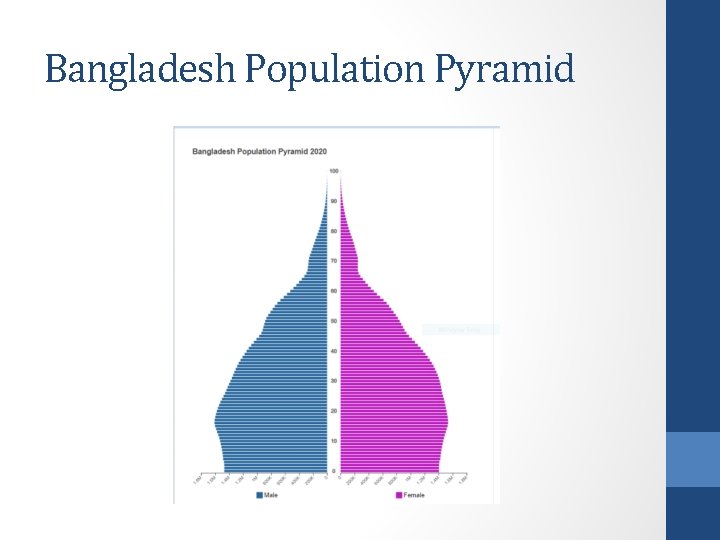
Bangladesh Population Pyramid
Age-Sex Pyramid • Population Pyramid • A Population pyramid (also called "Age-Sex Pyramid") is a graphical representation of the age and sex of a population. (Follow…)
• Types: • Expansive - pyramid with a wide base (larger percentage of people in younger age groups, indicating high birth rates and high fertility rates) and narrow top (high death rate and lower life expectancies). It suggests a growing population. Example: Nigeria Population Pyramid • Constrictive - pyramid with a narrow base (lower percentage of younger people, indicating declining birth rates with each succeeding age group getting smaller than the previous one). Example: United States • Stationary - with a somewhat equal proportion of the population in each age group. The population is stable, neither increasing nor decreasing.
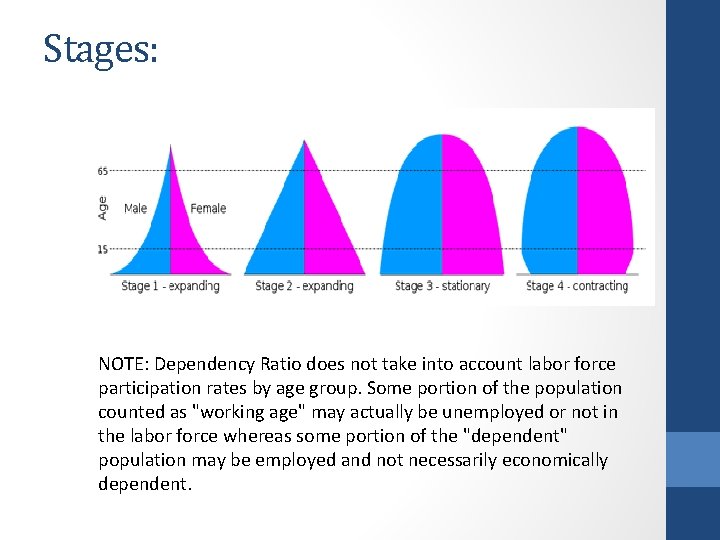
Stages: NOTE: Dependency Ratio does not take into account labor force participation rates by age group. Some portion of the population counted as "working age" may actually be unemployed or not in the labor force whereas some portion of the "dependent" population may be employed and not necessarily economically dependent.
• Dependency Ratio • There are three types of age dependency ratio: Youth, Elderly, and Total. All three ratios are commonly multiplied by 100. Youth Dependency Ratio Definition: population ages 0 -15 divided by the population ages 16 -64. Formula: ([Population ages 0 -15] ÷ [Population ages 16 -64]) × 100
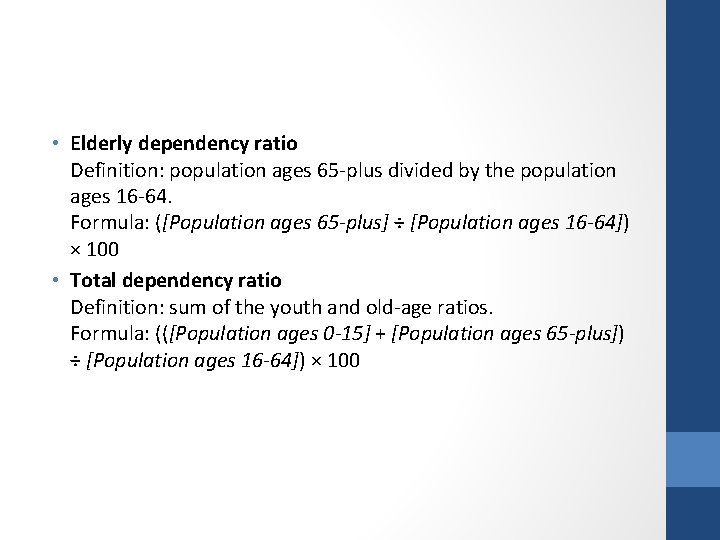
• Elderly dependency ratio Definition: population ages 65 -plus divided by the population ages 16 -64. Formula: ([Population ages 65 -plus] ÷ [Population ages 16 -64]) × 100 • Total dependency ratio Definition: sum of the youth and old-age ratios. Formula: (([Population ages 0 -15] + [Population ages 65 -plus]) ÷ [Population ages 16 -64]) × 100
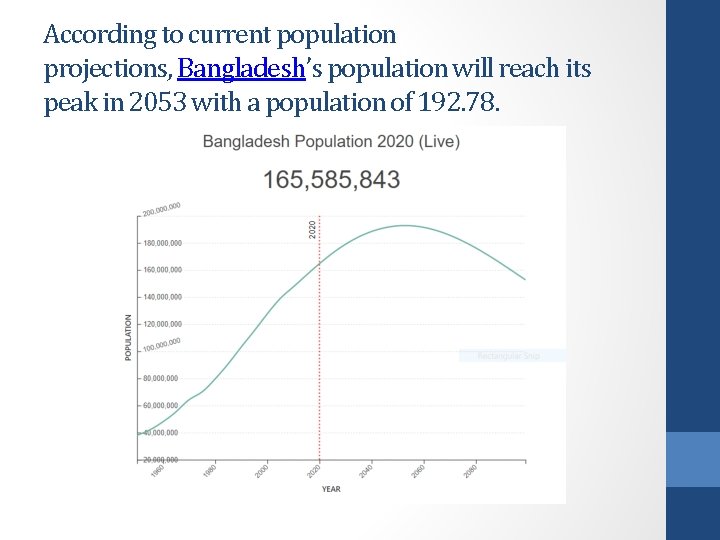
According to current population projections, Bangladesh’s population will reach its peak in 2053 with a population of 192. 78.
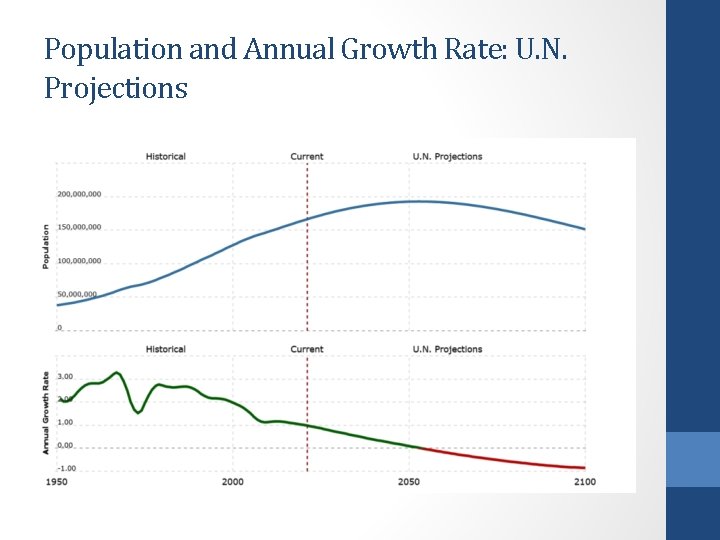
Population and Annual Growth Rate: U. N. Projections
Some Points of Population and Economy
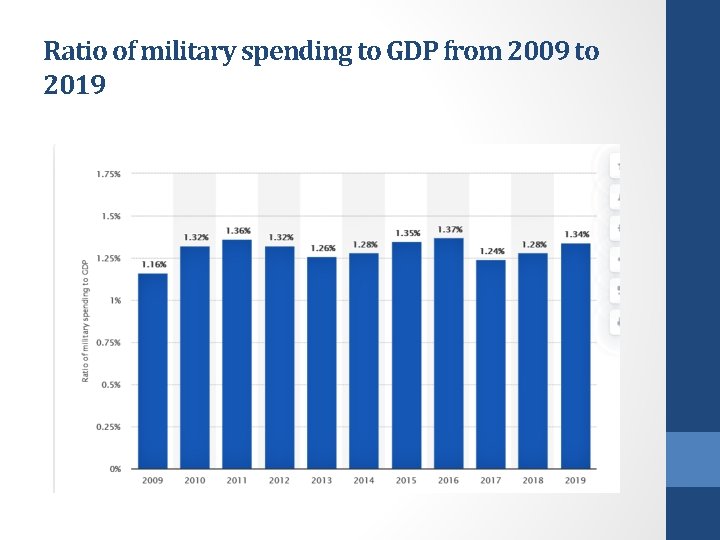
Ratio of military spending to GDP from 2009 to 2019
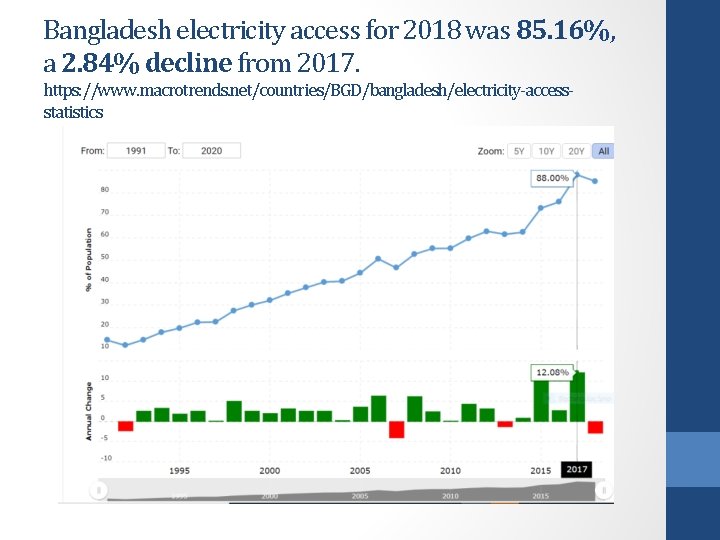
Bangladesh electricity access for 2018 was 85. 16%, a 2. 84% decline from 2017. https: //www. macrotrends. net/countries/BGD/bangladesh/electricity-accessstatistics
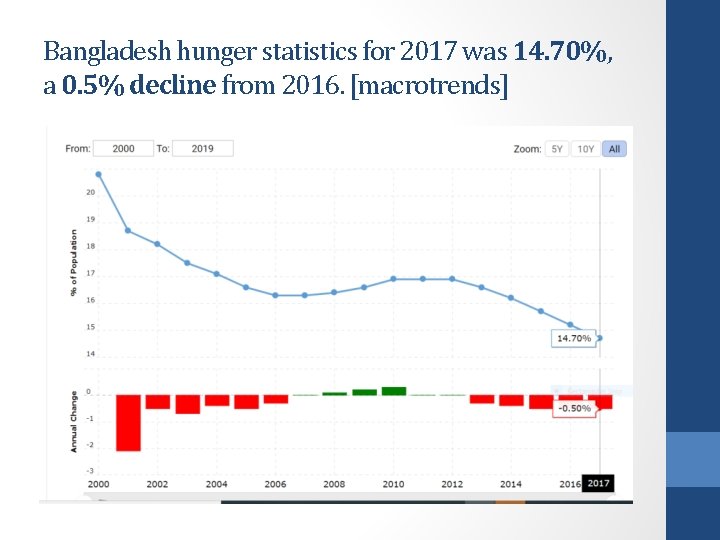
Bangladesh hunger statistics for 2017 was 14. 70%, a 0. 5% decline from 2016. [macrotrends]
Nourishment • Population below minimum level of dietary energy consumption (also referred to as prevalence of undernourishment) shows the percentage of the population whose food intake is insufficient to meet dietary energy requirements continuously. Data showing as 5 may signify a prevalence of undernourishment below 5%. [macrotrends: https: //www. macrotrends. net/countries/BGD/bangladesh/hungerstatistics]
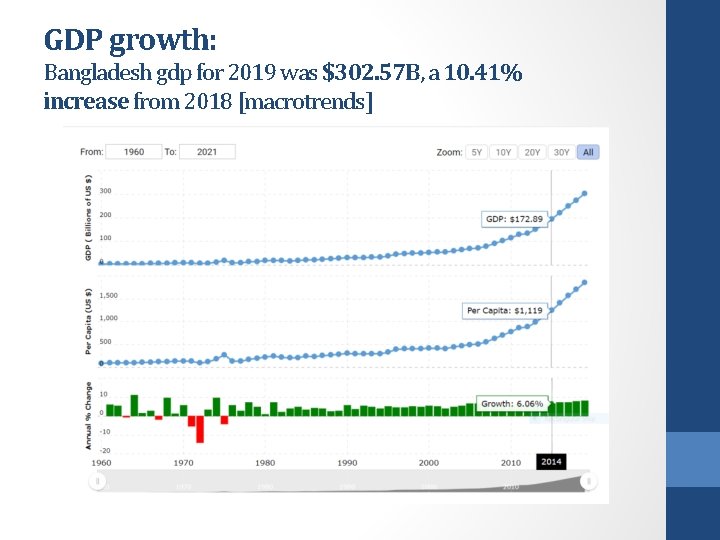
GDP growth: Bangladesh gdp for 2019 was $302. 57 B, a 10. 41% increase from 2018 [macrotrends]
![GDP in US $ [World Bank data]](http://slidetodoc.com/presentation_image_h2/3c784746cc6f86ea12a688c0ff27687e/image-30.jpg "GDP in US $ [World Bank data]")
GDP in US $ [World Bank data]
GDP growth (annual %) - Bangladesh • Annual percentage growth rate of GDP at market prices based on constant local currency. Aggregates are based on constant 2010 U. S. dollars. GDP is the sum of gross value added by all resident producers in the economy plus any product taxes and minus any subsidies not included in the value of the products. It is calculated without making deductions for depreciation of fabricated assets or for depletion and degradation of natural resources.
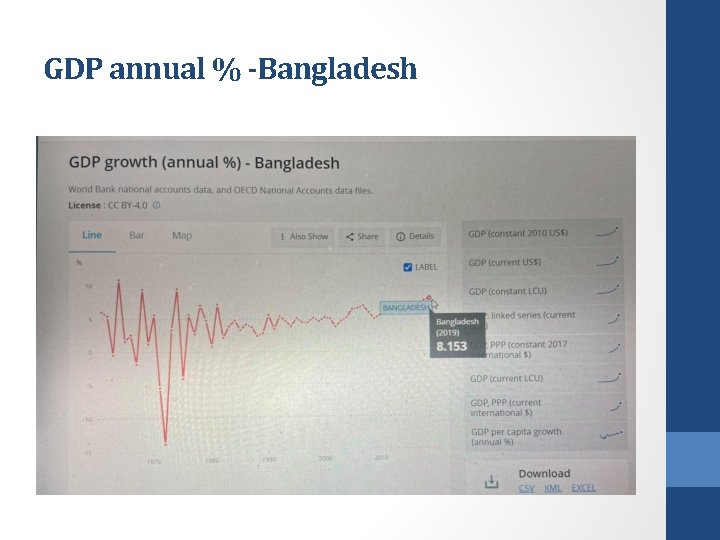
GDP annual % -Bangladesh
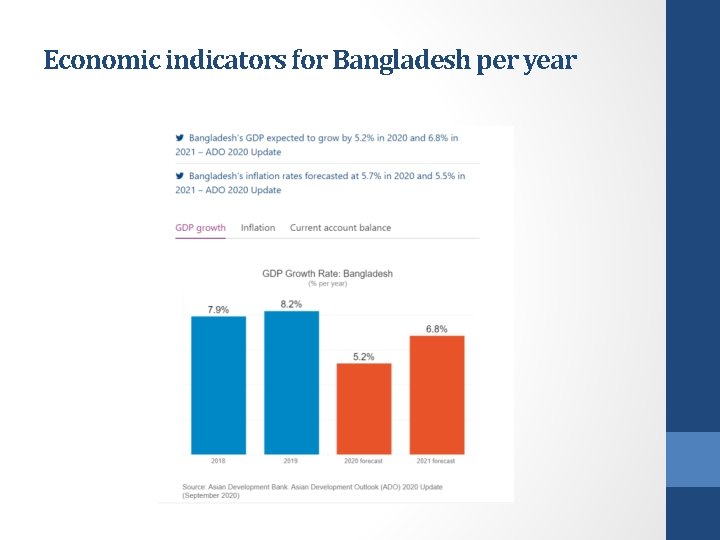
Economic indicators for Bangladesh per year
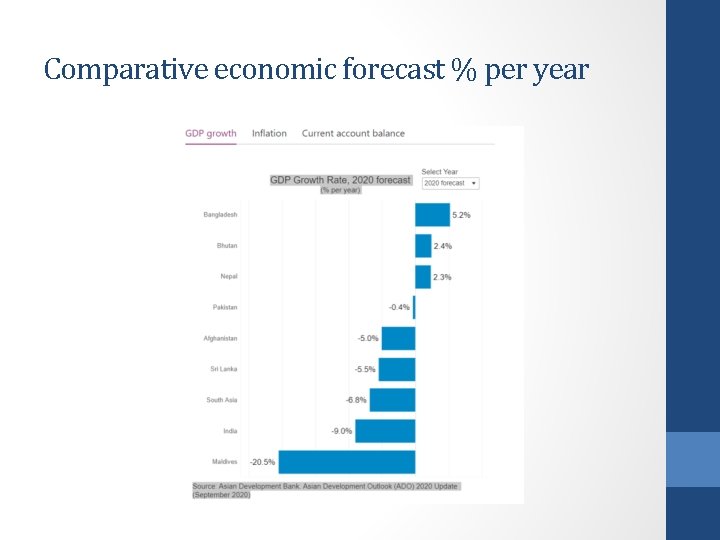
Comparative economic forecast % per year
Bangladesh GDP for 2019 was $302. 57 B, a 10. 41% increase from 2018. • GDP at purchaser's prices is the sum of gross value added by all resident producers in the economy plus any product taxes and minus any subsidies not included in the value of the products. It is calculated without making deductions for depreciation of fabricated assets or for depletion and degradation of natural resources. [https: //www. macrotrends. net/countries/BGD/banglad esh/gdp-gross-domestic-product (17 -01 -2021)]
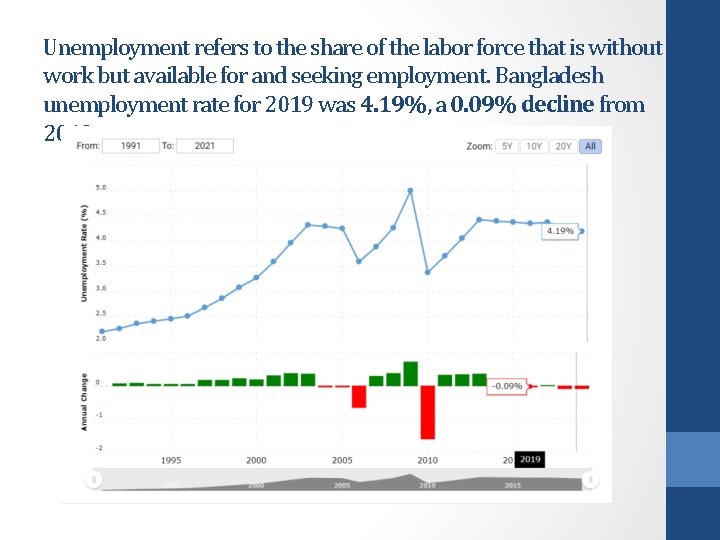
Unemployment refers to the share of the labor force that is without work but available for and seeking employment. Bangladesh unemployment rate for 2019 was 4. 19%, a 0. 09% decline from 2018.
Poverty in Bangladesh • Poverty headcount ratio at national poverty lines (% of population) – Bangladesh. • Poverty headcount ratio at $1. 90 a day (2011 PPP) (% of population) (Data are compiled from official government sources or are computed by World Bank staff using national ( i. e. countryspecific (poverty lines. ) • • 2000 2005 2010 2016 48. 9% 40 31. 5 24. 3 [World Bank datahttps: //data. worldbank. org/indicator/SI. POV. NAHC? l ocations=BD&most_recent_value_desc=true (20 -01 -2021)
• Although the agriculture sector contributes the least to national GDP, it provides employment to almost half of Bangladesh’s workforce. • Bangladesh operates a thriving textile and clothing export industry and is one of the world’s largest garment exporters. • Garments account for almost 80 percent of its total exports.
Conclusion • Bangladesh has more than halved its incidence of poverty over the past 25 years. The country gained lower middle-income status in 2015 and met the criteria to graduate from leastdeveloped country status in March 2018. • Bangladesh’s economic expansion has been robust over the past decade and in fiscal year (FY) 2019 the economy grew by 8. 2%, the highest in the Asia and Pacific region. (ADB) 2021)] [https: //www. adb. org/countries/bangladesh/overview (20 -01 -
Questions…Clarifications…?
Thank you all
- Slides: 41